this week in theater

IT’S ONLY A PLAY

(photo by Joan Marcus)

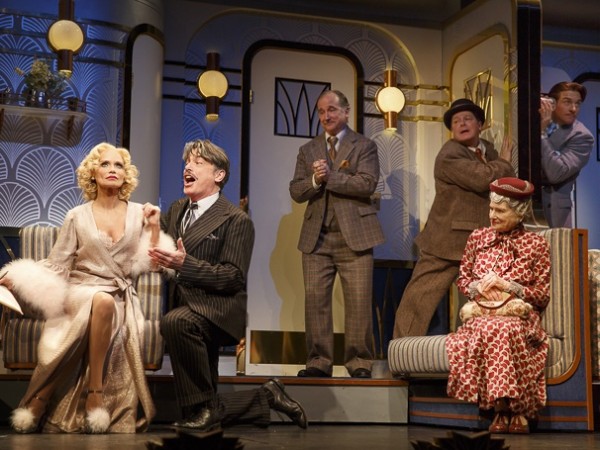
Producer Julia Budder (Megan Mullally) and Hollywood star James Wicker (Nathan Lane) are positively giddy at opening-night party for THE GOLDEN EGG (photo by Joan Marcus)

Gerald Schoenfeld Theatre
236 West 45th St. between Broadway & Eighth Aves.
Tuesday – Sunday through June 7, $72-$147
www.itsonlyaplay.com

Terrence McNally’s latest Broadway show might be titled It’s Only a Play, but oh, what a play it is. In 2012’s Golden Age, the four-time Tony winner (Master Class, Love! Valour! Compassion!) took us behind the scenes of the world premiere of Vincenzo Bellini’s I puritani, and in 2013’s And Away We Go he took us backstage at six different shows in six different time periods. And now, in the Broadway debut of this uproarious comic farce, the inside-joke-laden It’s Only a Play, McNally invites everyone to the opening-night party of The Golden Egg. The festivities take place in the bright and airy bedroom of first-time producer Julia Budder’s (Megan Mullally) luxurious Manhattan townhouse. Designer Scott Pask (The Book of Mormon, The Coast of Utopia) has put the door to the bedroom at the top center of the stage, allowing each character to make a grand entrance — and exit. A who’s who of the New York scene is at “the party of the year for the play of the season,” all ripe for skewering, which McNally and three-time Tony-winning director Jack O’Brien (Hairspray, Henry IV) handle with outrageous grace, leaving no one unscathed, including the audience itself. As the play opens, former Broadway actor and current television star James Wicker (Nathan Lane) enters the bedroom seeking privacy as he calls California to find out the status of his series, Out on a Limb. He encounters Gus P. Head (Micah Stock), a wannabe “actor-slash-singer-slash-dancer-slash-comedian-slash-performance artist-slash-mime” who is taking care of the coats for the evening, which are being collected on Julia’s bed. The endless stream of rapid-fire jokes rat-a-tat right from the start. “What did you think?” Gus asks James about the play. “Wonderful, just wonderful,” James responds, not really meaning it. Gus: “Too bad you’re not a critic.” James: “Tonight everyone’s a critic. You haven’t seen the play?” Gus: “I’m temporary help. This is a one-night stand.” James: “Tonight is a one-night stand for a lot of people.” They are soon joined by aging doyenne Virginia Noyes (Stockard Channing), the drug-addled star of The Golden Egg; Sir Frank Finger (Rupert Grint), its avant-garde director who is tiring of being called a genius; Julia, who is eagerly waiting for the good reviews to roll in so she can add big-time quotes to the marquee; smarmy theater critic Ira Drew (F. Murray Abraham), who has his own agenda; and anxious playwright Peter Austin (Matthew Broderick), who believes in the continuing legacy of the theater. “We have a lot to live up to tonight,” he says ever so earnestly. “It depends on us to remind this city that there is more to Broadway than guest appearances or special effects and revivals or another play from London or another Disney movie made live. We are an original American play. We must make that count for something.”

(photo by Joan Marcus)

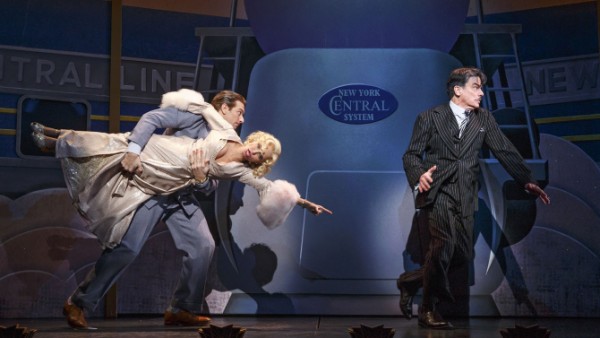
Cast, crew, and friends anxiously await the opening-night reviews for new Broadway show, THE GOLDEN EGG (photo by Joan Marcus)

McNally, O’Brien, and the outstanding cast make that count for a lot in It’s Only a Play, a tongue-in-cheek, and out-of-cheek, riotous evening of theater about theater. The play has been seen in various off-Broadway productions since its 1982 Manhattan Theatre Club premiere, with all-star lineups that have included Christine Baranski, Dana Ivey, Joanna Gleason, and Eileen Brennan as Julia, James Coco and Charles Nelson Reilly as James, David Hyde Pierce and Paul Guilfoyle as Sir Frank, Paul Benedict as Ira, and Željko Ivanek and Mark Blum as Peter. McNally continues to tailor the dialogue to fit his brilliant actors, such as this stinger from the end of James’s early soliloquy: “What’s the word for a mercy killing? Euthanasia? They do it for people, why not plays? But what do I know? What do any of us old gypsies know? I liked The Addams Family.” Lane, of course, played Gomez in that show, a musical adaptation of the television hit, so McNally will likely change that line when Martin Short replaces Lane beginning January 7. (In addition, Katie Finneran will take over the role of Julia, and Maulik Pancholy will play Sir Frank.) It’s a blast to see Lane and Broderick together again, having last lit up the Great White Way as a duo as Bialystock and Bloom, respectively, back in 2001 in The Producers. (As an added bonus, even Lane’s Harvey Fierstein references relate to Broderick too, as Broderick appeared as Fierstein’s adopted son in Torch Song Trilogy.) Abraham (Teibele and Her Demon, A Life in the Theatre) is deliciously droll as the none-too-beloved critic, Mullally (Grease, How to Succeed in Business without Really Trying) is charming as the ditzy, wide-eyed producer, Channing (Grease, Other Desert Cities) is a joy as the bitter former star, Grint (Ron Weasley in the Harry Potter films) is a barrel of energy as the crazed director, Broderick (How to Succeed in Business without Really Trying, Brighton Beach Memoirs) is dryly effective as the serious playwright, up-and-comer Stock (The Capables, McNally’s And Away We Go) is appropriately quirky as the newbie on the scene, and Lane (The Nance, The Iceman Cometh at BAM next month) is, well, Lane as the Broadway actor who sold out to make it in Hollywood. “We need new faces in the theater. New voices, new visions,” Ira says. It’s Only a Play, which is rife with sensational double-takes at all the inside references and hysterical self-needling by its actors (it even pokes fun at The Elephant Man, which is at the Booth next door), might not exactly be filled with new faces and new voices, but its vision is more than welcome in its spectacular Broadway debut.

THE ELEPHANT MAN

(photo by T. Charles Erickson)

Bradley Cooper contorts himself into character as Dr. Frederick Treves (Alessandro Nivola) explains the physical deformations of the real John Merrick (photo by T. Charles Erickson)

Booth Theatre
222 West 45th St. between Broadway & Eighth Ave.
Through February 22, $79 – $169
www.elephantmanbroadway.com
www.shubert.nyc

The first time we see Bradley Cooper in director Scott Ellis’s strong revival of Bernard Pomerance’s 1977 Tony-winning hit, The Elephant Man, he is whole, perfectly formed, standing on the left side of the stage, wearing only a pair of shorts, a specimen on display for the audience. (There might be no applause at his initial appearance, but there is an audible gasp from appreciators of a fine male physique.) At stage right, Dr. Frederick Treves (Alessandro Nivola) is explaining the deformations that Cooper’s character, John Merrick, suffers from, pointing at enlarged photographs of the real Merrick, a nineteenth-century British resident of London. As Treves mentions each body part, Cooper contorts his shape, curling a hand, tightening a foot, twisting his mouth. Without makeup, he has turned himself into the sideshow spectacle known as the Elephant Man, and the transformation becomes complete when he speaks, grunts that soon flow into more eloquent language emerging from his misshapen mouth. In David Lynch’s 1980 film, an Oscar-nominated John Hurt played Merrick in full, disturbing makeup, but in the play Cooper — like such previous Merrick stage portrayers as the Tony-nominated Philip Anglim in the 1979 original, David Bowie as one of his replacements, and the Tony-nominated Billy Crudup in the 2002 Broadway revival — turns Merrick into a grotesque yet elegant and graceful character, a man whose inner beauty shines through as he goes from circus freak to a respected human being. But even as Merrick is accepted by high society, the medical community, and royalty, he still can’t escape being an attraction, eliciting a strange combination of revulsion and attraction, as Ellis (You Can’t Take It with You, The Mystery of Edwin Drood) cleverly uses the most basic theatricality to investigate what is revealed and what is hidden, changing scenes merely with curtains pulled across the stage by various minor characters.

(photo by T. Charles Erickson)

Dr. Frederick Treves (Alessandro Nivola) and Mrs. Kendal (Patricia Clarkson) befriend John Merrick (Bradley Cooper) in powerful Broadway revival (photo by T. Charles Erickson)

Despite a few treacly moments of oversentimentality, Pomerance’s play is a profound exploration of what makes us all different — as well as what makes us very much the same. Two-time Oscar nominee Cooper (American Hustle, Silver Linings Playbook) is extraordinary as Merrick (whose real first name was Joseph), a severely disfigured man who just wants to be “normal.” Nivola (The Winslow Boy, A Month in the Country) is outstanding as Treves, a doctor who sees Merrick as more than just a difficult case, becoming a kind of proud yet seriously overprotective parent. And Patricia Clarkson (The House of Blue Leaves, Eastern Standard) is lovely and charming as the lovely and charming Mrs. Kendal, a popular actress who is more than a little intrigued by Merrick, ready to reveal herself in unexpected ways. The excellent cast also includes two-time Tony nominee Anthony Heald (Anything Goes, Love! Valour! Compassion!) as Bishop Walsham How, who wants to make sure that Merrick receives the proper religious education; Henry Stram (Inherit the Wind, Titanic) as hospital head Carr Gomm, who realizes that taking care of Merrick can be good for business; and Tony nominee Kathryn Meisle (Tartuffe, Outside Mullingar) as both Princess Alexandra, who takes an interest in the oddity that is the Elephant Man, and Miss Sandwich, a caretaker who is horrified by Merrick. Timothy R. Mackabee’s set is suitably spare, consisting of just a table at one time, a bathtub at another, matching Cooper’s courageous soul- and body-baring performance. Once upon a time, people flocked to see the Elephant Man for all the wrong reasons; now they are flocking to see The Elephant Man for all the right ones.

THE INVISIBLE HAND

(photo © Joan Marcus)

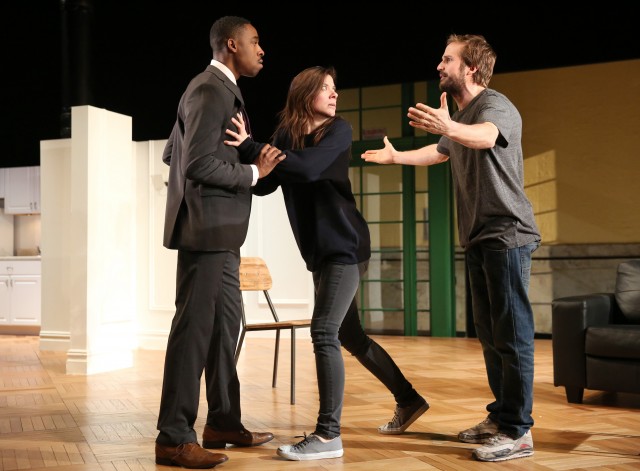
Imam Saleem (Dariush Kashani) and Bashir (Usman Ally) negotiate with Nick Bright (Justin Kirk) in the latest gripping drama from Ayad Akhtar (photo © Joan Marcus)

New York Theatre Workshop
79 East Fourth St. between Second & Third Aves.
Tuesday – Sunday through January 4, $75
www.nytw.org
www.ayadakhtar.com

In his essay “Dialogue in the Age of Industrial Storytelling: Finding Nemo, Derrida, Capitalism,” novelist and playwright Ayad Akhtar explains, “Growing capital has become our collective telos, the ultimate purpose of our body spiritual and politic; spiritual, for make no mistake, our capitalist dreams of abundance are no less the result of our desire for immortality than our erstwhile myths of paradise were. Capital must grow. The preservation of this dream of completion, the securing means by which it can be fulfilled, this is our new, our only holy devotion.” Akhtar, who won the 2013 Pulitzer Prize for Disgraced, now on Broadway in a beautiful and shattering production, explores the concepts of capitalization and holy devotion in the gripping The Invisible Hand, which continues through January 4 at New York Theatre Workshop. The second play he wrote and third to be staged in New York (The Who & the What ran at the Claire Tow this past summer), The Invisible Hand is set in Pakistan, where an American banker, Nick Bright (Justin Kirk), has been mistakenly taken hostage by a radical group led by the calm, determined Imam Saleem (Dariush Kashani) and his violent right-hand sergeant-at-arms, Bashir (Usman Ally). Bright, a family man, is guarded by Dar (Jameal Ali), who tries to treat him like a human being instead of a pawn in a fierce political battle. When the Imam sets the ransom at $10 million, Bright offers to help the group make the money through online stock trading, and as soon as they start amassing cash, their relationships — and their values — begin shifting in dramatic ways.

(photo © Joan Marcus)

Bashir (Usman Ally) learns from Nick (Justin Kirk) that greed is good in THE INVISIBLE HAND (photo © Joan Marcus)

In his previous two plays, Akhtar, who has also written the 2012 novel American Dervish and cowrote and starred in the 2005 indie film The War Within, explored personal identity through the lens of race and religion. But in The Invisible Hand, he turns his attention to the corrupting influence of capitalism, depicting how even the most righteous of individuals can succumb to pure greed. The play’s masterful construction employs reversals of power, empathy, and a brief lesson on puts and calls to investigate a world of questions about human values much larger than a terrorist prison cell. The title comes from a phrase coined in 1759 by Adam Smith, who wrote that the rich “are led by an invisible hand to make nearly the same distribution of the necessaries of life, which would have been made, had the earth been divided into equal portions among all its inhabitants, and thus without intending it, without knowing it, advance the interest of the society, and afford means to the multiplication of the species.” Indeed, money in The Invisible Hand changes everything among all four characters. Kirk (Other Desert Cities, Love! Valour! Compassion!) is gritty and honest as Nick, making the audience root for the kind of man many blame for the recent economic crisis. Similarly, Ally (Elaborate Entrance of Chad Deity) and Kashani (Homebody/Kabul) are able to humanize the most villainous of men on earth, murderous terrorists, while Ali is caught somewhere in the middle, like most people across the globe just trying to get by. Director Ken Rus Schmoll (Red Dog Howls) keeps the tension high and the atmosphere claustrophobic on Riccardo Hernandez’s dank, gray set that mysteriously opens up for the second act. With The Invisible Hand, Akhtar, who was born in New York City and raised in Milwaukee, further establishes himself as an outstanding interpreter of the ills of society in the twenty-first century.

SOUL DOCTOR: THE MUSICAL JOURNEY OF SHLOMO CARLEBACH

(photo by Carol Rosegg)

Shlomo Carlebach (Josh Nelson) and Nina Simone (Dan’yelle Williamson) are the unlikeliest of friends in SOUL DOCTOR (photo by Carol Rosegg)

Actors Temple Theatre
339 West 47th St. between Eighth & Ninth Aves.
Saturday – Thursday through May 3, $79.50 – $99.50
www.souldoctorbroadway.com
www.actorstempletheatre.com

Unfortunately, the third time is not the charm for Soul Doctor, the well-intentioned but overly earnest and hagiographic bio-musical about the King of Kosher Music, rabbi and folksinger Shlomo Carlebach. The show was first performed here at New York Theatre Workshop in the summer of 2012, then moved to Broadway’s Circle in the Square theater the following year, when it was rechristened Soul Doctor: Journey of a Rock Star Rabbi, closing after thirty-two previews and sixty-six regular performances. This latest incarnation, Soul Doctor: The Musical Journey of Shlomo Carlebach, opened December 14 at the Actors Temple on West Forty-Seventh St., an actual working synagogue that has been visited over the years by many a Jewish comedian, from Jerry Lewis and Henny Youngman to Jack Benny and Joe E. Lewis. Although the relatively humorless story is essentially the same — Daniel S. Wise’s book follows Carlebach (Hayden Wall as a boy, Josh Nelson as an adult) from his youth in Vienna to his successful recording career in the United States and unusual friendship with Nina Simone (Dan’yelle Williamson) — it has been trimmed down from the NYTW’s 165 minutes to an intermissionless 95 minutes, but any nuance it had is gone, and the narrative is more straightforward than ever. Some of the most interesting and entertaining moments from the Broadway show, particularly Shlomo’s potential relationship with Ruth (Dianna Barger), are now barely in evidence, in favor of concentrating yet more on the religious aspects of Shlomo’s mission. “Only the words of the Torah will keep us alive!” he calls out to his brother, Eli Chaim (Jacob Heimer). Nelson, a popular modern Jewish performer, is bland as Shlomo, who is treated like a saint. (No mention is made of sexual abuse allegations against Carlebach, which is not surprising, given that his daughter, Neshama Carlebach, is part of the creative team, and producer and conceiver Jeremy Chess points out in the program that “the current work reflects the continued efforts to bring the music and message of Rabbi Shlomo Carlebach to the public.”) Since the show takes place on the shul’s bimah, there is not much in the way of set design; instead, Brad Peterson’s projections effectively announce the changing scenes. All of the music is by Carlebach, along with some of the lyrics; additional lyrics are supplied by David Schechter. In my review of the Broadway production, which I enjoyed, I wrote that “you don’t have to be Jewish to enjoy the show”; however, this time around Soul Doctor is preaching to the choir.

THE IMMEDIATE FAMILY: PEER GYNT

Three characters share the lead role in the Immediate Family’s streamlined production of PEER GYNT (photo by Britannie Bond)

Three characters share the lead role in the Immediate Family’s streamlined production of PEER GYNT (photo by Britannie Bond)

Alchemical Theatre Laboratory
104 West 14th St. between Sixth & Seventh Aves.
Friday, December 19, 8:00, and Saturday, December 20, 3:00 & 8:00, $17
www.theimmediatefam.com
www.atlnyc.com

Founded by four graduates of the Brown University/Trinity Rep acting and directing program, the Immediate Family follows up its 2013 Fringe production, Perceval, with another inventive, stripped-down version of a classic story, Peer Gynt. Adapted by Scott Raker from the English translation by William and Charles Archer, Henrik Ibsen’s 1867 “dramatic poem” has been condensed from the five-act, thirty-eight-scene original, which can run four or five hours, into ninety swift, intermissionless minutes by an engaging company whose charm and energy are contagious. Set in a small all-white studio at the Alchemical Theatre Laboratory on West Fourteenth St., the tale of a young Norwegian lad with a rather creative imagination features no props, and most of the characters are dressed in white; Peer Gynt is played alternately by Jude Sandy, Lizzie King-Hall, and Raker, each donning Peer’s red vest when it is their turn to take the lead. Otherwise, they serve as a kind of Greek chorus while Gynt deals with his overbearing mother (Jessica Crandall), who is tired of being embarrassed by his lies; Ingrid (Rebecca Hirota), who wants to run away with him even though she is about to wed Mudd (David Jacobs); a green-clad troll princess (Hirota) whose father is the Mountain King (Rudi Utter); and Peer Gynt’s true love, the shy, guitar-carrying preacher’s daughter, Solveig (Brittannie Bond). But Peer Gynt, enamored with his dreams and the folktales he heard as a child, cannot settle down, preferring to go off on one adventure after another, some of them more reality-based than others.

Sandy, King-Hall, and Raker are simply splendid as Peer, their eyes wide with hope, smiles as big as a crescent moon. The cast enters and leaves through three white doors, sometimes huddling right behind the audience, which is seated on all four sides of the intimate horizontal space where the action takes place. Regen’s playful direction includes lovely choreography, from a wedding dance to the interaction between the three Peer Gynt portrayers to a spectacular bit of contemporary dance from the troll king’s daughter. In the far corner of the room, pianist Mackenzie Shivers plays original music inspired by Edvard Grieg’s familiar score, including variations on “In the Hall of the Mountain King,” accompanied by percussionist Michael Propster. The section when Peer Gynt leaves to become a successful businessman is nearly always problematic, and it is here as well, but the devilish Lean One (Khris Lewin) soon arrives to help bring the story, which is also about the very nature of storytelling itself, home to its inevitable conclusion. Ultimately, Peer Gynt is about self-realization and being true to oneself, and that all rings true in the Immediate Family’s charming adaptation.

A PARTICLE OF DREAD (OEDIPUS VARIATIONS)

(photo by Matthew Murphy)

Oedipus (Stephen Rea) and a ragged traveler (Lloyd Hutchinson) discuss life and death in A PARTICLE OF DREAD (photo by Matthew Murphy)

The Pershing Square Signature Center
The Alice Griffin Jewel Box Theatre
480 West 42nd St. between Tenth & Eleventh Aves.
Tuesday – Sunday through January 4, $25 through December 23, $55 after
212-244-7529
www.signaturetheatre.org

Pulitzer Prize-winning playwright Sam Shepard continues his Legacy residency at the Signature Theatre with A Particle of Dread (Oedipus Variations), a contemporary examination of the Oedipus myth first explored by Sophocles nearly twenty-five-hundred years ago. Presented with Brian Fiel and Stephen Rea’s Derry-based Field Day Theatre Company, where the ninety-minute play premiered in the fall of 2013, A Particle of Dread (Oedipus Variations) mixes two primary story lines, one taking place in Northern Ireland during the Troubles, the other set in the California desert. In the former, gangster kingpin Lawrence/Laius (Aidan Redmond) receives a prophecy from Uncle Del (Lloyd Hutchinson) that “any child born to you and your lovely queen, Jocasta, will turn out to be your killer and the husband of his mother,” so he locks his wife (Brid Brennan) in a cage. Meanwhile, out in the Far West of America, highway patrol officer Harrington (Jason Kolotouros) and forensic investigator RJ Randolph (Matthew Rauch) are on the case of a triple murder that the wheelchair-bound Otto (Rea) is obsessed with. “None of it makes any sense! Are you kidding? This is just — this is just plain old slaughter — butchery. Like the old days,” Harrington says. “Old days?” Randolph asks. “Disemboweling — hearts torn out — drawn and quartered — heads rolling. Blood dripping down the altar steps,” Harrington replies. Randolph: “Oh — ancient then?” Harrington: “Ancient, yes, but —” Randolph: “Everything has a history, doesn’t it? I mean, this stuff didn’t come out of thin air.” Everything does have a history, which Shepard delves into as the two stories echo each other and merge, “draped in mystery and confusion,” as Oedipus (Rea) says.

(photo by Matthew Murphy)

Aidan Redmond plays gangster kingpin Langos and ancient king Laius in Sam Shepard play (photo by Matthew Murphy)

Mystery and confusion abound in Shepard’s play, which reunites the two-time Tony nominee with longtime collaborators Rea (Geography of a Horse Dreamer, Kicking a Dead Horse) and director Nancy Meckler (Curse of the Starving Class, Buried Child), who have worked with one another on and off since the 1970s. The intersecting plots take place on Frank Conway’s clinically white-tiled set stained with blood, a clothesline of torn fabrics representing drying intestines in one corner, above which is an alcove where cellist Neil Martin and slide guitarist Todd Livingston contribute live music. It’s not always easy to know who is who and when is when as the story drags on, with several of the actors playing more than one role, occasionally addressing the audience directly, and the accents, American and Irish, eventually seem to intermingle. (Brennan plays Jocasta and Jocelyn, Judith Roddy plays Antigone and Annalee, Redmond plays Laius and Larry, and Hutchinson is Uncle Del, a traveler, Tiresias, and the Maniac of the Outskirts.) The Oscar-nominated Rea (The Crying Game) reveals the most depth as Oedipus, who is seeking revenge for a past wrong, and Otto, whose daughter, Annalee, is trying to protect her infant son, getting to the heart of Shepard’s own forensic investigation of fate and destiny, parents and children, and murder and duality, showing how little humanity has changed through the ages. It all makes for a rather uncomfortable experience. “Oh, tragedy, tragedy, tragedy, tragedy / Piss on it / Piss on Sophocles’ head,” Annalee says. “What’s it for? Catharsis? Purging? Metaphor? What’s in it for us?” Despite some intense moments amid lofty ideals, A Particle of Dread leaves us to ponder such critical questions, about the play itself.

PHILADELPHIA AND OTHER STORIES

PHILADELPHIA AND OTHER STORIES

Paul Rome and Roarke Menzies return to the Bushwick Starr with PHILADELPHIA AND OTHER STORIES

The Bushwick Starr
207 Starr St. between Wyckoff & Irving
December 18-20, $18, 8:00
www.thebushwickstarr.org

Brooklynites Paul Rome and Roarke Menzies (Calypso) specialize in collaborating on literary performances featuring an experimental score and narrative. The latest work from writer Rome and composer and musician Menzies is Philadelphia and Other Stories, running December 18-20 at the Bushwick Starr. Part radio play, part performance art, part literary reading, Philadelphia and Other Stories is built around a New Year’s Eve road trip to the City of Brotherly Love, in addition to tales of skin rashes and romantic memories. The presentation is directed by Mark Jaynes, with Rome, Menzies, actress Katie Schottland, guitarist David Kammerer, and singer-songwriter Katie Mullins.