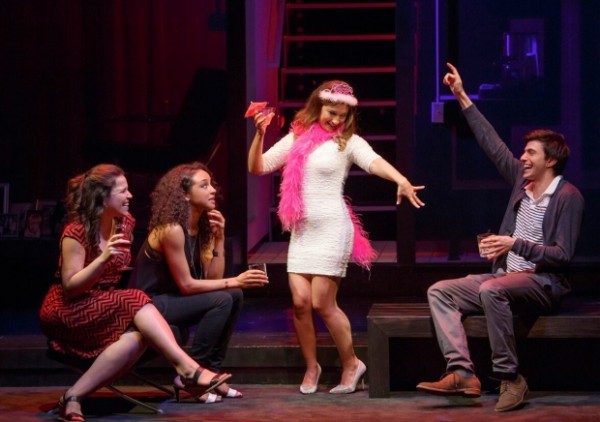
this week in theater

HAMILTON

(photo by Joan Marcus)

Lin-Manuel Miranda turns Alexander Hamilton into a hip-hop star in rousing musical at the Public (photo by Joan Marcus)

The Public Theater, Newman Theater
425 Lafayette St. by Astor Pl.
Tuesday – Sunday through May 3, $120
212-967-7555
www.publictheater.org
www.hamiltonbroadway.com

Six years ago, the Public Theater turned the seventh president of the United States into a rock star in Bloody Bloody Andrew Jackson, a breakthrough show that later transferred to Broadway. Now the Public, best known for its Shakespeare productions, has done it again with Hamilton, Lin-Manuel Miranda’s thrilling hip-hop bio-musical about another founding father, Alexander Hamilton. The same month that Bloody Bloody Andrew Jackson opened at the Public, Miranda was at the White House for “An Evening of Poetry, Music & the Spoken Word,” at which he premiered a song from The Hamilton Mixtape, which he called “a concept album about the life of someone I think embodies hip-hop, Treasury secretary Alexander Hamilton. You laugh, but it’s true! He was born a penniless orphan in St. Croix of illegitimate birth, became George Washington’s right-hand man, became Treasury secretary, caught beef with every other founding father, and all on the strength of his writing.” Inspired by Ron Chernow’s massive 2004 biography of Hamilton, Miranda tells the story of Hamilton’s dramatic rise and fall as the determinedly ambitious orphan seeks to make a difference in the world. Miranda, whose In the Heights won Tonys for Best Musical and Best Score in 2008, once again teams with director Thomas Kail, choreographer Andy Blankenbuehler, and musical director and orchestrator Alex Lacamoire, with Miranda playing the title character with charm and gusto. On his journey, Hamilton meets up with future nemesis Aaron Burr (Leslie Odom Jr.), the very serious General George Washington (Christopher Jackson), the fun-loving Marquis de Lafayette (Daveed Diggs), the dubious Thomas Jefferson (Diggs) and his dour protégé, James Madison (Okieriete Onaodowan), and the beautiful sisters Eliza and Angelica Schuyler (Phillipa Soo and Renée Elise Goldsberry, respectively), both of whom he has the hots for. Miranda follows Hamilton’s ascent as a major player in the American Revolution, a rise that is ultimately thwarted by sexual blackmail and a duel with Burr.

(photo by Joan Marcus)

Thomas Jefferson (Daveed Diggs) and Alexander Hamilton (Lin-Manuel Miranda) engage in a rap battle in HAMILTON (photo by Joan Marcus)

Hamilton explodes from the opening number, in which Miranda and company set the stage for what is to come, from Miranda’s almost-too-cool lyrics to David Korins’s wood-heavy set with a revolving center, from Paul Tazewell’s pristine period costumes to Lacamoire’s splendid orchestrations. “The ten-dollar founding father without a father / Got a lot farther by working a lot harder / By being a lot smarter / By being a self-starter,” Miranda declares. Miranda, who has also won an Emmy and a Grammy, glistens as Hamilton, eschewing any attempt to try to look like him — instead, he sports a mustache, goatee, and long black hair, sometimes put up in a ponytail — in favor of reaching deep inside to find what made the founding father tick. The show has several memorable set pieces, including a rap battle between Jefferson and Hamilton, a call for women’s rights led by the Schuyler sisters, and hysterical musical soliloquys by Jonathan Groff as King George that evoke The Rocky Horror Show. Exhilarating, endlessly energetic, and, yes, even educational, Hamilton is following in the footsteps of Bloody Bloody Andrew Jackson, moving to Broadway on July 13. Advance tickets for the Public run are sold out, but a limited number of twenty-dollar seats are available through a daily lottery in the lobby.

POSTERITY

(photo © Doug Hamilton)

Artist Gustav Vigeland (Hamish Linklater) discusses his lofty goals with patron Sophus Larpent (Henry Stram) in POSTERITY (photo © Doug Hamilton)

Atlantic Theater Company
Linda Gross Theater
336 West 20th St. between Eighth & Ninth Aves.
Tuesday – Sunday through April 5, $20-$65
866-811-4111
atlantictheater.org

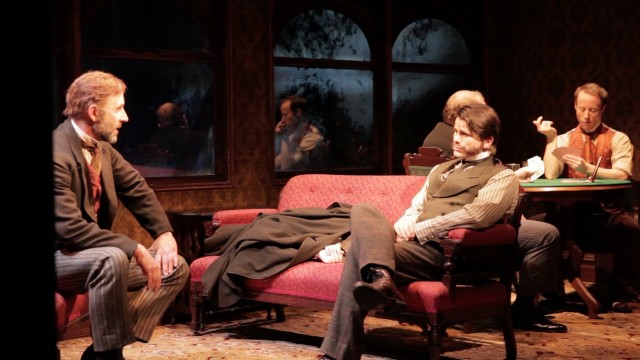
“I’m to entrust you to create a face that will outlive my own?” playwright Henrik Ibsen (John Noble) asks sculptor Gustav Vigeland (Hamish Linklater) in writer-director Doug Wright’s new play, Posterity. “Let you decide if I’m to be remembered as a genius or a madman, or both at once?” In Posterity, making its world premiere at the Atlantic Theater, Wright, who won a Tony for I Am My Own Wife and an Obie for Quills, examines legacy, fame, and artistic integrity as the young, ambitious Vigeland attempts to convince the old and frail Ibsen to sit for what will probably be his last portrait, a bust. At first Vigeland doesn’t want to do the commission, considering himself above mere standard portraiture — “I’m an artist,” he says. “An artist is a sculptor with an ego.” — but his prim and proper patron, Sophus Larpent (Henry Stram), tells him that if he doesn’t do it, his grand plan for a massive public fountain will never reach fruition. When Ibsen arrives, with cane and top hat, colorful medals on his fancy jacket, Vigeland’s young assistant and protégé, Anfinn Beck (Mickey Theis), and housekeeper, Greta Bergstrom (Dale Soules), flatter Norway’s most famous writer, but when Vigeland enters the studio, fireworks erupt as the two stubborn artists get involved in a battle of wits, arguing over the meaning of success, the importance of criticism, and the power of fame. Storming out, Ibsen collapses, leading to a second act that is repetitive and melodramatic, losing all of the momentum built up in the first act.

(photo © Doug Hamilton)

A mutton-chopped Henrik Ibsen (John Noble) considers sitting for an honorary bust in Doug Wright’s POSTERITY (photo © Doug Hamilton)

In 1901, Vigeland, who designed the Nobel Peace Prize medal, did indeed attempt to get Ibsen to sit for him. However, very little is known about the details of what happened inside Vigeland’s studio and Ibsen’s home, so most of Posterity is a creation of Wright’s, as are the characters of Beck and Mrs. Bergstrom, who were inspired by one of Vigeland’s sculptures. Shakespeare in the Park veteran Linklater (The Comedy of Errors, The School for Lies) is bold and audacious as Vigeland, his speech sharp and well defined, his movement stalwart and proud. Noble (Fringe, Sleepy Hollow) is an excellent foil, infusing Ibsen with a dark suspicion of others, more concerned about his legacy than he initially lets on. Derek McLane’s studio set features rows and rows of sculptures covered in white sheets, evoking Ibsen’s Ghosts. In the first act, Vigeland and Ibsen’s back-and-forth bantering about art teeters on the edge of pretentiousness but holds its ground, but in the second act it all falls apart like clay that’s too wet, as Wright adds several annoying plot twists and oversentimentality seeps in. No one really knows what happened when Vigeland and Ibsen met, what they said to each other; Wright has taken that situation and created a discourse on fame, ego, and longevity, but unfortunately Posterity is not one for the ages.

THE LIQUID PLAIN

(photo by Joan Marcus)

Dembi (Ito Aghayere) and Adjua (Kristolyn Lloyd) threaten John Cranston (Michael Izquierdo) in THE LIQUID PLAIN (photo by Joan Marcus)

The Pershing Square Signature Center
The Alice Griffin Jewel Box Theatre
480 West 42nd St. between Tenth & Eleventh Aves.
Tuesday – Sunday through March 29, $25
212-244-7529
www.signaturetheatre.org

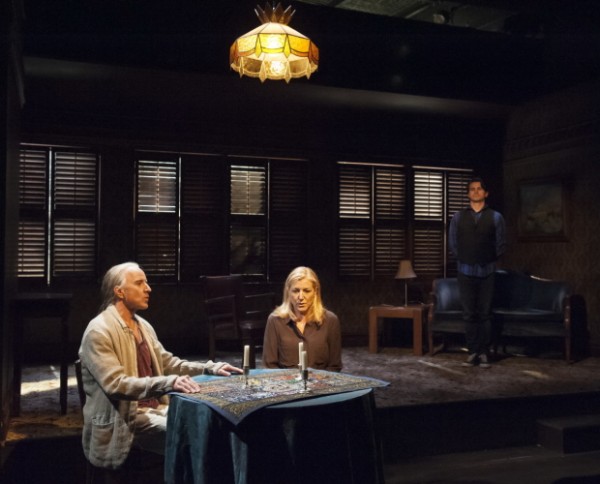
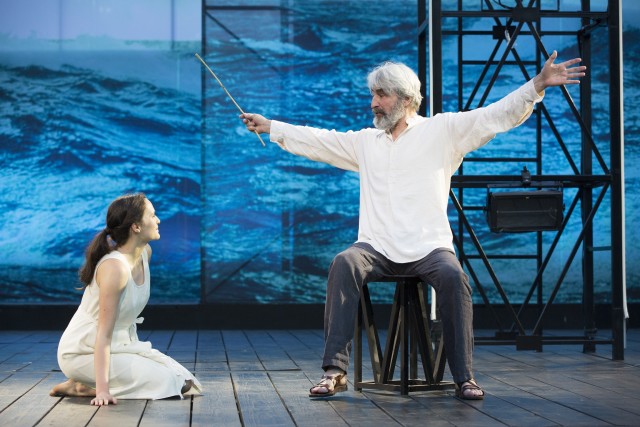
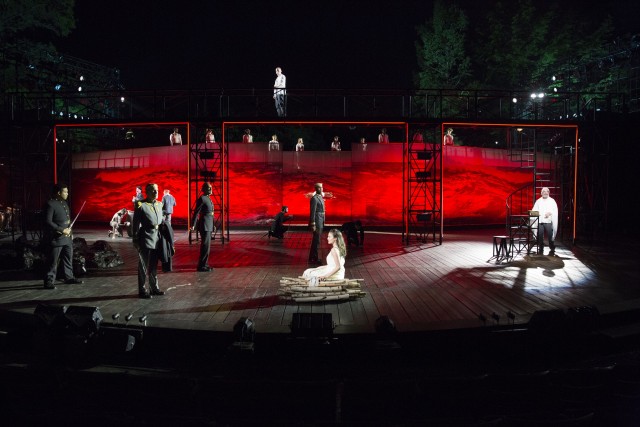
As The Liquid Plain opens, two people find what they think is a dead body, but the supposed corpse comes back to life. Unfortunately, the play has no such luck, pretty much showing up DOA. Originally commissioned for the Oregon Shakespeare Festival’s ten-year “American Revolutions: The United States History Cyle” series, which also includes Lynn Nottage’s Sweat and Robert Schenkkan’s Tony-winning All the Way, Naomi Wallace’s The Liquid Plain is a disconcerting, bewildering look at slavery in the Atlantic region. The title comes from Phillis Wheatley’s 1773 poem “A Farewell to America,” in which she writes, “While for Brittania’s distant shore / We sweep the liquid plain, / And with astonish’d eyes explore / The wide-extended main.” The play begins on a section of ratty dock in 1791 Bristol, Rhode Island. Hiding in bleak surroundings, runaway slaves Adjua (Kristolyn Lloyd) and Dembi (Ito Aghayere) are trying to save enough money to get on a ship bound for Africa, but their plans are complicated by the arrival of John Cranston (Michael Izquierdo), a white man who has lost his memory after his near-murder by drowning. Against Dembi’s better judgment, Cranston joins the pair and starts helping them out, but when one-eyed scoundrel Balthazar (Karl Miller) and ship captain Liverpool Joe (Johnny Ramey) show up, truths are revealed that threaten Adjua and Dembi’s future. The second act takes place forty-six years later, as the well-spoken Bristol (LisaGay Hamilton) comes to Rhode Island from London, seeking her father. But when she meets up with Cranston, Dembi, the ghost of William Blake (Miller), and the wealthy and powerful former slaver and senator James De Wolfe (Robert Hogan), she discovers unsettling facts that tear her life apart.

(photo by Joan Marcus)

Bristol (LisaGay Hamilton) searches for her past in Naomi Wallace play at the Signature (photo by Joan Marcus)

Although Wallace (Slaughter City, One Flea Spare) and director Kwame Kwei-Armah (Blues Brother Soul Sister, Elmina’s Kitchen), who previously collaborated on Wallace’s Things of Dry Hours, address some fascinating and lesser-known socioeconomic aspects of the slave trade in the North and the life of African Americans on the docks rather than on the plantation, the narrative is choppy and the dialogue befuddling. Meanwhile, the staging ranges from inventive to overstylized and confounding, and the plot twists feel forced when they’re not obvious. Influenced by Marcus Rediker’s book The Slave Ship: A Human History, Wallace tries to squeeze too much historical information into The Liquid Plain, which won the 2012 Horton Foote Prize for Promising New American Play. Perhaps it looked better on paper, but onstage, in this production running at the Signature through March 29, it’s all wet.

EVERY BRILLIANT THING

(photo by Matthew Murphy)

Jonny Donahoe interacts with the audience in one-man show EVERY BRILLIANT THING (photo by Matthew Murphy)

Barrow Street Theatre
27 Barrow St. at Seventh Ave. South
Tuesday – Sunday through March 29, $20-$79
www.everybrilliantthingplay.com
www.barrowstreettheatre.com

The Brits overuse the word brilliant the way Americans overuse the word awesome, diluting its impact and meaning. But Duncan Macmillan and Jonny Donahoe’s Every Brilliant Thing is bloody brilliant and absolutely awesome, in every majestic sense of the hyperbolic words. It’s billed as a one-man show, but it’s an immersive experience in which dozens of ticket holders get to participate either from their seats or onstage with Donahoe at the Barrow Street Theatre, a small, square space with the audience arranged on all four sides. Donahoe, a British stand-up comic and leader of the musical comedy act Jonny and the Baptists, is so good, so natural in the role of a man sharing the vivid, poignant details of having grown up with a suicidal mother that it’s hard to believe it’s not his own true story, but it is indeed a fictional work written by playwright Macmillan (The Forbidden Zone, Monster) based on his short story “Sleeve Notes,” a monologue he wrote for an actress who appeared in his first play. (Donahoe gets a smaller-font cowriting credit for what he brings to the production, which has been performed previously by other actors both male and female.) The lights remain up throughout the sixty-five-minute show, giving it even more of an involving, conversational feel. The story Donahoe, the narrator, tells is bittersweet and heartbreaking, beginning when he’s seven, the year his mother first tries to kill herself. Immediately afterward, he starts keeping “a list of everything brilliant about the world. Everything worth living for.” The list begins with “ice cream” and “water fights,” and as the narrator grows up, the items on the list grow up with him, often becoming more mature and poetic (“the smell of old books,” “old people holding hands”). The list also plays the central role in his relationship with Sam, leading to one of the most tender and heartwarming courtships you’ll ever see onstage; I nearly broke down in tears not only while watching the beautifully staged scene but also when reading it in the script the next day. Through it all, Macmillan and Donahoe explore the fragile nature of depression and suicide, from how families deal with mental illness to the hyper-controlled way it’s depicted in the media. “If you live a long life and get to the end of it without ever once feeling crushingly depressed, then you probably haven’t been paying attention,” the narrator says.

(photo by Matthew Murphy)

Jonny Donahoe celebrates the little things in life in brilliant show at the Barrow Street Theatre (photo by Matthew Murphy)

It’s impossible not to pay attention to Donahoe, who gives a dazzling performance as the narrator. Directed by George Perrin (Good with People, Macmillan’s Lungs), the Paines Plough production has an old-fashioned, home-made sensibility that matches the narrator’s handwritten list. The narrator speaks eloquently about his love of vinyl records, the latter being number 2,006 on the ever-growing list: “I’m not being pretentious, the sound quality is better,” he says. “It isn’t compressed and it’s tactile, you feel the weight of it in your hands. You can’t skip like with CDs or mp3s, you listen through to the entire album. Dad’s room had records on every surface and I loved the gatefold sleeves, the artwork, I love reading through the acknowledgments and the sleeve notes, the story of the making of the object.” Books also play a major role; when the narrator selects someone from the audience to play one of his professors, he has him or her hold aloft a copy of Goethe’s The Sorrows of Young Werther, a book he explains “resulted in thousands of copycat suicides.” Later he reminds people that “there was a world in which you couldn’t communicate with anyone after midnight. No mobile phones or social media. That world was called ‘1998.’” The heart of the show is the relationship between the narrator and a fellow student he meets in college, Sam, who was played when I saw it by a lovely young woman who really made the role her own, making a powerful connection with Donahoe that struck deep. And that’s what Every Brilliant Thing is essentially about: making connections, both in life and in theater, being part of something that is bigger than yourself. It’s tragedy and comedy of the highest order, an unforgettable experience that just might lead to your jotting down some of the things that make your life worth living. And the first one is very likely to be: Every Brilliant Thing.

THE MYSTERY OF LOVE AND SEX

(photo by T Charles Erickson)

Two generations deal with love, sex, and food in Lincoln Center production (photo by T Charles Erickson)

Lincoln Center Theater at the Mitzi E. Newhouse
150 West 65th St. between Broadway & Amsterdam Ave.
Tuesday – Sunday through April 26, $87
212-362-7600
www.lct.org

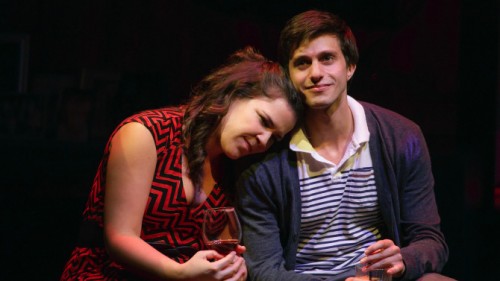
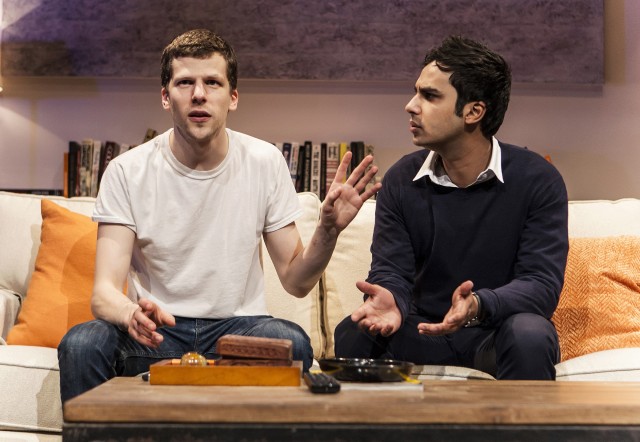
Bathsheba Doran’s The Mystery of Love and Sex explores the many facets of the title concepts in light but smart ways, touching on the complicated nature of friendship and family, romance and lust. Friends since they were nine years old, Charlotte (Gayle Rankin) and Jonny (Mamoudou Athie) are now going to the same Virginia college not far from where they were raised, and they have invited her parents, Lucinda (Diane Lane) and Howard (Tony Shalhoub), to come over for what Lucinda quickly decides is a “bohemian” dinner, on a makeshift table with salad, bread, no chairs, and cheap wine. While Lucinda gets right into the spirit of things, Howard has much more trouble, beginning with attempting to sit on the floor, then trying to serve himself some food. Soon the talk turns to the relationship between Jonny, a young black man with a sick mother, and Charlotte, a young Jewish woman preparing her own way in the world. Howard, a successful writer of detective fiction, might have been treating Jonny like a member of the family for the past decade, but now that he thinks that Jonny might become an official part of the family, he is not so happy. But the kids are still teenagers with their whole lives in front of them, and their undefined relationship grows more puzzling when Jonny starts dating another woman — and Charlotte says she has the hots for a fellow coed. Things heat up even further when the four main characters start debating such issues as racism, homophobia, anti-Semitism, misogyny, religion — and food. (The show features a lot of eating, so you might want to be sure to dine beforehand.) The second act takes place five years later, as some matters have been settled, but most have not, as marriage and divorce enter the conversation.

(photo by T Charles Erickson)

Jonny (Mamoudou Athie) and Charlotte (Gayle Rankin) contemplate their future in THE MYSTERY OF LOVE AND SEX (photo by T Charles Erickson)

Returning to New York theater for the first time since 1977, when she was twelve, the now fifty-year-old Lane (A Little Romance, Unfaithful) is resplendent as Lucinda, her smile lighting up the entire theater, along with her rich southern accent, her character’s flair for life infectious. Shalhoub (Act One, Golden Boy) is terrific as Howard, a bundle of nerves and deeply hidden prejudices who fumbles fantastically in the opening dinner scene, showing a riotous mastery of physical comedy, while standing firm later when he gets into it with Jonny. Athie and Rankin are fine as Jonny and Charlotte, the former timid and withdrawn, the latter energetic and fancy-free, but the play slows down considerably when Lane and Shalhoub are not onstage. One of the busiest directors in New York, Sam Gold, who has helmed such delights as Fun Home, The Realistic Joneses, and Seminar, makes good use of the small Newhouse stage, keeping things moving proficiently on Andrew Lieberman’s minimalist sets, which generally consist of a few pieces of furniture and long drapes in the back. Doran, who has written such other plays as Kin and Nest and for such cable series as Boardwalk Empire and Masters of Sex, has a gift for creating unpredictable situations and taking them further than expected with a smooth calm, although she is occasionally too clever for her own good. The Mystery of Love and Sex is a perfectly pleasant piece of theater, a tasty morsel if not quite the gourmet meal it attempts to be.

FISH IN THE DARK

(photo by Joan Marcus)

Brothers Norman (Larry David) and Arthur (Ben Shenkman) fight over where there mother will live in FISH IN THE DARK (photo by Joan Marcus)

Cort Theatre
138 West 48th St. between Sixth & Seventh Aves.
Tuesday – Sunday through June 7, $49 – $275
fishinthedark.com

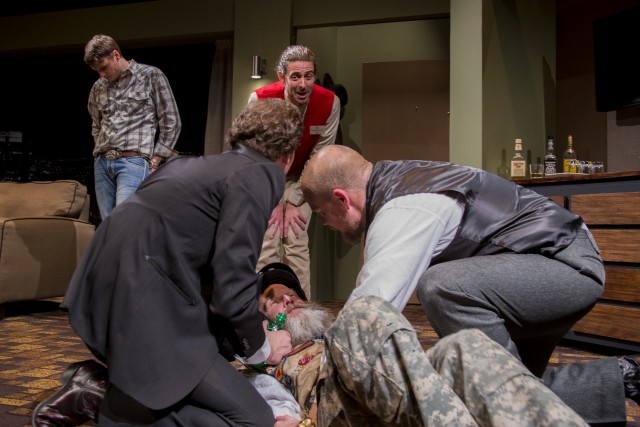
The first act of Larry David’s Broadway debut as writer and actor is pret-ty, pret-ty good; unfortunately, the second act is pret-ty, pret-ty not. David is well known and celebrated — or hated, by some — for his television work: He was the cocreator of Seinfeld (the character of George Costanza, played by Jason Alexander, is inspired by him) and the comic genius behind HBO’s Curb Your Enthusiasm, in which he stars as a self-obsessed version of himself, getting into uncomfortable, cringe-worthy situations that are as funny as they are annoying. He has arrived on Broadway with quite a bang; Fish in the Dark virtually sold out its eighteen-week run at the Cort Theater before it even officially opened and the reviews started coming in. (Only premium seating, ranging from $185 to $499, is now available.) Fish in the Dark is, in effect, an extended episode of Curb, but whereas the cable show lasts a mere half hour, Fish goes on, and on, and on, clocking in at approximately two hours (with intermission). And it feels even longer. Playing what appears to be yet another version of himself — David looks and acts like he’s on the set of Curb, his only nods to being live onstage his exaggerated gestures when he’s talking, as opposed to standing around doing nothing when he’s not — David is Norman Drexel, a urinal salesman whose father, Sidney (Jerry Adler), is in the hospital, on his last legs. Right before Sidney dies, he makes his sons, Norman and Arthur (Ben Shenkman), promise to take care of their mother, Gloria (Jayne Houdyshell), and swear never to let her live alone. Thus begins a fight about which son is supposed to take the widow into their home. Arthur is a well-off divorced single father and successful lawyer, while Norman has much less money and a wife, Brenda (Rita Wilson), who threatens to leave him if he takes in his mother. It’s classic David shtick that gets even more complicated when longtime family housekeeper Fabiana (Rosie Perez) reveals to Norman a very expensive secret. Doing what David does best, he has taken a somewhat familiar, clichéd situation and turns it inside out, getting caught up in trivialities that are lifted to absurdist levels. But it all falls apart in a second act that devolves into repetition, silly slapstick, and dreadful, minor-league-sitcom plot twists.

(photo by Joan Marcus)

Norman (Larry David) learns some surprising secrets about his father from housekeeper Fabiana (Rosie Perez) in David’s Broadway debut (photo by Joan Marcus)

Fish in the Dark, which boasts a talented cast of eighteen, also includes battles over a Rolex, eulogies, boob gropes, tipping doctors, reincarnation, and end-of-life care, all given equal weight in typical David fashion. Set changes are made behind a giant screen that is a blown-up State of California death certificate on which information is added or deleted over the course of the show, but it grows tiresome and confusing very quickly. Director Anna D. Shapiro (This Is Our Youth, Of Mice and Men) has done significantly better work; much of Fish in the Dark is too stagnant, with the audience (and the cast) waiting on the next telegraphed punch line. Meanwhile, some of the actors have trouble projecting, while others nearly shake the roof with their line readings. One of the many things that made Curb Your Enthusiasm so effective was that it was not overly scripted, instead providing plenty of room for the actors to improvise, providing a freshness to each exchange, something that is missing from Fish. (Critics were not permitted to see copies of the script, so I can’t verify what’s in it and what’s not, or how it might have changed since the play began previews.) In the fall of 2011, a trio of one-act comedies, Relatively Speaking, by Woody Allen, Elaine May, and Ethan Coen, ran at the Brooks Atkinson Theatre. The first act of Fish in the Dark would have felt right at home on that shared bill, since you’ll end up curbing your enthusiasm during the second act. Maybe it’s best to leave at intermission, feeling like you’ve seen a live taping of a decent lost episode of Curb.

FASHIONS FOR MEN / ROCKET TO THE MOON

(photo by Richard Termine)

Peter Juhász (Joe Delafield) gets quite a surprise from his wife, Adele (Annie Purcell), in Mint revival of FASHIONS FOR MEN (photo by Richard Termine)

FASHIONS FOR MEN
Mint Theater
311 West 43rd St. between Eighth & Ninth Aves.
Tuesday – Sunday through April 12, $27.50-$65
866-811-4111
www.minttheater.org

A current pair of off-Broadway revivals, one a 1917 Hungarian comedy, the other a 1938 American drama, tackle remarkably similar topics, albeit in very different ways. Written by extremely successful playwrights, each follows an overly kind business owner dealing with relationship issues and financial problems, featuring a number of similar characters and situations, but whereas one ends up stumbling to the finish line, the other reaches it with head held high. The Mint Theater, which resuscitates forgotten, neglected works, breathes fashionable new life into Ferenc Molnár’s Fashions for Men, which could alternately be called The Haberdashery Around the Corner. Joe Delafield stars as Peter Juhász, the tall, proper owner of a reputable clothing shop catering to a wealthy, annoying clientele. He has such a gentle, forgiving nature that he can’t get angry when one of his employees, Oscar (John Tufts), steals his wife, Adele (Annie Purcell), and they take off with a hefty sum of cash Peter had set aside in an account for her. Peter doesn’t want to go back to his primary backer, the fabulously wealthy, playfully pompous Count (Kurt Rhoads), an older gentleman who has his eyes on Peter’s beautiful young employee Paula (Rachel Napoleon). Meanwhile, another of Peter’s salesmen, Philip (Jeremy Lawrence), watches all the shenanigans with knowing glances. The second act, which takes place in the Count’s extravagant estate, gets bogged down in repetitive slapstick as Peter is determined to protect Paula’s purity, but the first and third acts, set in Daniel Zimmerman’s wonderfully designed haberdashery, are a joy. The cast, dressed in appropriate finery by costumer Martha Hally, is uniformly excellent, with particularly keen turns by Rhoads and Delafield, who is so up-to-snuff playing the absurdly good Peter you’ll want to slap him around to get him to finally face reality and stand up for himself. Director Davis McCallum (London Wall, The Few) keeps it all flowing smoothly in a way that would make Ernst Lubitsch proud. Mint artistic director Jonathan Bank has tweaked Benjamin Glazer’s 1921 translation with the help of Agnes Niemitz and Gábor Lukin, Molnár’s great-grandson; the original English-language version opened on Broadway in December 1922. Molnár might not be a household name, but several of his works are, adapted into such films as Carousel, The Guardsman, The Swan, The Devil, and One, Two, Three.

(photo by Carol Rosegg)

Dr. Stark (Ned Eisenberg) has quite a surprise for his wife, Belle (Marilyn Matarrese), in Pecadillo revival of ROCKET TO THE MOON (photo by Carol Rosegg)

ROCKET TO THE MOON
Theatre at St. Clement’s
423 West 46th St. between Ninth & Tenth Aves.
Tuesday – Sunday through March 28, $75-$95
www.thepeccadillo.com

Another troupe that rediscovers classic works, the Peccadillo Theater Company, has brought back Clifford Odets’s Rocket to the Moon in a solid production that ultimately reveals the play’s severe flaws. One of America’s most important and influential writers, Odets penned such plays as Golden Boy, The Big Knife, Awake and Sing! and The Country Girl and such films as None but the Lonely Heart, Humoresque, and Sweet Smell of Success. In Rocket to the Moon, which debuted on Broadway in 1938 with Luther Adler, Morris Carnovsky, Leif Erickson, and Sanford Meisner, Odets tells the sad-sack story of Dr. Ben Stark (Ned Eisenberg), a mensch of a dentist with a shrewish, overbearing wife, Belle (Marilyn Matarrese), who is none too thrilled with the sexy new office girl, nineteen-year-old Cleo Singer (Katie McClellan). Belle is also not happy that her husband is letting his fellow dentist, dour tenant Phil Cooper (Larry Bull), fall well behind on his rent. Despite their financial problems, Belle does not want Ben to accept a generous offer from her dapper, estranged father, Mr. Prince (Jonathan Hadary), to set him up in a fancier office in a better location and with more modern technology. At the same time, Ben is none too thrilled that the fabulously wealthy, playfully pompous Mr. Prince has his eyes on Cleo, as does one of Ben’s patients, a hotshot swinger named Willy Wax (Lou Liberatore) who is zeroing in on her as his next conquest. Meanwhile, Ben’s podiatrist neighbor, Frenchy (Michael Keyloun), watches all the shenanigans, sharing his perverse opinion seemingly without a care in the world. The cast is uniformly excellent, with particularly fine turns by Bull, McClellan, and Odets veteran Eisenberg, who excels as the infuriatingly indecisive Ben — getting Ben to stand up for himself is like pulling teeth. Precisely directed by Dan Wackerman (Ten Chimneys, The Man Who Came to Dinner), Rocket to the Moon soars in the first act, but the second act gets bogged down in a dreary battle between Mr. Prince and Dr. Stark over Cleo that is dated, misogynistic, and just plain tiresome. Odets tries too hard to make grand statements about family and responsibility in an America that is still rattling from the Depression and soon to get involved in WWII; the play works best when it gets right down to business, delving into the very human need for intimacy, understanding, compassion, and, most of all, love. But that’s precisely what you’ll find, along with a wry sense of humor, at the Mint’s stellar revival of Fashions for Men.