this week in theater

PUNCH TO THE GUT: A CYMBELINE FOR OUR TIME

The pure and passionate love between Princess Imogen (Jennifer Lim) and Posthumus Leonatus (KK Moggie) is challenged in NAATCO’s Cymbeline (photo by Julieta Cervantes)

CYMBELINE
Lynn F. Angelson Theater
136 East Thirteenth St. between Third & Fourth Aves.
Tuesday – Sunday through February 15, $25-$55
https://www.naatco.org

“Context is everything,” according to a phrase attributed to twentieth-century sociologist Alvin Ward Gouldner, author of such books as The Coming Crisis of Western Sociology and Against Fragmentation: The Origins of Marxism and the Sociology of Intellectuals.

That expression was on my mind as I watched the National Asian American Theatre Co.’s (NAATCO) splendid production of William Shakespeare’s Cymbeline, running at the Lynn F. Angelson Theater through February 15.

When I saw Heidi Schreck’s What the Constitution Means to Me at New York Theatre Workshop in 2018, it was the day that the Judiciary Committee had voted to advance the nomination of Brett Kavanaugh for Supreme Court Justice to the Senate floor. The air was thick with that event, which Schreck shrewdly noted without getting specific, but the entertaining show soon had the audience laughing.

I saw Cymbeline the day I learned that President Donald J. Trump had signed an executive order declaring, “It is the policy of the United States to recognize two sexes, male and female. These sexes are not changeable and are grounded in fundamental and incontrovertible reality. . . . Agencies shall remove all statements, policies, regulations, forms, communications, or other internal and external messages that promote or otherwise inculcate gender ideology, and shall cease issuing such statements, policies, regulations, forms, communications or other messages.”

Andrea Thome’s modern-verse adaptation, which identifies itself as “all-femme, all–Asian American,” feels like a punch to the gut of that executive order, which essentially seeks to ban the word “gender” from the English language. It is particularly relevant in a work by Shakespeare, since original productions of his plays featured all-male casts because women were not permitted to perform onstage in Elizabethan times. , as it was considered unladylike and demeaning to their established role in Victorian society.

In Ancient Britain, King Cymbeline (Amy Hill) has banished Posthumus Leonatus (KK Moggie), a soldier who has wed his daughter, the princess Imogen (Jennifer Lim), without royal permission, ignoring their deep love for each other. The queen (Maria-Christina Oliveras) is determined that her son from a previous marriage, Cloten (Jeena Yi), will be Imogen’s husband, ensuring he will be the next ruler.

In exile in Rome, Posthumus boasts to a group of men from Italy, the Netherlands, Spain, and France about his true love’s undying fidelity. The Frenchman tells the doubting Iachimo (Anna Ishida) of a conversation he had with Posthumus the night before in which they both were “lavishly praising our beloved mademoiselles back home; this gentleman at the time vouching (and vowing to defend it with his blood) that his lady was more lovely, virtuous, wise, chaste, faithful, praiseworthy and less temptable to seduction than any of the most extraordinary ladies in France.”

Iachimo takes that as a challenge and offers half his estate against Posthumus’s diamond ring, which belonged to Imogen’s mother, that he can seduce the princess and bring back absolute proof of his success. “The goodness of my mistress exceeds the depth of your vulgarity. I dare you to this match,” Posthumus says, agreeing to the bet and adding that they will duel when Iachimo fails.

Cymbeline features an “all-femme, all–Asian American” cast (photo by Julieta Cervantes)

Even though Imogen boldly rejects Iachimo’s advances, he tricks Posthumus into believing that the princess did indeed surrender her honor, prompting Posthumus to write to Imogen advising her to meet him in the Welsh town of Milford Haven and commanding his loyal servant, Pisanio (Julyana Soelistyo), to kill her because of her adultery. “Do I seem to the world to lack humanity so much as this crime asks?” Pisanio says, questioning the order.

In addition, the foolish Cloten has decided that he too will head to Milford Haven, to kill Posthumus and “defile” Imogen on his path to becoming next in line for the throne.

Meanwhile, the Roman ambassador Caius Lucius (Purva Bedi) has threatened King Cymbeline with war if he does not pay tribute tax to Augustus Caesar; the queen has acquired poison from the doctor, Cornelius (Narea Kang), that she intends to use on Imogen; and on her way to Wales disguised as a boy named Fidele, Imogen encounters a father and his two boys, who live in a cave, surviving on sheer will. Little does she know that it is actually Belarius (Oliveras), who was wrongly banished by Cymbeline many years before and who absconded with Arviragus (Annie Fang) and Guiderius (Sarah Suzuki), the king’s two young sons and her half brothers, who the ruler believes are dead.

The numerous subplots all come together in a rousingly satisfying finale.

Cymbeline is a problematic play that is far from the Bard’s finest. It feels cobbled together with leftovers from such other works as Twelfth Night, Romeo and Juliet, The Comedy of Errors, Richard III, Hamlet, and Othello. A dream sequence involving the god Jupiter (Soelistyo) is one of Shakespeare’s strangest, most awkward scenes. The dialogue lacks memorable, familiar lines. At nearly three hours (with intermission), it is too long. In New York City, the play has never made it to Broadway; the Public has presented it three times in its Shakespeare in the Park festival, in 1971, 1998, and, most recently, 2015, with Patrick Page as the king, Kate Burton as the queen and Belarius, Hamish Linklater as Posthumus and Cloten, Lily Rabe as Imogen, and Raúl Esparza as Iachomo.

But NAATCO, in partnership with Play On Shakespeare, has breathed new life into the show. Yi-Hsuan (Ant) Ma’s spare, often bare set is highlighted by a multipurpose large stretch of cloth that cleverly morphs from a bedsheet to royal drapery to a cave entrance, evoking what would be considered then women’s work, made by seamstresses. Mariko Ohigashi’s costumes feature lots of black leather and British and Roman finery that stand in contrast to the princess’s white gown. Yiyuan Li’s lighting keeps the audience, sitting on three sides of the action, visible through much of the show, as if we are all part of the kingdom, especially on the several occasions where the fourth wall is broken. Caroline Eng’s sound includes musical chimes that signal various changes.

The banished Belarius (Maria-Christina Oliveras) has raised Arviragus (Annie Fang) and Guiderius (Sarah Suzuki) in a cave in the woods (photo by Julieta Cervantes)

The majority of the cast is exemplary, ably emitting Shakespeare’s poetic iambic pentameter even when Thome’s contemporary translation uses modern language, although Bard purists should not be too worried.

Here is one example of Thome’s (Pinkolandia, A Dozen Dreams) style, with the Folger Library version first, followed by the new adaptation:

Cloten: Was there ever man had such luck? When I
kissed the jack, upon an upcast to be hit away? I
had a hundred pound on ’t. And then a whoreson
jackanapes must take me up for swearing, as if I
borrowed mine oaths of him and might not spend
them at my pleasure.

Cloten: Has there ever been a man with luck like mine? I’d bowled my
ball, just kissed the jack . . . and then was hit away! I had bet a
hundred pounds on that game: and then that damned monkey
son of a whore had to scold me for swearing.

It is important to point out that the ensemble is identified as “all-femme,” not “all-woman”; in real life, not all of the actors use the pronouns “she/her.” In addition, being “all–Asian American” is a strong rejoinder to the Asian and immigrant hate so pervasive in America today and apparently supported by the current administration, which is also seeking to subvert the fourteenth amendment by ending birthright citizenship and to deport Dreamers. Director Stephen Brown-Fried (Misalliance, Awake and Sing!), who does a terrific job guiding the proceedings, does not emphasize any of that, instead letting it all unfurl in an organic and natural way, gender be damned.

“I see a man’s life is a tedious one,” Imogen says in a soliloquy in Act 3, Scene 6, in front of the cave in the Wales forest.

In this wonderful adaptation in these troubled times, that statement speaks volumes.

[There are several special postshow events scheduled: January 29 is AAPINH Night, with a talkback with the director, members of the cast, and the casting company; February 2 is Shakespeare Trivia Night after the matinee; and the February 6 performance will be followed by the panel discussion “Shakespeare in Translation: Body and Verse,” with Lue Douthit, Karen Shimakawa, and Thome.]

[Mark Rifkin is a Brooklyn-born, Manhattan-based writer and editor; you can follow him on Substack here.]
A SINKING SHIP: SHOW BOAT / A RIVER AT NYU SKIRBALL

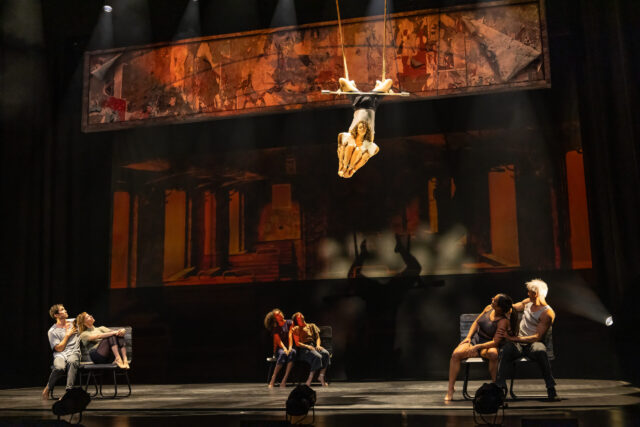
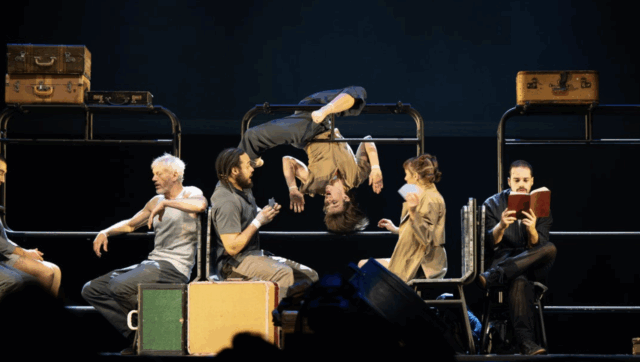
Target Margin Theater’s adaptation of Show Boat continues at NYU Skirball through January 26 (photo by Greg Kessler)

SHOW/BOAT: A RIVER
NYU Skirball Center for the Performing Arts
566 La Guardia Pl.
Through January 26, $60
nyuskirball.org

In 1927, Jerome Kern and Oscar Hammerstein II’s Show Boat revolutionized musical theater, taking on such tough topics as racism and addiction while making the narrative central to the production. Hammerstein called it a “musical play,” and Richard Rodgers announced that it was “trailblazing.”

You wouldn’t know any of that from Target Margin Theater’s head-scratching adaptation, renamed Show/Boat: A River, that is confusing audiences at NYU Skirball through January 26 as part of the Under the Radar festival.

There’s something off from the very first moments. The lights are on throughout the theater as several actors take the spare stage, the only design a large white cloth in the back with two doorways cut out, one marked “White,” the other “Black,” seen backward, meaning we are inside, not outside, but of what there is no telling. They begin singing “Cotton Blossom,” explaining, “Listen / N-word — work on de Mississippi / Black people work while de white folks play — / Loadin’ up boats wid the bales of cotton, / Gittin’ no rest till the Judgment day.”

The use of “N-word” is like nails on a chalkboard, and the first act doesn’t get any better. Each cast member wears a beauty-pageant-like sash that identifies their character as either white or black, and since some actors play multiple roles without costume changes, it’s impossible to know who’s who; one character is even portrayed by two people at the same time. I tried to make sense of it all by reading Target Margin Theater founding artistic director David Herskovits’s script after seeing the show, but it refers to the speakers and singers by their real first names, not the characters’. I initially was trying to figure out who Ruby is, as she’s not listed in the program as a performer and is not the name of any character, major or minor, but realized that it refers to the woman playing Magnolia; my first guess was they changed actors but didn’t update the script, although it now looks like Ruby is the nickname for the actor.

The plot, or what I could make of it, does follow the original story line, based on Edna Ferber’s 1926 novel. It’s the late 1880s, and Capt. Andy Hawks (Steven Rattazzi) owns and operates the Cotton Blossom, a riverboat docked in Natchez, Mississippi, whose star entertainer is Julie LaVerne (Stephanie Weeks), who is married to leading man Steve Baker (Edwin Joseph). Julie is half Black but passing as white. Capt. Andy and his unpleasant wife, Parthy (J Molière), have a daughter, Magnolia (Rebbekah “Ruby Reb” Vega-Romero), who is a burgeoning star. Known as Nola, she hooks up with smarmy gambler Gaylord Ravenal (Philip Themio Stoddard). Villain Frank Schultz (Tẹmídayọ Amay) and his wife, Ellie May Chipley (Caitlin Nasema Cassidy), the toast of Cairo, Illinois, are supporting actors in the troupe. Joe (Alvin Crawford) is a dockworker whose wife, Queenie (Suzanne Darrell), is the ship’s cook.

Pete (Stoddard), an engineer, has the hots for Julie and had given her a brooch that she then gifted to Queenie. The jewelry becomes a key symbol, bringing up issues of race, infidelity, and ownership — of things and people.

“That’s hell of a thing to do — givin’ my presents to a n—,” Pete tells her. She responds, “Pete — if Steve ever knew about you sending me that brooch, I declare he’d just about beat you to death.” Pete then threatens, “Well, he better not try, and you better be pretty nice to me — or you’ll be mighty sorry.”

A few moments later, Frank asks Queenie, “Where you get that brooch you got on?” She answers simply, “It was given to me.” Gaylord demands, “Who give it to you?” and she says, “Ax me no questions ‘n’ ah’ll tell y’no lies!”

It’s often difficult to tell who’s who and what’s what in Show/Boat: A River (photo by Greg Kessler)

Show Boat debuted on Broadway in 1927, with revivals in 1932, 1948, 1983, and, most recently, 1994, with Rebecca Luker, Lonette McKee, Robert Morse, Elaine Stritch, John McMartin, and Cloris Leachman. The musical was made into a film in 1936 by James Whale, with Irene Dunne as Magnolia, Hattie McDaniel as Queenie, Helen Morgan as Julie, and Robeson, who was not in the original Broadway cast, as Joe; George Sidney’s 1951 movie, starring Kathryn Grayson, Ava Gardner, Howard Keel, Joe E. Brown, Marge and Gower Champion, and Agnes Moorehead, earned Oscar nods for Best Color Cinematography and Best Scoring of a Musical Picture.

The first act of Herskovits’s two-and-a-half-hour Show/Boat: A River feels like an open rehearsal that still needs a lot of work. Early on, the “Show Boat parade” celebrates the upcoming performances on board the Cotton Blossom; during intermission, a very different kind of parade occurred, as dozens of audience members abandoned ship and left the theater. They did not return.

The second act is significantly better, although not necessarily anything to sing about. The sashes have been replaced by circular buttons, Kaye Voyce’s set adds numerous elements, Dina El-Aziz’s costumes get to shine, and Cha See’s lighting is not always annoyingly on, all combining to finally achieve important character and plot development. Perhaps more important, the score by musical directors Dionne McClain-Freeney (also vocal arranger) and Dan Schlosberg (also orchestrator) settles into a groove, performed by Nan-Cheng Chen on cello, Nicole DeMaio and Kristina Teuschler on reeds, Thomas Flippin on guitar, and Sam Zagnit on bass, the band visible in the pit where the actors occasionally take rests.

Among the highlights of Kern’s music and Hammerstein’s lyrics (he also wrote the book) are such songs as “Make Believe,” a duet between Stoddard and Vega-Romero; “Can’t Help Lovin’ Dat Man,” which becomes Nola’s dazzling audition number; “In Dahomey,” a racist tune at the World’s Fair; the moving “Bill,” achingly delivered by Weeks; and the show’s standard-bearer and underlying theme, “Ol’ Man River,” made famous by Paul Robeson as Joe and here boldly performed by Crawford: “Dere’s an ol’ man called de Mississippi; / Dat’s de ol’ man dat I’d like to be! / What does he care if de world’s got troubles? / What does he care if de land ain’t free?” he asks, bellowing, “Ol’ Man River / Dat Ol’ Man River, / He mus’ know sumpin’ / But don’t say nuthin’, / He jes’ keeps rollin’, /
He keeps on rollin’ along. . . . Ah gits weary / An’ sick of tryin’, / Ah’m tired of livin’ / An’ scared of dyin’, / But ol’ Man River, / He jes’ keeps rollin’ along.”

Oh, and don’t wait for “After the Ball,” because it’s been left on the cutting-room floor.

It all adds up to too little, too late by a beloved Brooklyn-based company that has been staging unique versions of classic and new works for four decades. Sometimes, as in this case, the ship just sinks.

[Mark Rifkin is a Brooklyn-born, Manhattan-based writer and editor; you can follow him on Substack here.]

HOPE IS THE THING WITH FEATHERS: DEAD AS A DODO AT BARUCH PAC

A dodo and a young boy are best friends fighting to survive in Dead as a Dodo (photo by Richard Termine)

DEAD AS A DODO
Baruch PAC
55 Lexington Ave. between Twenty-Fourth & Twenty-Fifth Sts.
Tuesday – Sunday through February 9, $55
utrfest.org
bpac.baruch.cuny.edu

“The race is over!” the Dodo suddenly calls out in Lewis Carroll’s 1865 masterpiece, Alice’s Adventures in Wonderland. Its animal friends crowd around, pant, and ask, “But who has won?”

You might be surprised by who wins in Wakka Wakka’s Dead as a Dodo, an awe-inspiring, visually stunning parable about the potential end of the human race and the tenuous future of the planet, sensationally staged with puppets. Running through February 9 at Baruch PAC as part of the Under the Radar festival, the eighty-minute extravaganza plays off the old adage “as dead as a dodo,” which refers to a person, place, or thing that is either no longer alive or decidedly out of date. The dodo (Raphus cucullatus) itself was a flightless bird of Mauritius that was last spotted in 1662.

In the Bone Realm, a pair of skeletons, a female dodo and a young boy, are besties. The boy is searching for bones to replace his arm and leg, digging into the basalt for anything that will fit. “So I’m missing an arm / And my ribs are all broken / I’ve lost half my teeth / And my skull is cracked open,” he sings. “Yes, I’m falling apart / And I’m close to the end / Still I’ve gotta take heart / Because I’ve got a friend / And my friend is a dodo.”

The two are always on the lookout for the Bone King and his daughter, the conniving princess, who are determined to own every bone in the land and are prepared to rip them right off the boy if necessary. “After life is stripped away / All the flesh has decayed / What remains? / Nothing but the bones / Nothing but the bones,” the king chants with dastardly glee. “All the bones in the fields are mine / You can try to take ’em if you got the spine.”

The greedy Bone King wants to own it all in sensationally eerie Dead as a Dodo (photo by Erato Tzavara)

As the boy fears he is disappearing, he notices that the dodo has grown a new feather or two — indications of life. When the Bone King discovers the feathers as well, the Bone Doctor, a kind of Grim Reaper, commands, “It is a plague upon our kingdom. There is only one thing to do. . . . You, sire! — Must chop it up and throw it into the fiery waters of the River Styx!”

The boy and the dodo then set off on a dangerous journey into other realms, where they meet a scavenging demon, a chatty gondolieri, a giant glowing fish, devil goats, a woolly mammoth, and a scientist named Phinneas who believes that the resurgent dodo is a sign that “the Age of Shimmering Darkness and Fog is coming to an end.”

But no one knows what will happen if the dodo actually returns to the Living Realm, rising like a phoenix. “Ha! That is not the order of things,” the gondolieri argues. “The river only flows in one direction.”

The staging of Dead as a Dodo is a marvel of technology and DIY ingenuity. There are three layers of opaque black string curtains onto which Erato Tzavara’s projections and Daphne Agosin’s lighting lend the proceedings a breathtaking 3D atmosphere. Lei-Lei Bavoil, Alexandra Bråss, Andy Manjuck, Hanna Margrete Muir, Sigurd Rosenberg, Marie Skogvang Stork, Anna Soland, and Kirjan Waage, dressed in black sequined costumes that meld into the background except for their glitter, operate the puppets with great skill and more than a touch of jaw-dropping magic.

The set and costumes are by Wakka Wakka cofounding artistic directors Gwendolyn Warnock and Waage, who also wrote and directed the production; in addition, Waage designed the puppets, based on actual skeletons. Thor Gunnar Thorvaldsson’s music and soundscape, harvested from geodes and crystals and featuring bells and gongs, keep the audience immersed in the riveting narrative, which evokes the climate change, war, and greed that threaten the earth today.

The look and feel of the show were inspired by Tales from the Crypt, Dante’s Inferno, old Silly Symphonies cartoons, and the art of Hieronymus Bosch, a mix that relates to the company’s Bioeccentrism Manifesto, which states, “Life like art is hyperbolically weird, stupendous, openly ridiculous, momentary, rapid, flashy fleshy and loud,” words that can also describe Dead as a Dodo and such previous Wakka Wakka works as The Immortal Jellyfish Girl, Animal R.I.O.T., and Saga.

The show is also about our own fear of death. “When you vanish, will you forget everyone you love?” the basalt asks at the beginning. Shortly after that, the dodo pulls an alarm clock out of the rubble and it rings. “That’s just junk,” the boy says, ignoring the literal and figurative wake-up call, a warning cry to all of us that humanity is on the brink of extinction.

“What do you think happens when you disappear completely? Are you going to forget about me? Will I forget you?” the boy says to the dodo, continuing, “I don’t want to disappear. I’m not ready.”

Then again, as Emily Dickinson once wrote, “Hope is the thing with feathers / That perches in the soul, / And sings the tune without the words, / And never stops at all.”

[Mark Rifkin is a Brooklyn-born, Manhattan-based writer and editor; you can follow him on Substack here.]
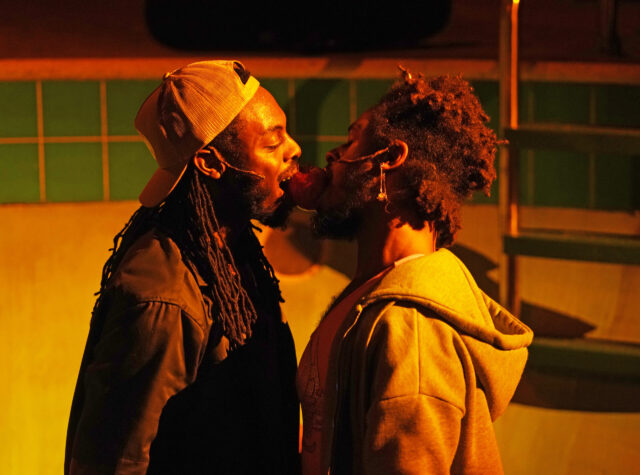
DUKE BLUEBEARD’S CASTLE IS “SO THRILLING!!!” AT JAPAN SOCIETY

Sujin Kim reimagines Shūji Terayama’s Duke Bluebeard’s Castle as macabre Harajuku burlesque at Japan Society (photo © Ayumi Sakamoto)

DUKE BLUEBEARD’S CASTLE
Japan Society
333 East 47th St. at First Ave.
January 15-18, $36-$48
www.japansociety.org
utrfest.org

Korean-Japanese director Sujin Kim’s macabre Harajuku burlesque adaptation of Shūji Terayama’s Duke Bluebeard’s Castle is an exhilarating two hours of nonstop fun, a wildly imaginative celebration of all that angura, or Japanese underground, unconventional theater, has to offer. For the show, which runs January 15–18 at Japan Society as part of the Under the Radar festival, Kim has brought together an inspiring multidisciplinary cast of more than thirty, including the tantalizing cabaret duo Kokusyoku Sumire, consisting of soprano vocalist and accordionist Yuka and violinist Sachi, who wear adorable outfits with light-up rabbit ears; magician Syun Shibuya, who, in a sharp-fitting tux, does card tricks, pulls doves out of a hat, and dazzles with mind-boggling costume changes; the delightful aerialist Miho Wakabayashi, who has been detailing her New York City trip here; and the experimental Japanese company Project Nyx, which was founded in 2006 by Kim’s wife, Kanna Mizushima, and specializes in “entertainment Bijo-geki, all-female cross-dressing theater.”

We get a taste of what’s to come when, early on, the stage manager (Misa Homma) tells Judith (Rei Fujita), who is portraying Bluebeard’s prospective seventh wife and closely checking the script, “You know what? — Things don’t always follow the script, y’know? Let’s see your improv muscles!”

The narrative regularly pops in and out of the Bluebeard fairy tale, which was written in 1697 by French author Charles Perrault; the self-referential story of the staging of the show; and the acknowledgment that it is being held at Japan Society, maintaining an improvisatory feel throughout.

“Wait, you’re saying the stage manager is doubling as the costume designer’s assistant in this production?” Bluebeard’s first wife (Miki Yamazaki) says to the stage manager while Carrot the Prompter (Ran Moroji) rubs her feet. Carrot had just amateurishly spoken a stage direction out loud: “Whistles dramatically and pretends to be a bird flying away.”

The play unfolds at a furious pace, so fast that it’s sometimes difficult to read the English surtitles, which are projected on small, raised monitors at the left and right sides; it can get a little frustrating, as you don’t want to miss a second of what’s happening onstage.

Asuka Sasaki’s kawai costumes and the far-out, colorful wigs are spectacular, like the best cosplay comic-con contest ever, with circuslike lighting by Tsuguo Izumi + RISE and enveloping sound by Takashi Onuki. Choreographer Taeko Okawa takes advantage of every piece of Satoshi Otsuka’s set, highlighted by seven white doors that flip to seven mirrors held by the seven wives in slinky black. As they dance with the mirrors, reflections shimmer throughout the space.

Kokusyoku Sumire’s songs are charming and engaging, including “[Doppelgänger],” in which they explain, “Even if I hide perfectly / There are times when misfortune finds me. / If I were to suppress this tormenting pain, / Would I be allowed to wish for your happiness?,” and poetic, as when they sing, “Walking in shadows, careful not to stumble, counting to nine, who are you? / The moonlight is full, playing the song of joy. If I close my eyes, I should be able to see everything.”

Dance with seven door-mirrors is a highight of Duke Bluebeard’s Castle (photo © Ayumi Sakamoto)

The scene titles in the script are not projected on the monitors but give a good idea of what audiences are in store for, including “The Bride in the Bathtub,” “A Goblin Peeks from Behind the Curtain,” “Don’t ruin my script with your life,” and “The Maestro of the Puppet Killers.” In “A Pig and a Rose,” which features some of the most hilarious dialogue in the play, Copula the Attendant (Chisato Someya) complains to the second wife (Yoshika Kotani) that the seventh wife has been miscast: “Her expressions are our hand-me-down, her heart is like a plastic trash can, and oh, her face — is the stuff that splashes out from an overflowing pit latrine. . . . She is Madam’s used tampon! Madam’s vomit — her face is fit for a manhole cover in a sewer!” The second wife is overjoyed, proclaiming, “So thrilling!!! Insults are divine, don’t you agree, Judith?”

Fujita and Homma stand out in the fantastic cast, which also features Ruri Nanzoin as Coppélius the puppeteer, You Yamagami as the costume designer, Haruka Yoshida as the debt collector, Nozomi Yamada as the actor, Yume Tsukioka as Aris, Hinako Tezuka as Teles, Kaho Asai as the magician’s assistant, Wakabayashi as the fourth wife, Mizushima as the fifth wife, Sayaka Ito as the third wife, and Mayu Kasai as wife number six. Don’t worry if you can’t keep it all straight; just let the extravaganza dazzle you time and time again.

Kim has a dream of presenting Terayama’s work in a tent along the New York City waterfront. Here’s hoping that’s next for this immensely talented creator.

[There will be a preshow lecture on Terayama by UCLA professor emerita Carol Fisher Sorgenfrei at 6:30 on January 17. Ticket holders on January 17 and 18 are invited to see the current exhibit, “Bunraku Backstage,” in the Japan Society Gallery; there is also a display of rare Terayama artifacts on view, including scripts, letters, photos, and more from the La MaMa Archive.]

[Mark Rifkin is a Brooklyn-born, Manhattan-based writer and editor; you can follow him on Substack here.]
TALKING RICE COOKERS EXPLORE TWENTY YEARS OF KOREAN HISTORY

Jaha Koo teams up with Hana, Duri, and Seri in Cuckoo (photo by Radovan Dranga)

CUCKOO
Perelman Performing Arts Center (PAC NYC)
251 Fulton St.
January 16-18, $78-$82
pacnyc.org
utrfest.org

On its website, the Korean appliance and electronics company known as Cuckoo explains that it “hopes to continue to reach diverse audiences and captivate them with products that make life simpler.”

For nearly eight years, South Korean artist Jaha Koo has been reaching diverse audiences and captivating them with his inventive play Cuckoo, in which he traces the last twenty years of Korean history with the help of three talkative Cuckoo rice cookers, Hana, Duri, and Seri, who speak to him in the isolation, or golibmuwon, that he is experiencing.

Cuckoo, which debuted in 2017, is the middle section of Koo’s Hamartia Trilogy, which began with Lolling and Rolling in 2015 and concluded with The History of Korean Western Theatre in 2020.

“Conceptually, it focuses on how the inescapable past tragically affects our lives today,” the forty-year-old Koo says about the three works in total.

Koo is now bringing the fifty-five-minute Cuckoo to PAC NYC for four shows January 16–18 as part of the Under the Radar festival; the 7:00 performance on January 17 will be followed by a discussion moderated by South Korean playwright Hansol Jung, whose daring works include Wolf Play and Merry Me.

Koo is responsible for the concept, direction, music, text, and video and performs with the cookers; the Cuckoo hacking is by Idella Craddock, with scenography and media operation by Eunkyung Jeong.

In case Cuckoo makes you hungry, Cuckoo the company promises, “Whether you enjoy sticky rice, soft grains, or the ability to whip up an array of dishes with minimal effort — we’ve got a rice cooker to meet any need!”

Update: Jaha Koo’s Cuckoo is an intimate, deeply personal investigation of grief and loss, as seen through the lens of colonialist capitalism. Divided into four sections, “Cuckoo,” “Jerry,” “Robert Rubin,” and “Screen,” the fifty-five-minute multimedia performance focuses on the $55 billion bailout of South Korea by the International Monetary Fund (IMF) in 1997, orchestrated in part by Clinton Treasury Secretary Robert Rubin. In a press release at the time, Rubin wrote, “South Korea and the IMF reached an agreement today on an economic reform program that commits Korea to important policy adjustments aimed at restoring stability.”

It didn’t turn out quite as planned.

Jaha Koo links rice cookers, the financial crisis, isolation, and suicide in Cuckoo (photo by Radovan Dranga)

One of the results of the bailout was the success of the Cuckoo brand rice cooker, as well as a rising suicide rate. After video of social and political unrest is projected on a large screen, Koo sits down at a table with three Cuckoo rice cookers: Hana, Duri, and Seri, which have been hacked so they can play music and, in the cases of Duri and Seri, talk to Koo and each other, including hilarious insults, complete with four-letter words.

Switching between English and Korean, Koo discusses the tragic death of his best friend, Jerry; “The Happiness Project” espoused by Robert Rubin’s daughter-in-law, Gretchen Rubin; a solitary worker responsible for fixing broken protective screens in the Seoul Metropolitan Subway; his relationship with his father, who asks, “Hello, my son, did you have a good meal?”; and the vast number of suicides in South Korea, with graphic footage of actual attempts.

He also shares the term “golibmuwon,” which essentially means helpless isolation.

It’s a bittersweet tale that blends in a strong dose of humor until a haunting darkness prevails, sadly as relevant today as it was when Koo first performed it in 2017, with South Korea currently experiencing economic and political distress, its highest suicide rates ever, and even, for a moment, martial law.

The best rice cooker in the world might be able to provide a consistent, dependable base for a good meal, but it can’t build a strong-enough foundation to guarantee a solid future for a nation in turmoil.

[Mark Rifkin is a Brooklyn-born, Manhattan-based writer and editor; you can follow him on Substack here.]
SAILING UNDER THE RADAR: BLUEBEARD AT JAPAN SOCIETY

Sujin Kim reimagines Shūji Terayama’s Duke Bluebeard’s Castle at Japan Society (photo by Yoji Ishizawa)

DUKE BLUEBEARD’S CASTLE
Japan Society
333 East 47th St. at First Ave.
January 15-18, $36-$48
www.japansociety.org
utrfest.org

In his 1697 book Histoires ou contes du temps passé, French author Charles Perrault adapted such famous folktales as “Little Red Riding Hood,” “Cinderella,” “Puss in Boots,” and “Sleeping Beauty.” Though not quite as well known, particularly when it comes to children, Perrault’s “Bluebeard,” about a duke who has a penchant for moving on from wife to wife in not the most legal of ways, has been turned into plays, short stories, novels, ballets, operas, and movies.

Multidisciplinary Japanese artist Shūji Terayama, who died in 1983 at the age of forty-seven, was obsessed with the story of Bluebeard. “The Japanese countercultural icon Terayama Shūji produced three projects in the years 1961–1979 that rework the legend of Bluebeard, often intermixing the folkloric narrative with contemporary lived reality,” Steven C. Ridgely wrote in Marvels & Tales in 2013. “This was a countervailing tendency to the tide of texts emerging at the time that demythologize Bluebeard by means of historical figures such as Gilles de Rais. Terayama’s work on Bluebeard might best be understood as an effort to frustrate the mapping of folklore and legend to practices of the past and to insist on the liberational potential of taking possession of narratives in the folkloric mode.”

Adding a macabre Harajuku burlesque touch to the proceedings, which take place backstage at a Japanese theater, Korean-Japanese director Sujin Kim has reimagined Terayama’s version in Duke Bluebeard’s Castle, running January 15–18 at Japan Society as part of the Under the Radar festival. The North American premiere of this new production is performed by Project Nyx, an all-female avant-garde ensemble led by Kanna Mizushima; avant-garde cabaret duo Kokusyoku Sumire; and magician Syun Shibuya.

There will be a reception following the January 15 show, an artist Q&A after the January 16 performance, and a preshow lecture on Terayama by UCLA professor emerita Carol Fisher Sorgenfrei at 6:30 on January 17. Ticket holders on January 16, 17, and 18 are invited to see the current exhibit, “Bunraku Backstage,” in the Japan Society Gallery; there is also a display of rare Terayama artifacts on view, including scripts, letters, photos, and more from the La MaMa Archive.

[Mark Rifkin is a Brooklyn-born, Manhattan-based writer and editor; you can follow him on Substack here.]
BLIND JUSTICE: RUNNING FOR LIBERATION AT ST. ANN’S

A woman (Ainaz Azarhoush) and her husband (Mohammad Reza Hosseinzadeh) contemplate freedom in Blind Runner (photo by Amir Hamja)

BLIND RUNNER
St. Ann’s Warehouse
45 Water St.
Tuesday – Sunday through January 24, $49-$69
stannswarehouse.org
utrfest.org

In September 2022, Iranian journalist Niloofar Hamedi was incarcerated for reporting on the controversial death of Mahsa Amini, a twenty-two-year-old Kurdish-Iranian woman who died in a hospital shortly after being arrested for not wearing a hijab; the case was followed around the world. While in prison, Hamedi began running while her husband, Mohamad Hosein Ajoroloo, ran outside the building, preparing for a marathon. In June 2023, he told the New York Times, “Niloofar believes that enduring prison is like training for a marathon. Daily suffering. But imagining the joy of the finish line cancels out all the pain.”

That story, and others involving political imprisonments, served as inspiration for Iranian writer-director Amir Reza Koohestani’s haunting Blind Runner, continuing at St. Ann’s Warehouse through January 24 as part of the Under the Radar festival.

Éric Soyer’s set is a deep, dark area with two long, horizontal lines of light. At either side is a small camera, the projections of which appear on the large screen in back. The sublime video design is by Yasi Moradi and Benjamin Krieg, with stark lighting by Soyer, tense music by Phillip Hohenwarter and Matthias Peyker, and contemporary costumes by Negar Nobakht Foghani.

As the audience enters the space, actors Ainaz Azarhoush and Mohammad Reza Hosseinzadeh are already onstage, standing in concerned poses. Soon they each approach stanchions on opposite sides where they alternately write and erase such morphing phrases as “Based on a true story,” “Based on an actual story,” “Based on true history,” “Based on an actual history,” “Based on a factual history,” “Based on fiction history,” “Fact,” and “Fiction” before the husband concludes, “This is a theater.” Thus, we are instantly reminded that while what we are about to experience is artifice, it has been born out of fact, but whose facts? The playwright’s? The Iranian government’s? Ours in New York City, in America?

At first, the husband visits the wife once a week and they talk every day on the phone; in between their meetings, they run across the stage, each in a different strip of light, moving in opposing directions that signal the growing gap between them. She points out to him that everything they are saying and doing is being closely watched and recorded, like they are trapped in a spiderweb. While he values the visits and phone calls, she is becoming tired of them, as she has to carefully parse her words so as not to get him — or her — in trouble. This lack of communication frustrates him, since he wants to know the truth about how she is being treated and is adamant that he will get her released. “False hopes are worse than despair,” she admonishes.

Running is at the center of Amir Reza Koohestani’s Blind Runner at St. Ann’s Warehouse (photo by Amir Hamja)

He asks her, “Why don’t you just give me a ring to say that you’re fine?” She quickly answers, “Why should I lie?”

At her request, he meets with a blind marathoner named Parissa (Azarhoush) who lost her sight during a political protest and wants him to be her guide runner for an upcoming competition in Paris. He is apprehensive about it, but his wife thinks it is a good opportunity. “It’s not just running,” he explains. “It’s a matter of rhythm. You need to be in sync together.”

It’s clear he is not just talking about his potential professional relationship with Parissa, especially when his wife is not worried that he his traveling to Europe with another woman as the contentious Illegal Migration Bill is about to be passed in England.

Presented by the Mehr Theatre Group in Persian with English supertitles, the sixty-minute Blind Runner is a bleak, mysterious, and deeply involving play about the physical, psychological, and emotional choices we make as individuals and as a society and the consequences that result. Justice around the world can be blind, but the answer is not running away, or remaining silent, even as the risks grow and private and public freedom is jeopardized.

Koohestani himself started running after the Green Movement in Iran was suppressed, an activity he considered “an alternative to the demonstrations that were no longer being held and the freedom that had left us again for the umpteenth time,” he writes in a program note. His hypnotic play, also inspired by the case of imprisoned student activist Zia Nabavi, captures that feeling, with its hard-hitting dialogue and striking visuals that zoom in on the characters’ faces and merge their bodies when they are running, leading to a powerful conclusion. It is sometimes difficult to know where to look — at the two actors, at their projections on the screen, or at the supertitles above — but Azarhoush and Hosseinzadeh deliver beautifully human performances that ground the narrative.

In conjunction with Blind Runner, St. Ann’s is hosting the exhibition “Unseen Iran: A Celebration of Iranian Art & Culture,” featuring works by Tahmineh Monzavi (street photography), Shirin Neshat (the Villains triptych and Divine Rebellion related to the Arab Spring riots), Bahar Behbahani (Warp and Woof from her “Through a Wave, Darkly” series ), and Safarani Sisters (the video painting Awake) in addition to a Persian Tea Room where you can sip tea and relax before the show.

[Mark Rifkin is a Brooklyn-born, Manhattan-based writer and editor; you can follow him on Substack here.]