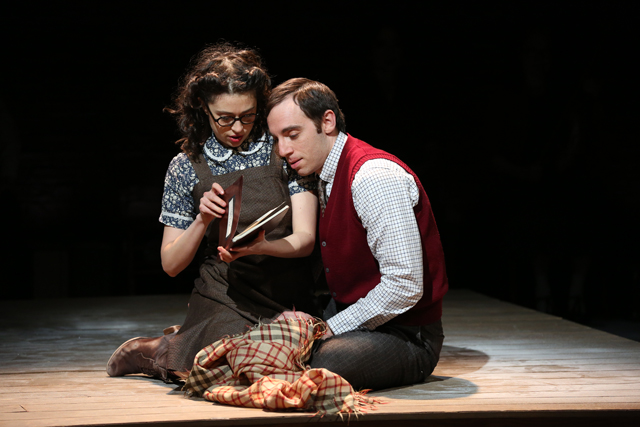
Who: Matthew Aughenbaugh, Michael Ruby, Graham Fawcett What: Immersive theater piece Where:The Old Stone House, Washington Park & JJ Byrne Playground, between Fourth & Fifth Aves. and Third & Fourth Sts., Park Slope, 718-768-3195 When: Friday, June 24, $15-$20, 8:00 Why: On June 24, Matthew Aughenbaugh will perform his one-man show, Song of Myself: The Words of Walt Whitman, at the Old Stone House in Park Slope, in the borough where the mighty poet was raised. “Crowds of men and women attired in the usual costumes, how curious you are to me! / On the ferry-boats the hundreds and hundreds that cross, returning home, are more curious to me than you suppose, / And you that shall cross from shore to shore years hence are more to me, and more in my meditations, than you might suppose,” Whitman wrote in 1856’s “Crossing Brooklyn Ferry.” Aughenbaugh, a Shakespearean actor who has also done musical theater, noted in a statement, “I was inspired to create a theater piece using only original text as a way to share my passion for our greatest American poet.” The immersive show, presented by London’s Upper Wimpole Street Literary Salon, will be followed by a Q&A with Aughenbaugh and Brooklyn poet Michael Ruby, moderated by British broadcaster, teacher, and translator Graham Fawcett. Tickets are $15 in advance and $20 at the door and come with wine and refreshments.
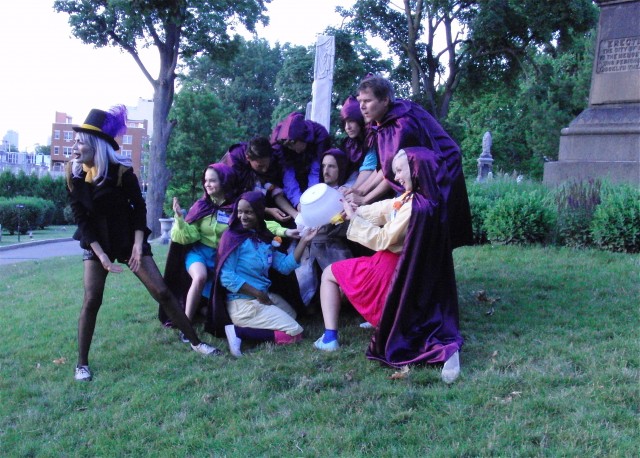
Unique production in Green-Wood Cemetery includes jugglers, a skeleton band, and lots of fire (photo by twi-ny/mdr)
Green-Wood Cemetery
Fifth Ave. and 25th St., Brooklyn
Thursday – Sunday through June 26, $75, 7:00 www.green-wood.com/gacc
In The Great American Casket Company,BREAD Arts Collective (Rise & Fall) takes full advantage of the opportunity to stage the first-ever site-specific multiperformance theatrical production in historic Green-Wood Cemetery. Every Thursday through Sunday in June, up to seventy-five “clients” come to Green-Wood Cemetery in Brooklyn to hear the extensive, immersive sales pitch from “employees” of the Great American Casket Co. The evening kicks off with heavenly standards by Coriander Suede and the Tombstones (Owen Weaver, Lizzie Hagstedt, Eric Powell Holm, and composer and musical director Andrew Lynch), including “My Blue Heaven” and “Pennies from Heaven.” (Feel free to dance if you’d like.) The audience is introduced to seven characters identified only by number (in ascending order from one to seven: Mélissa Smith, Kelly Klein, Gregory G. Schott, Kate Gunther, Andy Talen, Ashley Winkfield, and Ben Lewis) who are awaiting the arrival of the President (Toni Ann Denoble), a heavily made-up steampunk leader pushing the company’s exclusive afterlife technology.
Employees of the Great American Casket Co. push their exclusive afterlife technology in immersive show (photo by twi-ny/mdr)
As the sun sets over the spectacular grounds, the clients are guided through various parts of the cemetery, encountering puppets (courtesy of puppeteers Matthew A. Leabo, Winkfield, and Rachael Shane, who is also an aerialist), jugglers, ghostly guitarists, and other entertainments. The show drags significantly in the middle when a subplot regarding one Agnes Butterfield (Lyndsey Anderson) begins, but it takes off again toward a sparkling and otherworldly conclusion. Written by Anderson and Lewis, charmingly directed by Katie Melby, and featuring costumes by Elizabeth May that range from skeletal to clownish to devilish to angelic, The Great American Casket Company is, above all else, a great way to experience Green-Wood Cemetery, which is the resting place of such “famous residents” as Jean-Michel Basquiat, Boss Tweed, Leonard Bernstein, Horace Greeley, Louis Comfort Tiffany, Charles Ebbets, and Rev. Henry Ward Beecher. Not all of the knots are tied at the end, and several elements will leave you scratching your head, but if you “buy the plot,” as the opening number says with clever double meaning, you’ll have a grand old time. The show concludes with a reception with members of the cast and crew, hosted by Brooklyn-based alternative event planners Modern Rebel, with free popcorn, s’mores, and Pixy Stix, wine and beer (with suggested donation), and a photo booth.
Ollie (Sean Michael Verey) is suspicious of a deal the mysterious Miss Dee (Debra Baker) offers him and his wife, Jill (Scarlett Alice Johnson), in Philip Ridley’s RADIANT VERMIN (photo by Carol Rosegg)
BRITS OFF BROADWAY: RADIANT VERMIN
59E59 Theaters
59 East 59th St. between Park & Madison Aves.
Tuesday – Sunday through July 3, $35
212-279-4200 www.59e59.org
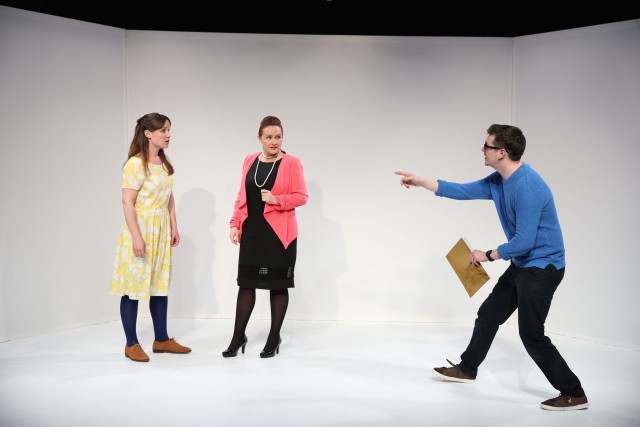
How far would you go to achieve your suburban dreams? British playwright Philip Ridley reveals just how much one young couple is ready to risk in the unapologetically delicious wicked black comedy Radiant Vermin. At first, Jillian and Oliver Swift (Scarlett Alice Johnson and Sean Michael Verey) are suspicious of the official government letter they receive from Miss Dee (Debra Baker) offering them a free house in a questionable neighborhood. Ollie thinks it’s some kind of reality television show gag. “Let’s make fun of the underclass desperate to get on the property ladder,” he says. But Jill quickly changes her mind after verifying that the offer is indeed real. “Ollie! If you do not agree to see this house then I will get very upset,” she declares to her husband. “And if I get very upset, our unborn baby will get very upset. And you remember what that psychiatrist on the telly said about pregnancy shaping the rest of a child’s life. Do you want our child to grow into someone who machine guns his classmates?” When they meet Miss Dee at the house, they overlook her strange, intimate knowledge of their life and sign a contract, taking ownership of the home; the only catch is that the house needs a lot of work, which they’ll need to take care of themselves. Everything else, including all taxes and utilities, have been paid. “You’re a marriage made in heaven,” Miss Dee proclaims, one of many references to heaven, hell, angels, reincarnation, and God. But when Jill and Ollie find out just what they have to do in order to renovate their new house, they are initially shocked but quickly go to the extreme lengths required to provide a happy home for them and their child. “What would you prefer, Jill? Eh?” Ollie asks. “A new kitchen? Or a dead body in the old one?”
Jill (Scarlett Alice Johnson) and Ollie (Sean Michael Verey) envision a much rosier future in wickedly funny Philip Ridley play (photo by Carol Rosegg)
Staging is always unusual in Ridley’s plays, and Radiant Vermin is no different. In the New Group’s 2015 revival of Mercury Fur at the Signature, the Romulus Linney Courtyard Theatre was turned into a postapocalyptic urban battleground. In the fierce 2012 love story Tender Napalm at 59E59, the action took place in a narrow space between the two rows of audience members on either side. And the back-to-back one-person shows Tonight with Donny Stixx and Dark Vanilla Jungle at HERE this past winter featured a cagelike area that entrapped the main characters. William Reynolds’s set for Radiant Vermin is a spare, almost blindingly white makeshift floor and backdrop, a little slice of heaven, with no props; three fluorescent lights hang from above, illuminating the sharp colors of the costumes, Jill in yellow, Ollie in blue, and Miss Dee, of course, in red. David Mercatali, who has directed six Ridley world premieres, keeps it as basic as possible as Jill and Ollie tell their crazy story directly to the audience. Johnson (EastEnders, Nightshift) and Verey (Tonight with Donny Stixx, Moonfleece), who starred together in Chris Reddy’s BBC series Pramface, playing teenagers who are going to have a baby, share a delightful familiarity with each other that is infectious, bringing the fabulous absurdities of Jill and Ollie’s situation down to earth, making it all natural and believable. And Baker (Mercury Fur, Vincent River) is a steadying force as the cool and calm Miss Dee, who is fully prepared for any and all eventualities. Ridley, who is also a children’s book writer, filmmaker, poet, and visual artist, was inspired to write the play after moving from his longtime home in Bethnal Green, which led to his questioning rampant consumerism and the housing crisis. As Jill and Ollie sing in the play, “Make it bigger / make it brighter / make it faster / make it louder / make it stand out in the crowdier / for the world to adore / and when you’ve done all that — / oh, hell, I’ll still want more. / Hell, I still want more.” Part of the annual Brits Off Broadway festival at 59E59, which also includes Alan Ayckbourn’s Confusions and Hero’s Welcome,Radiant Vermin is another thrilling triumph from one of England’s most talented voices.
Recently widowed John (Matthew Broderick) shares his haunting tale with his therapist, Ian (Billy Carter), in Irish Rep revival of Conor McPherson’s SHINING CITY (photo by Carol Rosegg)
Irish Repertory Theatre
132 West 22nd St. between Sixth & Seventh Aves.
Tuesday – Sunday through July 3, $50
212-727-2737 www.irishrep.org
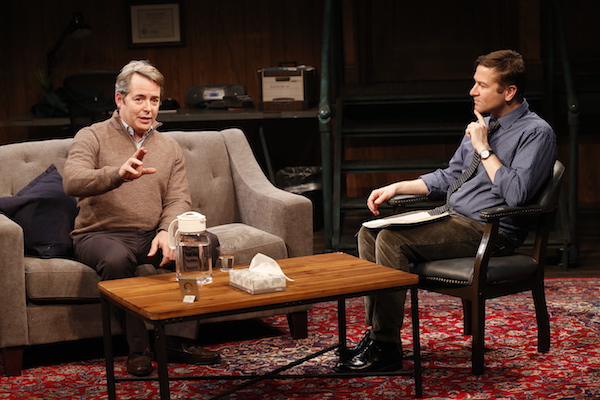
The Irish Rep has inaugurated its newly renovated space in its longtime Chelsea home with a play very much about, appropriately enough, home. Back in the Stanwick Building on West Twenty-Second St. following a season at the DR2 Theatre in Union Square, the Irish Rep is currently presenting a thrilling version of Conor McPherson’s Tony-nominated Shining City, a haunting psychological tale of dislocation, lack of communication, guilt, and the search for one’s place in the world. Matthew Broderick, in full Irish brogue, gives a thoroughly impressive performance as John, a fifty-four-year-old Dublin catering-supply rep who is seeing a therapist for the first time because he claims to have seen the ghost of his recently deceased wife in their house. Frightened and confused, John has temporarily moved into a bed and breakfast, but his disconnection began when his wife was still alive. “I started pretending I had to stay down the country, for work, you know, overnight, but I was really just staying in places so that I didn’t have to deal with the terrible pressure of going home, you know?” he tells his therapist, Ian (Billy Carter), a former priest who has left the house of God for a cozy third-floor office. Ian, meanwhile, is reconsidering his future with his wife, Neasa (Lisa Dwan), and their baby, who live with Ian’s brother. “I have nowhere to fucking go!” she screams at him when he talks about leaving her. “It’s their house! What right do I have to stay there if you’re not there?” Later, Ian meets Laurence (James Russell), a destitute man who has taken to the streets to try to survive after being kicked out of his cousin’s flat. “I don’t even want to go back, though, but I need an address,” a haggard Laurence tells Ian. Nearly everyone the four characters reference in their various stories relate to the concept of home, from a builder and a hotel executive to the B&B owners and women in a house of prostitution. Over the course of one hundred minutes, the four lost souls examine their loneliness and try to find a way out, to reconnect.
Shining City — which was nominated for a Best Play Tony for its Broadway debut in 2006, directed by Goodman Theatre head Robert Falls and starring Oliver Platt as John, Martha Plimpton as Neasa, Peter Scanavino as Laurence, and a Tony-nominated Brían F. O’Byrne as Ian — is a brilliantly written work, an intricate and endlessly inventive investigation into the hearts and minds of John and Ian, who are mirror images of each other; even their names are the same, as Ian is the Scottish version of John. John, a traveling salesman, often speaks in long monologues filled with the adjective “fucking” and the rhetorical phrase “you know” — the latter is spoken more than two hundred times throughout the play, and not just by John — during which Ian merely nods or makes quick comments; one entire scene is essentially a riveting soliloquy delivered exquisitely by Broderick in a breathless tour de force. Carter (McPherson’s Port Authority and The Weir at the Irish Rep), Beckett specialist Dwan (Not I / Footfalls / Rockaby), Russell (Port Authority, Juno and the Paycock), and two-time Tony winner Broderick (Torch Song Trilogy, Brighton Beach Memoirs) beautifully perform McPherson’s fragmented dialogue, maintaining its graceful poetic rhythm under the smooth direction of Ciarán O’Reilly (The Weir, The Hairy Ape). Charlie Corcoran’s therapist-office set subtly evokes the concept of home as well, with several boxes strewn around that hint at either someone moving in or moving out, and John settles in a little more with each visit even as Ian feels more uncomfortable. Shining City is an impeccable, haunting piece of theater and a deserving drama to welcome the Irish Rep, well, back home.
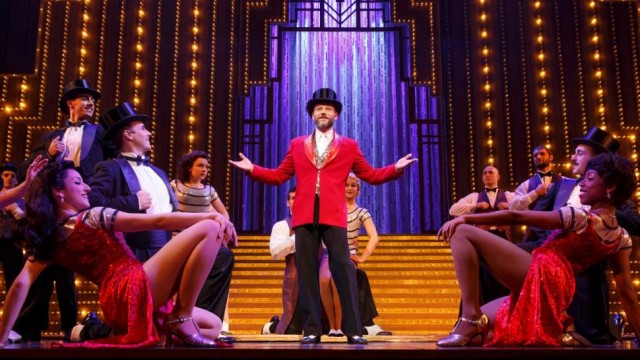
For more than thirty years, the Canada-based Cirque du Soleil has been wowing audiences with its unique reinvention of the circus, concentrating on stupendous feats of acrobatics with live music and an all-human cast. For its Broadway debut, however, it has bitten off more than it can chew with Paramour, running at the Lyric Theatre through February 19. Instead of concentrating on what the troupe does best, director and conceiver Philippe Decouflé and creative guide and creative director Jean-François Bouchard decided to frame the thrilling acrobatics within the confines of traditional musical theater, obscuring both in the process. Jeremy Kushner is the ersatz ringmaster as AJ Golden, a famous film director — don’t call them movies! — who thinks he has found his next superstar (and personal and professional muse) in local ingénue Indigo (Ruby Lewis) during the Golden Age of Hollywood. But standing in between them is Indigo’s partner, pianist and composer Joey (Ryan Vona), who is in love with her. As success comes to Indigo, she must make difficult decisions that will forever change her life and career.
Jeremy Kushner is film director and ersatz circus ringleader AJ Golden in Cirque du Soleil’s PARAMOUR (photo by Richard Termine)
The book is as standard as they come, as are the music (by Guy Dubuc and Marc Lessard) and lyrics (by co-composer Andreas Carlsson). As expected, the show looks terrific, with ecstatic sets by Philippe Guillotel, glittering costumes by Daphné Mauger, and choreography by Raffaello D’Andrea, but what’s wrong with Paramour can be summarized by one set piece that focuses on the central love triangle. A trio of aerialists, dressed in the same colors as AJ, Indigo, and Joey, beautifully reenact their troublesome situation, avatars performing remarkable feats in the air, but then AJ, Indigo, and Joey start singing a song that essentially retells everything we have just seen, as if the audience can’t be trusted to understand what the flying dance was all about. Indeed, the acrobatics usually occur in the background, forming no bond with the main story, as if they are two separate entities. Even when they do come together, as in a Calamity Jane scene involving a teeterboard, we are left scratching our heads, wondering why. The performers, who include artistic gymnasts Tom Ammirati, Martin Charrat, and Amber Fulljames, aerial strap artists Andrew and Kevin Atherton, trampolinist Lee Brearley, dancer Yanelis Brooks, martial artist Sam Charlton, contortionist Myriam Deraiche, juggler Kyle Driggs, Chinese pole and Cyr wheel specialist Jeremias Faganel, and clown Nate Cooper (who wanders through the audience before the show starts), exhibit extraordinary talent, but director West Hyler (the Big Apple Circus, Jersey Boys) puts too little of it front and center. It all feels too gimmicky; in fact, in front of each theatergoer, Velcroed to a seat, is a menu of merchandise that you can order and have delivered right there as you sit. That might work in Vegas, but it’s far too cheesy for Broadway.
INDECENT takes audiences behind the scenes of controversial drama THE GOD OF VENGEANCE (photo by Carol Rosegg)
Vineyard Theatre
Gertrude and Irving Dimson Theatre
108 East 15th St. between Union Square East & Irving Pl.
Extended through June 19 www.vineyardtheatre.org
A quartet of current or returning shows in New York City are as much about their back stories as the central plays themselves, all of which date from the 1920s. The first two are straight-up revivals, reconstructed after years of intense research: The National Yiddish Theatre has resurrected The Golden Bride, from the Golden Age of Yiddish theater; the operetta returns to the Museum of Jewish Heritage in July following a widely hailed production at the end of last year. I’ll Say She Is at the Connelly Theater revives the Marx Brothers’ long-lost Broadway debut, lovingly patched together by Groucho impersonator Noah Diamond. The two others are plays-within-plays. On Broadway at the Music Box Theatre, Shuffle Along goes behind the scenes to detail “the Making of the Musical Sensation of 1921 and All That Followed.” And now, in the Vineyard Theatre’s New York premiere of Indecent, Pulitzer Prize-winning playwright Paula Vogel (How I Learned to Drive) and director Rebecca Taichman (Familiar, Marie Antoinette) take a powerful look at Sholem Asch’s controversial drama The God of Vengeance, which, when it came to Broadway in 1923, resulted in the arrest of members of the cast and crew on obscenity charges. (The new play was inspired by Taichman and Rebecca Rugg’s 2000 The People vs. the God of Vengeance.) The hundred-minute show alternates between scenes from Asch’s (Max Gordon Moore) first play and what went into the creation of The God of Vengeance, which was decried as being anti-Semitic even by Asch’s friends and colleagues, as it tells the story of a devout Jewish man (Tom Nelis) who is running a brothel in his basement in order to be able to afford a better life for his daughter (Adina Verson), who instead falls in love with one of the prostitutes (Katrina Lenk). Lemml (Richard Topol) serves as the narrator of Indecent, explaining how he became the stage manager of The God of Vengeance as it toured Europe and America but is unable to remember how the play ends.
Madje (Adina Verson) and Sholem (Max Gordon Moore) have no idea what a furor his first play will cause (photo by Carol Rosegg)
Much of the cast takes on multiple roles; Nelis also portrays Asch’s mentor as well as Rudolph Schildkraut, the star of The God of Vengeance, Verson is also Asch’s wife, Madje, and Steven Rattazzi plays another colleague of Asch’s in addition to producer Harry Weinberger. (The excellent cast also features Mimi Lieber.) Even the Klezmer musicians, violinist Lisa Gutkin, accordionist Aaron Halva, and clarinetist Mike Cohen, occasionally double down. The primary controversy revolves around a lesbian kiss, which is reenacted over and over with poetic grace, the women dressed in angelic white costumes (by Emily Rebholz). Most of the action occurs on a slightly raised wooden platform (the scenic design is by Riccardo Hernandez), with the cast often sitting on chairs lined up against the back wall, on which Tal Yarden’s projections give the time and place, announce when there’s a “blink in time,” and tells the audience what language is theoretically being spoken, which is particularly effective when Lemml speaks in his non-native tongue and suddenly is talking in broken English. There are a few musical numbers, including “Bei Mir Best du Schon (Means That You’re Grand),” and David Dorfman’s choreography is subtly sensational, especially a breathtaking moment when the cast members of the show-within-a-show each grabs their suitcase, which are piled on top of one another, evoking a vertical Zoe Leonard installation. And when it’s all over, it becomes clear why Lemml doesn’t remember the ending, a haunting conclusion that you won’t soon forget.
THE GREAT AMERICAN CASKET COMPANY invites you to look at life, death, and legacy in historic Green-Wood Cemetery (photo by Kelly Klein, Calloway Productions)
Green-Wood Cemetery
Fifth Ave. and 25th St., Brooklyn
Thursday – Sunday through June 26, $75, 7:00 www.green-wood.com/gacc
As if there weren’t already enough ghosts and dead bodies in historic Green-Wood Cemetery, which boasts such “famous residents” — that’s their phrase, not ours — as Jean-Michel Basquiat, Boss Tweed, Leonard Bernstein, Horace Greeley, Louis Comfort Tiffany, and Rev. Henry Ward Beecher, the Brooklyn landmark is now hosting The Great American Casket Company, presented with BREAD Arts Collective and Modern Rebel, the latter specializing in “badass events that give back.” The show, which runs Thursday to Sunday through June 26, is billed as a “roving, immersive theatre experience” that examines “life, death, and personal legacy” with a large cast of musicians, actors, and aerialists and numerous rules. We’re not sure how immersive we want to get in a cemetery, even such a lovely one as Green-Wood, but we’ll be checking out the production soon and will report back. That is, if we are able to.