this week in theater

A DAY BY THE SEA

(photo © 2016 Richard Termine)

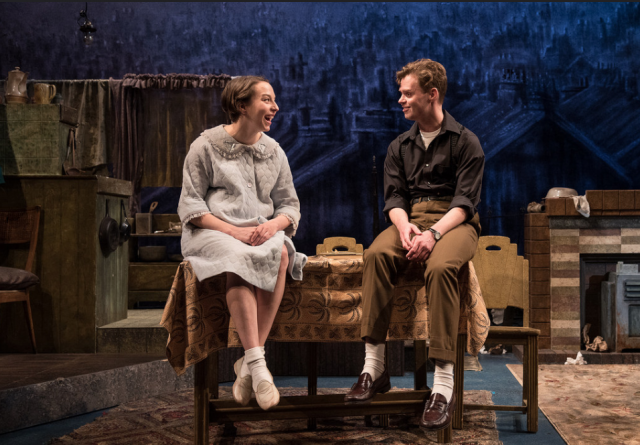
N. C. Hunter’s A DAY BY THE SEA begins and ends in a family garden (photo © 2016 Richard Termine)

The Beckett Theatre at Theatre Row
410 West 42nd St. between Ninth & Tenth Aves.
Tuesday – Sunday through October 30, $57.50
minttheater.org
www.theatrerow.org

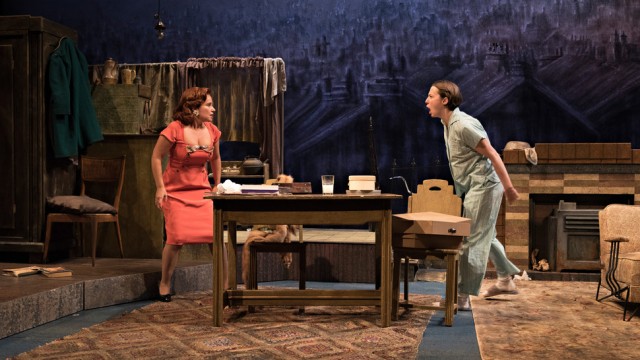
In a previously unpublished author’s note printed in the program for the Mint Theater’s first-ever New York revival of N. C. Hunter’s A Day by the Sea, the playwright discusses middle age, explaining, “It is late, but it is not too late. There is still time, at forty, to do what is still undone. To succeed, to change one’s mind, to shape one’s life anew — there is still time, but there is not very much. The mistakes from which one can recover in youth cannot be made now, truths can no longer be evaded, decisions no longer postponed.” He might have been referring to the characters in the play, but it could just as well have been about this nearly three-hour production itself, directed by Austin Pendleton at the Mint’s new home at the Beckett Theatre at Theatre Row. The first act is dreadfully dull, flat and lifeless, as Hunter’s Chekhovian story about lost opportunities searches for meaning, having trouble as it goes from its own infancy through adolescence and into adulthood. But it fortunately finds itself in the wonderful second and third acts, discovering its purpose in middle age, proving that the mistakes of youth can be overcome and that there is indeed still time left to do what is still undone. A Day by the Sea takes place in Dorset in 1953, as a once-prominent postcolonial family attempts to hang on despite growing problems as the changing world passes it by. Prodigal son Julian Anson (Julian Elfer), a classic stiff-upper-lip Brit who has traveled around the world working for the Foreign Office, has returned home briefly, but he’s not particularly happy about it. His widowed mother, Laura (Jill Tanner), has planned a picnic at the beach, but Julian is more concerned with international politics and a visit by his boss, Humphrey Caldwell (Sean Gormley). “A great character, your mother,” family solicitor William Gregson (Curzon Dobell) says. “Yes . . . I sometimes think she believes I selected my profession solely with the idea of annoying her. Every time I come home it’s the same story. For about ten minutes she seems pleased to see me, and after that she never stops making derogatory remarks about my work and interests,” Julian responds. “My mother, after all, is an educated adult citizen, and if such people are going to turn their backs on the contemporary scene, shuffle out of their responsibilities, content themselves with cultivating their gardens and then flaunt their own ignorance and indifference — what a prospect! What hope for the future!”

(photo © 2016 Richard Termine)

A picnic at the beach leads to discussions of age and what might have been in Mint Theater revival (photo © 2016 Richard Termine)

Serious-minded and judgmental, Julian is not happy that his childhood friend Frances Farrar (Katie Firth), whom his mother took in after her parents died, has been staying at the house with her two young children, Elinor (Kylie McVey) and Toby (Athan Sporek), who are cared for by their governess, Miss Mathieson (Polly McKie). Frances’s first husband was killed in the war, and her second husband recently committed suicide, so Julian, who perhaps was at one time destined to marry Frances himself, displays outward disgust at what he considers scandalous behavior. Also at the estate are David Anson (George Morfogen), Laura’s elderly and infirm brother-in-law, who does a lot of sleeping, and his doctor, Farley (Philip Goodwin), who does a lot of drinking. The first act, in the garden, is just plain dreary, but as the action moves to a seaside picnic for the second act (the lovely sets, a Mint tradition, are by Charles Morgan), things pick up dramatically, as the characters become better developed, the narrative hits its stride, and the actors evolve into their roles, like young adults adapting and adjusting to a more grown-up life.

(photo © 2016 Richard Termine)

A dysfunctional family explores its past, present, and future in A DAY BY THE SEA (photo © 2016 Richard Termine)

The compelling third act brings everything full circle, returning to the garden, where several of the characters must face their demons head-on. By now they all feel like old friends we have watched mature, with their unique quirks, and the set makes more sense, an outer frame within another frame, with a painting on the back wall in the same frame, as if we can now see and understand all of the details in this fascinating portrait. A Day by the Sea premiered in 1953 in London with Sir Ralph Richardson, Irene Worth, Sir Lewis Casson, Dame Sybil Thorndike, and Sir John Gielgud, who also directed the show; it made its Broadway debut two years later with Hume Cronyn and Jessica Tandy, directed by Sir Cedric Hardwicke, and inexplicably hasn’t been seen again until now. The Mint, which specializes in finding old plays that time has seemingly forgot, previously revived Hunter’s A Picture of Autumn in 2013, with Firth, Morfogen, and Tanner among the cast. The always delightful Morfogen first worked with Pendleton in 1960 and was the star of Pendleton’s 1995 play for the Mint, Uncle Bob, which was written specifically for the actor. “Does something happen soon? It’s pretty dull, this,” Morfogen says as David in the first act. Despite that slow start and the overtly Chekhovian familiarity of the story, A Day by the Sea grows into yet another triumph for this splendid company, which is settling in nicely in its new surroundings.

PUBLIC WORKS: TWELFTH NIGHT

public works twelfth night

Central Park
Delacorte Theater
September 2-5, free tickets available day of show, 8:00
publictheater.org

In 2013, the Public Theater initiated its Public Works program, an annual free Shakespeare production at the Delacorte that would bring together the community from all five boroughs in unique ways. “Public Works seeks to engage the people of New York by making them creators and not just spectators,” the mission statement explained. “Public Works deliberately blurs the line between professional artists and community members, creating theater that is not only for the people but by and of the people as well.” This year the Public is presenting a musical adaptation of William Shakespeare’s Twelfth Night, directed by actor, playwright, and director Kwame Kwei-Armah (Elmina’s Kitchen, Let There Be Love) and featuring music and lyrics by singer-songwriter Shaina Taub (Old Hats, Natasha, Pierre & the Great Comet of 1812), with choreography by Lorin Latarro (Waitress, Queen of the Night). The cast includes Nikki M. James as Viola, Andrew Kober as Malvolio, Jose Llana as Orsino, Jacob Ming-Trent as Sir Toby Belch, and Taub as Feste, along with some two hundred men, women, and children from primary participants Brownsville Recreation Center, Casita Maria Center for Arts and Education, Center for Family Life in Sunset Park, DreamYard Project, Fortune Society, Military Resilience Project, Children’s Aid Society, and Domestic Workers United and cameos by COBU, Jambalaya Brass Band, the Love Show, New York Deaf Theatre, Ziranmen Wushu Training Center, and a United States postal carrier. Free tickets, two per person, will be available beginning at 12 noon at the Delacorte and the Public the day of the show as well as via a daily virtual ticketing lottery online.

TICKET ALERT: BROADWAY WEEK SUMMER 2016

(photo by Matthew Murphy, 2015)

THE COLOR PURPLE is one of nineteen shows participating in this summer’s two-for one Broadway Week deal (photo by Matthew Murphy, 2015)

Multiple venues on Broadway
September 5-18, buy one ticket, get one free
Tickets on sale August 18 at 10:30 am
www.nycgo.com/broadwayweek

Tickets go on sale August 18 at 10:30 am for the summer edition of Broadway Week, which runs September 5-18 and offers theater lovers a chance to see new and long-running shows for half-price. Nineteen shows are participating, but tickets will go fast, so don’t hesitate or you’ll lose out on your chance to get two-for-one seats for such musicals as Aladdin, The Lion King, Beautiful, Cats, Chicago, Paramour, Jersey Boys, Kinky Boots, On Your Feet, The Phantom of the Opera, School of Rock, Wicked, and the new Holiday Inn. We highly recommend An American in Paris, The Color Purple, Fiddler on the Roof, Matilda, and Something Rotten! In addition, squeezing in among all those musicals is one play, the outstanding Tony-winning drama The Humans.

PARADISO: CHAPTER 1

(photo by Caleb Sharp)

PARADISO: CHAPTER 1 takes participants through a narrative-based series of futuristic noir escape rooms (photo by Caleb Sharp)

Exact Korea Town location given to ticketholders day of performance
Wednesday – Sunday through November 15, $40-$60
www.paradisoescape.com

Innovative theater impresario Michael Counts takes escape rooms to the next level in the fun and exciting narrative-driven Paradiso: Chapter 1. Counts, the pioneer behind such productions as The Walking Dead Experience tourist attraction, Rossini’s Moses in Egypt for New York City Opera at City Center, Philharmonic 360 for the New York Philharmonic at the Park Avenue Armory, The Ride New York, and Monodramas for NYCO at Lincoln Center, has teamed up with coproducer Jennifer Worthington, previously senior vice president of Jerry Bruckheimer Films, to present Paradiso: Chapter 1, in which groups of up to ten people must make their way through a series of locked rooms in sixty minutes. Inspired by Dante’s Divine Comedy, the three-part fourteenth-century epic poem in which Dante travels into the nine circles of hell and the nine spheres of heaven (Counts previously incorporated the work into So Long I Can’t Remember: A Divine Comedy in a DUMBO warehouse in 2001), Paradiso: Chapter 1 is set in the Virgil Corporation, in a building in Korea Town; the exact address is emailed to ticketholders on the day of the performance. Attendees must work together in unison in order to solve different kinds of games and puzzles in this obstacle course for the mind in which anything can be a critical clue; everyone needs to pay close attention and call out possibilities if you don’t want to fail. In several rooms actors not only drive the futuristic noir narrative, which is fraught with a cinematic type of danger, but also can provide hints if you ask the right questions.

The crew, which keeps it all moving on the fast track — the next group is thirty minutes behind yours — includes lighting designer Ryan O’Gara (Hamilton, Play/Date), art director and associate scenic designer Katie Fleming (Sleep No More, Empire Travel Agency), sound designer and associative creative director Caleb Sharp (Play/Date, The Walking Dead Experience), and production and technical director Gabriel Evansohn (The Tenant, Queen of the Night), with video design by BeSide Digital. The rotating cast consists of Joe Laureiro, Karen Li, Tim Haber, Claire Sanderson, Sarah Jun, Macy Idzakovich, Caitlin Davis, Brian Alford, and Paris Crayton III. Although we had a blast navigating Paradiso: Chapter 1 with strangers — we made it through with seconds to spare — you can make reservations of up to ten people at a time, filling the slots with friends. But you do need to jell pretty quickly in order to solve the puzzles; after the “show,” Counts told us the proportion of groups who make it through to the end, but we’re not telling. (Let’s just say that not everyone survives.) If you give yourself over to it, it’s quite a thrill, a maze in which everything matters, but to say any more would start giving things away, and Paradiso: Chapter 1 is best discovered on your own. And yes, as the title suggests, there will be more chapters to come. We can’t wait.

SHAKESPEARE IN THE PARK: TROILUS AND CRESSIDA

(photo by Joan Marcus)

Pandarus (John Glover) brings together Troilus (Andrew Burnap) and Cressida (Ismenia Mendes) in new Shakespeare in the Park production (photo by Joan Marcus)

Central Park
Delacorte Theater
Through August 14, free, 8:00
publictheater.org

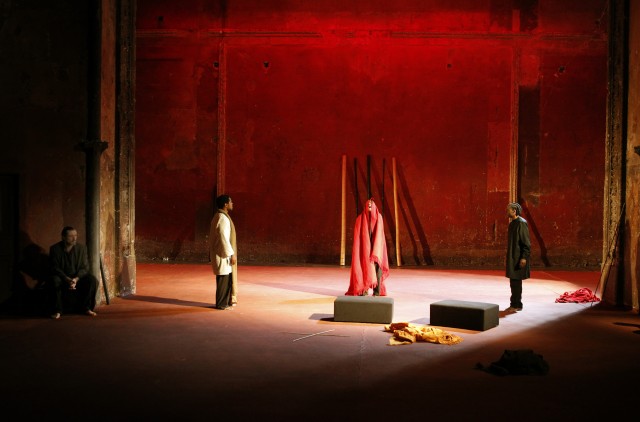
For the third time in the fifty-six-year history of Shakespeare in the Park, the Public Theater is taking on the seldom-performed, less-than-popular Troilus and Cressida at the Delacorte. One of William Shakespeare’s so-called problem plays, the work has fairly obvious issues, including convoluted story lines, subplots that never get resolved or have bleak conclusions, and a narrative that uneasily shifts between comedy, tragedy, history, and romance. In 1965, Public Theater founder Joseph Papp directed a production starring Richard Jordan as Troilus, Flora Elkins as Cressida, and James Earl Jones as Ajax, and thirty years later Mark Wing-Davey helmed a version with Neal Huff as Troilus, Stephen Spinella as Pandarus and Calchas, Elizabeth Marvel as Cressida, Catherine Kellner as Cassandra, and Tim Blake Nelson as Thersites. Shakespeare director extraordinaire Daniel Sullivan is firmly in charge of this latest adaptation, set in modern times, complete with contemporary military weapons and clothing, pounding music by Dan Moses Schreier, and blazing strobe lights by Robert Wierzel. David Zinn’s stark red set features a movable wall of doors in the back, small caged rooms at either side, and detritus composed of old chairs and other items at front stage left and right. (Zinn also designed the cool costumes.) The great John Glover begins and ends the play as Pandarus, the hobbled uncle of the lovely Cressida (Ismenia Mendes), daughter of Trojan priest Calchas (Miguel Perez), who has defected to the Greeks. Pandarus serves as a kind of matchmaker for his niece, who is coveted by Troilus (Andrew Burnap), son of Priam (Perez), king of Troy. (Yes, the word “pander” came from the character Pandarus.) Troilus and Cressida seal their true love with a night of passion, but the next day she discovers that she is to be sent to the Greeks, and back to her traitorous father, in exchange for a Trojan captive, Antenor (Sanjit De Silva). At the Greek camp she is wooed by Diomedes (Zach Appelman) while trying to remain faithful to her beloved Troilus. Meanwhile, after seven years of the Trojan War, both sides seek one-on-one combat, with first dimwitted warrior Ajax (Alex Breaux) and then hunky fighter Achilles (Louis Cancelmi), who has a thing for the effeminate Patroclus (Tom Pecinka), taking on one of Troilus’s brothers, the brave and true Hector (Bill Heck). Watching over it all are the leaders of the Greeks, general Agamemnon (John Douglas Thompson), elderly mentor Nestor (Edward James Hyland), the cuckolded Menelaus, Agamemenon’s brother (Forrest Malloy), and sly, clever adviser Ulysses (Corey Stoll). Lust, jealousy, pride, and power drive the mishmash story to its violent finale.

(photo by Joan Marcus)

Ulysses (Corey Stoll) tries to explain things to the none-too-bright Ajax (Alex Breaux) in TROILUS AND CRESSIDA at the Delacorte (photo by Joan Marcus)

Inspired by Chaucer’s poem “Troilus and Criseyde” and Homer’s The Iliad, Shakespeare’s play, which scholars believe was a late, unpaginated addition to the first folio, is all over the place, unable to find a central focus. But six-time Tony nominee (and one-time winner) Sullivan (The Merchant of Venice, Proof) manages to keep a precarious balance among the kitchen-sink events while also making it relevant to today’s ongoing wars in the Middle East, helped by fine performances by Burnap, who just graduated from the Yale School of Drama; Mendes (The Wayside Motor Inn, Family Furniture), who plays Cressida with a tentative, nuanced charm; Breaux (Red Speedo, Much Ado About Nothing), who brings a humorous doofiness to Ajax; Max Casella (The Lion King, Timon of Athens), who relishes his role as Thersites, the nasty fool, who declares, “The common curse of mankind, folly and ignorance”; Heck (The Merchant of Venice, Night Is a Room) as the honorable warrior Hector; and most especially Delacorte veteran, five-time Emmy nominee, and Tony winner Glover (Much Ado About Nothing, Love! Valour! Compassion!) as Pandarus, who immediately has the audience eating out of the palms of his very able hands. Troilus and Cressida might not be one of Shakespeare’s best works, but Sullivan and his excellent cast have turned it into a very welcome and entertaining production, despite its many flaws.

THE MUSHROOM CURE

Adam Strauss shares his quest for magic mushrooms to beat his OCD in one-man show (photo by Dixie Sheridan)

Adam Strauss shares his quest for magic mushrooms to cure his OCD in one-man show (photo by Dixie Sheridan)

Cherry Lane Studio Theatre
38 Commerce St.
Tuesday – Sunday through August 13, $19-$26
212-989-2020
themushroomcure.com
www.cherrylanetheatre.org

A hit at the 2014 Fringe Festivals in Edinburgh and New York, Adam Strauss’s cute and charming one-man show about his real-life battle with OCD, The Mushroom Cure, has been extended at the Cherry Lane Studio, in a streamlined, finished version, pared down to a swift eighty-five minutes from its original nearly two-hour length. In the play, Strauss shares the intimate details of his struggle with obsessive compulsive disorder, but he explains that he is not a hand washer, a stove checker, a counter, or any of the more well known types of OCD sufferers. Instead, Strauss has trouble making decisions, whether selecting an MP3 player, figuring out which shirt to wear, or choosing which side of the street to walk down. “Pick the right one pick the right one pick the right one pick the right one!” he says with both frustration and determination. “Go! Go! Go! No! No! No! Go no go no go no go!” He’s tried yoga, meditation, multiple medications, psychotherapy, CBT, and other treatments, but none of them have worked. He then becomes intrigued by a Journal of Clinical Psychiatry report about a study that has shown that in some cases a single does of psychedelic mushrooms can actually cure a person’s OCD. So he sets out on a mission to get his hands on the magic fungi and rid himself of this dread mental illness. In the meantime, Strauss, who is haunted by the breakup with his previous girlfriend, Annie, becomes interested in a Kansas tourist named Grace who is in the city for a psychology conference. But the more they are drawn to each other, the more his OCD threatens to get in the way.

the mushroom cure

Written by Strauss, a Brooklyn-based stand-up comic, and directed by Jonathan Libman (The Bench, Shall I Fetch the Apparatus?), The Mushroom Cure is an intimate portrait of mental illness, romance, and dick slapping. Strauss, who walks around the nearly empty stage, occasionally sitting in a chair and taking a drink of water from several glasses on a small table, does such an excellent job of relating the character of Grace that afterward you might forget that this was a one-man show, with no actress playing her. Strauss (The Uncertainty Principle) also plays his drug dealer, Slo, as well as his goofball psychiatrist, who calls him “Guy.” Strauss sometimes moves too quickly between self-effacement and self-approval, and the lighting can get a little confusing, particularly when it goes completely off and the audience wonders whether to clap or not. But most of all The Mushroom Cure will delight you and have you laughing at the ridiculousness of it all while also making you think about your own possible OCD, or that of a loved one. “Some of you didn’t think you had OCD when you walked in here, but now you’re like, wait, did this show give me OCD?” It might also have you seeking out magic mushrooms. All profits from the Cherry Lane run will go to the Multidisciplinary Association for Psychedelic Studies, which conducted the study that set Strauss off on his quest, which he generously shares with the rest of us.

THE SEEING PLACE THEATER: GETTING OUT / RHINOCEROS

The Seeing Place Theater is presenting RHINOCEROS, above, with Marsha Normans GETTING OUT at the Lynn Redgrave Theater

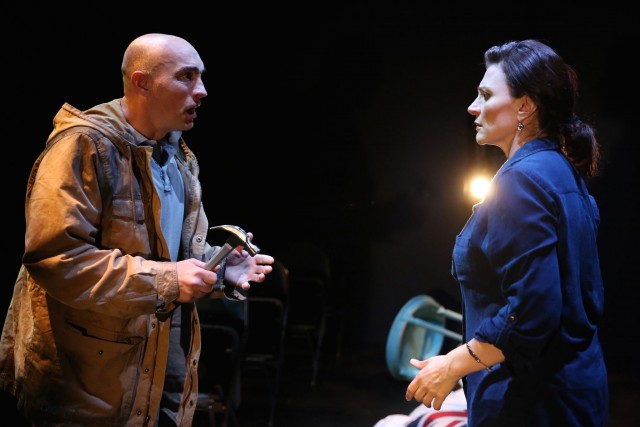
The Seeing Place Theater is presenting Eugène Ionesco’s RHINOCEROS, above, in repertory with Marsha Norman’s GETTING OUT at the Lynn Redgrave Theater

The Seeing Place @ the Lynn Redgrave Theater
45 Bleecker St. at Lafayette St.
Through August 7, $15
www.seeingplacetheater.com

The actor-driven Seeing Place Theater, whose name is the English translation of the Greek word theatron, continues its presentation of two very different works through this weekend as part of its “But Who Am I, Really” season. The company’s seventh season consists of Pulitzer Prize winner Marsha Norman’s Louisville-set debut play, 1978’s Getting Out, and Romanian-French absurdist Eugène Ionesco’s 1959 classic, Rhinoceros. The former follows a Kentucky woman trying to put her life back together after being released from prison, while the latter deals with a French villager recovering from a hangover as rhinos start stampeding all around him. Getting Out is directed by TSP founding managing director Erin Cronican, who also stars as Arlene, while Rhinoceros is directed by TSP founding artistic director Brandon Walker, who plays Berenger. “The more we’ve explored these plays as a pair the more we’ve noticed the profound amount of conformity society demands of us in order to keep us ‘civilized,’” Walker explained in a statement. “In both plays our central protagonist is faced with a fateful opportunity to step into a new reality, but who really makes this choice — the individual or society?” TSP has previously staged productions of such works as Macbeth, Hamlet, Othello, Martin McDonagh’s The Pillowman, Johnna Adams’s Gidion’s Knot, Lee Blessing’s Two Rooms, and Harold Pinter’s The Lover.