this week in theater

TURN ME LOOSE

Dick Gregory (Joe Morton) has been pointing his finger at Americas ailments for more than fifty years (photo by Monique Carboni)

Dick Gregory (Joe Morton) has been pointing his finger at America’s ailments for more than fifty years (photo by Monique Carboni)

Westside Theatre
407 West 43rd St. between Ninth & Tenth Aves.
Tuesday – Sunday through July 17, $79-$89
www.turnmelooseplay.com

“Now, I know that many of you folks out there do read the paper. But I wish you would read all the papers. You just read some of the papers — where they callin’ me the Negro Lenny Bruce. You gotta’ read those Congo papers where they callin’ Lenny Bruce — the white Dick Gregory!” Dick Gregory (Joe Morton) declares near the beginning of Turn Me Loose, Gretchen Law’s smart, essential play about the life and career of the comedian, activist, and self-described wellness guru born Richard Claxton Gregory in St. Louis in 1932. The Emmy-winning, Tony-nominated Morton is riveting as Gregory, going back and forth between club gigs and interviews from the 1960s to the present day, when he addresses the audience directly as an old man, looking back at his failures and accomplishments. (Fortunately, the play avoids his numerous forays into conspiracy theories.) Gregory talks about his life with his wife and children, his goals for financial success and social change, and his friendships with the Rev. Dr. Martin Luther King, Jr., and Medgar Evers. In fact, the title is taken from Evers’s final words: “Turn me loose.” As Morton ambles across Chris Barreca’s stripped-down set, consisting of a microphone, table, stool and phone, the play gets to the heart of what Gregory was and is about. “I’m out to find the truth. Expose the tricks,” he says. Discussing the ongoing battles between black and white, Muslims and Christians, Jews and Palestinians, and liberals and conservatives, he admonishes, “When you accept injustice, you become injustice. When you coexist with filth? You become filth. It’s all of those myths you’re buyin’ into.” Other gems include “Bein’ white ain’t got nothin’ to do with color,” “My tongue . . . was my switchblade. My humor was my sword,” “I believe that information is salvation,” and “When I grew up in St. Louis, I thought that poverty was the worst disease on the earth. I soon learned that racism is the worst disease on the face of the earth.”

(photo by Monique Carboni)

Joe Morton is riveting as comedian, activist, and wellness guru Dick Gregory (photo by Monique Carboni)

Law (The Adventures of a Black Girl in Search of Her God, Al Sharpton for President) and director John Gould Rubin (Hedda Gabler, Playing with Fire) zero in on the key moments of Gregory’s career: being invited by Hugh Hefner to perform at the Playboy Club in Chicago in 1961, where he faced a harsh crowd of white southerners, and demanding that if Jack Paar wanted him to do stand-up on the Tonight show, he had to be allowed to sit on the couch and speak with Paar afterward, something no black entertainer had done before. He also makes brilliant use of the word “n-gger.” He celebrates the way Mark Twain employed it (“Mark Twain was so brilliant! He gave a n-gger a name! ‘N-gger Jim.’ And then white folks had to read about a black man with a name. A person.”) and confronts the audience with it. After being heckled at the Playboy Club, he turns to the Westside Theatre audience and says, “How about you all out there? Anyone out there care to stand up and call me a n-gger? Come on now. Don’t miss out on a great opportunity. Stand up! Come on. Stand up! Go ahead. Get on up. Get on up and call me — a n-gger! It’s only a word.” Of course, at that moment you could hear a pin drop, aside from some nervous laughter. (The night I went, the crowd was about half white and half black.) Morton, who has starred in such films as The Brother from Another Planet and Lone Star, such television series as Scandal and Eureka, and the Broadway plays Hair, Art, and Raisin, does not go into full impersonation mode but effectively captures Gregory’s unique spirit in his every movement. However, Turn Me Loose is not quite a one-man show; John Carlin, who is white, also appears in bit parts as various hecklers and a comic. In addition, coproducer John Legend contributes an original song. At one point, Gregory declares, “Nobody makes it out alive when they make a real change that has to do with race. Nobody!” As he often has done over the course of his life, Gregory defies convention yet again.

JACK FERVER: I WANT YOU TO WANT ME

Jack Ferver

Jack Ferver will present “horror play/goth ballet” at the Kitchen as part of ADI/NYC Incubator residency program

Who: Jack Ferver, Carling Talcott-Steenstra, Barton Cowperthwaite, Reid Bartelme
What: ADI/NYC Incubator residency program
Where: The Kitchen, 519 West 19th St. between Tenth & Eleventh Aves., 855-263-2623
When: June 30 – July 2, $25
Why: Wait, what! You still haven’t gotten tickets to see the inimitable Jack Ferver’s latest show, I Want You to Want Me? Are you out of your mind? We’ve been telling you for years about Ferver, a genuine New York City treasure who is a storytelling marvel, mixing humor and melodrama, pathos and bathos, fiction and nonfiction, fantasy and reality in works that examine the state of our fame-obsessed world through a wacky and wild pop-culture sense and sensibility. Part of the American Dance Institute’s NYC Incubator program, I Want You to Want Me runs June 30 through July 2 at the Kitchen and features, alongside writer, choreographer, and star Ferver, Carling Talcott-Steenstra as Ann Erica Rose, Barton Cowperthwaite as Bartholomew, and longtime Ferver collaborator and costume designer Reid Bartelme as Reid in what is being billed as a “horror play/goth ballet.” Ferver, whose previous works include Chambre, Rumble Ghost, and All of a Sudden, explains, “I thought I would try to make something for everyone. You know, like ballet or a good subscription audience kind of play. I consider myself a populist, but some people really hate my work. They even hate me they hate my work so much. So I thought: ‘Well, why don’t I make a really pretty ballet or a play about a straight couple and their issues?’ So that’s what I’m going to do. Oh, I also just wanted to say that not everyone is going to make it. I don’t mean make it to the show. I mean make it out of the show alive.” The Incubator program continues in September with Zvi Dance and Steven Reker / Open House and in October with Morgan Thorson and Kate Weare Company.

SHAKESPEARE IN THE PARK: THE TAMING OF THE SHREW

(photo by Joan Marcus)

Katerina (Cush Jumbo) is not about to be tamed by men in all-female production of THE TAMING OF THE SHREW in Central Park (photo by Joan Marcus)

Central Park
Delacorte Theater
Through June 26, free, 8:00
publictheater.org

William Shakespeare, protofeminist? Well, not exactly. But in the hands of Tony-nominated director Phyllida Lloyd, Bard fans are offered a new way to look at Shakespeare’s troubling play about women’s submission at the hands of devious men. Lloyd, who previously helmed all-woman versions of Julius Caesar and Henry IV at St. Ann’s (as well as Mamma Mia! on Broadway), now takes the same route with The Taming of the Shrew, continuing at the Public’s Delacorte Theater in Central Park through June 26. Mark Thompson’s set and costumes create a kind of traveling circus atmosphere as a Donald Trump sound-alike introduces beauty-pageant contestants, instantly demeaning women in multiple ways. The women, who come in all the shapes and sizes that the presumptive Republican nominee for president would clearly not approve of, sing and dance, wearing giant smiles on their faces. But Katherina (Cush Jumbo), whose sister is the beautiful, ditzy blonde Bianca (Gayle Rankin), wants no part of this sideshow, demanding to make her own decisions and refusing to kowtow to any man.

(photo by Joan Marcus)

The tough-talking Petruchio (Janet McTeer) is ready for a challenge in THE TAMING OF THE SHREW (photo by Joan Marcus)

Her words are so harsh and brutal that the men in Padua treat her as a kind of laughingstock, wanting nothing to do with her. But when her wealthy father, Baptista (LaTanya Richardson Jackson), declares that until Katherina, his eldest daughter, is wed, his younger daughter, Bianca, an object of sexual desire among all the men, is off limits. So several of Bianca’s suitors, including Gremio (Judy Gold), Lucentio (Rosa Gilmore), and Hortensio (Donna Lynne Champlin), get involved in an elaborate scheme of lies, deception, and mistaken identity to convince Petruchio (Janet McTeer) to wed and bed the untamable Katherina so Bianca becomes fair game. But Kate is not about to fall for their tricks, until she has little choice, resulting in some very difficult scenes as Petruchio essentially starves and tortures Kate to force her to become his obedient sex slave. But Lloyd has a surprise in store that provides a conclusion that might not sit well with either Shakespeare or Trump.

(photo by Joan Marcus)

A beauty pageant sets the stage for a unique battle of the sexes at the Delacorte Theater (photo by Joan Marcus)

The cast, which also features Adrienne C. Moore as Tranio, Teresa Avia Lim as Biondello, Stacey Sergeant as Grumio, Candy Buckley as Vincentio, Leenya Rideout as a wealthy widow, and Morgan Everitt, Anne L. Nathan, Pearl Rhein, Jackie Sanders, and Natalie Woolams-Torres, has an absolute ball, seemingly enjoying every second of the show. Jumbo (Josephine and I, The River) stomps and shrieks around with fiery glee as Kate, while Tony-winning, Oscar-nominated British actress McTeer (God of Carnage, Tumbleweeds) channels a dirtbag Crocodile Dundee as Petruchio. Gold (The Judy Show — My Life as a Sitcom, 25 Questions for a Jewish Mother) stands tall as Gremio, replacing what she calls a boring speech with a brief stand-up routine that, the night we attended, referenced a raccoon that was sneaking around backstage. And Moore (Black Cindy on Orange Is the New Black) is delightful as Tranio, firmly entrenched right in the middle of all the shenanigans. Lloyd infuses the festivities — which actually do nearly fall apart during the wedding scenes and when Petruchio is “taming” Kate — with a feminist energy that nearly explodes to songs by Pat Benatar and Joan Jett. Of course, this production of an outdated, sexist play — which inspired the Cole Porter musical Kiss Me, Kate — comes along at an opportune moment in American history, as Hillary Clinton has a legitimate chance to become the first woman U.S. president, violence and discrimination against the LGBTQ community remain prevalent, and even discussions over bathroom usage have resulted in fear and loathing. In the program, Public Theater artistic director Oskar Eustis notes that Shrew “is the only major Shakespeare play which I have never produced or directed. . . . The reason is simple: I have never been able to get behind the central action of the play, which is, well, taming a woman. . . . But then I listened to Phyllida Lloyd.” We are all very glad that he did.

SONG OF MYSELF: THE WORDS OF WALT WHITMAN

One-man show honors the legacy of Walt Whitman

One-man show honors the legacy of Walt Whitman

Who: Matthew Aughenbaugh, Michael Ruby, Graham Fawcett
What: Immersive theater piece
Where: The Old Stone House, Washington Park & JJ Byrne Playground, between Fourth & Fifth Aves. and Third & Fourth Sts., Park Slope, 718-768-3195
When: Friday, June 24, $15-$20, 8:00
Why: On June 24, Matthew Aughenbaugh will perform his one-man show, Song of Myself: The Words of Walt Whitman, at the Old Stone House in Park Slope, in the borough where the mighty poet was raised. “Crowds of men and women attired in the usual costumes, how curious you are to me! / On the ferry-boats the hundreds and hundreds that cross, returning home, are more curious to me than you suppose, / And you that shall cross from shore to shore years hence are more to me, and more in my meditations, than you might suppose,” Whitman wrote in 1856’s “Crossing Brooklyn Ferry.” Aughenbaugh, a Shakespearean actor who has also done musical theater, noted in a statement, “I was inspired to create a theater piece using only original text as a way to share my passion for our greatest American poet.” The immersive show, presented by London’s Upper Wimpole Street Literary Salon, will be followed by a Q&A with Aughenbaugh and Brooklyn poet Michael Ruby, moderated by British broadcaster, teacher, and translator Graham Fawcett. Tickets are $15 in advance and $20 at the door and come with wine and refreshments.

THE GREAT AMERICAN CASKET COMPANY

(photo by twi-ny/mdr)

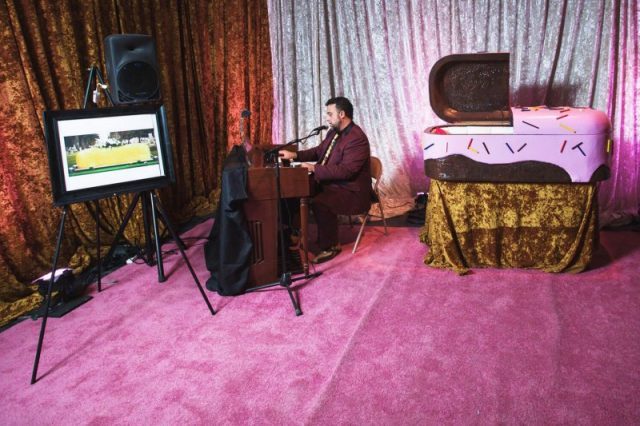
Unique production in Green-Wood Cemetery includes jugglers, a skeleton band, and lots of fire (photo by twi-ny/mdr)

Green-Wood Cemetery
Fifth Ave. and 25th St., Brooklyn
Thursday – Sunday through June 26, $75, 7:00
www.green-wood.com/gacc

In The Great American Casket Company, BREAD Arts Collective (Rise & Fall) takes full advantage of the opportunity to stage the first-ever site-specific multiperformance theatrical production in historic Green-Wood Cemetery. Every Thursday through Sunday in June, up to seventy-five “clients” come to Green-Wood Cemetery in Brooklyn to hear the extensive, immersive sales pitch from “employees” of the Great American Casket Co. The evening kicks off with heavenly standards by Coriander Suede and the Tombstones (Owen Weaver, Lizzie Hagstedt, Eric Powell Holm, and composer and musical director Andrew Lynch), including “My Blue Heaven” and “Pennies from Heaven.” (Feel free to dance if you’d like.) The audience is introduced to seven characters identified only by number (in ascending order from one to seven: Mélissa Smith, Kelly Klein, Gregory G. Schott, Kate Gunther, Andy Talen, Ashley Winkfield, and Ben Lewis) who are awaiting the arrival of the President (Toni Ann Denoble), a heavily made-up steampunk leader pushing the company’s exclusive afterlife technology.

(photo by twi-ny/mdr)

Employees of the Great American Casket Co. push their exclusive afterlife technology in immersive show (photo by twi-ny/mdr)

As the sun sets over the spectacular grounds, the clients are guided through various parts of the cemetery, encountering puppets (courtesy of puppeteers Matthew A. Leabo, Winkfield, and Rachael Shane, who is also an aerialist), jugglers, ghostly guitarists, and other entertainments. The show drags significantly in the middle when a subplot regarding one Agnes Butterfield (Lyndsey Anderson) begins, but it takes off again toward a sparkling and otherworldly conclusion. Written by Anderson and Lewis, charmingly directed by Katie Melby, and featuring costumes by Elizabeth May that range from skeletal to clownish to devilish to angelic, The Great American Casket Company is, above all else, a great way to experience Green-Wood Cemetery, which is the resting place of such “famous residents” as Jean-Michel Basquiat, Boss Tweed, Leonard Bernstein, Horace Greeley, Louis Comfort Tiffany, Charles Ebbets, and Rev. Henry Ward Beecher. Not all of the knots are tied at the end, and several elements will leave you scratching your head, but if you “buy the plot,” as the opening number says with clever double meaning, you’ll have a grand old time. The show concludes with a reception with members of the cast and crew, hosted by Brooklyn-based alternative event planners Modern Rebel, with free popcorn, s’mores, and Pixy Stix, wine and beer (with suggested donation), and a photo booth.

RADIANT VERMIN

(photo by Carol Rosegg)

Ollie (Sean Michael Verey) is suspicious of a deal the mysterious Miss Dee (Debra Baker) offers him and his wife, Jill (Scarlett Alice Johnson), in Philip Ridley’s RADIANT VERMIN (photo by Carol Rosegg)

BRITS OFF BROADWAY: RADIANT VERMIN
59E59 Theaters
59 East 59th St. between Park & Madison Aves.
Tuesday – Sunday through July 3, $35
212-279-4200
www.59e59.org

How far would you go to achieve your suburban dreams? British playwright Philip Ridley reveals just how much one young couple is ready to risk in the unapologetically delicious wicked black comedy Radiant Vermin. At first, Jillian and Oliver Swift (Scarlett Alice Johnson and Sean Michael Verey) are suspicious of the official government letter they receive from Miss Dee (Debra Baker) offering them a free house in a questionable neighborhood. Ollie thinks it’s some kind of reality television show gag. “Let’s make fun of the underclass desperate to get on the property ladder,” he says. But Jill quickly changes her mind after verifying that the offer is indeed real. “Ollie! If you do not agree to see this house then I will get very upset,” she declares to her husband. “And if I get very upset, our unborn baby will get very upset. And you remember what that psychiatrist on the telly said about pregnancy shaping the rest of a child’s life. Do you want our child to grow into someone who machine guns his classmates?” When they meet Miss Dee at the house, they overlook her strange, intimate knowledge of their life and sign a contract, taking ownership of the home; the only catch is that the house needs a lot of work, which they’ll need to take care of themselves. Everything else, including all taxes and utilities, have been paid. “You’re a marriage made in heaven,” Miss Dee proclaims, one of many references to heaven, hell, angels, reincarnation, and God. But when Jill and Ollie find out just what they have to do in order to renovate their new house, they are initially shocked but quickly go to the extreme lengths required to provide a happy home for them and their child. “What would you prefer, Jill? Eh?” Ollie asks. “A new kitchen? Or a dead body in the old one?”

Jill (Scarlett Alice Johnson) and Ollie (Sean Michael Verey) envision a much rosier future in wickedly funny Philip Ridley play (photo by Carol Rosegg)

Jill (Scarlett Alice Johnson) and Ollie (Sean Michael Verey) envision a much rosier future in wickedly funny Philip Ridley play (photo by Carol Rosegg)

Staging is always unusual in Ridley’s plays, and Radiant Vermin is no different. In the New Group’s 2015 revival of Mercury Fur at the Signature, the Romulus Linney Courtyard Theatre was turned into a postapocalyptic urban battleground. In the fierce 2012 love story Tender Napalm at 59E59, the action took place in a narrow space between the two rows of audience members on either side. And the back-to-back one-person shows Tonight with Donny Stixx and Dark Vanilla Jungle at HERE this past winter featured a cagelike area that entrapped the main characters. William Reynolds’s set for Radiant Vermin is a spare, almost blindingly white makeshift floor and backdrop, a little slice of heaven, with no props; three fluorescent lights hang from above, illuminating the sharp colors of the costumes, Jill in yellow, Ollie in blue, and Miss Dee, of course, in red. David Mercatali, who has directed six Ridley world premieres, keeps it as basic as possible as Jill and Ollie tell their crazy story directly to the audience. Johnson (EastEnders, Nightshift) and Verey (Tonight with Donny Stixx, Moonfleece), who starred together in Chris Reddy’s BBC series Pramface, playing teenagers who are going to have a baby, share a delightful familiarity with each other that is infectious, bringing the fabulous absurdities of Jill and Ollie’s situation down to earth, making it all natural and believable. And Baker (Mercury Fur, Vincent River) is a steadying force as the cool and calm Miss Dee, who is fully prepared for any and all eventualities. Ridley, who is also a children’s book writer, filmmaker, poet, and visual artist, was inspired to write the play after moving from his longtime home in Bethnal Green, which led to his questioning rampant consumerism and the housing crisis. As Jill and Ollie sing in the play, “Make it bigger / make it brighter / make it faster / make it louder / make it stand out in the crowdier / for the world to adore / and when you’ve done all that — / oh, hell, I’ll still want more. / Hell, I still want more.” Part of the annual Brits Off Broadway festival at 59E59, which also includes Alan Ayckbourn’s Confusions and Hero’s Welcome, Radiant Vermin is another thrilling triumph from one of England’s most talented voices.

SHINING CITY

(photo by Carol Rosegg)

Recently widowed John (Matthew Broderick) shares his haunting tale with his therapist, Ian (Billy Carter), in Irish Rep revival of Conor McPherson’s SHINING CITY (photo by Carol Rosegg)

Irish Repertory Theatre
132 West 22nd St. between Sixth & Seventh Aves.
Tuesday – Sunday through July 3, $50
212-727-2737
www.irishrep.org

The Irish Rep has inaugurated its newly renovated space in its longtime Chelsea home with a play very much about, appropriately enough, home. Back in the Stanwick Building on West Twenty-Second St. following a season at the DR2 Theatre in Union Square, the Irish Rep is currently presenting a thrilling version of Conor McPherson’s Tony-nominated Shining City, a haunting psychological tale of dislocation, lack of communication, guilt, and the search for one’s place in the world. Matthew Broderick, in full Irish brogue, gives a thoroughly impressive performance as John, a fifty-four-year-old Dublin catering-supply rep who is seeing a therapist for the first time because he claims to have seen the ghost of his recently deceased wife in their house. Frightened and confused, John has temporarily moved into a bed and breakfast, but his disconnection began when his wife was still alive. “I started pretending I had to stay down the country, for work, you know, overnight, but I was really just staying in places so that I didn’t have to deal with the terrible pressure of going home, you know?” he tells his therapist, Ian (Billy Carter), a former priest who has left the house of God for a cozy third-floor office. Ian, meanwhile, is reconsidering his future with his wife, Neasa (Lisa Dwan), and their baby, who live with Ian’s brother. “I have nowhere to fucking go!” she screams at him when he talks about leaving her. “It’s their house! What right do I have to stay there if you’re not there?” Later, Ian meets Laurence (James Russell), a destitute man who has taken to the streets to try to survive after being kicked out of his cousin’s flat. “I don’t even want to go back, though, but I need an address,” a haggard Laurence tells Ian. Nearly everyone the four characters reference in their various stories relate to the concept of home, from a builder and a hotel executive to the B&B owners and women in a house of prostitution. Over the course of one hundred minutes, the four lost souls examine their loneliness and try to find a way out, to reconnect.

Shining City — which was nominated for a Best Play Tony for its Broadway debut in 2006, directed by Goodman Theatre head Robert Falls and starring Oliver Platt as John, Martha Plimpton as Neasa, Peter Scanavino as Laurence, and a Tony-nominated Brían F. O’Byrne as Ian — is a brilliantly written work, an intricate and endlessly inventive investigation into the hearts and minds of John and Ian, who are mirror images of each other; even their names are the same, as Ian is the Scottish version of John. John, a traveling salesman, often speaks in long monologues filled with the adjective “fucking” and the rhetorical phrase “you know” — the latter is spoken more than two hundred times throughout the play, and not just by John — during which Ian merely nods or makes quick comments; one entire scene is essentially a riveting soliloquy delivered exquisitely by Broderick in a breathless tour de force. Carter (McPherson’s Port Authority and The Weir at the Irish Rep), Beckett specialist Dwan (Not I / Footfalls / Rockaby), Russell (Port Authority, Juno and the Paycock), and two-time Tony winner Broderick (Torch Song Trilogy, Brighton Beach Memoirs) beautifully perform McPherson’s fragmented dialogue, maintaining its graceful poetic rhythm under the smooth direction of Ciarán O’Reilly (The Weir, The Hairy Ape). Charlie Corcoran’s therapist-office set subtly evokes the concept of home as well, with several boxes strewn around that hint at either someone moving in or moving out, and John settles in a little more with each visit even as Ian feels more uncomfortable. Shining City is an impeccable, haunting piece of theater and a deserving drama to welcome the Irish Rep, well, back home.