this week in theater

HERE I AM: A TRANS RABBI SHARES HER STORY IN BECOMING EVE

Tommy Dorfman stars as a trans rabbi trying to come out to her father in Becoming Eve (photo by Matthew Murphy)

BECOMING EVE
Abrons Arts Center Playhouse Theater
466 Grand St. at Pitt St.
Through April 27, $29.88-$130
212-598-0400
www.nytw.org
www.abronsartscenter.org

On the second day of Rosh Hashanah, the Jewish New Year, synagogues around the world read and discuss Genesis 22:1–24, the story of Abraham’s binding of his son Isaac on Mount Sinai, preparing him as a human sacrifice until an angel of G-d intervenes, replacing Isaac with a ram at the last moment. Known as the Akedah, the passage has been hotly debated for millennia by religious leaders, scholars, and laypeople, exploring issues of faith, obedience, familial responsibility, and the value of human life.

One line of thought considers whether Abraham, and perhaps Isaac as well, is aware that it is a test and that Abraham believed that G-d never planned on having him go ahead with the slaughter of the son who was born to him and his wife Sarah in their old age.

In Emil Weinstein’s debut play, the searing Becoming Eve, another interpretation comes to the fore: whether what happened on Mount Sinai was actually a transformation of Isaac’s soul from female to male, as argued by Rabbi Yechiel Michel of Zloczow in the seventeenth century.

Based on Abby Chava Stein’s 2019 memoir, Becoming Eve: My Journey from Ultra-Orthodox Rabbi to Transgender Woman, the lightly fictionalized play, continuing at Abrons Arts Center through April 27, focuses on Chava (Tommy Dorfman), a trans rabbi who has not come out yet to her deeply religious family, whose ancestors include the Baal Shem Tov, the eighteenth-century founder of Hasidism.

Chava has been spotted wearing a dress in midtown Manhattan by a member of her parents’ tight-knit Williamsburg community, and, fearing that the observer will reveal her secret, she decides to tell her father, Tati (Richard Schiff), and mother, Mami (Judy Kuhn), enlisting the support of Jonah (Brandon Uranowitz), a rabbi who has recently started a progressive shul on the Upper West Side.

Chava is afraid her parents won’t understand, explaining to Jonah, “They live in a hermetically sealed nineteenth-century village that happens to be in Brooklyn. They don’t know the Internet. They don’t know Superman.”

Jonah is excited to learn of Reb. Michela’s interpretation, proclaiming, “That story has always confounded me. This essential paradox, at the very start of our religion, G-d telling Abraham to sacrifice Isaac, his beloved son, when G-d has just promised Abraham that Isaac will father generations! How can both be true? But the whole story is about both-ness, right? This essential both-ness that Abraham has to contend with. But it makes so much sense with the Michela commentary. It cracks the whole thing open. The sacrifice is actually a transformation, which is so essentially Jewish. We’re the people of transition. Of exodus, of leaving and starting over, of walking through doorways. And doorways are fundamentally about liminality, right? The in-between space between two extremes! Between borders and genders and sexualities and — This may have cracked open my Rosh Hashanah speech.”

Tati (Richard Schiff) reads Scripture next to a puppet of his son in powerful new play (photo by Matthew Murphy)

Chava is disappointed when only Tati shows up, and she hesitates in sharing her truth. As she delays, the narrative shifts back and forth between the present and the past, depicted in poignant memory scenes from Chava’s childhood in which she is portrayed by a series of Bunraku-style puppets that get bigger and older as Chava does; they’re operated by Justin Perkins and Emma Wiseman, dressed in all black, with Dorfman standing with them, speaking the dialogue in darkness.

The vignettes begin with Chava at the age of two and a half, when Tati, thrilled to finally have a son after five daughters, wants to bring his boy to shul for the first time and Mami disagrees. At six, Chava is asking Tati whether doctors will someday be able to perform full-body transplants. At thirteen, Chava is taught by Tati how to put on tefillin; he explains, “The tefillin binds us, father and son, together to the end of time,” recalling the Akedah. At sixteen, Chava grows close with a curious schoolmate, Chesky (Rad Pereira). And at nineteen, Chava is introduced to Fraidy (Tedra Millan), who has been chosen to be his bride.

Meanwhile, in the present day, Chava, Jonah, and Tati have intriguing conversations about family and the Torah. Tati is confused when Jonah offers, “I left Judaism completely for a few years, actually, and then I found my way back, through transdenominational Renewal Judaism, which takes a lot of inspiration from the Hasidic masters.” Tati doesn’t understand why Chava is refusing to attend her brother’s upcoming wedding. When Jonah mentions that Steven Spielberg helped fund the local Yiddish Book Center, Tati claims to have never heard of him. Chava reminds her father that, as a teenager, he had snuck out of his house to see Jaws, an event that he is ashamed of. “You looked America in the teeth and it scared you back to Williamsburg,” Chava says. Tati replies, “I wasn’t scared. It was clearly a machine.” Jonah adds, “Machines can be scary,” to which Tati concludes, “Only if you let them run your life,” a clever reference to biblical fundamentalists like Tati.

Presented by New York Theatre Workshop, Becoming Eve was initially scheduled for the Connelly Theater but had to be moved after the New York Archdiocese, which runs the venue, canceled the show because of its content. Archdiocese director of communications Joseph Zwilling wrote in a statement, “It is the standard practice of the archdiocese that nothing should take place on Church-owned property that is contrary to the teaching of the Church. That applies to plays, television shows, or movies being shot, music videos being recorded, or other performances.” The Connelly is part of the Cornelia Connelly Center, a nonprofit whose mission is “to champion girls, empowering them to realize their full potential from middle school through college and beyond.”

Tony winner Brandon Uranowitz plays an Upper West Side rabbi in Becoming Eve (photo by Matthew Murphy)

The play, which is in English but the characters are actually speaking in Yiddish and Hebrew, feels much more at home at Abrons Arts Center on the Lower East Side, where immigrant Jewish communities have thrived for more than a century. Abrons is part of the Henry Street Settlement, which was established in the late-nineteenth century and whose mission is “to open doors of opportunity for Lower East Side residents and other New Yorkers through social service, arts, and health care programs.”

To signal time shifts, Ben Stanton’s lighting goes dark and UptownWorks’ (Daniela Hart, Noel Nichols, Bailey Trieweiler) sound explodes before Daniel Kluger’s music calms things down. The convincing puppets are by Amanda Villalobos, who has previously worked on such shows as Is This a Room, Wolf Play, and The Old Country.

Becoming Eve unfolds on Arnulfo Maldonado’s exquisitely detailed set, an upstairs office with overstuffed bookcases, a small kitchen, a flyer for a production of The Hamantaschen Monologues, exposed air ducts, Jonah’s cluttered desk, a cabinet with two Torah scrolls, a bemah, and three arched windows. Enver Chakartash’s costumes range from Chava’s sexy dress to Jonah’s casual clothing to Tati’s traditional Hasidic garb.

Weinstein, a trans man who, as a teenager, attended the synagogue that Stein had left, writes incisive dialogue that avoids becoming, well, preachy and didactic, with unexpected twists and turns that are guided with expert precision by director Tyne Rafaeli (Epiphany, The Coast Starlight). Dorfman (Romeo + Juliet, “Daddy”) is heartbreaking as Chava, who is desperate to be accepted by her family; it is wrenching when she changes from her revealing dress to a zipped-up hoodie, terrified at how her father might react. Unrecognizable Emmy winner Schiff (Glengarry Glen Ross, The West Wing) is sensational as the long-bearded Tati, a respectable man stuck in the past, unwilling to face the realities of the modern era.

Tony winner Uranowitz (Falsettos, An American in Paris) is eminently likable as Jonah, a rabbi who understands just how to bridge the gap between Chava and Tati. Three-time Tony nominee Kuhn (Fun Home, Les Misérables) and Millan (On the Shore of the Wide World, The Wolves) excel as the key women in Chava’s life, while Pereira (Take Care, Madonna col Bambino) is touching as Chesky.

One of the best plays of the year, Becoming Eve begins with Chava singing Ariana Grande’s “Break Free,” which includes the lyrics “If you want it, take it / I should have said it before / Tried to hide it, fake it / I can’t pretend anymore,” and ends with SOPHIE’s “Immaterial” (“Im-ma-ma-material, immaterial / Immaterial boys, immaterial girls / Im-ma-ma-material, immaterial / We’re just, im-ma-ma-material [I could be anything I want] / Immaterial, immaterial boys [anyhow, anywhere] / Immaterial girls [any place, anyone that I want] / Im-ma-ma-material, immaterial”).

In Genesis 22:1, G-d calls out to Abraham, who answers, “Hineni” — “Here I am” — which is also the name of one of the most beautiful Rosh Hashanah and Yom Kippur prayers, sung in the shul by the cantor, who is representing the congregation despite their own personal faults and transgressions. The final word of Weinstein’s play is also “hineni,” a defiant conclusion to a complex, thought-provoking work about who we are, how we are seen by others, and everything in between.

[Mark Rifkin is a Brooklyn-born, Manhattan-based writer and editor; you can follow him on Substack here.]

FIRST LOVE AND TMI: RYAN J. HADDAD’S HOLD ME IN THE WATER

Ryan J. Haddad thinks it might be love in Hold Me in the Water at Playwrights Horizons (photo by Valerie Terranova)

HOLD ME IN THE WATER
Playwrights Horizons, the Judy Theater
416 West 42nd St. between Ninth & Tenth Aves.
Tuesday-Sunday through May 4, $62.50 – $102.50
www.playwrightshorizons.org

Even with a heavy dose of TMI, Ryan J. Haddad’s Hold Me in the Water is a poignant, touching, and very funny solo show about first love.

In such previous plays as Hi, Are You Single? and Dark Disabled Stories and the immersive installation Wings and Rings in the pandemic presentation The Watering Hole at the Signature, Haddad has shared important moments from his life as a queer actor and writer with cerebral palsy.

Rising from below the stage on a lift like a rock star, he opens his new show, running at Playwrights Horizons through May 4, by saying, “I’m Ryan J. Haddad. For those of you who don’t know me, I don’t know how you ended up here! But for those of you who don’t know me . . .” He then describes himself and the set to the audience, detailing what he looks like and what he is wearing, providing access to those who are blind or have low vision; in addition, everything he says is projected as surtitles for the hard of hearing.

For seventy minutes, Haddad, baring his soul while using his metallic posterior or reverse posture-control walker, moves around dots’ blue set, which features a nine-inch-high platform, a long, narrow bench, and a pair of modular cubes. The story begins in June 2018, when Haddad immediately fell for a beautiful boy at a summer artist residency in upstate New York. During a pair of inaccessible activities, one at a bookstore, the other at the beach — “Ryan doesn’t do the beach,” he notes — he receives help from “the boy,” as he calls him.

In the first case, Haddad explains, “His grip was firm. He went ahead of me and I leaned on his strong frame as I pulled my legs up one at a time. We walked through the door together. He waited for someone else to bring my walker up behind me before he let go. No questions had to be asked. No mishaps. The trust between our bodies — my hand, his hand — was magnetic and instinctual. And I told him that. And then we started texting.”

They get even closer at the beach, where the boy never lets go, making Haddad feel safe in the water and part of the group. “It was . . . um . . . it was the most intimate I had ever been with another man,” Haddad confesses.

Haddad wants it to be more, and when they start seeing each other, albeit with stops and starts, he thinks he might have found his first true love, shocked “that someone that attractive, that kind, that talented and dreamy and sexy would want to show me any sort of romantic affection.” But Haddad also learn some hard truths about relationships.

Several times, Haddad dives headfirst into graphic depictions of sex that go too far, regardless of race, gender, or whether it involves people with a physical, sensory, or intellectual disability or not. That much intimate, very specific information is a lot to take.

Otherwise, Haddad is an engaging storyteller, discussing emotions that everyone can relate to, from fear, loneliness, and lack of self-esteem to love, trust, and self-confidence. He connects with the audience from that initial ascent; director Danny Sharron gives Haddad plenty of room to reveal his deepest desires.

It’s a relaxed performance: The house lights are on dim, audience members can make sounds and move about to make sure they’re comfortable, and they can leave and come back if they need to use the facilities or require a break in a safe space on the second floor. There will also be select shows requiring masks, with ASL interpreters or audio description, and other enhancements.

As with Dark Disabled Stories, it’s a new way to experience theater, and its inclusivity and accessibility both echo and frame the themes of Haddad’s compelling narrative.

[Mark Rifkin is a Brooklyn-born, Manhattan-based writer and editor; you can follow him on Substack here.]
SISTERS ARE DOING IT FOR THEMSELVES: LESBIAN EROTICA AT HERE

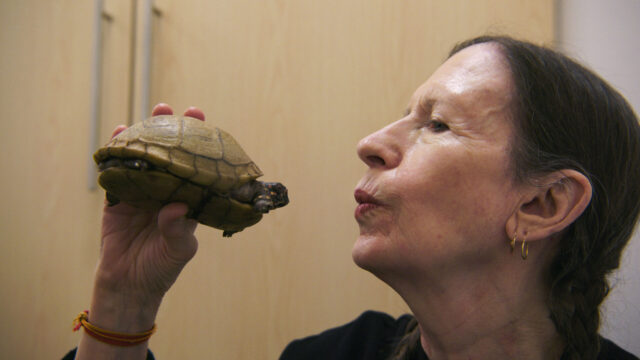
Bailey Williams and Emma Horwitz open up a lot of boxes at HERE Arts Center (photo by HanJie Chow)

TWO SISTERS FIND A BOX OF LESBIAN EROTICA IN THE WOODS
HERE Arts Center
145 Sixth Ave.
Through May 3, $45
here.org

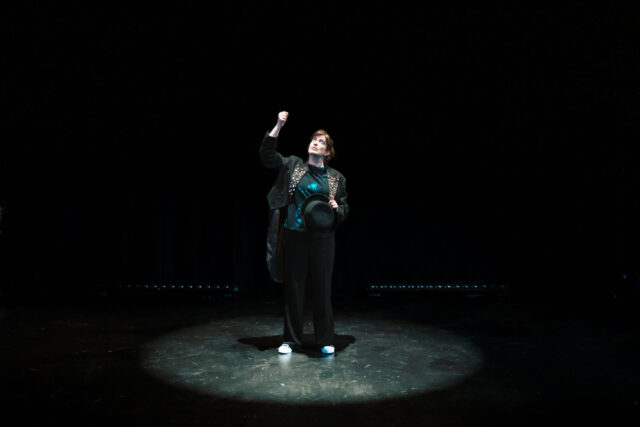
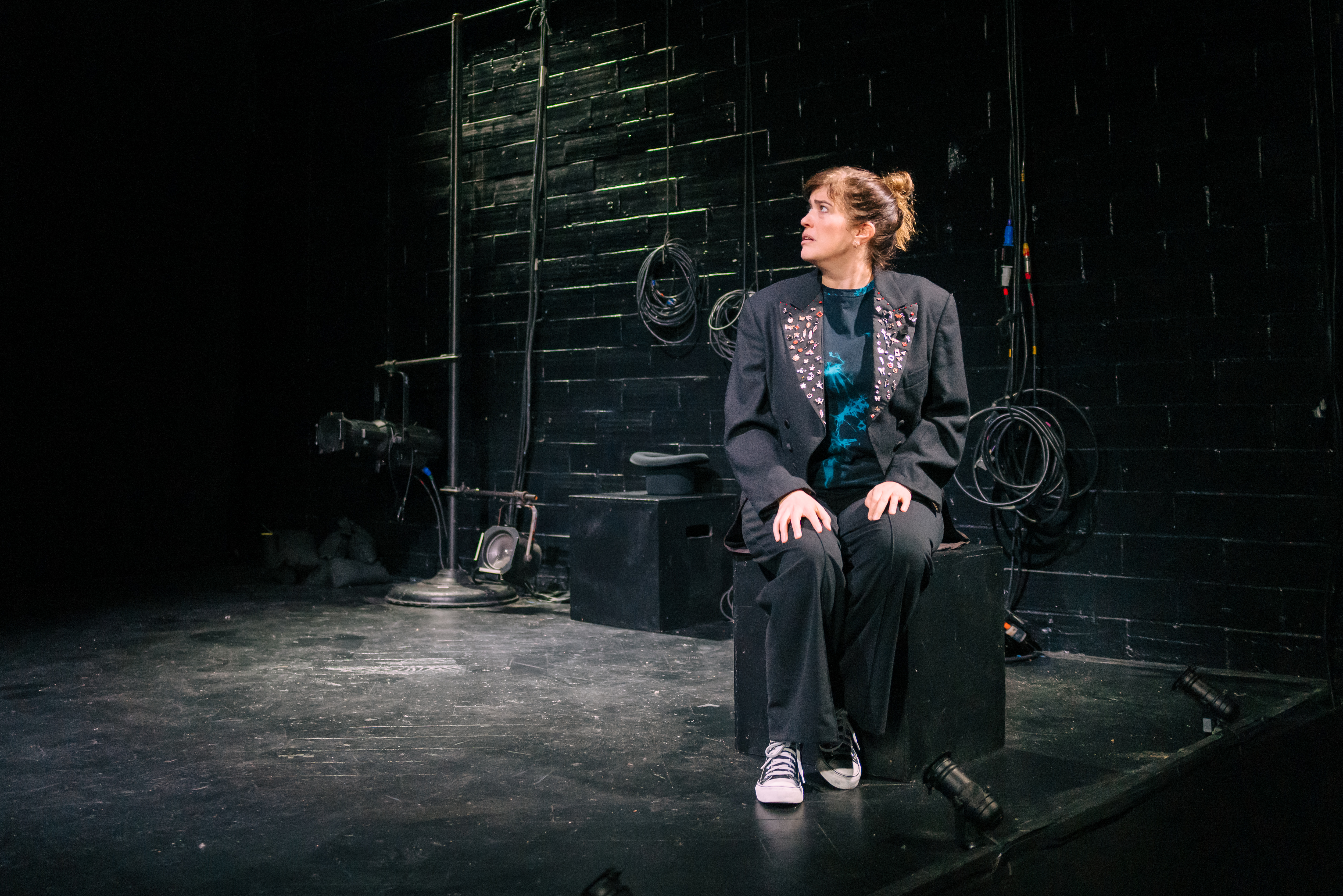
If you’re going to call your show Two Sisters Find a Box of Lesbian Erotica in the Woods, you had better live up to that amazing title. On- and offstage partners Emma Horwitz and Bailey Williams do just that and more in a rollicking extravaganza about art aesthetics and sisterhood in all their varying forms.

Extended at HERE Arts Center through May 3, the coproduction from Rattlestick Theater and New Georges starts with Horwitz bopping behind a desk, deejaying on her laptop; the playlist includes MUNA’s “Number One Fan,” Lady Gaga’s “Abracadabra,” and Le Tigre’s “Deceptacon,” which boasts, “Wanna disco? Wanna see me disco? / Let me hear you depoliticize my rhyme . . . Because I’m so bored that I’d be entertained / Even by a stupid floor, a linoleum floor, linoleum floor.”

Horwitz is surrounded by a semicircle of hundreds of carefully stacked bankers boxes with such labels as “Co-dependent Defendents” [sic], “Broken Vibrators,” “Top Chef Bottom Chef,” “Help! My Ex Has a Popular Podcast,” and “Gay Girls Who Like Gay Boys Who Also Like Gay Girls.” Over the course of the play — which runs exactly sixty-nine minutes, Williams explains with a smile — many of the boxes will be opened and explored, exposing clever, hilarious, and at times revealing plot devices.

In addition to portraying various versions of themselves, Horwitz is also an interviewer, a trucker, a doctor, a researcher, a businessman, and an executed spy/opera lover while Williams is an artist, a barback, a patient, an escort, a secretary, and a babysitter/pizza deliverer, among other characters. Across sixteen scenarios, they visit a pet shop, a diner, a black box theater, a lesbian spaceship, and the First Annual NIPPLI Conference, in which the National Institute for Paranormal Psychic Lesbian Investigations “posits that there are a number of energetic hotspots that produce hyper-dimensional gateways of electromagnetic significance. . . . They cannot — yet — transport humans. But they can — and do — transport lesbian erotica.”

The piece is inherently self-referential, fully aware that it is an experimental work taking place in a downtown venue, performed by a real-life queer couple to an ecstatic audience. Horwitz and Williams were inspired by such avant-garde theater companies as Split Britches and Five Lesbian Brothers, the woman-run erotica magazine On Our Backs, and the actual Reddit forum “We gotta talk about porn in the woods,” where people post stories of, well, finding lesbian erotica in the woods.

Two Sisters Find a Box of Lesbian Erotica in the Woods consists of a series of wildly funny and fiendishly clever vignettes (photo by HanJie Chow)

One of the show’s leitmotifs involves a mysterious performance artist known as Valentina, who interviewer Emma and artist Bailey may or may not know, have collaborated with, or had a relationship with. When Emma says she recently received a postcard from Valentina, Bailey says, “That is so very, very Valentina . . . a woman with extremely clear boundaries between work and play. Anyway, this is all – we’re here to talk about my new piece, I think?” In describing a previous performance installation, Body Double and the Doubled Body, Bailey explains, “I am here, I am my work.”

Slyly toying with notions of clear professional and personal boundaries, Horwitz and Williams also explore the multiple meanings of “sister,” from blood siblings to chosen family members to women who are good friends supporting each other — and, as another Reddit asks, “to lesbian couples, are you often mistaken as sisters?”

When artist Bailey tells interviewer Emma that she lives with her wife in Rhinebeck, interviewer Emma responds, “Oh! I thought you were sisters!” In a postcard to Valentina, Bailey writes about their pretending to be sisters and drinking Champagne in first class aboard a steamer ship. In another vignette, Emma and Bailey play sisters both named Christina, who are in business together giving psychic readings. “A sister is your first and greatest love,” Christina Bailey says.

Serious issues concerning queer culture, sexual orientation, societal rules and regulations, and private relationships pop up, but always through a comic lens that never gets overbearing or preachy. Tara Elliott (Illiterates, Burq Off!) directs the proceedings with a gleeful immediacy that sucks the audience in from the very start. Normandy Sherwood’s set, costumes, and props (red heels, gloves, soda cans, vibrators) all add to the fun, along with Josiah Davis’s humorous lighting and Johnny Gasper’s witty sound design.

Dancing, singing, telling jokes, and sharing wildly entertaining stories, Horwitz and Williams are so charming and engaging, so welcoming and self-possessed, that you’ll just want to give them both big hugs and hang out with them more — but don’t; that will have to wait for their next show, which can’t come soon enough.

[Mark Rifkin is a Brooklyn-born, Manhattan-based writer and editor; you can follow him on Substack here.]
REIMAGINING SHAKESPEARE IN STRIDE: WHITNEY WHITE’S MACBETH AT BAM

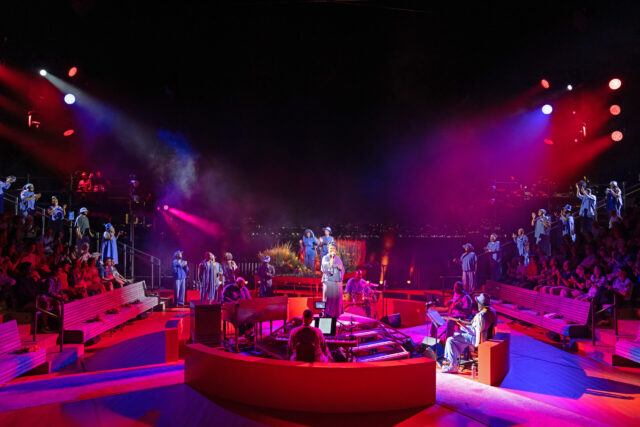
Whitney White reimagines Shakespeare tragedy in rousing Macbeth in Stride at BAM (photo by Marc J. Franklin)

MACBETH IN STRIDE
Brooklyn Academy of Music
Harvey Theater at the BAM Strong
651 Fulton St.
April 15-27, $29-$85
www.bam.org/macbeth

Whitney White’s Macbeth in Stride is an exhilarating hijacking of Shakespeare’s Scottish play, transforming it into an empowering and unrelenting Black feminist rock opera that serves as a takedown of the traditional roles assigned to women not only in the Bard’s canon but in theater and the world itself.

“Irreverence is everything,” White notes at the beginning of her multilayered, irreverent script. Best known as the award-winning director of such plays as Jaja’s African Hair Braiding, On Sugarland, soft, and Liberation, White is both the author and star of this dazzling production at BAM’s Harvey Theater. The ninety-minute show is fervently directed with plenty of winks and nods by Taibi Magar (Help, Twilight: Los Angeles, 1992) and Tyler Dobrowsky, who previously collaborated with White (and Peter Mark Kendall) on the virtual pandemic concert play Capsule.

In Macbeth in Stride, White portrays an unnamed woman who is the dazzling lead singer of a hot band and an actress playing Lady Macbeth. Holli’ Conway, Phoenix Best, and Ciara Alyse Harris are a trio of backup vocalists, the three witches, and a kind of Greek chorus; everyone interacts with the audience, starting with the sensational opening number, “If Knowledge Is Power.”

“So what’s the story?” the woman, dressed in a tight-fitting black sparkling pantsuit, asks in her speech following the song. “For me . . . tonight there is one story — one play in particular that kicked it all off / The funky little chain reaction that led someone like me / To be standing before you now / That led someone like me from where I’m from / To school and stage and work and rehearsals / And kept me up many nights / But for now let’s get back to all of you / Let’s stick with you. / What’s the story you told yourselves to get here?”

Macbeth is introduced in the next song, “Reach for It,” in which several characters sing, “So if foul is fair then fair is foul / Ambition’s not a sin at all!,” after which the woman proclaims she wants ambition and love, no matter that the witches tell her women cannot have both. She also is intent on flipping the switch on Shakespeare, since all of his “great women never seem to make it out of these plays alive!”

The man playing Macbeth (Charlie Thurston) arrives, a white accordionist clad in black leather. Learning that he is destined to be king, she realizes that she in turn would become queen and wants the power that comes with that, to be more than the secondary character Lady M is through much of the original play. She asks the audience, “Women, queer folk, and othered people out there? / What are you willing to do to get what you need? / To get what you want?” She admits that violence might be the answer.

When Macbeth tells Lady M that King Duncan will be staying the night at their castle, she advises her husband, “I’m pretty sure we’re gonna have to kill him.” He does the deed, she frames the guards, and they become king and queen. As he deals with a heavy dose of fear, suspicion, and guilt, she is determined to be more than an appendage who just gets to host dinner parties; instead, she is going to “reclaim everything.”

Whitney White and Charlie Thurston star as the doomed couple in meta-heavy Macbeth in Stride (photo by Marc J. Franklin)

Macbeth in Stride is a rousing reimagining of Shakespeare’s 1606 tragedy, a clever, passionate, and downright fun show that celebrates the freeing of women from the shackles of literature as well as the chains of real life. White’s Lady M is a symbol of changing the narrative and taking control of the story, in this case in the guise of a spectacular concert. Songs such as “Dark World,” “Doll House,” and “I for You” help place the tale in contemporary times. “You gon’ rework a four hundred year old play just for your ego?” the first witch asks White, who replies, “Yup. / Sure did! Sure did!”

Dan Soule’s set features several platforms and a diagonal walkway cutting through the middle. Jeanette Oi-Suk Yew lights the show like a concert, including vertical strips of colored lights, while Nick Kourtides’s sound balances the loud music with the less raucous dialogue. Qween Jean’s costumes are fashionably glitzy, as is Raja Feather Kelly’s choreography.

The crack band consists of music director Nygel D. Robinson on keyboards, Kenny Rosario-Pugh on guitar, Bobby Etienne on bass, and Barbara “Muzikaldunk” Duncan on drums. Conway (Six, Tina), Best (Dear Evan Hansen, Teeth), and Harris (Dear Evan Hansen, White Girl in Danger) excel as the chorus, who are worthy of their own show. Thurston (Liberation, Here There Are Blueberries) succeeds in a nearly impossible task, surrounded by strong, tenacious women.

White, who also sits at the piano for a few tunes, is right at home center stage. She might not always have the range the songs require — “Reach for It” is a bit of a reach for her — but she embodies her character with an intense grandeur that is as intoxicating as it is fierce.

Shakespeare purists will notice occasional iambic pentameter in the streamlined text, and most of the famous quotes are in there, in one form or another. However, since this is Lady M’s story, aside from Duncan, whose murder is described in some detail, there is no mention of Macduff and his family, no King Edward, no Donalbain and Malcolm, no visible ghosts, no Earl of Northumberland, no noblemen and doctors, no Birnam Wood, and only one mention of Banquo and his son.

As the end approaches, the woman wonders, “Why do they write us this way? / Why do they imagine us this way?”

White has picked up a sharp quill and stands boldly under the spotlight to write it her way. The script notes that Macbeth in Stride is the first of a four-part series; I can’t wait to see what she has in store for us next.

[Mark Rifkin is a Brooklyn-born, Manhattan-based writer and editor; you can follow him on Substack here.]
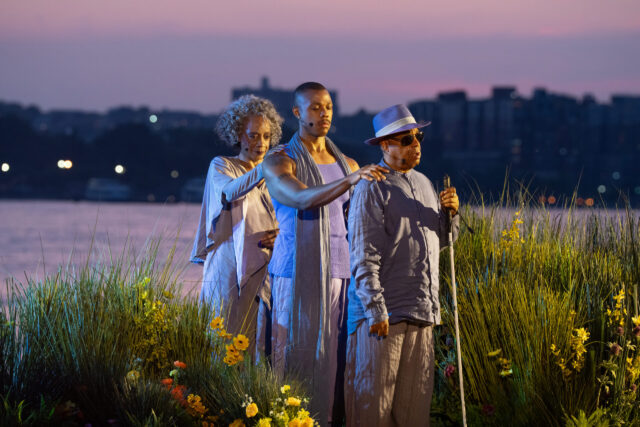
BLIND FAITH: OFF-BROADWAY PREMIERE OF THE SWAMP DWELLERS

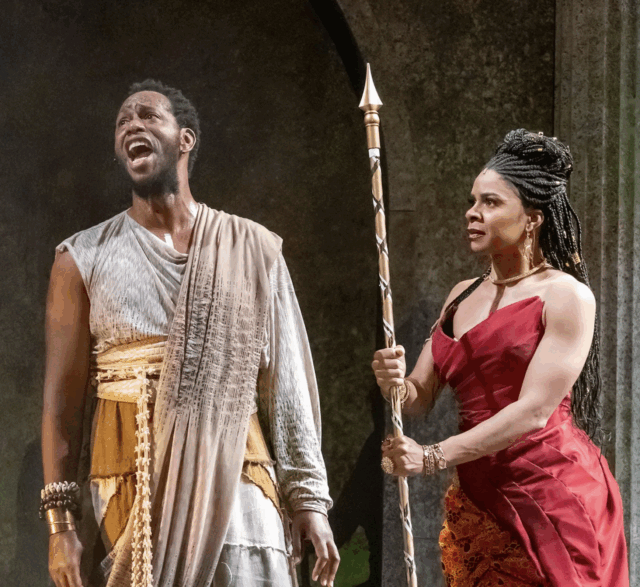
Makuri (Leon Addison Brown) and Alu (Jenny Jules) wait for their son to return in The Swamp Dwellers (photo by Hollis King)

THE SWAMP DWELLERS
Theatre for a New Audience, Polonsky Shakespeare Center
262 Ashland Pl. between Lafayette Ave. & Fulton St.
Tuesday – Sunday through April 27, $902-$132
www.tfana.org

Wole Soyinka, the first African to win the Nobel Prize for Literature, packs a lot of potent story into the seventy-minute one-act play The Swamp Dwellers, receiving its off-Broadway premiere at Theatre for a New Audience’s Polonsky Shakespeare Center, but it can’t quite stand on its own; instead, the quality production feels like the middle section of a larger work, with too much left unsaid.

The action takes place on Jason Ardizzone-West’s gorgeous set, in a hut constructed with marsh stakes and hemp rope, built on stilts in a small village along the Niger Delta; water shimmers under and around the abode. It’s the late 1950s, shortly before Nigeria will gain its independence from Britain on October 1, 1960, a time of major change that Soyinka relates through one family.

Sixtysomething couple Alu (Jenny Jules) and Makuri (Leon Addison Brown) are struggling to get by; she dyes Yoruba textile cloths while he is a barber and basket weaver. Their twin sons, Igwezu (Ato Blankson-Wood) and Awuchike, have left for the city, seeking wealth; While Igwezu has just returned and is checking to see if anything is left of his farmland, Awuchike is probably dead, according to Alu.

Alu and Makuri love each other, but each enjoys needling the other, as in this marvelous exchange:

Alu: If you had any good at all in you, you’d go and look for him.
Makuri: And catch my death of cramp? Not likely . . . And anyway, what’s preventing you from going?
Alu: I want to be here when he gives me the news. I don’t want to fall down dead out in the open.
Makuri: The older you get, the more of a fraud you become. Every day for the past ten years, you’ve done nothing but swear that your son was dead in the marshes. And now you sit there like a crow and tell me that you’re waiting for news about him.
Alu: I know he’s dead.
Makuri: Then what do you want Igwezu to tell you?
Alu: I only want to know if . . . I only want to ask him . . I . . . I . . . He shouldn’t have rushed off like that . . . dashing off like a madman before anyone could ask him a thing.
Makuri: Before anyone could ask him WHAT?
Alu: You’re always trying to make me a liar.
Makuri: I don’t have to make you one.
Alu: Bah! Frog-face! . . . Dropped his bundle and rushed off before I could ask him a thing . . . And to think he could have found him after all. To think he could have found him in the city.
Makuri: Dead men don’t go to the city. They go to hell.
Alu: I know one dead man who is sitting right here instead of going quietly to hell.
Makuri: Now see who is calling who . . .
Alu: You’re so useless now that it takes you nearly a whole week to make one basket . . . and to think you don’t even cut your own rushes!
Makuri: If you had to get up so often to shave the heads of the whole village . . . and most of them crusted with kraw-kraw so that a man has to scrape and scrape until . . .
[Alu yells suddenly and slaps herself on the arm.]
Makuri: Ha! Don’t tell me now that a fly has been trying to suck blood from your dried-up veins.
Alu: If you had enough blood to hold you up, you’d prove it by going to look for your own son, and bring him home to supper.

A blind Muslim beggar (Joshua Echebiri) arrives, having traveled far to seek employment, wanting to work the soil with his hands. He lost his sight to the fly sickness when he was a child; the mention of the word “fly” instantly recalls the flies that taunt Alu, as if potential illness hovers around her.

While the beggar learns about how floods ruined the family’s farm, the local holy man, known as the Kadiye (Chiké Okonkwo), the Servant and Priest of the Serpent of the Swamp, visits with his attendant (Jason Maina) and drummer (Olawale Oyenola). The Kadiye announces that the rains have stopped and planting can begin again. Makuri caters to him, insisting that the Kadiye sit in the fancy swivel barber chair and demanding that Alu bring them drink.

After the Kadiye leaves, Igwezu enters, bitter and distant. The beggar tells him he wants to be his loyal bondsman while also planting a seed that the Kadiye may be corrupt. “How does the Serpent fare in times of dearth? Does he thrive on the poisonous crabs? Does he drink the ooze of the mire?” the beggar asks. Makuri resonds, “Beware. That borders upon sacrilege. That trespasses on the hospitality of this house.” Igwezu wonders, “Perhaps he can give meaning to what seems dark and sour.”

When Kadiye and his attendants return, Igwezu details what happened between him and his brother and questions the holy man as he prepares to shave him, razor at the ready.

Igwezu (Ato Blankson-Wood) prepares to shave the Kadiye (Chiké Okonkwo) in Wole Soyinka off-Broadway premiere (photo by Hollis King)

Born in British Nigeria in 1934, Soyinka wrote The Swamp Dwellers, his second play, in 1958. He would go on to write such other works as The Lion and the Jewel, The Invention, The Interpreters, and Season of Anomy. In The Swamp Dwellers, he explores such issues as colonialism, systems of faith, infidelity, the ecosystem, and revenge. It’s a lot to take on in seventy minutes, and as compelling as it is under the direction of Awoye Timpo (Wedding Band, Elyria), some elements feel like they need more.

Qween Jean’s costumes, Seth Reiser’s lighting, Rena Anakwe’s sound, and Chief Ayanda Clarke’s music help transport the audience to the Niger Delta, where danger and darkness lurk amid the haze; you can practically smell the swamp and fear the serpent. The ensemble cast is led by strong performances by Brown (soft, The Painted Rocks of Revolver Creek) and Jules (Harry Potter and the Cursed Child, Sweat) as the bickering couple, trying their best in a nearly impossible situation, although independence is just around the corner, along with corporate drilling that followed the discovery of oil in the region.

In a December 2010 New York Times piece included in the revival’s online program, Soyinka, who collaborated with TFANA on the revival, remembered being in Nigeria as the extraction phase began, writing, “[Oil] flares signaled at the time nothing more than the mission of the company — to open the land to industrialization. Oil was only the facilitator. . . . The earth of the swamp dwellers was under siege. Eviction; land takeovers; home demolitions; environmental degradation; lost livelihoods: The oil flares were no longer harmless sky-writings but the fires of improvidence and indifference.”

The Swamp Dwellers gives us a glimpse of a world on the brink of dissolution, already starting to slide toward destruction.

[Mark Rifkin is a Brooklyn-born, Manhattan-based writer and editor; you can follow him on Substack here.]
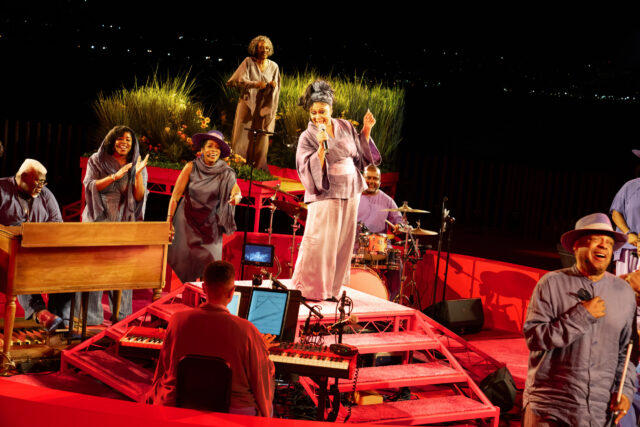
HOW IRISH DOES AN IRISH PLAY HAVE TO BE? IRISHTOWN AT THE IRISH REP

The Dublin-based Irishtown theater company prepares to stage a play in New York in Irish Rep world premiere (photo by Carol Rosegg)

IRISHTOWN
Irish Repertory Theatre, Francis J. Greenburger Mainstage
132 West Twenty-Second St. between Sixth & Seventh Aves.
Wednesday – Sunday through May 25, $60-$125
212-727-2737
irishrep.org

Ciara Elizabeth Smyth’s Irishtown, making its world premiere at the Irish Rep through May 25, tackles an issue that the theater company probably faces regularly: How Irish must a play be to be staged at the Irish Rep? How far does its cultural responsibility extend, and, perhaps most important, can it be a comedy?

As one of the characters asks the writer during rehearsals of the play within the play, a contemporary legal drama about sexual assault in Hertfordshire, England, “Where’s the lyricism? Where’s the backward syntax? And I’m sorry, I know I’ve said it before, but a happy ending? Do you know one happy Irish person?”

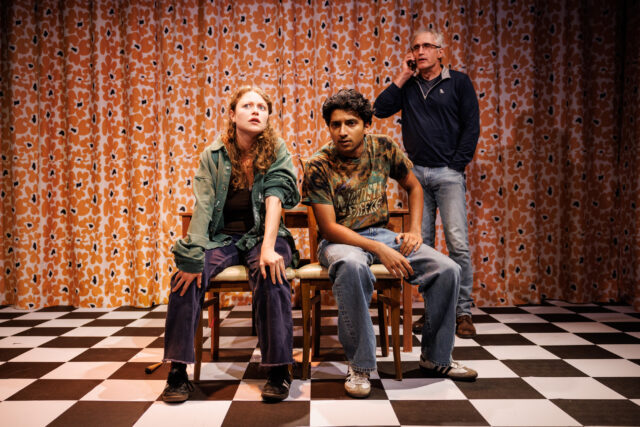
The ninety-minute show is set at the offices of the Dublin theater company Irishtown. Actors Constance (Kate Burton), Síofra (Saoirse-Monica Jackson), and Quin (Kevin Oliver Lynch) are completing a table read with director Poppy (Angela Reed) and playwright Aisling (Brenda Meaney) of Aisling’s latest work, Who Are We if We Are Not Ourselves at All, which is scheduled to open in New York City in four weeks.

The actors’ initial fawning displays of support soon give way to underhanded comments, sideways digs, and outright suggestions for changes, which infuriates Aisling, who insists the script will be locked and that the story is based on her own real-life experiences. Constance, an Irish legend who is struggling to pay for care for her ailing mother, is worried that “the script isn’t displaying as ‘authentically’ Irish” and that Poppy is English. Quin, who is bad at accents and has just been dumped by his girlfriend, complains about the script, “I think everything is wrong with it.”

Even Síofra, who is Aisling’s girlfriend and has been named Newcomer of the Year twice — ten years apart — and Poppy, who was kicked out of the Royal Shakespeare Company for having sex with numerous cast members, get in on the attacks.

Quin: We have one card in America, the Irish card, and you didn’t even play it? Even the English are playing the Irish card.
Poppy: Are they?
Constance and Síofra: Yes.
Aisling: Hang on now, not everything I write needs to be about being Irish.
Quin: But we are Irish.
Aisling: But if Irish drama needs to define Irish identity and its claims of independence from Britain, what further declaration of independence can there be than an Irish play not desperately seeking to be Irish?
Síofra: It’s a balance though, isn’t it? You want to represent Ireland as a home of ancient idealism with a rich cultural heritage but not tip it over into depicting us as buffoons of easy sentiment or drunken fucking monkies.

As the trip to New York inches closer and Aisling battles the producer, McCabe (voiced by Roger Clark), she decides to walk off with her script, leaving Constance, Quin, Síofra, and Poppy to come up with their own Irish play in a week.

Constance (Kate Burton) watches carefully as playwright Aisling (Brenda Meaney) and her girlfriend, Síofra (Saoirse-Monica Jackson), share a moment (photo by Carol Rosegg)

As always with the Irish Rep, the production is stellar. Colm McNally’s dingy, basement-like office set, featuring posters of such Irish classics as Waiting for Godot, Dancing at Lughnasa, and The Beauty Queen of Leenane — in addition to Aisling’s The Happy Leper of Larne — has a claustrophobic feel as time is running out; McNally also designed the lighting, with sound by Caroline Eng and casual costumes by Caroline Eng, highlighted by Aisling’s sweaters.

The cast is led by Burton (Hedda Gabler, The Elephant Man) as the careful Constance, Reed (Harry Potter and the Cursed Child, The Power of Darkness) as the tough but vulnerable Poppy, and the ever-dependable Meaney (Little Gem, The New Morality) as the defensive Aisling.

Even at only ninety minutes, the play, directed by Nicola Murphy Dubey (Belfast Girls, Pumpgirl), gets bogged down in slapstick while a few subplots get short shrift and the ending is rushed. But Smyth (Lie Low, We Can’t Have Monkeys in the House) has a lot to say about celebrating, and being honest about, personal and cultural identity, as exemplified by the title of the play within the play, Who Are We if We Are Not Ourselves at All. When Poppy talks about having “inherited” the cast, an English director in charge of an Irish crew, it brings up centuries of conflict.

But Quin sums it up best when he asks, “We could just devise an Irish play . . . How hard could it be?”

The Irish Rep knows the answer.

[Mark Rifkin is a Brooklyn-born, Manhattan-based writer and editor; you can follow him on Substack here.]
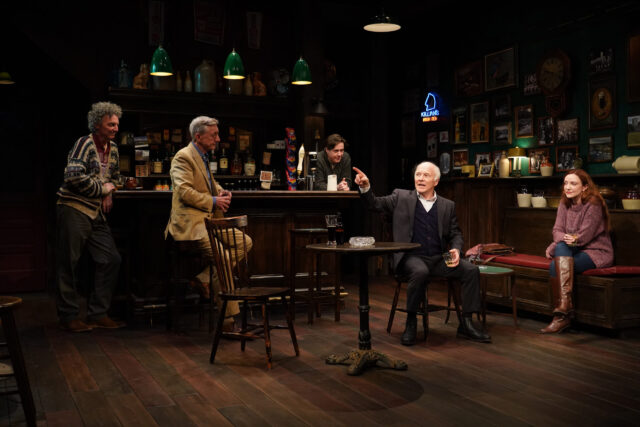
NORTH TEXAS EPIC: THE TROJANS AT THE CELL

The Trojans re-creates the glory days of a group of warehouse workers in North Texas (photo by Vivian Hoffman)

THE TROJANS
The Cell Theatre
338 Twenty-Third St. between Eighth & Ninth Aves.
Thursday – Sunday through April 26
www.thecelltheatre.org

Friday Night Lights meets Homer’s The Iliad with a touch of The Outsiders in Leegrid Stevens’s outrageously entertaining synthwave musical The Trojans, which has been extended through April 26 at the Cell.

Stevens and director Eric Paul Vitale have moved the epic Greek poem to a shipping facility in Carlton, North Texas, where a group of overworked, bored employees decide to suddenly reenact their glory days revolving around a crucial homecoming high school football game between the Trojans and their archrivals, the Highland Kings.

Scenic designer Simon Cleveland has transformed the front room of the Cell into a warehouse stocked with packages ready to ship to Heodorokon Nitis in Corinth, Mississippi, Thelexis Boulos in Parthenon, Arkansas, Stylis Fotikos in Achille, Oklahoma, and Marbara Vasiloudou in Troy, Alabama. Christopher Annas-Lee’s lighting features LED strips that outline the performance area on the floor, where an audience of about fifty sits on three sides, surrounded by towering walls of boxes. Signs warn, “This department has worked 4 days without a lost time injury: Be alert . . . Accidents hurt,” and “Notice: How to lift correctly — Bend knees to lift — Prevent back injury — Don’t bend over,” things that teenagers don’t need to worry about but older adults do.

The show begins with Heather (Deshja Driggs) and Doug (Sam Tilles) complaining about their jobs. “Oh man, one of those days,” Doug says, to which Heather responds, “Every day’s one of those now.” Heather asks Doug to tell one of his stories; Doug is worried that he will be caught by their manager, Daris (Arya Grace Gaston), and get fired, but soon the gang is re-creating “the Hit,” a controversial play during a long-ago high school football game by Keeley (Erin Treadway) that initiated the feud between the Trojans and the Kings. After Sondra (Jen Rondeau) questions how truthful their version is, Heather pulls out the actual cassette from the homecoming dance, puts it in an old red tape player, and everyone is transported back to the 1980s.

The Trojans consist of star quarterback Johnny/Agamemnon (Roger D. Casey); his girlfriend, Heather/Helen, the most popular girl in school; wide receiver Doug/Diomedes; the not-too-bright but sincere Jack/Ajax (E. James Ford), the running back who has to step in for Keeley/Achilles after Keeley quits the team; Lucas/Patroclus (Daphne Always), Keeley’s devoted boyfriend; and Sondra/Cassandra, who tells fortunes with a folded origami paper device known as a cootie catcher or chatterbox. The Kings are led by teen heartthrob Daris/Paris and his brother, imposing QB Tark/Hector (Alcorn Minor).

As they prepare for the big game, loyalties are tested, secrets are revealed, and hilarious songs are sung, from “OooAhhUs” and “Not Any More” to “Something Bad’s About to Happen” and “We’ll Never Become.”

A production of Brooklyn-based Loading Dock Theatre, The Trojans has a charming DIY feel, as the warehouse employees use their hard hats as football helmets, yellow-and-black vests as uniforms, and palettes, forklifts, and ladders as cars and other forms of movement. Will Watt’s sound includes appropriately muffled music when it’s supposedly coming out of the old tape deck, while Mindy Rebman’s boisterous choreography puts the audience right in the middle of a 1980s high school pep rally gone wrong. The ensemble, which also includes Bradley Cashman, Emma Imholz, Emma Kelly, Max Raymond, and Katherine Taylor in swing roles, is terrific, both as adults worrying about their job status and as teenagers making what might be one last grab at greatness.

Stevens references The Iliad over and over without the show being a one-to-one reimagining. A particularly sly moment occurs when Tark is reciting some football plays, saying, “Trips Left-60 Flip-Y Sticks. Go. Watch the backer if so, go hot, if not, post route. Touchdown. Let’s go. Heavy right 35 Pistol Zap. Go. Play action to a bootleg. If cover three, run. If not, deep left, Touchdown. Let’s go. Bunch right, green jet, Counter 2. Go.” Daris answers, “This is like the shittiest poem ever,” not unlike what a high school student might say about Homer’s works.

Deena Kaye’s music and vocal direction is thoroughly engaging; each actor sings and dances in accordance with their character. Thus, Casey and Driggs excel in that respect, whereas Ford has a more appropriately bumpy ride.

Early on, Heather asks Johnny, “Do you think in thirty years we’ll love music as much as we do now? . . . Do you think we’ll still love to dance? . . . Do you think we’ll still love to drive under the stars?” His concentration fully on the upcoming game, Johnny replies, “I think we’ll pretty much like all the same stuff we do now.”

Ah, the glorious dreams of youth.

[Mark Rifkin is a Brooklyn-born, Manhattan-based writer and editor; you can follow him on Substack here.]