this week in theater

A BRONX TALE: THE NEW MUSICAL

(photo © Joan Marcus, 2016)

Chazz Palminteri’s A BRONX TALE is now a Broadway musical (photo © Joan Marcus, 2016)

Longacre Theatre
220 West 48th St. between Broadway & Eighth Ave.
Tuesday – Sunday through November 19, $50-$187
abronxtalethemusical.com

Chazz Palminteri’s autobiographical A Bronx Tale started life as a one-man show in 1989, telling the story of a young Belmont boy, Calogero, who witnesses a murder involving local crime boss Sonny but keeps his mouth shut, earning Sonny’s respect and ultimately a job with the mobster, which deeply angers his bus driver father, Lorenzo. Four years later, the film version arrived, directed by Robert De Niro and starring Palminteri — whose real first name is Calogero — as Sonny, Francis Capra and Lilo Brancato Jr. as Calogero (at different ages), and De Niro as Lorenzo. The show made it to Broadway in the fall of 2007, directed by four-time Tony winner Jerry Zaks. At De Niro’s urging, A Bronx Tale has now been turned into a Broadway musical at the Longacre, codirected by Zaks and De Niro, who should have left well enough alone. The best parts of the new show, and they’re very, very good, are the spoken dialogue scenes, which book writer Palminteri has expanded from his solo show, making excellent use of the expanded cast. However, the musical numbers, by a pair of Disney veterans, bring the show to a screeching halt, filled with syrupy sentimentality that neither enhances the development of the characters nor forwards the plot, instead restating what the audience already knows and feels. Composer Alan Menken and lyricist Glenn Slater, who have previously collaborated on The Little Mermaid, Sister Act, and Leap of Faith, should have known better, too.

Ariana DeBose steals the show as Jane as a race war threatens in A BRONX TALE (photo © Joan Marcus, 2016)

Ariana DeBose steals the show as Jane as a race war threatens in A BRONX TALE (photo © Joan Marcus, 2016)

Tony-winning designer Beowulf Boritt (Act One, The Scottsboro Boys) has created a cool, hip set, centered by a street sign that turns from Belmont Ave., where the Italians live, to Webster Ave., a black community, with storefronts and tenement buildings that also rotate to indicate a change of location; the two neighborhoods are close to each other but couldn’t be further apart. The show is narrated by Bobby Conte Thornton, in his engaging Broadway debut, as the adult Calogero, who looks back at the choices he and his father made; Hudson Loverro plays the nine-year-old Calogero, nicknamed “C” by Sonny. Tony nominee Nick Cordero (Bullets over Broadway, Rock of Ages) is impressive as Sonny, forming an intimate chemistry with both Calogeros while battling against Lorenzo (a rock-solid Richard H. Blake of Jersey Boys). The real stand-out is Ariana DeBose (Hamilton, Pippin) as Jane, an African American high school student whom Calogero is interested in, which threatens to set off a local race war. She has a mesmerizing stage presence, with the voice and moves to match. But the real problem is the music, a mix of doo-wop and ballads, and Sergio Trujillo’s (On Your Feet, Jersey Boys) choreography, which together range back and forth between pale imitations of Grease and West Side Story. The film featured classic songs by the Impressions, John Coltrane, the Beatles, Frank Sinatra, Jimi Hendrix, James Brown, Dion, the Moonglows, and others, helping set the proper mood; in the musical, the orchestrations by three-time Tony winner Doug Besterman (Thoroughly Modern Millie, The Producers) are drab and dull, unfortunately matching the music and lyrics, sapping the energy out of the show. If one more song focused on the word “heart,” I might have had to run out of the theater screaming. Without the production numbers, A Bronx Tale is compelling and intriguing; with them, it embodies the critical advice Lorenzo gives young Calogero: “The saddest thing in life is wasted talent. Promise me you won’t waste yours.”

HOLIDAY MUSIC, COMEDY, AND THEATER

Ronnie Spector will celebrate the best Christmas ever at City Winery

Ronnie Spector will celebrate the best Christmas ever at City Winery

New York City has tons of special programs during the holiday season, some well known and annual traditions, others more cutting edge and unique. Below is only a handful of seasonal recommendations, several of which are likely not to be on most people’s radar. Keep checking this space as more Christmas and Hanukkah celebrations are added.

Wednesday, December 14
Ingrid Michaelson’s 10th Annual Holiday Hop, with Sugar and the Hi Lows, Bowery Ballroom, 6 Delancey St., $40, 9:00

Kevin Geeks Out About Holiday Specials, with Kevin Maher, Erin Farrell, Wendy Mays, Paul Murphy, and Steve Flack, Nitehawk Cinema, 136 Metropolitan Ave. between Berry St. & Wythe Ave.$16, 9:30

Thursday, December 15
The Menorah: From the Bible to Modern Israel, with Steven Fine, Met Fifth Ave., Bonnie J. Sacerdote Lecture Hall, Uris Center for Education, 1000 Fifth Ave. at 82nd St., free with museum admission, 3:00

The Oh Hellos Present: The Oh Hellos Christmas Extravaganza, with Tyler and Maggie Heath, Music Hall of Williamsburg, 66 North Sixth St., $20-$22, 9:00

Thursday, December 15
through
Saturday, December 17

The 37th Annual Winter Solstice Celebration, with the Paul Winter Consort (soprano saxophonist Paul Winter, cellist Eugene Friesen, double-reed player Paul McCandless, keyboardist Paul Sullivan, bassist Eliot Wadopian, drummer Jamey Haddad, organist Tim Brumfield, Procol Harum singer Gary Brooker, and Forces of Nature Dance Theatre, Cathedral Church of St. John the Divine, 1047 Amsterdam Ave. at 112th St., $35-$95

Friday, December 16, 23
Holiday Music in Gilbert Court, A Renaissance Christmas with My Lord Chamberlain’s Consort, Morgan Library, 225 Madison Ave. at 36th St., free with museum admission, 6:30

Saturday, December 17
Brandenburgers Holiday Concert, with the Brooklyn Brandenburgers performing music by Bach, Corelli, Dvorak, Glickman, Ostyn, and Piazzolla, Old Stone House, 336 Third St. in Washington Park, $10, 2:00 & 7:00

Karen Luschar Sings “Mistletoe and Holly,” New York Public Library for the Performing Arts, Bruno Walter Auditorium, 40 Lincoln Center Plaza, free, 2:30

Saturday, December 17
Friday, December 23
Monday, December 26

A Darlene Love Christmas: Love for the Holidays, B. B. King Blues Club & Grill, 237 West 42nd St., $45-$82.50

Sunday, December 18
Latkepalooza!, with food, music, and family-friendly activities, Museum of Jewish Heritage, Edmond J. Safra Plaza, 36 Battery Pl., $10, 10:00 am

Hanukkah Family Day, Jewish Museum, Scheuer Auditorium, 1109 Fifth Ave. at 92nd St., free with museum admission, 12 noon – 4:00 pm

Karina Posborg is one of many filmmakers screening their Yule Log shorts at BRIC

Karina Posborg is one of many filmmakers screening their Yule Log shorts at BRIC

Monday, December 19
Yule Log 2.016, fifty short films, the Stoop at BRIC Arts | Media House, 647 Fulton St., free, 1:00 – 6:00

Harmony for Peace Holiday Peace Concert, Carnegie Hall, Stern Auditorium / Perelman Stage, 881 Seventh Ave. between 56th & 57th Sts., $21-$100, 8:00

Tuesday, December 20
MetLiveArts: The Little Match Girl Passion, directed by Rachel Chavkin and starring Ekmeles, Met Breuer lobby, 945 Madison Ave. at 75th St., $65, 7:00

Tuesday, December 20
and
Wednesday, December 21

Ronnie Spector’s Best Christmas Party Ever!, City Winery, 155 Varick St. between Spring & Vandam Sts., $55-$75, 8:00

Thursday, December 22
and
Friday, December 23

Yule Shul vs. Nutcracker: Rated R — A Love Show Holiday Extravaganza, (le) poisson rouge, 158 Bleecker St. between Thompson & Sullivan Sts., $15-$35, 8:00

christmas-for-the-jews

Thursday, December 22
through
Saturday, December 24

Merry Hanukkah with Judy Gold, Carolines on Broadway, 1626 Broadway between 49th & 50th Sts., $32.75

Saturday, December 24
A Very Jewish Christmas, with Modi, Gotham Comedy Club, 208 West 23rd St. between Seventh & 8th Aves., $25, 7:00 & 9:00

Sunday, December 25
Christmas for the Jews, with Joel Chasnoff, Dan Naturman, Cory Kahaney, and more, City Winery, 155 Varick St. between Spring & Vandam Sts., $25, 8:00

Friday, December 30
Kwanzaa 2016: Songs for the Soul, with Ruben Studdard, Dr. Linda H. Humes, and students from the Celia Cruz Bronx High School of Music, American Museum of Natural History, Milstein Hall of Ocean Life, Central Park West at 79th St., free with museum admission, 12 noon & 3:00

SWEET CHARITY

(photo by Monique Carboni)

Fandango dancers Charity Hope Valentine (Sutton Foster), Helene (Emily Padgett) and Nickie (Asmeret Ghebremichael) hope there’s something better than this in SWEET CHARITY (photo by Monique Carboni)

The New Group at the Pershing Square Signature Center
The Romulus Linney Courtyard Theatre
480 West 42nd St. between between Ninth & Tenth Aves.
Tuesday – Sunday through January 8, $30-$115
www.thenewgroup.org

Sutton Foster is dazzling in the title role of the New Group’s intimate and fun fiftieth-anniversary streamlined production of Sweet Charity, which has been extended at the Pershing Square Signature Center through January 8. Foster, who has been nominated for six Tonys, winning two (Thoroughly Modern Millie and Anything Goes), is reunited with fellow Tony winner Shuler Hensley (Oklahoma!); the two previously worked together in Young Frankenstein, in which Foster played Inga and Hensley was the Monster. Here they play another iteration of Beauty and the Beast, with Foster as the adorable Charity Hope Valentine and Hensley as the schlubby but likable Oscar Lindquist. The show is set in 1960s New York City, where Charity works as a dance-hall hostess at the Fandango, sometimes doing more than just the foxtrot with strangers while always dreaming that someday her prince will come. Joining her at the Fandango are Nickie (Asmeret Ghebremichael), Helene (Emily Padgett), Elaine (Sasha Hutchings), and new girl Rosie (Hutchings), who all have dreams of their own.

Early on, all the dancers sing, “The minute you walked in the joint / I could see you were a man of distinction / A real big spender,” with Nickie and Helene later adding, “I can show you . . . a good time.” After giving all her money to a panhandler, Charity somehow ends up in the arms of Italian movie star Vittorio Vidal (Joel Perez), who is in the midst of a terrible fight with his girlfriend, the high-maintenance Nikka Graff Lanzarone (Ursula), leading to one very unusual night. But Charity’s life changes when she gets stuck in an elevator at the 92nd St. Y with the meek Oscar. “Hey! You don’t have claustrophobia, do you?” Charity asks. Oscar replies, “Oh, no. No. No, nothing like that. Claustrophobia? No . . . I just don’t like to be in small, tight places that I can’t get out of.” Soon a charming romance blossoms, but Charity’s past lingers close behind.

(photo by Monique Carboni)

Charity (Sutton Foster) can’t believe she’s hanging out with Italian move star Vittorio Vidal (Joel Perez) in SWEET CHARITY (photo by Monique Carboni)

The musical’s past lingers as well. Sweet Charity was based on the screenplay of Federico Fellini’s Oscar-winning 1957 film, Nights of Cabiria, written by Fellini, Tullio Pinelli, and Ennio Plaiano; the Italian classic starred Fellini’s wife, Giuletta Masina, as an unforgettable luckless prostitute. The musical debuted on Broadway in 1966, directed and choreographed by Bob Fosse and featuring his wife, Gwen Verdon, as Charity and John McMartin as Oscar, with music by Cy Coleman, lyrics by Dorothy Fields, and book by Neil Simon. Fosse directed and choreographed the 1969 film, which cast Shirley MacLaine as Charity, McMartin again as Oscar, Ricardo Montalban as Vittorio, and Chita Rivera as Nickie. (Other onstage Charitys have included Debbie Allen, Molly Ringwald, Ann Reinking, and Christina Applegate.) Foster, looking like a cross between Judy Carne and Twiggy in Clint Ramos’s powder-blue minidress, is a memorable Charity, making endlessly adorable faces reminiscent of Masina’s smiles and pouts with those puppy-dog eyes, no matter how much life throws at her, and it throws a whole lot. The supporting cast is solid, especially Perez, who plays Vittorio in addition to Fandango manager Herman, Charity’s boyfriend Charlie, and Daddy Brubeck of the Rhythm of Life Church.

Derek McLane’s spare set is often nearly empty, with chairs and tables occasionally wheeled on and a brick wall in back that opens on dressing rooms and closets. The audience sits up close on three sides, with the cast entering and exiting through the crowd. The outstanding all-woman band — music director and keyboardist Georgia Stitt, bassist Lizzie Hagstedt, drummer Janna Graham, reed player Alexa Tarantino, guitarist Elana Arian, and cellist Nioka Workman — perform Mary-Mitchell Campbell’s contemporary orchestrations on the balcony behind the stage. Several set pieces fall flat — “The Rhythm of Life” feels completely out of place and time, and “I’m a Brass Band” is not the showstopper it is meant to be — and Joshua Bergasse’s (On the Town, Cagney) choreography is limited and repetitive, at least partly because of the small stage. But director Leigh Silverman (Chinglish, The Madrid), who worked with Foster on Violet, otherwise embraces the space with this warm and cozy production, in which the audience can nearly reach out and touch the performers. Other highlights are Foster’s “If My Friends Could See Me Now,” Padgett, Ghebremichael, and Foster’s “There’s Gotta Be Something Better Than This,” and the company’s “Where Am I Going?,” which has been moved to the finale. It’s a mostly golden production for its golden anniversary, centered by a glorious performance by one of the theater’s brightest, most engaging stars.

ELEMENTS OF OZ

(photo by Gennadi  Novash, courtesy of Peak Performances @Montclair State University)

Unique app is key part of ELEMENTS OF OZ (photo by Gennadi Novash, courtesy of Peak Performances @Montclair State University)

3LD Art and Technology Center
80 Greenwich St. at Rector St.
Tuesday – Sunday through December 18, $25
866-811-4111
www.3ldnyc.org
www.thebuildersassociation.org

The Builders Association (Sontag:Reborn, Invisible Cities) takes audiences on a wild trip down the yellow brick road as it deconstructs and reconstructs The Wizard of Oz in its fun and innovative multimedia experimental production Elements of Oz. Conceived by Marianne Weems, Moe Angelos, and James Gibbs, directed by Weems, and cowritten by Gibbs and Angelos, Elements of Oz delves into the legend and legacy of the classic 1939 film, sharing little-known stories, reenacting key scenes, and examining its online presence, including theories about how the book and movie are metaphors for the U.S. monetary system and gold standard. Continuing at the 3LD Art and Technology Center through December 18, the show presents a small corp of actors who reenact and reshoot key scenes, creating a new version via multiple monitors that project what is happening onstage and freeze-frames taken from previous scenes. The piece is performed by Angelos, Sean Donovan, and Hannah Heller, who each portray several characters — all three play Dorothy Gale at various points. They not only switch roles, they also shift from commenting on the film to acting in its re-creation, and from past to present, telling tales of 1939 moviemaking and its ongoing reverberations in popular culture. Following a YouTube overture, Angelos delivers the first of many “talking points,” giving inside information to the audience. “It’s a masterpiece,” she says about the film, “but all we see is the magic. We don’t see all the brutal work and failure.” Elements of Oz reveals how much of that magic was made as stage manager April Sigler, associate lighting designer Elliott Jenetopulos, video designer Austin Switser, production manager Brendan Regimbal, and technical director Carl Whipple set up and break down Neal Wilkinson’s sets, filming short scenes that are then edited live to mimic the original, shot by shot, and played back on a large onstage screen as well as the monitors that fill the theater. Meanwhile, Moe relates stories about Margaret Hamilton and her double, Betty Denko, suffering major injuries; how “Somewhere Over the Rainbow” was almost left on the cutting-room floor; that some of the munchkins were repurposed as flying monkeys; and what really happened when the film went from black-and-white to color.

(photo by Gennadi  Novash, courtesy of Peak Performances @Montclair State University)

Hannah Heller and Sean Donovan play multiple characters in experimental exploration of the making of THE WIZARD OF OZ (photo by Gennadi Novash, courtesy of Peak Performances @Montclair State University)

Just as The Wizard of Oz made use of cutting-edge technology, so does Elements of Oz, which has a unique innovation of its own. During the show, which is based on both the film and the book by L. Frank Baum, there are moments that are best viewed through your smart phone or tablet via a free augmented reality app, designed by John Cleater, that enhances what you’re watching by adding visual and aural effects, from snow to giggling munchkins to other cool surprises. Angelos (the Five Lesbian Brothers), Donovan (Thank You for Coming: Play), and Heller (The World Is Round) are hysterical as they change from role to role, with Angelos as Dorothy and Glinda, the mustachioed Donovan as Dorothy, Uncle Henry, Mike Wallace, the Scarecrow, the Tin Man, Salman Rushdie, and the Wizard, and Heller as Dorothy, Aunt Em, the Wicked Witch, the Scarecrow, Judy Garland, and Ayn Rand. (The costumes are by Andreea Mincic, with lighting by Jennifer Tipton, sound design and original music by Dan Dobson, and interactive design and programming by Jesse Garrison.) Originally presented by Peak Performances @ Montclair State University, the goofy and charming Elements of Oz is probably about twenty minutes too long, as things get a little repetitive, and as fun as the app is, you’ll find yourself at times looking at your phone, waiting for the next bit of AR to take place, instead of watching what is happening onstage. But like the original book and film, Elements of Oz is an enjoyable mind-expanding journey; and be sure to keep that app on as you exit 3LD and head down Greenwich St.

THE WOLVES

(photo by Daniel J. Vasquez)

Girls soccer team prepares for next game in Sarah DeLappe’s winning debut, THE WOLVES (photo by Daniel J. Vasquez)

The Playwrights Realm
The Duke on 42nd St.
Wednesday – Monday through December 24, $65-$85
www.playwrightsrealm.org

Sarah DeLappe’s sharply incisive debut play about a girls soccer team, The Wolves, is back for an encore engagement at the Duke on 42nd St., making a playoff run after a superb regular season in September. The Playwrights Realm production is set in the present in an unnamed middle America town, where the team is making a championship run of its own. The action takes place on Laura Jellinek’s rectangular AstroTurf set, with the audience seated bleacher-style on the two longer sides of the central green field. Over the course of ninety minutes and a handful of Saturday game warm-ups, the nine girls discuss menstruation, their perpetually hung-over coach, social media, religion, exercise, parents, abortion, political correctness, and making a difference in the world while stretching, jogging in formation, and kicking the ball around in predetermined practice routines (including the awesome spider). The sixteen- and seventeen-year-old students are more than a bit fascinated with aging and death; the play opens with a debate about whether ninety-year-old former Khmer Rouge leader Nuon Chea should be imprisoned or executed for horrific crimes he committed in the 1970s. When a few of the girls admit they don’t know anything about the Khmer Rouge, one says, “We don’t do genocide till senior year.” When they argue about the success of various types of feminine hygiene products, the same girl declares, “Score on me with my own baby blood? I think not!” The Wolves regularly passes the Bechdel test, as very few of the discussions have anything to do with boys. In addition, nearly everyone involved with the play is female; the only male listed in the program is one of the sound designers.

(photo by Daniel J. Vasquez)

Sarah DeLappe’s award-winning play is back for an encore run at the Duke on 42nd St. (photo by Daniel J. Vasquez)

The Realm’s Page One Playwright, DeLappe, and director Lila Neugebauer (Signature Plays: The Sandbox, The Wayside Motor Inn) — both of whom played soccer and made playing the sport with the actors part of the audition process — serve up rapid-fire dialogue like a ball being passed around during a game, with multiple conversations going on at the same time, the audience swerving their heads back and forth to keep up with the fast pace and flow. After a victory, many an athlete has attributed success to that mundane sports cliché, Total Team Effort, but that is exactly what makes The Wolves such a winner; the nine young actors are individually excellent and even better as a unit, although they are later joined by a soccer mom (Kate Arrington) in a heartfelt but unnecessary coda. DeLappe’s clever writing prevents the girls from turning into stereotypes; in fact, for most of the play they are referred to by their numbers, not their names. (We don’t even learn everyone’s given appellation.) They all wear Ásta Bennie Hostetter’s blue uniform costumes except for the goalie, #00 (Lizzy Jutila), who dresses in yellow and purposely mismatched sneakers; she barely speaks but pays close attention to what the rest of the girls are saying. The team is led by #25 (Lauren Patten), the captain, who has learned various motivation techniques from her father. The rest of the cast, each of whom deserves kudos, features Sarah Mezzanotte as the skinny #2; Brenna Coates as the bold and brash striker, #7; Midori Francis as the childlike and innocent #8; Susannah Perkins as the elitist and morbid #11; Jenna Dioguardi as the wacky, filter-less #13; Samia Finnerty as the serious #14, who is best friends with #7; and Tedra Millan as the mysterious #46, an odd new girl who, according to #13, lives with her mother in a “yogurt.” (It’s actually a yurt.) All of their interactions feel honest and genuine, fully immersing the audience in their very believable private and public dramas. The play, which shared the inaugural Relentless Award (with Clare Barron’s Dance Nation), presented by the American Playwriting Foundation in honor of Philip Seymour Hoffman, makes us eager to see more from DeLappe. A wonderful and unique theatrical experience, The Wolves continues at the Duke through December 24, but it deserves a whole lot more extra time before that final whistle blows.

HANASAKA JIISAN (THE OLD MAN WHO MADE FLOWERS BLOOM)

(photo © Naoya Ikegami)

Ryohei Kondo’s playful HANASAKA JIISAN makes its North American debut this weekend at Japan Society (photo © Naoya Ikegami)

Japan Society
333 East 47th St. at First Ave.
Saturday, December 10, 7:30, and Sunday, December 11, 2:30, $28
212-715-1258
www.japansociety.org

Japan Society is hosting the North American premiere this weekend of a rather unique retelling of the favorite mukashi banashi folktale Hanasaka Jiisan (The Old Man Who Made Flowers Bloom), a wild and wacky version by Ryohei Kondo and his all-male Condors dance company. In the story, a childless couple’s dog finds treasure in their backyard, but things go awry when a greedy neighbor then borrows the pooch so it can dig up treasure on his land as well. Currently celebrating its twentieth anniversary, the twelve-member Condors troupe has previously performed such shows as Nezumi no Sumo (Rats’ Sumo), Apollo, Conquest of the Galaxy: Mars, and 2012 Angry Men, an adaptation of 12 Angry Men. The Tokyo-born, South America-raised Kondo, who brought Goats Block the Road, Part III: Goat Stampede to Japan Society in January 2011, has a talent for creating works that combine silliness and unpredictability with a strong social conscience, sharing Japanese culture while avoiding preaching. (He has also choreographed Takashi Miike’s crazy The Happiness of the Katakuris and Yatterman.) Performed by Michihiko Kamakura, Yoshihiro Fujita, Kojiro Yamamoto, and Kondo, Hanasaka Jiisan features playful props and costumes (by Hiroko Takamatsu) on Hanako Murayama’s ever-changing set. It will be preceded by Tokyo-born, Brooklyn-based Maiko Kikuchi’s Pink Bunny, a parade consisting of puppets and unusual objects marching across the stage in short vignettes. In November 2015, the Pratt graduate’s No Need for a Night Light on a Light Night Like Tonight had its world premiere at La MaMa; Pink Bunny premiered in 2014 as part of St. Ann’s Labapalooza! Answering the question “What do you want to be?,” the piece will be performed by Maiko Kikuchi, Shun Kikuchi, Monica Lerch, David Commander, and Zac Pless.

NATASHA, PIERRE, AND THE GREAT COMET OF 1812

(photo by Chad Batka)

Josh Groban makes his Broadway debut as a cuckolded Russian aristocrat in NATASHA, PIERRE & THE GREAT COMET OF 1812 (photo by Chad Batka)

Imperial Theatre
249 West 45th St. between Broadway & Eighth Ave.
Tuesday – Sunday through September 3, $59-$189
greatcometbroadway.com

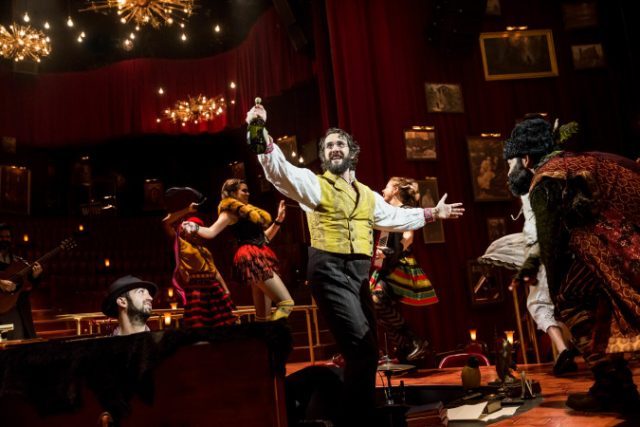
Hamilton, watch out; there’s a new historical musical in town, dueling it out for the designation of best show on Broadway. In his epic 1869 novel War and Peace, Leo Tolstoy wrote of his protagonist, Count Pierre Bezukhov, “At the entrance to the Arbat Square an immense expanse of dark starry sky presented itself to his eyes. Almost in the center of it, above the Prechistenka Boulevard, surrounded and sprinkled on all sides by stars but distinguished from them all by its nearness to the earth, its white light, and its long uplifted tail, shone the enormous and brilliant comet of 1812 — the comet which was said to portend all kinds of woes and the end of the world.” And there are all kinds of woes indeed in Natasha, Pierre & the Great Comet of 1812, Dave Malloy’s smashing electro-pop opera adapted from a 70-page section of Tolstoy’s classic tale, which has been magnificently transported to Broadway’s reconfigured Imperial Theatre. The little show that could began life in 2012 at 87-seat Ars Nova, where it ran for 39 performances. The next year it moved to the 199-seat tented Kazino cabaret in the Meatpacking District, and now it’s on Broadway, appropriately enough at the 1,200-seat Imperial, which set designer Mimi Lien (John, An Octoroon) has turned into an immersive wonderland, with ramps snaking from the stage throughout the theater and the audience seated in conventional chairs in the balcony and tavern-like chairs on the stage as well as in slightly sunken pits. The large cast of more than 40 actors and musicians emerge from every nook and cranny, every corner, even occasionally taking a seat right next to you and clinking glasses for a toast. You will be served a potato pierogi early on, and later a percussive egg to shake during some merriment. You might even get a page of War and Peace dropped in your lap. During intermission, you can roam anywhere, getting up close and personal with hundreds of paintings (many of Napoleon) that line the walls.

(photo by Chad Batka)

Countess Hélène Bezukhova (Amber Gray) has some dastardly plans for Countess Natalya Ilyinichna Rostova in immersive Broadway musical (photo by Chad Batka)

Set during the Napoleonic Wars, Natasha is a delightfully soapy story of love and betrayal in 1812 Moscow. The fabulous prologue introduces the major characters: brave Prince Andrey Bolkonsky (Nicholas Belton), who is away at war; “bewildered and awkward” Pierre Bezukhov (Josh Groban), a drunken cuckold who has given up on life; “young” Countess Natalya Ilyinichna Rostova, Andrey’s beautiful fiancée, called Natasha (Denée Benton); “hot” Anatole Kuragin (Lucas Steele), an immoral ladies’ man; “slut” Countess Hélène Bezukhova (Amber Gray), Anatole’s devious sister, who is married to Pierre; “good” Sofia Alexandrovna Rostova, Natasha’s trusted cousin, who goes by Sonya (Brittain Ashford); “crazy” Old Prince Bolkonsky (Belton), Andrey’s doddering father; “plain” Princess Mary Bolkonskaya (Gelsey Bell), Andrey’s sister; “old school” Marya Dmitryevna Akhrosimova (Grace McLean), Natasha’s godmother; “fierce” Fedya Dolokhov (Nick Choksi), a good friend of Anatole’s; and “fun” Balaga (Paul Pinto), a carefree troika driver. Don’t worry if it all doesn’t soak in immediately; there is a family tree in the program, which the cast suggests you refer to when necessary. After the prologue, a chorus declares, “Oh Pierre! Our merry feasting crank / Our most dear, most kind, most smart and eccentric / A warm-hearted Russian of the old school / His purse is always empty / Cuz it’s open to all / Oh Pierre / Just one of a hundred sad old men / Living out their final days in Moscow.” The downtrodden Pierre readily admits, “I never thought that I’d end up like this / I used to be better.” Attending an opera, Natasha sees Anatole and is instantly smitten with him, so the swaggering Anatole swoops down on her, soon proclaiming his undying love. Scandal ensues as there’s a duel, a costume ball, and various deceptions, leading to a deeply intimate and emotional conclusion.

“We are speaking of most ordinary things,” Anatole says at one point, but there is nothing ordinary about Natasha, Pierre & the Great Comet of 1812. Director Rachel Chavkin (The Royale, Small Mouth Sounds), who has been with the show from the start, finds endlessly inventive ways to bring this epic to life, as characters weave in and among the audience, the ensemble is always on the move, and the pace never lags for even a second. As Bradley King’s lights go down after one number, anticipation builds as to where the next song will begin. Choreographer Sam Pinkleton (Machinal, Significant Other) makes full use of the space, further involving the audience in the cast’s movements. The gorgeous costumes, by Paloma Young (Peter and the Starcatcher), range from elegant and fashionable to sexy and steam-punk. The ensemble is uniformly outstanding, from the wandering accordion players to the opera dancers (Reed Luplau and Ani Taj) to the larger roles, many of which are performed by the original Ars Nova actors, including Steele, Gray, Ashford (her “Sonya Alone” solo is stunning), Bell, Choksi, and Pinto. In her Broadway debut, Benton is both alluring and delicate as the torn Natasha, but the biggest surprise was Scott Stangland, who was subbing for an ill Josh Groban the night I went.

Scott Stangland gave an award-winning performance as Pierre of ART production of musical now on Broadway (photo © Gretjen Helene)

Scott Stangland gives award-winning performance as Pierre in ART production of musical now on Broadway (photo © Gretjen Helene)

In an 1858 letter to the editor comparing the comets of 1811 and 1858, British admiral and astronomer William Henry Smyth wrote, “In re the magnificent comet [of 1858], I have been closely attending to its fine figure; and am asked on various sides, as I had the advantage of having closely watched both, which I thought the most splendid in appearance, this, or that of 1811? Now, to my memory, which is very distinct, the palm must be given to the latter. As a mere sight-object, the branched tail was of greater interest, the nucleus with its ‘head-veil’ was more distinct, and its circumpolarity was a fortunate incident for gazers.” I feel very fortunate to have experienced the splendidly fine figure of Stangland, who played Pierre in the pre-Broadway American Repertory Theater production at Harvard in December 2015/January 2016 and who is absolutely magnificent at the Imperial, embodying Pierre as if he were born for the part. With his stout frame and bushy facial hair, he commands the audience’s attention whether taking center stage or playing the accordion or the piano in a pit. I was floored by the original presentation at Ars Nova, in which show creator Malloy, who wrote the music, lyrics, and book and did the orchestrations, played Pierre with an innate charm, and now I’ve been blown away by Stangland, who gives a profound performance that will break your heart — and left me playfully thinking, “Josh and Lin-Manuel who?”