this week in theater

THE EMPEROR JONES

(photo by Carol Rosegg)

Brutus Jones (Obi Abili) suddenly finds himself in trouble as the emperor of an unnamed Caribbean nation in Eugene O’Neill revival (photo by Carol Rosegg)

Irish Repertory Theatre, Francis Greenburger Mainstage
132 West 22nd St. between Sixth & Seventh Aves.
Tuesday – Sunday through May 21, $50-$70
212-727-2737
irishrep.org

In the fall of 2009, the Irish Rep presented Eugene O’Neill’s 1920 play, The Emperor Jones, during President Barack Obama’s first year in office, a positive time of hope and change that also saw a rise in hate speech in what was most definitely not a postracial America. Irish Rep producing director Ciaran O’Reilly’s award-winning production is now back, returning on the heels of Donald Trump’s election to the White House, also a time of rising hate crimes and political correctness across a deeply divided country. Inspired by stories about Haitian president Vilbrun Guillaume Sam as well as German Expressionism and Joseph Conrad’s 1899 novella, Heart of Darkness, O’Neill sets The Emperor Jones in an unnamed Caribbean nation, where Brutus Jones (Obi Abili) has declared himself dictator after escaping from a U.S. prison. Wearing a military uniform reminiscent of Marcus Garvey’s, Jones says to brash British colonialist Henry Smithers (Andy Murray), “Talk polite, white man! Talk polite, you heah me! I’m boss heah now, is you fergettin’?” A moment later, Jones brags to Smithers, “Ain’t r de Emperor? De laws don’t go for him. You heah what I tells you, Smithers. Dere’s little stealin’ like you does, and dere’s big stealin’ like I does. For de little stealin’ dey gits you in jail soon or late. For de big stealin’ dey makes you Emperor and puts you in de Hall o’ Fame when you croaks. If dey’s one thing I learns in ten years on de Pullman ca’s listenin’ to de white quality talk, it’s dat same fact.” Smithers warns Jones that a revolt against him is under way, which the emperor first dismisses but then believes, sending him off on a hallucinatory journey through the Great Forest, where, in the spirit of Macbeth, he encounters his checkered past and faces his ultimate fate, all the while a tom-tom beating in the distance like the pumping aorta in Edgar Allan Poe’s “The Tell Tale Heart.”

(photo by Carol Rosegg)

Brutus Jones (Obi Abili) faces his past in Irish Rep revival directed by Ciaran O’Reilly (photo by Carol Rosegg)

The role of Jones was originated by Charles S. Gilpin at the Provincetown Playhouse and then on Broadway, but it was later made famous onstage and onscreen by Paul Robeson. Controversy has surrounded the play from the very beginning because of its use of stereotypes, speech, and rampant use of the N-word by both Jones and Smithers. However, in a 1924 article in Opportunity: A Journal of Negro Life, Robeson wrote, “And what a great part is ‘Brutus Jones.’ His is the exultant tragedy of the disintegration of a human soul. How we suffer as we see him in the depths of the forest re-living all the sins of his past — experiencing all the woes and wrongs of his people — throwing off one by one the layers of civilization until he returns to the primitive soil from which he (racially) came.” The debate over whether the work itself is racist or an exploration of racist oppression, especially now, following the recent expurgation of the N-word from a new edition of Mark Twain’s Adventures of Huckleberry Finn, continues; however, O’Neill doesn’t do himself any favors by describing one character in the script as “a heavy-set, ape-faced old savage of the extreme African type, dressed only in a loin cloth.”

Regardless of where you find yourself on the racist controversy, it’s hard to deny the sheer power of the play, which is both uncomfortable to watch and utterly captivating in this intense and intimate production. Following in the footsteps of John Douglas Thompson at the Irish Rep (in addition to such other Jones portrayers as Ossie Davis, Albie Woodington, Paterson Joseph, and Kate Valk in blackface), Abili (Six Degrees of Separation, Titus Andronicus) fully embodies the role, his fear palpable as he encounters moving trees, masked figures, and puppets acting out scenes from his past as he gets lost in the forest and starts doubting his mind. Murray (War Horse) makes Smithers a fine foil for Jones, as ready to cut him down as to cower at his feet. Everyone involved deserves kudos: The haunting set design is by Charlie Corcoran, with regional costumes by Antonia Ford-Roberts and Whitney Locher, evocative lighting by Brian Nason, eerie choreography by Barry McNabb, affecting music by Christian Frederickson, stirring sound design by Ryan Rumery and M. Florian Staab, Caribbean puppets and masks by Bob Flanagan, and cool props by Deirdre Brennan. The ensemble also includes William Bellamy, Carl Hendrick Louis, Sinclair Mitchell, Angel Moore, and Reggie Talley. It might have been written nearly a century ago, but The Emperor Jones can still shock, providing no easy outs, particularly in this poignant version that bookends the Obama years.

THE SKIN OF OUR TEETH

(photo by Henry Grossman)

TFANA revival of Thornton Wilder’s THE SKIN OF OUR TEETH balances doom and gloom with hope and faith (photo by Henry Grossman)

Theatre for a New Audience, Polonsky Shakespeare Center
262 Ashland Pl. between Lafayette Ave. & Fulton St.
Tuesday – Sunday through March 19, $60-$110
866-811-4111
www.tfana.org

For the uninitiated, Thornton Wilder’s The Skin of Our Teeth, running in an exhilarating revival at Theatre for a New Audience through March 19, may come as quite a shock, a complex, unpredictable, boundary-shattering exploration of the human experience over millennia from the man most famous for Our Town. “The remarkable thing is how we forget, again and again. We forget Wilder’s vision and voice; in our memory we assign his works to a nostalgic theater of our youth, encountered first in high school, in community theater, in assigned work judged to be inoffensive enough to constitute the canon for young readers,” Pulitzer Prize-winning playwright Paula Vogel explains in the foreword to the 2003 Perennial Classics edition of the play. “And then we encounter him on stage as he is and will remain through the ages: tough-minded, exacting, facing the darkness in human existence without apology.” Professor, novelist, actor, and screenwriter Wilder won the last of his three Pulitzer Prizes — he won the fiction award for the novel The Bridge of San Luis Rey in 1928 and his first drama prize in 1938, for Our Town — for The Skin of Our Teeth, the wild and wacky story of the Antrobus clan as it survives the Ice Age, the biblical flood, and a world war. Wilder wrote the play during WWII, worried about the possible outcome but showing faith and hope in humanity’s natural will to survive; in fact, the Antrobuses, who live in Excelsior, New Jersey, are named after “anthropos,” the Greek word for “human.”

(photo by Henry Grossman)[

The Antrobus family fights crises both existential and real at Theater for a New Audience (photo by Henry Grossman)

Mr. George Antrobus (David Rasche) is the inventor of the alphabet, the multiplication table, and the wheel; he’s been married for five thousand years to Mrs. Maggie Antrobus (Kecia Lewis), and they have two children, Gladys (Kimber Monroe) and Henry (Reynaldo Piniella). They also have a loud, sexy maid, Lily Sabina (Mary Wiseman), who regularly quits when things don’t go her way, and a pair of prehistoric pets, a dinosaur (Fred Epstein) and a mammoth (Eric Farber). The family makes its way through a series of global crises, an Atlantic City beauty contest, a refugee invasion, a doom-preaching fortune-teller (Mary Lou Rosato), and even Homer (Andrew R. Butler) and Moses (Robert Langdon Lloyd), all the while breaking character and speaking directly to the audience, sometimes as the actor playing the actor playing the role. The show begins with Sabina alone onstage, delivering a monologue about the life and times of the Antrobuses while cleaning up; however, she has to repeat a line about the depression several times as it becomes apparent that another actor has missed their cue, breaking that fourth wall immediately. Out of sight, the stage manager, Mr. Fitzpatrick (William Youmans), tells her, “Make up something! Invent something!” Instead, as Miss Somerset, the actress playing Sabina, she boldly proclaims, “I hate this play and every word in it. As for me, I don’t understand a single word of it, anyway.” For the next two and a half hours, the actors, the actors they’re playing, and the characters they’re playing continually go “off script” to one another and to the audience, including a riotous scene in which Mr. Fitzpatrick must suddenly recast a handful of roles because of illness, needing bodies to recite philosophical musings by Aristotle, Plato, and Spinoza as the planets. Of course, every deviation from the standard, traditional nature of storytelling is carefully choreographed by Wilder and director Arin Arbus.

(photo by Henry Grossman)

Lily Sabina (Mary Wiseman) has the hots for her boss, George Antrobus (David Rasche), in Thornton Wilder revival (photo by Henry Grossman)

The Skin of Our Teeth debuted on Broadway in 1942, directed by Elia Kazan and starring Fredric March as Mr. Antrobus, Florence Eldridge as Mrs. Antrobus, Montgomery Clift as Henry, Frances Heflin as Gladys, Tallulah Bankhead as Sabina, E. G. Marshall as Mr. Fitzpatrick, and Dickie Van Patten as the telegraph boy. Wilder was inspired and influenced by the works of Bertolt Brecht, Luigi Pirandello, Gertrude Stein, the German Expressionists, and, primarily, James Joyce and Finnegan’s Wake. The play contains a nearly endless stream of references, particularly biblical (George and Maggie as Adam and Eve, Sabina as Lilith, Henry as Cain), while also attacking subjects that are as relevant today as they were seventy-four years ago, including climate change, war, education, religion, and the refugee crisis. As Vogel also writes, “Regardless of how his characters speak, it is what his characters say that remains timeless.” TFANA associate artistic director Arbus (A Doll’s House, The Father) takes full advantage of the theater, as the cast of nearly three dozen makes its way through the audience and the upper balcony. Riccardo Hernandez’s phenomenal set is centered by two side walls and a roof gable that forms the Antrobus’s open house, which goes through a dazzling change later in the show. César Alvarez’s original music includes a song near the end that is one of the only elements that feels out of place. The play itself has its problems, but this splendid production sweeps most of them aside. “The theatric invention must tirelessly transform every fragment of dialogue into a stylization surprising, comic, violent, or picturesque,” Wilder wrote about the play in his 1940 notebook. This revival of The Skin of Our Teeth does all that and more.

THE PENITENT

(photo by Doug Hamilton)

Charles (Chris Bauer) makes his case to his wife, Kath (Rebecca Pidgeon), in David Mamet’s THE PENITENT (photo by Doug Hamilton)

Atlantic Theater Company
Linda Gross Theater
336 West 20th St. between Eighth & Ninth Aves.
Tuesday – Sunday through March 26, $65
866-811-4111
atlantictheater.org

David Mamet has been having a tough time these past few years, earning less-than-stellar reviews for his last three Broadway plays, The Anarchist, China Doll, and a revival of Glengarry Glen Ross. Meanwhile, in a March 11, 2008, piece for the Village Voice entitled, “Why I Am No Longer a ‘Brain-Dead Liberal,’” he publicly proclaimed, “I took the liberal view for many decades, but I believe I have changed my mind.” It appears that no one’s mind is going to be changed by his latest show, The Penitent, continuing through March 26 at the Atlantic Theater, the company that he cofounded with William H. Macy in 1985. Chris Bauer (True Blood, Mamet’s Race) stars as Charles, a psychiatrist thrust into the public eye after a patient he refers to as “the boy” commits a heinous act. A newspaper article about the crime cites the boy’s anger at Charles for calling homosexuality an “aberration,” but Charles insists to his wife, Kath (Rebecca Pidgeon), and his lawyer, Richard (Jordan Lage), that the word he used in his published paper was “adaptation,” a typo that is now threatening his reputation and career. Charles is unwilling to accept the paper’s offer of a small retraction, so he decides to fight for the truth, despite the misgivings of Kath, Richard, and a Bible-quoting deposition lawyer (Lawrence Gilliard Jr. channeling Samuel L. Jackson).

(photo by Doug Hamilton)

Charles (Chris Bauer) makes his case to his lawyer, Richard (Jordan Lage), in Mamet world premiere at the Atlantic (photo by Doug Hamilton)

The drama unfolds over a series of two-character scenes around the same desk and chairs, which are rearranged to indicate various locations in Tim Mackabee’s sparse set. Bauer is steadfast as Charles, seemingly a stand-in for Mamet himself, as Bauer sports the playwright’s trademark glasses and even his style of facial hair; in addition, Charles’s wife is portrayed by Mamet’s wife, Pidgeon, who speaks in an overly clear and precise manner, emphasizing her “t”s and “d”s, for example, in an annoying way. The dialogue is sharp if not as fast-paced or brutal as in so many Mamet works, and director Neil Pepe’s pacing is rather lazy as revelation after revelation comes to light, including a twist ending. The crucial fact involved really should have been revealed earlier but becomes merely an excuse to end the ninety-minute show, which also has an intermission. There are several very strong moments in The Penitent, primarily early on as Charles battles for his rights, but as the character finds himself more and more up against the wall and turning to religion for solace, the play devolves and is then just over, leaving too many unanswered questions. Mamet’s return to the Atlantic might not be quite the welcome homecoming the playwright and the audience were expecting.

ON THE EXHALE

(photo by Joan Marcus)

Marin Ireland is captivating in harrowing new play by Martín Zimmerman (photo by Joan Marcus)

Black Box Theatre
Harold and Miriam Steinberg Center for Theatre
111 West 46th St. between Sixth & Seventh Aves.
Tuesday – Sunday through April 2, $25
212-719-1300
www.roundabouttheatre.org

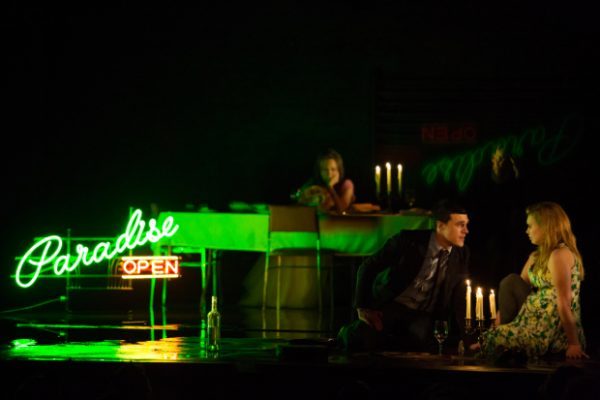
About fifteen minutes into Martín Zimmerman’s shattering On the Exhale, there’s a collective gasp from the audience. The show’s lone character, an unnamed woman portrayed with extraordinary grace and dignity by Marin Ireland, has just revealed the tragic event that forever changed her life. For the rest of the hour-long play, there is an almost unbearable silence from the audience as the woman shares her harrowing story in the Roundabout’s basement Black Box Theatre at the Harold and Miriam Steinberg Center. No one shifts in their seat, unwraps candy, coughs; you can’t even hear a breath until, near the end, there’s one cathartic laugh that makes it all feel even more real. The woman is a high school teacher and single mother who has a dream/nightmare that one of her students might attack her with a gun; then, her actions following an actual mass shooting are completely unexpected and utterly haunting. Rachel Hauck’s set consists only of a long, rectangular metal floor and ceiling that look like they’re closing in on the woman, echoing the psychological prison she is trapped in. On one side of the stage is Jen Schriever’s lighting grid of sixteen spots that fade in and out on the woman as she speaks directly to the audience in the second person, as if the events are happening to everyone, implicating us all. Zimmerman (Seven Spots on the Sun, Let Me Count the Ways) takes on issues of parenting, politics, education, sexuality, feminism, the media, and, most significantly, gun violence in starkly intelligent and understated ways, while Leigh Silverman (Violet, In the Wake) directs with a captivating subtlety. Tony nominee Ireland’s (reasons to be pretty, Ironbound) every movement, from the lifting of a hand to the stretch of a finger, from a pause in the darkness to a stare into the distance, is packed with emotional power. It’s a gently frightening, boldly courageous performance. When the play is over, actress and audience can finally take a much-needed deep exhale, and Ireland unleashes a cleansing, heart-wrenching smile. It’s an unforgettable, exhilarating conclusion to a terrifying play that reveals an America that is all too familiar.

LINDA

(photo by Richard Termine)

Linda (Janie Dee) faces down older daughter Alice (Jennifer Ikeda) as younger daughter Bridget (Molly Ranson) looks on in LINDA (photo by Richard Termine)

Manhattan Theatre Club
New York City Center Stage 1
Tuesday – Sunday through April 2, $79-$90
212-581-1212
www.lindaplay.com
www.nycitycenter.org

I’m writing this on International Women’s Day, when women around the world came together “to help forge a better working world — a more gender inclusive world,” which is particularly relevant to Penelope Skinner’s Linda, making its New York debut at City Center Stage I through April 2. Two-time Olivier Award winner Janie Dee gives a breathless, whirlwind performance as the title character in an otherwise lackluster, kitchen-sink production from Manhattan Theatre Club. It appears that Linda, a fifty-five-year-old marketing executive at Swan with a devoted husband and two daughters, has it all. The play opens with her making an impressive multimedia pitch for a new campaign for an anti-ageing cream, aiming it at older women who are often overlooked by the beauty market, unless they’re Helen Mirren. “Let’s make these invisible women feel seen again,” she says. “Let’s say to them: ‘Ladies? We know you’re out there! We see you! You exist!’” However, the head of the company, Dave (John C. Vennema), decides instead to go with a campaign aimed at social-media-savvy millennials presented by Amy (Molly Griggs), an ambitious and aggressive twenty-five-year-old who has her eyes set on Linda’s office and job. Meanwhile, temp Luke (Maurice Jones) finds Linda quite attractive. Back at home, Linda’s daughter from her first marriage, Alice (Jennifer Ikeda), spends most of her time in her room, wearing a skunk costume to try to make herself invisible to others because of a cyber-shaming incident that occurred ten years before, when she was fifteen. Linda’s other daughter, fifteen-year-old Bridget (Molly Ranson), from her second marriage to Neil (Donald Sage Mackay), is agonizing over which monologue to deliver at an audition to get into a prestigious acting academy. Her parents want her to do Ophelia, but Bridget is more interested in a stronger role, perhaps Macbeth or Lear, instead of the suffering, victimized female character. And Neil is in a new band with inexperienced young singer Stevie (Meghann Fahy). “I’m an award-winning businesswoman. I’m happily married with two beautiful daughters and I still fit in the same size ten dress suit I did fifteen years ago,” Linda proudly says several times, but her carefully constructed world is about to come tumbling down. “I will not disappear!” she declares, even as she is becoming a footnote in her own life.

(photo by Richard Termine)

Linda (Janie Dee) encounters unexpected problems at the office with company founder Dave (John C. Vennema) (photo by Richard Termine)

Titling the play after the protagonist’s first name places the character front and center, as if she’s on her own, battling stereotypes all by herself. She’s threatened not only by men but by women who want what she has and knowingly or unknowingly undermine her to taste at least a little bit of her power. Dee (Carousel, Comic Potential) is exceptional as Linda, a role originated in London by Noma Dumezweni after Kim Cattrall had to drop out for health reasons. She looks sexy and glamorous in Jennifer von Mayrhauser’s sharp, boldly colored outfits, but she stands out too much, overwhelming the other characters, who are more like caricatures. Walt Spangler’s revolving set drags down the narrative, as does Fitz Patton’s uninspired music. MTC artistic director Lynne Meadow can’t find a natural pace to the proceedings, which stagger from scene to scene. Skinner (The Village Bike, The Ruins of Civilization) packs Linda with far too many subplots, taking on too many women’s issues in a mere two hours. Each one is important in its own way, but they get lost in the shuffle. “I used to be the protagonist of my life and now suddenly I’m starting to feel irrelevant,” Linda admits; that statement also relates to the play itself, especially in the shadow of the International Women’s Day marches also known as “A Day without a Woman.”

MAN FROM NEBRASKA

(photo by Joan Marcus)

Nancy (Annette O’Toole) and Ken’s (Reed Birney) marriage is turned inside out when Ken starts questioning his faith (photo by Joan Marcus)

2econd Stage Theatre
Tony Kiser Theatre
305 West 43rd St. between Eighth & Ninth Aves.
Tuesday – Sunday through March 26, $82
www.2st.com

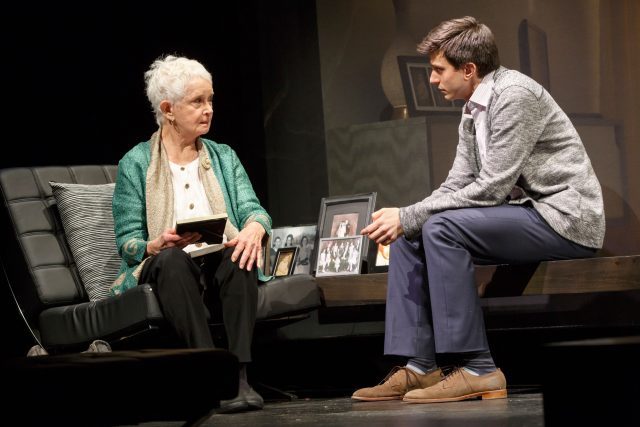
David Cromer’s revival of Tracy Letts’s 2003 Pulitzer Prize finalist, Man from Nebraska, is a gentle, beautifully poetic, sensitively drawn drama about one midwesterner’s crisis of faith and the effects it has on his family. Reed Birney, one of New York City’s finest, and busiest, actors, stars as Ken Carpenter, a fifty-seven-year-old insurance agent in Lincoln, Nebraska, who wakes up one morning in tears. “I don’t think . . . there’s a God. I don’t believe in Him anymore,” he tells his wife, Nancy (Annette O’Toole). “Maybe we’re just . . . science. Like they say. Accidental science.” As Nancy tries to comfort him, he adds, “Nobody listens when I pray. We’re not rewarded for what we do right — punished for what we do wrong.” Nancy invites the local pastor, Reverend Todd (William Ragsdale), to discuss the matter with Ken, ultimately suggesting that he take a solo vacation to clear his doubts. “Faith takes work. Sometimes you need a break,” Reverend Todd says. So Ken flees to London, where he was stationed when he was in the Air Force, leaving behind a confused Nancy, their upset daughter Ashley (Annika Boras), and his ailing mother, Cammie (Kathleen Peirce), who is in a nursing home. Generally calm and dependable, Ken gets involved in some very new experiences overseas as he sets out on a kind of Baptist rumspringa, meeting traveling businesswoman Pat Monday (Heidi Armbruster), poetry-reading bartender Tamyra (Nana Mensah), and cynical sculptor Harry (Max Gordon Moore), wondering if his life will ever be the same. Meanwhile, Reverend Todd’s father, Bud (Tom Bloom), decides to try to help Nancy through this difficult time.

(photo by Joan Marcus)

Tamyra (Nana Mensah) and Harry (Max Gordon Moore) show Ken (Reed Birney) a different side of life in Tracy Letts revival at 2econd Stage (photo by Joan Marcus)

Originally staged in 2003 at Steppenwolf, Man from Nebraska unfolds like a gentle symphony in its New York debut at 2econd Stage; in fact, Letts, who won the Pulitzer and Tony for August: Osage County as well as a Best Actor Tony for Who’s Afraid of Virginia Woolf?, calls the acts “movements” in the script. Cromer’s (Our Town, The House of Blue Leaves) staging is wonderfully precise and relatively simple, taking full advantage of 2econd Stage’s wide theater. Takeshi Kata’s set features only the most basic elements for each scene; lining the back and sides of the stage are a few beds, a church pew, a desk, small tables, two beds, a bar, and a sculptor’s area. Many scenes last only a few minutes, as the necessary element is brought forward in the dark; Keith Parham’s lighting then shines a spot on the actor(s) until the scene ends and the stage goes dark again until the next one. After intermission, the scenes are more like jazz solos, becoming longer and more complicated. Whether the scene depicts Ken and Nancy eating steak and mashed potatoes at a local restaurant, not saying much at all, or Ken pouring his heart out to Pat and Tamyra, everything is given equal weight and emotional impact. O’Toole (Hamlet in Bed, Cat People) plays Nancy with a slow simmer that threatens to boil as Ashley says some harsh things to her, but the show belongs to Tony, Obie, and Drama Desk winner Birney (The Humans, Circle Mirror Transformation), so quietly understated as Ken, whose last name, Carpenter, isn’t coincidentally the occupation of Jesus and Joseph. Troubled by his loss of faith, he is not quite everyman; he is very specifically the kind of heartlander who felt shunned by the Democrats and ended up voting for Donald Trump. He is undereducated, lacks culture (“I’ve never known anyone who read poetry,” he tells Tamyra after mispronouncing Pablo Neruda’s last name), and still uses such words as “colored” without realizing how offensive it is, especially to Tamyra, who is black. Letts and Cromer walk a very fine line between making Ken a sympathetic figure and a clueless redneck; in the hands of a different actor and director, this revival might not be nearly as successful, and timely, as it is.

IF I FORGET

(photo by Joan Marcus, 2017)

The Fischer family face more than they bargained for in Roundabout world premiere (photo by Joan Marcus, 2017)

Laura Pels Theatre
Harold and Miriam Steinberg Center for Theatre
111 West 46th St. between Sixth & Seventh Aves.
Tuesday – Sunday through April 30, $89
212-719-1300
www.roundabouttheatre.org

Right before seeing Steven Levenson’s If I Forget at the Laura Pels Theatre, I watched Ferne Pearlstein’s excellent The Last Laugh, a documentary about the appropriateness of jokes regarding Nazis and the Holocaust. Little did I know that Levenson’s stirring black comedy shatters boundaries by having one of its protagonists suggest that Jews should finally put the Holocaust behind them and move on. At one point, as much of the audience, including me, laughed at a religious-tinged joke, the woman seated to my left looked around and said, “That’s just not funny.” In the superb Roundabout world premiere, Jeremy Shamos is dazzling as cynical elitist Michael Fischer, a Jewish Studies professor who has been recommended for tenure; he is also writing a controversial book about Jewish history and heritage. It’s July 2000, and he and his non-Jewish wife, Ellen (Tasha Lawrence), a social worker, have just moved to Park Slope; their nineteen-year-old daughter, Abby, is on a birthright trip to the Holy Land. “I guess, I just still don’t really understand why we had to send our daughter to Israel in the most — the worst time to be in the Middle East in the last twenty-five years,” a rattled Michael says to Ellen. The Fischer family — Michael and Ellen; Michael’s younger sisters, Sharon (Maria Dizzia) and Holly (Kate Walsh); Holly’s second husband, the McCain-loving Howard (Gary Wilmes); and Holly’s son from her first marriage, teenage schlub Joey (Seth Michael Steinberg) — has gathered at the Washington, DC, home of patriarch Lou (Larry Bryggman) to celebrate the old man’s seventy-fifth birthday. Lou hasn’t been the same since the recent death of his wife, who needed special care, leading to arguments and estrangement among the siblings, with Sharon doing the vast majority of the daily, difficult work and Michael mostly staying away. “I’m not good in that sort of . . . I didn’t want to see her like that,” Michael says. “No one wanted to see her like that. We still did, though,” Sharon responds. Meanwhile, Holly has dreams of turning the family legacy, a property owned by Lou that for years has been operated as a bargain store by a Guatemalan family that pays below-market rent, into an interior decorating business for herself, but Sharon does not want to kick out Rodrigo and his clan, for more than one reason.

(photo by Joan Marcus, 2017)

The Fischers get some bad news in Steven Levenon’s IF I FORGET (photo by Joan Marcus, 2017)

If I Forget is in some ways the Jewish version of Stephen Karam’s The Humans, which was also staged at the Laura Pels (before moving to Broadway) and also features a tear-away two-floor set, although in this case Derek McLane’s rotates to reveal another side. Levenson (Dear Evan Hansen, The Unavoidable Disappearance of Tom Durnin) takes sharp aim at faith and religion in the twenty-first century with insightful dialogue that incites both the characters and the audience. “The things he says sometimes,” Holly tells Ellen, referring to Michael. “If I didn’t know him, honest to God, if I heard him on the street, I would think he was an anti-Semite. Honest to God.” When Michael, an avowed atheist, finds out that Abby is rediscovering her Jewish roots, he gets into a philosophical argument with Holly.

Michael: Why is everyone, why are we excited about this?
Holly: It’s wonderful. It’s keeping the tradition alive.
Michael: Which tradition, exactly?
Holly (to Ellen): He has to contradict everything.
Michael: It’s not her tradition. It’s not, our grandparents, Mom’s parents, do you think they spoke Hebrew? They didn’t even go to temple. They were educated people. They were enlightened, cosmopolitan people. Now everyone is suddenly, I don’t know what happened. What happened? Everybody’s religious now?
Holly: So what?
Michael: The head of my department — and this is a smart guy, this is not, this is a world-renowned scholar — he grew up like us: cheeseburgers, sweet and sour shrimp, Christmas trees — remember, we had that Christmas tree?
Holly: I love Christmas trees.
Michael: Now, his whole family, they’re shomer shabbos, they’re walking to synagogue on Saturday mornings.
Holly: Why does that upset you?
Michael: Because we spent the entire twentieth century trying to get away from that. And now you look around and everybody on the Upper West Side is reading books on Kabbalah and kosher sex, whatever the hell that is, and it’s just, what happened to the last hundred years?
Didn’t we already have this conversation? Didn’t we decide we were done with, you know, spirits in the sky?
Ellen: I think you could be a little more tolerant of other people’s beliefs.

Obie winner and Tony nominee Shamos (Engaged, Clybourne Park) is scintillating as Michael, all pent-up energy and intense nervousness, so sure he’s always right and quick to exploit others’ flaws; it’s one of those performances you can’t take your eyes off of, never knowing what he will say or do next. No matter how insensitive Michael gets, and he reaches some epic proportions, you still can’t help but root for him as he seeks tenure, tries to protect his daughter, and genuinely wants to do what’s best for the family. The entire cast is outstanding, from two-time Tony nominee Bryggman’s fading Lou — who delivers a captivating story about liberating Dachau at the end of WWII — to high school junior Seth Michael Steinberg’s Joey, a teenager who thinks he’s immune from the adults’ many problems. Walsh (Private Practice, Dusk Rings a Bell) and Dizzia (Belleville, In the Next Room [or the Vibrator Play]) make excellent foils, as the hoity Holly never misses a chance to take a shot at anyone and everyone while the steadfast Sharon plays martyr. Lawrence (The Whale, Proof) and Wilmes (Chinglish, Isolde) are both solid as the once-dependable in-laws who start showing cracks themselves. Shakespeare in the Park regular Daniel Sullivan (Prelude to a Kiss, Intimate Apparel) directs with a steady hand, maintaining a controlled chaos that could explode at any moment. Levenson has written a finely honed portrait of an American family coming apart at the seams as they examine the past and fear the future, with religion serving as the trigger. “Obviously you hate where you come from, you hate the culture that you come from,” Sharon tells Michael. They’re not exactly enamored with where they’re going either. Balancing humor and pathos, If I Forget — the title references both the phrase “Never Forget,” which Jews say about the Holocaust, as well as Alzheimer’s disease and personal and collective memory, is a powerful, very human play that captures the zeitgeist of Jewish life in the modern era, especially in a time when anti-Semitic hate crimes and mixed marriages are on the rise, religion drives so much political discourse, and the number of Holocaust survivors keep dwindling.