this week in theater

THE HAIRY APE

(photo by Stephanie Berger)

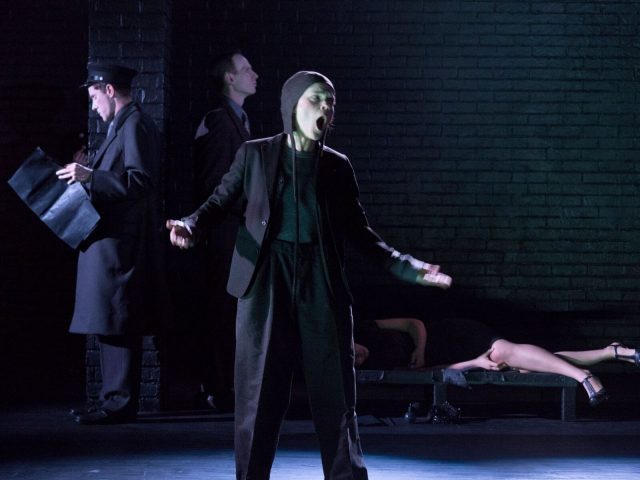
Robert “Yank” Smith (Bobby Cannavale) asserts himself in Richard Jones’s fierce revival of Eugene O’Neill’s THE HAIRY APE (photo by Stephanie Berger)

Park Ave. Armory, Wade Thompson Drill Hall
643 Park Ave. at 67th St.
Tuesday – Sunday through April 22, $60-$195
212-933-5812
www.armoryonpark.org

If it’s subtlety you’re looking for, you won’t find it in Eugene O’Neill’s 1922 play, The Hairy Ape, which continues through April 22 at the Park Avenue Armory in a grunting, ferocious production imported from the Old Vic. Written shortly after he won two Pulitzer Prizes (for Beyond the Horizon and Anna Christie), The Hairy Ape is O’Neill’s clarion call against capitalism, classism, socialism, slavery, and even ageism, focusing on the role of each unique person in contemporary American society. “I have tried to dig deep in it, to probe in the shadows of the soul of man bewildered by the disharmony of his primitive pride and individualism at war with the mechanistic development of society,” he said of his first draft of the play, which was partially inspired by the suicide of a friend of his, a stoker named Driscoll. Bobby Cannavale is fierce as Robert “Yank” Smith, a brute of a man who is the ersatz leader of a group of men working in the stokehole of an ocean liner, feeding coal to the fires to keep the vessel moving. Stewart Laing’s eye-opening conveyor-belt set rotates on a revolving, slightly elevated strip, half of which is in front of the audience, half of it behind. The men work in a long but not very high rectangular bright-yellow metal container that is open on one side, with two locked entrances at the end, one barred, as if they’re animals in a cage. Covered in black soot that looks like it will never come off, the men sing and play rough in drunken camaraderie, fully aware of their dank and dreary situation. “T’hell wit home. Where d’yuh get dat tripe? Dis is home, see?” Yank says in his tough New York City accent. A tipsy Long (Chris Bannow) rages, “Listen ’ere, Comrades! Yank ’ere is right. ’E says this ’ere stinkin’ ship is our ’ome. And ’e says as ’ome is ’ell. And ’e’s right! This is ’ell. We lives in ’ell, Comrades — and right enough we’ll die in it.” Old Paddy (David Costabile) remembers how things once were, when the men intertwined with nature, aboard clippers, working in the fresh air and sunshine. “’Twas them days men belonged to ships, not now,” he says. “’Twas them days a ship was part of the sea, and a man was part of a ship, and the sea joined all together and made it one.” But Yank is having none of that. “I belong and he don’t. He’s dead but I’m livin’,” he declares about Paddy. “Listen to me! Sure I’m part of de engines! Why de hell not!” Later, when the stokers are hard at work with their shovels, Mimi Jordan Sherin’s dazzling lighting, filled with ever-changing primary colors, turns the container red, as if the men are trapped in the fiery furnaces of hell itself.

Stewart Laing’s sculptural sets and Mimi Jordan Sherin’s colorful lighting look stunning in Park Avenue Armory (photo by Stephanie Berger)

Rich kid Mildred Douglas (Catherine Combs) tells her aunt (Becky Ann Baker) that she’s planning on visiting the stokers working down below (photo by Stephanie Berger)

Meanwhile, Mildred Douglas (Catherine Combs), the twenty-year-old heiress to the steel company for whom the stokers toil down below, is on the promenade deck of the ship, with her aunt (Becky Ann Baker). Dressed in white, Mildred walks through the oversized sans serif logo of her father’s company as she tells her aunt that she has arranged to go meet the men. The rich Mildred believes she can help them, make their lives better, but she also sees them merely as animals. “When a leopard complains of its spots, it must sound rather grotesque,” she says in a mocking tone. “Purr, little leopard. Purr, scratch, tear, kill, gorge yourself and be happy — only stay in the jungle where your spots are camouflage. In a cage they make you conspicuous.” Her visit doesn’t go very well — Yank can’t tell if she’s an angel or a ghost — but she awakens something deep inside him; he starts considering who he really is and where he truly belongs, leading to a string of absurdist adventures in New York City.

(photo by Stephanie Berger)

Stewart Laing’s sculptural sets and Mimi Jordan Sherin’s colorful lighting look stunning in Park Avenue Armory (photo by Stephanie Berger)

O’Neill pulls no punches in the play, pitting rich vs. poor, heaven vs. hell, old vs. young, male vs. female, and the concept of “clean” vs. “dirty.” His stage notes compare the men’s camaraderie to “the bewildered, furious, baffled defiance of a beast in a cage” and calls them “chained gorillas.” Cannavale (Boardwalk Empire, The Motherfucker with the Hat) is explosive as Yank — a role previously played onstage by Paul Robeson and Willem Dafoe and on the silver screen by William Bendix — whether taking a moment and posing as Rodin’s “Thinker” or pounding his chest, expressing his mental and physical superiority. The container can’t contain him; when Yank does venture out, Laing’s objects disappear and instead Yank is faced with a large, dark, unknown space, as Olivier Award–winning theater and opera director Jones (Too Clever by Half, The Illusion) takes full advantage of the massive Wade Thompson Drill Hall while adding surreal elements. In addition, composer Sarah Angliss contributes an immersive sound design, making the audience feel as if it is trapped as well. Not everything works; for example, the face of Mildred’s father shows up in a few strange places, and it probably wasn’t necessary. Costabile excels as Paddy, waxing poetic as he drinks himself into oblivion. The cast also includes Cosmo Jarvis as a prisoner, Mark Junek as the second officer, Henry Stram as a socialist secretary, and Tommy Bracco, Emmanuel Brown, Nicholas Bruder, Jamar Williams, and Amos Wolf as stokers. (It would be unfair to give away who Phil Hill portrays.) The play features existential movement by choreographer Aletta Collins (Anna Nicole, La Traviata) and dance captain (and ensemble member) Isadora Wolfe, starts and stops that are curious but effective. The seats, arranged in rising rows against the east wall of the drill hall, are all bright yellow, matching the container, making the audience complicit in O’Neill’s marvelous manipulations. The word “yellow” is used several times in the play, primarily representing the fear that lies in the heart of humanity, particularly when it’s up against dehumanizing industrial progress; Yank calls both Long and Paddy yellow, as well as the unseen engineer blowing a whistle that means the men have to get back to work. “He ain’t got no noive. He’s yellow, get me?” Yanks says. “All de engineers is yellow. Dey got streaks a mile wide. Aw, to hell wit him!” The Hairy Ape might not be one of O’Neill’s most popular plays — although he thought it was his best — but it’s a treat to see it in such a dazzling, unpredictable version, powered by a bold and brutal lead performance.

TICKET ALERT: AN EVENING WITH GEORGE TAKEI

(photo courtesy George Takei)

George Takei will be at BAM on May 1 to discuss social media, online activism, LGBTQ rights, and his life and career (photo courtesy George Takei)

Who: George Takei, Jay Kuo
What: “Where No Story Has Gone Before”: George Takei in conversation with Jay Kuo
Where: BAM Howard Gilman Opera House, 30 Lafayette Ave. between Ashland Pl. & St. Felix St., 718-636-4100
When: Monday, May 1, $28-$75, 7:30
Why: On April 1, social media sensation and Star Trek favorite George Takei announced that he was running for Congress, moving out of LA and to Visalia, California, with his husband to make a grab for embattled Republican representative Devin Nunes’s seat in 2018. It turned out that it was all an April Fools’ Day setup to endorse Jon Ossoff, who is a candidate in a special election in Georgia on April 18. But it’s no joke that Takei, who will turn eighty on April 20, will be at BAM on May 1 for the special presentation “Where No Story Has Gone Before,” where he will talk about his life and career with theater composer Jay Kuo, who wrote the book, music, and lyrics for Allegiance, the Broadway musical inspired by Takei’s experiences in a Japanese internment camp during WWII. Takei played Sam Kimura in the show; the portrayer of Hikaru Sulu is currently appearing as the Reciter in Classic Stage Company’s revival of Stephen Sondheim’s Pacific Overtures. Takei and Kuo will also explore activism and the internet; with millions of followers, Takei is a major figure in the fight for social justice, marriage equality, and LGBTQ rights. Meanwhile, Kuo (Upwardly Mobile, Insignificant Others, Worlds Apart), the head of Team Takei and the chief creative officer at the Social Edge, recently tweeted, “The Ministry has fallen. Obamadore has left Hogwarts. Bellatrix Conway shrieks lies. Elizabeth McGonnowarren is holding back the Dementors.” As Takei has been known to say, “Oh my!”

SWEAT

SWEAT

A local bar serves as the main set in Broadway production of Lynn Nottage’s SWEAT

Studio 54
254 West 54th St.
Tuesday – Sunday through October 1, $59-$149
212-719-1300
sweatbroadway.com

Pulitzer Prize-winning playwright Lynn Nottage at last makes her Broadway debut with the timely Sweat, as powerful and searing at Studio 54 as it was last year at the Public Theater. The two-act play takes place in 2000 and 2008 in Reading, Pennsylvania, where the futility of the American dream is on display. The play opens with a scene in 2008, as former best friends Chris (Khris Davis) and Jason (Will Pullen) have been released from prison after eight years behind bars for an undisclosed crime. Flashback to 2000, when factory workers Cynthia (Michelle Wilson), Chris’s mother, who’s married to the drug-addicted Brucie (John Earl Jelks); Tracey (Johanna Day), Jason’s mother; and Jessie (Alison Wright), a divorced drunkard, are celebrating a birthday in a bar run by former factory worker Stan (James Colby) and his bus boy, Oscar (Carlo Albán). When a front-office job at the factory becomes available, Cynthia shows an interest in getting off the floor, leading to dissension in the ranks, jealousy, envy, and, ultimately, violence.

SWEAT

Tracey (Johanna Day), Cynthia (Michelle Wilson), and Jessie (Alison Wright) weigh their options over pints of beer in SWEAT

Sweat has transferred exceedingly well from the Public to Broadway, with only very minor tweaks to the script by Nottage (Intimate Apparel, Meet Vera Stark), while the direction by Kate Whoriskey (How I Learned to Drive, The Piano Teacher), who also helmed Nottage’s Ruined, is even sharper. The only cast change is Wright (The Americans), who adds more depth to the role of Jessie; Lance Coadie Williams also returns as a parole officer assigned to Chris and Jason, along with John Lee Beatty’s expertly designed rotating set. (All of the actors give strong performances, but Day stands out as a single mother who is willing to see only so far in front of her.) The play gets right to the heart of what has been happening in the United States during and after the recent presidential campaign, as Democrats and Republicans continue to argue over jobs, particularly in the Rust Belt. Nottage did a lot of firsthand research in Reading, the steel and textile town that was ranked as the most impoverished city in America in 2011 and has remained in the top ten ever since, with extremely high unemployment and low education leading to a poverty rate of more than forty percent. She met with many of the struggling people there, encountering feelings of desperation, sadness, and betrayal, and turned their poignant stories into Sweat, a fierce and fiery work with plenty of heart and soul, a brilliant microcosm of a deeply divided nation where hardworking people have to live with choices no one should be forced to make. [Ed. note: Sweat has just earned Nottage her second Pulitzer Prize, announced on April 10; she also won in 2009 for Ruined, making her the first female playwright to win multiple Pulitzers.]

AMÉLIE, A NEW MUSICAL

(photo by Joan Marcus)

French film favorite AMÉLIE is now a musical at the Walter Kerr Theatre (photo by Joan Marcus)

Walter Kerr Theatre
219 West 48th St. between Broadway & Eighth Ave.
Tuesday – Sunday through October 1, $79-$26
www.ameliebroadway.com

Jean-Pierre Jeunet and Guillaume Laurant’s Amélie is one of the most imaginative romantic comedies of the twenty-first century, an endlessly charming and surprising tale of a lonely young woman who, after an unfortunate childhood, moves to Paris, where she tries to help make everyone around her happy. Her story is told with visual magic and a carnivalesque soundtrack that would seem to lend itself to becoming a musical. Unfortunately, despite a promising cast and crew, the Broadway adaptation that opened at the Walter Kerr Theatre last week lacks all the exuberant and mysterious joi de vivre that made the film, which received five Oscar nominations, such a critical and popular success. Tony nominee Phillipa Soo (Hamilton, Natasha, Pierre, and the Great Comet of 1812) stars as the adult Amélie Poulain, who was played with such wide-eyed wonder in the film by Audrey Tatou. (Savvy Crawford is the young Amélie.) Soo has a lovely singing voice, but the motivations for her character’s quirky, beguiling behavior are lost as she interacts with such oddballs as a blind beggar (David Andino), her cold, rigid father (Manoel Felciano), unpublished writer Hipolito (Randy Blair), café owner Suzanne (Harriet D. Foy), airline hostess Philomene (Alison Cimmet, who also plays Amélie’s mother), plumber Joseph (Paul Whitty), waitress Gina (Maria-Christina Oliveras), local grocer Collignon (Tony Sheldon) and his somewhat simple employee, Lucien (Heath Calvert), Fluffy the giant goldfish (Whitty), and a garden gnome (Andino). There’s also a rock star based on Elton John (Blair), but we’re trying to forget we ever saw that.

(photo by Joan Marcus)

Nino (Adam Chanler-Berat) and Amélie (Phillipa Soo) meet at a photo booth in AMÉLIE (photo by Joan Marcus)

Three of the most touching parts of the film get lost in the overstaging by Tony-winning director Pam MacKinnon (Clybourne Park, An American in Paris, Prelude to a Kiss): when Amélie finds a small metal box in her apartment and tries to track down its rightful owner (Felciano); develops a friendship with the Glass Man, Dufayel (Sheldon), a brittle painter re-creating Renoir’s “Luncheon of the Boating Party”; and is enchanted by Nino (Adam Chanler-Berat), a young man who collects discarded prints from a photo booth. The songs, meanwhile, by Daniel Messé (music and lyrics) and Nathan Tysen (lyrics), along with Sam Pinkleton’s uninspired choreography and David Zinn’s confusing set, are trite and unmemorable, making the story much more kid friendly (although book writer Craig Lucas does leave in Amélie’s orgasm joke). What the production seems to miss is that Amélie is not merely an adorable gamine doing cute things but a complex character living in a complicated, broken world that she is trying to fix; unfortunately, she can’t fix the musical itself.

LATIN HISTORY FOR MORONS

(photo by Joan Marcus)

John Leguizamo looks back at his cultural heritage in LATIN HISTORY FOR MORONS (photo by Joan Marcus)

Anspacher Theater, the Public Theater
425 Lafayette St. at Astor Pl.
Tuesday through Sunday through April 28, $50-$100
212-539-8500
www.publictheater.org

Last July, Iowa Republican congressman Steve King claimed that only white Christians have made significant contributions to Western civilization throughout time. Emmy- and Obie-winning actor and comedian John Leguizamo sets King — and the rest of us — straight in his latest one-man show, Latin History for Morons, running at the Public’s Anspacher Theater through April 28. In such previous works as Mambo Mouth, Spic-O-Rama, Freak, Ghetto Klown, and Sexaholix . . . A Love Story, the Colombia native inhabited multiple characters to explore what it was like growing up in Queens and, eventually, reaching success as an actor. He also plays numerous roles in Latin History, but for the most part he’s just himself, a concerned father, upset that he knows so little about his heritage. His shy, sensitive teenage son, who is being bullied by a white classmate, is assigned to write a paper on a hero, and Leguizamo decides he will help find a historical Latino the boy can be proud of. Dressed like a professor, Leguizamo stomps around Rachel Hauck’s messy set, laden with boxes of books, papers and articles taped and pinned to the back wall, and, in the center, a two-sided blackboard where he shares surprising facts about the Taíno, the Aztecs, the Incas, and the Maya as well as Christopher Columbus, Hernán Cortés, and Moctezuma II. Meanwhile, he keeps trying to help his son, whom he affectionately calls “honey” and “buddy.” Leguizamo is embarrassed that he has no quick comebacks when he confronts the bully’s father, who has some bully tactics of his own, so the project is as much for himself as for his son.

(photo by Joan Marcus)

John Leguizamo sets the record straight on the impact of Latinos throughout history in latest one-man show (photo by Joan Marcus)

Leguizamo, who has also appeared in such films as Carlito’s Way, Super Mario Bros., Summer of Sam, and To Wong Foo, Thanks for Everything! Julie Newmar in addition to voiceover roles in such children’s movies as the Ice Age series, occasionally breaks into choppy native dances when discussing older civilizations, and his interactions with the audience are hit or miss. (Some audience members chime in on their own when they hear something specific about their heritage.) He talks about the importance of books and education, using chalk and an eraser to keep things lively; in fact, when he dances or pounds himself in the chest, a white chalk residue disperses into the air, as if he’s getting rid of the dust surrounding these facts. This is a more mature Leguizamo, though no less unpredictable and funny, as at home referencing Howard Zinn and George Santayana as he is making a Kardashian joke (and a darn good one it is). As in his previous shows, he’s not afraid to get deeply personal; he even portrays his own psychiatrist as he deals with some difficult issues. He’s also more conscious than ever about word choice, carefully avoiding certain terms now considered insensitive and derogatory. Directed by Tony Taccone (Bridge & Tunnel, Brundibar) of Berkeley Repertory Theatre, where the show was workshopped as part of the Ground Floor incubator program, Latin History for Morons is another triumph for Leguizamo, who once again displays his unique way of looking at the world. “I’m getting too old for this shit,” the still-youthful fifty-two-year-old Leguizamo says at one point. As his latest one-man show ably displays, he is most certainly not too old for this, and neither are we.

HOW TO TRANSCEND A HAPPY MARRIAGE

HOW TO TRANSCEND

Polyamory is front and center in Sarah Ruhl’s HOW TO TRANSCEND A HAPPY MARRIAGE (photo by Kyle Froman)

Lincoln Center Theater at the Mitzi E. Newhouse
150 West 65th St. between Broadway & Amsterdam Ave.
Tuesday – Saturday through May 7, $87
212-362-7600
www.lct.org

“I think in the polyamory movement, you sort of just — accept — the person’s sexual predilections,” Jane (Robin Weigert) says early on in Sarah Ruhl’s How to Transcend a Happy Marriage. “Is it a movement now?” Paul (Omar Metwally) asks. “I think so. There’s a book — called The Ethical Slut. It tells you how to do it,” Michael (Brian Hutchison) replies (referring to an actual book). Two New Jersey couples learn quite a lesson about the “movement” when a polyamorous triad comes over for New Year’s Eve in this extremely clever play, running at Lincoln Center’s Mitzi E. Newhouse through May 7. Married breeders Jane and Michael and George (Marisa Tomei) and Paul are best friends, but they’re not exactly Bob and Ted and Carol and Alice. When legal aid lawyer Jane tells the others about a polyamorous temp in her office who lives with two men and slaughters her own meat, they all decide that they have to meet. So on New Year’s Eve in a quaint suburban home, the beautiful, free-spirited Pip (Lena Hall), brash mathematician David (Austin Smith), and stoned slacker Freddie (David McElwee) discuss hunting, Pythagoras, music theory, Twelfth Night, “radical honesty,” impenetrable pistachios, harmony, and mermaids over vegan hash brownies that soon have Jane, Michael, George, and Paul so enraptured with the alluring Pip that they’re ready to do just about anything with her and her two lovers — but they’re not prepared for what they have to face the next morning, and potentially the rest of their lives.

(photo by Kyle Froman)

Lena Hall stars as a polyamorous ingénue in new Sarah Ruhl play at Lincoln Center (photo by Kyle Froman)

As the audience enters the theater, a skinned animal hangs from the ceiling of David Zinn’s living-room set. A woman, whom we later learn is Pip, walks up to the sacrificial object, takes it down, and carries it offstage, cradling it like it’s a baby. It’s an apt metaphor for what follows, as the conventional world of straight married couples gets butchered, in a way. Paul is an architect relegated to bathroom renovation. George (short for Georgia) became a junior high school teacher instead of getting her PhD in classics. Michael used to be in a rock band but now writes jingles. And Jane regrets losing what she once was. “Life with a teenager is a series of reprimands until your personality disappears,” she says. Believing they’re all stuck in a rut, they are fascinated by the seemingly carefree world that Pip, David (pronounced dah-VEED), and Freddie live in, even if they don’t understand it. “Our language is limited and so our imagination is limited,” David explains, referring to most of humanity. George is particularly ready to break out; she wants to sing “Wild Thing” and compares the New Year’s Eve party to the “wild rumpus” in Maurice Sendak’s Where the Wild Things Are, telling the audience directly, “It was dirty but I felt sort of gloriously clean.” George and Paul and Michael and Jane might have thought they were happy, but Pip represents a spirituality that has evaded them. (Even the brand name of the bow George uses in the forest is Spirit.) Pip is studying to be a body worker, but she gets inside people’s minds as well, with a touch of magic.

Two couples deal with the fall-out from a crazy New Year’s Eve party in HOW TO TRANSCEND A HAPPY MARRIAGE (photo by Kyle Froman)

Two couples deal with the fall-out from a crazy New Year’s Eve party in HOW TO TRANSCEND A HAPPY MARRIAGE (photo by Kyle Froman)

“Really polyamory takes all the fun out of adultery,” Paul says playfully, but two-time Pulitzer finalist Ruhl (Stage Kiss, In the Next Room or the vibrator play) digs much deeper than that relatively simplistic aside. Ruhl and director Rebecca Taichman (Marie Antoinette, The Oldest Boy), who have previously collaborated on Stage Kiss, The Clean House, Dead Man’s Cell Phone, and Orlando, neither defend nor attack polyamory while dealing with such issues as personal and familial responsibility, shame, and sexuality throughout one’s life. The cast is uniformly strong, but Tony winner Hall (Hedwig and the Angry Inch, Kinky Boots) does the heavy lifting with an infectious lightness; in order for the play to work, the audience must fall in love with her just as all the characters do, and she makes it nearly impossible not to be drawn into her youthful enthusiasm. The second act is much darker than the first and sometimes goes astray, particularly when Pip takes George hunting and things don’t turn out quite as planned, and thank goodness the show doesn’t immediately end after Michael sings one of his songs. Ruhl still has a bit more to say, bringing it all back home with a sweetly meaningful finale.

ARTHUR MILLER’S THE PRICE

(photo by Joan Marcus)

Gregory Solomon (Danny DeVito) seeks to make a deal with brothers Victor (Mark Ruffalo) and Walter Franz (Tony Shalhoub) in THE PRICE (photo by Joan Marcus)

American Airlines Theatre
227 West 42nd St. between Broadway & Eighth Ave.
Tuesday – Sunday through May 14, $69-$169
212-719-1300
www.roundabouttheatre.org

The past looms over a family like so much old furniture in Terry Kinney’s edge-of-your-seat adaptation of Arthur Miller’s 1968 drama, The Price. The last few years have seen a resurgence of Miller’s work in conjunction with the 2015 centennial of the native New Yorker’s birth, including Ivo van Hove’s dual versions of The Crucible and A View from the Bridge on Broadway in 2016 and Signature’s Incident at Vichy and New Yiddish Rep’s Death of a Salesman off-Broadway in 2015 (not to mention Mike Nichols’s 2012 Great White Way revival of Salesman with Philip Seymour Hoffman). Underrated and underseen, The Price is a powerhouse family tale that, in the hands of Kinney and a superb cast, proves to be one of Miller’s masterpieces. It’s 1968, and patrolman Victor Franz (Mark Ruffalo) has returned to the Manhattan home where he grew up. The building is being torn down, so he is selling off the old furniture, much of which holds deep-set memories for him, especially as he approaches fifty and considers retirement. The room is packed with tables, chairs, dressers, lamps, sofas, and more, with dozens of pieces hanging on the walls and from the ceiling, as if ghosts with their own stories to tell. (Miller’s introductory note explains, “The room is monstrously crowded and dense, and it is difficult to decide if the stuff is impressive or merely overheavy and ugly,” a concept that is nailed by set designer Derek McLane.) Victor is joined by his wife, Esther (Jessica Hecht), who presses him to bargain for a good deal and not just give the furniture away; although she loves him, she is disappointed in the choices he has made, especially involving money and career, and now, with their son off at MIT, she wants more out of life. “Just because it’s ours why must it be worthless?” she says to Victor, who does not think the furniture has much financial value, like the rest of his life.

Tony Shalhoub, Jessica Hecht, and Mark Ruffalo listen to director Terry Kinney at rehearsal of THE PRICE (photo by Jenny Anderson)

Tony Shalhoub, Jessica Hecht, and Mark Ruffalo listen to director Terry Kinney at rehearsal of THE PRICE (photo by Jenny Anderson)

Soon, making his way up the steps, is eighty-nine-year-old Russian-Yiddish furniture appraiser Gregory Solomon (Danny DeVito), a shrewd businessman who can’t help but share his unique insights about existence. “It was very good stuff, you know,” Victor says about the furniture, to which Solomon replies, “Very good, yes . . . I can see. I was also very good; now I’m not so good. Time, you know, is a terrible thing.” A moment later he adds, “When do they call me? It’s either a divorce or somebody died. So it’s always a new story. I mean it’s the same, but it’s different.” Victor says, “You pick up the pieces.” Solomon adds, “That’s very good, yes. I pick up the pieces. It’s a little bit like you, I suppose.” In the middle of their negotiation — with Victor growing more and more frustrated while Solomon cannily avoids naming a price — Victor’s long-estranged brother, Walter (Tony Shalhoub), a dapper, erudite, pristinely dressed surgeon, enters, throwing a wrench into the proceedings as the siblings try to relate to each other after sixteen years of silence between them following their father’s death. Solomon serves as a kind of intermediary, even when Esther returns and they all start reaching deep inside and arguing over past events that shaped their very different lives.

(photo by Joan Marcus)

Estranged siblings Walter (Tony Shalhoub) and Victor (Mark Ruffalo) reconnect as Ester (Jessica Hecht) looks on (photo by Joan Marcus)

As in Tennessee Williams’s The Glass Menagerie, the absent family patriarch hovers over everyone and everything; in Menagerie, it’s an unseen portrait of Amanda Wingfield’s husband, while in The Price, it’s the chair, front and just off center, where Mr. Franz would sit. Over the course of the play, each character sits in it, feeling its power, and its lacking. McLane’s imposing set allows the cast to weave through it intricately as they come upon items that spark remembrances, from an old laughing record to an épée to a harp. The nimble Hecht (A View from the Bridge, The Assembled Parties), the ever-elegant Shalhoub (Act One, Golden Boy), and the brusque Ruffalo (This Is Our Youth, Awake and Sing!), Tony nominees all, form an intimate trio, three pros at the top of their game, each character burdened with faded dreams, while DeVito makes an impressive Broadway debut, hanging right with them, injecting humor and smart sarcasm as the old dealer who just might be in it for the thrill of the battle more than any potential profit. Steppenwolf cofounder Kinney (One Flew over the Cuckoo’s Nest, reasons to be pretty) gets right to the heart of the play, examining the choices we all make and the costs, visible and hidden, that come with them, the prices, both financial and not, we pay as we continue through life with differing views of what is of value and what is worth sacrificing. In the first act, just as Solomon and Victor have apparently reached an agreement, a price, Solomon has trouble parting with the money, while Victor keeps getting distracted as the bills are slowly put into his hand. He spends the rest of the play grasping an incomplete sum, as if he is perpetually caught in the middle, agonizing over the choices he made when he was younger as well as those he is making today, a lost soul who has still not come to grips with his past. The price is both literal and figurative, haunted by the ever-present shock of buyer’s remorse. “What have you got against money?” Solomon asks Victor just before naming his price. In this glorious revival, money, of course, is never the answer.