this week in theater

THE GOVERNMENT INSPECTOR

(photo by Carol Rosegg)

Red Bull Theater puts a wacky contemporary spin on The Government Inspector (photo by Carol Rosegg)

Red Bull Theater
The Duke on 42nd St.
229 West 42nd St. between Seventh & Eighth Aves.
Tuesday – Sunday through June 24, $80-$100
www.redbulltheater.com
dukeon42.org

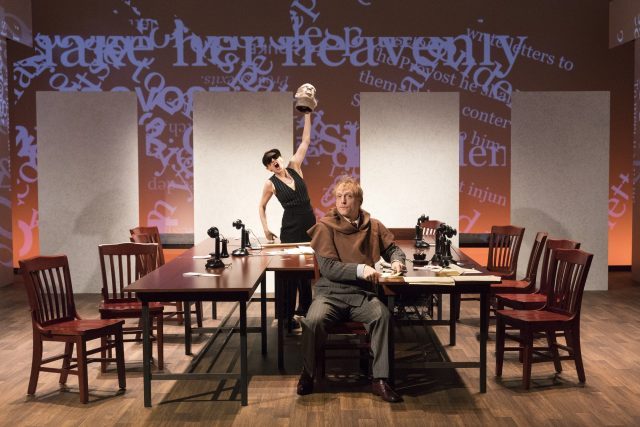
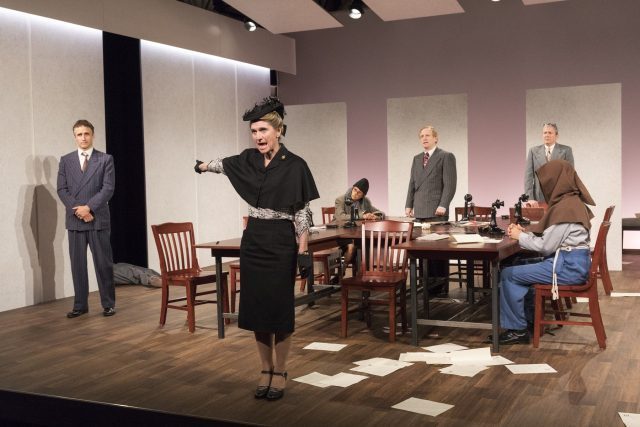
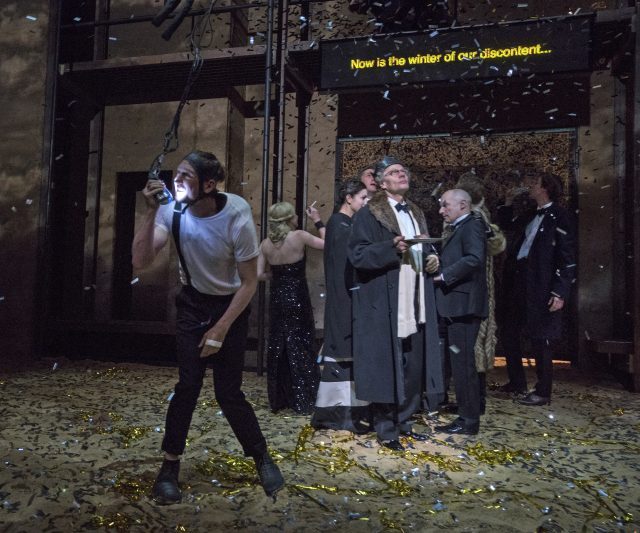
Nikolai Gogol meets the Marx Brothers, Woody Allen, Monty Python, and the Three Stooges in Red Bull Theater’s latest terrific farce, The Government Inspector, which opened last night at the Duke on 42nd St. “Do me a favor; send me some subject, comical or not, but an authentically Russian anecdote. My hand is itching to write a comedy,” Gogol wrote to Alexander Pushkin on October 7, 1835. “Give me a subject and I’ll knock off a comedy in five acts — I promise, funnier than hell. For God’s sake, do it. My mind and stomach are both famished.” Pushkin (Boris Godunov, Eugene Onegin) provided Gogol (Taras Bulba, “The Diary of a Madman”) with an anecdote based on something than happened to him, and the result was Revizo, a wild and wacky sociopolitical slapstick parody that uncovers corruption both in a small Russian village and in humanity itself. Jeffrey Hatcher’s adaptation never misses an opportunity to capitalize on a bad pun or raunchy joke as the leaders of the town learn that a government inspector has arrived from Moscow, prepared to look into their nefarious doings, which are many, despite Mayor Anton Antonovich’s (Michael McGrath) declaration, “And just when things were going so well!” The opening scene, which takes place in the mayor’s study, a crowded room at the lower right of Alexis Distler’s two-story, three-compartment set, introduces the town brain trust, consisting of the bribe-happy mayor (“It’s a bribe if you eat it, it’s a bribe if you drink it, it’s a bribe if you spend an hour with it and it tells you it’s always been attracted to powerful men but has another appointment at eight!”), the school principal (David Manis), who cannot fire any of his terrible teachers (“Last month I found the poetry instructor in the lavatory with three farm girls and a goat, and I had to write him an apology because I didn’t knock”), a judge (Tom Alan Robbins) whose court is full of shit (“That’s a matter of opinion,” he tells the mayor, who responds, “I’m talking about the geese your bailiff is raising in the jury box! The place is hip high in dung”), and a hospital director (Stephen DeRosa) whose facility has no patients and a doctor (James Rana) who speaks a language no one understands. Meanwhile, the playfully effete postmaster (Arnie Burton) has a habit of opening all of the town’s mail, and not always delivering it, preferring to spread malicious gossip.

(photo by Carol Rosegg)

Ivan Alexandreyevich Hlestakov (Michael Urie) and Osip (Arnie Burton) take advantage of an opportunity in Jeffrey Hatcher’s update of Nikolai Gogol (photo by Carol Rosegg)

Entering the fray are the bumbling sort-of-twins Bobchinksy (Ryan Garbayo) and Dobchinsky (Ben Mehl), Gogol’s Rosencrantz and Guildenstern, who incorrectly identify Ivan Alexandreyevich Hlestakov (Michael Urie) as the much-feared inspector from Saratov. Actually a low-level clerk and luckless gambler pretty boy who is trying to kill himself, Hlestakov is first seen brandishing a gun in a quaint room in the inn, on the bottom left side of the stage. “I’m sorry to leave you like this, Osip. You’re my only friend, you know that?” he says to the raggedy man (Burton) with him. Osip responds, “I’m not your friend, I’m your servant.” Hlestakov replies, “Well, you’ve behaved like a friend,” to which Osip concludes, “You’ve misunderstood the signals.” Not going through with suicide, Hlestakov instead decides, “No more drinking, no more gambling, no more the pretense that I’m better than I am. From this point forth, I shall lead a simple, honest, courageous life.” But when the mayor and his sycophants start treating him like royalty — and the mayor’s wife, Anna Andreyevna (two-time Tony nominee Mary Testa), and daughter, Marya (Talene Monahon), both show romantic interest in him — well, Hlestakov opts to let them all swoon over him, and, of course, high jinks ensue as the action moves to the top level of the stage, the elegant sitting room in the mayor’s house.

(photo by Carol Rosegg)

Anna Andreyevna (Mary Testa), Mayor Anton Antonovich (Michael McGrath), and Ivan Alexandreyevich Hlestakov (Michael Urie) share a toast and more in Red Bull adaptation (photo by Carol Rosegg)

Hatcher (Tuesdays with Morrie, The Turn of the Screw) and Red Bull founding artistic director Jesse Berger (Volpone, ’Tis Pity She’s a Whore) keep the jokes and gags flying at warp speed over two hours (with intermission); some are repetitive or fall flat, but the vast majority hit their targets, which include health care, education, the court system, surveillance, class distinction, poverty, power, the institution of marriage, and government itself, with more than a few laughs coming at the expense of the current U.S. administration. Tony winner McGrath (Nice Work If You Can Get It, Spamalot) and Drama Desk winner Urie (Buyer & Cellar, The Temperamentals) lead the charge in Tilly Grimes’s fab costumes; the former channels Nathan Lane, with big, boisterous bloviating, while the latter, channeling Jim Carrey, is utterly charming, displaying quite a knack for physical comedy. Burton nearly steals the show as both the postmaster and Osip, who develops a direct rapport with the audience, while Mary Lou Rosato, Luis Moreno, and Kelly Hutchinson pop up in multiple smaller, wonderfully ridiculous, roles. “I became a prey to fits of melancholy which were beyond my comprehension,” Gogol once confessed. “In order to get rid of them I invented the funniest things I could think of. I invented funny characters in the funniest situations imaginable.” In today’s exhausting world, The Government Inspector is just the thing to rid us of those fits of melancholy we all experience from time to time, perhaps more often of late.

SACHA YANOW: DAD BAND

Sacha Yanow will present one-woman show, Dad Band, at Joes Pub on June 4 (photo by Amanda Ryan)

Sacha Yanow will present one-woman show, Dad Band, at Joe’s Pub on June 4 (photo by Amanda Ryan)

Joe’s Pub
425 Lafayette St. by Astor Pl.
Sunday, June 4, $15, 9:30
212-539-8778
www.publictheater.org
www.sachayanow.com

New York-based actor and artist Sacha Yanow portrays her father in Dad Band, playing at Joe’s Pub on June 4 before heading to the Festival Theaterformen in Hannover, Germany. Yanow, whose previous work includes Silent Film and The Prince, will don a mustache, glasses, and button-down shirts to try to better understand her father, taking on the patriarchy and white supremacy through songs from the 1950s and ’60s, motivational speeches, dance, and footage of her dad’s appearance on To Tell the Truth in the 1970s. Yanow, who has collaborated with a wide range of artists, including Karen Finley, Dynasty Handbag, Sarah Michelson, and Elisabeth Subrin, and is the director of the Art Matters Foundation, wrote and performs the show, which features costume design by Signe Mae Olson. An early version of the piece premiered in November 2015 at the New Museum as part of the “Temporary Arrangements” series curated by Wynne Greenwood.

STEREOPTIK: DARK CIRCUS

(photo ©JM_BESENVAL)

STEREOPTIK will present the live-animation piece Dark Circus at HERE May 30 through June 4 (photo © JM Besenval)

HERE
145 Sixth Ave. at Dominick St.
May 30 – June 4, $25
212-647-0202
www.here.org

HERE’s Dream Music Puppetry Program has something special planned this week: Dark Circus, a multimedia production from innovative French company STEREOPTIK, running May 30 through June 4. Founded in 2011 by Romain Bermond and Jean-Baptiste Maillet, STEREOPTIK (The Suit Is Too Big, Paid Leave) creates live animated shows projected on screens but without actual film, whether digital or analog. Inspired by silent cinema, Bermond and Maillet serve as illustrators, musicians, projectionists, sound designers, lighting designers, and cameramen. For the fifty-five-minute Dark Circus, based on an original story by Pef and in collaboration with Frédéric Maurin, they are using animations made offstage for the first time. This is no mere Ringling Bros. and Barnum & Bailey Circus but an experimental wonderland with surprises galore, brought to life through shadow puppetry, ink drawings, sand animation, and unusual objects by Bermond and Maillet, who sit on either side of the screen, in full view of the audience as they work their theatrical magic.

BUILDING THE WALL

(photo by Carol Rosegg)

Rick (James Badge Dale) tells his harrowing story to Gloria (Tamara Tunie) in Robert Schenkkan’s Building the Wall (photo by Carol Rosegg)

New World Stages
340 West 59th St. between Eighth & Ninth Aves.
Wednesday – Monday through July 9, $32-$97
buildingthewallplay.com
newworldstages.com

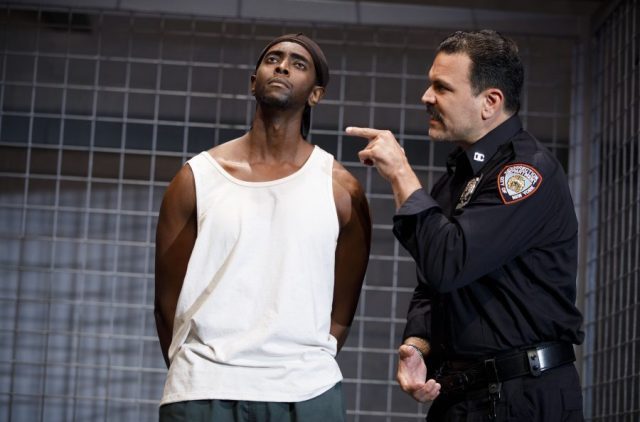
James Badge Dale is electrifying as a prisoner in 2019 telling his story to a historian in Robert Schenkkan’s gripping, of-the-moment Building the Wall, which opened last night at New World Stages. Dale is Rick, a white convict relegated to solitary confinement and facing possible execution. His lawyer advised him not to take the stand at trial, so he has now decided to share the details of his frightening tale with Gloria (Tamara Tunie), who is considering writing a book about him. Both in their forties, Rick and Gloria are in a small prison room, a table at the center separating them. (The claustrophobic set is by Antje Ellermann.) “Why are you here?” Rick asks. Gloria responds by remembering a racist incident from her childhood, on the Fourth of July when she was six and a white police officer said something deeply offensive to her. “Was he just a, a ‘man of his time,’ like the nose on his face, his racism so much a part of him that he wasn’t even aware of it anymore? Or did he know exactly what he was doing and there was a special thrill in taking this little black child’s racial innocence?” she says. It’s a microcosm of the questions surrounding Rick’s incarceration, as well as much of what is going on in America and around the world, particularly since WWII. Rick, a native Texan whose family moved around a lot because his abusive father was in the air force, wanted to be an architect, but he quit school early and eventually joined the army because of 9/11. As he describes the next events in his life, leading up to the horrific crimes he committed, he makes it clear that every step of the way he worked hard to avoid problems, never intending for things to go so wrong. “You had a situation that got out of control, obviously. Why?” he asks rhetorically in his defense. “Chaotic conditions resulted from a lack of infrastructure, absurd overcrowding, inadequate training, poor discipline, and confusion over mission goals. . . . [The brass] tossed a lotta little people into the trash and then congratulated themselves.” But Gloria refuses to let him get off so easy, making him confront the harsh realities of what he became involved in. “I’m just trying to understand, Rick, given what happened,” Gloria says, making him go over every detail. “I’m just a guy, all right, a regular guy in extraordinary circumstances trying to do the best he can with very limited resources,” Rick responds. But there’s no defense for what ultimately occurred.

(photo by Carol Rosegg)

Rick (James Badge Dale) and Gloria (Tamara Tunie) explore horrific events in searing political play at New World Stages (photo by Carol Rosegg)

Pulitzer and Tony winner Schenkkan (Lewis and Clark Reach the Euphrates, The Kentucky Cycle), who has also been nominated for two Emmys (The Pacific) and an Oscar (Hacksaw Ridge), wrote Building the Wall in a weeklong “white hot fury” shortly before the 2016 presidential election. The play touches upon numerous hot-button issues, from race, religion, and education to the privatization of prisons, false flags, and illegal immigration, from NAFTA, NATO, and attorney general Jeff Sessions to Benghazi, Muslim terrorists, and border security. Schenkkan, whose previous play, All the Way, was about President Lyndon Baines Johnson’s efforts to pass civil rights legislation — much of which was recently gutted by a Republican Congress — does not hide that his tale is a warning of what could happen under the Trump administration if people don’t push back, but he and director Ari Edelson slowly unfurl the narrative to make it all wholly believable rather than the ranting of a liberal sore loser. “What does a writer who has often turned to history to illuminate present political crises do when he finds himself living through a turning point in history?” Schenkkan explains in the introduction to the published edition of the play. “To those who say that it could never happen here in this country, I reply, maybe not, but that of course will depend entirely on what you do.” (With that in mind, Schenkkan is widely licensing Building the Wall, realizing it has a limited shelf life and hoping it will be frequently performed all over America.) Dale (The Walk, The Pacific) is intense and affecting as Rick, a bundle of nervous energy who moves around the room like a lost soul; from the very beginning, Dale is able to elicit a critical amount of sympathy for a skinhead in an orange jumpsuit whose next stop appears to be death row. Obie winner Tunie (Familiar, Law & Order: Special Victims Unit) cannot quite keep up with Dale, her delivery too static, unable to get past the expository nature of some of her dialogue, something that Dale pulls off in the meatier role. The play is reminiscent of Nicholas Wright’s similarly staged two-person A Human Being Died That Night, in which black psychologist Pumla Gobodo-Madikizela interviews convicted white torturer and assassin Eugene de Kock, who committed his crimes for South Africa’s apartheid government. The main difference, of course, is that Wright’s play is based on facts, involving real people and actual events; Schenkkan’s main goal in his latest political play is to ensure that his shocking story remains completely fictional.

TICKET GIVEAWAY: KILL MOVE PARADISE

kill move paradise

IN PURSUIT OF BLACK JOY: KILL MOVE PARADISE
The National Black Theatre: Institute for Action Arts
2031 Fifth Ave. between 125th & 126th Sts. (National Black Theatre Way)
May 31 – June 2, $20; June 4-18, $35 ($25 with code RISE), June 18-25, $40
212-722-3800
www.nationalblacktheatre.org

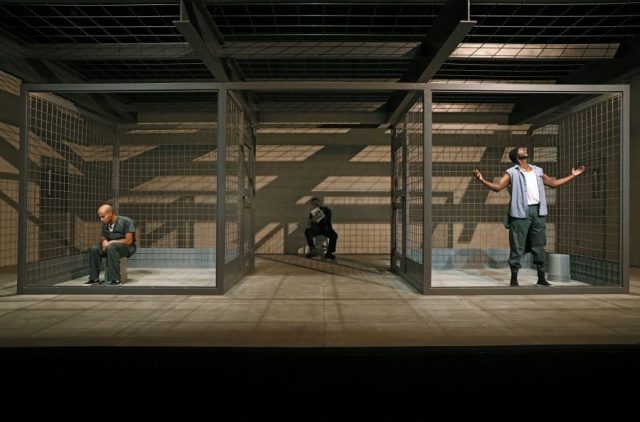
Award-winning actor and writer James Ijames (The Brothers Size, White) makes his New York City debut with the ripped-from-the-headlines Kill Move Paradise, about the plight of four black men after they have been killed by racist acts and are now in an otherworldly place. The world premiere closes Dr. Barbara Ann Teer’s National Black Theatre’s forty-eighth season, which is themed “In Pursuit of Black Joy” and featured such other works as Harrison David Rivers’s Sweet and Craig ‘muMs’ Grant’s A Sucker Emcee. Inspired by recent events, the play, which explores the “All Lives Matter” controversy, stars Ryan Swain (A Negro Writer, Black Nativity) in his New York City stage debut, Donnell E. Smith (Time: The Kalief Browder Story, Ugly Is a Hard Pill), Clinton Lowe (Bamboo in Bushwick, The Hustle), and Sidiki Fofana (Most Dangerous Man in America, Children of Killers) and is directed by Saheem Ali (Nollywood Dreams, The Erlkings). Maruti Evans is the scenic designer, with lighting by Alan Edwards, sound by Palmer Hefferan, and costumes by Ntokozo Fuzunina Kunene. “We wanted to flip the narrative surrounding the oppressive tropes that keep us feeling helpless and stuck as a community,” National Black Theatre theatre arts director Jonathan McCrory said in a statement. “With Kill Move Paradise, we are seeking to inspire our community to remember the power of joy as a tool of resistance, a mechanism forged as our sacred birthright to gain freedom in the midst of oppression.”

TICKET GIVEAWAY: Kill Move Paradise runs May 31 to June 25 at Dr. Barbara Ann Teer’s National Black Theatre, and twi-ny has three pairs of tickets to give away for free. Just send your name, daytime phone number, and favorite sociopolitical play or movie to contest@twi-ny.com by Tuesday, May 30, at 3:00 pm to be eligible. All entrants must be twenty-one years of age or older; three winners will be selected at random.

A DOLL’S HOUSE, PART 2

(photo © Brigitte Lacombe)

Nora (Laurie Metcalf) returns after fifteen years in A Doll’s House, Part 2 (photo © Brigitte Lacombe)

Golden Theatre
252 West 45th St. between Broadway & Eighth Ave.
Tuesday – Sunday through January 7, $39 – $147
dollshousepart2.com

It’s the most famous door slam in theatrical history and a symbolic touchstone of the women’s rights movement. At the end of Henrik Ibsen’s 1879 play, A Doll’s House, Nora Helmer declares her freedom and walks out on her banker husband, Torvald, and their three young children, in order to figure out who she is and what she wants out of life. In his book From Ibsen’s Workshop: Notes, Scenarios, and Drafts of the Modern Plays, Ibsen wrote of A Doll’s House: “A woman cannot be herself in the society of the present day, which is an exclusively masculine society, with laws framed by men and with a judicial system that judges feminine conduct from a masculine point of view.” Playwright Lucas Hnath delves deeper into those rules of conduct between men and women in his audacious, decidedly contemporary follow-up, A Doll’s House, Part 2. It’s also extremely intelligent and very, very funny, more than worthy of its title.

Hnath and director Sam Gold attack the story with relish, beginning with Miriam Beuther’s set, a large room with two high walls that meet at the back, while the front corner angles into the first few added rows; the feet of the audience members in the first row can actually reach under the stage. To the left is the door, big and brown and austere; a few chairs and a table are arranged around the room sparsely but neatly. A glowing yellow neon sign hangs from the ceiling, boldly announcing the name of the play, rising up and out of view shortly after the show starts, with a knock on the door; Nora (Laurie Metcalf) has returned. “Nora, I can’t believe it’s you!” proclaims an excited Ann Marie (Jane Houdyshell), the nanny who first raised Nora, then Nora’s children. “It’s good to see you,” Nora responds calmly, but she can’t wait to tell Ann Marie what she’s been up to these last fifteen years, during which she has had no contact whatsoever with anyone in the house. She proudly informs Ann Marie that she’s become a successful writer, using a pseudonym, publishing controversial books that argue against the institution of marriage and monogamy, which she calls “self-torture.” When Torvald (Chris Cooper) unexpectedly arrives, he doesn’t even recognize Nora. “Who’s your friend?” he asks Ann Marie before looking a little closer. “Are you . . . You aren’t . . . You are,” he says. “I am,” Nora responds. “I have to go to the bathroom,” Torvald declares, and leaves the room. It’s a scintillating exchange, 15 years in the making in the play itself, but 138 years since Ibsen first wrote Nora’s exit.

(photo © Brigitte Lacombe)

Ann Marie (Jane Houdyshell) and Nora (Laurie Metcalf) discuss responsibility and more in “sequel” to Ibsen classic (photo © Brigitte Lacombe)

The reason why Nora has returned is brilliant; she has not come back to explain herself to Torvald or to see how her children are doing. Avoiding all sentimentality, Nora explains that Torvald never filed the divorce papers, so she desperately needs him to finally sign them, which will at last legally set her free of all attachments, allow her to sign contracts on her own behalf, and save her reputation as an anti-marriage crusader — all the dilemmas that ensue from women’s lack of the rights that men enjoy. “I think it’s to be expected that a person would think that after I left this house and my husband and my children that I’d have a very difficult time,” she tells Ann Marie, who says, “The world is a hard place.” Nora adds, “So we’re trained to think. I mean, I think there’s something in our time and place and culture that teaches us to expect and even want for women who leave their families to be punished.” It’s a statement that wittily comments on the audience’s own expectations, displaying how inequality remains very much in force today; Nora might be flaunting her independence and her career triumphs, but she has not yet broken free of society’s rules, many of which have continued into the twenty-first century.

Over the course of the swiftly moving ninety-minute play, Nora goes one-on-one with each character, the next bout announced by a projection of that character’s name on the wall in huge sans-serif block letters by Peter Nigrini. The interactions are superbly staged, as Ann Marie gives Nora a piece of her mind, Torvald is not keen on granting her the divorce, and Emmy shows she has matured into a fine, albeit traditional, young woman. The dialogue in each scene is razor-sharp and unpredictable as Hnath (Red Speedo, The Christians) explores the age-old battle of the sexes with surprisingly modern language. In researching the project, Hnath sought advice from numerous feminist scholars, including Carol Gilligan, Elaine Showalter, Toril Moi, Susan Brantly, and Caroline Light, resulting in a play that never is condescending or didactic and instead is illuminating and wholly believable.

(photo © Brigitte Lacombe)

Mother (Laurie Metcalf) and daughter (Condola Rashad) meet for the first time in fifteen years in new play by Lucas Hnath (photo © Brigitte Lacombe)

The cast is divinely exquisite, all four earning Tony nods. Four-time Tony nominee Metcalf (The Other Place, Domesticated) is sensational as Nora, following in the door-slamming footsteps of Julie Harris, Claire Bloom, Jane Fonda, Dorothy McGuire, and Joan Crawford. Wearing a gorgeous art nouveau shirtwaist and ladies’ suit by costume designer David Zinn, she’s utterly magnetic as she moves around the stage, completely unafraid to face the realities of Nora’s situation, many of which she did not expect. Oscar winner and Tony and Emmy nominee Cooper (My House in Umbria, Adaptation.), last seen on Broadway in the short-lived 1980 drama Of the Fields, Lately, is gentle and understated as Torvald, who is not sure how to react when he abruptly has to confront something he has tried to put past him. Three-time Tony nominee Rashad (The Trip to Bountiful, Stick Fly) is adorably charming as Emmy, a confident woman who holds no grudges and has an infectiously positive view of life. And Tony and Obie winner Houdyshell (The Humans, Follies), who played the nurse to Rashad’s Juliet in David Leveaux’s 2013 Broadway version of Romeo and Juliet with Orlando Bloom, is, as always, a marvelous delight, holding nothing back as Ann Marie defends the choices she made and delivers the funniest, most direct, and totally un-Ibsen-like line of the play. Tony winner Gold (Fun Home, John) again proves he is one of the theater’s most inventive directors, allowing Hnath’s sparkling words to shine on a sparse but powerful set. One door closes; one door opens. Entrances and exits are the way of life, and the way of theater, and they come together beautifully in this electrifying and masterful production.

THE WHIRLIGIG

(photo by Monique Carboni)

Derrick (Jonny Orsini) and his brother, Patrick (Noah Bean), argue over baseball, beer, and more in The Whirligig (photo by Monique Carboni)

The New Group at the Pershing Square Signature Center
The Alice Griffin Jewel Box Theatre
480 West 42nd St. between Tenth & Eleventh Aves.
Tuesday – Sunday through June 18, $75-$120
www.thenewgroup.org

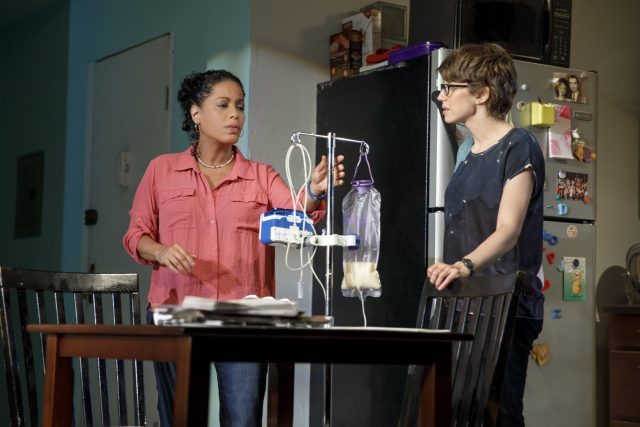
When the audience enters the Alice Griffin Jewel Box Theatre at the Pershing Square Signature Center, the curtain is up, exhibiting a young woman lying on a hospital bed. She is hooked up to an IV drip and revolving slowly around the stage, surrounded by thick horizontal tree branches on either side, bursting with green leaves. She is twenty-three-year-old Julie Evans Tyler (Grace Van Patten), who is dying in the Berkshires. She is joined by her divorced parents, Kristina (Dolly Wells) and Michael Tyler (Norbert Leo Butz), who are trying their best to face the reality of the situation but are not succeeding very well. “Do you think it’s your fault?” Julie asks her mother. Actor and writer Hamish Linklater’s The Whirligig, a New Group world premiere that opened last night at the Griffin, is an emotionally powerful drama about love and addiction, friendship and responsibility, and what encompasses “fault,” as the truth about how Julie arrived at death’s door is gradually revealed. The tale is told by her tightly enmeshed group of friends and neighbors — and just how tightly bound they are to one another is gradually revealed as well. “I know specifically when it turned, when things got really bad for her — and it wasn’t the mom, it wasn’t the dad — I know the exact day it happened,” Derrick (Jonny Orsini), the brother of Julie’s doctor, Patrick (Noah Bean), tells Julie’s former best friend, Trish (Zosia Mamet), who has yet to visit the hospital or talk at all to Kristina and Michael. Trish is married to Greg (Alex Hurt), a former acting student of Michael’s and a bartender in Great Barrington who regularly serves Mr. Cormeny (Jon DeVries), a bloviating former high school teacher who waxes not-quite-poetic about the Russians but occasionally does pick up on human emotions. “I just hope Mr. Tyler’s OK,” Patrick says after Michael falls off the wagon and Greg helps him outside. “Him? Oh no. That poor gentleman is in a whirligig of grief,” Mr. Cormeny says as he heads behind the bar. “There is a silver lining, howsomever: I’m de facto barkeep. Tipple?” the septuagenarian offers.

(photo by Monique Carboni)

A bar is one of several rotating sets by Derek McLane in Hamish Linklater’s world premiere for the New Group (photo by Monique Carboni)

Linklater’s narrative weaves seamlessly between the present day, where, among other things, Trish and Derrick spy on Julie from a high branch in a tree, and fifteen years earlier, as carefree teenagers Julie and Trish talk about sex and drugs, Michael battles the bottle, and Kristina tries not to lose her grip. It’s quite fitting that Michael and Kristina met at the Edgar Allan Poe Museum in Virginia and that their favorite poem is “Annabel Lee.” As Julie deteriorates, her friends, relatives, and acquaintances, each connected, whether they know it or not, like the branches of a tree, argue over how and why it has all come to this. The torrent of revelations could overwhelm the story but instead helps everything fall into place, although there are no simple answers to the main questions. Linklater, who was born in Great Barrington to a mother named Kristin (a theater professor and cofounder of Shakespeare & Co.) and a father whose last name was Cormeny, is better known as an actor, appearing in such films as The Big Short and 42, such television series as The New Adventures of Old Christine and The Crazy Ones, and such Shakespeare in the Park productions as Cymbeline and Much Ado About Nothing. He has previously written The Vandal for the Steep Theatre in Chicago and The Cheats for the Flea in Lower Manhattan, and he has made a significant jump now with his third play.

(photo by Monique Carboni)

Julie (Grace Van Patten) and Trish (Zosia Mamet) share a sweet moment before it all came crashing down in The Whirligig (photo by Monique Carboni)

“And thus the whirligig of time brings in his revenges,” Feste tells Malvolio in the fifth act of Shakespeare’s Twelfth Night. The title of Linklater’s play could refer to a pinwheel, time, or even a medieval torture involving a revolving cage used to discipline “trifling misdemeanors,” particularly committed by women. The Whirligig investigates punishment and revenge, as well as forgiveness and making amends, told with a clever circularity, with well-developed characters and a tightly written script that, despite some bumps and bruises — the scene in which Kristina celebrates her thirty-fifth birthday in the bar with Michael could use some rethinking — bring it all together, complete with unexpected twists and turns. Director Scott Elliott (Evening at the Talk House, Mercury Fur) successfully circumnavigates through the rotating set and two time periods, which occasionally appear to merge, as past and present clash. The cast is excellent, with standout performances by DeVries (Sweet and Sad, The Wayside Motor Inn), Orsini (The Nance, Incident at Vichy), Wells (Blunt Talk, Doll & Em) and Mamet (Girls, Really Really). So whose fault is it that Julie is in the situation she’s in? “Everyone knows everyone tonight, and I don’t recognize a soul,” Mr. Cormeny says at one point. The Whirligig is populated with people who have some serious soul searching to do of their own, and it’s about a lot more than just who is to blame.