this week in theater

THE PARISIAN WOMAN

(photo by Matthew Murphy)

Uma Thurman, Josh Lucas, and Marton Csokas discuss sex and politics in Beau Willimon’s The Parisian Woman (photo by Matthew Murphy)

Hudson Theatre
139-141 West 44th St. between Sixth & Seventh Aves.
Tuesday – Sunday through March 11, $59.50 – $260
www.thehudsonbroadway.com

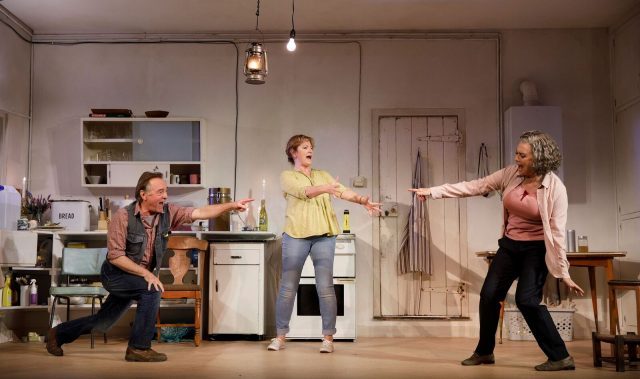
Oscar and Emmy nominee Uma Thurman makes her Broadway debut in The Parisian Woman by Beau Willimon, the creator of the American version of House of Cards. The ninety-minute play, set in contemporary Washington, DC, could be an alternate episode of the popular Netflix hit. Thurman is Chloe, the socialite wife of tax lawyer Tom (Josh Lucas), who is being considered for a federal judgeship. Unsurprisingly, sex, lies, and power will determine whether he succeeds or not. Chloe is having an affair with the obsessively jealous Peter Lafont (Marton Csokas), a wealthy banker who just might have the ear of President Trump. When Chloe and Tom are invited to a party at the home of high-powered Republican Jeannette Simpson (Tony winner Blair Brown), Chloe sees it as an opportunity to manipulate Jeannette, who has been nominated to become the chairwoman of the Federal Reserve, in order to find out Tom’s chances. At the party, Chloe also speaks with Bob and Jeannette’s daughter, rising political star — and liberal Democrat — Rebecca (Tony nominee Phillipa Soo). Bedroom intrigue and political maneuverings lead to a surprising conclusion that would probably make House of Cards’ Frank and Claire Underwood proud.

(photo by Matthew Murphy)

Chloe (Uma Thurman) and Jeannette Simpson (Blair Brown) make a deal in The Parisian Woman (photo by Matthew Murphy)

Running through March 11 at the Hudson Theatre, The Parisian Woman, which was inspired by Henri Becque’s scandalous 1885 play, La Parisienne, is slight though enjoyable, but it seldom achieves the intimacy it strives for. Thurman (Kill Bill, Pulp Fiction), who was last onstage in Classic Stage’s 1999 revival of Molière’s The Misanthrope, is elegant but too languid — she may look great in Jane Greenwood’s fab costumes, but her character is so vapid it is difficult to understand why everyone is in love with her. Csokas (The Lord of the Rings, LovingHamilton, Natasha, Pierre & the Great Comet of 1812) underwhelming, while Lucas (Corpus Christi, The Glass Menagerie) is plenty smarmy, but it’s Brown (Arcadia, Copenhagen) who saves the day with a stellar performance as Jeannette, the most fascinating and likable character in the play, which shines whenever she is onstage. Tony winner Pam MacKinnon (Clybourne Park, Who’s Afraid of Virginia Woolf?) directs with a sure hand on Derek McLane’s stylish sets, but the play suffers from Willimon’s repeated references to Trump and White House Chief of Staff John Kelly, making it feel more like liberal propaganda at times; in fact, Willimon (Farragut North, Lower Ninth), who worked on campaigns for Charles Schumer, Hillary Clinton, Bill Bradley, and Howard Dean, has significantly revised the play several times since its 2013 premiere at South Coast Repertory, where the cast included Dana Delany and Steven Weber. The Parisian Woman is not without its merits, but it ends up being akin to a good episode of House of Cards, which will not be enough for more discerning theatergoers.

THE SORCERESS (DI KISHEFMAKHERIN)

the sorceress

Museum of Jewish Heritage — A Living Memorial to the Holocaust
Edmond J. Safra Plaza, 36 Battery Pl.
December 25 – January 1, $25
866-811-4111
nytf.org
mjhnyc.org

Two years ago, the National Yiddish Theatre Folksbiene resurrected Joseph Rumshinsky’s long-lost Yiddish musical,
The Golden Bride, to well-deserved, widespread critical and popular acclaim. The company is now kicking off its Global Yiddish Theatre Restoration Project with a special work-in-progress presentation of the long-lost operetta The Sorceress (“Di Kishefmakherin”). The show, based on a Jewish and Romanian superstition about witches, was written in 1878 by playwright, songwriter, and poet Abraham Goldfaden, considered the father of modern Yiddish theater; in 1882, it became the first Yiddish Theatre production in America, and was directed by fourteen-year-old Boris Thomashefsky. From Christmas Day to New Year’s Day, there will be five lightly staged performances in Yiddish, with English and Russian supertitles, at NYTF’s home in Edmond J. Safra Hall at the Museum of Jewish Heritage. The scenic design is by Dara Wishingrad, with costumes by Izzy Fields, lighting by Zachary Heffner, sound by Howard Fredrics, and scripts in hand, featuring Michael Yashinsky as Bobe Yakhne, Stephanie Lynne Mason as Mirele, Pat Constant as Markus, Steve Sterner as Hotsmakh, Rachel Botchan as Basye, and a ten-piece orchestra. The meticulously restored piece incorporates partial arrangements that were discovered at the YIVO Institute for Jewish Research, rescued by the Paper Brigade; through January 23, YIVO is hosting the exhibition “The Paper Brigade: Smuggling Rare Books and Documents in Nazi-Occuped Vilna.” The developmental production of The Sorceress is directed by Motl Didner, with music direction by Zalmen Mlotek and musical staging by Merete Muenter. The Christmas Day show is already sold out, so hurry if you don’t want to miss this Yiddish treasure.

PRIDE AND PREJUDICE

(photo by James Leynse)

Mr. Bennet (Chris Thorn) tries to avoid the shenanigans of his wife and daughters in exhilarating adaptation of Jane Austen’s first novel (photo by James Leynse)

Cherry Lane Mainstage Theatre
38 Commerce St.
Tuesday – Sunday through January 6, $82-$152
212-989-2020
primarystages.org
www.cherrylanetheatre.org

“How do you know if you’ve found the right match?” Lydia Bennet (Kimberly Chatterjee) asks her sisters, Lizzy (Kate Hamill), Mary (John Tufts), and Jane (Amelia Pedlow), early on in Hamill’s rousing adaptation of Jane Austen’s Pride and Prejudice, continuing at the Cherry Lane through January 6. Hamill is an actress who started writing plays to ensure strong roles for herself and other women, and she has found the right match yet again. Her latest work is her third consecutive triumphant and wholly original adaptation of a classic novel, following Bedlam’s production of Austen’s Sense and Sensibility, which ran at the Gym at Judson for ten months, and William Makepeace Thackeray’s Vanity Fair, the final presentation at the late, lamented Pearl Theatre. Hamill, who has hinted that she is making her way through Austen’s books in chronological order, meaning that Mansfield Park might be next, has also found the right match in her personal and professional partner, Jason O’Connell (The Dork Knight), who plays Mr. Darcy, and in directors, with Oregon Shakespeare Festival veteran Amanda Dehnert having a blast with Austen’s comedy of manners regarding marriage and money. The show begins with the cast performing Wayne Fontana and the Mindbenders’ 1965 hit, “The Game of Love,” which starts out, “The purpose of a man is to love a woman / And the purpose of a woman is to love a man.” As Lizzy soon explains, “Playing games keeps one sane, when the stakes involved threaten to drive one mad.” Mrs. Bennet (Nance Williamson) is determined to marry off her daughters to wealthy, somewhat respectable suitors, no matter the cost — since they have no male heirs to inherit their estate — so she kicks into high gear with the arrival of the goofy Bingley (Tufts), “a fellow of large income!” Bingley takes a liking to Jane, which makes Lizzy happy that it’s not her. “I am an ugly sharp-tongued awkward little creature, but you are good and kind and about five times prettier than any other girl in the county,” Lizzy tells Jane. “Nono, you shall have to fall on Mr. Bingley’s sword, and be quick about it too — the clock is ticking for us old maids!” Bright and cheery fourteen-year-old Lydia is also interested in finding a man — as is the sisters’ archrival, Charlotte Lucas (Chris Thorn), but the dour Mary sees only darkness in life amid her constant coughing.

It is not exactly love at first sight for Lizzy (Kate Hamill) and Mr. Darcy (Jason O’Connell) in Pride and Prejudice (photo by James Leynse)

It is not exactly love at first sight for Lizzy (Kate Hamill) and Mr. Darcy (Jason O’Connell) in Pride and Prejudice (photo by James Leynse)

Meanwhile, Mr. Bennet (Thorn) reads the business section of the Times as the women gossip, plot, argue, and complain all around him. “Matrimonial games are women’s purview, Elizabeth, and I had enough of them when my own round was lost,” Mr. Bennet says. Soon entering the proceedings are potential suitors Mr. Collins (Mark Bedard), a strange and annoying man, and Wickham (Bedard), a charming cad who was childhood friends with Darcy, in addition to the domineering and demeaning Lady Catherine (Chatterjee), who is Darcy’s aunt, and her daughter, Miss De Bourgh (Pedlow), who remains curiously hidden behind a veil. And so the game is on, and a deliciously wicked and fun contest it is. Hamill and Dehnert focus on the more comic elements of Austen’s novel, staying true to the heart of the beloved story while leaving no double entendre or sly joke on the cutting room floor. There’s a reason Pride and Prejudice has been made into and/or has heavily influenced films, opera, theater, and literary works, including such wide-ranging beauties as Pride and Prejudice and Zombies, Bridget Jones’s Diary, and Death Comes to Pemberley. Dehnert has added anachronistic songs to the show, from Stevie Wonder to RuPaul, and the doubling of the cast is an absolute riot, as Thorn changes from Charlotte to Mr. Bennet, Bedard switches between Wickham, Collins, and Miss Bingley, and Tufts shifts from Mary to Bingley right before our eyes. When an actor is not part of a scene, he or she sits in the background of John McDermott’s sweetly crowded set, laughing along with the audience at the numerous comedy bits — especially Collins’s difficulty with a chair. As much fun as the audience is having, the cast might be having that much more, even as Hamill makes her on-target points about the treatment of women through the centuries. It’s a barely controlled kind of mayhem in which anything can happen at any moment — be sure to follow the bouncing ball — adding to the ever-building excitement. “Please do pardon the chaos,” Mr. Bennet tells Wickham. “I wish I could say it was unusual.” A coproduction with the Hudson Valley Shakespeare Festival, Pride and Prejudice is a sheer pleasure, an exuberant and exhilarating reimagining of a cherished classic about the rather tricky game of love and holding out for just the right match.

SCHOOL GIRLS; OR, THE AFRICAN MEAN GIRLS PLAY

(photo by Joan Marcus)

Ericka Boafo (Nabiyah Be, center) instantly changes the power dynamic when she arrives at Aburi Girls Boarding School in debut play by Jocelyn Bioh (photo by Joan Marcus)

MCC Theater at the Lucille Lortel Theatre
121 Christopher St. between Bleecker & Hudson Sts.
Tuesday – Sunday through December 31, $49-$125
212-352-3101
www.mcctheater.org

Actress Jocelyn Bioh’s professional playwriting debut is a sharp, uproarious tale of a clique of young boarding school students in central Ghana who can be as nasty as they wanna be, able to go toe-to-toe with Cady, Regina, Gretchen, Janis, and Karen from Mark Waters’s 2004 hit movie, Mean Girls. Bioh, who has appeared in such plays as Suzan-Lori Parks’s In the Blood, Branden Jacobs-Jenkins’s Everybody and An Octoroon, and Jaclyn Backhaus’s Men on Boats, even references the film, which was written by Tina Fey (and is coming to Broadway as a musical in the spring), in the title of her show, School Girls; or, the African Mean Girls Play, making its MCC world premiere at the Lucille Lortel through December 31. It’s 1986, and the students at Aburi Girls Boarding School are getting ready to audition for the Miss Ghana beauty pageant. Paulina Sarpong (MaameYaa Boafo) is the egotistical, narcissistic leader of a group of girls, willing to say or do just about anything to remain in charge. She brags about her soccer-playing boyfriend and how she is a shoo-in to be named Miss Ghana while brazenly putting down the rest of her crew, which consists of the tall, bright Ama (Níkẹ Kadri), the innocent, overweight Nana (Abena Mensah-Bonsu), and the twinlike duo of Gifty (Paige Gilbert) and Mercy (Mirirai Sithole). The power dynamic immediately shifts when headmistress Francis (Myra Lucretia Taylor) introduces a new student, Ericka Boafo (Nabiyah Be), a beautiful, talented, and bold young woman who quickly challenges Paulina’s authority. Of course, putting Paulina on the defensive is not something you want to do, unless you’re ready for the barrage that will follow. So when Miss Ghana 1966, Eloise Amponsah (Zainab Jah), whom Francis knows all too well, arrives to select one of the girls to compete in the pageant, the gloves are off and sides are chosen in a no-holds-barred battle for supremacy. “Headmistress likes to make everyone feel like they have a fair chance,” Paulina declares, “but we all know I’m the best.”

(photo by Joan Marcus)

The ruthless Paulina Sarpong (MaameYaa Boafo) is determined to follow in the footsteps of Miss Ghana 1966, Eloise Amponsah (Zainab Jah), in MCC world premiere at the Lucille Lortel (photo by Joan Marcus)

School Girls; or, the African Mean Girls Play was inspired by the true story of Yayra Erica Nego, the 2009 Miss Minnesota who went on to be named Miss Ghana 2011, a controversial decision for several reasons, including her fair skin, as well as by Rosalind Wiseman’s nonfiction book Queen Bees and Wannabes. In the seventy-five-minute play, Bioh, a first-generation Ghanaian American who went to boarding school in Hershey, Pennsylvania, explores such issues as body image and colorism, beauty and friendship, and race and class in this microcosmic Lord of the Flies scenario. Arnulfo Maldonado’s scenic design is simple but effective, a few tables in the school cafeteria, while Dede M. Ayite’s costumes change from the standard green-and-white school uniform to fancy dresses for the competition, giving each character a moment to shine. Tony-winning director Rebecca Taichman (Indecent, Familiar) keeps it all in check, never letting things get out of hand or become too clichéd. Be (Hadestown, Queen of the Night) is charming and delightful as Ericka, who has some secrets of her own; Jah (Eclipsed, In Darfur) brings heft to the complicated Eloise; and Taylor (Nine, Familiar) is warm and amiable as the caring, concerned Francis. The rest of the cast is terrific as well, although the character of queen bee Paulina can come off as too harsh at times, going too far and getting away with too much. School Girls; or, the African Mean Girls Play is no mere African American version of Mean Girls; instead, it is as smart and entertaining, as sweet and honest, its characters as obnoxious and horrible and lovable and vulnerable, as teen girls themselves.

NEW YIDDISH REP: AWAKE AND SING!

(photo by Pedro HernandezP

The Bergers sit down for some food and tsouris in New Yiddish Rep adaptation of Clifford Odets’s Awake and Sing! at the 14th Street Y (photo by Pedro Hernandez)

VAKH OYF UN ZING
Theater at the 14th Street Y
344 East 14th St. at First Ave.
Tuesday – Saturday through December 24, $45
646-395-4310
www.newyiddishrep.org
www.14streety.org

In her 1983 book From Stereotype to Metaphor: The Jew in Contemporary Drama, Ellen Schiff calls Clifford Odets’s Awake and Sing! “the earliest quintessentially Jewish play outside the Yiddish theatre. It bears the unmistakable stamp of authenticity, exactly what one would wish from a Jewish dramatist writing a slice of Jewish life problem play.” That stamp of authenticity is at the center of a new version by New Yiddish Rep, continuing at the Theater at the 14th Street Y through Christmas Eve. The show is adapted and directed by New Yiddish Rep artistic director David Mandelbaum, using Chaver Paver’s Yiddish translation for Jacob Mestel’s 1938 Federal Theatre production. During the Depression, the Berger family is trying to get by in their crowded Bronx apartment, where they are not exactly living the immigrant American dream. Matriarch Bessie Berger (Ronit Asheri-Sandler) is desperate for her children to marry well, but son Ralph (Moshe Lobel), a wannabe entertainer, is secretly dating a young woman from a poor family and daughter Hennie (Mira Kessler) doesn’t seem to like any of her suitors, who include Moe Axelrod (Gera Sandler), a shady operator who lost his leg in the war, and Sam Feinschreiber (Luzer Twersky), for whom Hennie has no desire. Bessie’s husband, Myron (Eli Rosen), is a gentle man who can’t keep a good job and instead puts money on the horses, while Bessie’s elderly father, Jacob (Mandelbaum), wanders around the apartment listening to opera and spouting Marxist doctrine. Bessie’s sister, Mimi (Amy Coleman), occasionally stops by to gossip and gloat. When Hennie gets pregnant and the man who did it is instantly out of the picture, the close-knit but argumentative family has some important decisions to make, facing difficult choices in very hard times.

(photo by Pedro Hernandez)

Hennie Berger (Mira Kessler) and Moe Axelrod (Gera Sandler) have one of many disagreements in New Yiddish Rep production of Awake and Sing! (photo by Pedro Hernandez)

Awake and Sing! premiered on Broadway in 1935 with the sensational cast of Luther Adler, Stella Adler, Morris Carnovsky, John Garfield, and Sanford Meisner. In 2013, the National Asian American Theatre Co. staged a strong version with an all-Asian cast. But the show really feels at home in this Yiddish production, featuring a charming apartment set by Nathan Rosen, with an old radio and Victrola, a kitchen table, a couch, an armchair, and a daybed in the corner of the living room, where Ralph sleeps. The Bergers complain about life and love in Yiddish, with English supertitles. The whole thing is warm and comfy, with an emphasis on the status and power of women in Jewish families; the men in the show are at the mercy of the women. In addition, the part of Mimi was originally written for a man, Morty, but it has been skillfully changed to a successful businesswoman, something that was relatively unusual in 1930s America. Asheri-Sandler, who is married to Sandler in real life, is wonderfully domineering as Bessie, while Lobel ably personifies a man refusing to give up on his dreams. The play sounds absolutely lovely in Yiddish, flowing with the beauty and angst ingrained in the language like no other. It’s almost disappointing when English words or lines suddenly show up, probably because there’s no legitimate translation for them. The theater is also filled with Yiddish songs as the audience enters and during intermission, adding to the nostalgic atmosphere. Established in 2013 to keep Yiddish theater alive, New Yiddish Rep has previously staged Waiting for Godot, Death of a Salesman, Rhinoceros, and a double bill of one-acts by Wolf Mankowitz. Awake and Sing! is a natural for them, and they do Odets, and Yiddish theater, proud.

DESCRIBE THE NIGHT

Nikolai Yezhov (Zach Grenier) and Isaac Babel (Danny Burstein) begin a dangerous friendship in Describe the Night (photo by Ahron R. Foster)

Nikolai Yezhov (Zach Grenier) and Isaac Babel (Danny Burstein) begin a dangerous friendship in Describe the Night (photo by Ahron R. Foster)

Atlantic Theater Company
Linda Gross Theater
336 West 20th St. between Eighth & Ninth Aves.
Tuesday – Sunday through December 24, $51-$86.50
866-811-4111
atlantictheater.org

At the beginning of Rajiv Joseph’s extraordinary Describe the Night, Isaac Babel (an almost unrecognizable Danny Burstein), a military journalist covering the Polish-Soviet War in 1920, has stopped in the Polish countryside and says to himself, “Describe the night . . . Describe the air . . . Describe the field . . .” as he unsuccessfully tries to capture their essence in his diary. He is soon joined by Russian captain Nikolai Yezhov (Zach Grenier). “The night. Describe it,” Isaac says. “Why?” Nikolai asks, dumbfounded. Isaac explains, “I just described it in my journal. I’m wondering how you would describe it. And if we both describe the same thing at the same time, will one of our descriptions be more true than the other?” Joseph’s follow-up to Guards at the Taj and Bengal Tiger at the Baghdad Zoo is a glorious, difficult-to-describe work that searches for the truth amid many lies, melding fact and fiction in creating a wildly unpredictable, endlessly adventurous tale that is as historical as it is contemporary. (At one point, a character says, “Go ahead, write your fake news story.”) The swiftly moving 165-minute play is told in three acts of four scenes each, featuring such titles as “Lies,” “Fate,” “Blood,” “Asylum,” and “Freedom,” shifting back and forth between 1920, 1937, 1940, 1989, and 2010, from Smolensk to Moscow to Dresden. As Isaac becomes a successful and well-respected writer, he maintains an odd friendship with Nikolai, who rises in the ranks of Stalin’s secret police; Isaac also has an extra-close relationship with Nikolai’s wife, Yevgenia (Tina Benko). Meanwhile, in 1989 Dresden, Russian KGB agent Vova (Max Gordon Moore) is determined to not let young Polish immigrant Urzula (Rebecca Naomi Jones) defect to the West, for both personal and political reasons. And in 2010, a plane flying from Poland to Russia to honor the seventieth anniversary of the Katyn Massacre in WWII crashes in Smolensk, setting journalist Mariya (Nadia Bowers) on the run, where she encounters young Feliks (Stephen Stocking), who just wants to avoid trouble. Through the years, various characters and their stories intersect in unexpected ways as Isaac’s diary makes its way around the world.

(photo by Ahron R. Foster)

Rajiv Joseph’s Describe the Night climbs high at the Atlantic (photo by Ahron R. Foster)

Continuing at the Atlantic through December 24, Describe the Night is a gorgeously ambitious play, continually challenging the audience with its unconventional twists and turns. Director Giovanna Sardelli, who has previously collaborated with Joseph on Archduke and Guards at the Taj, brilliantly navigates through the multiple time periods and Tim Mackabee’s mostly simple but effective changing sets. Six-time Tony nominee Burstein (Fiddler on the Roof, The Drowsy Chaperone) is gentle and touching as Isaac, a man who believes that his principles will triumph over tyranny; Tony nominee Grenier (33 Variations, The Good Wife) is an excellent counterpoint, loud and blustery as Nikolai, a proud but uncomplicated man who is able to overlook friendship when necessary for the sake of the party. Benko (Scenes from a Marriage, Desdemona) excels as the strangely mysterious Yevgenia, while Stocking (Archduke, Dance Dance Revolution) embodies all of our everyday fears with an intense quirkiness. The Playbill comes with an extra sheet that details the true stories of Isaac, Nikolai, Yevgenia, and the Smolensk crash; be sure not to read it until after the show to fully appreciate the artistic license Joseph takes in transforming this tale into so much more. “You’re a media person, and so you you you love to make up stories that are more interesting than what the truth is and what the truth is that sometimes planes try to land in a heavy fog over a forest and then hit trees and crash,” Feliks tells Mariya. So how to succinctly describe Describe the Night? Truthfully, it’s indescribable.

DOWNTOWN RACE RIOT

(photo by Monique Carboni)

A drug-addict mother (Chloë Sevigny) and her troubled son (David Levi) prepare for battle in Downtown Race Riot (photo by Monique Carboni)

The New Group at the Pershing Square Signature Center
The Romulus Linney Courtyard Theatre
480 West 42nd St. between between Ninth & Tenth Aves.
Tuesday – Sunday through December 23, $20-$100
www.thenewgroup.org
www.signaturetheatre.org

Not a whole lot of the New Group world premiere of Seth Zvi Rosenfeld’s Downtown Race Riot makes sense. Continuing through December 23 at the Signature Center’s Romulus Linney Courtyard Theatre, the one-act play, set in an apartment in Greenwich Village in 1976, is dominated by its long, deep set by master designer Derek McLane, which stretches across the space, consisting of, from left to right, a bedroom, a living room / kitchen with a small cast-iron clawfoot tub, and another bedroom. The center section juts one row into the audience, assuming added intimacy, while many of the seats in the left and right sections offer limited, sharply angled views that require patrons to stretch their bodies to try to see what’s going on, which is not really that much, as most of the action takes place center stage. Oddly, many people in the first row placed their drinks and even a bag or hat on the stage itself while waiting for the rest of the crowd to enter; one of the theater employees had to tell them that doing that was a no-no. The individual rooms are splendidly decorated, with one bedroom filled with pictures and posters of 1970s celebrities and music groups, the kitchen capturing the feel of the schlocky era, and the far bedroom a tribute to a former flower child. I realize that I’ve gone on at length about the set, primarily because it’s the most interesting part of the play; the story, inspired by an actual 1976 riot in Washington Square Park, is slack and uninvolving, with unlikable characters and questionable plot developments.

(photo by Monique Carboni)

New Group world premiere looks at real 1976 riot in Washington Square Park (photo by Monique Carboni)

Chloë Sevigny plays Mary Shannon, a thirty-nine-year-old drug addict and single mother living on disability and constantly coming up with new scams to bring in money. Her twenty-one-year-old daughter, Joyce (Sadie Scott), is a lesbian who is looking to move out, while her eighteen-year-old son, Jimmy, known as Pnut (David Levi), has no big plans except for hanging out. His best friend is Marcel “Massive” Baptiste (Moise Morancy), a Haitian American considered an acceptable black; Pnut is also acquainted with Italian troublemakers Jay 114 (Daniel Sovich) and Tommy-Sick (Cristian DeMeo). Later the family is visited by lawyer and former hippie Bob Gilman (Josh Pais), who just confuses the story, which takes place during one endless day as Joyce comes on to Massive, Pnut makes hamburgers, Mary shoots up, and the teenage boys get ready to hurt some people in the park. “The whole neighborhood is goin’ out there with pipes and bats and it’s open season on yans and piss-a-ricans,” Pnut tells his mother, who replies, “Are you demented? Did I bring you up to be a KKK member? We’re in Greenwich Village, for chrissakes. This is where people come to be free.” (There is also plenty of hatred for gays and Jews.) Director Scott Elliott, the New Group’s artistic director who recently helmed terrific productions of Mercury Fur, Evening at the Talk House, and The Whirligig, can’t do much with Rosenfeld’s (The Flatted Fifth, The Get Down) muddled, stilted dialogue or the inefficient acting, although it is a treat to see Oscar nominee Sevigny so up close and personal — she previously appeared onstage with the New Group in 1998 in Hazelwood Junior High and two years later in What the Butler Saw. And as fab as McClane’s set is, it ends up only adding to the problems of the hundred-minute play, as you won’t know where to look when all three rooms are occupied at the same time. Of course, if you are in one of the numerous partial-view seats, you might not have much of a choice, nor might you care.