this week in theater

THE PERPLEXED

(photo © Matthew Murphy, 2020)

Rival families try to find common ground in Richard Greenberg’s The Perplexed (photo © Matthew Murphy, 2020)

Manhattan Theatre Club
MTC at New York City Center – Stage I
Tuesday – Sunday through March 29, $99-$109
212-581-1212
perplexedplay.com

Succession meets Romeo and Juliet in Richard Greenberg’s The Perplexed, making its world premiere at City Center’s Stage I. The Manhattan Theatre Club production, which opened last night and runs through March 29, takes place in a stunning library in a Fifth Avenue mansion that has audience members gasping in delight (and jealousy) as they enter the space; the set, filled with books, austere furniture, and inviting nooks that disappear off into the wings, was designed by Santo Loquasto, who has won five Drama Desk Awards and four Tonys and has been nominated for three Oscars for his production design and costumes, most prominently for Woody Allen films. You are instantly sucked into this insulated sphere of the rich and the formerly rich, men and women dealing with who they were, not necessarily knowing who they are or who they will be.

Isabelle Stahl (Tess Frazer) and Caleb Resnik (JD Taylor) are getting married in the massive town house owned by her grandfather, the unseen, ridiculously wealthy Berland, who nobody seems to care for very much. Isabelle and Caleb have been destined to be together since they were six years old, but a rift over money tore the families apart until the two millennials reconnected on a subway platform twenty years later — how gauche! — and fell in love. The controlling and manipulative Berland is the father of the somewhat addled Joseph Stahl (Frank Wood), who is married to the elegant Evy (Margaret Colin), a candidate for City Council speaker; her red dress is wet and dirty from a stop she made at the site of a water-main break on the way to the wedding, and throughout the action the stain creeps slowly up from the hem. Their son, Micah (Zane Pais), is in med school but has also added acting in online porn to his resume. So much for the bride’s side.

(photo © Matthew Murphy, 2020)

Margaret Colin, Frank Wood, Ilana Levine, and Gregg Edelman play in-laws-to-be in MTC world premiere (photo © Matthew Murphy, 2020)

Caleb’s mother, Natalie Hochberg-Resnik (Ilana Levine), is a would-be social justice warrior not above delivering verbal jabs and none-too-subtle innuendoes, while her husband, Ted Resnik (Gregg Edelman), appears to be a pleasant, understated gentleman. “Don’t our children look too beautiful? Doesn’t it positively make you want to kill yourself?” Natalie says, to which Evy responds, “That’s not what does.” A few moments later, Natalie offers, “We can maintain an entente cordiale. For the kids.” Evy replies, “There’s never been a real reason for the rupture. We hate the same things. And the kids are so great. It would be a pity to make this evening worse than it already is.”

Meanwhile, Evy’s brother, the sarcastic, wry writer James Arlen (Patrick Breen), adds erudite commentary to the goings-on as former rabbi Cyrus Bloom (Eric William Morris), who will be officiating the marriage, is preparing his words for the ceremony. “I think you’re slinging a whole lot of bullshit here, James,” Cyrus says early on. “If I am, it’s not original to me, it’s what’s been passed down — heirloom bullshit,” James answers. It is clear that no one wants to be there with Berland as former glories, current enmity, and the stratifications of wealth threaten to crack the smooth social veneer. As the midnight nuptials approach, surprising past relationships among various characters are revealed and blood is spilled.

(photo © Matthew Murphy, 2020)

Richard Greenberg’s The Perplexed is about wedding that brings together two formerly wealthy families (photo © Matthew Murphy, 2020)

In Greenberg’s 2013 Broadway play, The Assembled Parties, one character says, “God is bogus, and religion a scourge. Still, I believe in something, though I’m not sure what.” The same thing applies to The Perplexed, which several times invokes the Kabbalistic concept of the broken vessels, which involves God’s light, good and evil, and repairing a shattered universe. Several characters think Cyrus can just spit out a biblical parable and all will be well, but that’s not quite how it works. “My friends started pointing out that I was using the word God a lot and wasn’t I an official atheist and would I please cut it out?” Cyrus admits. It’s hard to know just what the Arlens and the Resniks believe in. Perhaps it is all summed up by Patricia Persaud (Anna Itty), Berland’s housekeeper. “When we are foolish, it’s good that things hurt a little,” she tells everyone.

Efficiently guided through extensive changes during previews — there was confusion the night I went about the running time, which is currently officially listed as two hours and fifteen minutes with one intermission — by MTC artistic director and three-time Tony nominee Lynne Meadow, who has previously helmed Greenberg’s Our Mother’s Brief Affair and the aforementioned The Assembled Parties, the superbly acted The Perplexed is a clever and witty drawing-room comedy that journeys into the world of a privileged class trying to hold on after much of that privilege has gone away.

THE HOT WING KING

(photo by Monique Carboni)

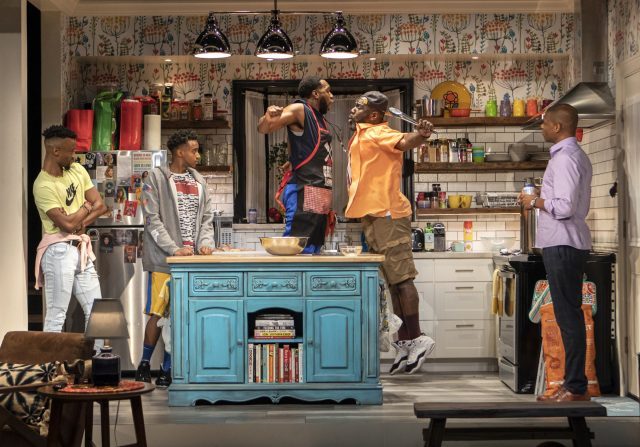
A close-knit group of friends prepares for a big contest in Katori Hall’s The Hot Wing King (photo by Monique Carboni)

The Pershing Square Signature Center
The Alice Griffin Jewel Box Theatre
480 West 42nd St. between Tenth & Eleventh Aves.
Tuesday – Sunday through March 22, $35-$55
212-244-7529
www.signaturetheatre.org

Katori Hall’s The Hot Wing King is a tantalizingly spicy, robust and savory contemporary comedy that sticks to your ribs like only the best, well, hot wings. The play, which opened tonight at the Signature, has a familiar setup — a group of friends and family trying to win a cooking contest — but fresh ingredients and high style take these hot wings to the next temperature level. In Memphis, Cordell (Toussaint Jeanlouis) is getting ready to marinate 280 pounds of chicken for an annual hot wing contest, confident that he has a good chance of winning the $5,000 prize this year with a new recipe. Two months prior, he left his wife, kids, and job in St. Louis to be with Dwayne (Korey Jackson), an efficient and pragmatic hotel manager. Cordell’s prepping for the contest with his special team, the New Wing Order, which consists of him, Dwayne, the fabulously swishy Isom (Sheldon Best), and the basketball-loving Big Charles (Nicco Annan); the latter two men had hooked up once but now mostly poke fun at each other. Meanwhile, Cordell’s been frustrated by his lack of professional success since coming to Memphis, so the contest has become a benchmark for him. The Anchor Bar in Buffalo might claim that hot wings were invented there in 1964, but Cordell argues that his secret family recipe dates back to 1808.

“I ain’t move all the way down from St. Louis to be left in the house every chance he get,” Cordell says about Dwayne. Big Charles replies, “Number one, St. Louis ain’t all the way from nowhere. Two, this big old castle y’all done got fuh yuh self ain’t necessarily a cage, Cordell.” Cordell: “I gave up a lot for this. For him.” Big Charles: “And for yourself. You ain’t living a lie no more. Shackled by somebody else’s expectations of you.” Cordell: “Oh, I’m still shackled. Vanessa still ain’t signed them papers.”

(photo by Monique Carboni)

EJ (Cecil Blutcher) and Cordell (Toussaint Jeanlouis) go one-on-one in world premiere play at the Signature (photo by Monique Carboni)

Everything is proceeding as scheduled until the drug-dealing TJ (Eric B. Robinson Jr.), Dwayne’s former brother-in-law (Dwayne’s sister tragically died), stops by to leave a package for his son, sixteen-year-old EJ (Cecil Blutcher), who soon arrives himself with two bags of clothing. The teen is looking for a place to stay, throwing a wrench into Cordell’s intensely managed strategy to make the wings. “Just know that when that bell ring we all gone be led by God’s will cause He gone guide us through the sauce and the fire for that whippin’ and whippin’ and whippin’,” Cordell says early on, but the Lord might have other plans.

Hall, whose previous plays include Our Lady of Kibeho and Hurt Village as part of her Signature residency and The Mountaintop and Tina: The Tina Turner Musical on Broadway (Hall wrote the book), was inspired to write The Hot Wing King by her brother’s relationship with his male partner and the real hot-wing festival held annually in her hometown of Memphis. Her dialogue is slick and smart (“I can smell shade a mile away — I’m a walking umbrella,” the gossipmongering Isom says), moving at an infectious velocity that practically sings; you might not understand all the colloquialisms, but they reverberate like music.

(photo by Monique Carboni)

Dwayne (Korey Jackson) dishes out some advice to his nephew, EJ (Cecil Blutcher), in new Katori Hall play (photo by Monique Carboni)

The show is not specifically about gay men, or black men, or gay black men; it’s about four friends coming together to reach a goal, attempting to fight off various obstacles that are out of their control. Director Steve H. Broadnax III (The Hip Hop Project, Blood at the Root) keeps it all hopping on Michael Carnahan’s set, a comfy house with a living room, kitchen, upstairs bedroom, and outdoor basketball hoop. There are no women to be found here; this is a bunch of guys, superbly played by an outstanding ensemble cast that makes you want to hang with them as they goof around, needle one another, and, in the case of Cordell and Dwayne, explore their deepening but still new love.

The show continues through March 22 at the Alice Griffin Jewel Box Theatre; on Fridays and Saturdays, the Signature is serving Memphis-style wings (both chicken and vegan, with house beer); if you eat twenty in one sitting, your photo will be added to a lobby display so you can become a “Hot Wang Kang” yourself. “Everything always a contest with you,” Big Charles says to Cordell. But isn’t that true of all of us?

GRAND HORIZONS

(photo by Joan Marcus)

Nancy (Jane Alexander) and Bill (James Cromwell) reevaluate their marriage in Bess Wohl’s Grand Horizons (photo by Joan Marcus)

Hayes Theater
240 West 44th St. between Broadway & Eighth Ave.
Tuesday – Sunday through March 1, $79-$149
2st.com/shows/grand-horizons

The opening scene of rising star Bess Wohl’s wickedly funny Grand Horizons is a masterpiece of simplicity. In a generic, pastel cookie-cutter home, an elderly couple, Nancy (Jane Alexander) and Bill (James Cromwell), are sitting down for tea. They both move slowly, saying nothing, their daily, dull routine instantly clear. “I think I would like a divorce,” Nancy announces peacefully. “All right,” Bill calmly responds as they continue doing what little they were doing.

Wohl’s hysterical Broadway debut follows such terrific shows as Make Believe, in which four young siblings are forced to take care of one another in their attic when their mother disappears; Small Mouth Sounds, which takes place at a silent meditation retreat where participants form a kind of temporary family; and Continuity, about the making of an action movie involving climate change in which the cast and crew function like a dysfunctional family.

(photo by Joan Marcus)

Ben (Ben McKenzie) is less than thrilled at his father’s actions in Second Stage production at the Hayes (photo by Joan Marcus)

News of the impending divorce brings Nancy and Bill’s thunderstruck children rushing home to talk them out of it. The practical, workaholic Ben (Ben McKenzie) arrives with his pregnant wife, therapist Jess (Ashley Park), while Brian (Michael Urie) shows up alone, as he often does. A gay theater teacher, Brian is directing a cast of two hundred kids in a high school production of Arthur Miller’s The Crucible. But Nancy, a former librarian, and Bill, a pharmacist who now wants to be a stand-up comic, seem set on their decision, and as secrets emerge, Ben and Brian find themselves questioning everything they ever knew about their parents as they refuse to believe their mother and father can be serious.

“I thought it was kind of a good sign,” Ben says when Nancy and Bill appear to go to bed together, in the same room. “Sure, if you block out the part where they barely spoke to each other. And then your mom pretended to have dementia. And then your dad told a dick joke,” Jess responds. “No, I know, it’s insane, they’re children,” Ben acknowledges. The changing of places between the parents and the kids is at the heart of Grand Horizons. Brian brings back a one-night stand, Tommy (Maulik Pancholy), who becomes annoyed when Brian hesitates because of his family situation. “Lots of parents get divorced,” Tommy says. “It sucks when you’re like, eight. But you seem pretty middle-aged.” A moment later, Tommy explains, “They’re adults. They can do whatever the fuck they want.” To which Brian replies, “Are you kidding? Adults cannot do what they want. . . . The defining feature of adulthood is that you never get to do what you want. Children do what they want. Adults struggle to meet the needs of other people. Make a living. Satisfy a thousand obligations. And still fall short and wind up disappointing everyone.”

Wohl was inspired to write a play about gray divorce after some of her friends’ parents called it quits later in life, including director Leigh Silverman’s, after their fiftieth anniversary. (At one point, a distraught Ben declares, “I if you wanted to get divorced, you should have done it after we went to college, like normal people.”) Tearing down conceptions and expectations about sex, intimacy, and aging, Wohl (American Hero, Touched) and Silverman (Harry Clarke, In the Wake) share a keen sense of humor even as things get very serious. After Nancy makes a crack, the endlessly dreary and dour Bill opines, “What is she joking for? I’m the funny one. I’ve always been the funny one.”

(photo by Joan Marcus)

Ashley Park, Michael Urie, Jane Alexander, and James Cromwell are part of outstanding ensemble cast in Grand Horizons (photo by Joan Marcus)

The ensemble cast, which also features Priscilla Lopez as a dentist office receptionist who also is trying to be a comedian, is in sync every step of the way; they seem to be having just as much fun as we are in the audience, relishing their antics on Clint Ramos’s pristine set (well, pristine until the end of the first act). Tony winner and Oscar nominee Alexander (The Great White Hope, The Sisters Rosensweig) and Oscar nominee and Emmy winner Cromwell (Babe, American Horror Story: Asylum) are exceptional as the divorcing couple driving a knife through their sons’ memories; it is a special treat watching them work together onstage, their years of experience taking the relationship between Nancy and Bill to another level. McKenzie (Gotham, The O.C.) and Urie (Torch Song, The Government Inspector) do a good job keeping pace with them as they occasionally bicker like an old married couple themselves.

I have to admit to a personal bias when it comes to Alexander. When I was a teenager, a friend and I were so excited to see her and Henry Fonda in First Monday in October on Broadway that we waited around to talk to her after the show. She appreciated our interest and invited us back to her apartment for tea, which I of course thought of when she makes tea in the first scene of Grand Horizons. That experience encouraged my love of theater and was one of the seminal moments that led me to the cherished responsibility of writing about the stage all these years later.

THE CONFESSION OF LILY DARE

(photo by Carol Rosegg)

Lily Dare (Charles Busch) enchants everyone around her in homage to 1930s pre-Code confession films (photo by Carol Rosegg)

Cherry Lane Mainstage Theatre
38 Commerce St.
Tuesday – Sunday through March 5, $82-$152
212-989-2020
primarystages.org
www.cherrylanetheatre.org

Writer, actor, and downtown drag icon Charles Busch pays homage to pre-Code melodramas about women done wrong in The Confession of Lily Dare, a sinfully seductive treat that continues at the Cherry Lane through March 5. Honoring such films as San Francisco, The Sin of Madelon Claudet, Frisco Jenny, and Madame X with a healthy dose of Barbara Stanwyck, Bette Davis, Marlene Dietrich, Gloria Swanson, and even Hayley Mills, the play is told in flashback, beginning in 1950 when former prostitute and oft-married Emmy Lou (Nancy Anderson) and piano player Mickey (Kendal Sparks) are at the grave of their old friend Lily Dare. “Nobody can say this boneyard isn’t deluxe,” Emmy Lou says. “Lil, how in blazes did a Sawdust Gal get to lie down with the upper crust? And howja finagle the grand tombstone? You should see the stone carving. It’s gorgeous . . . just like you.” The action then shifts back to 1906 and the story begins, revealing just how Lily managed to be buried in the ritzy section of the cemetery. The journey recalls such classic flashback noirs as Citizen Kane, DOA, The Killers, and Double Indemnity, just a whole lot funnier.

Following the death of her mother, darling little Lily (Busch) arrives at the doorstep of her aunt Rosalie Mackintosh (a riotous Jennifer Van Dyck), who runs a successful Barbary Coast brothel. Lily had been in a fine convent school in Switzerland, where she learned four languages, but now, at sixteen, she’s broke with nowhere else to go. The tough-talking Rosalie is not exactly thrilled that Lily is there, but she decides to take her in nevertheless, at least temporarily. Everybody who meets Lily is instantly captive to her charm, from penniless bookkeeper Louis Markham (Christopher Borg) to dapper whorehouse regular Blackie Lambert (Howard McGillin), who tells Lily, “I’m what is known as a shady character from a once prominent family who adds a veneer of class to whatever room he’s in.” Lily wants to be a singer, but her dreams are curtailed by the San Francisco earthquake, a pregnancy, and a stint in the hoosegow, after which she follows in her aunt’s footsteps, all the while keeping track from afar of the daughter she had to give up.

(photo by Carol Rosegg)

A baroness (Jennifer Van Dyck) and a baron (Christopher Borg) have their eyes on Lily (Charles Busch) in Primary Stages production at the Cherry Lane (photo by Carol Rosegg)

Busch is at his diva best as Lily, all dolled up in outrageously funny costumes by Jessica Jahn and wigs by Katherine Carr. (Rachel Townsend designed the duds for the rest of the cast.) Busch has never met a double (or single) entendre he didn’t like, and Confession is full of them, along with lots of zany, tongue-in-cheek knowing glances. It’s more than mere parody, instead infused with a passion and an adulation that permeate every scene, immersing the audience in its several atmospheric genres. Anderson is utterly charming as the squeaky-voiced hooker with a heart of gold, Sparks is sweet as the innocent Mickey (who wants to write “The Bordello Symphony in four movements: the Madame, the Stoolie, the Flatfoot, the Stooge”), and McGillin is appropriately smarmy as the devilish Blackie, but Borg and Van Dyck (in her ninth Busch collaboration) nearly steal the show as a series of fab characters, from a baron and baroness to a doctor and his wife to an opera impresario and his soprano protégée. Van Dyck is so sensational that the audience is all atwitter each time she merely enters as a new character, our expectations soaring and wholly satisfied.

Director Carl Andress (The Tribute Artist, The Divine Sister), who has been working with Busch since 1997, keeps the slapstick coming, along with some genuinely touching moments; as beautifully bawdy as the dialogue is (“Somehow or other, we got by. There’s always work to be found for a piano player who knows ragtime and a hooker who does anal,” Mickey says. “These new-fangled tarts have one customer and then put a ‘Closed for Renovation’ sign on their privates,” Rosalie complains.), the actors’ delivery rockets it into another stratosphere, each character having a distinctly hilarious method of speaking. The way lines are said is often as important as the words themselves, which is central to both high and low camp. Longtime Busch set designer B. T. Whitehill adds lovely romantic flourishes to the stage, incorporating the Golden Gate Bridge and numerous cute no-budget details.

Busch (The Tale of the Allergist’s Wife, Vampire Lesbians of Sodom) has spent much of the last ten years staging short-run plays at Theater for a New City, quickie productions with no press and featuring his friends; when Primary Stages asked him to participate in the company’s thirty-fifth anniversary season, he decided to bring back Confession, which played at TNC in 2018. It’s a terrific choice, as he gets to vamp it up all he can in a work that has semiautobiographical elements, perhaps giving him an extra shot of fervency; Busch’s mother passed away when he was seven and he was sent to live with his aunt, but not in a brothel. Though it’s not quite The Confession of Charles Busch, you don’t have to get the many cinematic references to love Busch and Confession, a fab show with plenty of kitschy melodrama to spare.

TWI-NY TALK: HIDEKI NODA — ONE GREEN BOTTLE

Glyn Pritchard, writer-director Hideki Noda, and Lilo Baur star in One Green Bottle at La MaMa (photo by Terry Lin)

Glyn Pritchard, writer-director Hideki Noda, and Lilo Baur star in One Green Bottle at La MaMa (photo by Terry Lin)

Ellen Stewart Theatre, La MaMa Experimental Theatre Club
66 East Fourth St.
February 29 – March 8, $35
212-475-7710
lamama.org/one-green-bottle

“This story is very connected with the world at the moment,” Hideki Noda says in a promotional video for his wild and wacky farce, One Green Bottle, making its US premiere February 29 to March 8 at La MaMa. A presentation of Tokyo Metropolitan Theatre and Noda・Map, the show takes place over one crazy night during which a dysfunctional family faces massive strangeness as writer-director Noda tackles our selfie society, egotistical instincts, and rampant, potentially apocalyptic consumerism. Noda plays Bo, the father, with Lilo Baur (The Three Lives of Lucie Cabrol, The Street of Crocodiles) as Boo, the boy-band-loving mother, and Noda regular Glyn Pritchard (The Twits, The Dark Philosophers) as Pickle, the young daughter; the chaotic set is by Yukio Horio, with lighting by Christoph Wagner, zany costumes by Kodue Hibino, music by Denzaemon Tanaka XIII performed by Genichiro Tanaka, video by Shutaro Oku, and hysterical hair and makeup by Eri Akamatsu.

Noda incorporates noh and kabuki into this tale that also features a pregnant dog, a deranged Mickey Mouse, and other unpredictable elements. The title comes from the repetitive children’s song “Ten Green Bottles,” which goes in part, “Ten green bottles hanging on the wall / Ten green bottles hanging on the wall / And if one green bottle should accidentally fall / There’ll be nine green bottles hanging on the wall.” Noda, who has also staged such shows as Pandora’s Bell, Red Demon, and The Diver, discussed his work in this succinct interview, which has been edited for clarity.

twi-ny: One Green Bottle was initially written for Japanese audiences in 2010, then adapted by Will Sharpe into English for British crowds in 2018. What kinds of changes, if any, have been made for the US premiere?

hideki noda: We perform according to the London version’s script. However, the direction will be more slapstick than the performances in London.

twi-ny: You don’t always appear in your plays. What made you want to be in this one, and continue in it through the iterations?

hn: An actor on the stage can see what a director in the director’s seat can’t see. Of course, and vice versa.

twi-ny: Selfie culture is a key theme in One Green Bottle. What is your relationship with selfies?

hn: I suppose that selfie culture will make the world self-destructive.

twi-ny: If someone wants to take a selfie with you, are you game?

hn: After the performance, if anybody asks me to take one with me, of course I am willing to.

twi-ny: Glyn Pritchard is reprising his role from the London version, but Lilo Baur is replacing the great Kathryn Hunter, who has been in several of your works, including The Bee. What kind of different dynamic does Lilo give the show?

hn: Kathryn has been working with Peter Brook at the moment. Although Kathryn is a great performer, Lilo is also an especially physically talented actress.

twi-ny: You’ve mentioned that La MaMa is important to you specifically. Why is that?

hn: Shūji Terayama, a Japanese legendary director who I respect, used to work at La MaMa. [Ed. note: The late Terayama brought several of his avant-garde pieces to La MaMa, and a memorial for him was held there in 1983 after his death at the age of forty-seven.]

twi-ny: A pregnant dog figures prominently in the show. Are you more of a dog or a cat person?

hn: I’ve been asked the same question, whether I’m a dog or a cat person, since I was a junior high school student. I have been bored with answering; I am a dog person.

twi-ny: Which of your works would you like to bring to New York next?

hn: I would like to bring a big production, such as Q: A Night at the Kabuki, which I just finished last December, to New York next.

twi-ny: While in New York, will you get a chance to see any theater? If so, what is on your radar?

hn: I have just one day off. Please recommend me any physical theater in New York besides musicals and ballet.

DANA H.

Deirdre O’Connell is mesmerizing as the title character in Lucas Hnath’s Dana H. (photo by Carol Rosegg)

Deirdre O’Connell is mesmerizing as the title character in Lucas Hnath’s Dana H. (photo by Carol Rosegg)

Vineyard Theatre
Gertrude and Irving Dimson Theatre
108 East 15th St. between Union Square East & Irving Pl.
Tuesday – Sunday through March 29, $45-$120
www.vineyardtheatre.org/dana-h

Searching for a way to tell a remarkable true story about his mother — at his mother’s request — playwright Lucas Hnath came up with an ingenious solution. In 2015, Hnath’s friend and frequent collaborator Steve Cosson, the artistic director of the New York–based “investigative theater” company the Civilians, interviewed Hnath’s mother and muse, Dana Higginbotham, focusing on her 1997 abduction by a man identified only as Jim, a dangerous, suicidal ex-con and member of the Aryan Brotherhood. Using a precisely edited version of the recorded interview, Hnath and director Les Waters (Evocation to Visible Appearance, Recent Alien Abductions) have created the mesmerizing Dana H., a seventy-five-minute play unlike anything you’ve ever seen — or heard — before.

The play takes place in a 1990s-era ordinary motel room, with bed, sink, bathroom, dresser, and a chair front and center. (The set design is by Andrew Boyce, with vivid lighting by Paul Toben and affecting sound by Mikhail Fiksel.) Obie and Drama Desk winner Deirdre O’Connell spends nearly the entire show sitting in the chair, wearing earphones. She lip-synchs everything that comes out of Higginbotham’s mouth through multiple speakers, every word, sigh, breath, stumble, and laugh. (She was coached on the lip-synching by Steve Cuiffo, who has worked with John “Lypskinka” Epperson.)

It might be a very serious topic, but Higginbotham, a minister, relates it with a certain degree of distance, often explaining what were likely deeply emotional events in an almost matter-of-fact way, recounting the story more than reliving it, which makes sense, given what she went through. O’Connell shifts her body slightly at times, imagining how Higginbotham might have been moving as she spoke with Cosson, occasionally reaching into her purse. Not missing the slightest sound is miraculous in itself, since live theater depends on a unique relationship between actor and audience, so she cannot adjust her performance based on the reactions of the crowd. She can’t even cough or sneeze without potentially losing pace with the prerecorded voice she is matching. It doesn’t take long before you think that O’Connell is Higginbotham; the novelty of the technology wears off and the two women have become one. (In fact, they did not meet each other in person until the play’s world premiere opening night in June 2019 at the Kirk Douglas Theater in Culver City, California.)

Higginbotham was a psych ward chaplain when she first met and treated Jim. When he was released and had nowhere to go for Christmas, Higginbotham invited him to stay with her and her second husband, Rick Hnath, Lucas’s stepfather. Jim tried to make it out in the real world, but his failures mounted and one day he kidnapped Higginbotham and took off on a crime spree. Her tale of what happened during the abduction, including interactions with police, is horrifying as she develops a hostage mentality. “You adapt to maladaptation,” she says.

(photo by Carol Rosegg)

Deirdre O’Connell barely moves and never utters a sound as Lucas Hnath’s mother at the Vineyard (photo by Carol Rosegg)

Admitting that she suffers from PTSD, she is, of course, an unreliable narrator, though you have no reason to not believe her. Higginbotham has an innate gift for storytelling, filling in gaps and anticipating plot-driven questions to ensure a taut narrative structure, though you will still leave wondering about certain unanswered elements, including how Lucas, who was born Lucas Blanche in 1979 in Miami, fit in her life in the immediate aftermath of the events. Hnath (A Doll’s House Part 2, The Christians), who actually met Jim when he came home from winter break at NYU back in 1998, has chosen not to discuss his involvement in his mother’s story in various interviews he has given over the last year, but his presence hovers throughout the theater, both in the past and the present.

Coincidentally, Dana H. follows Tina Satter’s Is This A Room at the Vineyard, a play in which all the dialogue is taken verbatim from the FBI transcripts of the bureau’s interrogation of Reality Winner regarding leaked classified documents, as well as Hnath’s The Thin Place at Playwrights Horizons, in which one of the main characters is a woman who spends most of the show sitting in a chair, trying to contact her deceased mother via a medium. But Dana H. exists in its own universe. It is a superb, grandly unique work of art, a brilliant foray into trauma and physical and sexual abuse, as the brave Higginbotham, superbly portrayed by O’Connell (Fulfillment Center, Circle Mirror Transformation), shares her horrific struggle trapped in extreme, violent situations and ultimately survives. “A person who can be an empathetic witness can bring healing,” she says. It can also make for great theater, in the right hands.

CAMBODIAN ROCK BAND

(photo by Joan Marcus)

The actors double as a music group in Lauren Yee’sCambodian Rock Band at the Signature (photo by Joan Marcus)

The Pershing Square Signature Center, the Irene Diamond Stage
480 West 42nd St. between Tenth & Eleventh Aves.
Tuesday-Sunday through March 15, $55-$65
212-244-7529
www.signaturetheatre.org

Back when pop music was released on actual records, artists in the 1970s would often put their best songs on side one of their albums, knowing that many people would rarely get off the couch, go to the turntable, and flip the disc to hear the other side. In Cambodian Rock Band, Lauren Yee’s play with music about the second-generation immigrant experience and the Cambodian genocide of 1975–79, it’s side two that is much better, but not quite enough to save the overall proceedings at the Signature Theatre.

Cambodian Rock Band was inspired both by Dengue Fever, a 2000s California band that resurrected the lost Cambodian psychedelic sounds of the 1970s, and the true story of Kang Kek Iew, aka Duch (Francis Jue), a math teacher whom the Khmer Rouge turned into the coldblooded head of Tuol Sleng prison, known as S-21. The end of pop music in Cambodia and the rise of war criminals like Duch are, of course, related, and Duch serves as a kind of host/narrator in the show, jovially introducing several scenes, watching from the wings, and joining the band before becoming a key figure in the story’s second half. Yee focuses on the relationship between Neary (Courtney Reed), a young American of Cambodian descent who works for the International Center for Transitional Justice in Phnom Penh, and her father, Chum (Joe Ngo), a Cambodian immigrant who has returned to his homeland for the first time in decades in order to bring his daughter back to the United States. But Neary is on a big case, attempting to take down Duch as she searches for the eighth survivor of S-21, an eyewitness who can help put Duch away for life, to make him pay for his vicious crimes. Neary is working and living with Ted (Moses Villarama), a Canadian of Thai and Cambodian background; he is surprised when her father’s unexpected appearance on Cambodian New Year’s Eve causes her to doubt herself. “You’re working to convict the first Khmer Rouge official to be tried for crimes against humanity. You are a rock star, Near,” he assures her. But it all starts making sense when she figures out who the eighth survivor is and the action flashes back to S-21, highlighting both the torture and the bravery under Brother Number One Pol Pot’s brutal policies.

(photo by Joan Marcus)

Chum (Joe Ngo) is forced to admit secrets to his daughter (Courtney Reed) in play set in Cambodia (photo by Joan Marcus)

The show moves between 1975, 1978, and 2008; in 1975, Chum is the guitarist in a Cambodian rock band known as the Cyclos that specializes in psychedelic surf garage rock, with Villarama as bassist Leng, Reed as lead vocalist Sothea, Abraham Kim as drummer Rom, and Jane Lui as keyboardist Pou. (Kim and Lui also portray minor characters.) The music they play are Cambodian rock songs that were discovered in the 1990s, mostly from bands from the 1960s and ’70s that did not survive the genocide; one of the first things the Khmer Rouge did upon taking over was to kill artists. The Cyclos, named for the three-wheeled bicycle that is pervasive in Cambodia, perform numbers by Yol Aularong, Ros Serey Sothea, Sinn Sisamouth, and Voy Ho, who were all murdered, as well as originals by LA-based Dengue Fever. Most of the songs are sung in Cambodian without translation, about love and heartbreak, but some have more relevant lyrics, so it’s too bad there are no surtitles. “The windy season makes me think of my village / I think of the old people, young people, aunts and uncles / We used to run and play, hide and seek / But now we are far apart far apart,” they sing in one.

(photo by Joan Marcus)

Francis Jue portrays a math teacher turned vicious prison head in Cambodian Rock Band (photo by Joan Marcus)

Takeshi Kata’s effective sets range from a hotel bedroom with a view of the street (the sign about the piranha is purposefully misspelled, yes?) to one of the cells in S-21; Linda Cho’s costumes for the band are downright groovy, while Mikhail Fiksel’s sound design immerses you in the action. The music is excellent, but there’s too much of it; unfortunately, it makes you feel like you’re at a concert, which takes you out of the play. Yee (The Great Leap, King of the Yees) and director Chay Yew (Mojada, Low) have trouble establishing a rhythm; the setlist/narrative is a bumpy road that never quite comes together. Jue (Soft Power Kung Fu) has fun as the villainous Jue, and Reed shuttles smoothly between Neary and Sothea, but Ngo, whose parents are survivors and who helped develop the show with Yee, overplays Chum, who is often too goofy and too loud. A finalist for the prestigious Susan Smith Blackburn Prize, Cambodian Rock Band has an important story to tell, but it ends up like one of those albums in your collection that has some great songs on it that you rarely listen to all the way through.