UNDER THE RADAR: KANJINCHO
Japan Society
333 East 47th St. at First Ave.
January 8–11, $63 japansociety.org utrfest.org
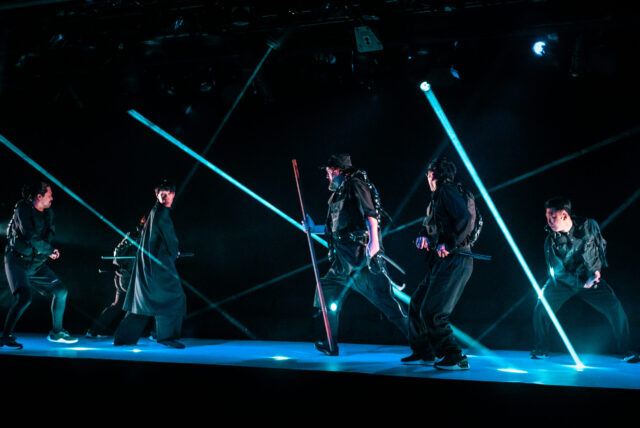
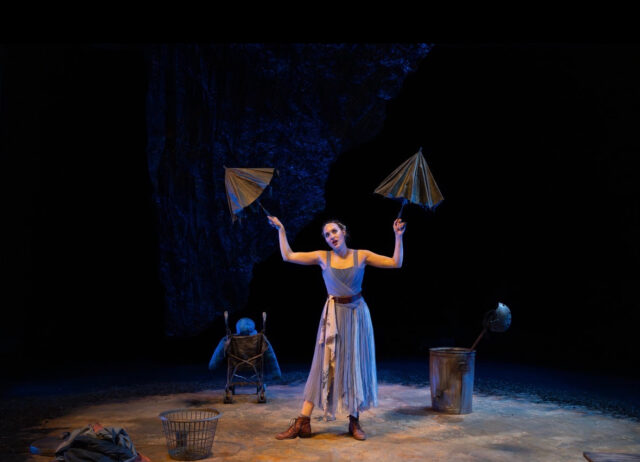
Kinoshita Kabuki makes its North American debut at Japan Society with a rousing adaptation of the 1840 Kabuki classic Kanjincho (“The Subscription List”), reimagining it as a contemporary hip-hop and pop-culture-infused theatrical experience.
Based on the Noh play Ataka, the original Kanjincho was written by Namiki Gohei III, with nagauta songs by Kineya Rokusaburo IV and choreography by Nishikawa Senzo IV. Company founder Yuichi Kinoshita has modernized the text, with a new score by Taichi Kaneko and movement by Wataru Kitao, resulting in a tense and thrilling eighty-minute drama about loyalty, revenge, and the borders that separate people not only geographically but by race, gender, class, and power in the past and present.
Inspired by actual twelfth-century events, Kanjincho tells the story of half brothers Lord Minamoto-no Yoritomo and General Minamoto Yoshitsune around the time of the Genpei War. Yoritomo has become the first shogun of the Kamakura shogunate, but he distrusts the motives of the military hero Yoshitsune (Noemi Takayama) and has demanded his capture. Yoshitsune, disguised as a porter, heads out on the seldom used Hokurokudō road with the brave and loyal Benkei (Lee V) and four shitenno (armed retainers), Kamei Rokuro (Kazunori Kameshima), Kataoka Hachiro (Hiroshi Shigeoka), Suruga Jiro (Yuya Ogaki), and Hitachi (Yasuhiro Okano), who are pretending to be mountain priests collecting donations on their way to repair Todaiji Temple in Nara. In fact, they are seeking safety in Michinoku with the Fujiwara clan.
When they reach the Ataka Barrier checkpoint, one of many set up throughout Japan to stop Yoshitsune, they are met by Mr. Togashi (Ryotaro Sakaguchi) and his four guards (Kameshima, Shigeoka, Ogaki, and Okano), who are determined to bring Yoshitsune back and behead him in front of Yoritomo. Togashi has been told that Yoshitsune is traveling with a group of fake mountain priests, so he is suspicious of them. “I’m gonna make every last damn mountain priest grovel at Mr. Togashi’s feet!” one of the guards declares.
Togashi decides to test Benkei with a series of questions about their mission and Buddhism that turns into a sensational verbal duel in which Benkei shows off his considerable mental acuity, impressing Togashi, who is leaning toward letting them pass even as one of his guards believes that the lowly porter is Yoshitsune. The cat-and-mouse game continues through a picnic with a transistor radio and contemporary snacks, the four shitenno breaking out into a J-pop boy band, and Benkei enjoying a whole lot of sake.
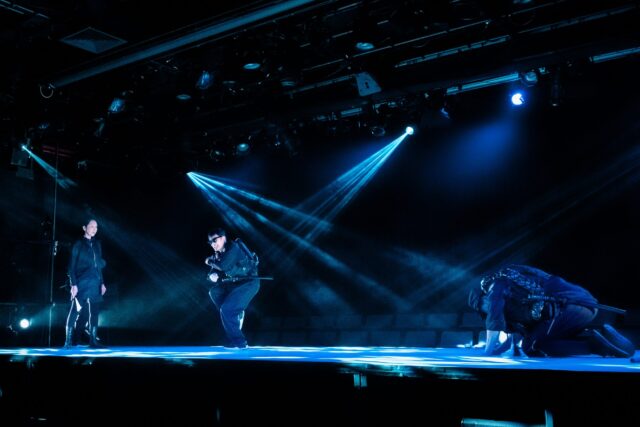
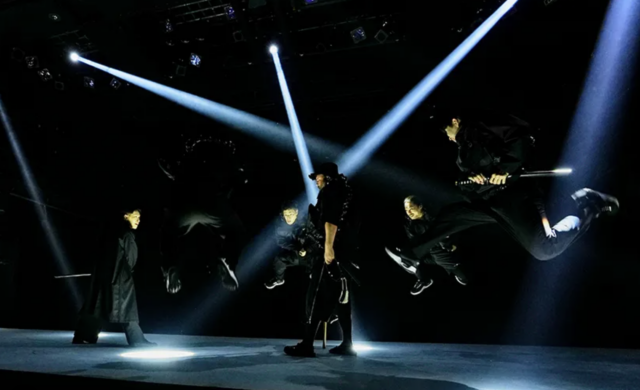
Beautifully directed and designed by Sugio Kunihara (Tokaido Yotsuya Kaidan,Shin Suikoden), Kanjincho — the English title, “The Subscription List,” refers to the scroll of supposed temple donors Togashi asks Benkei to reveal — takes place on a raised horizontal hanamachi (“flower path”) platform behind which two rows of the audience sit. The characters are dressed by Haruki Okamura in modern-day black militaristic gear except for Yoshitsune, who wears a wide-brimmed hat and carries a large walking stick, and Togashi, who is in more regal attire. The sound, by Daisuke Hoshino and Chiharu Tokida, includes moments of silence amid forest noises and Kaneko’s loud electronic and rap score.
Lighting designers Masayoshi Takada, Arisa Nagasaka, and Naruya Sugimoto nearly steal the show with spectacular effects, from pinpoint laserlike beams, slow, shadowy atmospheres, and an occasional subtle white bar on the floor that represents the numerous barriers separating the characters. “No matter how much I care about you / I can’t hold on to you / because of the borderline / You’re right next to me / but still so far away,” the pseudo–boy band sings in Japanese, except for the word borderline, which they say in English, connecting East and West. The East-West relationship is further developed by Kitao’s choreography, which incorporates traditional kabuki (primarily by Takayama) and hip hop, as well as by the casting of Benkei, portrayed by the outstanding Lee V, a caucasian poetry slam champion who was born in the United States; he evokes David Harbour as Sheriff Hopper in Stranger Things.
At its heart, Kinoshita’s adaptation attempts to break down barriers without preaching, even as the shitenno proclaim, “Equality for all!” and “Everyone’s the same! No more discrimination!” Having the same four men play the shitenno and the guards, running from one side of the stage to the other to indicate who they are without changing costumes — one actor apologizes for coughing first as a shitenno, then as a guard, equating the two despite their being enemies — packs a powerful message, especially in America today, as ICE agents patrol the streets of major cities rounding up citizens and legal and illegal immigrants alike.
Kunihara and Kinoshita may be delivering a warning, but they do so with a masterful sense of fun that transcends all our differences.
[Mark Rifkin is a Brooklyn-born, Manhattan-based writer and editor; you can follow him on Substack here.]
Leo McGann’s The Honey Trap at Irish Rep travels between the present and 1979 (photo by Carol Rosegg)
THE HONEY TRAP
Irish Repertory Theatre, Francis J. Greenburger Mainstage
132 West Twenty-Second St. between Sixth & Seventh Aves.
Wednesday – Sunday through February 15, $60-$125 irishrep.org
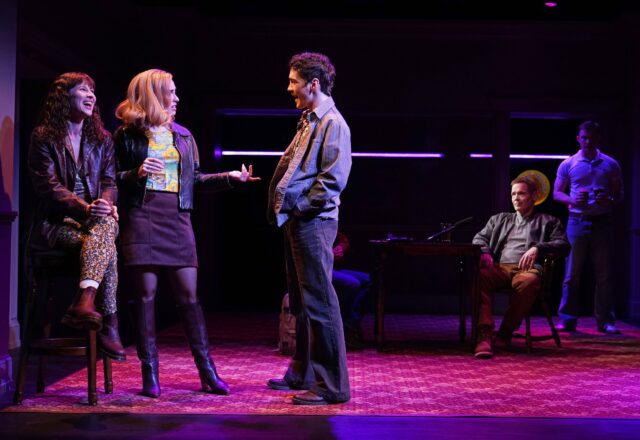
Inspired by Ed Moloney’s Belfast Project at Boston College, in which audio interviews were conducted with approximately fifty former paramilitaries involved in the Troubles in Northern Ireland in the 1970s and ’80s, Leo McGann’s The Honey Trap is a gripping thriller that explores the Troubles in a unique and compelling way. It is now back at the Irish Rep for an encore run January 10 through February 15, giving everyone a second chance to catch this piece of theatrical magic.
The play begins in the dark, with snippets of dialogue heard in voiceover from former members of the IRA, the UDR, and a Scottish soldier talking about the thirty-year conflict. “They act holier than thou but they were rotten to the core. They couldn’t kill us themselves so they got their death squads to do it for them,” a Republican woman says. A former Ulster Defence Regiment man states, “I see them rarely enough but I do now and then. The post office. The big supermarket. Petrol station sometimes. I look them straight in the eye. They know what they did.”
As the voiceovers fade out, we see Emily (originally Molly Ranson, now played by Rebecca Ballinger), a twentysomething American PhD candidate and researcher, sitting at a table preparing to interview David Henson (Michael Hayden), a former British soldier. He is suspicious of Emily’s possible biases, as the vast majority of her previous subjects were on the side of the IRA, but he sees this as an opportunity to set the record straight. “Okay. I mean, I know you’re more interested in talking to IRA types, but here we are. I’m glad I’m going to get a chance to tell you the truth. Because you won’t get that from them,” he says. She responds, “We’re thrilled that you’re telling your truth.” To which he shoots back, “My truth? No. The truth.”
For the next two hours (with intermission), the play shifts between the present and 1979, when the young Dave (Daniel Marconi) and his friend and fellow soldier, Bobby (Harrison Tipping), had a night out that ended up with Bobby’s murder, a case that was never solved. We gradually disover that Dave is not speaking with Emily merely to share his story but also to find out who killed Bobby — and perhaps exact revenge.
In 1979, Dave and Bobby, who are both married, are at a pub after a tough day working riot control in West Belfast. As part of a game meant to embarrass Bobby, Dave forces his mate to approach two young women, Kirsty (Doireann Mac Mahon) and Lisa (Annabelle Zasowski), despite Bobby’s initial reluctance. Soon the four of them are flirting.
The action occurs in flashback around the table where Emily is interviewing Dave, who carefully watches his memories unfold as Emily continues to probe. Dave insists that he and Bobby were at the bar just to relax and have a few pints. “Did you have any idea anything was amiss?” she asks. He replies, “Not a clue.”
Dave eventually takes off, leaving Bobby with the two women. “And that was it. Last I ever saw of him,” Dave explains. “They took him to some flat just outside Belfast. We don’t know if they interrogated him first or what. Then someone shot him twice in the head. His own mum wouldn’t have recognised him. But they left his army ID in his pocket. So that made it a bit easier. Thoughtful of them, eh?”
In the second act, the modern-day Dave travels to South Belfast to meet Sonia (Samantha Mathis), who he believes knows exactly what happened to Bobby that night.
Every character gets more than they bargained for in The Honey Trap. McGann (Friends Like These,In the Moment) and director Matt Torney (The White Chip,Stop the Tempo), both of whom grew up in Belfast, maintain a simmering tension all the way to an explosive conclusion, with plenty of shocks and surprises, overcoming a few awkward moments. At the center of it all is the older Dave, who is onstage the entire show, either in the present day meeting with Emily and Sonia or watching his younger self on the night his life changed forever.
Tony and Olivier nominee Hayden (Judgment at Nuremberg,Carousel) is riveting as Dave, a private man on a quest while fighting off his demons; it will make you wonder what you would do if given the opportunity to watch scenes from your past unfurl before your very eyes. The rest of the cast is strong, led by a tender performance by Mathis (33 Variations,Make Believe) as a woman who thought she had escaped her past.
Master set designer Charlie Corcoran expertly integrates the different time periods and locations, from the unionist pub to a coffee shop to a bedroom, enhanced by Sarita Fellows’s casual and military costumes and Michael Gottlieb’s sharp lighting, switching between brightness and dark, shadowy interiors. James Garver’s sound ranges from the voiceovers to a loud pub and a quiet café.
The Honey Trap — which takes its name from the form of covert deception in which an operative uses seduction to lure someone into a manipulative situation — is another winner from the Irish Rep, a complex play that explores issues of guilt, responsibility, trauma, and vengeance that might be about a specific fictional event but feels all too relevant in today’s world.
[Mark Rifkin is a Brooklyn-born, Manhattan-based writer and editor; you can follow him on Substack here.]
Ed Schmidt’s Edward is back for a bookstore run this winter (photo by Sophie Blackall)
EDWARD
Multiple bookstores including the Strand, Rizzoli, PowerHouse Arena, the Mysterious Bookshop, McNally Jackson, and Books Are Magic
January 22 – March 1, $40 edschmidttheater.com
Last May, I saw Ed Schmidt’s Edward at the All Street Gallery on the Lower East Side. It is now back for a tour of New York City bookstores in Brooklyn and Manhattan, running January 22 through March 1. Below is my original review; please note that tickets go fast to this unique theatrical experience.
Ed Schmidt knows about endings. His 2010 solo show, My Last Play, was ostensibly his swan song, written two years after the death of his father and a transformative rereading of Our Town, concluding a twenty-year career that had also featured Mr. Rickey Calls a Meeting,The Last Supper, held in his Brooklyn kitchen, and the monthly variety show Dumbolio. Nevertheless, in 2015, Schmidt, at the time a professor and basketball coach at Trinity on the Upper West Side, wrote and performed the high school basketball drama Our Last Game, staged in an actual high school locker room.
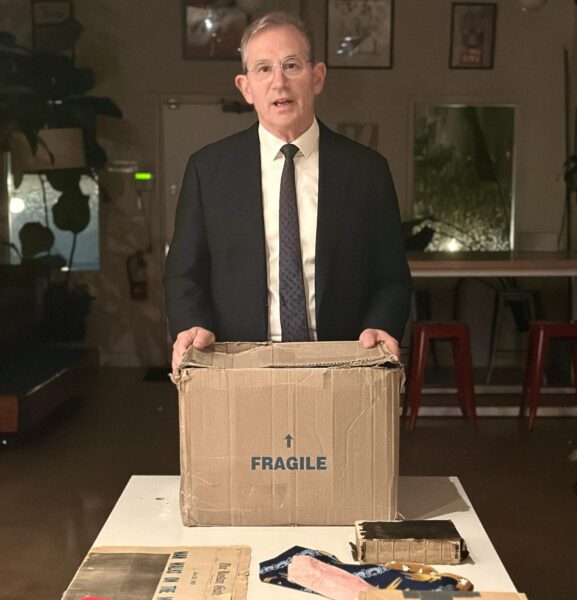
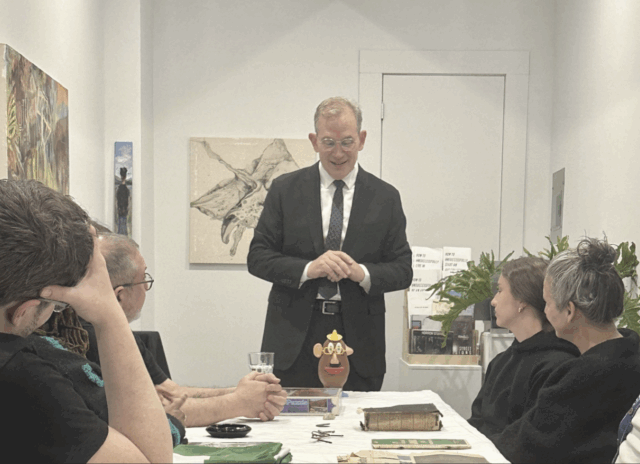
Thankfully, Schmidt is back again with the superb Edward, the poetic, graceful, intimate tale of one Edward O’Connell, an unspectacular but respectable and enigmatic divorced father and educator. The hundred-minute play takes place at All Street Gallery on Hester St., with the audience of between twelve and eighteen people sitting around a long white table covered with twenty-seven objects and an empty box. Fortunate ticket holders are encouraged to arrive early and examine each piece, to pick them up and scrutinize them closely: A Brooks Robinson baseball glove. Four neckties. Mr. Potato Head. A copy of The Catcher in the Rye. A “Goose Girl” Hummel. An ashtray. A jazz CD. A postcard of a boy on a lake. A business card.
“Edward O’Connell died twelve years ago, at the age of seventy-three, and left behind this box, and all that it contained,” Schmidt, resembling a mild-mannered Kevin Costner and sounding like a toned-down Albert Brooks, begins. “With these twenty-seven objects, there are over ten octillion ways to tell Edward’s story. Ten octillion. That’s a one followed by twenty-eight zeroes. That’s the number of grains of sand on the Earth. Multiplied by the number of stars in the Milky Way. In other words, an unfathomable number. Tonight, we will tell one of those ten octillion versions.”
Wearing a dark suit and white shirt, Schmidt then serves as an Our Town–style Stage Manager, going through the objects in random order, each one a way into Edward’s life, directly or indirectly. He speaks in the third person although it feels like he’s channeling O’Connell, delving deep into his being. We learn about Edward’s wife, Angela, and their children and grandchildren; his love of the Celtics and Red Sox; his battles with department head Nona and headmaster Renée Marsh at his school, Enright Academy; his first car; his favorite word; the vacation when he thought his son had drowned; where he was at seminal moments in US history; his multiple regrets.
Many passages unfurl with a quiet majesty. “He likened her transformation to watching a sunset: you can sense a change coming — the air cools, the light fades, the sky pinkens, and then, all of a sudden, you realize, ‘It’s dark. When did that happen?’ Or perhaps the proper metaphor was a sunrise, and darkness slowly, suddenly turning to day,” he muses.
Others are experiences that everyone can relate to. “You know how, on every To Do List, there’s that one task that never gets done? It’s the one item that, for whatever mysterious reason, you can’t cross off, and it ends up getting transferred to the next list and the next and the next, and, in the end, you either complete the task or you just let it slip away and forget, but, in either case, your inability to follow through feels like a moral failure. Why did it take me so long to clean out the gutters? Or send that thank-you note? Or throw away that box of stuff in the attic? What is wrong with me?”
But each helps us learn who Edward O’Connell was and, in turn, who Ed Schmidt is — and who we are. As you walk around the table, examining the objects, several almost certainly will stand out to you personally, bringing up your own memories; for me, the baseball glove, The Catcher in the Rye, the small rock, and the Hummel figurine sent me back. The friend I attended with had actually completed the very jigsaw puzzle that was on the table. Schmidt’s writing is so evocative that the stories will also remind you of similar situations you got tangled up in as a child and an adult.
In Francesco Bonami’s newly updated semifictional Stuck: Maurizio Cattelan — The Unauthorized Autobiography, about the Italian artist and prankster, Bonami writes, “Here is my story of his story. You can believe it or not — it doesn’t matter, just as long as you enjoy it, that’s enough. If cultivating ‘doubt’ is essential to life . . . well, Maurizio Cattelan harvests doubts like nobody else.” Schmidt has accomplished a similar feat with Edward.
Ed Schmidt’s Edward is an intimate and poetic tale of an ordinary man’s life (photo courtesy Ed Schmidt)
Spoiler alert: The next two paragraphs give information about the show that you might not want to know before seeing it but was a critical part of my connecting with the work. The objects are chosen one at a time by the audience, going around in a clockwise circle. I thought long and hard about the two that I selected, wanting to impress Schmidt, hoping they would lead to great anecdotes that I would feel partly responsible for, and imagining that I could have shared my own reminiscence about them.
It seems impossible for Schmidt to know O’Connell as well as he does, especially since Edward did not leave behind a memoir or journal. But as real as O’Connell’s life appears to be, did he even exist? Did Schmidt make it all up, or perhaps use elements from his own life in crafting the play? Going on an intense Google search, I found that there is very little on the internet about Schmidt, and there seems to be no Edward O’Connell who died in 2012 at the age of seventy-three. However, I did find facts about other Edward O’Connells and various Schmidts that pop up in Edward, from names to professions to family relationships. For example, Schmidt talks about a skiing accident that Edward’s brother, Steven, had. I discovered a Substack post by political pundit Steve Schmidt about a skiing accident as well as a news story about a man named Steve Schmit who survived a life-threatening skiing mishap. Coincidence? Maybe — but maybe not.
Spoilers over, it’s also clear that Schmidt has some prankster in him too, as well as a wicked sense of humor, which emerges in his official bio, where he calls himself a “Playwright, Performer, Director, Producer, Genius,” lists the many rejections his plays have received from “some of the most and least venerable theater companies in America,” and explains that “none of Mr. Schmidt’s work has been made possible, in part or in whole, by the generous support of the National Endowment for the Arts, the New York State Council on the Arts, or the New York City Department of Cultural Affairs, or of any corporate foundation or charitable institution, though it’s not for lack of trying.”
As Bonami posits about Cattelan, “It doesn’t matter, just as long as you enjoy it, that’s enough.” For one thoroughly enjoyable evening in a Lower East Side gallery, it was enough to believe in Edward O’Connell, to believe in Ed Schmidt, and just maybe to believe in oneself.
[Mark Rifkin is a Brooklyn-born, Manhattan-based writer and editor; you can follow him on Substack here.]
Elevator Repair Service’s Ulysses is a highlight of the January performance festival season (photo by Maria Baranova)
Every January, many of us begin the new year with resolutions to make positive changes in our lives; I find the best way to start that is by checking out the latest in cutting-edge and experimental theater, music, dance, opera, film, and other forms of entertainment. Performance festivals abound this month, at tiny venues you’ve never heard of, places you’ve always wanted to go to but haven’t yet, and well-known spaces you haven’t been to in years.
You now have the chance to fill those voids at such festivals as Under the Radar, Prototype, Exponential, Out-Front!, Live Artery, Winter Jazzfest, New Ear, the Fire This Time, and PhysFestNYC, none of them costing nearly as much as a Broadway show. As sound designer Mark Anthony Thompson says in the below video, “Get out of your house and be with people.”
Here are only some of the highlights of this exhilarating time to try something that might be outside your comfort zone — or right up your alley.
UNDER THE RADAR: IN HONOR OF JEAN-MICHEL BASQUIAT
New York Theatre Workshop
79 East Fourth St. between Second & Third Aves.
Tuesday – Sunday, January 7–18, $35 www.nytw.org utrfest.org
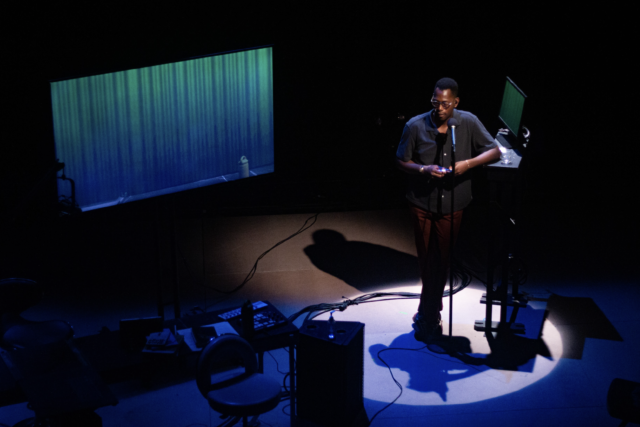
Obie-winning actor, playwright, rapper, and director Roger Guenveur Smith has staged such solo shows as A Huey P. Newton Story, about the founder of the Black Panthers, Frederick Douglass Now, in which he embodies the nineteenth-century abolitionist and orator, and Juan and John, which explored the real-life 1965 fight between Major League pitcher Juan Marichal and catcher John Roseboro. For the 2026 Under the Radar festival, he will perform In Honor of Jean-Michel Basquiat, about his friendship and collaboration with the highly influential Brooklyn-born artist and musician who died of a heroin overdose in 1988 at the age of twenty-seven. Smith and Basquiat met during their LA club years in the 1980s; Smith created the character of Smiley, inspired by Basquiat, for the 1989 Spike Lee film Do the Right Thing. The sixty-minute piece features live sound design by Mark Anthony Thompson; the January 8 and 15 performances will be followed by a Q&A.
UNDER THE RADAR: KANJINCHO
Japan Society
333 East 47th St. at First Ave.
January 8–11, $63 japansociety.org utrfest.org
Yuichi Kinoshita reimagines the 1840 Kabuki classic Kanjincho (“The Subscription List”) as a contemporary hip-hop and pop-culture-infused theatrical experience, making its North American premiere at Japan Society January 8–11 as part of Under the Radar. The eighty-minute show is set in the twelfth century, around the Genpei War, a civil clash between the Taira and Minamoto clans. The work is performed by the Kyoto-based Kinoshita Kabuki, all dressed in black, and directed by Sugio Kunihara on a runway-like hanamachi (“flower path”) platform that juts into the audience, with the first two rows on the stage itself. The story concerns war, betrayal, race, and class as refugees attempt to cross borders, giving it a modern-day relevance. The company’s previous works include Musume Dojoji,Shinju Ten no Amijima, and Sannin Kichisa. The 7:30 show on January 8 will be followed by a reception; the 7:30 performance on January 9 will conclude with an artist Q&A. Ticket holders are invited to visit the immersive exhibition “Chiharu Shiota: Two Home Countries” with complementary same-day admission.
UNDER THE RADAR: ALL THAT FALL
Mabou Mines@122CC
150 1st Ave. at Ninth St.
January 8–26 www.maboumines.org utrfest.org
“It is our desire to create, as Beckett says, ‘a text written to come out of the dark,’” director JoAnne Akalaitis says about Mabou Mines’s tenth production of a work by Samuel Beckett, the absurdist black comedy All That Fall, following such presentations as Cascando,Happy Days,Play, and Worstward Ho over the course of the company’s fifty-six-year history. The seventy-five-minute one-act radio play will be performed by Randy Danson, Jesse Lenat, Steven Rattazzi, Tony Torn, Tẹmídayọ Amay, Wendy vanden Heuvel, Lila Blue, and Sylvan Schneiderman as part of Under the Radar. “What have I done to deserve all this, what, what?” the frail Mrs Maddy Rooney moans to bill broker Mr Tyler, later adding, “Have you no respect for misery?” I saw Trevor Nunn’s splendid version in 2013 starring Michael Gambon and Eileen Atkins and can’t wait to see what Akalaitis (Beckett’s First Love,BAD NEWS! I was there . . .) has in store for us this time around, with a set by Thomas Dunn, lighting by Jennifer Tipton, sound by Bruce Odland, costumes by Andreea Mincic, and projections by Jeri Coppola. Expect the unexpected.
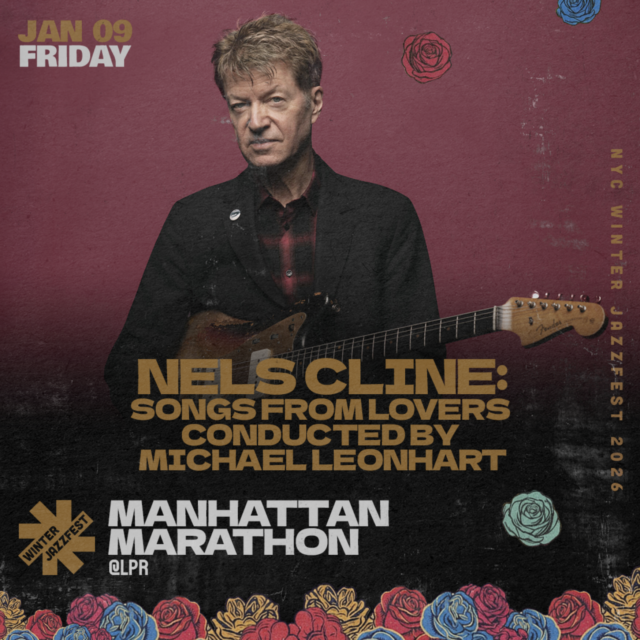
Founded in 2005, “Winter Jazzfest celebrates the music as a living entity, wherein history collides with the future in every note. Creative improvisation in the digital age continues to stimulate thought and emotion of its listeners, embracing innovation, defying instrumental boundaries and the old cliches of ‘What is Jazz?’” The festival runs January 8–13 and is highlighted by the Manhattan Marathon on January 9, boasting forty-five shows at Le Poisson Rouge, Nublu, DROM, City Winery, Close Up, Zinc, and the Bitter End, featuring Nels Cline’s “Songs from Lovers,” the Getdown, James Carter, David Murray, Lady Blackbird, and many more.
Drita Kabashi stars in Sara Farrington’s Euripides adaptation at the Tank (photo by Carol Ostrow)
APAP: A TROJAN WOMAN
Theater 98 at the Tank
312 West Thirty-Sixth St. between Eighth & Ninth Aves.
January 10-11, $23-$42 apap365.org/conference thetanknyc.org
“A Trojan Woman exists inside an act of modern warfare, inspired by an early moment in the Russian war against Ukraine that affected me deeply,” playwright Sara Farrington explains in a note about her adaptation of Euripides’s 415 BCE Greek tragedy The Trojan Women. Originally performed at the outdoor Theatro Attikou Aldous/Katina Paxinou Attica Grove Theater in Athens, Greece, in July 2023, A Trojan Woman will be at the Tank January 10-11 as part of the APAP (Association of Performing Arts Professionals) festival, directed by Meghan Finn and starring Drita Kabashi as Irina; the costumes are by Suzanne Bocanegra, with video by Ana Veselic. Farrington has previously collaborated with her husband, Reid Farrington, on such productions as BrandoCapote,CasablancaBox, and Dora Maar, always providing a unique take on the world and theater itself; Sara is currently working on Dr. Uncanny Presents: Moreau ’96, a musical based on the 2014 documentary Lost Soul: The Doomed Journey of Richard Stanley’s Island of Dr. Moreau. She is also the author of the popular Theater Is Hard. on Substack.
Ian Andrew Askew and Johnnie Cruise Mercer will present world premieres at Out-FRONT! Fest (photos by Maria Baranova and Johnnie Cruise Mercer)
OUT-FRONT! FESTIVAL: IAN ANDREW AND JOHNNIE CRUISE MERCER
Judson Memorial Church
243 Thompson St. at 55 Washington Square South
Saturday, January 10, and Sunday, January 11, free with advance RSVP (suggested donation $28.52) pioneersgoeast.org www.judson.org
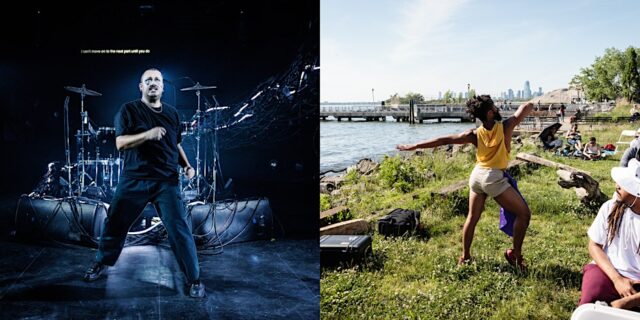
Pioneers Go East Collective’s multidisciplinary Out-FRONT! Fest “champions the voices of LGBTQ and Feminist artists for a lively exchange of art and culture.” Curated by Gian Marco Riccardo Lo Forte, Remi Harris, Philip Treviño, and Joyce Isabelle, the 2026 edition runs January 5–11, with works by such performers as Dominica Greene, Suzzanne Ponomarenko, Alexa Grae, Sugar Vendil, Jo Warren, Owen Prum, and Corentin JPM Leven at Judson Memorial Church. On January 10 and 11, Ian Andrew Askew will present the world premiere of SLAMDANCE punk lessons, which explores sociopolitical aspects of moshing and violence, followed by the world premiere of Johnnie Cruise Mercer’s Mercies of a Butterfly, “a movement allegory about resilience.” All tickets are free with suggested donation and are going fast.
Wally Cardona and Molly Lieber restage David Gordon’s 1975 duet in original SoHo loft (b&w photo by Babette Mangolte; color photo by Daqi Fang)
LIVE ARTERY: TIMES FOUR / DAVID GORDON: 1975/2025
New York Live Arts / Pick Up Performance Co. Studio
541 Broadway between Spring & Prince Sts.
January 11–13, $33.85 newyorklivearts.org
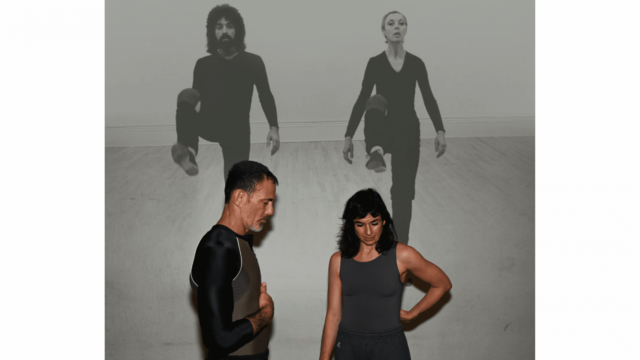
Two of my favorite dancer-choreographers, Wally Cardona and Molly Lieber, have teamed up for Times Four / David Gordon: 1975/2025, an adaptation of David Gordon’s 1975 duet with his wife and muse, Valda Setterfield, that will run January 11–13 as part of New York Live Arts’ Live Artery festival. The work will be presented in the same SoHo loft where Obie and Bessie winners Gordon and Setterfield debuted it fifty years ago; Times Four has not been seen in its entirety since then. In 2021, Gordon asked Cardona, who is married to playwright Ain Gordon, David and Valda’s son, if he wanted to perform something from his archives. Cardona was instantly interested in Times Four, an unusual, relatively unknown piece, but Gordon rejected that. However, after both Gordon and Setterfield died, the former in 2022 at the age of eighty-five, the latter in 2023 at eighty-eight, Cardona decided to resurrect Times Four in their honor. “I think that they, especially Valda, would be very happy that we are doing this piece and that we are performing something,” Cardona told choreographer, dancer, director, and NYLA head Bill T. Jones in an online interview. Cardona (Interventions,The Set Up) and Lieber (Rude World,Gloria) reconstructed the piece from a video rehearsal, Setterfield’s handwritten notes, photographs, and other ephemera, as no footage of the full original duet, which is done in silence, exists. The audience will sit in folding chairs on all four sides of the loft.
Eric Berryman shares African American toasts in Wooster Group’s Get Your Ass in the Water and Swim Like Me (photo by Marika Kent)
UNDER THE RADAR: GET YOUR ASS IN THE WATER AND SWIM LIKE ME
Joe’s Pub, the Public Theater
425 Lafayette St. at Astor Pl.
Monday, January 12, and Tuesday, January 13, $36 utrfest.org publictheater.org
In 2019, the Wooster Group production of The B-Side: “Negro Folklore from Texas State Prisons,” a Record Album Interpretation earned a Drama Desk nomination for Unique Theatrical Experience for Eric Berryman’s multimedia adaptation of a 1965 LP compiled by Bruce Jackson, consisting of performances by inmates of color on segregated agricultural prison farms. Writer and actor Berryman and director Kate Valk followed that up with Get Your Ass in the Water and Swim Like Me, which is having an encore presentation at Joe’s Pub as part of Under the Radar. This time Berryman dives deep into Jackson’s 1974 book and 1976 disc, Get Your Ass in the Water and Swim Like Me: Narrative Poetry from Black Oral Tradition, a collection of folktales known as toasts, made for heroes and antiheroes in the Black storytelling canon. The tales are filled with tawdry sex and extreme violence — bullets are flying everywhere — but as funny as they are, there’s also an underlying sense of discomfort, particularly with a primarily white audience, as the stories contain stereotypes reminiscent of minstrelsy. Berryman compares over-the-top characters to Greek myths, where such figures as Hercules and Jason “would do stupid shit because they knew it would help them uh, uh, more quickly achieve kleos, and get kleos . . . A community creates the heroes that they need.” Berryman (Primary Trust,Toni Stone) is not just sharing old fables but exploring Black identity then and now. At one point he digresses into a discussion of his own name, how disappointed he is to be anchored with the plain “Eric” when he has relatives called Qasim, Idris, Indira, Akeem, Alenka, and Adia. (He does note that there is a Gary but does not share that it’s his uncle, Grammy-winning jazz saxophonist Gary Bartz.) The show concludes with the all-time favorite “Stackolee,” a tale of murder and mayhem that has been recorded in different versions by Mississippi John Hurt, Doc Watson, Wilbert Harrison, Long Cleve Reed, Lloyd Price, and Nick Cave and the Bad Seeds, among others, its familiarity spotlighting the centrality rather than the marginalization of the Black experience in American popular culture.
PhysFestNYC: BILL BOWERS: IT GOES WITHOUT SAYING
Stella Adler Center for the Arts
65 Broadway
Tuesday, January 13, $20, 7:30 & 9:00 www.physfestnyc.org
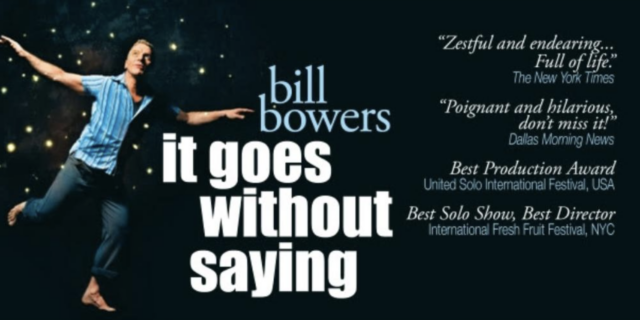
PhysFestNYC was started in 2024 as “a community-focused festival that celebrates, enriches, and envisions our field of physical theater . . . [which] tends to be experimental, innovative, and genre-breaking.” The third annual event, taking place January 8–18 at the Stella Adler Center for the Arts, consists of workshops, panel discussions, masterclasses, and live performances. On January 13, Bill Bowers will present the one-man show It Goes without Saying, which delves into his life and career from his childhood in Montana to studying with Marcel Marceau and appearing in several Broadway productions.
Christopher-Rashee Stevenson, Vin Knight, and Scott Shepherd rehearse for NYC premiere of ERS’s Ulysses (photo by Joan Marcus)
UNDER THE RADAR: ULYSSES
Martinson Theater, the Public Theater
425 Lafayette St. at Astor Pl.
January 13 – February 15, $109 publictheater.org utrfest.org
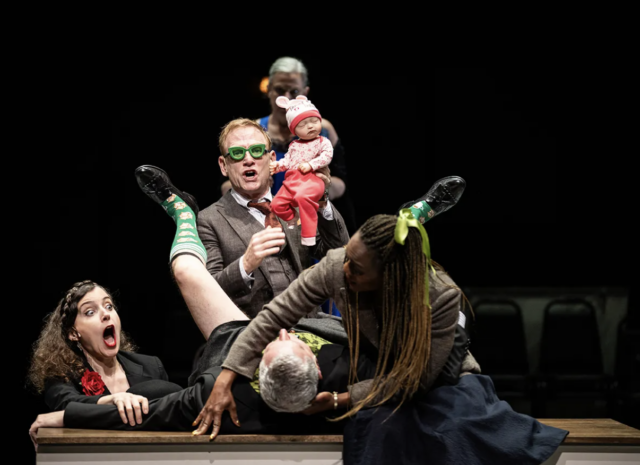
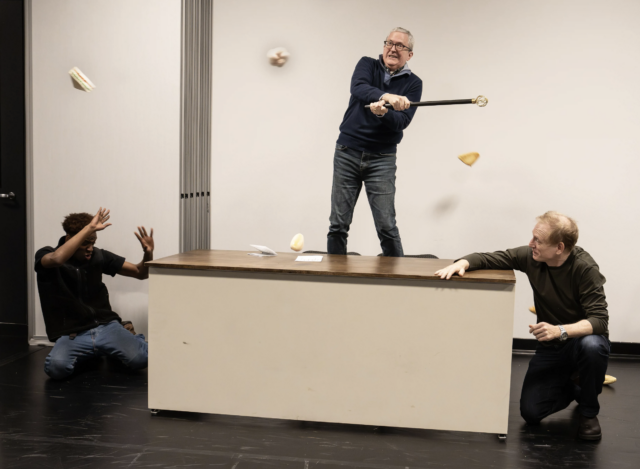
Elevator Repair Service follows up its farewell performance of the eight-hour Gatz at the Public with its adaptation of James Joyce’s Ulysses, clocking in at a mere two hours and forty minutes. Directed by John Collins, who has previously tackled such literary biggies for ERS as The Sound and the Fury and The Sun Also Rises in addition to Gatz, the show stars Dee Beasnael, Kate Benson, Maggie Hoffman, Vin Knight, Christopher-Rashee Stevenson, Stephanie Weeks, and codirector and dramaturg Scott Shepherd, with sets by dots, costumes by Enver Chakartash, and projections by Matthew Deinhart. Joyce is having a bit of a renaissance onstage recently, with a rare revival of Joyce’s only play, Exiles, last winter and Colin Murphy’s The United States vs. Ulysses at the Irish Arts Center last spring; ERS’s Ulysses, part of Under the Radar, promises to be the best of the bunch.
Writer Jay Stull (The Capables,Rantoul and Die) and director Jillian Jetton have put together a fantastic cast for my utopias, running at the Loading Dock Theatre as part of the Exponential Festival: Brittany Bradford, Ugo Chukwu, Fernando Gonzalez, Melissa Hurst, Jon Norman Schneider, Colleen Werthmann, and Julyana Soelistyo. The show is about a kind of postapocalyptic nightmare in New York City as a group of survivors wonder what the future holds.
Paul Lazar and Annie-B Parson stage first revival of Richard Foreman’s What to wear at BAM (photo by Scott Groller)
PROTOTYPE: WHAT TO WEAR
Brooklyn Academy of Music
BAM Strong Harvey Theater
651 Fulton St. at Ashland Pl.
January 15-18 www.bam.org www.prototypefestival.org
“Don’t finish what you start,” reads one of ninety-four notecards collected in experimental theater maestro Richard Foreman’s posthumously published book No Title. Fortunately, Foreman, the founder of the Ontological-Hysteric Theater who died last January at the age of eighty-seven, finished much of what he started, including more than eighty plays, operas, films, and books. The seven-time Obie winner and Guggenheim and MacArthur Fellow turned the theater and opera community inside out and upside down with such influential avant-garde works as Sophia = (Wisdom) Part 3: The Cliffs,Pandering to the Masses, and Elephant Steps. In the past year and a half, Object Collection presented the world premiere of Foreman’s Suppose Beautiful Madeline Harvey, the Wooster Collective staged 1987’s Symphony of Rats, and the Segal Center Film Festival on Theater and Performance held a retrospective of Foreman’s movies and videos. Big Dance Theater’s Paul Lazar and Annie-B Parson are now reviving, for the first time since its premiere, Foreman and Michael Gordon’s 2006 surreal post-rock opera What to wear, running January 15–18 at the Harvey as part of the Prototype and BAM’s Next Wave festivals. Foreman wrote the libretto and directed the original; Gordon composed the music, which will be performed by Bang on a Can All-Stars. The cast is highlighted by St. Vincent, sopranos Sarah Frei and Sophie Delphis, mezzo Hai-Ting Chinn, and tenor Morgan Mastrangelo, along with an ensemble of more than a dozen vocalists and dancers.
NEW EAR FESTIVAL: NIGHT 02
Fridman Gallery
169 Bowery between Delancey & Broome Sts.
Saturday, January 17, $22.46–$43.57, 8:00 withfriends.events
The Fridman Gallery’s annual New Ear multimedia festival showcasing “time-based art in all its forms” is highlighted by an impressive roster of performers on January 17, consisting of dancer and choreographer Jade Manns, artist and biohacker Dr. Heather Dewey-Hagborg, and the live debut of the trio of sound artist Stephen Vitellio, Fugazy drummer Brendan Canty, and multi-instrumentalist and producer-engineer Hahn Rowe, supporting their sophomore LP, Second. Talullah Calderwood, Sue Huang, and Konjur Collective open the three-day fest on January 16, while La Frae Sci, Ben Shirken x Dorothy Carlos, and Lucky Dragons close things out on January 18.
Fire This Time fest features ten-minute works by six playwrights
THE FIRE THIS TIME FESTIVAL: TEN-MINUTE PLAY PROGRAM
The Apollo Stages at the Victoria
233 West 125th St. between Frederick Douglass & Adam Clayton Powell Jr. Blvds.
January 23–31, $51.25 www.firethistimefestival.com
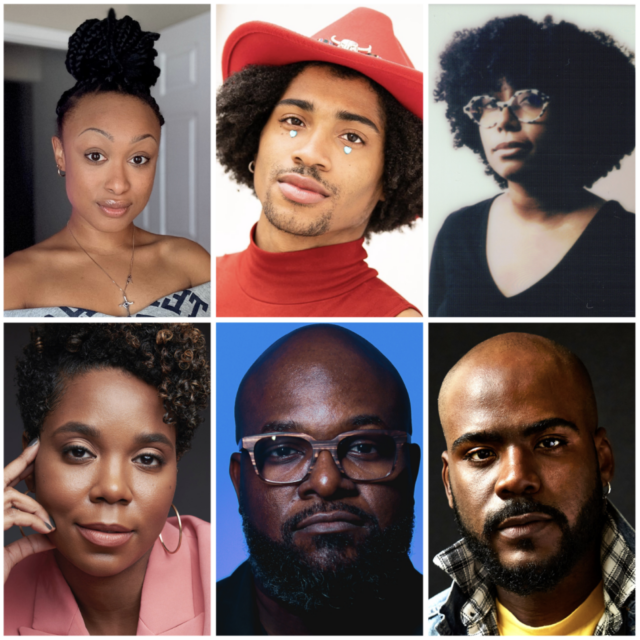
Founded in 2009 by Kelley Nicole Girod, the Fire This Time Festival, now in its seventeenth year, “provides a platform for early career playwrights of African and African American descent.” The 2026 iteration comprises six ten-minute shows at the Apollo Stages at the Victoria: Teniia Micazia Brown’s Everything But–, Preston Crowder’s Black to Save the Day, Mo Holmes’s Clumsy, Naomi Lorrain’s DNR, DeLane McDuffie’s Goose, and Donathan Walters’s White Diamond.
[Mark Rifkin is a Brooklyn-born, Manhattan-based writer and editor; you can follow him on Substack here.]
Mike (Connor Wilson) and Mandy (West Duchovny) form a bond in Scott Organ’s Diversion (photo by Edward T. Morris)
DIVERSION
The Barrow Group Performing Arts Center
520 Eighth Ave. between Thirty-Sixth & Thirty-Seventh Sts., ninth floor
Tuesday- Sunday through January 11, $49 www.barrowgroup.org
“If you’re gonna take care of people, you have to take care of yourself first,” Emilia (Tricia Alexandro) tells Mandy (West Duchovny) in Scott Organ’s potent Diversion, one of the best plays of 2025. It’s a maxim that rings true both on- and offstage.
The show unfolds at the Barrow Group Performing Arts Center, on the ninth floor of the modernized hundred-year-old high-rise office tower at 520 Eighth Ave., where ticket holders have to display their ID and have their picture taken at the front desk, not that different from entering a hospital these days. Once upstairs, some audience members have to walk right through Edward T. Morris’s intimate set, a nurses’ break room at a hospital’s ICU, in order to get to their seats, adding to the immersive feel of the powerful narrative.
It’s the holiday season, shortly after Thanksgiving, and the nurses’ manager, Bess (Thaïs Bass-Moore), announces to her staff that someone has been stealing, or “diverting,” Oxycontin and fentanyl patches; an investigator named Josephine Holden (Colleen Clinton) has been sent by the feared Fortune Consultants to uncover the perpetrator. A former nurse herself — a fact she uses to try to gain the nurses’ trust — Jo is an unwelcome intruder in their private space, where they take much-needed respite from treating seriously ill patients fighting for their lives in the ICU.
At first, the stern Bess tells her team of four nurses that if it is any one of them, they need to come clean and that if they are an addict, she will make sure to get them help and not notify the police. Bess’s boss, Cunningham, has placed them all under suspicion: the hypercritical Amy (DeAnna Lenhart), a long-established nurse with back pain who is married to a cop; the younger Mike (Connor Wilson), a single father with a special-needs kid; newcomer Mandy, who is living with a sketchy boyfriend; and Emilia, a sterling nurse who ran the triage during the Covid pandemic and whose husband just moved out after they were unable to conceive.
When everyone denies being involved in the thefts, Bess admonishes them: “Look. I gave everyone a chance. A very fair chance. And whoever did this decided instead to tell me and all their peers here to fuck off. And I will accordingly offer them the same respect when I find them out. This is an embarrassment. And I gave you all a chance. And whoever it is didn’t want to deal with me so they can deal with the cops. Cunningham wants a head on a pike. I will deliver that head.”
Amy and Emilia have worked together the longest and are close. When they start looking into who the culprit might be, Emilia says, “You’re my Watson?” Amy replies, “Or perhaps I’m your Holmes.” Meanwhile, Mike and Mandy bond as the probe deepens and New Year’s Eve approaches with Jo determined to get to the bottom of it.
Bess (Thaïs Bass-Moore) turns to Emilia (Tricia Alexandro) to try to solve a mystery in powerful play from the Barrow Group (photo by Edward T. Morris)
Diversion is expertly directed by Seth Barrish (The New One,Death, Let Me Do My Show), getting the most out of the relatively small, confined set, while Organ’s (17 Minutes,Phoenix) dialogue is sharp and on point, with a poetic flow and no wasted words. Solomon Weisbard keeps the lights dim, making the audience feel as if it’s in the room with the nurses, enhanced by Geoff Grimwood’s sound, which incorporates hospital noises into the mix. Gina Ruiz’s blue-scrub costumes are offset by Jo’s wardrobe and a late surprise.
Alexandro (Seven Deadly Sins), Bass-Moore (Any Ordinary Day), Clinton (Muswell Hill), Lenhart (The Fear Project), and Wilson (Stone Don’t Lie) are excellent as believable men and women who have sacrificed some of life’s inherent joys in order to help others, at the risk of personal health and, as Jo notes, “moral injury.” In her off-Broadway debut, Duchovny (the daughter of David Duchovny and Téa Leoni) sparkles as Mandy, a young woman still figuring out who she is and where she belongs. She may not be the smartest of the group — she regularly does not understand certain words or know various aphorisms, telling Emilia in a charmingly hesitant, choppy manner, “You’re like good at quotes” — but she might have the biggest heart. It’s a complex and tender performance that bodes well for her future.
“I will do all in my power to maintain and elevate the standard of my profession,” reads part of the Florence Nightingale Pledge, which is referred to several times in the play and is something all six characters took upon their pinning when they became a nurse. “I will zealously seek to nurse those who are ill wherever they may be and whenever they are in need.” It is an oath they all take seriously and defines why they have chosen that field. “Why did you take this job?” Emilia asks Mandy early on, sarcastically adding, “The vacations? The fact that your schedule is flexible? The fact that there is always work?”
Nurses who are overworked and underappreciated is an age-old dilemma, one that Organ subtly notes by having the clock in the break room stuck at 2:47, as if time doesn’t change anything. (It’s also a reference to how they are essentially on call 24/7.) It takes more than just banging pots and pans and whistling and cheering at seven o’clock to celebrate devoted health-care workers, and Diversion goes a long way in showing that.
[Mark Rifkin is a Brooklyn-born, Manhattan-based writer and editor; you can follow him on Substack here.]
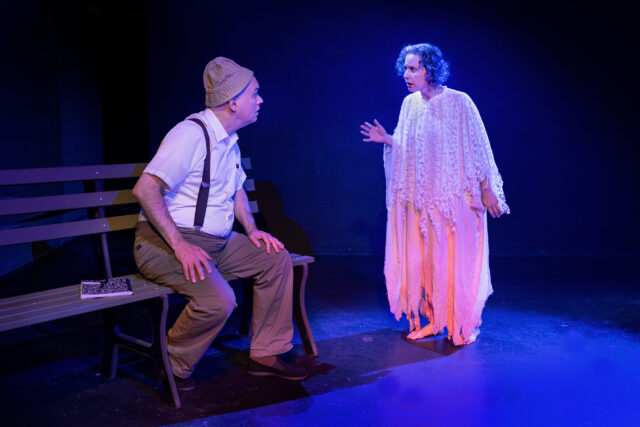
Shane Baker and Miryem-Khaye Seigel star in four spooky tales by Avrom Sutzkever (photo by Jeffrey Wertz)
NIGHT STORIES: 4 TALES OF REANIMATION BY AVROM SUTZKEVER
the wild project
195 East Third St. between Aves. A & B
Tuesday – Sunday through January 11, $54.22 thewildproject.com www.congressforjewishculture.org
The wonderful duo of Shane Baker and Miryem-Khaye Seigel have again teamed up with directors Moshe Yassur and Beate Hein Bennett, this time for Night Stories: Four Tales of Animation, a quartet of short works by Smorgon-born Yiddish poet Avrom Sutzkever, a leader of the Jewish Resistance and a Vilna ghetto survivor who wrote and spoke often about the Holocaust; the play is a follow-up to last December’s Bashevis’s Demons, which dramatized three Yiddish tales by Nobel Prize winner Isaac Bashevis Singer and was also produced by the Congress for Jewish Culture.
Running at the wild project through January 11, the sixty-five-minute Night Stories features supernatural fantasies that are reminiscent of The Twilight Zone and Night Gallery but lack the final twist; in fact, the audience couldn’t tell when several of them had concluded. In addition, although each is told poetically amid an appropriately ominous atmosphere, unfortunate choices about the space can interfere with sight lines, resulting in the opening setting me off course from the start.
In the brief “A Child’s Hands,” Baker and Seigel stand at opposite sides at the front of the stage, emotionless as they perform the text in Yiddish. However, from my seat, Baker was blocking part of the supertitles, which are projected at the top back, behind him and Seigel. I had to shift quickly to the right and left to read the translation but even then could make out only some of it. The woman in front of me actually got up and changed her seat in the first row so she could see the words, adding to the distraction. Thus, it was hard to concentrate on what appeared to be an intense story about handprints on the frosty window of a cellar that holds a horse’s head and scraps from a women’s prayerbook.
“Lupus” is a solo piece in which Baker portrays a writer fed up with the spread of electricity, preferring to stay safely inside his apartment with his trusted old lantern. “Electricity is electric wires, electric chair. Maybe tomorrow they’ll make an electric bed, electric bride and groom, and electric children will be born. Or die,” he mutters to himself. “But the old lantern is like another living being. It’s my first appraiser. By night I read it my creations and according to the lantern’s expressive flame, I understand clearly which pieces can go to hell and which — to heaven.” He is soon joined by an orphaned shadow that he has resurrected, like his own Frankenstein’s monster, except this one, a former cyanide dealer called Lupus, wants him to “unalive” him. Instead, the writer reads from his manuscript, explaining, “I have a good memory because I’m not strong enough to forget.” Baker sits at a small table stage left, next to a divider onto which his shadow becomes Lupus. Although Baker does a good job using his voice to differentiate between the two characters, and Cameron Darwin Bossert’s lighting maintains the haunting feeling, the supertitles do not delineate who is saying which lines, so it’s often difficult to know who is speaking. And then the audience didn’t know it was over until the furniture began being rearranged.
In “There Where the Stars Spend the Night,” a man in a hat and suspenders (Baker), sitting on a park bench with his composition notebook, is joined by a woman (Seigel) who thinks he is the dead Volodya. “A miracle! How can you be alive, when your soul is no longer within you?” she declares. Deciding to go along with it, he responds, “I’ve been alive since I was born, maybe longer. And no one ever suggested such a divorce. True, I’ve never seen my soul, but I can swear it’s buried inside me safely and no sophisticated soul-thief has stolen it.” It’s an engaging exchange that also feels like more is to come.
The evening finishes with “Portrait in Blue Sweater,” about a writer who proudly wears the sweater his mother made him for Chanukah while he describes his friendship with real-life Vilna painter Chaim Urison. “A quiet type, his minimal speech was a pale imitation of his silence,” the writer says about the artist. “But his painting was eloquent, with an authenticity that shone out from underneath the colors, as if they were overpainted. Like clouds overpaint the sunset before a storm.” Evil spirits, souls, and a duel to the death are discussed until an image puts an exclamation point on it all.
Baker once again proves that he is a gem of Yiddish theater, as he has in such previous shows as God of Vengeance,Tevye Served Raw, and Waiting for Godot. There’s an elegant grace to the way he performs in Yiddish, a celebration of the language and its unique poetry, and he has a fine accomplice in Seigel, who is also a successful Yiddish singer-songwriter and music and culture scholar.
A program note points out, “The stories you will witness require your full sensory attention.” It also quotes Yiddish literature expert Professor Ruth R. Wisse, who writes in her introduction to the 1989 Sutzkever collection Prophecy of the Inner Eye, “For Sutzkever everything hangs on the precision of each Yiddish word. It is the supreme validation of reality and of his authentic powers as its prophet.” In addition to the problem I had following the English surtitles of “A Child’s Hands,” there were some dropped props and a few other minor distractions that impacted my overall enjoyment of the show, but I’m glad I saw it, and I will keep on going to anything Baker is involved with as he continues to resurrect the glory of Yiddish theater.
[Mark Rifkin is a Brooklyn-born, Manhattan-based writer and editor; you can follow him on Substack here.]
Bryce Pinkham leads a supercharged ensemble in Chess Broadway revival (photo by Matthew Murphy)
CHESS: A COLD WAR MUSICAL
Imperial Theatre
249 West 45th St. between Broadway & Eighth Ave.
Tuesday – Sunday through May 3, $74-$571 chessbroadway.com
There are practically as many versions of the musical Chess as there are opening gambits in the fifteen-hundred-year-old game of intense strategy and mental acuity. With an original book by Tim Rice, music by ABBA’s Benny Andersson and Björn Ulvaeus, and lyrics by Rice and Ulvaeus, the show has gone through multiple adaptations since the release of the concept album in 1984, from concert versions to music videos to full theatrical presentations in the West End in 1986, on Broadway in 1988, and around the world, attracting major directors (Trevor Nunn, Des McAnuff, Jim Sharman, Rob Marshall) and actors (Josh Groban, Judy Kuhn, Raúl Esparza, Carolee Carmello), featuring significantly changed books (by Richard Nelson, Robert Coe, and Rice himself, several times) involving song swaps and deletions and major plot alterations, often due to shifting world politics, primarily between Russia/the Soviet Union and the United States.
The current Broadway production, scheduled to continue through May 3 at the Imperial Theatre, where it’s breaking house box-office records, is the first iteration I’ve seen, and I found it to be a ton more exciting than watching, well, a chess match. Tony-winning director Michael Mayer (Spring Awakening,American Idiot) has teamed up with Emmy-winning film and television writer, actor, and director Danny Strong, making his Broadway debut, to reimagine the show, and it’s a major triumph filled with clever and insightful moves, despite occasionally delving into soapy melodrama, while not overplaying the cold war connections between the 1980s and today.
“Nineteen seventy-nine. The entire world is on high alert, trapped in a never ending confrontation between two opposing ideologies: communism and democracy,” the Arbiter (Bryce Pinkham), a kind of narrator and referee who oversees the proceedings, announces at the start. The ensemble belts out, “No one can deny that these are difficult times,” and the Arbiter responds, “It’s the US vs. USSR / Yet we more or less are / To our credit putting all that aside / We have swallowed our pride. . . . / No one’s way of life is threatened / by a flop.” The ensemble adds, “But we’re gonna smash their bastard / Make him wanna change his name / Take him to the cleaners and devastate him / Wipe him out, humiliate him / We don’t want the whole world saying / ‘They can’t even win a game!’ We have never reckoned on coming in second / There’s no use in losin’.”
Just in case you’re not already considering how the plot aligns with the foreign policy of President Donald Trump compared to that of Ronald Reagan, who was commander-in-chief when the show was written, the American chess master is named Freddie Trumper (Aaron Tveit), who is in love with his second, the beautiful theoretician Florence Vassy (Lea Michele). They are preparing for a major match against the brilliant Anatoly Sergievsky (Nicholas Christopher), whose handler is the devious Alexander Molokov (Bradley Dean). Molokov is quick to remind Anatoly what happened to the previous Soviet champion who lost to an American, but Anatoly tells him, “I do not fear sharing the same fate as Boris Ivanovich. The State cannot execute a man that is already dead.” But Molokov is relentless in his defense of his country, later using Anatoly’s estranged wife, Svetlana (Hannah Cruz), against him.
As the players travel to Merano, Stockholm, and, most famously, Thailand, where they spend a memorable night in Bangkok, relationships come together and fall apart, loyalty is tested, and the SALT II treaty is hotly debated as the KGB and the CIA fight to assert their prominence, with the game of chess as its centerpiece.
Freddie Trumper (Aaron Tveit) and Florence Vassy (Lea Michele) have a complicated personal and professional relationship in Chess (photo by Matthew Murphy)
Inspired in part by the famous 1972 world championship between American Bobby Fischer and Boris Spassky of the Soviet Union held in Reykjavík, Iceland, which was seen as a microcosm of the ongoing battle between the US and the USSR, Chess is a thrilling evening of theater, highlighted by Pinkham (A Gentleman’s Guide to Love & Murder,Ohio State Murders), who serves as an engaging ringleader to the proceedings, addressing the audience directly and including playful contemporary references. He is often accompanied by a terrifically talented ensemble performing Lorin Latarro’s dazzling choreography; the singers and dancers are like a glorious symphony that makes you instantly forget the book’s occasional meanderings and messiness.
The orchestra is spread across David Rockwell’s glittering multilevel set, which boasts columns of chess pieces and live and archival video footage by Peter Nigrini. The costumes, by Tom Broecker, glitter as well, particularly for the ensemble, with flashy lighting by Kevin Adams and blasting sound by John Shivers.
Yes, there are too many songs, Freddie’s transition to being an announcer is annoying, the love triangle is messy, the politics are oversimplified, and the ballads are histrionic, but Mayer and Strong keep the actual chess to a minimum, and every time the show threatens to give in to the lowest common denominator, Pinkham and the ensemble swoop in to rescue it as the endgame approaches.
This Chess is certainly no flop.
[Mark Rifkin is a Brooklyn-born, Manhattan-based writer and editor; you can follow him on Substack here.]