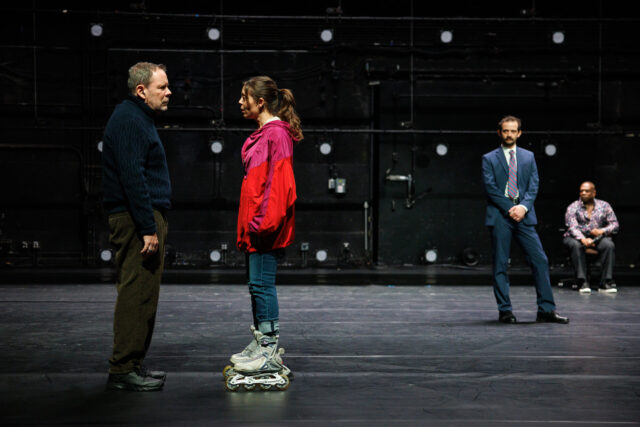
this week in theater

A CIVIL WAR LOVE BOAT REUNION: LADY PATRIOT AT THEATRE ROW

Count Stovall and Chrystee Pharris star as slaves during the Civil War in Lady Patriot (photo by Maria Baranova)

LADY PATRIOT
Theatre Row
410 West 42nd St. between Ninth & Tenth Aves.
Tuesday – Sunday through September 20, $70-$90
www.theatrerow.org

There was an infectious buzz in the air on opening night of the New York premiere of Lady Patriot at Theatre Row. Based on a true story, the play is written and directed by Ted Lange, who portrayed Isaac the bartender on The Love Boat, and features two other actors from that hit show, Fred “Gopher” Grandy and Jill “Vicki Stubing” Whelan. Among those in the close-knit audience of ninety-nine were Tony nominee John Douglas Thompson, The Wire star Frankie Faison, Classical Theatre of Harlem producing artistic director Ty Jones, and Bernie Kopell, best known as Dr. Adam Bricker on The Love Boat, which “promises something for everyone.” And for a while, Lady Patriot keeps that promise as well.

The 150-minute play (with intermission) begins in Confederate president Jefferson Davis’s (Gordon Goodman) White House garden in Richmond, Virginia, in July 1861. The Davises’ neighbor Elizabeth “Lizzie” Van Lew (Jill Whelan) is visiting the president’s pregnant wife, Varina (Josie DiVincenzo), who has a taste for absinthe and a shortage of household help; most of the Davis’s enslaved staff is still journeying to meet them. While Elizabeth tends to the herbs, Varina complains — using the N-word over and over — so Elizabeth offers to lend her Mary Bowser (Chrystee Pharris), an experienced midwife. Mary will work hand in hand with the Davises’ longtime slave, Old Robert Brown (Count Stovall), so trusted by Jefferson that the two share some Kentucky bourbon and cigars every day.

Jefferson also trusts Judah P. Benjamin (Derek Powell), a Jewish lawyer from St. Croix who was previously a US senator and is soon promoted from Confederate attorney general to secretary of war. Varina initially doesn’t hide her distaste:

Judah: Mrs. Davis, you are not fond of me, are you?
Varina: Mr. Benjamin, I don’t think about you one way or another. You are a colleague of my husband. He thinks you are valuable to the war effort. I’m a lady. I don’t mix into the affairs of state.
Judah: You are not just any lady. You are the first lady of the Confederate states. Does my being a Jew bother you?
Varina: No.
Judah: Not at all?
Varina: Not in the least . . . however, the fact that you killed our Lord and Savior Jesus Christ . . . does give me pause.

Yet eventually, Judah proves his worth, as does Mary, in a different way. When Old Robert catches Mary reading Jefferson’s private papers — she’s actually a Union spy — she at first denies it as he explains how he remains out of trouble, delivering one of the play’s most potent moments:

“I look a person in dere eyes. A white man’s eyes can’t hold no secret without him telling you . . . it’s a secret. Oh, I’ve seen ’em try to hide a secret, but I been around long enough to recognize a lie or see de truth . . . sitting right dere in dey eye. Know when a white man is scared and know when he’s working himself up to beating a ni–er’s ass. It’s all in dey eyes. If’n I take my shirt off, you ain’t gonna find no scars on my back. Dat ain’t no accident. I know de truth of what I see. I’m gonna ask you a question, little Mary . . . if’n you value Old Robert as a friend, you gonna look me in my eyes and you gonna spread truth all over your words.”

Mary admits that she can read and write, explaining, as she does numerous times, that she is “special.” Instead of reporting her, Old Robert asks her to teach him how to read and write, hiding it from his masters.

The action moves from the White House garden and state room, which are center stage, to Lizzie’s cramped pantry to the left and Jefferson’s home office to the right as the war turns against the Confederacy, and Varina and Jefferson realize that there is a leak, believing it must be from a member of his cabinet. The tension builds as the war drives on to its inevitable conclusion while the characters struggle to maintain their ideals, relationships, and dignity amid the mounting tragedies of slavery and loss around them.

Love Boat veterans Jill Whelan and Fred Grandy reunite onstage in fellow castmate Ted Lange’s Lady Patriot (photo by Maria Baranova)

Lady Patriot concludes Lange’s historical trilogy, which began with George Washington’s Boy, set during the Revolutionary War, and continued with The Journals of Osborne P. Anderson, which dealt with John Brown’s raid on Harpers Ferry in October 1859. He cites more than two dozen sources in a bibliography in the program; he learned about Bowser from a friend and then started extensive research, deciding to focus his story on Lizzie, Mary, and Varina, each of whom he considers a patriot.

Paul Jonathan Davis’s set and lighting and Alex Rockey’s period costumes do a good job of re-creating the look and feel of the 1860s; hovering above the stage are both a Union and Confederate flag, not only a constant reminder that the play takes place during the Civil War but also evoking the divisiveness in contemporary America. Will Mahood’s sound is unobtrusive in the first act but becomes inexplicably overwhelming after intermission, with loud music nearly drowning out the actors’ voices and rifle shots and explosions seemingly right outside that don’t initially alarm any of the characters.

The introduction of a journalist, Mr. Slydell (Fred Grandy), is confusing, particularly when he conceals himself just offstage while listening to a conversation between Lizzie and Mary and later interviews Varina. Scenes go on too long and contain too much speechifying, references to using a strong glue to catch the informant are awkward, and quotes such as “[I’ll] skin him like a cornered badger in a skunk’s holler” feel forced (as does Lizzie’s first-act sentiment, “I’m just a cracker looking for a barrel” and Old Robert saying, “Black don’t crack.).

Among a solid cast, award-winning actor, writer, director, and poet Stovall steals the show as Old Robert, a house slave with a strong sense of decorum and responsibility, a man who knows and understands more than he lets on and dreams of being reunited with his wife and children, who were sold many years before. It’s heart-wrenching when he tells Mary, “Wish I could have seen them grow up. Ernestine, Olive, Sylvester, and Amos . . . dose were mine. Lorraine sure knew how to make beautiful babies. . . . Hell, a gal as pretty as Lorraine . . . you think de master wasn’t gonna give her some children? She had twelve.”

Lange doesn’t hold back racist and antisemitic tropes; the N-word is used a disturbing amount of times, but, in a program note, he asserts, “The authenticity of the language is vital to the historical context of slavery. It should offend us and educate us in the atrocities that it encompassed so that we can learn from the evils of this degrading aspect of American history and demand a more equal society for all Americans.” While that is certainly true, it doesn’t have to feel like we’re in a Quentin Tarantino film.

Grandy, Whelan, and Lange appeared two years ago in Herb Gardner’s I’m Not Rappaport at the Encore in Michigan, but this is the first such Love Boat stage reunion in New York City. It was great to see them together again on opening night, joined by their medical cohort, Kopell. With a few tweaks here and there, Lady Patriot could indeed make another run, setting a course for adventure.

[Mark Rifkin is a Brooklyn-born, Manhattan-based writer and editor; you can follow him on Substack here.]
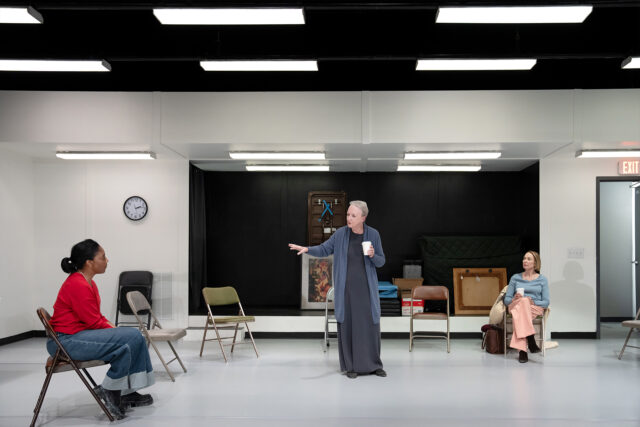
RESTORING CHAOS: JAPAN SOCIETY CELEBRATES YUKIO MISHIMA CENTENNIAL

YUKIO MISHIMA CENTENNIAL SERIES: EMERGENCES
Japan Society
333 East 47th St. at First Ave.
September 11 – December 6
japansociety.org

“Only art makes human beauty endure,” Yukio Mishima wrote in his 1959 novel Kyoko’s House.

In his short life — Mishima died by suicide in 1970 at the age of forty-five — the Japanese author and political activist penned approximately three dozen novels, four dozen plays, five dozen story and essay collections, ten literary adaptations, and a libretto, a ballet, and a film.

Japan Society is celebrating the hundredth year of his birth — he was born Kimitake Hiraoka in Tokyo in January 1925 — with “Yukio Mishima Centennial Series: Emergences,” comprising six events through December 6. The festival begins September 11–20 with Kinkakuji, SITI company cofounder Leon Ingulsrud and Korean American actor Major Curda’s theatrical adaptation of Mishima’s intense 1956 psychological novel The Temple of the Golden Pavilion, based on the true story of extreme postwar actions taken by a young Buddhist monk. Creator and director Ingulsrud cowrote the script with Curda, who stars in the play. The stage design is by Japanese visual artist Chiharu Shiota, whose international installations, featuring red and black yarn structures, include “In the Light,” “My House Is Your House,” and “Memory of Lines.” Her latest, “Two Home Countries,” runs September 12 through January 11 in the Japan Society gallery, consisting of immersive, site-specific works created in commemoration of the eightieth anniversary of the end of WWII.

There are unlikely to be many empty seats at Japan Society for Kinkakuji and other Mishima events (photo © Ayako Moriyama)

There will be eleven performances of Kinkakuji, with a gallery-opening reception following the September 11 show, a separate gallery talk on September 12, a lecture preceding the September 16 show, and an artist Q&A on September 17. Each ticket comes with free same-day admission to “Two Home Countries.”

On September 27, Japan Society, as part of the John and Miyoko Davey Classics series, will screen Kon Ichikawa’s 1958 film, Conflagration, based on The Temple of the Golden Pavilion and starring Raizo Ichikawa, Tatsuya Nakadai, and Ganjiro Nakamura.

In conjunction with L’Alliance New York’s Crossing the Line Festival, Japan Society will present Le Tambour de Soie (The Silk Drum) on October 24 and 25, Yoshi Oida and Kaori Ito’s adaptation of Mishima’s 1957 Noh play Aya no Tsuzumi, a dance-theater piece about love and aging featuring downtown legend Paul Lazar and choreographer Ito, with music by Makoto Yabuki. The second show will be followed by an artist Q&A. On November 6, Japanese novelist and cultural ambassador Keiichiro Hirano (Nisshoku, Dawn) and Tufts University Mishima scholar Dr. Susan J. Napier will sit down for a conversation discussing Mishima’s life and legacy.

Le Tambour de Soie (The Silk Drum) will be performed October 24 and 25 at Japan Society (photo © courtesy of the Maison de la Culture d’Amiens)

On November 15 and 16, the Tokyo-based company CHAiroiPLIN brings The Seven Bridges (Hashi-zukushi) to Japan Society, a visually arresting adaptation for all ages of Mishima’s short story about four women seeking wishes during a full moon. The series concludes December 4–6 with the US debut of Hosho Noh School and Mishima’s Muse – Noh Theater, three unique programs of noh and kyogen theater comprising performances of works that inspired Mishima: Shishi (Lion Dance), Busu (Poison), Aoi no Ue (Lady Aoi), Kantan, and Yoroboshi. The December 4 performance will be followed by a ticketed soirée, and there will be an artist Q&A after the December 5 show with Kazufusa Hosho, the twentieth grand master of Hosho Noh School, which dates back to the early fifteenth century. In addition, members of Hosho Noh School lead a workshop on December 6.

“This series revitalizes Mishima’s contributions to the world of the arts through a slate of brand new commissions and premieres adapting his writings, as well as a historic US debut for a revered noh company,” Japan Society artistic director Yoko Shioya said in a statement. “This series recognizes not only Mishima’s critical legacy but the ongoing current influence of this essential postwar author on artists today.”

That legacy can be summed up in this line from his 1963 novel Gogo no Eikō (The Sailor Who Fell from Grace with the Sea): “Of course, living is merely the chaos of existence, but more than that it’s a crazy mixed-up business of dismantling existence instant by instant to the point where the original chaos is restored.”

FINDING BEAUTY: HAGIOGRAPHIC HOUSE OF McQUEEN SEEKS BALANCE BETWEEN ART AND COMMERCE

Alexander McQueen (Luke Newton) and his sister Janet (Jonina Thorsteinsdottir) face adversity in House of McQueen (photo by Thomas Hodges)

HOUSE OF McQUEEN
The Mansion at Hudson Yards
508 West 37th St. between 10th & 11th Aves.
Tuesday – Sunday through October 19, $40-$185.05
www.thehouseofmcqueen.com

“Find beauty in everything. People perceive what they are most afraid of as ugliness. I find beauty in what we fear,” Lee Alexander McQueen (Luke Newton) says halfway through the world premiere of House of McQueen. “The tragedy of it is, fashion isn’t going to cure your nightmares, or child abuse, or cancer — or anything else for that matter. At the end of the day, it’s just clothes.”

Of course, it’s not just clothes, as the play, which opened last night at the newly constructed Mansion at Hudson Yards, chaotically tells the audience over and over again. The show attempts to capture the fierce energy of a McQueen runway extravaganza but instead gets mired in overuse of technology, a narrative that offers little sense of time and place, and characters that don’t grow or develop across two hours (plus intermission).

Lee was born in 1969 in the East End of London, the youngest of six children; his father, Ron (Denis Lambert), was a taxi driver and his mother, Joyce (Emily Skinner), a teacher. While Joyce and his oldest sister, Janet (Jonina Thorsteinsdottir), encourage his artistic abilities — Janet even gives him her old album of paper dolls — his father worries about his future, particularly when it comes to his son’s apparent sexual orientation. “When are you going to listen to me? You’re gonna get hurt doin’ this!” his father argues, referring to both class and homophobia. When the teenage Lee expresses his desire to become a tailor on Savile Row, Ron declares, “Even if they hired you, they’d let you go soon enough. Those Savile Road types don’t want someone like you. And they never will. They’ll break your heart. Don’t try to be somethin’ you’re not.”

At sixteen, the ambitious and determined Lee quits school and heads to Savile Row with a garbage bag filled with samples of his work. “I want to learn everything, everything, everything,” he says. He lands a job as a tailor, which kickstarts a career that will take him around the world as he attends the prestigious Central Saint Martins university, creates designs for Gigli, Givenchy, and Gucci, and is taken under the wing of magazine editor and well-connected fashionista Isabella “Issie” Blow (Catherine LeFrere), who buys out his entire first collection, which surprises his mother and sister.

“Oh, dear, how are we gonna tell him? It was gruesome!” Joyce says to Janet, who replies, “All that blood! How could he do that? It was awful!” Issie jumps in, proclaiming, “It was perfect! I’ve never seen anything so perfect in my life.” She didn’t think his name, Lee, was perfect, advising him to go by his middle name, Alexander, professionally, although his close friends and family continued to call him Lee.

The press (Margaret Odette) agrees with Joyce and Janet, making such statements as “McQueen’s debut was a horror show” and “McQueen’s brand of misogynistic absurdity gives fashion a bad name.” But he contends, “I just want women to fight back!”

Explaining to a professor (Odette) where he gets his ideas, he comments, “Grew up East End. Same neighborhood as Jack the Ripper. Inspired by viscera, slashings, streams of blood. Happy childhood, loving parents. Tons of encouragement. Dreams of becoming the next Yves St. Laurent. Yadayadayada . . .”

But the fame and notoriety he achieves as l’enfant terrible of the fashion industry come with a price as sex, drugs, partying, and the desperate desire to remain on top take over his life.

Alexander McQueen’s fashions are on display in world premiere play at Mansion at Hudson Yards (photo by Thomas Hodges)

House of McQueen is written by Darrah Cloud (Sabina, Turning) and directed by Sam Helfrich (Owned, Tape), in collaboration with Gary James McQueen, a textile designer and creative director who is Alexander’s nephew; several of his lenticular skulls are on view in the extensive lobby gift shop at the entrance to the theater. The nonlinear story feels stitched together somewhat randomly, then splattered with various bells and whistles to inject much-needed drama. A dance competition referencing McQueen’s collection inspired by Sydney Pollack’s 1969 film They Shoot Horses, Don’t They? falls flat, and surreal scenes in which the young Lee wears a diving helmet — the sea is a leitmotif, for good and bad — feels frivolous.

It’s not always clear when and where things are happening; Alexander is always in the same white T-shirt and plain pants, although he adds an unbuttoned shirt later. The costumes, which include re-creations of some of McQueen’s designs, are by Robert Wierzel, but you can check out the real deals in the exhibition “The Company of Melancholiacs,” which is open before and after the performance as well as during intermission, a kind of miniature version of the Met’s smash 2011 “Savage Beauty,” held the year after McQueen’s death at the age of forty.

Brad Peterson’s videos and projections create a nearly nonstop barrage of images on a wall of monitors and overhead screen, from crackling static to clips from actual runway shows (Highland Rape, Plato’s Atlantis, La Dame Bleue, Deliverance), pseudo-fashion reports, and seemingly endless live scenes of Joyce asking Alexander questions for a BBC program, based on a print interview mother and son did for the Guardian. Jason Ardizzone-West’s set features a pair of platforms that rise and lower; G Clausen’s sound and Robert Wierzel’s lighting don’t add to the mayhem.

Newton (The Shape of Things, The Book of Mormon), best known as Colin Bridgerton in Bridgerton, does what he can but is hampered by the uneven narrative and such aspirational and overwrought dialogue as “I’m a tailor, not a fighter,” “I’ve got to show them how wrong they are,” and “I need people to understand me!” Tony nominee Skinner (Suffs, Side Show) battles through the maelstrom as McQueen’s devoted mother, and LeFrere (Confessions of a Young Character Actress, The Green Knight) munches on the scenery as Issie. The cast includes Tim Creavin, Fady Demian, and Joe Joseph as some of McQueen’s many boyfriends; Joseph also plays Terence, Janet’s then-boyfriend and later husband who was physically abusive to her, which is in the play, but also sexually abusive to the young McQueen, which is not. (The play never mentions McQueen’s other siblings.)

In addition, the hagiographic, superficial House of McQueen depicts Alexander as a modern-day Joan of Arc, the misunderstood French military hero who fought against England and was tried and executed for blasphemy and wearing men’s clothes. McQueen’s Voss collection was influenced by Joan of Arc’s chainmail, primarily the outfit that Issie dons near the end of the show, and close-ups of Renée Falconetti in Carl Theodor Dreyer’s 1928 silent film The Passion of Joan of Arc are projected on the monitors, making McQueen both saint and demon as he searches for balance between art and commerce.

The concept of the play is credited to filmmaker Seth Koch and executive producer Rick Lazes; Lazes and Gary James McQueen are also behind Provocateur, an immersive multimedia McQueen experience, written by Cloud, that is scheduled to open October 1 in Los Angeles. In a program note, Lazes writes that “House of McQueen is flamboyant, unflinching, and achingly human — a requiem for a man who turned beauty into a weapon and fashion into art.”

McQueen said that one of his goals was to “find beauty in everything,” but it’s hard to do so with this show, which feels a lot more like commerce than art. It’s even a stretch to call the theater the Mansion at Hudson Yards, since Hudson Yards, which is anchored by a high-end shopping mall, does not technically extend to Thirty-Seventh St.

[Mark Rifkin is a Brooklyn-born, Manhattan-based writer and editor; you can follow him on Substack here.]
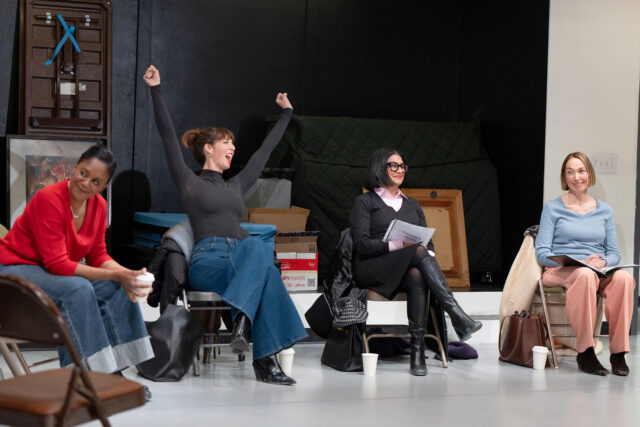
THE LABOR OF LAUNDRY: LYNNE SACHS, LIZZIE OLESKER, AND FRIENDS AT UNNAMEABLE BOOKS

Who: Lizzie Olesker, Lynne Sachs, Silvia Federici, Veraalba Santa
What: Reading and performance
Where: Unnameable Books, 615 Vanderbilt Ave., Brooklyn
When: Monday, September 8, free, 7:00
Why:This is not a play. It is something else. / Call it a blueprint, a map, a documentation / of something that has already happened / but could happen again — / a rendering in book form of a performance. / Making a mark, words on a page instead of bodies in space. / A book that contains what’s remembered and what could be. / All of it written down and placed here, into this / Hand Book: A Manual,” Lizzie Olesker and Lynne Sachs write in the introduction to Hand Book: A Manual on Performance, Process, and the Labor of Laundry (Punctum, June 2025, 425). “We are a playwright and a filmmaker who discovered a shared interest in making work that magnifies quotidian elements of life in the city where we live. We met years ago in Brooklyn while sitting on a bench waiting for our young daughters to finish their music lessons. A conversation began about our lives as mothers and working artists. We couldn’t yet know that those early encounters would lead to a ten-year theater and film collaboration. Now in our sixties, our daughters fully grown, we continue to build an experimental model for making live performance and film, engaging in a dialogue on how art-making can alter our understanding of urban life.”

Olesker, an actor and playwright who has penned such shows as 5 Stages of Grief, A Kind (of) Mother, and Night Shift, and Sachs, a fiction writer and filmmaker who has directed such works as Which Way Is East, Your Day Is My Night, and Film About a Father Who, are the coauthors and codirectors of Hand Book, which Sachs describes as “a collection of writings and images from a performance and film set within a neighborhood laundromat.” In addition to sections by Olesker and Sachs, the illustrated, colorfully designed book (by Vincent W. J. van Gerven Oei) features contributions from Margarita Lopez (“A Thousand Pieces a Day”), Jasmine Holloway (“Taking on a Role”), Stephen Vitiello (“Shake, Rattle, and . . .”), Amanda Katz (“Sound of a Machine Door Closing”), Emily Rubin (“Loads of Prose: From the Beginning”), Veraalba Santa (“Score for a Folding Dance”), and others. The foreword, “A New Refusal and a New Struggle,” is by feminist historian, author, and activist Silvia Federici.

On September 8, Olesker, Sachs, Federici, and Santa will be at Unnameable Books in Brooklyn for a reading and performance. There will also be a reading and signing September 13 at noon at Printed Matter’s NY Art Book Fair
at MoMA PS1 and a performance, reading, and signing September 28 at 2:00 at Torn Page with Tony Torn and Alvin Eng. Sachs continues, “As authors, Lizzie and I along with our many collaborators construct a model for making art about essential work that often goes unrecognized. Turning a page becomes a quasi-cinematic encounter, calling to mind the intimacy of touching other people’s clothes, almost like a second skin, the textural care for things kept close to the body.”

[Mark Rifkin is a Brooklyn-born, Manhattan-based writer and editor; you can follow him on Substack here.]
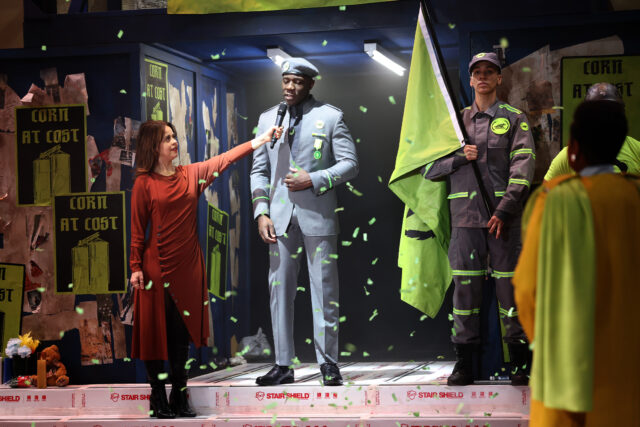
THE COURAGE TO RECOGNIZE CRUELTY: ROAD KILLS AT PARADISE FACTORY

Owen (D. B. Milliken) has to teach Jaki (Mia Sinclair Jenness) the ins and outs of roadkill collection in world premiere play (photo by Nina Goodheart)

ROAD KILLS
Paradise Factory Theater
64 East Fourth St. between Second & Third Aves.
Thursday – Saturday through September 6, $19.50 – $53.25
www.goodapplescollective.com
www.paradisefactory.org

“If having a soul means being able to feel love and loyalty and gratitude, then animals are better off than a lot of humans,” British veterinary surgeon and author James Herriot wrote. Playwright Sophie McIntosh explores relationships between animals and humans — and humans with one another — in her powerful, beautifully staged new play, Road Kills, continuing at the Paradise Factory Theater through September 6.

The eighty-five-minute show takes place in a narrow, horizontal space, designed by Junran “Charlotte” Shi, with the audience sitting in three rows of folding chairs on one side; on the other side is a strip of grass, rocks, dirt, and a deer crossing sign. In between is an asphalt road, where a shocking image lies. The first row of seats are on a double yellow line, creating a level of intimacy and potential risk that hovers over the proceedings.

The play follows professional roadkill collector Owen Morris (D. B. Milliken) and Jaki Johnson (Mia Sinclair Jenness), a twenty-year-old college student who has been ordered to do six Saturdays of community service with Owen for an initially unnamed offense. It’s late fall in rural Wisconsin, so both are wearing parkas, with Owen in a red vest and Jaki in a yellow one, along with a red Green Bay Packers knit cap and a pink Stanley cup. (The props are by Sean Frank, with costumes by Saawan Tiwari; the temperature in the theater has been lowered for added effect, so a sweatshirt or other jacket is recommended for audience members.)

Owen and Jaki use shovels to carry the roadkill to a wheelbarrow; Owen asks Jaki, who would rather be anywhere else, to spot him, watching for oncoming traffic. “We’re in the middle of nowhere,” she argues. It turns out that the dead animal is stuck to the road, so removal will require additional finesse, as well as Jaki’s participation. Owen asks for some of Jaki’s coffee to help thaw the carcass, but she steadfastly refuses, claiming that it’s iced mocha — but as we soon learn, it’s got an extra kick to it.

She ultimately has to help pick up the carcass, but when she tosses it into the wheelbarrow like it’s a bag of garbage, Owen interjects, “Hey, careful. Don’t go throwing her around. . . . She deserves some respect.” Jaki then pukes in the wheelbarrow. Owen suggests they take a break before heading out to collect two other dead animals, but she insists on moving ahead because “Sigma Chi is throwing a Homecoming party tonight, and I’m not gonna miss it.”

A picnic does not go quite as planned in Sophie McIntosh’s Road Kills (photo by Nina Goodheart)

It’s a terrific opening scene, firmly establishing the characters and the situation and immersing the audience in the setting. Each successive scene begins with a prerecorded mini audio drama in which a variety of drivers carelessly speed down the road, leaving carnage in their wake as the car lights flash by in the darkness. At each stop, Owen and Jaki share a little more about their lives; Owen, who is in his late twenties, inherited his job when he was sixteen from his father and lives with his mother and their dog, Annie. He is soft-spoken and displays a natural affinity for the dead animals and the environment. Jaki is attending the University of Wisconsin–Oshkosh, which she calls Sloshkosh, although she is destined to work on her family’s farm, which she is not happy about but thinks she has no other options. She talks openly about how much sex she is having with different guys, which makes Owen uncomfortable.

“You sure it’s safe to be . . . hooking up . . . with a stranger?” Owen says. Jaki responds matter-of-factly, “Aww, you worried about me? I’ll be fine. Just scared he’ll say my pussy smells like roadkill.”

The essential beliefs of each character are emphasized in this key exchange about Jaki’s family’s business:

Owen: Animals are — They’re us. I mean, we’re one of them, you know?
Jaki: Yeah, sure, humans are just supersmart monkeys. But I’ve seen Planet Earth. Even the chimps eat each other.
Owen: I know this isn’t . . . You may not see it this way. But when G-d made His creatures, great and small, He put His spirit into each of us. We didn’t get more or less than any other being — it’s not something you can measure like that. It’s . . . It’s all just life. And to take away the dignity of any man, any animal . . . it’s wrong.
Jaki: At least we don’t, like, mass murder our cattle.
Owen: Could be what you do is even worse. Violating them like that.
Jaki: Come on. It’s not like it’s — Like they have any concept of — You can’t rape a thing.
Owen: You really believe that?
Jaki: Yeah. And even if I didn’t . . . you know what they say. It’s a fuck-or-get-fucked world.

On one Saturday, Owen and Jaki meet Neil (Michael Lepore), and on another Jaki’s cousin Miles (Lepore) comes to get her; both interactions result in altercations that lead to the revelation of dark secrets.

Jaki (Mia Sinclair Jenness) and Owen (D. B. Milliken) forge an intriguing relationship while performing an unusual job (photo by Nina Goodheart)

Wisconsin native McIntosh started researching and writing the play in 2019, when she was an undergrad. Over the years she drove the Wisconsin streets looking for roadkill, interviewed the wife of a Wisconsin roadkill collector, and took some of the cast and crew on a five-day trip as preparation. It all paid off, as Road Kills has an intensely realistic and relatable feel to it. It’s exquisitely directed by Nina Goodheart, who cofounded Good Apples Collective with McIntosh; they previously collaborated on cunnicularii, which also starred Milliken. Each scene is carefully choreographed, although there are some confusing moments, particularly when Owen and Jaki don’t bring the wheelbarrow close to the carcasses and instead have to pick the pieces off the road and walk them over. The production features stellar lighting by Paige Seber and sound by Max Van; despite being such a small space with primarily only two actors, there is always something new to see or hear. Milliken is warm and gentle as the easygoing Owen, while Jenness is fearless as the complicated Jaki, who has a bitter edge to everything she says and does.

As with her 2022 play, macbitches, McIntosh makes some harsh turns near the end, piling on too much as we learn more about Owen and Jaki. Good Apples describes itself as “a developmental orchard for new theatrical works that expose abuses of power, challenge taboos around desire and sexuality, and uplift the voices of queer and gender marginalized communities,” but the show nearly overloads on that in a short period of time. Still, it’s a powerful, provocative, and compelling statement on contemporary society.

Like American author, marine biologist, and environmentalist Rachel Carson wrote, “Until we have the courage to recognize cruelty for what it is — whether its victim is human or animal — we cannot expect things to be much better in this world.”

Also, and just as important, after experiencing Road Kills, you’re likely to be more careful than ever when you’re behind the wheel, and you’ll never hear John Denver’s “Annie’s Song” or Cat Stevens’s “Moonshadow” quite the same way again.

[Mark Rifkin is a Brooklyn-born, Manhattan-based writer and editor; you can follow him on Substack here.]
NOT AS YOU LIKE IT: TWELFTH NIGHT AT THE DELACORTE

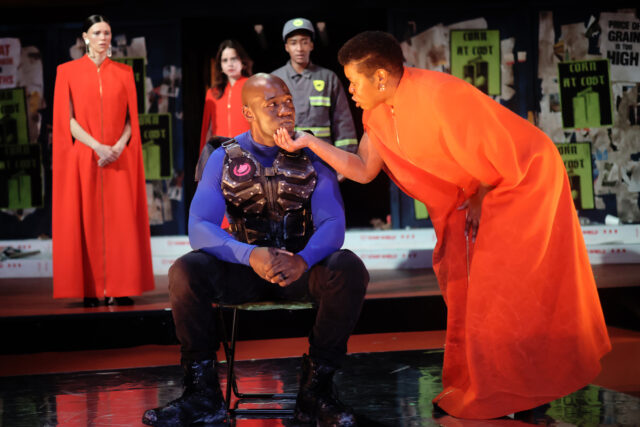
Duke Orsino (Khris Davis) and his minions get ready for action in Twelfth Night (photo by Joan Marcus)

TWELFTH NIGHT
Delacorte Theater, Central Park
Tuesday – Sunday through September 14, free with advance RSVP, 8:00
shakespeareinthepark.org

The confusion begins early in Saheem Ali’s inconsistent adaptation of William Shakespeare’s 1601–02 romantic comedy, Twelfth Night, which opens the newly revitalized Delacorte Theater in Central Park. As the audience enters the space — the majority of the $85 million upgrade went to technical operations, dressing rooms, bathrooms, accessibility, and signage, along with improvements to the facade and seats — a string quartet is playing on a red stage that features swirling patterns and, in giant, bold letters around the back, the subtitle of the play: What You Will. (The renovation did not rid the Delacorte of its famous raccoons, one of which ambled along atop the back wall moments before the play began, eliciting the adoring attention of the crowd.)

Then Ghanaian American singer-songwriter Moses Sumney, portraying the fool, Feste, walks onto the stage with a guitar and sings, “All the world’s a stage, / And all the men and women merely players. / They have their exits and their entrances, / And one man — or woman — in their time plays many parts.”

The line actually comes from the second act of As You Like It and seems like a cliché here taken out of context, even with its addition of “or woman.” Meanwhile, the musical shift from classical to Sumney’s alternative/indie R&B is jarring, and the character feels more like a demonic troubadour than one of Shakespeare’s fools.

Maria (Daphne Rubin-Vega) offers some intriguing news to Malvolio (Peter Dinklage) in Shakespeare production at revitalized Delacorte (photo by Joan Marcus)

Next, a sea captain (Joe Tapper) and Viola (Lupita Nyong’o) rise in a small boat from one of the Delacorte’s new modular trap doors. Emphasizing that they are strangers to this land, the first words they say to each other are in Swahili, although most of their conversation in in English. (Nyong’o was born in Mexico and raised in Kenya and speaks fluent English, Spanish, Luo, and Swahili.) The explicatory scene lets us know that there has been a shipwreck that has led the captain and Viola to Illyria, which is ruled by the duke Orsino (Khris Davis), who is in love with Olivia (Sandra Oh), a count’s daughter who is mourning the recent deaths of her father and brother and currently uninterested in suitors. Viola’s brother, Sebastian (Junior Nyong’o), was also on the ship, and Viola holds out hope that he has survived as well. She decides to disguise herself as a man named Cesario and serve the duke. (Sebastian has indeed survived and is on the island, with Antonio [b], an enemy of the duke’s, as his servant.) Only then do we meet Orsino as he declares to court gentleman Curio (Ariyan Kassam) and Feste, “If music be the food of love, play on,” which usually starts the play.

Thus, this Twelfth Night has a completely different atmosphere, which is not in itself a bad thing. I am not a Bard purist who insists that Shakespeare plays should not be messed with. Among the endless beauties of his work are the myriad possibilities it offers for reinterpretation. Over the last dozen years, I have seen three memorable productions of Twelfth Night: one on Broadway starring Mark Rylance as an Olivia who is light on her feet and a wickedly funny and towering Stephen Fry as her steward, the much-maligned Malvolio, in a delightful version that harkened back to the seventeenth century in form and style; one off Broadway by Axis that was dark and foreboding and utterly involving; and one at the Delacorte in 2018, an engaging musical comedy by Shaina Taub, who also portrayed Feste. (Twelfth Night is a favorite of the Public Theater’s Shakespeare in the Park presentations, having been staged six times previously, going back to 1969.)

In 2021, I was disappointed in Jocelyn Bioh and Ali’s Merry Wives, which moved the location of the story from Windsor to South Harlem and felt too caught up in shtick, and the same is true here. Scenes move by too quickly as actors enter and leave down the aisles, via the traps, and through the “What You Will” wall like a one-ring circus, not allowing enough time for character development or actor chemistry. Attempts at amusement abound: Olivia’s uncle, the Falstaffian Sir Toby Belch (John Ellison Conlee), and his sidekick, the cheeky Sir Andrew Aguecheek (Jesse Tyler Ferguson), hang out in a hot tub doing lines of coke and whippets when they’re not plotting with Olivia’s chambermaid, Maria (Daphne Rubin-Vega), to publicly embarrass Malvolio (Peter Dinklage) in front of Olivia, whom he secretly pines for. Orsino asserts his strength and power by working out barechested at a gym and ordering his minions to drop and do pushups for punishment. Sir Toby, Sir Andrew, and Fabian (Kapil Talwalkar) hide from Malvolio behind four handheld letters, T, R, E, and E, instead of a tree, which is cute at first but goes on too long. A duel is transformed into a comic boxing match, with Sir Andrew in full boxing regalia.

Olivia (Sandra Oh) and her minions get ready for action in Twelfth Night (photo by Joan Marcus)

Real-life siblings Lupita and Junior Nyong’o are dapper in their double-breasted suits. The inspired casting of Dinklage as Malvolio tails off when he is left doing too much voguing, particularly when trying to put a smile on his face. Davis has impressive abs. The actor known as b seems out of place whenever they’re onstage, although the part of Antonio can be a challenge to integrate in even the best of productions. Rubin-Vega looks fabulous, but it’s hard to remember she’s playing a maid. Conlee has fun as Sir Toby, but it’s Oh who steals the show as Olivia, wonderfully balancing comedy and pathos as her lust builds up, subduing her mourning with an elegant wit and grace, best capturing the spirit of Ali’s intentions.

The director has excelled in such non-Shakespeare plays as James Ijames’s Fat Ham, Bioh’s Nollywood Dreams, and Donja R. Love’s Fireflies, but I’ve found both Merry Wives and now Twelfth Night overwrought and scattershot, with too many scenes and characters appearing to come from different plays, lacking continuity despite individual moments that shine. It’s perhaps best exemplified by the Twelfth Night finale, a showcase for costume designer Oana Botez and set designer Maruti Evans; it looks fabulous, but it comes out of nowhere. It elicits wild applause from the audience, but it feels like a preening peacock that has arrived onstage, perhaps watching out for that raccoon.

[Mark Rifkin is a Brooklyn-born, Manhattan-based writer and editor; you can follow him on Substack here.]

YO-HO-HO! A PYRATE MUSICAL ON A RED HOOK BARGE

Black Sam Bellamy (Danny Hayward) and Paulsgrave Williams (Lauren Molina) anticipate trouble ahead in The Royal Pyrate (photo by Geve Penaflor)

THE ROYAL PYRATE
Lehigh Valley Railroad Barge No. 79
Waterfront Museum, 290 Conover St., Red Hook
Saturday & Sunday through August 31, $35-$65
www.theroyalpyrate.com

“Ahoy there, maties! I know we all be feelin’ the weight o’ the world crushin’ down on us of late: a system which only seems to serve thems already on top, where ye’re afraid that if ye get hurt, or sick, ye’ll never find o’ way o’ diggin’ yer way outta the grave,” Paulsgrave Williams (Lauren Molina) says at the beginning of The Royal Pyrate. “There always be gold for wars, but never for our strugglin’ families. Life sure is difficult in 1715! But . . . that ain’t no reason we can’t have a bit o’ fun together tonight, eh?”

There’s more than a bit o’ fun to be had aboard Lehigh Valley Railroad Barge No. 79 in Red Hook, where the world premiere musical, featuring music and lyrics by Jason Landon Marcus and a book by Chas LiBretto, continues Saturday and Sunday nights through August 31.

Home to the Waterfront Museum owned and operated by Captain David Sharps, the barge has presented such previous shows as the Drama Desk–nominated The Wind and the Rain: A story about Sunny’s Bar, which related the true tale of the next-door Red Hook institution Sunny’s Bar, and Port Cities NY, which explored the sociocultural and –economic impact of the seventeenth-century Dutch trade routes via a game called “The Settlers of Manahatta.”

The rousing opening number, “Roll the Bones,” sets the tone for the hundred-minute show, which starts out in Wellfleet, Massachusetts, in 1715. Paulsgrave, Tommy Toothacher (accordionist Charley Layton), Ferguson (bassist Charlie Bennett), and Crabby Conrad (guitarist Marcus) are gambling when they are joined by their former colleague, master smuggler Black Sam Bellamy (Danny Hayward). Sam has returned because his girlfriend, Mary Hallet (Maggie Likcani), is pregnant and he needs fast money. Luck is not going his way, so he reveals a treasure map he has obtained that gives the location of where sixteen Spanish trips carrying riches have sunk.

Mary enters, disappointed that instead of getting a real job, Sam has opted to go back to his merry band of pirates, a word that offends Paulsgrave. “Pirates . . . attack ships. Kill the captain. Steal the cargo,” she explains. “Smugglers . . . selflessly distribute that cargo to the poor folks that needs ’em.” Tommy adds, “For a price.”

After Mary delivers the didactic song “New World,” which includes such lyrics as “If you really want a new world / Make sure you’re fighting the right fights. / We need inalienable rights. / Monetary compensation / Breeds corruption in a nation. / Citizens will need to have an independent core / And stop wasting time fighting a rich man’s war,” Simone Van Vorst (flutist Tais Szilagi) announces that Rev. Treat (Korie Lee Blossey) is looking for Sam, claiming he stole a corpse from the harbor; Treat is also upset with Mary because of her determination to change the status quo and expand the rights of the common people.

On their search for the treasure, they are accosted by a pirate ship captained by Edward Teach, better known as Blackbeard (Blossey), an imposing figure who deliciously declares, “Who’s got the beard that be most feared? Who to the mouth of the devil hath steered? . . . Pipe ye down then, shake a leg! / Seek me the captain and roll out a keg / Drop anchor, cut out the sails, I say / Stir not ye rascals or it’s hell ye’ll pay!” In addition, Sam and his ship, the Whydah, have made another enemy in Captain Beer (Layton) and his god-fearing crew, who want to see Sam hanged.

Meanwhile, Treat, Henrietta Hinkley (Marcus), Deidre Dimmock (Layton), Gilda Gilpen (Bennett), and the rest of the villagers in Wellfleet have accused Mary of witchcraft, wanting to see her hanged as well.

Thus, treasure might await some, a noose others.

Blackbeard (Korie Lee Blossey) is not about to back away from sunken treasure in musical aboard Red Hook barge (photo by Geve Penaflor)

The Royal Pyrate is based on the true story of Black Sam Bellamy, Mary “Goody” Hallet, Edward “Blackbeard” Teach, Paulsgrave Williams, the Rev. Samuel Treat, and the sunken Spanish treasure ships. In 1980, lifelong Cape Codder Barry Clifford discovered the Whydah and began salvaging it. However, far more is known about Bellamy, for example, than Hallet, so LiBretto (Melville on the Shore, Cyclops: A Rock Opera) and director Emily Abrams (Eeeeeeeee, Superfeats) try to fill in the gaps, although the pacing can sometimes be as choppy as the water outside. The night I went, it was windy and raining, so the barge occasionally lurched this way and that, which actually enhanced the overall immersive experience.

The audience, some of whom are asked to participate in small ways, is seated in two rows on three sides of the center space, the band occupying the fourth. Among the playful props are barrels, oars, swords, guns, playing cards, a small telescope, doubloons, and skeletons. Juli Abene and Alex Abene’s period costumes depict scalawags, rapscallions, buccaneers, and sea wolves — which are also the four levels of ticket prices — and are highlighted by Hallet’s petticoats, several cool pirate hats, and numerous vests. Marcus’s (Sally May, Cyclops: A Rock Opera) score melds English ballads, Irish folk, sea shanties, and West African and Caribbean melodies, with such standouts as “Roll the Bones,” “The Beard,” belted out by Blossey with operatic grandeur, and the rollicking finale, “Tell No Tales.”

The band crafts a jaunty sound while some members double as minor characters. Molina is an engaging host, and Blossey’s booming baritone and large physical presence can barely be contained by the rocking barge. Likcani is understated as Hallet, complementing the more boisterous Hayward as Bellamy.

And yes, there are plenty of Aaarrrr!s throughout, along with a healthy dose of self-referential humor.

Also, be sure to get there early — taking the ferry is highly recommended — and soak in the barge itself, as Sharps has lovingly preserved it, with fascinating details galore.

[Mark Rifkin is a Brooklyn-born, Manhattan-based writer and editor; you can follow him on Substack here.]