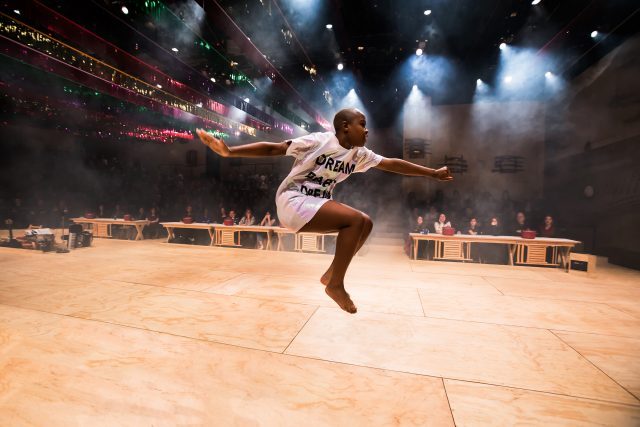
X Joey (Cheech Manohoar) watches the sun set over the Hudson River in X the Experience
X THE EXPERIENCE
Fridays at 8:30 and Saturdays at 3:30 through May 22, $25-$50 www.xtheexperience.com
“Paranoia strikes deep / Into your life it will creep / It starts when you’re always afraid / Step out of line, the men come and take you away,” Stephen Stills sang in Buffalo Springfield’s 1966 counterculture classic, “For What It’s Worth,” inspired by the Sunset Strip curfew riots between LA rock clubs and the police. Paranoia is a continuing dilemma during the pandemic: about contracting the virus, about keeping a job, about kids going back to school and adults going back to work, and now about the country opening up as vaccines get widely distributed. “The exceptionally prolonged lockdown because of ineffective management and the subsequent social disruptions and economic misery — in many ways worse than the Great Depression, with tremendous inequities, hunger, homelessness, unemployment, and despair — are already leading to rampant drug addiction, depression, suicides, and homicides,” Dr. Bandy X. Lee, president of the World Mental Health Coalition, told CNN last month. “Meanwhile, we now have a large segment of the population that has been encouraged and conditioned to avoid reality. When living in delusion, detached from reality, one naturally becomes paranoid because facts and evidence are constantly ‘attacking’ these false, cherished beliefs,” the doctor added. Of course, as Joseph Heller wrote in Catch-22, “Just because you’re paranoid doesn’t mean they aren’t after you,” a quote that Nirvana adapted for its 1991 song about isolation, “Territorial Pissings.”
All of which brings us to X the Experience, an interactive, immersive online theatrical production that uses paranoia and fear as key ingredients in an exciting two-hour adventure into the dark underbelly of the near future. Conceived, directed, and coedited by Aaron Salazar and written by Jason Veasey, the show casts the viewer as a trainee for WE, an all-powerful organization that squashes individuality and personal identity in favor of the hive-minded whole. “So it’s your goal. And hope. That you can aid in someone’s journey back to the collective. To the community. To WE,” a disembodied robotic voice known as the I (Gillian Saker) commands. You are tasked with helping first X Joey (Cheech Manohoar), then X Joei (Kim Exum), to come back to the fold. WE believes it is transforming the citizenry from “self-importance to selflessness,” but there’s much more to it, as the I explains:
You. I. They. Them. Black. White. Man. Woman. / What are you? Where are you from? Who are your people? / Equity. Inclusion. Diversity. / So many questions about so many labels. / That was life. For a long time. For a lot of people. / The focus on having a society where individuals of all backgrounds could exist in an equitable and harmonious world. Where we could be every adjective we wanted and somehow would all live as one. . . . It’s time WE all let go of the constructs of gender and race and sexuality that were used to keep us apart and actually just be WE.
A HAL-like disembodied voice (Gillian Saker) is in charge in immersive virtual production X the Experience
It might sound like a nirvana of inclusiveness, but it’s also like becoming part of the Borg from Star Trek: The Next Generation. We watch X Joey and X Joei as they contemplate their choices, deciding whether to face their responsibilities to the WE or take off. All the while, as an audience member you are text messaging over WhatsApp with your supervisor, who is asking questions to ensure your loyalty to the cause. (Note: You will not be on camera or speaker at any time.)
X the Experience features an ever-shifting visual style, from high-tech computer imagery to low-tech surveillance, from stark confessional to poetic beauty, from hypnotic colors to grainy grays, incorporating music and dance into the story. Wearing headphones and turning all other devices and browsers off to immerse yourself fully in the action is highly recommended. I found myself putting my face nearly right up against my monitor to get sucked into some of the more mesmerizing animation. It is a bit too long at two hours (there is a five-minute interval) and can get repetitive, and the overall world building is ambitious though flawed, but is also like nothing I’ve seen during the pandemic. It evokes X-Files conspiracy theories, HAL from Stanley Kubrick’s 2001: A Space Odyssey,Tron-like video games, the urgency of Logan’s Run, and the opening sequence of Dr. Who, leading viewers into a mysterious universe that points toward the future of hybrid entertainment. The ominous score is by Matt Katz, Giancarlo “Ssanti” Bonfanti, and Manuel Pelayo, with yearning songs that recall Joy Division and Suicide.
X Joei (Kim Exum) has to decide her future while being constantly monitored by the mysterious WE
Salazar, the producing artistic director and founder of Poseidon Theatre Company and executive director of Alvarez Keko Salazar Productions, previously staged such works as Antigone and BitterSweet at the Cell as well as The Cooping Theory 1969: Who Killed Edgar Allan Poe?, a 2019 immersive hit at RPM Underground, where audiences followed multiple arcs through different rooms, trying to uncover the true tale behind Poe’s demise. While X the Experience can’t have the same kind of interactivity, Salazar makes viewers feel that they’re part of the story, involved in something special that is occurring in real time.
Exum (The Book of Mormon, For the Last Time) and Manohoar (Mean Girls, Mrs. Fletcher), a trained Bollywood dancer, capture the paranoia and fear of the moment, staring directly at us, practically begging us to free them from their dilemmas — which relate not only to the fictional narrative but to their reality, actors who cannot perform in front of in-person audiences, and therefore our dilemma too, sheltering in place at home. Like all of us, they just want to live happy, full lives, free of constant paranoia and fear, but we — WE? — are there to judge them in a changing social order where such judgment is appropriately shunned. But in this world, no one is innocent, and no one is to be trusted.
On March 14, 2020, Mayor Bill de Blasio stated, “I am not ready today at this hour to say, let’s have a city with no bars, no restaurants, no rec centers, no libraries. I’m not there.” But he was there the next day, shutting down the city while allowing St. Patrick’s Day revelers one last chance to become superspreaders, letting them have one final party night on March 16. A year later, Gotham has suffered 775,000 cases and more than 30,000 deaths, so for 2021, the St. Patrick’s Day Parade will be virtual, but restaurants are back open. For those who are not planning on cramming into any pubs quite yet, there are several online gatherings to celebrate the patron saint of Ireland.
The parade, a New York City institution since 1762, will be virtual in 2021, honoring first responders and essential workers. There will be events all day long, from a livestreamed mass and a composite of previous parades to live entertainment and interviews.
The Gingold Theatrical Group, which is dedicated to the work of George Bernard Shaw, is hosting a livestreamed Irish Poetry Slam with Robert Cuccioli, Tyne Daly, Melissa Errico, Jessica Hecht, Daniel Jenkins, Andrea Marcovicci, Tonya Pinkins, Thom Sesma, Renee Taylor, Sally Wilfert, Karen Ziemba, and others taking part in an open mic night beginning at 6:00 (admission is free with advance RSVP), with people contributing poetry, songs, toasts, jokes, monologues, sayings, and more, preferably by or inspired by Irish writers. “Ordinarily, we’d be having our annual Golden Shamrock Gala on the seventeenth, but . . . nope!” Gingold artistic director David Staller said in a statement. “This shindig will take place over Zoom! Not Irish? Not a problem. On St. Pat’s, we’re ALL a little Irish. This is just a party. Not a performance. Not a fundraiser. Just a chance for us all to raise a glass and be ‘together.’”
Meanwhile, Knowledge Workings Theater Company, started in 2018 by Joe Queenan, T. J. Elliott, and Marjorie Phillips Elliott, is holding its Second Annual Virtual (Not Necessarily Virtuous) St. Patrick’s Day Celebration. Anyone can participate by making their own video, following specific instructions on YouTube here and seeing what contributors posted last year. It’s free, but it you want to donate, Knowledge suggests you do so to the Irish Rep, which is presenting JM Synge’s The Aran Islands, starring Brendan Conroy, March 16-28, including 3:00 and 8:00 screenings March 17.
On Wednesday night at 8:00 GMT, Dublin’s St. Patrick’s Day Festival concludes with Barróg Lá Fhéile Phádraig, featuring performances by Lisa O’Neill, Colm Mac Con Iomaire, Caoimhe Ní Fhlatharta, Seamus and Ronan Ó Flatharta, Diarmuid and Brian Mac Gloin, Cormac Begley, Ronan O’Snodaigh and Myles O’Reilly, Doireann, and Siún Glackin and Mohammad Syfkhan, sharing a big virtual hug extending across the Atlantic.
Who: Daniel Fish, Ted Chapin, Rebecca Naomi Jones, Patrick Vaill, Gabrielle Hamilton, Foster Hirsch What: Discussion of reworking of classic Broadway musical Where:The National Arts Club Zoom When: Monday, March 15, free with RSVP, 7:30 Why: In 2018, Daniel Fish presented his seventy-fifth-anniversary adaptation of Rodgers and Hammerstein’s beloved Oklahoma! The longtime downtowner reimagined the show with diverse casting, an intimate setting that included chili during intermission, significant tweaking of the score, and a controversial solo dance to replace Agnes de Mille’s dream ballet. In my review, I called the show, which started at St. Ann’s Warehouse before moving to Circle in the Square, an “extraordinary adaptation . . . Fish has created a masterful retelling of the 1943 original, immersing the audience in the optimism that came with the southern territory becoming a state in 1906 — but uncovering a deep layer of darkness in the rich farmland soil.”
On March 15 at 7:30, the National Arts Club is hosting the live Zoom panel discussion and Q&A “Oklahoma! Re-imagining a Classic Broadway Musical,” featuring the Tony-nominated Fish; Rodgers & Hammerstein president Ted Chapin (about halfway through the show, the woman next to me muttered, “How could Ted Chapin let this happen?”); Rebecca Naomi Jones, who played Laurey; Patrick Vaill, who portrayed Jud; Bessie winner Gabrielle Hamilton, who performed the dance that opens the second act; and moderator Foster Hirsch. (The show was nominated for eight Tonys, winning for Best Orchestrations [Daniel Kluger] and Best Revival of a Musical.) Registration is free, but donations will be accepted for the NAC Artist Fellows program.
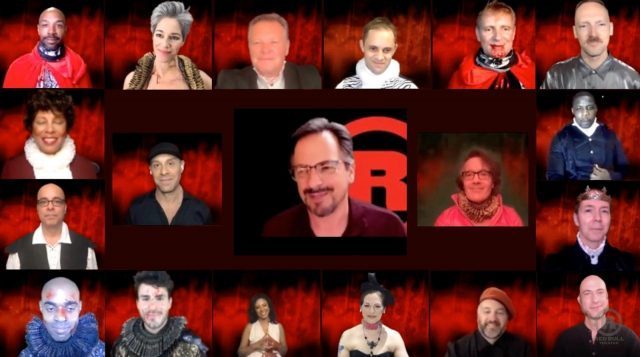
Founding artistic director Jesse Berger introduces one of Red Bull’s livestreamed readings during the pandemic (screenshot by twi-ny/mdr)
Red Bull Theater Galathea: Monday, March 15, free (suggested donation $25), 7:30 (available on demand through March 19) Galatea: Monday, March 22, free (suggested donation $25), 7:30 (available on demand through March 26) Paradise Lost: Monday, April 12 & 26, free (suggested donation $25), 7:30 www.redbulltheater.com
A year ago yesterday, New York City closed all entertainment venues, leading to endlessly sad postponements and cancellations that no one thought would last as long as it has. Theater companies were forced to examine their immediate and long-term futures: Some went into hiatus, others came up with intermittent virtual offerings, and a handful went all in, quickly developing an online streaming presence through readings, conversations, and innovative interactive live programming. One of the busiest, and most successful, has been Red Bull Theater. Founded in 2003 by artistic director Jesse Berger, Red Bull specializes in splendidly designed and costumed Jacobean works (Ben Jonson’s Volpone, John Ford’s ’Tis Pity She’s a Whore, Richard Brinsley Sheridan’s The School for Scandal) in addition to inventive contemporary adaptations (Erica Schmidt’s Mac Beth set in a girls school, Berger’s take on Gogol’s The Government Inspector, starring Michael Urie). Over its history, the troupe has also hosted more than two hundred Revelation Readings with all-star casts in various theaters, and it sponsors the Shakespeare in Schools initiative to bring the Bard to young students.
Red Bull’s virtual season kicked off in April with the first-ever “RemarkaBULL Podversation,” with Urie delivering Mercutio’s “Queen Mab” speech from Romeo and Juliet, followed by a discussion with Red Bull associate artistic director Nathan Winkelstein; subsequent Podversations have featured Chukwudi Iwuji performing “A Homely Swain” from Henry VI, Elizabeth Marvel doing “Cry Havoc” from Julius Caesar, and the phenomenal Patrick Page delving deep into Othello in “Exploring Iago.” All Podversations are available for free on YouTube, but the dozen live Zoom readings the company has streamed, from Berger’s new version of Thomas Middleton’s The Revenger’s Tragedy to Anchuli Felicia King’s modern-day Keene and Frances Burney’s The Woman Hater directed by Everett Quinton, remain online for only four days after the initial livestream. Each reading is accompanied by still-available Bull Session panels with Winkelstein and members of the cast and crew. Up next is a two-parter, John Lyly’s 1588 queer love story, Gallathea, on March 15, in collaboration with the Drama League, and MJ Kaufman’s new Galatea, on March 22, a trans love story in collaboration with WP Theater. Red Bull held its tenth annual Short New Play Festival in July, a fun virtual evening with works by Jeremy O. Harris, Theresa Rebeck, and others, with casts that included Kathleen Chalfant, Lilli Cooper, Edmund Donovan, William Jackson Harper, and Charlayne Woodard; the eleventh annual event, the theme of which is restoration, is scheduled for July 12.
A native Oregonian who was previously the assistant director of the Shakespeare Theatre Company in Washington, DC, Berger took time out of his ridiculously busy schedule to talk about Red Bull, the pandemic, and the future of theater.
Jesse Berger is front and center at a Red Bull Zoom reading (photo courtesy Red Bull Theater)
twi-ny: Red Bull has been one of the most active theaters in the country during the pandemic, going back to April. How and when was it decided to proceed full steam ahead with reunion readings and conversations?
jesse berger: It’s been almost exactly a year since the shutdown, and I think all of us went through the stages of grief at different paces — shock, denial, etc. — and out of that confoundingly confusing time and in consultation and through conversations with our wonderful team — led by our great managing director Jim Bredeson, wonderful board, terrific staff, extraordinary artistic associates, and other supporters — came the hunger for us to do something, anything, to connect our community. So . . . the original impetus was really just — get something out there that is our work that gets artists and audiences together, even if only virtually.
Just two weeks after lockdown began, on March 26, we announced the first of what has become a robust series of online activities. Since then it has simply been a learning experience that has led us to do more. For the first six months, we really just tried different ways to improve and experiment with the online experiences we were concocting. As it began to sink in over the summer that this shutdown was likely going to take a year or more, we made the decision to proceed with planning a fully virtual season for 2020–21. We probably hit our stride on these activities around October and have of course kept looking for ways to improve and innovate throughout.
twi-ny: The economic toll on theater companies has been devastating. Have these programs been financially viable for you?
jb: It has been devastating, indeed, and we count ourselves among the lucky ones because we were relatively financially healthy and relatively unencumbered when the shutdown hit. We made the decision to offer all our activities for free or pay what you can, and of course to compensate participating artists as much as we possibly can. We have found that audiences have by and large been generous in responding to this work and this method, so the programs are at minimum paying for themselves / breaking even through many small donations of $25, $10, $50. . . . Then we have hugely relied upon the larger generosity of larger donors, major institutional supporters, government support like PPP, and other foundation grants to keep the lights on and the staff fully employed. We’re grateful for the fact that we have not had to lay anyone off or furlough.
twi-ny: Red Bull has been streaming presentations several Monday nights every month going back to nearly the beginning of the lockdown, while other theaters have either been silent or put on occasional readings or talks, but not necessarily both. What’s the process like, especially gathering everyone together for the reunions, rehearsing over Zoom, and working at such a furious pace?
jb: We have a wonderful staff of four, and I appreciate you recognizing the quantity as well as the quality of the overall work output from Red Bull in this time! All I can say is that everyone is working hard, but I think it’s fair to say that no one feels particularly overwhelmed or overtaxed. We’ve simply done our best to be efficient and strategic with our efforts and our plans. As far as gathering the artists and that process, it’s not that different from the before-times — we reach out with offers to agents and/or directly to the participating artists, we make a schedule, we stick to it. The new stuff is the preplanning around what if anything needs to be sent to the actors for them to do their best work — greenscreens, microphones, internet help, lighting, etc. Nathan also schedules one-on-one tech sessions to check in with every participant so they have what they need before rehearsals start.
twi-ny: Red Bull’s bread and butter is Jacobean theater, which seems to be very relevant to what is happening today. Why do you think that is?
jb: Well, while I believe in social progress and that many things are probably better for humanity now than they were four hundred years ago, I’m also totally convinced that human beings and human relationships weren’t that different four hundred years ago. If anything, this most recent plague has brought home how similar our times are, even if the circumstances in which we live are more civilized — and thankfully we have amazing scientists making vaccines in record time. Also, I think that the Jacobeans in particular feel pretty contemporary in their outlook. These plays can be powerfully used to reflect our current society’s hypocrisies and inequities as well as its greatest hopes and aspirations.
twi-ny: In October, the amazing Patrick Page gave a master class on Iago as part of the company’s “Othello 2020” project. Have you seen his one-man show for Shakespeare Theatre Company, All the Devils Are Here? Have you watched much theater during the pandemic, and if so, has anything stuck out for you?
jb: Patrick Page is amazing, isn’t he? He’s one of the best Shakespearean actors in America, and beyond. We actually were privileged to share the New York premiere of All the Devils Are Here as a one-night benefit performance last February to a packed house at the Cherry Lane, so I know it well.
Patrick and I go way back — we both hail from an Oregon background, and we actually met when we were both working at the Utah Shakespeare Festival a number of years ago. It’s been a great experience to reconnect with him at Red Bull in NYC over the past years — he starred in our productions of The Duchess of Malfi and Coriolanus and has taught a number of acting intensives for us. He was also our 2010 Matador Award for Excellence in Classical Theater recipient. He’s great. I can’t wait to work with him again. And All the Devils Are Here on film is well worth your time, as well as Patrick’s excellent PODversation with Nathan on Iago.
I was voraciously consuming online theater in the earlier days of the pandemic, but I will admit to watching a bit less over time. Part of the reason is personal and part professional. I have two young kids at home, so finding additional time to watch things on the screen beyond keeping up with everything we are doing at Red Bull is hard. However, I loved Richard Nelson’s What Do We Need to Talk About?, Michael Urie’s Buyer & Cellar, TFANA’s Mad Forest, Jefferson Mays’s Scrooge, and Bill Irwin and Christopher Fitzgerald’s Old Globe comedy routine.
twi-ny: Do you and Nathan ever sleep?
jb: I can’t speak for Nathan, but thanks to the aforementioned wonderful two young kids at home, no — I never sleep. And yes, Red Bull’s online activity has certainly kept us a bit sleep deprived.
twi-ny: Do you have a wish list of plays you’d like to do as readings or of actors you’d like to work with online?
jb: Yes, but it’s top secret!
Jesse Berger has been a busy man during the coronavirus lockdown (photo courtesy Red Bull Theater)
twi-ny: Companies are now starting to film plays on their stage, selecting works that feature very small casts, often only one or two actors. Red Bull specializes in plays with many characters. Are there any plans to film anything onstage? How will cast size affect what plays you do once we come out of this?
jb: With the work we do, large cast sizes are often de rigueur and can make for difficult decisions when it comes to our budget. However, we have also produced plays such as Erica Schmidt’s seven-actor Mac Beth, Keith Hamilton Cobb’s two-actor American Moor, as well as Jean Genet’s The Maids, plus a ten-actor (is that small?) Coriolanus directed by Michael Sexton. As we begin to get clear guidance from the authorities and the unions that represent the artists with whom we work, we will be better situated to make decisions about if we might have to do some smaller cast plays simply as a safety necessity. And we are certainly keeping our eye on and out for some great material that will suit that bill.
twi-ny: Once theaters are back open and audiences are allowed inside, what do you think is the future of virtual productions? Do you see hybrid works continuing, or do you think online shows and readings will phase out?
jb: At the moment, I think the genie is out of the bottle, and online readings will likely continue. I suspect they will continue to be part of many theaters’ ancillary programming. I know they will be part of our future as they enable us to reach audiences worldwide with the work that is central to our mission. Of course our heart and soul will still be in the live theater experience.
twi-ny: What has sheltering in place been like for you on a personal level? Have you remained in New York City the whole time or been able to travel to see family?
jb: We were relatively lucky to be out of NYC for the first six months of the shutdown and have also been grateful to be able to be back in NYC since September. Sadly we have not yet been able to see our extended family who live all over the country, although we are Zooming with them a lot. Now that vaccines are rolling out, we are looking forward to making some plans to see everyone again in person.
twi-ny: Once you’re fully vaccinated, what’s the first thing you’re going to do that you have not been able to do since last March?
jb: So many things to do! But . . . it’s still a bit complicated, isn’t it?
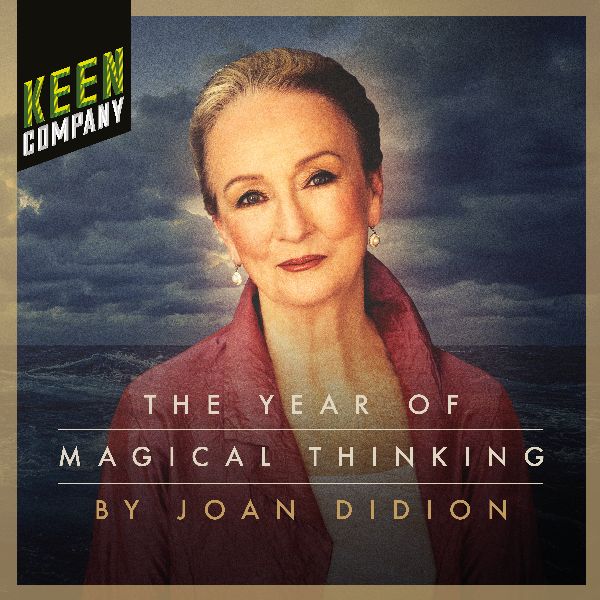
Who: Kathleen Chalfant What: Benefit livestream Where:Keen Company When: Saturday, March 13, $25, 7:00 (available on demand through March 17) Why: It’s been precisely a year since the coronavirus crisis shuttered theaters across the country. With more than half a million Americans dead from Covid-19 and more than 2.6 million victims worldwide, the planet has experienced a tremendous amount of loss since the WHO declared on March 11, 2020, “We have made the assessment that Covid-19 can be characterized as a pandemic. Pandemic is not a word to use lightly or carelessly. It is a word that, if misused, can cause unreasonable fear, or unjustified acceptance that the fight is over, leading to unnecessary suffering and death.” In homage to what this year has wrought, Keen Company is presenting a livestreamed virtuaL reading of Joan Didion’s 2007 play, The Year of Magical Thinking, which she adapted from her memoir that detailed what she experienced in the twelve months and one day following the sudden death in 2003 of her husband, writer John Gregory Dunne, during which their daughter, Quintana Roo, was seriously ill with a series of health issues that began with the flu; she passed away shortly before the National Book Award–winning bestseller was published, an incident that was added to the play.
Thus, the time seems right for a reading of the one-woman show, which premiered on Broadway in 2007 at the Booth Theater, starring Vanessa Redgrave; more recently, Kathleen Turner performed the role in a 2016 run at Arena Stage. The Keen presentation features the grande dame of New York theater, five-time Obie winner Kathleen Chalfant, who in the fall of 2019 portrayed Mabel Loomis Todd in Rebecca Gilman’s one-woman play, A Woman of the World. The online show is helmed by Keen artistic director Jonathan Silverstein, who said in a statement, “I am thrilled and honored to be reunited with Kathleen Chalfant on this beautiful play. Working with Kathleen for A Walk in the Woods [in 2014] was a highlight of my career, and she is a brilliant match for Joan Didion’s moving text. Didion’s words are clear-eyed, inspiring, and resonate on this one-year anniversary of the pandemic. We will be coming to you remotely, yet this intimate reading of Didion’s play will make you feel you’re in conversation with Chalfant and Didion.” Chalfant (Wit, Angels in America) is always elegant and graceful, whether onstage, on the big and small screens, or on Zoom. The one-night-only event takes place March 13 at 7:00 and will be followed by a talkback; tickets are $25, and purchasers can access the stream through March 17 at 7:00. Proceeds will benefit Keen’s Hear/Now season of audio theater in addition to Keen Playwrights Lab and Keen Teens.
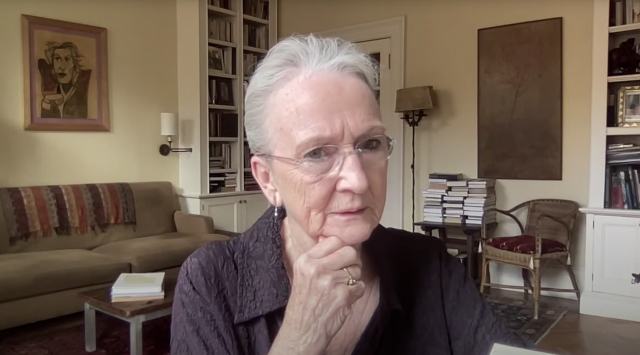
Kathleen Chalfant is exquisite in livestreamed reading of Joan Didion’s The Year of Magical Thinking for Keen Company
Update: Kathleen Chalfant gives an exquisite, beautiful reading of Joan Didion’s The Year of Magical Thinking for Keen Company. It is so well done you will sometimes forget you’re watching an actress performing and think you’re seeing Didion reading from her own book. Chalfant, who had contacted director David Hare about originating the part on Broadway, a role that had already been given to Vanessa Redgrave, rehearsed the play four times with director Jonathan Silverstein, including once in her home, where she delivers this performance, sitting in her living room, book in hand. She was offered a TelePrompter but found reading directly from the published play was more effective, and she’s right. She touches her chin, adjusts her glasses, pauses at a poignant moment when, by chance, ambulance sirens can be heard outside, and looks directly at the viewer, baring her character’s soul as she shares Didion’s tragic story over one hundred uncut, unedited minutes. It’s a gentle tour de force that comes at a time when we are all reflecting on a year like no other, delivered by a wonderful actress like no other. The reading is followed by a short talkback that lends further insight into this moving virtual presentation.
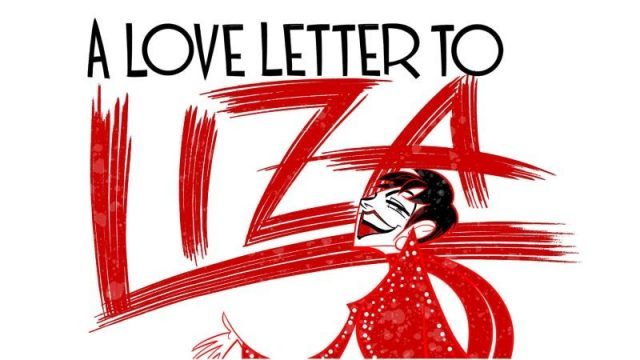
Who: Lorna Luft, Joel Grey, Lily Tomlin, Michael York, Joan Collins, Catherine Zeta-Jones, Ben Vereen, Ute Lemper, Michael Feinstein, Billy Stritch, Kathie Lee Gifford, Lea Delaria, Chita Rivera, Jonathan Groff, Charles Busch, Kathy Najimy, Sandra Bernhard, Andrew Rannells, Julie Halston, John Waters, John Kander, Nathan Lane, Mario Cantone, Tony Hale, Coco Peru, John Cameron Mitchell, Andrea Martin, Michele Lee, Nicolas King, Parker Posey, Craig Ferguson, Hoda Kotb, Jason Alexander, Jim Caruso, Kathy Griffin, Neil Meron, Haley Swindal, Seth Sikes, Verdon Fosse legacy dancers What: Seventy-fifth birthday tribute to Liza Minnelli Where:The Town Hall via Stellar When: Friday, March 12, $30, 8:00 (also available March 13 at 8:00 and March 14 at 7:00) Why: On March 12, 1946, Liza May Minnelli was born to beloved actress and singer Judy Garland and Hollywood director Vincente Minnelli in Los Angeles, ultimately a family of Academy Award winners. On March 12, 2021, several dozen of Liza’s friends and admirers will gather virtually to wish the Tony-, Oscar-, and Emmy-winning star of stage and screen — Cabaret, The Sterile Cuckoo, Arthur, Liza with a Z, The Act — a very happy seventy-fifth birthday. Presented by the Town Hall, “A Love Letter to Liza Minnelli: 75th Birthday All-Star Tribute” will feature performances and appearances by a wide-ranging group of celebrities, including Joel Grey, Lily Tomlin, Joan Collins, Catherine Zeta-Jones, Ben Vereen, Michael Feinstein, Kathie Lee Gifford, Chita Rivera, Jonathan Groff, Charles Busch, Sandra Bernhard, Andrew Rannells, John Waters, John Kander, Nathan Lane, Mario Cantone, Andrea Martin, Michele Lee, and Kathy Griffin, along with surprise guests and never-before-seen footage of Liza.
“Sometimes you’re happy, sometimes you’re sad / But the world goes ’round / Sometimes you lose every nickel you had / But the world goes ’round,” Minnelli sings in New York, New York, offering words to live by, especially during the current crises. “Somebody loses and somebody wins / And one day it’s kicks, then it’s kicks in the shins / But the planet spins, and the world goes ’round.” Of course, this is Liza’s world; we’re only living in it. Tickets to the birthday tribute are $30, with twenty percent of the proceeds benefiting the Actors Fund.
Who:WP Theater in partnership with Ma-Yi Theater Company What:New streaming play Where:WP Theater online When: Select hourly streams March 10-14, free – $100 Why: WP Theater and Ma-Yi Theater Company have teamed up to present the world premiere of Stefani Kuo’s Final Boarding Call, streaming at specific times March 10-14. Directed by Mei Ann Teo (The Shape of a Bird,SKiNFoLK: An American Show) with multimedia design by Hao, the play is set during the Hong Kong protests, as seven characters face the crisis from different perspectives, affected in different ways. A New York–based playwright, poet, and performer, Kuo (Architecture of Rain, Bedlam’s King Lear) explores global capitalism, Chinese power, and people struggling to get by in tough, dangerous times. Admission is based on what you can afford; the play features unique use of Zoom boxes, animation, and green screens in telling its story.
WP Theater has been busy the last several months, streaming such other works as Cori Thomas’s Lockdown, Obehi Janice’s Ole White Sugah Daddy, Monica Bill Barnes & Company’s Keep Moving, and Rebecca Martínez’s The Nourish Project. Up next is a broadcast reading of MJ Kaufman’s Galatea in association with Red Bull Theater. Similarly, Ma-Yi and its new Ma-Yi Studios have been producing virtual works, including Ohnobu Pelican’s Clippy & Ms. U, which deals with the Fukushima disaster; Frederick Kennedy’s mesmerizing Rest, which repurposes seismic data in conjunction with quarantine recordings; and Ron Domingo’s short film Sophocles in Staten Island, about a family obsessed with Greek tragedy. Next is Daniel K. Isaac’s Once Upon a (korean) Time in April.
Update: I had expected Final Boarding Call to be a straightforward short trip, but it ended up being an emotionally turbulent and wholly satisfying two-hour nonstop flight. Written by Stefani Kuo and directed by Mei Ann Teo, the play tackles the 2019–20 Hong Kong protests, also known as the Anti-Extradition Law Amendment Bill movement, from multiple perspectives via seven characters, portrayed by actors over Zoom. Any public criticism of China is met with harsh retaliation, so some cast members don’t even use their full, real names in the credits, although facial recognition software makes that point moot.
Christina Ho (Sarah) is a flight attendant with a radical brother, Ting-Ting Ho, who is right in the middle of the protests at Hong Kong Polytechnic University. She works with Godfrey Kwok (Will Dao), a flight attendant who takes a liking to one of his passengers, Marc Olberg (Philip Cruise), a Tiffany’s executive with an advertising dilemma. Lucy Wang (M) is a freelance journalist attempting to interview a mysterious protest leader who goes by the screen name cocacola_chicken_wing; Lucy is about to have twins with her partner, Ravichandran Chopra (Rohan Kymal), but her estranged mother, Xiao Feng (Y.C.), wants her to return to mainland China despite the the suppression of dissent. As the various narrative threads come together and the characters debate just what freedom is, a small television monitor shows violent, frightening news footage of the protests. “I really admire the Hong Kong people for their . . . your spirit. It’s just — we can’t live in idealism, right?” Marc tells Godfrey.
Teo and designer Hao employ an impressive arsenal of Zoom stagecraft: They include text messages, use green-screen backgrounds to create the illusion that the well-developed characters are in the same rooms, display written-out stage directions, and utilize multiple, changing boxes to keep the action flowing, which prevents Final Boarding Call from becoming a standard virtual theatrical presentation with actors essentially buckled into their seats, tray tables in their upright position. Final Boarding Call concludes with a hard-hitting, powerful monologue by Sarah that makes the audience complicit in the fight for freedom everywhere, in Hong Kong and wherever else human beings are being held down, in the midst of resistance and rebellion. It’s an impressive landing to a play that isn’t afraid to pull any punches or wear its heart on its sleeve, symbolically taking the kinds of risks that freedom is all about.