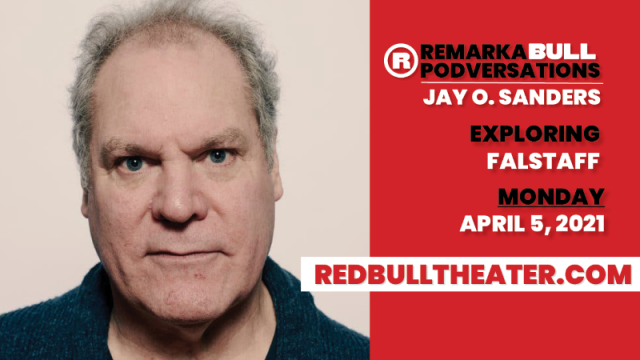
Who:Red Bull Theater company What:Conversation about William Shakespeare character Falstaff Where:Red Bull Theater website,YouTube, and Facebook Live When: Monday, April 5, free with RSVP (donations accepted), 7:30 Why: The last hand I shook was the large paw of Drama Desk Award–winning actor Jay O. Sanders, following his performance in the Broadway show Girl from the North Country at the Belasco on March 10, 2020, two days before the pandemic lockdown shuttered the city. With most theaters and the Great White Way still closed, Sanders will take part in Red Bull’s next online RemarkaBULL Podversation, “Exploring Falstaff,” on April 5 at 7:30. In the free virtual event, streamed live on Facebook and YouTube, the Austin-born actor and activist will perform an excerpt from Act 2, Scene 4 from Henry IV, Part 1, in which the bearish Sir John Falstaff tells Prince Hal at the Boar’s Head Tavern: “Shall I? content: this chair shall be my state, / this dagger my sceptre, and this cushion my crown. / Give me a cup of sack to / make my eyes look red, that it may be thought I have / wept; for I must speak in passion.”
After the speech, Sanders will discuss the character, who appeared in both parts of Henry IV and The Merry Wives of Windsor before being eulogized in Henry V, with Red Bull associate producer Nathan Winkelstein. The conversation will include several questions from the audience as well. Sanders (Uncle Vanya,the Apple Family plays) has portrayed such Shakespearean figures as Titus Andronicus, Marc Antony, Macbeth, Toby Belch, Caliban, Petruchio, and Bottom and has the record for most appearances at the Public’s Shakespeare in the Park presentations at the Delacorte, so he knows what of he speaks. Up next for Red Bull’s ambitious lockdown programming is a Zoom benefit reading of Paradise Lost on April 12 and 26; you can watch previous RemarkaBULL Podversations with André De Shields, Kate Burton, Patrick Page, Elizabeth Marvel, Michael Urie, Chukwudi Iwuji, Stephen Spinella, and others here.
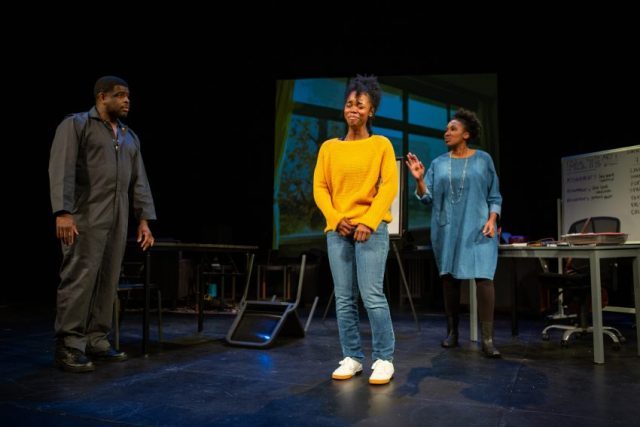
Trauma and PTSD hover over all four characters in the world premiere of Erika Dickerson-Despenza’s searing drama [hieroglyph], streaming in a filmed, fully staged production from San Francisco Playhouse and Lorraine Hansberry Theatre through April 3. Inspired by the true story of the kidnapping and rape of nine-year-old Shatoya Currie, known as Girl X, [hieroglyph] stars Jamella Cross as Davis Despenza Hayes, a thirteen-year-old girl who has moved to Chicago with her hardworking father, Ernest (Khary L. Moye), two months after being displaced by Hurricane Katrina in New Orleans, where her mother stayed behind. Davis is hiding a dark secret that slowly emerges as she excels in art class, taught by Ms. T. (Safiya Fredericks), who harbors a secret of her own. Meanwhile, Davis’s best friend, Leah (Anna Marie Sharpe), is more open and positive about life, until something goes wrong.
[Hieroglyph], the real title of which is an inarticulate symbol, is beautifully written by Susan Smith Blackburn Prize–finalist Dickerson-Despenza (ocean’s lip/heaven’s shore, shadow/land) and intimately directed by Lorraine Hansberry Theatre artistic director Margo Hall (Barbecue, Red Velvet) on SFP artistic director Bill English’s circular stage, which revolves from the classroom to Davis’s bedroom to the Hayes living room. A screen in the back shows Davis’s compelling drawings, works by Harlem Renaissance painter Ernest Crichlow, abstract videos of Davis’s nightmares, and a window to the outside world. Regina Y. Evans’s sharp costumes further define the four characters, portrayed by an outstanding cast led by a moving performance by Cross and a powerful turn by Moye, who represents those who want to do the right thing but don’t have the facility to wholly understand. Although some of the camerawork and editing can get a bit shaky at times, Hall’s staging makes it feel like you’re watching a play, not a film, with superb lighting by Kevin Myrick, sound and interstitial music by Everett Elton Bradman, and projections by Teddy Hulsker. I can’t wait to see [hieroglyph] in person.
Part of the playwright’s planned ten-play Katrina Cycle, [hieroglyph] is a harrowing exploration of the systemic abuse of the Black woman’s body; it’s about shame, racism, and sexual violence, about boys and men taking advantage of the vulnerability of young girls, and about trying to take back the power. “Can’t nobody take something from me that I give up. If I’m in control, if I give it away, can’t nobody take it,” Leah tells Davis.
In a program note, Dickerson-Despenza writes, “This play is for girls who suffer & survive in silence. It’s for the women & girls of New Orleans who courageously tell their stories of sexual assault in the aftermath of Hurricane Katrina & the Flood. This play is for Black fathers navigating their own toxic masculinity & role in perpetuating rape culture. . . . This play is for Black women who hold the vestiges of Black girlhood joy in our muscle memory through bounce, juke parties, & other sacred Black cultural formations. It’s for the Black girl friendships & art that holds & heals us. This play is for all of the survivors. & me too.” And now it’s available for everyone to see. Don’t miss it.
Who: Chasten Buttigieg, Ariana DeBose, Debra Messing, Sheryl Lee Ralph, Tony Shalhoub, Ben Vereen, Stephanie J. Block, Deborah Cox, Lea Salonga, Amy Adams, Debbie Allen, Matt Bomer, Brenda Braxton, Len Cariou, Glenn Close, Loretta Devine, Jesse Tyler Ferguson, James Monroe Iglehart, Cheyenne Jackson, Cherry Jones, L Morgan Lee, Raymond J. Lee, Aasif Mandvi, Eric McCormack, Michael McElroy, Debra Messing, Ruthie Ann Miles, Brian Stokes Mitchell, Jessie Mueller, Javier Muñoz, Kelli O’Hara, Karen Olivo, Jim Parsons, Bernadette Peters, Eve Plumb, Roslyn Ruff, Sis, Elizabeth Stanley, Tony Yazbeck, Anderson Cooper, Don Lemon, Robin Roberts, Robert Creighton, Danyel Fulton, Eileen Galindo, Sam Gravitte, Sheldon Henry, Diana Huey, Aaron Libby, Nathan Lucrezio, Melinda Porto, Shelby Ringdahl, Vishal Vaidya, Blake Zolfo What: Benefit for Broadway Cares/Equity Fights AIDS and the Lesbian, Gay, Bisexual & Transgender Community Center Where:Broadway Cares and YouTube When: Tuesday, March 30, free, 8:00 (available on demand through April 3) Why: Mayor DeBlasio has announced that he expects Broadway to reopen in September, but that doesn’t mean the forty-one official theaters will be hosting shows come the fall. In the meantime, we have to keep quenching our thirst with Zoom readings, filmed stagings, and virtual gala celebrations. Next up is “Broadway Backwards,” premiering March 30 at 8:00 and available on demand through April 3. The benefit for Broadway Cares and the Lesbian, Gay, Bisexual & Transgender Community Center in New York City, which honors gender diversity and love, began in 2006, raising $7,325, rising each year until it reached $704,491 in 2019; the 2020 edition, scheduled for March 16, was canceled because of the coronavirus.
It has now returned with a vengeance, featuring clips from previous shows (Tituss Burgess, Len Cariou, Carolee Carmello, Darren Criss, Cynthia Erivo, Andrew Keenan-Bolger, Debra Monk, Andrew Rannells, Chita Rivera, Lillias White, more), appeals from Chasten Buttigieg, Ariana DeBose, Debra Messing, Sheryl Lee Ralph, Tony Shalhoub, and Ben Vereen, and new performances from such major names as Stephanie J. Block, Amy Adams, Debbie Allen, Glenn Close, Jesse Tyler Ferguson, Cheyenne Jackson, Cherry Jones, Eric McCormack, Brian Stokes Mitchell, Jessie Mueller, Kelli O’Hara, Karen Olivo, Jim Parsons, and Bernadette Peters. This year’s edition is centered around Jay Armstrong Johnson portraying a lonely New Yorker navigating the Covid-19-riddled city with the help of a late-night TV host played by Jenn Colella. The show is written and directed by event creator Robert Bartley, with Mary-Mitchell Campbell as music supervisor, Ted Arthur as music director, and Eamon Foley as director of photography and video editor. It’s free to watch, but donations will be accepted to help members of the LGBTQ community and others who have been significantly impacted by the health crisis and pandemic lockdown.
In addition to watch parties, where people from around the world gather online to experience streaming content together, from old TV shows to theater productions and Zoom cast reunions, listening parties have taken off as well. One of my favorites is Tim Burgess’s Twitter edition, in which he spins classic records, sometimes joined by members of the band who talk about the making of the album. Melding that idea with Kanye West’s 2018 Wyoming media listening party for Ye, New Light Theater Project and 59E59 Theaters have teamed up for The Jackson C. Frank Listening Party w/ Special Guests, a virtual show running March 29 to April 11, an interactive listening party for Jackson C. Frank’s eponymously titled 1965 record, which was produced by Paul Simon. Written by Michael Aguirre and directed by Sarah Norris, the eighty-minute show is hosted by Allen, who is still upset that he could not make it to Kanye’s party, so now he is putting on an event to outshine all others, while also sharing the story of his missing brother. The cast includes Aguirre as Allen, Bethany Geraghty as Mom, Dana Martin as Grandma Woodstock, and Sean Phillips as Simon, with film and sound editing by Hallie Griffin.
After purchasing your ticket, you’ll receive a link to download the record and instructions on how to make the official event cocktail, Hippie Juice. The folk album, originally released in 1965, features ten songs remastered in 2001, from “Blues Run the Game,” “Don’t Look Back,” and “Kimbie” to “I Want to Be Alone,” “Just Like Anything,” and “You Never Wanted Me.” It was the Buffalo-born Frank’s only record during a tragic life; when he was eleven, he suffered severe burns across half his body in a fatal fire at his elementary school, was given a guitar while being treated at the hospital, and later recorded Jackson C. Frank in England in six hours. He lost a child, was shot in the eye by a pellet gun, was homeless, and battled debilitating mental health issues; he died in Massachusetts in 1999 at the age of fifty-six, having never released another album (although a box set of his complete recordings came out in 2014). Despite his influence on many musicians, he has faded away into history, now to be resurrected at a virtual, interactive listening party, using his intimate songs to explore contemporary society.
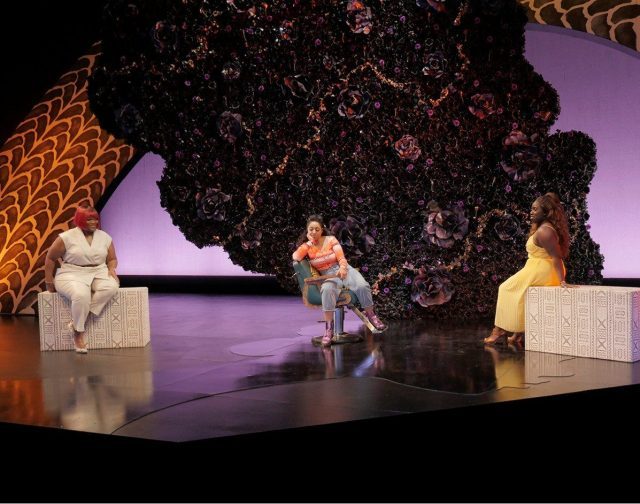
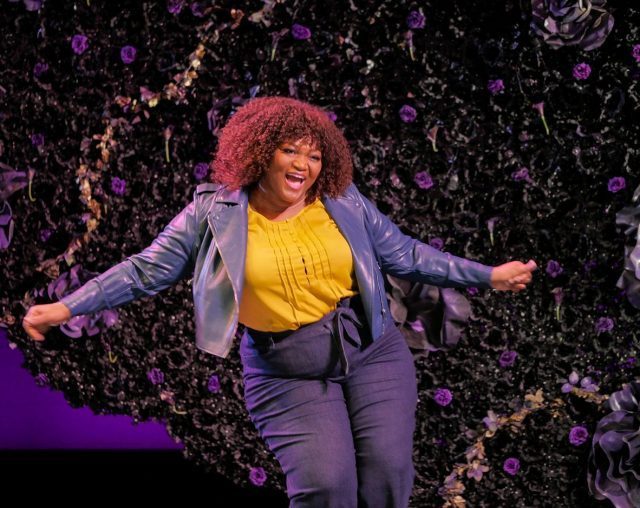
The Glorious World of Crowns, Kinks and Curls takes on sociopolitical and -cultural issues by exploring reactions to Black women’s hair (photo by Diggle)
There are two critical takeaways from Baltimore Center Stage’s world premiere of Kelli Goff’s extraordinary virtual play, The Glorious World of Crowns, Kinks and Curls. The first, as declared in unison by the trio of performers: “Don’t ever touch a Black woman’s hair without her permission!” The second: There is great theater happening all over the country, not just in New York City, as the pandemic has introduced me to wonderful companies in California, DC, Ithaca, Texas, Massachusetts, New Jersey, Maryland, Florida, Illinois, Michigan, and other locations, where I have never had the privilege of seeing them in person.
In the ninety-minute play, filmed onstage in Baltimore without an audience, Emmy nominee, journalist, and NAACP Image Award winner Goff tackles the issue of how Black women are treated because of their hair. In a series of monologues and scenes with two or all three of the actresses, Stori Ayers, Awa Sal Secka, and Shayna Small, each portraying multiple characters, share more than a dozen stories about how their hairstyle has impacted their lives, and usually not for the better, as they are either judged negatively by others or seen as some kind of doll that can be touched, ogled, and thrown away.
The work opens with a woman auditioning for a play based on a book called Scars. “Even if you don’t have physical scars, all of us have scars that we carry with us, and within us,” she says, explaining how much she identifies with the script, implying not only the fictional one but Goff’s. “I mean, for me, I’ve mostly dealt with weight and body image stuff for years, and, well, I just know what it’s like to walk through the world and have people not see you but look right through you. And the stories in this play are fundamentally about women who want to be seen for who they are. Not dehumanized for who they are or judged for who we are or how we look. I mean they, how they look.”
After the actress explains that she would do anything, within reason, to get the part, the casting director asks, “Would it be possible for you to change your hair?” The producers want the actresses to look “as natural as possible,” but even when the woman auditioning explains that her curls are natural, the casting director adds, “You’re just so talented. I’d hate for something as silly as how you choose to wear your hair to hurt your chances. I mean, this show could change your whole life. And after all, it’s just hair.”
Seamlessly directed by Bianca LaVerne Jones and filmed and edited by Dean Radcliffe-Lynes and David Lee Roberts Jr., the vignettes that follow detail how Black women’s hair affected their job, dates, friendships, and family relationships. A mother is appalled when her daughter chops off her hair on her wedding day. A Black man running for president of the Black Graduate Student Association is furious when his Black girlfriend straightens her hair, making her seem less Black. An up-and-coming lawyer gives up a Caribbean vacation with her partner in order to be at an important meeting, but her Black woman boss is appalled that she has shown up in cornrows. A young biracial girl and her Black mother are taunted because they don’t look like parent and child. A politician refuses to make her hair an issue but acknowledges that a woman has to prepare for public appearances differently from how men do; she’s not going to worry about how she’s perceived by others just to get more votes because of her hair, although she understands that “representation does matter.”
And girls named Amaya and Claire, only their hands visible, clasped over a drawing of African symbols (which can also be seen on several props used in other scenes), speak to G-d. As they mention various objects, the items magically pop up in their hands as they talk about their hair, with a striking final twist that speaks of legacy and the future.
Stori Ayers is one of three actresses portraying multiple characters in Baltimore Center Stage world premiere (photo by Diggle)
Ayers, Secka, and Small — who never touch one another and are always at least six feet apart — are terrific switching from role to role, each requiring significantly different clothing, makeup, accents, and hair. Jones (Armed,Feast: A Yoruba Tale) and Goff (The Birds & the Bees,Reversing Roe,Being Mary Jane) have assembled an outstanding crew of Black women, including two-time Tony-nominated set and costume designer Dede Ayite (A Soldier’s Play,Slave Play) and hair and wig designer Nikiya Mathis, whose creations run the gamut, giving each character an individuality that speaks volumes. (The sound is by Twi McCallum and lighting by Nikiya Mathis.) The set is anchored by a large, glittering, abstract hair sculpture reminiscent of the work of artist Mickalene Thomas.
The Glorious World of Crowns, Kinks and Curls is a superb example of what theater can accomplish even during a pandemic lockdown, using technology to make the most of the online nature of presentation, telling a story that is fresh and of-the-moment, particularly now that America has a Black and brown vice president, while also taking on racial, gender, and wealth inequality. It’s about personal and cultural identity, about imagery and messaging, about bigotry and racism, about love and respect, about who we are as a nation and what we can be. It’s about all of us, in 2021 and beyond. And, because of the Covid-19 health crisis, it is available to everyone to experience for ourselves, no matter where, or who, we are.
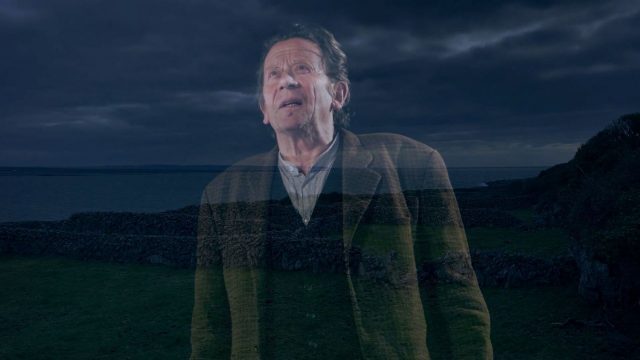
Brendan Conroy roams empty theaters and a rocky landscape in cinematic reimagining of The Aran Islands (photo courtesy Irish Rep)
THE ARAN ISLANDS
Irish Rep Online
March 23-28, suggested donation $25 irishrep.org
As far as I can tell, no other company in the world has been able to accomplish what the Irish Rep has during the pandemic lockdown. And the West Twenty-Second St. institution has done it again with the stirring hybrid presentation of John Millington Synge’s The Aran Islands, about the Dublin writer’s experiences in the islands off the west coast of Ireland in 1898, a journey urged by W. B. Yeats.
The Irish Rep has quenched at least part of the thirst of theater lovers desperate for entertainment by reimagining past works for the virtual environment, using innovative techniques that include green-screened backgrounds and real props that make it appear that the actors are in the same room. In Conor McPherson’s The Weir, the characters seemed to be passing around drinks as they each shared a ghost story. In Eugene O’Neill’s A Touch of the Poet, it looked as if family members were sitting at the same table at an inn.
The company, which was founded in 1988 by Charlotte Moore and Ciarán O’Reilly, who are still at the helm and leading the online programming, also has produced Darren Murphy’s The Gifts You Gave to the Dark, a live show filmed with a smartphone (and one of the first to address the health crisis directly); Bill Irwin’s On Beckett, updated for the pandemic and beginning with Irwin walking down Twenty-Second St. and entering the Irish Rep, performing onstage to empty seats; and Love, Noël: The Songs and Letters of Noël Coward, in which Steve Ross and KT Sullivan revisit their recent two-person hit at the Irish Rep by moving into the Players, following all Covid-19 protocols.
And now the Irish Rep and Co-Motion Media, which teamed up in 2017 for Joe O’Byrne’s adaptation of Synge’s 1907 book, The Aran Islands, have transformed the one-man show into a gripping, uncanny film, directed by O’Byrne and again starring Brendan Conroy. The ninety-minute work was shot by O’Byrne in the New Theatre and the Smock Alley Theatre in Dublin as well as on the rocky shores of the title location, where a grizzled Conroy, portraying a descendant of Synge’s, roams around through the fog and mist, searching for folks speaking Gaelic and relating wonderful tales, often with a supernatural twist, by and about the people he encounters, taking on their personas. A fairy steals a child. An elderly man misses the old days. The blind storyteller of Mourteen, bent over with rheumatism, spins a yarn about two farmers, their son and daughter, and a bargain involving a bag of gold and cut-off flesh. A dead man tries to catch his unfaithful wife in the act. These and other anecdotes reveal a unique, incorruptible people who have different ideas about family and justice, hell and death.
He says of the islanders, “If a man has killed his father, and is already sick and broken with remorse, they can see no reason why he should be dragged away and killed by the law. Such a man, they say, will be quiet all the rest of his life, and if you suggest that punishment is needed as an example, they ask, ‘Would any one kill his father if he was able to help it?’”
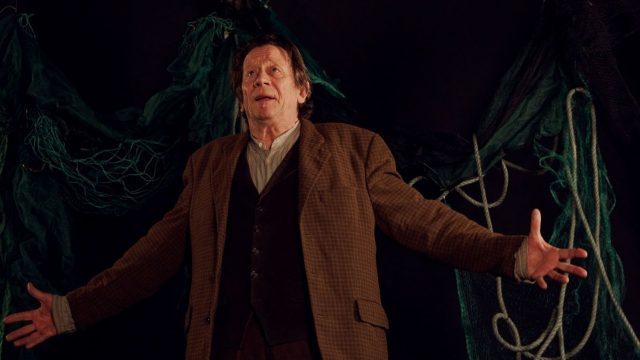
Brendan Conroy gives a tour-de-force performance in The Aran Islands (photo courtesy Irish Rep)
At a burial, the traveler poetically explains, “This grief of the keen is no personal complaint for the death of one woman over eighty years, but seems to contain the whole passionate rage that lurks somewhere in every native of the island. In this cry of pain the inner consciousness of the people seems to lay itself bare for an instant, and to reveal the mood of beings who feel their isolation in the face of a universe that wars on them with winds and seas. They are usually silent, but in the presence of death all outward show of indifference or patience is forgotten, and they shriek with pitiable despair before the horror of the fate to which they are all doomed.”
The interior set design is by Margaret Nolan, with costume by Marie Tierney, lighting by Conleth White, and lovely original music by Kieran Duddy; O’Byrne (Departed, Enough) also edited the film, with shadowy superimpositions and ruminative shots of the sea. Conroy (Translations, Synge’s The Playboy of the Western World) delivers a tour de force performance, adjusting his accent, demeanor, and intonation for each character, every story worn into the deep lines of his face. It’s a treat for lovers of story, and one that is triumphant as a film, evolving from a book and a play in what feels like a seamless, organic way.
It’s also a marker of time, of a life lived, of right now, after a year spent in isolation, without travel or in-person theater. As Synge’s descendant states: “The old man is suggesting that I should send him a clock when I go away. He’d like to have something from me in the house, he says, the way they wouldn’t forget me, and wouldn’t a clock be as handy as another thing, and they’d be thinking of me whenever they’d look on its face.” We do have this play, although it will be available only through March 28.
Since September 2020, Open-Door Playhouse has produced more than two dozen short audio plays, primarily by new and emerging playwrights. The company was founded by filmmaker, playwright, and director Bernadette Armstrong, whose Custody was scheduled to premiere at the Secret Rose Theater in North Hollywood last September. Canceled because of the pandemic lockdown, the play instead was reimagined as Open-Door’s inaugural audio work, which you can listen to here.
The company is now looking to the past for its next show, a family-friendly adaptation of the first short story Oscar Wilde ever published, the 1887 classic The Canterville Ghost. The supernatural tale has been made into numerous stage and screen productions, including a 1944 film with Charles Laughton, Margaret O’Brien, and Robert Young; a 1966 TV musical with Douglas Fairbanks Jr., Peter Noone, and Michael Redgrave; several TV movies featuring such stars as John Gielgud, Andrea Marcovicci, David Niven, Richard Kiley, Patrick Stewart, Neve Campbell, Ian Richardson, and Celia Imrie; and a long-awaited, soon-to-be-released British animated version with Stephen Fry, Hugh Laurie, and Miranda Hart.
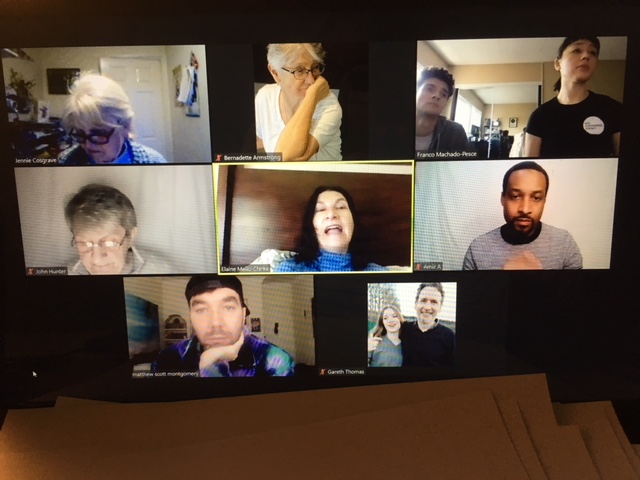
The new audio play is from Hands Across the Pond Theatre, a collaboration between Open-Door Playhouse from Glendale, California, and Our Kid and Me Productions, from Oxfordshire, England, adapted for the theater by Gareth Thomas and for audio by Armstrong with John and David Hunter, directed by Armstrong. The cast, which rehearsed over Zoom, consists of Jennie Cosgrave as Mrs. Umney, John Hunter as Sir Simon de Canterville, Thomas as Lord Canterville, Amir Abdullah as Hiram Otis, Elaine Mello-Clarke as Elizabeth Otis, Franco Machado as Washington Otis, McKenna Koledo as Virginia Otis, Matthew Scott Montgomery as Roger, and Gary Reed as Roland. The play premieres March 24 on the Open-Door Playhouse Podcast and the Springline Radio Players Podcast; admission is free, with donations welcome.
“Can’t we go to bed one night without talking about that horrible apparition?” Elizabeth asks, referring to the haunted house they are in. Washington responds, “The more we talk about it, Elizabeth, the less it should frighten you. You don’t see me or even the twins shuddering and screaming.” Be prepared for some shuddering as the creepy narrative, complete with sound effects, unfolds.