this week in theater

LUDIC PROXY: FUKUSHIMA

Japan Society: Online Contemporary Theater
Saturday, March 6, 9:30; Sunday, March 7, 4:30; Thursday, March 11, 8:00 (followed by a live Q&A), $15
Available on demand March 12—26, $15
www.japansociety.org
ayaogawa.com

In 2015 at Walker Space, Tokyo-born, Brooklyn-based playwright, director, performer, and translator Aya Ogawa debuted Ludic Proxy, a three-part immersive, apocalyptic play that takes place in the past (Pripyat, post-Chernobyl), the present (Fukushima, post-disaster), and the future (New York, underground). Ogawa has now adapted the middle section for the virtual multimedia production Ludic Proxy: Fukushima, streaming live through Japan Society on March 6, 7, and 11 (and available on demand March 12-26). The title, a phrase coined by a game designer, “refers to the phantom knowledge of something or somewhere real gained through game play,” Ogawa explains in a video about the reimagining. Originally commissioned by PlayCo in 2010, Ogawa was inspired to write Ludic Proxy following the 2011 Great East Japan Earthquake, tsunami, and nuclear disaster in Fukushima Prefecture, the death of her mother, and the birth of her second child. “The collision of [these personal life-changing events and the global disasters] created the foundation for this play. And it made me really think about, How does the intrinsic human tendency to play, to want to play, help us process the catastrophes that we experience in life?” she adds. The three-act play gave the audience the opportunity to help direct the narrative, like a choose-your-own-adventure story; that component will be adapted for the virtual presentation, about two sisters (Saori Tsukada as Maho and Yuki Kawahisa as Maki) in Fukushima. Online viewers will be asked to vote on what one of the sisters, an avatar for the audience, says and does, meaning that every live performance is unique.

Live, online show features interactive component for audience to help steer the action (photo © Ludic Proxy: Fukushima 2021)

“During this almost year that we’ve been living through this pandemic, I’ve really been thinking about the Fukushima section,” Ogawa continues. “It has audience interaction built into it that translates naturally to a digital platform but also there is something newly resonant about its premise today in 2021.” The sisters are attempting to connect in a way that relates to the problems so many American families are having today amid different belief systems involving politics and Covid-19, while honoring the tenth anniversary of the Fukushima disaster. If you buy a ticket for March 6 or 7, you will also have access to the subsequent live performances; the March 11 show will be followed by a live Q&A with Ogawa (The Nosebleed, Journey to the Ocean, oph3lia). From March 12 to 26, on-demand viewers will be able to control the path of the prerecorded narrative themselves instead of via online polling by everyone watching. Ludic Proxy: Fukushima is part of Japan Society’s ongoing program “Ten Years Later: Japan Society Remembers 3.11,” which also includes the March 9 symposium “Resiliency & Recovery: A U.S.-Japan Dialogue Ten Years after 3.11” and “Tea Time Season Three: Remembering 3.11.” In addition, Ogawa is the special guest at the next PlayClub on March 9 at 5:00, a live conversation about Toshiki Okada’s 2018 Time’s Journey Through a Room; sign up now to read a copy of the script, which also deals with the 2011 earthquake and tsunami, and participate in the discussion, facilitated by Kate Loewald.

ADJUST THE PROCEDURE

Adam Files, Nicholas Miles Newton, Meagan Moses, and Ed Altman (clockwise from top left) get into a tense Zoom meeting in Adjust the Procedure

ADJUST THE PROCEDURE
Available on demand through March 28, $10
spincyclenyc.com

A new genre of theater has arisen during the pandemic lockdown: Zoom plays about Zoom gatherings, both personal and professional. I’m not talking about Zoom benefits with actors reading Shakespeare and Sophocles or Fast Times at Ridgemont High and The Princess Bride but new works written for Zoom, performed on Zoom — and set on Zoom. For the Public, Richard Nelson’s What Do We Need to Talk About? reunited the familiar Apple family with the original cast — Jon DeVries (Benjamin Apple), Stephen Kunken (Tim Andrews), Sally Murphy (Jane Apple Halls), Maryann Plunkett (Barbara Apple), Laila Robins (Marian Apple Platt), and Jay O. Sanders (Richard Apple) — holding a Zoom family meeting. Rough & Ready Productions’ seven-minute Brown, an early entry from April 2020, imagines a Zoom brainstorming session about the color of cruise line swimwear, particularly prescient given the status of cruises over the last year. And Jordan E. Cooper’s Mama’s Got a Cough (with the wonderful Danielle Brooks) is fourteen of the funniest minutes you’ll ever spend on Zoom, as a family convenes an emergency online meeting to figure out what to do about their elderly matriarch.

Spin Cycle and JCS Theater Company take it to the next level with Adjust the Procedure, which delves deep into the psychological impact the coronavirus crisis is having on individuals as well as institutions, in this case a university. Written and directed by Jake Shore, the play is built around several Zoom meetings dealing with the school’s Counseling and Wellness center and what might have gone wrong in the case of student David De La Cruz. Director of academic development Kyle (Adam Files) first discusses the issue with assistant dean of student achievement Ben (Nicholas Miles Newton), relating a call he received from the suicidal undergraduate.

“In most circumstances I wouldn’t have pressed him on it at all, I would’ve just followed the procedure, but I felt I had a responsibility to deal with it on my own for some reason,” a concerned Kyle says.

Ben initially seems more interested in following the rules than facing the reality of the situation. He replies, “I would advise against intervening. . . .” That conversation ends with Ben’s advice:

“You need to know your role, Kyle, and it’s going to help a great deal in the long run. The life of this student is not on your back. It does not hang in the balance due to anything that you’ve done or will do. That’s just not the way it is. You talking to him, interfering, it’s just not going to matter that much in the grand scheme of things. It’s brutal, I’m sorry to say it, but it’s the truth. You don’t have that type of responsibility to him, or to any other student. It’s just not your job.”

On another call they are joined by director of enrollment management Aimee (Meagan Moses), who appears to only care about the numbers on her spreadsheet rather than the students themselves. She explains with robotic precision, “As you both know, for the most part, we weathered the storm caused by the international student problem, and in addition to that, we’ve made up for the additional students who either dropped out, transferred, or exited for reasons directly tied to the pandemic.” Those reasons include deportation.

Despite Ben’s pleas for Kyle to stop, the latter continues to press the issue as they discover more about Counseling and Wellness and where the De La Cruz case failed. Soon Kyle, Ben, and Aimee are on a Zoom call with executive dean Frank (Ed Altman), who is all about protecting the university’s reputation and avoiding any kind of legal trouble, no matter the truth. The four of them get into it, ascertaining things about themselves and their colleagues they might not like, leading to a surprise ending.

Available on demand over the Stellar platform through March 28, Adjust the Procedure gets off to a slow start, just talking heads Zooming in from wherever they are sheltering in place, but Shore (The Devil Is on the Loose with an Axe in Marshalltown, Down the Mountain and Across the Stream) picks up the pace as he brings up pertinent issues that address how the pandemic has been handled from multiple perspectives. Kyle represents the person who wants to do right but is thwarted by rules and procedures that need to be reevaluated. Ben is the earnest employee who might agree with Kyle but is not about to rock the boat. Aimee is the efficiency expert who can’t see the human component. And Frank claims that he is “worried about society unraveling,” but his beliefs about just what that society is don’t necessarily gel with the others’.

No one comes out unscathed in this trenchant Covid-19 parable; it might be specifically about a university, since education has been so hard hit during the pandemic, but it could also be about corporations and local, state, and federal governments as they face the reality of mounting death tolls and economic collapse and decide how they are going to proceed, choosing whose interests to put first amid the bureaucracy and numbers crunching.

At one point the four characters are discussing a new class at the school, “Free Will: The Big Lie.” Frank pounces on the subject, declaring, “Do you know what an immature adolescent is going to think when he finds out that free will doesn’t exist? He’ll misconstrue it. All of a sudden, there’s no accountability for one’s actions. If there’s no free will, then there’s no control.

As has been made all too clear during this crisis, control is all about power — control of information, of the media, of statistics, of money, of scientific interpretation — primarily at the expense of the individual, the poor schnooks trying to do right by themselves, their family, their school district, and their community, attempting to assert whatever free will is supposed to exist in a representative democracy. And as we have learned, procedures need to be adjusted, and fast.

GOING IT “ALONE” DURING LOCKDOWN: BAD DATES / FIRST LOVE / FRANZ KAFKA’S LETTER TO MY FATHER

Online solo shows during the pandemic have found new ways to challenge and entertain the audience, as with online adaptation of Franz Kafka’s Letter to My Father (photo by Eileen Meny Photography)

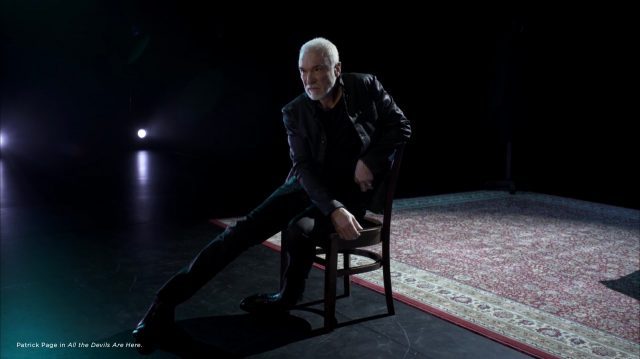
With theaters shuttered across the country — and the world — since last March, companies big and small have been coming up with creative and inventive ways to put on shows, from benefit Zoom readings to, more recently, live and recorded presentations onstage, following all Covid-19 protocols and performed by a minimal cast without an audience. Among the highlights have been Arlekin Players Theatre’s State vs. Natasha Banina, starring Darya Denisova, directed by her partner, Igor Golyak, streamed live from their living room; Jefferson Mays in Michael Arden’s tech-heavy A Christmas Carol, filmed at the empty United Palace theater on Broadway at 175th St.; Ryan J. Haddad’s Hi, Are You Single?, recorded live at the Woolly Mammoth in DC in front of a limited masked audience of staff members; Lauren Gunderson’s The Catastrophist, in which William DeMeritt portrays her husband, virologist Nathan Wolfe, filmed at the Marin Theatre in San Francisco; Bill Irwin’s updated version of On Beckett / In Screen, which begins with him walking down Twenty-Second St. and entering the Irish Rep, trudging through an empty theater to the stage; and Patrick Page’s All the Devils Are Here: How Shakespeare Invented the Villain, a crash course in the Bard’s bad guys, taped at Shakespeare Theatre Company’s vacant home at the Harman Centre for the Arts in DC.

A trio of new one-person shows have pushed the envelope with casting, technology, and location, resulting in virtual productions that challenge and entertain the viewer, offering sustained thrills and, occasionally, a bit of frustration. Even the most jaded of theatergoers who have refused to recognize what has been occurring online should reconsider by streaming at least one of these ambitious, worthwhile works.

Andréa Burns recounts her sad dating history and love of fancy shoes in virtual reimagining of Theresa Rebeck’s Bad Dates

BAD DATES
George Street Playhouse
Twenty-four-hour stream available on demand through March 14, $33
georgestreetplayhouse.org

George Street Playhouse’s online adaptation of Theresa Rebeck’s Bad Dates is a family affair. Originally performed by Tony winner Julie White at Playwrights Horizons in 2003, the play now features Andréa Burns as Haley Walker, a divorced single mother who, after years of struggling with finances while raising her daughter, Vera, has been promoted to managing the restaurant where she worked as a waitress and is ready to start dating again now that Vera is thirteen. The lively seventy-five-minute monologue is set in the home of George Street Playhouse board member Sharon Karmazin, a producer of such Tony-winning shows as Clybourne Park, Dear Evan Hansen, and The Band’s Visit. It’s directed in person (not over Zoom) by Burns’s husband, Peter Flynn (Curvy Widow, Smart Blonde), the streaming director of Stars in the House, Seth Rudetsky and James Wesley’s daily benefits for the Actors Fund, and filmed and edited by Burns and Flynn’s seventeen-year-old son, Hudson Flynn, the technical director of Stars in the House. (You can watch Burns guest hosting a “Date Night” edition of the series with Peter here.)

Burns (In the Heights, On Your Feet! The Story of Gloria Estefan) is effervescent as Haley, who can’t wait to get back into the dating scene. She agonizes over which shoes to wear — there are several dozen boxes of fancy footwear in her bedroom, along with a box of cold, hard cash — and tries on a parade of dresses. “Okay, this looks good, right? This is very good,” she says, checking herself out in a full-length mirror. “I look like a hooker. Well, maybe I can wear this with a scarf. You know, look like a hooker wearing a scarf.” She wanders from the bedroom to the bathroom to the closet to down the hall to get the unseen Vera’s approval, charmingly blathering on directly into the camera, aware we are watching her every move. She shares details of a series of bad dates, compares her life to that of the fictional Mildred Pierce in Michael Curtiz’s 1945 film, and recognizes her strengths and weaknesses, her successes and failures.

“It seems like I’m the only one who knows anything about how the place works,” she says about the restaurant. “So, you know, finally, the noncriminal Romanians go, ‘To hell with it,’ and they put me in charge because apparently, I’m some sort of weird restaurant idiot savant. Who knew? Born to run a restaurant. Which is exciting, when you find something, that strange combination of who you are and what you can do — to find your gift like that. How many people get that to fall on their head like that? ’Cause I started out being, like, just a waitress trying to support herself and her kid. I was just another person who married a moron and then had a load of shit to deal with.”

She unloads the shit with an infectious demeanor leading up to a surprise ending. A full crew helps make the production a joy, with fab costumes by Lisa Zinni, sharp lighting by Alan C. Edwards, incidental music and sound by Ryan Rummery, grand hair and makeup by Dorothy Petersen, and fun props and sets by Helen Tewksbury. Bad Dates makes for a great date night, streaming through March 14.

Bill Camp explores his family home in online adaptation of Samuel Beckett short story (photo courtesy Theatre for a New Audience)

FIRST LOVE
Theatre for a New Audience
Available on demand through March 1, free with registration
www.tfana.org

Tony and Emmy nominee and Obie winner Bill Camp is all on his own in JoAnne Akalaitis’s adaptation of Samuel Beckett’s 1946 short story “First Love” for Theatre for a New Audience, streaming through March 1. The seventy-five-minute show takes place in Camp’s family home in Vermont, where he travels through several rooms while telling us his woeful tale of love, loss, and isolation. Camp (The Crucible, The Queen’s Gambit), with his scruffy, scraggly beard and wearing a Petzl headlamp as if he were going spelunking, looks like a hermetic recluse as he lies on the floor, rolls across the wall, and puts his face uncomfortably right up against the screen, speaking with an absurdist tongue.

“I associate, rightly or wrongly, my marriage with the death of my father, in time, That other links exist, on other levels, between these two affairs, is not impossible. I have enough trouble as it is in trying to say what I think I know,” he begins. In the memory play, the wholly unreliable narrator doesn’t understand why he can’t stay in his father’s house after the home is sold, shares why he has “no bone to pick with graveyards,” meets a woman named Lulu on a bench and starts an odd relationship with her, and doesn’t hesitate to talk about his bowel movements and erections. “What mattered to me in my dispeopled kingdom, that in regard to which the disposition of my carcass was the merest and most futile of accidents, was supineness in the mind, the dulling of the self and of that residue of execrable frippery known as the non-self and even the world, for short,” he opines.

Camp is not completely alone in the making of the show, which was rehearsed and filmed over Zoom. The collaboration with Akalaitis also features lighting by Jennifer Tipton, costume and scenery by Kaye Voce, and video design by Eamonn Farrell. (In 2007-8, Camp, Akalaitis, Tipton, and Voce worked together on Beckett Shorts at New York Theatre Workshop.) Camp’s strange adventure through the house is captured by three carefully positioned laptop cameras, one of which is sometimes picked up and carried by him, giving the piece a Blair Witch Project feel. Throughout, the narrator is on edge, literally and figuratively, Camp daring us to look away, but we can’t. And this is the only chance we get to see this version of First Love.

“If theaters opened up tomorrow, I wouldn’t do this on the stage: It’s made specifically for Zoom and our times, and very do-it-yourself,” Akalaitis notes in the program. “Part of my wanting to do it is to acknowledge that the world has changed. One of the big game players in cultural change was Samuel Beckett, to whom I owe so much. It just felt right to put this work by a young, war-damaged Beckett — this mean-spirited, mordant, misanthropic piece from the point of view of this fucked up, misogynist character — in the hermetic setting of Zoom.” You can learn more about the production in two Q&As with the cast and crew here.

Michael Guagno reprises his stage role in Letter to My Father for livestreamed production (photo by Eileen Meny Photography)

FRANZ KAFKA’S LETTER TO MY FATHER
M-34
Fridays at 7:00 and Sundays at 3:00 through March 28, free with registration (suggested donation $15)
www.m-34.org/kafka

In May 2012, M-34 premiered Letter to My Father, a one-man show adapted and directed by James Rutherford and performed by Michael Guagno, the latter sitting at a desk with a microphone and computer at the Magic Futurebox theater in Brooklyn. He reads Hannah Stokes and Richard Stokes’s translation of a 1919 letter Franz Kafka wrote to his father, Hermann, a ritual slaughterer; it’s a dark, deeply personal, and disturbing confession that his father never saw. Rutherford and Guagno have now adapted the work for the internet, presenting the show Friday nights and Sunday afternoons through March 28.

The seventy-five-minute play streams live from a cramped, crowded room in M-34’s rehearsal space in Industry City in Brooklyn; the set, designed and lit by Oona Curley and Stacey DeRosier, is filled with rows and rows of boxes organized in a Kafkian manner on shelves. Some of the boxes come with a Kafka-like warning on them: “Contents: From: Destruct:” In a far corner, a mattress is on the floor, and closer to the center is a desk with two computers and a large microphone.

The interactive streaming platform allows each audience member to choose from three feeds: one straight-on view of Guagno at the desk, a second shot from the side (and sometimes upside down), and a third that consists of four different views that are harder to make out, not as crystal clear as the others. You can decide how to arrange the three feeds on your screen, and you also have the choice to watch only one feed at a time by switching over to Twitch. (Don’t worry; it’s easy to get back, and an instructional video is sent with the link.) There’s also a live chat associated with each view, although the night I attended, no one used it. As much as I love live chats during some shows, this one truly requires your attention; headphones are highly recommended, as is closing all other browser windows and turning off your cell phone, just like you were in an actual venue.

Guagno casually flips the pages of the long diatribe, which has been annotated just like the actual letter, but he knows the text so well he is not merely reading the words. When the stream begins, it takes a few minutes to figure out what is going on; don’t worry that you’re doing anything wrong with the controls, as things will soon become more explicit. Guagno eventually crawls out of bed, goes over to the desk, and delivers the opening lines of the letter:

“You asked me recently why I claim to be afraid of you. I did not know, as usual, how to answer, partly for the very reason that I am afraid of you, partly because an explanation of my fear would require more details than I could even begin to make coherent in speech. And if I now try to answer in writing it will still be nowhere near complete, because even in writing my fear and its consequences raise a barrier between us and because the magnitude of material far exceeds my memory and my understanding.”

Ominous sounds and foreboding music by Dave Harrington hover over the scene as Guagno brings up memories of humiliation, guilt, contempt, powerlessness, defenselessness, and “an orgy of malice,” suffering psychological and physical parental abuse no child should encounter. When he quotes the father specifically, Guagno clicks on a keyboard that triggers a prerecorded, deeper voice, as if Hermann were suddenly in the room, overwhelming Kafka again. “Not a word in contradiction!” the father demands. “I’ll gut you like a fish,” he threatens.

Kafka’s recounting of life under his father’s thumb is done not so much to assign blame but to explain how the writer became who he is. It’s not a stretch to rethink such Kafka works as The Trial, The Metamorphosis, A Hunger Artist, and the unfinished The Castle in light of this filial relationship. One example gets to the heart of the matter:

“There is only one episode from those early years that I remember directly, perhaps you remember it too. I was whining persistently for water one night, certainly not because I was thirsty, but in all probability partly to be annoying, partly to amuse myself. After a number of fierce threats had failed, you lifted me out of my bed, carried me out onto the pavlatche and left me awhile all alone, standing outside the locked door in my nightshirt. I do not mean to say that this was wrong of you, perhaps at that time there really was no other way of having a peaceful night, but I mention it as a characteristic example of the way you brought me up and the effect it had on me. This incident almost certainly made me obedient for a time, but it damaged me on the inside. I was by nature unable to reconcile the simple act (as it seemed to me) of casually asking for water with the utter horror of being carried outside. Years later it still tormented me that this giant man, my father, the ultimate authority, could enter my room at any time and, almost unprovoked, carry me from my bed out onto the pavlatche, and that I meant so little to him.”

Guagno is appropriately efficient in his performance; the haunting specter of Kafka’s father lingers in the air, exacerbating the already claustrophobic nature of the production, which features media design by
Lacey Erb, technology design by Casey Robinson, and technical direction by David Rudi Utter. When the feeds grow ever-so-slightly out of sync as the end approaches, that is not a glitch but a look further inside Kafka’s troubled mind.

Like Bad Dates and First Love, this adaptation of Letter to My Father could only exist in a virtual setting. The productions are not film or theater but a new hybrid format that should outlive the pandemic. All three shows deal with issues of belonging, isolation, and family crises that are crucial to this unique moment in history; though written by different writers at different times for distinct purposes, together they feel of a piece, a kind of trilogy that reveals a little of all of us as we face personal loss as well as that of in-person theater.

THE SEEING PLACE THEATER: SWEAT

Who: The Seeing Place Theater
What: Live Zoom productions of Pulitzer Prize–winning play
Where: The Seeing Place Theater Zoom and YouTube
When: Saturday, February 27, 7:00, and Sunday, February 28, 3:00, $10-$50, live (available on demand through March 3)
Why: The East Village’s Seeing Place Theater, which has previously presented live Zoom versions of Amiri Baraka’s Dutchman and Liz Duffy Adams’s Dog Act as part of its Ripple for Change series during the pandemic lockdown, is turning next to Lynn Nottage’s Pulitzer Prize–winning 2016 stunner, Sweat. I saw the powerful work, about how changes at a factory impact a Reading, Pennsylvania, company town, first at the Public, then on Broadway at Studio 54, and both blew me away. The SPT cast, which is made up of more than 50% BIPOC performers, features Miguel Fana as Evan, Lori Kee as Tracey, Logan Keeler as Jason, Juanes Montoya as Oscar, David Nikolas as Stan, Justin Phillips as Chris, Philipe D. Preston as Brucie, Joy Sudduth as Cynthia, and Eileen Weisinger as Jessie; the play is directed by Brandon Walker.

“Income inequality, incarceration, and corporate greed are things faced by millions of Americans, many of whom feel like there is no way out from underneath them,” producer and TSP executive artistic director Erin Cronican said in a statement. “This play presents these problems as a microcosm of a larger fight over racial equity and a sense of belonging — the small town that is the setting of Sweat is really Anytown, USA. These problems affect us all.” There will be two live performances, February 27 at 7:00 and February 28 at 3:00, after which a recording will be available on YouTube on demand through March 3; tickets are $10-$50 based on what you can afford, with proceeds benefiting the Fortune Society, the mission of which “is to foster a world where all who are incarcerated or formerly incarcerated will thrive as positive, contributing members of society.” Each live performance will be followed by the interactive talkback “Doing Issues-Based Plays in a Trauma-Filled World”; in addition, on March 3 at 7:00, speakers from the Fortune Society will lead the discussion “Action Steps — Racism and Economics: The Social Impact of Recession.” As Chris says in the play, “A couple minutes, and your whole life changes, that’s it. It’s gone,” something that is truer than ever these days.

ARTISTS & COMMUNITY: FIRST LOVE

Who: Bill Camp, JoAnne Akalaitis, Alisa Solomon
What: One-man show and live discussions
Where: TFANA Vimeo
When: Thursday, February 25, free with RSVP, 7:00 (available through March 1 at 7:00)
Why: “I associate, rightly or wrongly, my marriage with the death of my father, in time. That other links exist, on other levels, between these two affairs, is not impossible. I have enough trouble as it is in trying to say what I think I know.” So begins Samuel Beckett’s short story First Love, which was written in French in 1946 but was not translated into English by the author until 1973. Theatre for a New Audience will be presenting a theatrical adaptation of the work performed by Tony and Emmy nominee and Obie winner Bill Camp (The Crucible, Homebody/Kabul, The Queen’s Gambit), streaming February 25 at 7:00 through March 1 at 7:00; admission is free with advance RSVP. The show, a confessional that deals with death, desire, and solitude, is directed by six-time Obie winner JoAnne Akalaitis, with lighting by Jennifer Tipton, costumes and scenery by Kaye Voce, and video design by Eamonn Farrell. Camp has previously appeared in Measure for Measure, Macbeth, Sore Throats, and Notes from Underground at TFANA; in 2007-8, he collaborated with Akalaitis, Tipton, and Voce on Beckett Shorts at New York Theatre Workshop.

“If theaters opened up tomorrow, I wouldn’t do this on the stage: it’s made specifically for Zoom and our times, and very do-it-yourself,” Akalaitis said in a statement. “Part of my wanting to do it is to acknowledge that the world has changed. One of the big game players in cultural change was Samuel Beckett, to whom I owe so much. It just felt right to put this work by a young, war-damaged Beckett — this mean-spirited, mordant, misanthropic piece from the point of view of this fucked up, misogynist character — in the hermetic setting of Zoom.” Part of TFANA’s “Artists & Community” series, the performance, filmed over Zoom from Camp’s family home in Vermont, will be supplemented by two live talks with Akalaitis, Camp, and other members of the team, moderated by Alisa Solomon, on February 25 and 26 at 8:45.

WALKING WITH GHOSTS: GABRIEL BYRNE IN CONVERSATION WITH SARAH McNALLY

Who: Gabriel Byrne, Sarah McNally
What: Livestreamed discussion
Where: McNally Jackson Books Zoom
When: Thursday, February 25, $5, 7:00
Why: “How many times have I returned in my dreams to this hill. It is always summer as I look out over the gold and green fields, ditches foaming with hawthorn and lilac, river glinting under the sun like a blade. When I was young, I found sanctuary here and the memory of it deep in my soul ever after has brought me comfort. Once I believed it would never change, but that was before I came to know that all things must. It’s a car park now, a sightseers panorama.” So begins award-winning actor Gabriel Byrne’s widely hailed, poetic, soul-searching memoir, Walking with Ghosts (Grove Press, January 2021, $26).

The seventy-year-old Dublin native has appeared in such films as The Usual Suspects and Miller’s Crossing, such television series as In Treatment and Vikings, and such Broadway productions as A Moon for the Misbegotten and Long Day’s Journey into Night. On the book, he recounts his childhood in a working-class family, his discovery of the theater, and his battle with addiction with grace, humor, and bracing honesty. On February 25 at 7:00, he will speak with McNally Jackson Books founder Sarah McNally about the memoir and his career, live over Zoom. Admission is $5, but you can get those five bucks back if you buy a copy of the book when registering for the event and using discount code BYRNE5OFF.

THE WORK OF ADRIENNE KENNEDY: INSPIRATION & INFLUENCE

Juliana Canfield and Michael Sweeney Hammond face off in Adrienne Kennedy’s He Brought Her Heart Back in a Box (photo courtesy Round House Theatre)

Round House Theatre / McCarter Theatre Center
Extended through April 30, digital festival pass $60
www.roundhousetheatre.org
www.mccarter.org

Round House Theatre in Maryland and McCarter Theatre Center at Princeton have teamed up to deliver an extraordinary gift during the pandemic lockdown. Continuing through April 30, “The Work of Adrienne Kennedy: Inspiration & Influence” is a fabulous crash course in all things Adrienne Kennedy, consisting of staged readings of four of the eighty-nine-year-old Pittsburgh native’s avant-garde plays, filmed onstage at the Round House without an audience, along with four panel discussions. I am embarrassed to admit that I knew relatively little about Kennedy and had seen only two of her works, the Signature’s 2016 revival of her 1964 debut, Funnyhouse of a Negro, and TFANA’s 2018 world premiere of He Brought Her Heart Back in a Box. That last work is the shining star of the virtual program, which celebrates Kennedy’s uncompromising fierceness, her unique use of narrative, and her brilliant understanding of such issues as race, slavery, whiteness, and power in America.

Directed by Nicole A. Watson, He Brought Her Heart Back in a Box is one of the best plays of the coronavirus crisis. Inspired by events in her own life and featuring snippets from Noël Coward’s Bitter Sweet and Christopher Marlowe’s The Massacre at Paris, the half-hour show, introduced by Jeremy O. Harris and with stage directions read by Agyeiwaa Asante, takes place during WWII, in the fictional town of Montefiore, Georgia. The white Christopher (Michael Sweeney Hammond), heir to a successful local business, is declaring his love for Kay (Juliana Canfield), the daughter of a white writer and a Black woman who died mysteriously shortly after Kay was born. Christopher doesn’t seem to fully comprehend the dilemma of their potential relationship, especially as Kay learns more about what happened to her mother.

At TFANA, you could check out a miniature model of the town; here Watson incorporates models presented to us in a person’s hands, a miniature house, graveyard, and train car and station onto and through which she projects images of racism in the Jim Crow south, ingenious stagecraft that could only be this effective onscreen, shot in close-up by cinematographer Maboud Ebrahimzadeh, with visual effects by Kelly Coburn and editing by Joshua Land of Mind in Motion. Canfield and Hammond, who also portrays the father, deliver most of their lines while at music stands, socially distanced but intrinsically tied together. Simply dazzling.

Kim James Bey and Deimoni Brewington play mother and son in Adrienne Kennedy’s Sleep Deprivation Chamber (photo courtesy Round House Theatre)

Original director Michael Kahn introduces Kennedy’s very personal 1996 play, the Obie-winning Sleep Deprivation Chamber, which she wrote with her son, Adam P. Kennedy, about something that actually happened to him. Driving home one day, just down the street from his father’s house, a Black man is pulled over by a white police officer and is brutally beaten. It’s winter, and the Antioch College Theatre Department is rehearsing Hamlet. “Ophelia, betrayal, disillusionment,” five students announce twice, establishing the tone of the play. Kim James Bey stars as Adrienne Kennedy alter ego Suzanne Alexander, mother of Teddy (Deimoni Brewington), who was visiting his dad, David Alexander (Craig Wallace), in Arlington, Virginia, where the incident occurred.

Director Raymond O. Caldwell cuts between Suzanne reading letters she has sent in defense of her son; Teddy on the stand, describing what happened in detail; his older brother, March (Marty Lamar), speaking on a terrace; Teddy’s lawyer, Mr. Edelstein (David Schlumpf), trying to convince the prosecutor, Ms. Wagner (Jjana Valentiner), that they can come to an agreement without going to trial; David Alexander testifying about what he saw; flashbacks from Suzanne’s life, with other actors playing a younger version of her and other characters (Imani Branch, Sophia Early, Janelle Odom, Moses Princien, and Kayla Alexis Warren); and Officer Holzer (Rex Daugherty) giving his side of the story of the encounter. The constant shifting in time and space, along with dream scenes and surreal touches, furthers the confusion surrounding the event, one that is all too representative of what the Black Lives Matter movement is battling against. It’s a powerful if familiar story, handled with grace and anger.

“I was asked to talk about the violent imagery in my work, bloodied heads, severed limbs, dead father, dead Nazis, dying Jesus,” Suzanne (Lynda Gravatt) says at the beginning of Ohio State Murders, repeating words she stated in Sleep Deprivation Chamber. Introduced by Awoye Timpo and Arminda Thomas of Classics, Ohio State Murders, published in 1992, offers a different perspective on Suzanne, who is played in flashbacks by Billie Krishawn set between 1949 and 1952. The modern-day Suzanne is in the library at Ohio State, delivering a speech about what occurred when she was a student there, involving her English teacher, Robert Hampshire (Daugherty).

It’s a sordid tale of racism, sex, and murder that brings to life earlier episodes from her time at college, filmed in black-and-white, as the younger Suzanne faces her complicated situation with her aunt Louise (Andrea Harris Smith), her ex-boyfriend Val (Yao Dogbe), her new friend David Alexander (Dogbe), and her roommate, violinist Iris Ann (Heather Gibson). Along the way she learns about Sergei Eisenstein, Thomas Hardy, and the importance of symbols. Directed by Valerie Curtis-Newton, the hourlong work is poignant and sharp, the flashback scenes like a kind of noir mystery. Unfortunately, Gravatt, who tells the story from start to finish, never quite finds the right rhythm in her narration, emphasizing the wrong words and reading too obviously, which is a shame, because the language is powerful and poetic. But Krishawn is mesmerizing as Kennedy’s young alter ego.

Caroline Clay gives a dazzling solo performance in Adrienne Kennedy’s Etta and Ella on the Upper West Side (photo courtesy Round House Theatre)

Caroline Clay is exquisite as the narrator in the world premiere of Etta and Ella on the Upper West Side, hitting all the right notes. The play, directed by Timothy Douglas, is like an interwoven short story, set in Manhattan, as two sisters, Ella and Etta Harrison, fight over men, writing, and hairdos. Sitting at a table in front of the brick wall at the back of the stage, Clay discusses musician and writer Troupe, the Vanishing Literary Club, and murder — yes, another reference to Ohio State Murders and Sleep Deprivation Chamber — in a captivating matter-of-fact way while her eyes search the space and notes appear on the screen. (For example, “sometimes he walks to the roof of the brownstone and looks to the Harlem” and “suddenly Etta stood up.”)

About ten minutes in, the narrator gets to the heart of the dilemma. “‘Ella, I’ve asked my editor, can I stop you from writing articles about me?’ He told me to leave you alone. I told him you’re making me sick. ‘I think if you leave her alone, she’ll stop. I don’t want to upset you, Etta, but I saw parts of manuscript she submitted to Grove on you. Do you want to see it? I took a look to see if she’s violating your legal rights. I feel this is leading to something terrible between you.’” Who has the right to tell whose story has become a major issue over the last few years.

Kennedy’s words sing as the narrator describes characters’ clothing, their quirks, and their desires as they meander through New York City, from the Upper West Side and the Hudson River to the Strand and the East Village, and lament what happened to old, treasured movie theaters like the Thalia and the New Yorker. Kennedy draws a pretty picture of the metropolis as she focuses in on the relationship between two sisters who are practically clones of each other.

Kennedy — the first syllable of her first name is pronounced “ah,” not “ay” — deserves to be more famous than she is, her acclaim currently relegated to the inner circle of theater people, but this program should go a long way to spreading the word about just how important she is to the canon. “The Work of Adrienne Kennedy: Inspiration & Influence” is a fitting tribute to one of America’s most talented playwrights, a fearless woman who has taken on the status quo for five decades, tackling difficult subjects with elegance and beauty, revealing the dark underbelly of a nation unable, and unwilling, to reckon with its past. After experiencing these four tales, you’ll never miss another Adrienne Kennedy play when it comes to your town.

You can take a deeper dive by watching the four talks, which are available for free: “Influence & Imagination,” with Eisa Davis, Zakiyyah Alexander, and Haruna Lee; “Acting Adrienne Kennedy,” with Watson, Clay, Crystal Dickinson, and Mikéah Ernest Jennings; “Critical Reflections,” with Jill Dolan, Rohan Preston, and Regina Victor; and “The Black Avant Garde,” with Caldwell, Daniel Alexander Jones, and Holly Bass.