this week in theater

THE ARAN ISLANDS: A PERFORMANCE ON SCREEN

Brendan Conroy roams empty theaters and a rocky landscape in cinematic reimagining of The Aran Islands (photo courtesy Irish Rep)

THE ARAN ISLANDS
Irish Rep Online
March 23-28, suggested donation $25
irishrep.org

As far as I can tell, no other company in the world has been able to accomplish what the Irish Rep has during the pandemic lockdown. And the West Twenty-Second St. institution has done it again with the stirring hybrid presentation of John Millington Synge’s The Aran Islands, about the Dublin writer’s experiences in the islands off the west coast of Ireland in 1898, a journey urged by W. B. Yeats.

The Irish Rep has quenched at least part of the thirst of theater lovers desperate for entertainment by reimagining past works for the virtual environment, using innovative techniques that include green-screened backgrounds and real props that make it appear that the actors are in the same room. In Conor McPherson’s The Weir, the characters seemed to be passing around drinks as they each shared a ghost story. In Eugene O’Neill’s A Touch of the Poet, it looked as if family members were sitting at the same table at an inn.

The company, which was founded in 1988 by Charlotte Moore and Ciarán O’Reilly, who are still at the helm and leading the online programming, also has produced Darren Murphy’s The Gifts You Gave to the Dark, a live show filmed with a smartphone (and one of the first to address the health crisis directly); Bill Irwin’s On Beckett, updated for the pandemic and beginning with Irwin walking down Twenty-Second St. and entering the Irish Rep, performing onstage to empty seats; and Love, Noël: The Songs and Letters of Noël Coward, in which Steve Ross and KT Sullivan revisit their recent two-person hit at the Irish Rep by moving into the Players, following all Covid-19 protocols.

And now the Irish Rep and Co-Motion Media, which teamed up in 2017 for Joe O’Byrne’s adaptation of Synge’s 1907 book, The Aran Islands, have transformed the one-man show into a gripping, uncanny film, directed by O’Byrne and again starring Brendan Conroy. The ninety-minute work was shot by O’Byrne in the New Theatre and the Smock Alley Theatre in Dublin as well as on the rocky shores of the title location, where a grizzled Conroy, portraying a descendant of Synge’s, roams around through the fog and mist, searching for folks speaking Gaelic and relating wonderful tales, often with a supernatural twist, by and about the people he encounters, taking on their personas. A fairy steals a child. An elderly man misses the old days. The blind storyteller of Mourteen, bent over with rheumatism, spins a yarn about two farmers, their son and daughter, and a bargain involving a bag of gold and cut-off flesh. A dead man tries to catch his unfaithful wife in the act. These and other anecdotes reveal a unique, incorruptible people who have different ideas about family and justice, hell and death.

He says of the islanders, “If a man has killed his father, and is already sick and broken with remorse, they can see no reason why he should be dragged away and killed by the law. Such a man, they say, will be quiet all the rest of his life, and if you suggest that punishment is needed as an example, they ask, ‘Would any one kill his father if he was able to help it?’”

Brendan Conroy gives a tour-de-force performance in The Aran Islands (photo courtesy Irish Rep)

At a burial, the traveler poetically explains, “This grief of the keen is no personal complaint for the death of one woman over eighty years, but seems to contain the whole passionate rage that lurks somewhere in every native of the island. In this cry of pain the inner consciousness of the people seems to lay itself bare for an instant, and to reveal the mood of beings who feel their isolation in the face of a universe that wars on them with winds and seas. They are usually silent, but in the presence of death all outward show of indifference or patience is forgotten, and they shriek with pitiable despair before the horror of the fate to which they are all doomed.”

The interior set design is by Margaret Nolan, with costume by Marie Tierney, lighting by Conleth White, and lovely original music by Kieran Duddy; O’Byrne (Departed, Enough) also edited the film, with shadowy superimpositions and ruminative shots of the sea. Conroy (Translations, Synge’s The Playboy of the Western World) delivers a tour de force performance, adjusting his accent, demeanor, and intonation for each character, every story worn into the deep lines of his face. It’s a treat for lovers of story, and one that is triumphant as a film, evolving from a book and a play in what feels like a seamless, organic way.

It’s also a marker of time, of a life lived, of right now, after a year spent in isolation, without travel or in-person theater. As Synge’s descendant states: “The old man is suggesting that I should send him a clock when I go away. He’d like to have something from me in the house, he says, the way they wouldn’t forget me, and wouldn’t a clock be as handy as another thing, and they’d be thinking of me whenever they’d look on its face.” We do have this play, although it will be available only through March 28.

THE CANTERVILLE GHOST

Hands Across the Pond Theatre rehearses audio version of The Canterville Ghost over Zoom

Hands Across the Pond Theatre
Premieres Wednesday, March 24, free (donations welcome)
www.opendoorplayhouse.org
springlineamdram.podbean.com

Since September 2020, Open-Door Playhouse has produced more than two dozen short audio plays, primarily by new and emerging playwrights. The company was founded by filmmaker, playwright, and director Bernadette Armstrong, whose Custody was scheduled to premiere at the Secret Rose Theater in North Hollywood last September. Canceled because of the pandemic lockdown, the play instead was reimagined as Open-Door’s inaugural audio work, which you can listen to here.

The company is now looking to the past for its next show, a family-friendly adaptation of the first short story Oscar Wilde ever published, the 1887 classic The Canterville Ghost. The supernatural tale has been made into numerous stage and screen productions, including a 1944 film with Charles Laughton, Margaret O’Brien, and Robert Young; a 1966 TV musical with Douglas Fairbanks Jr., Peter Noone, and Michael Redgrave; several TV movies featuring such stars as John Gielgud, Andrea Marcovicci, David Niven, Richard Kiley, Patrick Stewart, Neve Campbell, Ian Richardson, and Celia Imrie; and a long-awaited, soon-to-be-released British animated version with Stephen Fry, Hugh Laurie, and Miranda Hart.

The new audio play is from Hands Across the Pond Theatre, a collaboration between Open-Door Playhouse from Glendale, California, and Our Kid and Me Productions, from Oxfordshire, England, adapted for the theater by Gareth Thomas and for audio by Armstrong with John and David Hunter, directed by Armstrong. The cast, which rehearsed over Zoom, consists of Jennie Cosgrave as Mrs. Umney, John Hunter as Sir Simon de Canterville, Thomas as Lord Canterville, Amir Abdullah as Hiram Otis, Elaine Mello-Clarke as Elizabeth Otis, Franco Machado as Washington Otis, McKenna Koledo as Virginia Otis, Matthew Scott Montgomery as Roger, and Gary Reed as Roland. The play premieres March 24 on the Open-Door Playhouse Podcast and the Springline Radio Players Podcast; admission is free, with donations welcome.

“Can’t we go to bed one night without talking about that horrible apparition?” Elizabeth asks, referring to the haunted house they are in. Washington responds, “The more we talk about it, Elizabeth, the less it should frighten you. You don’t see me or even the twins shuddering and screaming.” Be prepared for some shuddering as the creepy narrative, complete with sound effects, unfolds.

THE ACTING COMPANY: IN PROCESS

ALUMNI SPOTLIGHT SERIES
The Acting Company
March 23 – May 19, free (donations accepted)
theactingcompany.org
www.youtube.com

Founded in 1972 by John Houseman and Margot Harley, the Tony-winning Acting Company has served as a training ground for hundreds of performers over the years. During the pandemic, they are looking inside artistic creation with “In Process,” a series of online presentations written by and starring alumni. From March 23 to 26, you can stream Luis Quintero’s Hip Hop Therapy, a preview of a concept album in which Nick Bottom from A Midsummer Night’s Dream is a therapist for out-of-work actors. That is followed March 26-29 with an untitled piece by Joshua David Robinson and Susanna Stahlmann consisting of poems written in response to the protests of the summer of 2020. And March 29 to April 1 sees Jimonn Cole’s Chickens, in which Megan Bartle, Zo Tipp, and Rich Topol portray fowl creatures living on Michael Potts’s farm. Each short play will also include a Q&A with Tatiana Wechsler. After a break, “In Process” returns April 21-25 with Muse, a new play written and directed by Tom Alan Robbins, starring Dakin Matthews as a painter and Helen Cespedes as an aspiring artist and his inspiration, followed May 24 with a virtual adaptation of Nilo Cruz’s Pulitzer-winning Anna in the Tropics, directed by Alejandro Rodriguez. All events can be watched for free on YouTube, although donations will be accepted, to be split between the Acting Company and Jeffrey Wright’s Brooklyn for Life!, a nonprofit that supports Brooklyn health-care workers and small businesses, primarily restaurants.

VISION RESIDENCY: RAJA FEATHER KELLY

Tuçe Yasak’s Light Journals kicks off raja feather kelly’s Ars Nova Vision Residency

VISION RESIDENCY
Ars Nova
March 20 – April 9, $10 per show
arsnovanyc.com/SUPRA
thefeath3rtheory.com

It’s time to face facts: This is raja feather kelly’s world; we’re only living in it. Kelly is an Obie-winning choreographer, director, artistic director of the feath3r theory, and creative associate at Juilliard who has been involved with such productions as Young Jean Lee’s We’re Gonna Die at Second Stage, Electric Lucifer at the Kitchen, A Strange Loop and If Pretty Hurts Ugly Must Be a Muhfucka at Playwrights Horizons, Fireflies at the Atlantic, and Fairview at Soho Rep and TFANA. In December he premiered his solo performance installation Hysteria in the glassed-in lobby at New York Live Arts, for which he is also making the film Wednesday, a queer-fantasia reimagining of Dog Day Afternoon that he offered a sneak peek of at a wild watch party also in December. He will be bringing back Hysteria for encore performances April 8-10.

Kelly is now curating Ars Nova’s Vision Residency program, featuring presentations by four creators: Tuçe Yasak, Tislarm Bouie, L Morgan Lee, and Emily Wells, running March 20 to April 9. “There is no separation between who these people are as artists and who they are as people. Their work is indelible and one of a kind,” kelly said in a statement. The Ars Nova Supra events begin March 20 with Yasak’s virtual installation Light Journals, inspired by poetry by Rumi, followed March 25 by Bouie’s dance film on Black masculinity, THUG; a reading on April 8 of The Women, the working title of a play in progress, led by L Morgan Lee and kelly as Kirsten Childs, Dane Figueroa Edidi, Donnetta Lavinia Grays, Christine Toy Johnson, Bianca Leigh, Carmen LoBue, and Nia Witherspoon explore what it means to be a woman in today’s society; and, on April 9, kelly & Wells’s Artifact, a listening and viewing party previewing their work-in-progress Album and Opera. Tickets to each show are $10; a monthly subscription to Ars Nova’s Supra digital platform is $15. Kelly is one of seven 2020–21 Vision Residents; the others are Starr Busby, nicHi douglas, JJJJJerome Ellis, Jenny Koons, David Mendizábal, and Rona Siddiqui.

NEGATIVE LIBERTY / POSITIVE LIBERTY

The Invisible Dog Art Center
51 Bergen St.
Thursday – Sunday, March 18 – April 18, free with advance RSVP
www.theinvisibledog.org
www.theamericanvicarious.org

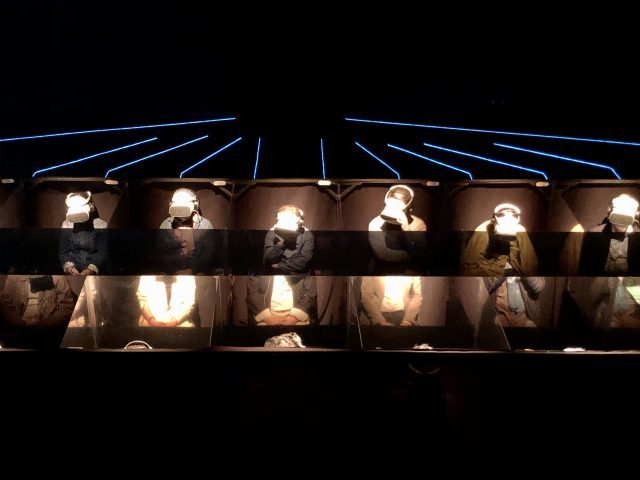
The american vicarious and the Invisible Dog Arts Center follow up their socially distanced Static Apnea with Negative Liberty / Positive Liberty, an immersive performance installation for one audience member at a time. The piece explores Latvian-born British philosopher Isaiah Berlin’s Oxford lecture delivered on Halloween 1958, “Two Concepts of Liberty: Negative & Positive.” while also incorporating Anthony Barboza’s 1966 photograph, Pensacola, Florida, of a neon sign depicting the word Liberty with a broken “E” and dangling “R,” revealing the fragility of freedom, as they both relate to current events. Berlin writes:

“To coerce a man is to deprive him of freedom – freedom from what? Almost every moralist in human history has praised freedom. Like happiness and goodness, like nature and reality, the meaning of this term is so porous that there is little interpretation that it seems able to resist. I do not propose to discuss either the history or the more than two hundred senses of this protean word, recorded by historians of ideas. I propose to examine no more than two of these senses – but those central ones, with a great deal of human history, behind them, and, I dare say, still to come. The first of these political senses of freedom or liberty (I shall use both words to mean the same), which (following much precedent) I shall call the ‘negative’ sense, is involved in the answer to the question ‘What is the area within which the subject – a person or group of persons – is or should be left to do or be what he is able to do or be, without interference by other persons?’ The second, which I shall call the positive sense, is involved in the answer to the question ‘What, or who, is the source of control or interference, that can determine someone to do, or be, one thing rather than another?’ The two questions are clearly different, even though the answers to them may overlap.”

Conceived and directed by Christopher McElroen (Debate: Baldwin vs Buckley, Static Apnea), the installation features performers Sarah Ellen Stephens and Olivia Gilliatt, with scenography by Troy Hourie, video design by Adam J. Thompson, sound by Andy Evan Cohen, and lighting by Lucrecia Briceno. Admission is free to each eight-minute session but must be reserved in advance; slots are already filling up, so you’d best sign up fast. In addition, Barboza is included in the Whitney exhibition “Working Together: The Photographers of the Kamoinge Workshop,” which continues through March 28.

ROMEO Y JULIETA

The Public Theater’s bilingual radio play Romeo y Julieta was rehearsed over Zoom (screenshot courtesy the Public Theater)

Who: Saheem Ali, Lupita Nyong’o, Juan Castano, Alfredo Michel Modenessi, Rebeca Ibarra, more
What: Online premiere listening party for bilingual audio production of Romeo y Julieta
Where: The Greene Space and the Public Theater
When: Thursday, March 18, free with RSVP, 6:45 (stream available for one year)
Why: Unsurprisingly, audio plays have made a comeback during the pandemic, with theaters in lockdown. Keen Company’s Season of Audio Theater has included finkle’s 1993 and Pearl Cleage’s Digging in the Dark, with James Anthony Tyler’s All We Need Is Us up next. Playing on Air, which predated the Covid-19 crisis, has posted such nonvisual works as Cary Gitter’s How My Grandparents Fell in Love, Daniel Reitz’s Napoleon in Exile, Naveen Bahar Choudhury’s Skin, and Dominique Morisseau’s Jezelle the Gazelle, featuring such actors as Julie White, Jesse Eisenberg, Marsha Mason, Ed Asner, Jane Kaczmarek, J. Alphonse Nicholson, and others.

Meanwhile, the Public Theater has presented Anne Washburn’s Shipwreck: A History Play About 2017 as well as the four-part Free Shakespeare on the Radio: Richard II, adapted and directed by Saheem Ali. Ali has now teamed up with playwright Ricardo Pérez González on Romeo y Julieta, a bilingual audio adaptation based Alfredo Michel Modenessi’s Spanish translation of Shakespeare’s heart-wrenching tragedy.

Colorful illustrations by Erick Dávila add visuals to bilingual radio play (courtesy the Public Theater)

The play alternates between English and Spanish; thankfully, you don’t hear every line in both languages, or else the show would be four hours long. However, the Public provides the script on its website so you can follow along and see the full translation. (The website also offers a visual guide to the cast and characters, a bilingual synopsis, colorful illustrations by Erick Dávila, and a trailer.) Presented in conjunction with WNYC Studios and the Greene Space, the radio play premieres on March 18 at 6:45 with much virtual fanfare, kicking off with a preshow greeting and cocktail demonstration (Mezcal Negroni or nonalcoholic Mojito), hosted by WNYC’s Rebeca Ibarra. Then the group listening party starts at 7:00, followed by a live talkback and Q&A with Ali, actors Lupita Nyong’o, who plays Juliet, and Juan Castano, who stars as Romeo, and translator Modenessi, moderated by Ibarra. Everything is free with advance RSVP, but you have to supply your own drinks.

The rest of the cast consists of Carlo Albán as Benvolio, Karina Arroyave as the apothecary, Erick Betancourt as Abram, Michael Braugher as Balthasar, Carlos Carrasco as Lord Montague, Ivonne Coll as the nurse, John J. Concado as Peter, Hiram Delgado as Tybalt, Guillermo Diaz as Gregory, Sarah Nina Hayon as Lady Montague, Kevin Herrera in the ensemble, Modesto Lacen as Prince Escalus and Capulet’s cousin, Florencia Lozano as Capulet, Irene Sofia Lucio as Mercutio, Keren Lugo as Sister Joan, Benjamin Luis McCracken as Paris’s page, Julio Monge as Friar Lawrence, Javier Muñoz as Paris, and David Zayas as Sampson. The original score by Michael Thurber is performed by Jon Lampley on trumpet, Eddie Barbash on alto saxophone, and Mark Dover on bass clarinet; bassist Thurber will also entertain the audience during intermission. The stream of the radio play will be available for one year.

BROADWAY’S BEST SHOWS: SPOTLIGHT ON PLAYS

BROADWAY’S BEST SHOWS
Discounted tickets available through March 21, $49
Streaming begins March 25 (each show available on demand for four days)
www.broadwaysbestshows.com
www.stellartickets.com

Last fall, Broadway’s Best Shows hosted “Spotlight on Plays,” a series of all-star staged virtual readings, taking actors out of Zoom boxes and filming them in more theatrical settings. Among the offerings, for $5 each, were Gore Vidal’s the Best Man with John Malkovich, Morgan Freeman, Vanessa Williams, Zachary Quinto, Phylicia Rashad, Reed Birney, and Elizabeth Ashley; Kenneth Lonergan’s This Is Our Youth with Lucas Hedges, Paul Mescal, and Grace Van Patten; David Mamet’s Race, with David Alan Grier, Ed O’Neill, Alicia Stith, and Richard Thomas; Mamet’s Boston Marriage with Patti LuPone, Rebecca Pidgeon, and Sophia Macy; Anton Chekhov’s Uncle Vanya with Alan Cumming, Constance Wu, Samira Wiley, K. Todd Freeman, and Ellen Burstyn; Donald Margulies’s Time Stands Still with original cast members Laura Linney, Alicia Silverstone, Eric Bogosian, and Brian d’Arcy James; and Robert O’Hara’s Barbecue with Colman Domingo, S. Epatha Merkerson, Tamberla Perry, Kimberly Hebert Gregory, Heather Simms, Laurie Metcalf, Carrie Coon, David Morse, Kristine Nielsen, and Annie McNamara. Sorry you missed that, yes?

Fortunately, Broadway’s Best Shows is now back for another round of online productions, seven plays that can be purchased for $49 total through March 21, after which tickets can be bought individually, at a higher per-show cost. The presentations begin March 25, with each play available for four days. It’s another impressive lineup: Meryl Streep, Bobby Cannavale, Carla Gugino, Mary-Louise Parker, Kevin Kline, Debbie Allen, Ellen Burstyn, Keanu Reeves, Kathryn Hahn, Audra McDonald, Phylicia Rashad, Heidi Schreck, Alia Shawkat, Heather Alicia Simms, Stith, and others will be appearing in Larissa FastHorse’s The Thanksgiving Play, directed by Leigh Silverman (March 25), Pearl Cleage’s Angry, Raucous and Shamelessly Gorgeous, directed by Camille A. Brown (April 9), Lillian Hellman’s Watch on the Rhine, directed by Sarna Lapine, Adrienne Kennedy’s Ohio State Murders, directed by Kenny Leon, Sarah Ruhl’s Dear Elizabeth, directed by Kate Whoriskey, Paula Vogel’s The Baltimore Waltz, directed by Lileana Blain-Cruz, and Wendy Wasserstein’s The Sisters Rosensweig, directed by Anna D. Shapiro. All proceeds go to the Actors Fund, which provides “emergency financial assistance, affordable housing, health care and insurance counseling, senior care, secondary career development, and more . . . to meet the needs of our entertainment community with a unique understanding of the challenges involved in a life in the arts.”