this week in theater

SEEING TRIPLE: TALKING BAND’S LATEST IS ANOTHER AVANT-GARDE MASTERWORK

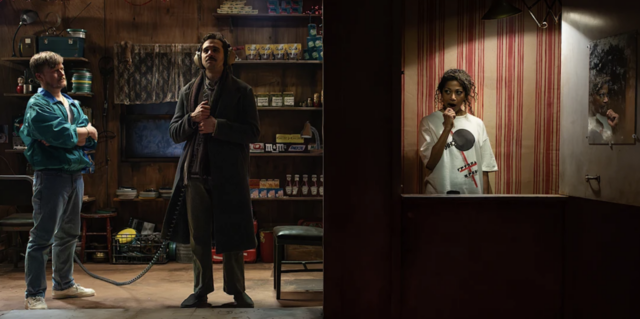
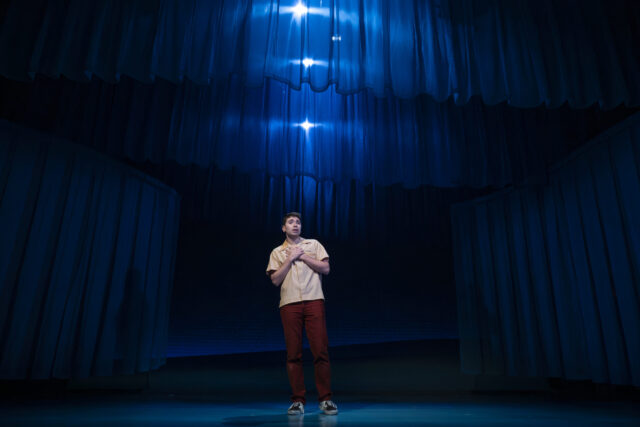
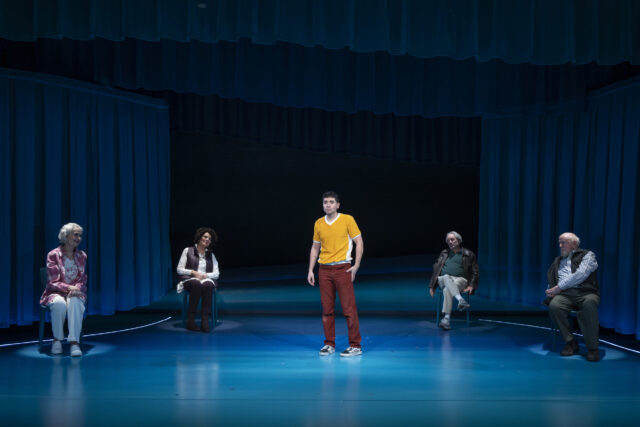
Steven Rattazzi, Amara Granderson, and Lizzie Olesker star as three accidentally interconnected New Yorkers in Triplicity (photo by Maria Baranova)

TRIPLICITY
Mabou Mines@122CC
150 1st Ave. at Ninth St.
Wednesday – Monday through October 26, $30-$40
talkingband.org

I got so mad watching Triplicity, Talking Band’s latest fantastic foray into the experimental and the avant-garde. The legendary downtown troupe was founded in 1974 by Paul Zimet, Ellen Maddow, and Tina Shepard and has presented approximately sixty shows over the years. Embarrassingly, I discovered them only a few years ago and have been blown away by their last five productions but, oh, what I have missed over the decades.

In a program note, director Zimet writes, “I feel Triplicity is a quintessential Talking Band work: It uses music, the music of speech, and choreography to heighten the ordinary and allow us to appreciate it in a new way.” If you’ve never experienced a Talking Band work, then Triplicity is a great place to start. And if you have been to previous TB shows, well, what are you waiting for? Triplicity runs at Mabou Mines@122CC only through October 26.

Triplicity is a truly New York City tale, following the interconnected, overlapping lives of four strangers as they go about their regular, mostly mundane existence in the big metropolis.

Frankie Shuffleton (Lizzie Olesker) is a seventy-something widowed bookkeeper who walks around her Christopher Street block every day at noon, sits on a park bench, and picks up a salad in a plastic container on her way home, where she listens to the news on the radio at seven, catches a police procedural at ten, then goes to bed. In true Beckett fashion, her first words are “There’s nothing to say,” which sharply contrasts with her accidental acquisition of a “talk to me” phone in which people call seeking advice.

Danny Dardoni (Steven Rattazzi) is a fifty-something exterminator who lives in a large Italian household in Bay Ridge, reads the poems of Virgil, and is shocked to learn that there is an enormous beehive in the attic. Danny, who has an innate sense for details, specializes in killing mice and rats and, not necessarily happily, tells us that he “is responsible for the safety and well-being of my family, to provide a home, this house, that is a safe place in a dangerous world.”

Norma Linda Box (Amara Granderson) is a twentysomething wannabe writer with five roommates, four jobs, and a hatred of people saying her name. When she sees a snake on the sidewalk, she takes him home because his blue stripes match a tattoo on her left ankle. “No one has witnessed the event,” she says. “I own it. I can define it. It’s mine to define.”

And Calliope (El Beh) is a street singer who is kind of a Greek chorus in funky, wild clothing, singing songs related to the words and actions of Frankie, Danny, and Norma, picking up on their sound and movement. “Whatever the weather / Calliope sings to whoever will listen / That’s it / That’s it,” she warbles.

As they share their stories, they break out into formalistic dances and roll around on their chairs; the playful choreography by Sean Donovan and Brandon Washington evokes the independence, and loneliness, of so many New Yorkers.

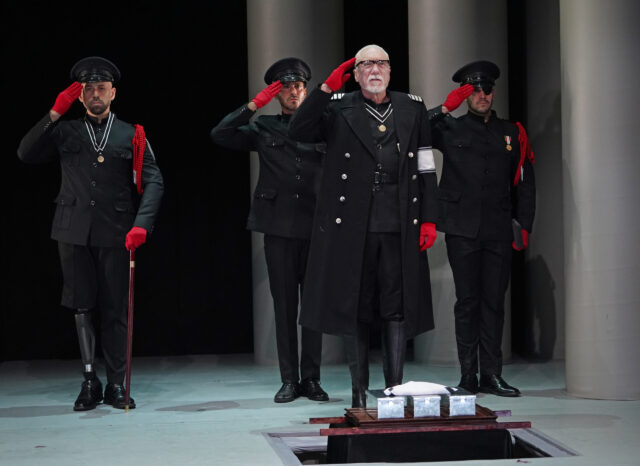
Talking Band’s Triplicity features unique choreography by Sean Donovan and Brandon Washington (photo by Maria Baranova)

In astrology, triplicity is an essential dignity involving a group of three Zodiac signs belonging to one element. That definition fits the show well, as the worlds of three people intersect and become one through the participation of a fourth.

The play begins with Frankie telling her story three different ways, moving her chair and adding more detail each time, a dazzling introduction to how we talk about our lives and share them with others. The concept of numbers is key throughout the seventy minutes, a poetic leitmotif. “Suddenly everything is in two’s!” Frankie declares. Three girls ride scooters. At four, Frankie goes out for coffee. Norma has five roommates and writes six essays. There are seven shards of glass on a blue tile floor. They get ten inches of rain over three days. The barrage of numbers suggests the passage of time, in minutes, hours, days, weeks, months, and years on the journey from birth to death.

Anna Kiraly’s set consists of rolling chairs, doorways with windows on which she projects different color schemes, a mazelike path on the floor, and a corner with special props for Calliope. Olivera Gajic’s costumes feature Frankie in a quaint sweater and skirt, Danny in a white T-shirt and sneakers, Norma in blue-jean overalls and wearing a red bandanna, and Calliope in a series of wildly adorned outfits.

Triplicity is written and composed by Ellen Maddow and directed by Paul Zimet, the incomparable married team who have been collaborating as writer, director, composer, and/or actors for half a century, including on Talking Band’s recent surge of endlessly compelling and engaging works, which have made me nearly weep with joy as the company continues to push the limits of what theater can be: Shimmer and Herringbone at Mabou Mines, Existentialism and Lemon Girls or Art for the Artless at La MaMa, and The Following Evening at PAC NYC.

In Triplicity, they capture the essence of New York City, the heart and soul of everyday people, the music and energy, divided into such chapters as “Adagio,” “Allegretto,” and “Scherzo,” resulting in a beautiful mini-symphony performed by a magical quartet.

[Mark Rifkin is a Brooklyn-born, Manhattan-based writer and editor; you can follow him on Substack here.]
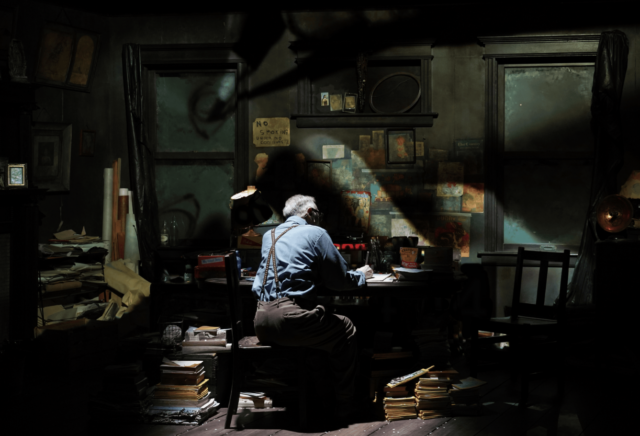
NOTHING TO SAY OR DO? A SAMUEL BECKETT HAT TRICK IN NEW YORK

Keanu Reeves and Alex Winter star in Broadway smash version of Samuel Beckett’s Waiting for Godot (photo by Andy Henderson)

WAITING FOR GODOT
Hudson Theatre
141 West Forty-Fourth St. between Sixth & Seventh Aves.
Tuesday – Sunday through January 4, $98.56-$558.88
godotbroadway.com
www.thehudsonbroadway.com

“There’s nothing to do,” Vladimir tells Estragon in Samuel Beckett’s 1953 masterpiece Waiting for Godot.

There’s plenty to do for Beckett fans in New York City right now, much but not all of it a most excellent adventure.

The talk of the town is Keanu Reeves and Alex Winter reprising — well, channeling? — their roles from 1989’s Bill & Ted’s Excellent Adventure and the 1991 and 2020 sequels in Godot at the Hudson Theatre. Action star Reeves is making his Broadway debut as Estragon (Gogo) in Jamie Lloyd’s bumpy adaptation, while Winter returns to the Great White Way for the first time in forty-four years as Vladimir (Didi).

Reeves and Winter follow in the formidable footsteps of such duos as Michael Shannon and Paul Sparks, Ian McKellen and Patrick Stewart, and Robin Williams and Steve Martin and, for the most part, hold the audience’s attention. Gogo and Didi usually find themselves in a strange, dark wasteland, with only a single bare tree, a country road, and a solitary stone as they contemplate life and death, heaven and hell, and existence and humanity, but Lloyd and set designer Soutra Gilmour locate them inside a giant tube that is part tunnel, part circular skateboard ramp, part existential void in space. Resembling abandoned vaudevillians in all black, sporting impressive bowlers (the costumes are also by Gilmour), they sit at the edge of the tube, feet dangling, waiting for the mysterious Godot to arrive and, perhaps, bring meaning to their sad, pathetic lives.

They are visited instead by the loud, blustery Pozzo (Brandon J. Dirden) and his menial, an apparent servant named Lucky (Michael Patrick Thornton). Pozzo usually leads Lucky around by a rope around his neck — evoking master and slave, circus ringleader and animal performer while referencing the rope Gogo had mentioned earlier when he and Didi considered hanging themselves — but here Lloyd has the verbally abusive Pozzo pushing Lucky, who is in a wheelchair, altering their dynamic. Curiously, Lucky breaks the fourth wall several times, acknowledging the audience and encouraging them to clap after he does his dance (with his head and hands). In addition, a young boy (Eric Williams or Zaynn Arora) shares important information with Gogo and Didi.

Lloyd (A Doll’s House, Sunset Blvd.) has slimmed down the show to just over two hours including intermission, so the pacing works well. Lloyd’s decision to get rid of nearly all the usual props, including a key carrot that Gogo chews in an annoying manner, seems like overkill. There’s a perpetual droning hum of doom hovering over the proceedings (the sound is by Ben and Max Ringham), contrasting Jon Clark’s subtle lighting shifts, highlighted by dazzling surprises at the end of each act.

Reeves and Winter may not display a wide range of emotions, but they avail themselves well enough to keep the audience engaged. At one point Didi says, “This is not boring you I hope,” looking out at us, and we essentially answer no.

Bill and Ted enthusiasts may whoop when Gogo says, “Back to back like in the good old days,” and the two actors stand back to back and play air guitar, echoing what they do in the film series, but the reference feels out of place in a show that exists in a barren emptiness and is about nothing (and everything).

“The only true wisdom consists in knowing that you know nothing,” Bill says in the first movie, quoting Socrates. Ted responds, “That’s us, dude.”

Party on, dudes!

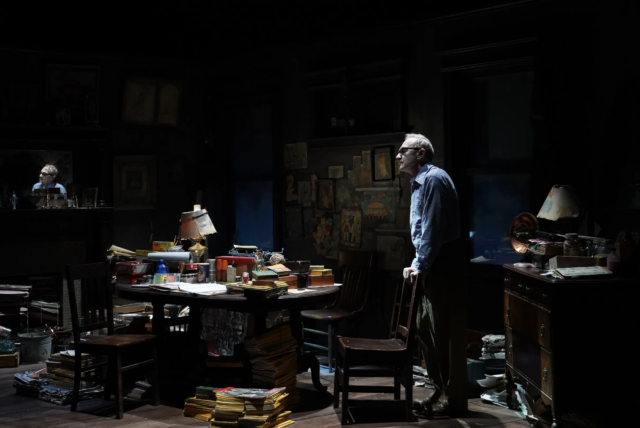
Stephen Rea is mesmerizing as a man listening to his past in Krapp’s Last Tape (photo courtesy Patricio Cassinoni)

KRAPP’S LAST TAPE
NYU Skirball Center for the Performing Arts
566 La Guardia Pl.
Through October 19, $83-$130
nyuskirball.org

“Nothing to say,” an old man declares in Samuel Beckett’s 1958 autobiographical classic, Krapp’s Last Tape, a fascinating kind of companion piece to Waiting for Godot.

In 2012, Irish actor Stephen Rea decided to go into a studio and perform the prerecorded sections of Krapp’s Last Tape, in case he was ever asked to do the one-man show, in which a dissatisfied man listens to tapes his younger self made thirty years before. Rea is now touring the play, which continues at the NYU Skirball Center through October 19.

Jamie Vartan’s spare set features a desk in the center, an overhead hanging light, and a door at the back, stage right. Paul Keogan’s shadowy lighting maintains an old-fashioned vaudeville black-and-white feel. The past is present in both Vicky Featherstone’s taut staging and the theme of the play.

The show begins with Krapp slowly opening a hilariously long drawer and removing a banana. He eats the fruit — the yellow of the banana stands out from the otherwise colorless gloom — and tosses the peel onto the floor, where, of course, he soon slips on it. He does not make the same mistake twice.

To celebrate his birthday, he is going to listen to one of his old reel-to-reel tapes, the one he made when he turned thirty-nine, discussing his life. He brings in the machine and a stack of tapes, carefully searching for box three, spool five, taking great delight in saying the word “spool” over and over again. “Thirty-nine today, sound as a bell, apart from my old weakness, and intellectually I have now every reason to suspect at the . . . crest of the wave — or thereabouts,” he listens to his old self explain. “Good to be back in my den, in my old rags. Have just eaten I regret to say three bananas and only with difficulty refrained from a fourth. Fatal things for a man with my condition. Cut ’em out! The new light above my table is a great improvement. With all this darkness round me I feel less alone. In a way. I love to get up and move about in it, then back here to . . . me. Krapp.”

Not much has changed in those thirty years; his loneliness in the darkness is palpable. He looks up the meaning of “viduity,” sings, and recalls a romantic evening on a lake. But the tape does not provide him with happiness; he barks out, “Just been listening to that stupid bastard I took myself for thirty years ago, hard to believe I was ever as bad as that. Thank God that’s all done with anyway.”

What’s next? Well, the play’s French title is La Dernière Bande, or “The Last Tape.”

Krapp’s Last Tape has previously been performed by such actors as Patrick Magee, Harold Pinter, Brian Dennehy, and Michael Gambon; I’ve seen it with John Hurt at BAM and, earlier this year, F. Murray Abraham at the Irish Rep. The play, a haunting examination of time, memory, and the futility of language, works best in more intimate quarters; it gets a bit lost at the Skirball, even at only about fifty minutes.

Rea (A Particle of Dread, Cyprus Avenue) inhabits the character with a graceful elegance despite Krapp’s pathetic, sad-sack circumstances, at times recalling Buster Keaton, one of Beckett’s favorites. It’s a bravura performance that I would have loved to see in a significantly smaller venue.

Druid production of Samuel Beckett’s Endgame comes to Irish Arts Center for monthlong run (photo by Ros Kavanagh)

ENDGAME
Irish Arts Center, JL Greene Theatre
726 Eleventh Ave. between Fifty-First & Fifty-Second Sts.
October 22 – November 23, $25-$86
irishartscenter.org

“Nothing is funnier than unhappiness,” Nell tells Nagg in Samuel Beckett’s 1957 chess-inspired Endgame, which takes place during some kind of apocalypse as four characters contemplate their fate in a dingy basement dungeon, two of them living in garbage cans.

In a conversation in the Skirball program for Krapp’s Last Tape, Stephen Rea tells director Vicky Featherstone and Dr. Tanya Dean, “Endgame is a tough thing. I remember Beckett saying he loved Endgame, and he didn’t like Waiting for Godot. And I said, ‘Well, it’s been absorbed.’”

Rea played Clov in the 1976 Royal Court production of Endgame; I’ve seen the show twice, in 2008 at BAM with Max Casella, Alvin Epstein, Elaine Stritch, and John Turturro, and in 2023 at the Irish Rep with John Douglas Thompson, Bill Irwin, Joe Grifasi, and Patrice Johnson Chevannes. From October 22 through November 23, Galway’s Druid theater company will be presenting Endgame at the Irish Arts Center, with Tony winner Marie Mullen, Bosco Hogan, Aaron Monaghan, and Rory Nolan, directed by Tony winner Garry Hynes. As with Soutra Gilmour’s set for Waiting for Godot on Broadway, Francis O’Connor’s scenic design for Endgame also emphasizes the circularity of life.

Monaghan, who plays Clov, previously starred as Estragon opposite Marty Rea (no relation to Stephen) in Druid and Hynes’s Waiting for Godot at Lincoln Center’s 2018 White Light Festival. Hynes also helmed a stunning Richard III starring Monaghan in 2019 as well as The Beauty Queen of Leenane at BAM in 2017, with Marty Rea and Mullen.

Endgame is part of Druid’s fiftieth anniversary celebration. In the play, Clov shouts, “The end is terrific!” But luckily for theatregoers, the end appears to be nowhere in sight for Druid, or for seeing Beckett in New York.

[Mark Rifkin is a Brooklyn-born, Manhattan-based writer and editor; you can follow him on Substack here.]
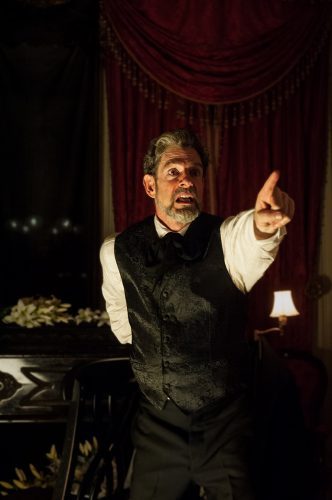
STRAPPING IT ON: (UN)CONDITIONAL AT SOHO PLAYHOUSE

Valerie (Kate Abbruzzese) and Kyle (Brooks Brantly) face marital difficulties as Mia (Georgia Waehler) watches in (un)conditional (photo by Russ Rowland)

(UN)CONDITIONAL
SoHo Playhouse
15 Vandam St. between Varick St. & Sixth Ave.
Wednesday – Monday through October 26, $41-$72
www.sohoplayhouse.com

Ali Keller’s (un)conditional is an awkward, uncomfortable theatrical experience that will have you squirming in your seat, but not in a good way.

The ninety-minute play, continuing at SoHo Playhouse through October 26, is a decidedly adult look at sexual fantasy involving two couples. For their tenth anniversary, Valerie (Kate Abbruzzese) has convinced Kyle (Brooks Brantly) to participate in a robber-rapist role-play scenario in order to reinvigorate their love life, but when she reveals herself wearing a purple strap-on dildo and tells him what she wants to do with it, he freaks out. It gets even more complicated when they discover that their seven-year-old daughter, Mia (Georgia Waehler), has been listening at the door.

Valerie and Kyle have a brutal fight about each other’s needs, Valerie explaining that she has been feeling neglected for a long time. “You could’ve just told me you felt like that. You didn’t need to do all this. You are more than a bunch of holes, Val,” Kyle explains, holding her hand. Valerie replies, “I know.” Kyle clarifies, “I mean to me. You are more than a bunch of holes to me.” Valerie rips her hand away and declares, “This is not about you. It’s about me and something I want.”

In another part of town, Lenox (Annalisa Chamberlin) is making steak and potatoes for her husband, the somewhat older Hank (Nathan Darrow), in order to reinvigorate their love life and have children. “Even though I don’t like steak and potatoes as much as you like steak and potatoes, I know that you’ll get that look on your face where you’re all excited, and I know you’ll enjoy yourself and it makes me like steak and potatoes more than I normally would,” she says demurely, slyly letting him know that she will do everything she can to get him back in the sack, which he has been avoiding like the plague.

Valerie decamps to her parents’ house for a while; when Kyle takes Mia to the store to buy Halloween costumes, they bump into Lenox, Kyle’s coworker, and Hank, who quickly bonds with Mia. Behaving like a whiny brat, Mia insists that her father get her a pretzel — a metaphor for the twisted relationships becoming apparent among the five characters — but when she acts out, Hank puts on a magician outfit and magically makes the obnoxious girl happy.

He also makes himself happy; after Kyle and Mia leave, Lenox says to Hank, “Maybe we don’t need miracles. I told you role play would work. Let’s get the magician costume.”

Eventually everyone comes together at one of the most absurd New Year’s Eve parties ever, featuring a plot twist that elicited an enormous groan from the audience the night I went.

Lenox (Annalisa Chamberlin) and Hank (Nathan Darrow) face marital difficulties in (un)conditional (photo by Russ Rowland)

The ninety-minute (un)conditional is about as icky a show as I’ve seen for quite some time. There are a few good moments — the early dildo scene is poignant and hilarious — but director Ivey Lowe is unable to smooth out the bumps, both in the narrative, which ranges from ridiculously silly to darkly serious as it jumps from holiday to holiday, and the constant set changes, as white furniture is transformed between beds and couches while interstitial music shifts from cool rocking guitar and bass to more maudlin instrumentals. Given the uneven dialogue, the cast does what it can, although Waehler, who is twenty, portrays Mia in a ceaselessly annoying manner.

Winner of SoHo Playhouse’s 2024 Lighthouse Series for emerging talent in New York City, (un)conditional gets off to a rousing start but goes limp too soon and never recovers its mojo.

[Mark Rifkin is a Brooklyn-born, Manhattan-based writer and editor; you can follow him on Substack here.]
QUEENS IN THE HOUSE: SATURDAY CHURCH AT NYTW

Ulysses (Bryson Battle) finds himself living a double life in Saturday Church (photo by Marc J. Franklin)

SATURDAY CHURCH
New York Theatre Workshop
79 East Fourth St. between Second & Third Aves.
Tuesday – Sunday through October 24, $63-$129
www.nytw.org

Tony winner J. Harrison Ghee is glorious as Black Jesus in the world premiere of Saturday Church at New York Theatre Workshop. The same cannot be said for the rest of the show.

Adapted by Emmy nominee Damon Cardasis from his 2017 film — he has written the book and additional lyrics with Pulitzer winner and Tony nominee James Ijames — Saturday Church feels like something you’ve already seen, Choir Boy filtered through Cats: “The Jellicle Ball” with a heavy dash of The Voice and RuPaul’s Drag Race and a touch of Godspell. Which is to say, there is little new to the story or the production.

Boston Conservatory graduate Bryson Battle makes his professional debut as Ulysses, a teenager grappling with his sexuality shortly after his father’s untimely death. At church, he prays for his mother, Amara (Kristolyn Lloyd), and wishes he could join the choir, where his father excelled, but his aunt Rose (Joaquina Kalukango) thinks he’s “too much.” Ulysses says, “I see the way she looks at me and the way people talk . . . But I feel completely free when I’m singing in church. I just wish I could fit in . . . oh, and I’d love a Gucci belt. Thanks.”

While Amara works crazy hours at the hospital in order to pay the rent and put food on the table, Aunt Rose babysits him and worries that he is too “flouncy.” Ulysses expresses his frustration with his aunt but Amara just says, “I don’t have time for this. You two figure it out.”

Aunt Rose takes the matter up with Pastor Lewis (Ghee), who agrees with her, telling Ulysses, “We expect the men in the choir to comport themselves in a righteous way, like your dad. And I think some of your flamboyance might be distracting.”

On the subway, Ulysses meet-cutes Raymond (Jackson Kanawha Perry), a confident young man who suggests that he come to Saturday Church, where “everyone’s welcome. Gay. Queer. Trans. Straight kids that like queer kids, kids that just want a meal, and kids with no place to live. That’s me.” Ulysses is clearly considering Raymond’s invitation but is not ready to admit that he might be one of them.

At the Christopher Street Pier, Ebony (B Noel Thomas), who runs Saturday Church and is mourning the loss of her close friend Sasha, is dancing at a wild gathering with Heaven (Anania) and Dijon (Caleb Quezon). Dijon suddenly cries out, “Yes, Ebony! Let loose. Just because Sasha died doesn’t mean we have to!” Everyone stops and Heaven says, “Girl. You have the worst timing.” An angry Ebony declares, “You keep living it up, but I’m gonna warn you. Life ain’t a fucking party and by the time you figure that out, shit might be too late. Step up. ’Cause I’m done.” Ebony leaves Saturday Church, placing the much-less-competent Heaven and Dijon in charge.

After being lectured to by Pastor Lewis and getting bullied by classmates on the subway, Ulysses is visited by the majestic Black Jesus, who shows off their fabulous shoes and instills in Ulysses the confidence to contact Raymond and join him at Saturday Church, a kind of makeshift space by the pier. Ulysses is blown away by what he sees, people in outrageous clothing, singing, dancing, rejoicing in being themselves — and making him feel included.

As the Saturday Church ball approaches and Aunt Rose and Pastor Lewis want him to help with the Saturday night youth group, Ulysses finds himself caught in the middle, wanting to please both his family and his new friends while no longer hiding who he is.

“Living a double life takes a toll,” Black Jesus advises him.

Music and passion are always in fashion at New York Theatre Workshop world premiere (photo by Marc J. Franklin)

Saturday Church is “too much” — but not in the way Aunt Rose meant. At 140 minutes (with intermission), it is too long and too repetitive, overloaded with too many songs (by Sia and DJ Honey Dijon). Clichés abound throughout as the show tries to figure out just what it is, going over the top in attempting to present the story of a teenager, named after the hero of Homer’s Odyssey, trying to figure out who he is.

The diverse cast cuts loose, but Battle is too static in the lead role, his transformation lacking dramatic impact. Inspired by a St. Luke in the Fields program for at-risk LGBTQ youth, the show panders to the audience in self-celebration; it’s more a party than a play, and judging by the enthusiastic crowd the night I went, that’s enough for many. “Are there any queens in the house?” Black Jesus asks, to rapturous applause.

Qween Jean’s costumes are dazzling, David Zinn’s set brings a welcoming intimacy to the proceedings, Adam Honoré’s lighting and Gareth Owen’s sound are appropriately flashy, and Darius Thomas’s hair and wigs are fab, but the festivities run out of surprises too quickly as Cardasis, Ijames (Fat Ham, Good Bones), and director Whitney White (Jaja’s African Hair Braiding, Macbeth in Stride) focus on style instead of substance, preaching to the choir.

At one point, just as Ulysses is about to admit that he is gay, Black Jesus tells him, “I’ll advise but you got free will, baby.”

If only Saturday Church felt the same about its audience.

[Mark Rifkin is a Brooklyn-born, Manhattan-based writer and editor; you can follow him on Substack here.]
BRINGING THE OUTSIDE IN: WEATHER GIRL AT ST. ANN’S

Julia McDermott plays a TV meteorologist on the edge in Weather Girl (photo by Emilio Madrid)

WEATHER GIRL
St. Ann’s Warehouse
45 Water St.
Through October 12
stannswarehouse.org

Julia McDermott is mesmerizing as a Fresno morning show meteorologist desperate to find shelter from the storm in Brian Watkins’s Weather Girl, continuing at St. Ann’s Warehouse through October 12.

“People always said I was destined to become a weather girl . . . That I always ‘had that look.’ I think it might’ve been more that I had a crippling fear of being killed by an act of god,” KCRON’s Stacey Gross (McDermott) says as the solo show begins. She talks about how she has to get up at 4:00 for her job, a time at which, someone once told her, according to the Bible, “sin enters the world. . . . And at a quarter past four you feel all the destroyed things swimming around in the dark and when you do the weather here in California you can sometimes feel the devil’s breath right at your earlobe.”

Standing in a cramped TV-studio green-screen setup with lights and microphones, dressed in a low-cut red blouse, supertight pink skirt, and heels (the costume is by Rachel Dainer-Best), Stacey explains the reason why she thinks we are all here: “to bring the inside outside.” And for the next seventy minutes, she spills her guts, literally and figuratively, in hilarious and heart-wrenching ways.

In her cheery on-air disposition, she reports from the field on the Coalinga wildfire, focusing on a specific house burning in a cul-de-sac, noting that the “wildfire hopped the freeway at 4 am.” Lifting up her ever-present Stanley Quencher, she declares to the anchors in the studio, “They need a few more of these out here!” But it’s not water in the giant cup; she’s drinking Prosecco.

She’s devastated when she learns the next day that a family of five and their two dogs perished in that house fire; moments later, Jerry, the station manager, tells her she is being promoted to the Phoenix gig, a move she is not happy about. “Fuck you, Jerry,” she responds several times, although she is not sure if she actually said it out loud. As her colleagues congratulate her, she says/thinks, “Fuck you guys I’m gonna murder you guys.”

Stacey explains to the audience that the reason she does the weather is because “there’s some things you can’t change,” referring primarily to her difficult childhood with foster parents because her mother, Magdalena, preferred drugs to a house, but also alluding to global warming and environmental disaster. She hasn’t seen her mom, who is homeless, in a while, but wonders how she is doing, “if she’s out there somewhere dying of thirst and heat and smoke.” The California drought serves as a constant metaphor for her life, which is devoid of family, friends, or a significant other. Instead, she has cheap sex with a man she meets online, never bothering to learn his name while getting loaded on wine during a wild night that does not end well.

She does find her mother, who asks her, “Have you said things you didn’t intend to say? Are you always thirsty?” letting her know that she likely has inherited a magical power from her as Magdalena talks about Moses parting the Red Sea and Jesus performing miracles involving water.

But when Stacey asks her mother to teach her, things start getting really weird.

Weather girl Stacey Gross (McDermott) is concerned about climate change and more at St. Ann’s Warehouse (photo by Emilio Madrid)

Winner of a Fringe First Award in Edinburgh, Weather Girl is directed with a fiery fury by Tyne Rafaeli (Becoming Eve, The Coast Starlight), occasionally going over the top as Watkins’s (Epiphany, Evergreens) otherwise tight script goes too far a few times, especially in an overwrought on-air confession. Isabella Byrd’s set and lighting keep it all intimate; curiously, the sound, by Kieran Lucas, features Stacey at the same vocal level whether she uses a microphone or doesn’t.

McDermott (Heroes of the Fourth Turning, Orpheus Descending) expertly portrays the pathos and bathos of Stacey and her mixed-up life, turning the stereotype of the beautiful blond ditzy weather girl on its head. Stacey is a complex woman whose insides are drying out as her exterior continues to be celebrated on its slick surface, even as she falls apart.

But at the center is the miracle of water, which makes up between sixty and seventy percent of the human body and about seventy-one percent of the planet; without water, everything would die.

“Water does not resist. Water flows. When you plunge your hand into it, all you feel is a caress,” Margaret Atwood writes in The Penelopiad. “Water is not a solid wall, it will not stop you. But water always goes where it wants to go, and nothing in the end can stand against it. Water is patient. Dripping water wears away a stone. Remember that, my child. Remember you are half water. If you can’t go through an obstacle, go around it. Water does.”

Words to live by, for Stacey and the rest of us as we watch the world burn.

[Mark Rifkin is a Brooklyn-born, Manhattan-based writer and editor; you can follow him on Substack here.]
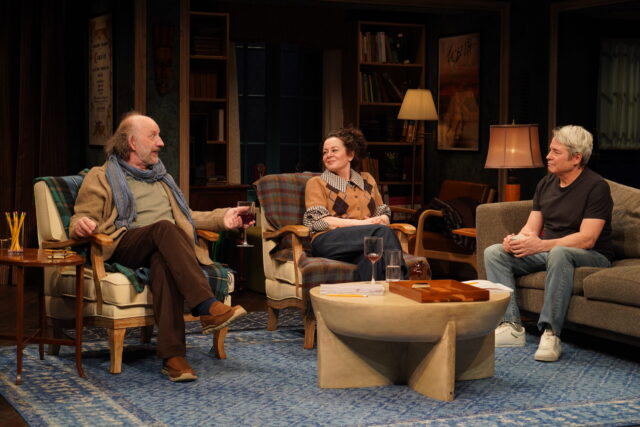
THEATER ISN’T EASY: SUBSTACK COMES TO LIFE AT THE COFFEE HOUSE

Who: Sara Farrington, Jocelyn Kuritsky, Tony Torn, James Scully
What: Live performance, talkback, and dinner
Where: The Salmagundi Library at the Coffee House Club, 47 Fifth Ave. between Eleventh & Twelfth Sts.
When: Wednesday, October 8, free with advance RSVP (a la carte dinner to follow), 6:30
Why: Back in May, Sara Farrington came to the Coffee House Club to discuss her work during a cozy Friday lunch. The playwright and author will be back on October 8, in the Salmagundi Library, for the latest installment of “Breaking the Audio Fiction Form.” Joined by actor and creator Jocelyn Kuritsky (A Simple Herstory) and actor and director Tony Torn (Paul Swan Is Dead and Gone), Farrington will perform several pieces from her fast-growing, no-holds-barred Substack Theater Is Hard, in which she waxes poetic about independent, experimental, and unconventional theater in a way that is “half–Socratic dialogue, half-manifesto.” The performance will be followed by a brief talkback moderated by actor, writer, and director James Scully (Breaking Walls).

“Sara is a cool fit for this series because breaking the audio fiction form means just that — pushing its boundaries and blending it with other mediums,” Kuritsky told twi-ny. “Her work spans both theater — as a playwright and Substack writer — and audio, as a performer. She offers an informed perspective on the current challenges facing theater and has a unique take on how audio can, does, and could further intersect with it.”

Jocelyn Kuritsky, Sara Farrington, and Tony Torn team up for latest edition of “Breaking the Audio Fiction Form” on October 8

Farrington has collaborated with her husband, Reid, on such multimedia productions as BrandoCapote, CasablancaBox, and The Return while also writing her own plays, including A Trojan Woman, Mickey & Sage, and the forthcoming musical Dr. Uncanny Presents: Moreau ’96, about the making of the infamous 1996 horror disaster The Island of Dr. Moreau. She is also the author of The Lost Conversation: Interviews with an Enduring Avant-Garde, in which she speaks with such legends as Richard Foreman, André Gregory, David Henry Hwang, Bill T. Jones, Adrienne Kennedy, Mac Wellman, and Robert Wilson.

Admission to this first-ever live edition of Theater Is Hard is free with advance RSVP; the evening will conclude with an à la carte dinner with the participants.

[Mark Rifkin is a Brooklyn-born, Manhattan-based writer and editor; you can follow him on Substack here.]
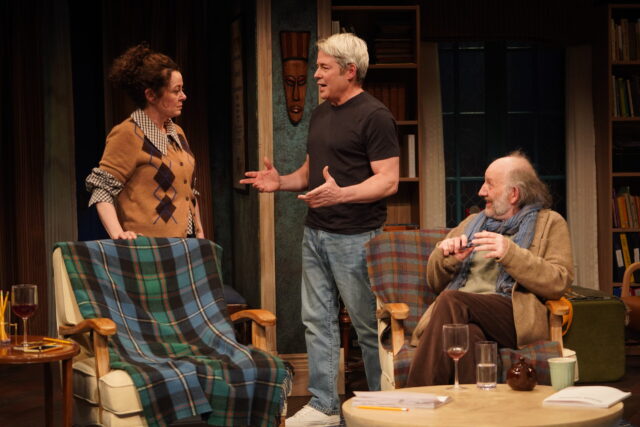
THE MEXICAN EXODUS: A HIP-HOP TALE OF SLAVERY AND FREEDOM

Nygel D. Robinson and Brian Quijada wrote and star in Mexodus (photo by Curtis Brown)

MEXODUS
Audible’s Minetta Lane Theatre
18 Minetta Lane between Sixth Ave. and MacDougal St.
Monday – Saturday through November 1, $56.50-$120.50
mexodusmusical.com
www.audible.com

Between 1829 and the end of the Civil War, several thousand American slaves escaped to Mexico, a kind of Underground Railroad that headed south instead of north, though without the same organized support system. Brian Quijada and Nygel D. Robinson have adapted that story into Mexodus, an exhilarating, funny, and passionate must-see two-person musical that has been extended through November 1 at Audible’s Minetta Lane Theatre.

“Did you know this shit? / We didn’t know this shit!” they declare early on. “In eighteen forty-eight it was America that won the war. / Ten territories from Mexico / Including the behemoth of Texas, yo! / And what would that land be used for? / Oh lord! To pick a bale of cotton / And what was slaves’ most common chore? / To jump down, turn around, and pick a bale a day. / Cotton: America’s original sin / And it’s then and there where our story begins.”

Quijada and Robinson switch between portraying versions of themselves, speaking directly to the audience in the present day, and two tough men from the pre–Civil War era. They also play all the instruments — guitars, keyboards, standup bass, harmonica, accordion, drums, percussion, triangle — creating live loops by recording snippets of music, then layering them electronically so it often sounds like there’s a full band in the theater while allowing them to act with their hands and feet free.

Henry (Robinson) is a Black man who has escaped from a brutal incident on the Texas plantation where he was enslaved, while Carlos (Quijada) is a former Mexican army medic and deserter overwhelmed by guilt, now working on a farm in la Frontera, which he describes as “la mitad — the middle. No laws, no lines, tierra descontrolada,” evoking a kind of middle passage.

Carlos found Henry washed up on the shore of the Rio Grande and is nursing him back to health. Henry is suspicious of Carlos; when Henry asks if it’s safe there, Carlos responds, “It’s not safe anywhere,” adding that he’s seen many “gringos” in the area hunting down runaways.

Both men are in vulnerable positions, alone and on their own, so they’ll need to help each other if they are going to survive while battling the elements and worrying about the slave hunters.

Brian Quijada and Nygel D. Robinson play all the instrument in historical loop musical (photo by Curtis Brown)

Quijada and Robinson met at a conference in February 2020 and decided to team up for the show, which was inspired by a Facebook post Quijada saw in 2017 and is named after this little-known Mexican exodus. The story of how the two strangers came to team up runs parallel to the relationship fostered between Carlos and Henry, who are composites of real figures, bonding through different aspects of looping. During the musical, Quijada and Robinson each share a tale from their childhood involving racism, love, and sacrifice. Robinson, honoring three generations of women in his family, says, “I don’t think I’m their wildest dreams because where we’re from, you don’t get to dream like this.” Quijada, describing a frightening instance of racial profiling at a gas station, explains, “We are taught to separate, we are taught to stick to our own, / Taught how to protect our homes. / We are given reasons to fight and start wars. / But what if / What if / What if we weren’t so quick to lock our doors.”

Director and costume designer David Mendizábal (Tell Hector I Miss Him, the bandaged place) expertly blends the multilayered narrative with Mextly Couzin’s lighting, Mikhail Fiksel’s looping and powerful sound, Johnny Moreno’s live projections, and Tony Thomas’s movement choreography on Riw Rakkulchon’s barn set, which includes multiple platforms, doors at either end, a DJ table at the top, and a rear wall of lights and speakers.

Robinson and Quijada, who wrote the book, music, and lyrics, are magnetic as they move across the stage and pause for emotional interludes. The score is influenced primarily by Hamilton, but in this case hip-hop interlaced with country and the blues. Their apprehension is palpable every step of the way — not just as Henry and Carlos but as themselves, Black and brown men in a nation that is rounding up nonwhite people ever more frequently and violently. When the law comes knocking at the barn door, it is hard not to think about what ICE is doing to legal and illegal immigrants — and citizens — in America.

“We’re all in this together,” Henry says. Echoing his words in Spanish, Carlos replies, “Todos estamos juntos en esto.” Henry responds, “Whoa, slow that down.”

The message of Mexodus is clear: We are all in this together — and this is no time to slow down.

[Mark Rifkin is a Brooklyn-born, Manhattan-based writer and editor; you can follow him on Substack here.]