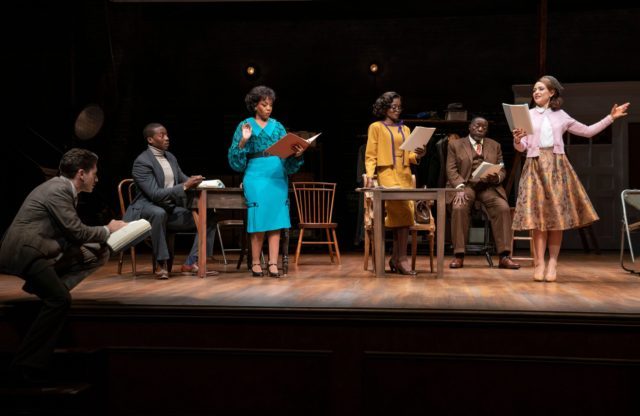
this week in theater

NI MI MADRE

Stephanie Osin-Cohen’s set design is a highlight of new play at Rattlestick (photo by Andrew Soria)

NI MI MADRE
Rattlestick Playwrights Theater
224 Waverly Pl. between Eleventh & Perry Sts.
Tuesday – Sunday through September 19, $40
866-811-4111
www.rattlestick.org

“Gender’s confusing in our family,” Bete (pronounced “BET-chi”) says in Arturo Luís Soria’s one-person show, Ni Mi Madre, performed live at Rattlestick and streaming online through September 19. In the sixty-minute play, writer-star Soria portrays his domineering Brazilian mother, zeroing in on their complicated relationship.

Ni Mi Madre, which means “not (or “nor”) my mother,” begins with Soria, in a long white gown (by Haydee Zelideth) that bares his hirsute chest, walking onstage carrying a row of ritual candles and flowers. He puts the objects down carefully and pulls the top of the dress over his chest and voilà, he is now his mother. He spends the remainder of the show acting and speaking like her as she discusses life and love, family and children, with a particular focus on her queer Latino son, Arturo.

“You know, he had the right idea going gay,” she says. “I just don’t think he executed it properly, because when he came out . . . He. Came. Out! I mean, it was like the Fourth of July on New Year’s, okay. Then he tells me he’s not just gay, he’s bisexual. So I say, ‘Listen, bisexuals are greedy, okay. The world is gay and it’s straight; it’s black and it’s white; it’s in and it’s out, so figure it out.’”

Arturo Luís Soria portrays his mother in one-person show (photo by Andrew Soria)

Elegant and proud, Bete talks about her three marriages, to Inebriated Jew, Ecuadorian Commie, and Gay Dominican; how it’s okay for her to beat her children; her dedication to Meryl Streep; and her own difficult mother. “My mother never wanted to be a mother. Never,” she explains. “You only get one mom. And my mother didn’t want me.” However, she’s not seeking sympathy but instead defends her treatment of her children.

“My kids don’t know how lucky they are to have a mother like me. I am their inspiration and they don’t even know it and I went through a lot of trouble to raise them,” she says. “I was a good mother to them. And I never abandoned them nor shipped them off to boarding school. I thought about it. Arturo was such a maniac as a kid I used to pray to God that he would go to sleep and not wake up until college, but those were only empty prayers. Kind of. Arturo thinks I was a bad mother to him. I wasn’t bad. He was a fuckin’ lunatic.” She might be harshly critical of him, but she also loves and supports him. “He’s following his dreams,” she adds. “He’s doing what I always wanted but never could because I didn’t have a mother like me.’

The night I saw the show, it was followed by a talkback with Soria and director Danilo Gambini (The Swallow and the Tomcat, An Iliad), a native Brazilian who has been working with Soria on the play since their Yale days going back to 2017 (in addition to other collaborations); Soria began writing Ni Mi Madre in 2008, and it has gone through numerous iterations before opening in New York City on August 25, when Soria’s mother was present in the audience. The postshow discussion lent further insight into mother and son, especially how the latter came to better understand and humanize the former through forgiveness and love as the play developed and he grew in the role. (There will be a free Zoom community conversation with Soria, Gambini, and Sam Morreale on September 2 at 5:00, and if you bring your own mother to the play, you can use code HIMOM to get her in for free September 2-6.)

The show, which features songs by Cher, Cyndi Lauper, Gloria Estefan, and Maria Bethania, lip-synced in drag finery by Soria, takes place on Stephanie Osin-Cohen’s gorgeous stage, a kind of shrine room with ritual objects, including candles galore, a bedecked vanity, and a large depiction of Iemanjá, the Umbanda (Candomblé) goddess of the sea, protector of fishermen and pregnant women — and who looks suspiciously like Cher. The floor is patterned like an Ipanema sidewalk of twisting black-and-white designs in the style of Roberto Burle Marx, which was highlighted in 2019 at the New York Botanical Garden. The walls are “persuasive papaya,” as Bete believes that “you have to paint the colors of your walls something that has to do with suggestive foods.” Krista Smith’s lighting shines brightly on Soria and casts long shadows on either side of the stage in one scene when Bete confronts her own parents.

Bold and barefoot, Soria (The Inheritance, Hit the Wall) fully inhabits the character of his mother. Too many of the lines fall flat and it can feel a bit repetitive even at only an hour, but Ni Mi Madre is a potent and poignant observation of first-generation immigrants, queer Latinidad, and the importance of family, despite the headaches.

“No matter how hard I try / You keep pushing me aside / And I can’t break through / There’s no talking to you,” Cher sings in “Believe,” which Bete mistakenly thinks is by Madonna. With Ni Mi Madre, Soria has taken a very public platform and touching way to break through to his mother.

PROJECT NUMBER ONE: NO PLAY

IFE OLUJOBI: NO PLAY
Digital download $10, print copy $20
sohorep.org
theaterworknow.com/the-book

During the pandemic lockdown, Soho Rep. created Project Number One, a series of eight presentations about artistic expression for which theater makers were paid a salary and provided with health insurance. The program ran from May through July and included David Ryan Smith’s autobiographical The Story of a Circle, an online journey to his childhood home in the Blue Ridge Mountains; Carmelita Tropicana’s That’s Not What Happened, a podcast tracing her queer Cuban roots; David Mendizábal’s Eat Me!, constructed around the Ecuadorian ritual of consuming guaguas de pan; Stacey Derosier’s Peep Show and Becca Blackwell’s The Body Never Lies, both of which took place at Soho Rep.’s Walker St. space; Jillian Walker’s The Orange Essays, consisting of readings and a live discussion; and an excerpt from Shayok Misha Chowdhury’s upcoming Public Obscenities.

Project Number One concluded with Ife Olujobi’s No Play, a book that explores the impact the coronavirus crisis has had throughout the artistic community. Olujobi is a Nigerian American playwright whose play Jordans was a finalist for the Susan Smith Blackburn Prize; during the lockdown, she contributed two pieces to “The 24 Hour Plays: Viral Monologues!,” If you can see it with Javier Muñoz and Run Me Over with Ato Blankson-Wood. For the book, she surveyed and/or interviewed more than one hundred writers, directors, artists, teachers, critics, composers, administrators, technicians, producers, and others whose work is connected to theater, including the seven other Project Number One creators and me.

I first filled out the online survey, which asked such questions as “How did you make money before the pandemic? If that has changed, how do you make money now?,” “Has your creative working process changed at all during quarantine? Has your relationship to your creative work changed in light of COVID and the events of the last year?,” and “How does ‘doing the work’ of advancing racial and social justice intersect with the other forms of work you engage in, if at all? Does this work impact your ability to complete other forms of work? Do your other forms of work impact your ability to engage in this work?” It made me instantly realize that I was probably in a different situation from most of the others who would be taking the survey, as I am a straight white male with a full-time job outside the theater industry; twi-ny is really a labor of love.

Olujobi understands this is not a scientific undertaking. “This endeavor is not, and was never meant to be, any kind of demographically comprehensive or definitive statement on ‘how theater people are feeling right now,’” she writes. “I have never taken on a project quite like this before, and my information gathering methods were unofficial and imprecise and resulted in a fascinating, if not always easily contextualized, array of responses from participants. . . . Despite the inherent faults of my process, I am thankful for the connections I made and can stand behind the relative diversity of the voices included across race, age, gender identity, disability, vocation, and career level.”

I was somewhat surprised when Olujobi later asked if I wanted to be interviewed, but I immediately agreed and was glad I did. (I was one of eleven participants who filled out the survey and were interview subjects.) We had an eye-opening talk on Zoom in which we did a deep dive into my privilege, exploring such questions as “How much time do you spend working for money?,” “How has the pandemic affected your creative working process?,” “How have you engaged with Zoom and ‘virtual’ theater, either as a creator or a viewer?,” and “What does ‘doing the work’ mean to you?” I responded openly and honestly, and Olujobi never let me off the hook if I unintentionally skirted the issue. All along the way, Olujobi made it clear that there are no wrong answers.

Now that the book is out, it is even more eye-opening to read the other participants’ answers. “COVID shut everything down, and when I couldn’t work I found myself losing my purpose. Losing my identity. Which made me look at my creative work differently. It was difficult. Lots of sleepless nights,” actor-artist Alana Bowers says. Playwright-actor Jake Brasch explains, “I’m collecting unemployment and I’m teaching a section of fifth-grade playwriting and I’m under a couple of commissions. [Pre-pandemic] I was a birthday party clown on the weekends, and also lived in a work-trade situation that fell apart because of COVID in which I walked the dogs for discounted rent.” And playwright Dan Giles admits, “I guess my job is twenty-eight hours a week, or twenty to twenty-eight hours depending on the week. And then the writing stuff sometimes feels like I’m writing for money and sometimes not. And that can either be all-consuming or it can be like half-an-hour working and then four hours of staring at a wall, full of despair.”

There are not a lot of fans of Zoom theater. While I fully engaged with online shows, having watched more than a thousand since March 2020 (theater, dance, music, art, film, food), I was in the minority. “I have not watched any Zoom theater, and am not that interested in seeing theater virtually,” one anonymous respondent says. Artist-researcher Janani Balasubramanian replies “I honestly have not, with the exception of work made by my friends, logged on or watched a lot of livestreams or Zooms. I basically don’t have the capacity after my work days to do additional online commitments because I already have so many during day-to-day work. I kinda wanna throw my computer in the Gowanus Canal, is a real feeling I have on certain days.”

But Olujobi goes beyond the pandemic, also delving into why the participants got into theater in the first place, what they love about it, and what they would change going forward. Reading other people’s origin stories is energizing, summed up by writer-actor Harron Atkins remembering the exact moment he decided, “I’m gonna do this for the rest of my life.

When it comes to “the most pressing work that needs to be done right now,” theater maker Mattie Barber-Bockelman gets straight to the point: “Redistribution of wealth.” Writer Melis Aker says, “Tackling income inequality and segregation that has only reinforced racist segregation. Divesting and reinvesting. Money flow needs to change for corporations to change their values.” Playwright Joshua Young declares, “Erasing the way capital informs primacy. It’s not enough to have more diverse boards or employees. We’ve done all this work to dismantle the systems of power. We can’t stop now.”

Ife Olujobi explores the effects of the pandemic lockdown on theater professionals in No Play

Diversity and equality are at the heart of what comes next. Actor-singer Jenna Rubaii advises, “Everyone in the world needs to start looking at each other as equals.” Set designer and educator Carolyn Mraz says, “Getting white people to shut up (me included) and decenter themselves, so that we can listen, step back, and figure out how to give our support where it can be useful in support of BIPOC voices and leaders.” Writer, actor, and comedian Obehi Janice declares, “People need to leave Black women alone and figure out their own shit.” And artistic director RJ Tolan concludes, “We have to try to renovate the story that America tells itself about itself. If there’s one thing that theater is, it’s sitting in a room and telling some stories and hopefully you have an influence on people. That’s definitely moving the sand dune with tweezers.”

As Olujobi explains in her introduction, “The confluence of the gig economy and the era of identity politics has caused an increasingly consequential melding of personal and professional identities, so that the question is no longer just ‘what do you do?’ but, ‘who are you?’ and therefore, ‘what can you do?’ or, more directly, ‘what are you doing?’ Of course these questions are not exclusive to the performing arts, but as a result of the complete shuttering of theater as we knew it since March 2020, they feel acute, almost violent to pose to anyone who, at one point or another, has called themselves a theater artist.” She adds, “What was meant to be an excavation of the present ended up being just as much about the past and future of financial stability, physical and mental health, survival for marginalized peoples, and the ways that a career in theater presents these necessities as luxuries.” (Proceeds from the sale of the book, available in a print or digital edition, and the accompanying Generator zine go to Lenape Center, Black Trans Liberation, See Lighting Foundation, and Access Acting Academy.)

With Broadway and off Broadway reopening, these issues are more relevant than ever, not only in theater but in the world outside as we (too slowly?) emerge from the pandemic. The coronavirus crisis has forced us all to look deep inside ourselves, figure out who we are and what we want — or, more important, what we need. Olujobi has done a great service by putting this book together and investigating this moment in time, just as the best theater does, even if the work is called No Play.

ISLANDER

David Gould steers through a treatise on toxic white masculinity in Islander (photo by Maria Baranova)

ISLANDER
HERE Arts Center
145 Sixth Ave. at Dominick St.
Through September 4, $25
212-647-0202
here.org/shows/islander

The New York Islanders ruined an important part of my coming-of-age. Going to high school on Long Island in the 1980s was not a home-ice advantage for true-blue Rangers fans. The Fish Sticks dynasty was shortly followed by the early, unexpected death of my father — who, I’m ashamed to admit, was one of those inexplicable people who rooted for both teams — making a bad time even worse. Although I don’t blame the Islanders for his passing, I see it as the culmination of a hellish nightmare that still haunts me today.

So the prospect of watching a play built around the Islanders’ disastrous 2017–18 season filled me with so much hope and joy that I wore my Mark Messier captain’s jersey to the show, Islander, which runs at HERE Arts Center through September 4. It didn’t even bother me that the Rangers actually finished below the Islanders that year, coming in last in the Metropolitan Division by a single but harrowing point.

However, I was soon to learn — after the singing of “The Star-Spangled Banner,” for which I was the only one standing — that the seventy-five-minute play is not really about hockey but is instead a thinly disguised treatise on toxic white masculinity that never mentions the sport and doesn’t bring up the last name of the key player and team or even use such terminology as “stick,” “puck,” and “neutral zone” till the end, when the protagonist (David Gould) is joined by an older fan (Dick Toth) and a young child (Aksel Latham-Mitchell) embodying that star player.

Gould, portraying a fictional amalgamation of Islanders players structured mostly around goaltender Jaroslav Halák, declares early on, “You can feel my breathing / you can feel my excitement / rough transitions through the decades / half-empty promises / a twenty-three-year-long drought / getting endlessly pushed around by my crosstown rivals / worst of all, I had to say goodbye to my home of forty-three years / forced out / some friends abandoned ship / and those that remained were tried, time and time again — / My friends have been through a lot / Life as my friend hasn’t been easy.”

The dialogue has been taken verbatim from television and radio broadcasts, interviews, blog posts, and podcasts but stripped of its hockey specificity, so it comes across as a privileged white man who believes he deserves to be successful, that it’s in his blood. “I’m good, I’m good. I’m exciting. I’m . . . sure, I’m a little bit lucky but I tend to look at luck as a surface level,” he tells us. “I’m the benefactor of the, of last . . . there’s a little bit of luck. But if you’re a good guy, you’re gonna create your own luck. Looking back on when I was bad, you could be like: oh, he’s a little unlucky. Because I was bad, you know? But like . . . so bad guys tend to do stuff . . . like that . . . but. I think I’m good. The system the . . . system is definitely working. Which is nice.” The “system” is not so much the Islanders’ method of play but the systemic problems in society that impact race, gender, and income inequality. When he adds, “Good is the enemy of great. No more good; it’s time to be great. Watch me,” he sounds like a finance bro determined to rake in mounds of cash.

An unnamed man (David Gould) and a fan (Dick Toth) talk hockey in Islander (photo by Maria Baranova)

You don’t have to understand anything about hockey to get the show, but it might help to know that the 2017–18 campaign was the Islanders’ third season at Barclays Center in Brooklyn; they had skated at Nassau Coliseum in Uniondale from their inaugural 1972–73 season through 2014–15 before moving back temporarily in 2018. The “John” referred to in the play is captain and team star John Tavares, who will become a free agent after that season. And hockey is by far the least diverse of the major sports, with very few people of color on the ice, behind the bench, or in the front office. The title, Islander, is as much a sly reference to colonialism as it is to hockey.

Compiled by Liza Birkenmeier and directed by Katie Brook, who previously collaborated on the terrific Dr. Ride’s American Beach House, and presented by Televiolet and New Georges, the show works best when Gould is directly addressing the audience and expounding on his abilities. “I need to come out on top. There’s no way around it. I need to come out on top,” he declares. He takes off his shirt to reveal his relatively hot bod, whispers confusing self-affirmations into a microphone in front of a mirror, performs interpretive movements that are more like ice dancing than hockey, and sits down with a fan and talks turkey over a cooler.

Once the narrative turns its attention to the details of hockey, it loses its flow and suddenly becomes about something specific instead of being a more abstract study of white male fragility. It’s like the power play is over and now the team is skating with a wing in the penalty box. As the fan explains, “I know exactly what you’re talking about. No one else does.” The spare set design — I’m still trying to figure out why a mattress was brought onstage — and lighting are by Josh Smith, with choreography by Katie Rose McLaughlin and sound by Ben Williams. Projections on the back screen keep track of the month of the season and ask such questions as “Do you believe that performance matters?,” “What do you think of natural selection?,” and “Have you ever been blindsided?,” the last being a hockey term for being caught unawares by a heavy body check.

“I think I’m the only one who understands the enormity of this historical moment,” the man says, adding later, “Why can’t I just win.” We are now in the midst of an enormous historical moment, one in which white men are not going to win like they used to. Islander is having a good season, better than the Islanders had in 2017–18, although it might not go far in the playoffs. Seating for the show at HERE is half capacity, so it should feel like a real Islanders game. The Islanders’ 2021–22 hockey season kicks off October 14, with the first thirteen games on the road before they christen the brand-new UBS Arena in Elmont with a home contest against Calgary on November 20. I do not wish them well.

ALMA BAYA

Edward Einhorn’s Alma Baya can be seen in person or online (photo by Arthur Cornelius)

ALMA BAYA
A.R.T./New York, Jeffrey and Paula Gural Theatre
502 West Fifty-Third St. at Tenth Ave.
August 13-28, $25 in person ($15 until August 25 with code UTC61); available on demand through September 19, $25
www.untitledtheater.com

Writer-director Edward Einhorn’s Alma Baya is a claustrophobic, vastly entertaining sci-fi parable for this moment in time, an absurdist look at what comes next. The play can be seen in person through August 28 at A.R.T./New York’s Jeffrey and Paula Gural Theatre, or two recordings can be accessed online; the August 14 and 15 performances, featuring different casts, were livestreamed for on-demand viewing. I saw the show with Ann Marie Yoo as Alma, Sheleah Harris as Baya, and Rivera Reese as a mysterious stranger; the second cast consists of Maggie Cino, Nina Man, and JaneAnne Halter.

In a not-too-distant future in an undefined part of the universe, the stern, ultraserious Alma and the wide-eyed, innocent Baya are living in a self-contained, highly sterile white pod, following instructions word-for-word as laid out in a series of white books. Alma is the alpha woman, in charge, while Baya is her obedient, willing assistant.

Like pushing the button at the underground swan site in the TV series Lost, Alma and Baya must twist and turn various handles and wheels when alarm bells sound, even though they don’t know what any of it means. Their controlled existence becomes threatened when a shadowy figure appears outside the pod and they debate whether to let it in. “It’s terrible. It’s helpless. Waiting. It thinks it’s being rescued,” Baya argues. “Don’t you dare,” Alma shoots back. “It’s either it or us. . . . If it gets in, it will kill us.”

Alma ultimately relents and they open the airlock, inviting in an unnamed naked, feral woman with a protective suit who needs food and water and promises she’s not dangerous. Alma insists she is a threat, but Baya wants to help her. The stranger also says she can help maintain their crops in return for being able to stay with them; Alma and Baya had thought the crops were dead — they have no working suit and haven’t been outside in months — and so are intrigued by the prospect of more sustenance. However, as the stranger tells stories about how her pod was so different from this one and begins questioning the many rules and the very purpose of it all, Alma grows more suspicious of her intentions, calling her a liar who is cleverly plotting against them. “I’m too hungry to be clever,” the stranger says. “That’s too bad. I thought you were too clever to be hungry,” Alma responds.

Two casts alternate in futuristic parable Alma and Baya

All the while, Alma and Baya expect the eventual arrival of the original Alma and Baya, as predicted in the books, evoking the New Testament and the return of Jesus as well as Vladimir and Estragon in Samuel Beckett’s Waiting for Godot. “When?” the stranger asks. “Someday,” Baya answers. Alma explains, “That’s why we’re here. That’s the reason that we’re here. All of us. Even you.” A moment later, the stranger asks, “How do you know whether they’ll come or not?” Alma: “Why else are you here?” The stranger: “I don’t know if there is a reason.” Ultimately, they all might be right, or they all might be wrong.

Staged by Untitled Theater Company No. 61 — which playwright, novelist, filmmaker, and podcaster Einhorn (The Marriage of Alice B. Toklas by Gertrude Stein, The Iron Heel) cofounded with his brother, David, who died of cancer during rehearsals — the seventy-five-minute Alma Baya adeptly tackles such topics as faith and religion, the refugee crisis, Covid-19, and others without ever mentioning them by name. The stranger could represent a manifestation of Jesus or the devil or a political refugee desperate for asylum; she even is a gardener, a profession that employs myriad people from other countries. There is also the much clearer comparison to the pods we all formed during the height of the coronavirus crisis, allowing only our live-in partner/families into our homes, afraid that anyone else could introduce Covid and kill us.

The fun, DIY set is by Mike Mroch, with flashy lighting by Federico Restrepo, effective sound by Mark Bruckner, and costumes by Ramona Ponce. The cast performs its job well, with Reese standing out as the stranger, a juicier role that keeps the audience guessing whether she’s good or bad. It’s an escapist play about how we are all trapped by something, including by ourselves, and that blind trust and faith are not always the best way out.

WALDEN

TheaterWorks Hartford adaptation of Amy Berryman’s Walden is set on edge of woods (photo by Christopher Capozziello)

WALDEN
TheaterWorks Hartford
RiverFront Recapture, 100 Meadow Road, Windsor, $95-$150
Livestream at Dunkin’ Donuts Stadium, Downtown Hartford, $15
Available on demand through August 29, $25
twhartford.org

One of the best new plays of the last eighteen months, Amy Berryman’s superb Walden is a cogent and timely exploration of loss, loneliness, and reconnection in an indeterminate near-future. Berryman started writing the play five years ago, concentrating on the devastating effects of climate change, and it debuted onstage at the Harold Pinter Theatre on London’s West End in May. It has now been ingeniously reimagined by TheaterWorks Hartford, taking place in a specially built wood-and-glass cabin on the edge of the woods by the Connecticut River at a location known as Riverfront Recapture in Windsor. The very small house has a sustainable vegetable garden on one side, a hammock on the other, and a cozy outdoor front porch.

There are three unique ways of experiencing the hundred-minute show: You can watch it in person, wearing masks, in socially distanced chairs on the grass, listening on headphones; see it with other people streaming at Dunkin’ Donuts Stadium in downtown Hartford, home of the minor league baseball team the Yard Goats; or check it out online, where it is available on demand. Do choose one, because Walden is an absolute must-see.

Bryan (Gabriel Brown) and Stella (Diana Oh) are living together in this wilderness; he is a staunch EA (Earth Advocate), a radical movement that believes the government must exhaust all possibilities of saving the planet before considering establishing habitats on the moon or Mars. Stella is a former prominent NASA architect who is adapting to her more private life with Bryan; they have a solar car, a flush toilet, and electricity, and Stella follows the news on a portable device, but Bryan refuses to use any kind of screen, living a Henry David Thoreau–like existence. Recently engaged, they each suffered different kinds of losses a year ago and are still dealing with the effects.

Cassie (Jeena Yi), Bryan (Gabriel Brown), and Stella (Diana Oh) spend time in the garden in Walden (photo by Christopher Capozziello)

After spending the last twelve months on the moon, where she miraculously made something grow out of the ground, Stella’s twin sister, Cassie (Jeena Yi), is coming for a visit. Their fathers were astronauts who also taught them about Walden, often quoting Thoreau. They remember him repeating to them, from the Solitude chapter, “This whole earth which we inhabit is but a point in space. How far apart, think you, are the two most distant inhabitants of yonder star, the breadth of whose distance cannot be measured by our instruments. Why should I feel lonely? Is not our planet in the Milky Way?”

Over the course of an evening, Bryan, Stella, and Cassie drink wine, share secrets, argue over technology, and debate not only the future of the blue marble but their own individual destinies as they contemplate where they belong in the universe. “It’s too late to turn things around!” Cassie declares. She’s right in more ways than one.

TheaterWorks Hartford’s first outdoor production in its thirty-five-year history, Walden is a seductive and charming play, no matter which side of the climate crisis discussion you are on. The isolation the characters feel, whether living in the woods or on the moon, is even more palpable in this time of Covid. When Cassie first arrives, she has a mask on. “You know, you don’t have to wear that,” Bryan says. “I wasn’t sure,” Cassie responds. “Within a hundred miles the air is totally safe. You don’t need a mask,” Bryan assures her. That’s something we would all like to hear.

The future of the planet is hotly debated in powerful new play (photo by Christopher Capozziello)

Walden is beautifully directed by Mei Ann Teo (SKiNFoLK: An American Show, Where We Belong) with a relaxed, easygoing pace that befits its lovely surroundings. I watched it online, where the cameras take you inside the house, into the garden, and onto the grass, where you can see some members of the masked audience sitting in front of you, making you feel part of set designer You-Shin Chen’s stunningly real and inviting environment. Jeanette Oi-Suk-Yew’s lighting evolves organically as darkness falls, while Hao Bai’s sound design immerses you in the action.

Berryman, a playwright, filmmaker, and actor who has written such shows as The New Galileos and The Whole of You and appeared in such works as Jessica Dickey’s The Convent and Greg Kotis’s Lunchtime at the Brick — her coronavirus microplay Pigeons for Eden Theater Company’s “Bathroom Plays” Zoom trilogy earned star LeeAnne Hutchison twi-ny’s Best Actor in a Short Play award during the pandemic lockdown — has given us an extraordinary treat in these difficult times, a splendidly constructed, wholly believable tale about where we are as a species today, and where we might be tomorrow.

Oh ({my lingerie play}, The Infinite Love Party), Yi (Judgment Day, Network), and Brown (Bobbie Clearly, Joe Turner’s Come and Gone) form a terrific trio, their well-drawn characters expressing serious contemporary concerns without becoming preachy or didactic. When it’s over, you’ll feel exhilarated by the return of live theater — and sincerely worried for the future of humanity.

ON BROADWAY

Sir Ian McKellen waxes poetic about Broadway in Oren Jacoby’s documentary

ON BROADWAY (Oren Jacoby, 2019)
Quad Cinema
34 West 13th St. between Fifth & Sixth Aves.
Opens Friday, August 20
quadcinema.com

As Broadway prepares to reopen in a big way in September following a year and a half of a pandemic lockdown that shuttered all forty-one theaters, Oren Jacoby’s documentary arrives like a love letter to the recent past, present, and future of the Great White Way (so named for its lights and illuminated marquees). “Without the theater, New York somehow would not be itself,” Sir Ian McKellen says near the beginning of On Broadway, which opens August 20 at the Quad and will have a special rooftop screening September 1 outside at the Marlene Meyerson JCC. “Live theater can change your life,” he adds near the end. Both lines appear to apply to how the city is coming back to life even as the Covid-19 Delta variant keeps spreading, but the film is nearly two years old, having made its New York City debut in November 2019 at DOC NYC.

On Broadway is a bit all over the place as it traces the history of Broadway from the near-bankrupt doldrums of 1969-72 to its rebirth in the 1980s and 1990s as a commercial force while also following Richard Bean’s UK import The Nap as it prepares to open September 27 at MTC’s Samuel J. Friedlander Theatre. I was a big fan of The Nap, calling it “a jolly good time . . . a tense and very funny crime thriller” in my review. Jacoby speaks with Bean, director Daniel Sullivan, and star Alexandra Billings, the transgender actor playing transgender character Waxy Bush. The behind-the-scenes look at the play, which was taking a big risk, lacking any big names and set in the world of professional snooker, is the best part of the film and it deserved more time instead of focusing on how such innovators as Stephen Sondheim, Bob Fosse, Andrew Lloyd Webber, Mike Nichols, and Michael Bennett helped turn around Broadway’s misfortunes with such popular shows as Pippin, Chicago, A Chorus Line, Annie, Evita, Cats, Amadeus, and Nicholas Nickleby, ultimately leading to Rent, Angels in America, and Hamilton. But Broadway still found room for August Wilson’s ten-play Pittsburgh Cycle.

The film explores how spectacle, celebrity, and extravaganza began ruling the day, at the expense of new American plays. “This could be a business,” Disney head Michael Eisner remembers thinking; his company bought a theater and produced such hits as Beauty and the Beast and The Lion King, which attracted families paying exorbitant ticket prices and going home with plenty of merch. Jacoby speaks with Sidney Baumgarten and Rebecca Robertson, who were involved in transforming Times Square from a haven for addicts, hookers, and porn shops to a place where parents could bring their kids to see a show. “We’re like Las Vegas now,” Tony-winning director Jack O’Brien laments.

Among the many other theater people sharing their love of Broadway — as well as their concerns — are John Lithgow, George C. Wolfe, Alec Baldwin, Helen Mirren, Tommy Tune, Hal Prince, Cameron Mackintosh, James Corden, Nicholas Hytner, David Henry Hwang, Oskar Eustis, and Hugh Jackman. “In the theater, you have to be present. You have to be present as an artist, and you have to be present as an audience member, for the experience to really happen,” Emmy, Tony, and Obie winner Christine Baranski says, evoking what it feels like as we wait for Broadway to reopen this fall. “And when you see a great performance, it is a spiritual experience.”

Jacoby, whose previous works include Shadowman, Master Thief: Art of the Heist, and My Italian Secret: The Forgotten Heroes, will be at the Quad for Q&As at the 7:00 screenings on August 20 and 21. But it’s Sardi’s maître d’ Gianni Felidi who gets to the heart of it all. “This is what Broadway’s about,” he says. “Great theater is a mirror to the human condition, to us, to people, and how we’re really all the same despite our differences, our perceived differences; be it if we’re from a different race, a different gender, a different sexual orientation, we’re really all the same. And that’s what theater shows us.”

SHAKESPEARE IN THE PARK: MERRY WIVES

An exuberant cast welcomes Shakespeare in the Park back to the Delacorte in Merry Wives (photo by Joan Marcus)

MERRY WIVES
Central Park, Delacorte Theater
Monday – Saturday through September 18, free, 8:00
shakespeareinthepark.org

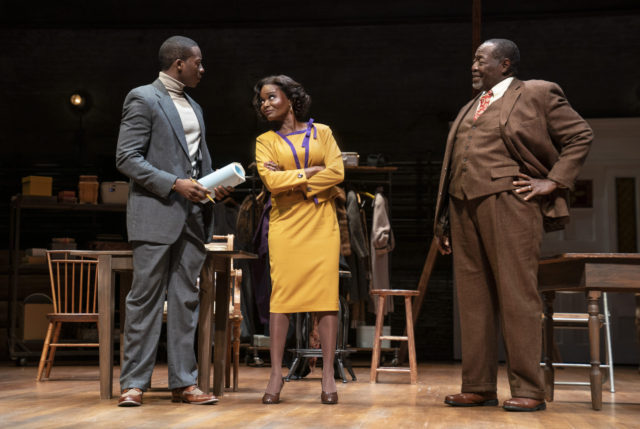
Shakespeare in the Park returns to the Delacorte after a canceled 2020 Covid summer season with the Public Theater’s exuberant but overbaked Merry Wives, continuing through September 18. Adapted by actress and playwright Jocelyn Bioh, who has appeared in such shows as An Octoroon and The Red Letter Plays: In the Blood and written such works as School Girls; or, the African Mean Girls Play and Nollywood Dreams, the play is thoroughly updated but often feels like a mash-up of such sitcoms as What’s Happening!! and The Jeffersons with such reality programs as The Bachelorette and Real Housewives.

The evening begins with Farai Malianga in a Brooklyn Nets Kyrie Irving jersey pounding on his djembe and eliciting an engaging call-and-response with the audience. It’s a wonderful start, reminiscent of how the late Baba Chuck Davis would kick off BAM’s annual DanceAfrica series. The seating is less thrilling but important, divided into sections full of vaccinated people who may choose not to mask — most don’t — and two emptier sections of unvaccinated people who must be masked and socially distanced.

Merry Wives is set in modern-day South Harlem, with a cast of characters from Ghana, Liberia, Nigeria, and Senegal, portrayed exclusively by actors of color. In 2019, Kenny Leon directed a fabulous all-Black version of Much Ado About Nothing, but lightning doesn’t strike twice.

Madams Ford (Susan Kelechi Watson) and Page (Pascale Armand) join forces in contemporary update of Merry Wives (photo by Joan Marcus)

There’s a reason why The Merry Wives of Windsor is so rarely presented; it’s only been performed at the Delacorte twice before, in 1974 (with George Hearn, Marilyn Sokol, Barnard Hughes, Cynthia Harris, Michael Tucker, and Danny DeVito) and 1994 (with Margaret Whitton, David Alan Grier, Andrea Martin, Brian Murray, and Tonya Pinkins). It’s not one of the Bard’s better plays, a Medieval farce that tears down one of his most beloved creations, Sir John Falstaff, far too mean-spiritedly. And too many of the devices and subplots — mistaken identity, the exchange of letters, secret romance — feel like hastily written retreads here.

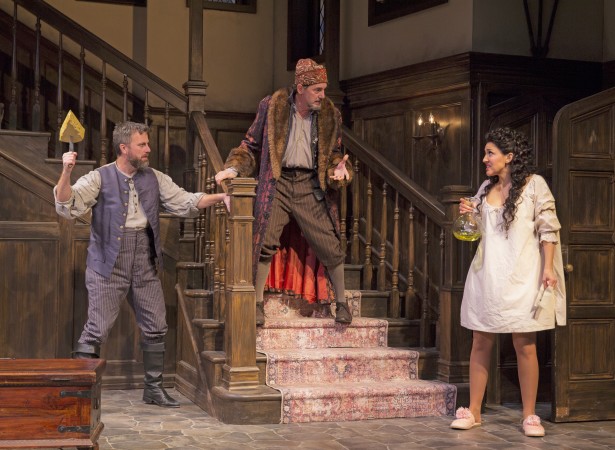
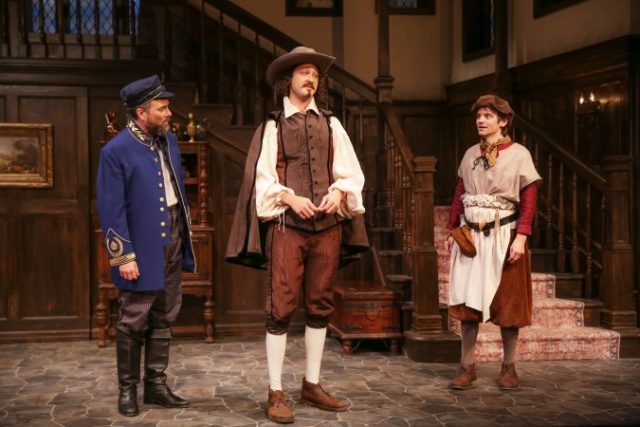
Falstaff (Jacob Ming-Trent) is a Biggie Smalls–loving wannabe playa out to conquer laundromat owner Madam Nkechi Ford (Susan Kelechi Watson) and socialite Madam Ekua Page (Pascale Armand), making cuckolds of their husbands, the distinguished Mister Nduka Ford (Gbenga Akinnagbe) and the generous Mister Kwame Page (Kyle Scatliffe).

“Nah man, I’m serious,” the sweats-wearing Falstaff tells Pistol (Joshua Echebiri), one of his minions. Madam Page “did so course over my exteriors with such a greedy intention that the appetite of her eye did seem to scorch me up like a burning-glass. She bears the purse too; she is from a region in Ghana, all gold and bounty. I will be cheaters to them both, and they shall be sugar mamas to me; we’re gonna have the Ghanaian and the Nigerian jollof rice! Go bear this letter to Madam Page — and this one to Madam Ford. And then, my friend, I will thrive! . . . I mean . . . We will thrive.”

Misters Kwame Page (Kyle Scatliffe) and Nduka Ford (Gbenga Akinnagbe) try to avoid being cuckolded in Bard farce in Central Park (photo by Joan Marcus)

At the same time, the Pages’ daughter, Anne (Abena), is considered the most eligible bachelorette in Harlem and is being wooed by the well-established Doctor Caius (David Ryan Smith), the shy, nervous Slender (Echebiri), and Anne’s true love, Fenton (MaYaa Boateng), whom no one approves of. Manipulating various elements are the caring Pastor Evans (Phillip James Brannon) and the busybody Mama Quickly (Angela Grovey). Madams Ford and Page get wind of Falstaff’s deceit and team up to confound him, while a jealous Mister Ford disguises himself as a Rastaman named Brook to try to uncover Falstaff’s plan to bed his wife. “Please, off with him!” Sir John tells Brook about Ford. “I will stare him out of his wits, I will awe him with my club; I shall hang like Lebron James over the cuckold’s horns.” It all concludes with a series of matches that are as playful as they are convenient and contemporary.

Beowulf Boritt’s set is fabulous, consisting of the facades of a health clinic, a laundromat, and a hair braiding salon, which open up to reveal various interiors. Dede Ayite’s gorgeous costumes honor traditional African designs with bold colors and patterns. But director Saheem Ali (Fireflies, Fires in the Mirror), the Public’s associate artistic director who helmed audio productions of Romeo y Julieta, Richard II, and Anne Washburn’s Shipwreck: A History Play About 2017 during the pandemic lockdown, can’t get a grip on the story, instead getting lost in silly, repetitive slapstick that overwhelms the narrative. The laughs come inconsistently, settling for trivial humor over sustained comedy. This Merry Wives is a crowd pleaser the way familiar but routine sitcoms and reality shows are; light and frothy, none too demanding, but once they’re done, you’re on to the next program.