this week in lectures, signings, panel discussions, workshops, and Q&As

NOWHERE FEST

Nowhere Fest takes place in three-dimensional fantastical wonderlands

NOWHERE FEST
March 11-13, $5-$100
www.urnowhere.com/fest

One of the most innovative online platforms to emerge during the pandemic is Nowhere, a three-dimensional fantastical world where users’ images appear on the front of seedlike pods that can move around the location and interact with one another face-to-face. I’ve experienced it three times so far, twice for multimedia presentations from EdgeCut and New York Live Arts (NYLA), allowing participants to navigate through different virtual spaces to watch live and prerecorded dance, music, and high-tech art, and once when NYLA rolled out its upcoming season, previewing works and giving people the opportunity to speak with the artists. What feels unique is the agency each pod has, able to meet others and interact, settle in front of a virtual screen or proscenium within the virtual area, or wander off with magical flourishes. The platform, which can be pronounced “No Where” or “Now Here,” will be hosting a virtual festival March 11-13, featuring performances, panel discussions, and more in conjunction with the one-year anniversary of the World Health Organization’s declaration that Covid-19 was a global pandemic. Admission is $5 to $100, based on what you can afford, with proceeds benefiting Helping Hearts NYC, which “was created to provide aid to those affected the most during this time, and to those on the front line saving lives.”
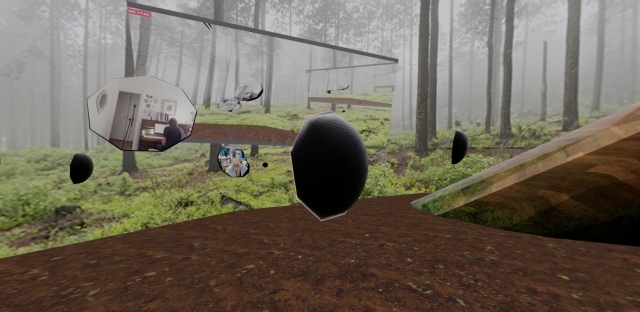
Nowhere digital platform offers new way to experience live events with other people (screenshot by twi-ny/mdr)

Nowhere Fest celebrates the technological advances made over the last twelve months to connect people when they couldn’t physically be together in the same space. Jen Lyon, Liz Tallent, Patrick Wilson, Stephen Chilton, and Becca Higgins of the National Independent Venue Association will talk about their industry and the Save Our Stages Act. Columbia University Rabbi Irwin Kula, the president of the National Jewish Center for Learning and Leadership, will meet with Kristina Libby, the CEO and founder of SoCu and the Social Works Co., and chair professor Robert Wolcott, cofounder of the World Innovation Network. Athena Demos, Michael “Danger Ranger” Mikel, and Damian Madray will look at the future of Burning Man. Tony winner Christine Jones, director Tamilla Woodard, and actor-writer Shyla Lefner will discuss the success of the Theatre for One program “Here We Are,” in which one actor at a time performed for one audience member, with microphones and cameras on for both. Heidi Boisvert and Kat Mustatea of EdgeCut will lead a conversation with artists about the development of hybrid live performances. Group.BR will delve into its use of the Gather.town digital platform in its reimagining of its immersive, site-specific Inside the Wild Heart. EMBC Studio goes behind the scenes of its recharge rooms.
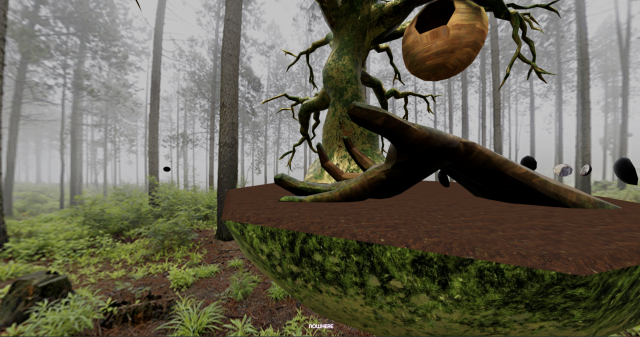
People can meet face-to-face and watch live performances and talks at Nowhere Fest

There will also be appearances, performances, demonstrations, and talks by comedian Chris Gethard, mentalist and mind reader Vinny Deponto, Shasta Geaux Pop, world champion whistler Lauren Elder, singer-songwriter Andrew McMahon, QuarMega, House of Yes & Elsewhere, Macy Schmidt of Broadway Sinfonietta, Deep End NYC, the Feast + Art Plus People, wellness innovator Leah Siegel, Hoovie cofounder Vallejo Gantner, Pete Vigeant of Completely Surrounded Games, poet Mason Granger, filmmaker Storm Saulter, MICRO DIY MUSEUMS founder Charles Philipp, Robert Siegel and Scott Simon of NPR, magician Greg Dubin, DJ Passionfruit, DJ MSG, Globally Curated founder Megs Rutigliano, photographer Will O’Hare, and strategy and design consultant and musician Alain Sylvain. Attending Nowhere Fest might just be the best five-dollar entertainment purchase you make during the pandemic (of course, give more if you can), introducing you to the future of live, online performance once we’re on the other side of this crisis.
HYMN

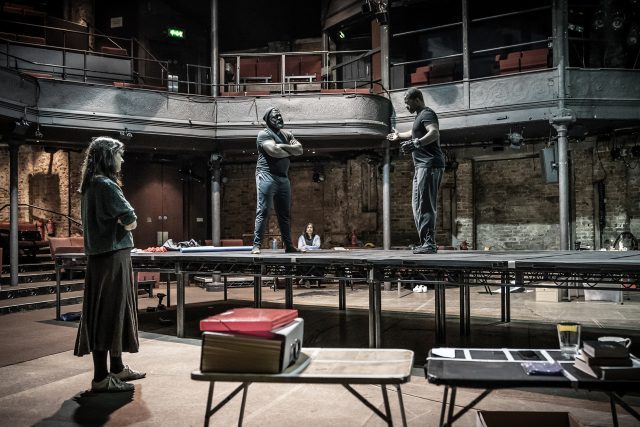
Danny Sapani and Adrian Lester rehearse Hymn with director Blanche McIntyre for livestream (photo by Marc Brenner)

HYMN
Almeida Theatre
Available on demand through March 9, £15-£40
almeida.co.uk

Last month, London’s Almeida Theatre streamed several live performances of Lolita Chakrabarti’s new play, Hymn, followed by two discussions, all held with no audience. A recorded version of the sizzling two-character show is now available on demand, but only through March 9, so act quickly if you want to catch this stellar production. (You can watch the discussions any time here.)

The play starts with the two actors, Adrian Lester and Danny Sapani, walking onto the long, vertical wooden thrust stage wearing masks. They stop on opposite sides of a piano, turn off the house lights, click on a metronome, walk down the set, and circle around a small bottle of booze and a Bible, two items that men turn to in times of strife. Gil (Lester) picks up the latter, while Benny (Sapani) scoops up the former. They determinedly remove their masks, and the sound of shattering glass kicks off the dialogue.

“What the hell?” a surprised Benny, wearing a dark T-shirt, shouts at an unseen barman. “Get off me! Move your fuckin’ hands! . . . Been a shit day; I just’ wanna drink! People to stand next to. Nothing wrong with that, is there?” Actually, in the era of Covid-19, there is a lot wrong with that, and although the coronavirus is not part of the play, it is central to director Blanche McIntyre’s compelling staging.

Gil and Benny meet each other at the funeral service for Gil’s beloved, well-respected father, Augustus Clarence Jones, a successful stationer and family man known affectionately as “Gus.” But Gil is forced to reevaluate his father’s image after learning that Benny is his half-brother, only six days younger, the product of an affair between Gus and Benny’s mother. Gil rejects Benny’s claim outright at first, but soon they are having an exhilarating bromance, living a kind of fantasy, until reality takes hold again.

Hymn is beautifully written, directed, acted, and, perhaps most important, filmed. Even though this version is prerecorded with no audience, it has the feel of live theater, as photographed by screen director Matt Hargraves and his team of camera operators. McIntyre (The Writer, Women in Power) does a terrific job of keeping the two actors apart — they never come into contact with one another, never touch the same objects, keep at least six feet apart when standing still, even as they grow very close emotionally on the narrow stage. Chakrabarti (Last Seen, Life of Pi), who is married to Lester — the playwright and actors have all worked together previously, and Chakrabarti wrote Hymn specifically for her husband and Sapani — has created a fascinating relationship between the two men, who, despite sharing the same father, are very different people, neither exactly what they first appear to be. There’s nothing new about the plot itself — someone shows up at a funeral to claim they are a long-lost or hidden-away relative — but it’s treated with such care and humor that you’ll be sucked in immediately.

The spare set and costumes, which come into play big-time in one exhilarating scene, are by Miriam Buether, with lighting by Prema Mehta, sound by Gregory Clarke, and musical direction by D. J. Walde. The show features a handful of songs sung by Lester and Sapani, including Bill Withers’s “Lean on Me” and the Temptations’ “Papa Was a Rolling Stone,” which easily could have been schmaltzy but instead point at how much the half-siblings need each other.

Hymn is a moving, powerful ninety-minute piece that, though a product of its time — it also delves briefly but critically into the BLM protests — well deserves to be brought back post-lockdown, when audiences will be able to absorb its elegance and artistry in person. Lester (Company, Sweeney Todd), who battled the coronavirus with Chakrabarti over Christmas, and Sapani (Invisible Cities, Big White Fog) capture their evolving feelings of brotherly love with intelligence and grace, fully immersed in the characters’ ever-more-complicated lives, sharing what Benny calls “sympathetic resonance.” In his eulogy at the beginning, Gil remembers his father telling him, “Music is silence, sound, and time. If you listen, Son, you’ll hear it too.” You can experience all that and more in this special production.

THREE SIDES OF BALANCHINE

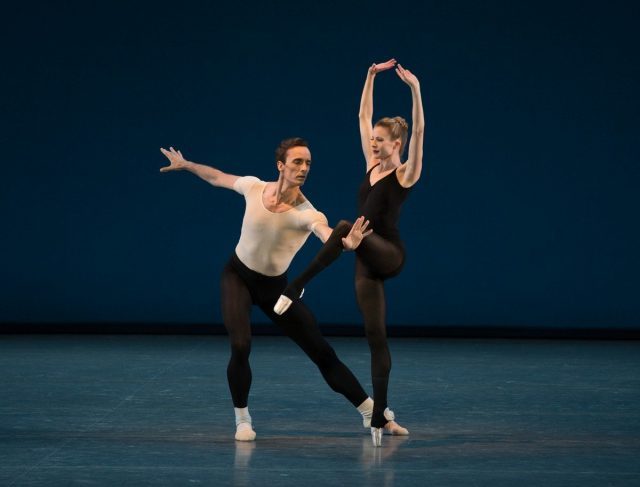
Ask la Cour and Sterling Hyltin perform in Stravinsky Violin Concerto, choreographed by George Balanchine for NYCB (photo by Rosalie O’Connor)

THREE SIDES OF BALANCHINE
New York City Ballet online
Through March 18, free
www.nycballet.com

New York City Ballet pays digital tribute to its legendary cofounder and longtime leader, George Balanchine, with the free virtual program “Three Sides of Balanchine,” continuing through March 18. The three-week series, hosted by principal dancer Russell Janzen, consists of “Inside NYCB” on Tuesdays at 8:00 and streams of previously recorded performances on Thursdays at 8:00. Each part will be available on YouTube and the NYCB site for seven to nine days. “Three Sides of Balanchine” kicked off February 23 with an exploration of the Siren from Sergei Prokofiev’s Prodigal Son, with a sneak peek at a rehearsal and a live conversation with principal dancer Maria Kowroski, who has played the role many times, NYCB repertory director Lisa Jackson, and corps de ballet member Christina Clark, who is learning the role. That was coupled with a stream of Prodigal Son with Daniel Ulbricht and Teresa Reichlen.

Through March 11, you can catch a discussion about the male solo from Tschaikovsky’s Theme and Variations, with principal dancers Andrew Veyette and Joseph Gordon and repertory director Kathleen Tracey, paired with a 2015 stream of Theme and Variations starring Veyette and Tiler Peck. On March 9, NYCB will explore one of the female solos from Stravinsky Violin Concerto with a conversation and rehearsal session with principal dancer Sara Mearns, soloist Claire Kretzschmar, and repertory director Rebecca Krohn and, beginning March 11, a filmed performance featuring Sterling Hyltin, Ask la Cour, Mearns, and Taylor Stanley. As Balanchine himself said, “Why are you stingy with yourselves? Why are you holding back? What are you saving for — for another time? There are not other times. There is only now. Right now.”

PUBLIC ART FUND VIRTUAL TALKS: ELMGREEN & DRAGSET

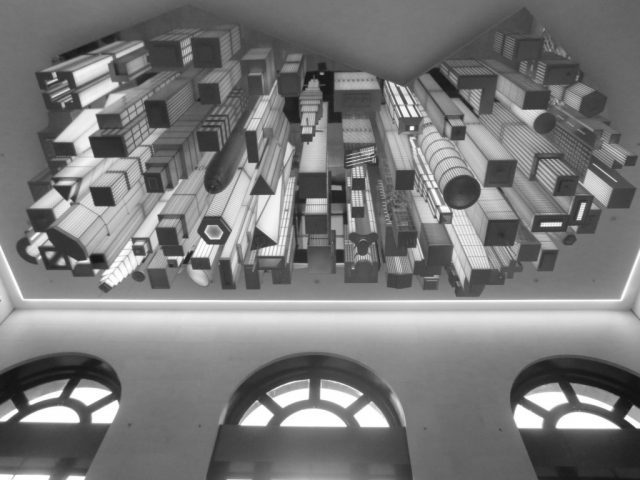
Elmgreen & Dragset’s The Hive welcomes busy bees to Moynihan Train Hall (photo by twi-ny/mdr)

Who: Elmgreen & Dragset (Michael Elmgreen and Ingar Dragset), Nicholas Baume
What: Public Art Fund live discussion
Where: The Cooper Union on Zoom
When: Thursday, March 11, free with RSVP, 1:00
Why: On January 1, Moynihan Train Hall opened to the public with much fanfare, highlighted by site-specific commissions from Stan Douglas (Penn Station’s Half Century), Kehinde Wiley (Go), and Elmgreen & Dragset. The Hive, E&D’s inverted cityscape on the ceiling of the Thirty-First St. midblock entrance, has dazzled visitors, who stare up at ninety-one miniature buildings that contain seventy-two thousand LEDs and weigh more than thirty thousand pounds, part mysterious metropolis, part cave stalactites. The duo of Denmark-born Michael Elmgreen and Norway-born Ingar Dragset, who have been combining art, architecture, performance, and installation for more than a quarter of a century, will discuss the construction and meaning of The Hive in a free Public Art Fund conversation hosted by the Cooper Union on Zoom, straight from their Berlin studio. The event will be moderated by PAF director and chief curator Nicholas Baume. To catch Baume’s January 28 talk with Douglas, go here.

VIRTUAL HD SCREENING & LIVE TALK — THE PARIS OPERA & BALLET: PLAY

FIAF will fly in the Paris Opera & Ballet’s playful Play this week, with a live talk March 11

Who: The Paris Opera & Ballet
What: Virtual screening and live discussion
Where: French Institute Alliance Française (FIAF) online
When: Thursday, March 11, $15, 12:30 (stream available on demand March 8-14)
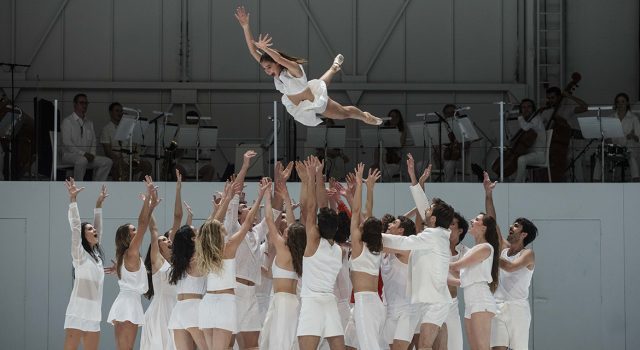
Why: Swedish dancer, choreographer, and director Alexander Ekman’s first commission from the Paris Opera & Ballet was the wild and woolly Play, a 2017 work that featured women dressed as deer, a furious rain of green balls, large blocks floating in the air, and other dreamlike scenarios. “We thought of life by analogy with the journey, with a pilgrimage, which had a serious purpose at the end, but the thing was to get to that end, success or whatever it is, or maybe heaven after your death, but we missed the point the whole way along,” a disembodied voice explains. FIAF will be streaming a recorded version of the production, with music composed by the Harlem-based Mikael Karlsson, from March 8 to 14; each $15 ticket also gives you access to a livestreamed Zoom talk with Ekman (Cacti, Tuplet), Karlsson, and theater critic Laura Cappelle on March 11 at 12:30.

JOYCE CAROL OATES: WOMEN ON THE MOVE

Who: Joyce Carol Oates, Zibby Owens
What: Livestreamed conversation
Where: The Temple Emanu-El Streicker Center
When: Tuesday, March 9, free with RSVP, $25 with book, 11:00 am
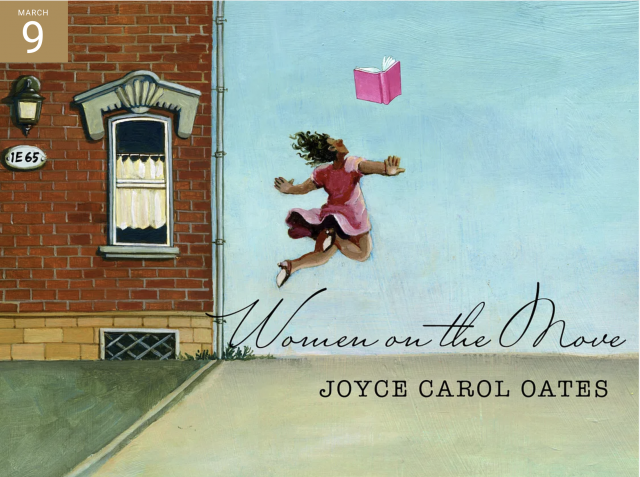
Why: On February 16, mother of four and creator and host of the podcast “Moms Don’t Have Time to Read Books” Zibby Owens was introduced as the moderator for the Temple Emanu-El Streicker Center’s new virtual conversation series, “Women on the Move.” Owens, whose Moms Don’t Have Time To: A Quarantine Anthology (Skyhorse, February 2021, $24.99) was published last month, spoke with Jeanine Cummins on February 23 and Nicole Krauss on March 3. On March 9 at 11:00 in the morning, Owens will Zoom in with eighty-two-year-old living legend Joyce Carol Oates, the New York State native who has written more than a hundred novels, novellas, short stories, essays, and plays. The latest collection from the winner of two O. Henry Awards, the National Book Award, the Jerusalem Prize, and the National Humanities Medal is The (Other) You: Stories (HarperCollins, February 2021, $26.99), which, among other things, is about the act of reading itself. “Bought a bookstore. Mostly secondhand books,” the title story begins. Admission to the live webinar is free with RSVP, although you can receive a copy of the book for a $25 fee.

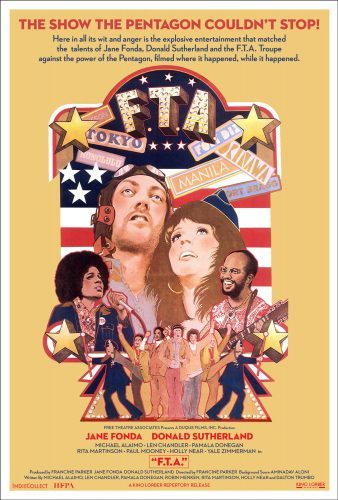
F.T.A.

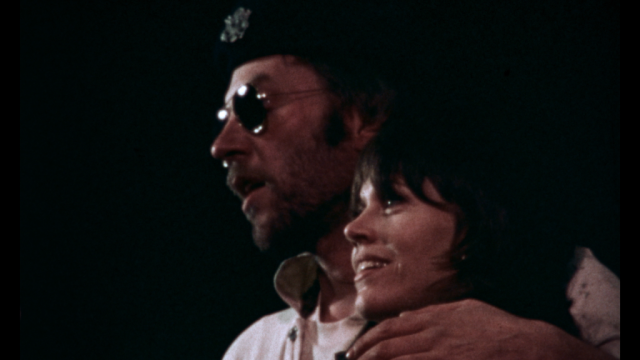
Donald Sutherland and Jane Fonda lead a vaudeville-like antiwar tour in 1971 in restored documentary F.T.A.

F.T.A. (Francine Parker, 1972)
New Plaza Virtual Cinema
Opens Friday, March 5
kinomarquee.com
newplazacinema.org

In 1972, actress Jane Fonda was excoriated for posing for a picture in North Vietnam sitting on an anti-aircraft gun with members of the Viet Cong, earning her the nickname “Hanoi Jane.” But the previous year, Fonda was being cheered wildly by US soldiers as she brought the antiwar F.T.A. tour to American military bases in Hawaii, Japan, Okinawa, and the Philippines. The tour, alternately known as “Fun, Travel, and Adventure,” “Free the Army,” “Free Theater Associates,” “Foxtrot Tango Alpha,” and “Fuck the Army,” featured comedy sketches and music with Fonda, fellow actors Donald Sutherland, Pamela Donegan, and Michael Alaimo, singer-songwriters Rita Martinson, Len Chandler, and Holly Near, and comedian Paul Mooney. Kino Marquee has just released a 4K restoration by IndieCollect of Francine Parker’s rarely screened, little-known 1972 film, F.T.A., documenting the Pacific section of the tour. The movie, about “the Show the Pentagon Couldn’t Stop!,” according to its ad campaign, ran for a week before being pulled from theaters by the distributor, who destroyed most copies.

“Histories of the Vietnam War all mention the widespread antiwar movement that was centered on college campuses. What most histories don’t tell you is that an equally widespread and powerful movement against the war existed inside the military itself,” Fonda says in a new video introduction, recorded in what has become a very familiar scene to viewers of Fire Drill Fridays, her weekly show about climate change and the Green New Deal, which the two-time Oscar and Emmy winner hosts in her home, sitting in front of a wall of photos.

The brainchild of court-martialed antiwar army doctor Howard Levy, F.T.A. was created specifically as “a counter show to the very pro-war, sexist” Bob Hope shows that were so popular, Fonda notes. She had just completed shooting Klute and so she invited her costar, Sutherland, who had previously appeared in such war films as The Dirty Dozen, M*A*S*H, Kelly’s Heroes, and Johnny Got His Gun, to join her. Working with material garnered from GI magazines in addition to skits written by the likes of Jules Feiffer and Herb Gardner, the revue ended up entertaining some 64,000 active-duty soldiers, sailors, marines, and air force men and women. But it wasn’t just fun and games; Fonda, Sutherland, and the rest of the team were there to make a point.

The film doesn’t open with comedy or music but with an unidentified GI saying, “I mean, how can you write your mother and tell her that her handsome young darling marine, her hero, is anti-military? But I sat down and I wrote her a letter and told her exactly how I felt, and my mother wrote back and she said she fully understood and she was happy I felt that way.” Parker follows that with several other servicemen and -women explaining that they were serving in the military either to avoid jail or because they didn’t have any other options, not because they wanted to fight Communism and defend democracy in Southeast Asia.

The narrative then shifts to the tour itself, an alternative modern vaudeville with political songs and short skits that skewer the government and military leaders, poking fun at the bureaucracy while focusing on the very real class, gender, and race differences that are inherent in war and society. “I went down to that base / They took one look at my face / And read out an order to bar me / I said, ‘Foxtrot Tango Alpha’ / ‘F-f-free the army,’” Fonda sings with Chandler and others.

Amid the laughs — and there are many of them, including one funny scene in which Sutherland and Alaimo play two sports announcers, both named Red, calling the war as if it were a football game — Parker, Fonda, and Sutherland speak with more antiwar soldiers, individually and at small gatherings, where they feel comfortable enough to express their views about chemical warfare and nuclear weapons. The crowd gets rocking singing along with such songs as Chandler’s “My Ass Is Mine” and “Set the Date!” and Robin Menken’s “Nothing Could Be Finer Than to Be in Indochina!” and “So Nice to Be a Member of the Military Class,” while Martinson’s “Soldier, We Love You,” about injustice and inequality, hits hard and Beverly Grant’s feminist rant, “I’m Tired of Bastards Fuckin’ Over Me,” brings down the house.

Produced by Parker, Fonda, and Sutherland, F.T.A. is a clarion call against the misuse of military power; it feels today much more than a mere time capsule celebrating opposition to one war fifty years ago but a shot across the bow for protestors everywhere fighting against the military-industrial complex, against corrupt government, in a country that’s more divided than ever and where identity politics have run rampant.

“You won’t see a change here [overseas] until you see a change back in the world [in the US],” one man says. “Gimme a cause that I can believe in and let me die for that,” another adds. After watching F.T.A., you’ll realize that 2021 is not as different from 1971 as you might have thought, or wanted it to be.