this week in lectures, signings, panel discussions, workshops, and Q&As

UNCHARTED TERRITORY: DANCERS IN ISOLATION

UNCHARTED TERRITORY: DANCERS IN ISOLATION
Eryc Taylor Dance
Sunday, March 21, pay-what-you-can, 6:00
Available on demand with live Q&As March 22-28
etd.nyc

New York City–based nonprofit Eryc Taylor Dance (ETD) looks back at a year in lockdown and celebrates its fifteenth anniversary with its first dance film, Uncharted Territory: Dancers in Isolation. The half-hour work premieres on YouTube on March 21 at 6:00, introduced by Robbie Fairchild, after which it will be available on demand March 22–28.

Conceived and developed over Zoom beginning last March, Uncharted Territory is divided into five segments, each featuring one dancer portraying a character, filming themselves indoors and/or outdoors, with an original score by Daniel Tobias. “My husband was one of the first to suffer a Covid-19 infection for three excruciating weeks in March, Tobias said in a statement. “He survived, but it scared me to death. When Eryc Taylor asked me to compose music for Uncharted Territory, there was already a tsunami of emotions heading his way. Each dancer’s story helped me process this tragic epic global pandemic, and I hope the music helped them as well.”

In “Movement One: Solitude,” set to Tobias’s acoustic guitar composition “Distancia,” Taylor Ennen is Spenser, a young woman in danger of unraveling, gliding through her family’s apartment in a short, loose-fitting dress as she grabs a bottle of wine, wriggles on a table under a Noguchi Akari lamp, and sits in a rocking chair; editor Benny Krown incorporates doubling, mirroring, and ghosting as Spenser wrestles with her mind.

In “Movement Two: In-Memoriam,” set to Tobias’s wind-chime “Bahay ni Lola Grandmother’s House,” AJ Guevara is Ivan, who is grieving for his grandmother, who died alone from the coronavirus. The piece begins with birds flying in a blue sky before following Ivan as he puts on his grandmother’s jewelry and starts a ritual fire in her backyard, near a handmade sign that reads, “Lola & Papa’s Nest: Where the Flock Gathers.” In “Movement Three: Meltdown,” Alex Tenreiro Theis is Dani, an attorney who has just lost her job, going from the kitchen to the bedroom as Tobias’s “Dark City” swirls around her, with quick cuts, backward and forward jumps, slow motion, and emotional thermal colors ultimately enveloping her.
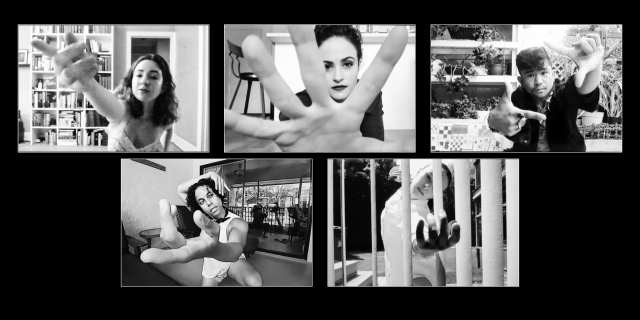
Uncharted Territory: Dancers in Isolation was rehearsed over Zoom before being filmed on location by each performer (photo by Shannel Rest)

In “Movement Four: Manhunt,” set to Tobias’s “Path,” Chris Bell plays an anonymous, lonely man seeking a random sexual encounter in the woods by a muddy lake, by the side of a highway, and at a city bus stop. And finally, rehearsal director Nicole Baker is a nurse fighting paranoia and doubt in “Movement Five: Compulsion,” roaming from her bed to her car to a gravel driveway to an outdoor shower, trying to keep herself together as Tobias’s keyboard-based “Nurses Rhapsody” sweeps over a scene occasionally bathed in a blue tint.

Uncharted Territory: Dancers in Isolation was shot by each dancer in Queens, the West Village, Marshfield, Massachusetts, Brooklyn, and Grover Beach, California. ETD, whose previous works include Cycles, Into the Light, and The Missing, dedicate the new piece “to all artists who persevere, find their fire, and create during one of the most challenging times of our lives.”

In addition, there will be several events on Instragam Live (@eryctaylordance): a Q&A with Krown on March 22 at 6:00, a 5×5 interview with photographer Shannel Resto on March 23 at 6:00, and a Q&A with Baker on March 25 at 6:00.
WOJNAROWICZ: F**K YOU F*GGOT F**KER

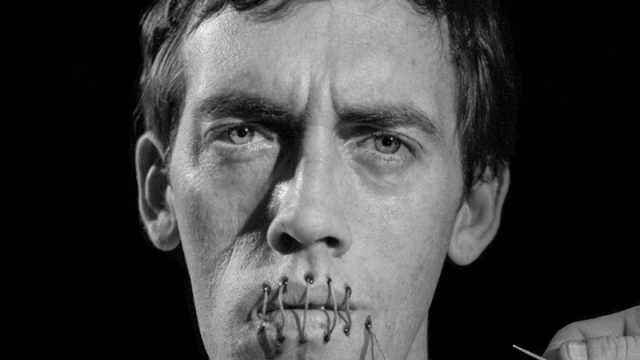
David Wojnarowicz tells his own story in Chris McKim documentary (Andreas Sterzing, David Wojnarowicz (Silence = Death), photograph, 1989 [courtesy of the artist, the estate of David Wojnarowicz, and P·P·O·W, New York])

WOJNAROWICZ: F**K YOU F*GGOT F**KER (Chris McKim, 2020)
Film Forum Virtual Cinema
Opens Friday, March 19; live Q&A on Tuesday, March 30, free with RSVP, 7:00
filmforum.org
kinomarquee.com

David Wojnarowicz packed a whole lot of living into his too-brief thirty-seven years, and the frenetic pace of his life and death is copiously captured in Chris McKim’s dynamic documentary, Wojnarowicz: F**k You F*ggot F**ker. Born in New Jersey in September 1954, Wojnarowicz — pronounced VOY-nah-ROH-vich — experienced a difficult childhood riddled with physical abuse from his father, became a teen street hustler in Times Square, and later dabbled in heroin. He gained fame as an avant-garde artist and anti-AIDS activist in the 1980s, when several of his pieces earned notoriety, condemned by right-wing politicians who wanted to censor the works and defund the National Endowment for the Arts, which had supported the shows of art they found objectionable or morally corrupt. (The controversy continued decades past his death, into December 2010, when the National Portrait Gallery edited his short film Fire in My Belly in a group show.)

McKim lets Wojnarowicz, who died of AIDS-related complications in July 1992, tell his own story, using the multimedia artist’s extensive archive of journals, cassette tapes, phone messages, photographs, and super 8 films; Wojnarowicz lived his life as if it was an ongoing radical performance installation itself, obsessively recording himself. “All the paintings are diaries that I always thought as proof of my own existence,” he says. “Whatever work I’ve done, it’s always been informed by what I experience as an American in this country, as a homosexual in this country, as a person who’s legislated into silence in this country.”

Editor Dave Stanke does a masterful job of putting it all together, primarily chronologically, seamlessly melding Wojnarowicz’s paintings, photographs, and videos into a compelling narrative that is as experimental, and successful, as the artist’s oeuvre, placing the audience firmly within its milieu. He intercuts news reports and other archival footage as Wojnarowicz’s life unfolds; among those whose voices we hear, either in new interviews or old recordings, are cultural critics Fran Lebowitz and Carlo McCormick, gallerist Gracie Mansion, curator Wendy Olsoff, his longtime partner Tom Rauffenbart, photographer and close friend/onetime lover Peter Hujar, artists Kiki Smith and Nan Goldin, artist and activist Sur Rodney Sur, Fire in the Belly author Cynthia Carr, Wojnarowicz’s siblings, and photographer and filmmaker Marion Scemama, who collaborated with Wojnarowicz on the haunting Untitled (Face in Dirt), pictures of the artist partially buried in the southwest desert. In addition, McKim includes such conservative mouthpieces as Donald Wildmon of the American Family Association and Senator Jesse Helms, who both sought to shut down Wojnarowicz and the NEA.

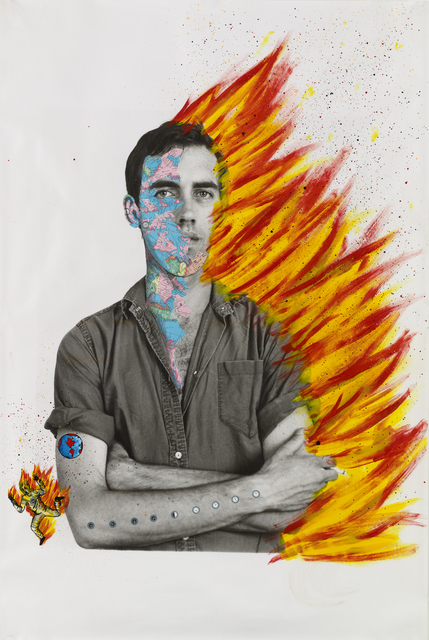
Influenced by such writers and artists as Jean Genet, William S. Burroughs, and Arthur Rimbaud, Wojnarowicz’s art is as bold and in your face as it can get, relentlessly depicting a hypocritical world inundated with lies, violence, and perpetual inequality. Among the works that are examined in the film are Untitled (Buffalo), Untitled (Peter Hujar), Gagging Cow at Pier, Arthur Rimbaud in New York (Times Square), Burning House, Untitled (One Day This Kid . . . , David Wojnarowicz (Silence = Death, New York), Untitled (Genet After Brassai), and his Fire, Water, Earth, and Air four elements series. McKim also focuses on Wojnarowicz’s incendiary East Village punk band, 3 Teens Kill 4, with snippets of such songs as “Hold Up,” “Hunger,” and “Stay & Fight.” Wojnarowicz spoke in a relatively calm, straightforward tone, especially when compared with the constant whirlwind surrounding him, but his work, from art to music, revealed the fiery emotions bubbling inside, a roiling mix of rage, rebellion, and resistance.

Self-Portrait of David Wojnarowicz, acrylic and collaged paper on gelatin silver print, 1983–84 (photo by Ron Amstutz/Whitney Museum of American Art)

McKim (RuPaul’s Drag Race, Out of Iraq) adds a curious, overly sentimental modern-day ending that might elicit a tear or two but is completely out of place; otherwise, Wojnarowicz: F**k You F*ggot F**ker, named after one of the artist’s works from 1984, is an intense journey into the mind of a deeply troubled soul who shared his endless dilemmas in very public ways that made so many people uneasy. “Last night I was standing around here, looking at my photographs. They’re my life, and I don’t owe it to anybody to distort that just for their comfort,” he says.

Wojnarowicz: F**k You F*ggot F**ker opens virtually at Film Forum through Kino Marquee on March 19 and includes a prerecorded Q&A with McKim, Mansion, McCormick, and producer Fenton Bailey, moderated by journalist Jerry Portwood. There will also be a live Q&A on March 30 at 7:00 with McKim and Stanke, moderated by artist and activist Leo Herrera, that is free and open to all.

VISION RESIDENCY: RAJA FEATHER KELLY

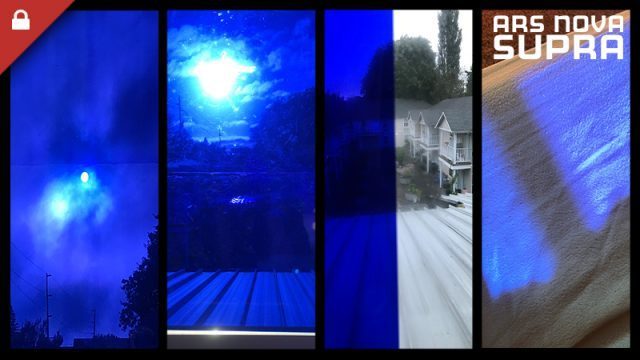
Tuçe Yasak’s Light Journals kicks off raja feather kelly’s Ars Nova Vision Residency

VISION RESIDENCY
Ars Nova
March 20 – April 9, $10 per show
arsnovanyc.com/SUPRA
thefeath3rtheory.com

It’s time to face facts: This is raja feather kelly’s world; we’re only living in it. Kelly is an Obie-winning choreographer, director, artistic director of the feath3r theory, and creative associate at Juilliard who has been involved with such productions as Young Jean Lee’s We’re Gonna Die at Second Stage, Electric Lucifer at the Kitchen, A Strange Loop and If Pretty Hurts Ugly Must Be a Muhfucka at Playwrights Horizons, Fireflies at the Atlantic, and Fairview at Soho Rep and TFANA. In December he premiered his solo performance installation Hysteria in the glassed-in lobby at New York Live Arts, for which he is also making the film Wednesday, a queer-fantasia reimagining of Dog Day Afternoon that he offered a sneak peek of at a wild watch party also in December. He will be bringing back Hysteria for encore performances April 8-10.

Kelly is now curating Ars Nova’s Vision Residency program, featuring presentations by four creators: Tuçe Yasak, Tislarm Bouie, L Morgan Lee, and Emily Wells, running March 20 to April 9. “There is no separation between who these people are as artists and who they are as people. Their work is indelible and one of a kind,” kelly said in a statement. The Ars Nova Supra events begin March 20 with Yasak’s virtual installation Light Journals, inspired by poetry by Rumi, followed March 25 by Bouie’s dance film on Black masculinity, THUG; a reading on April 8 of The Women, the working title of a play in progress, led by L Morgan Lee and kelly as Kirsten Childs, Dane Figueroa Edidi, Donnetta Lavinia Grays, Christine Toy Johnson, Bianca Leigh, Carmen LoBue, and Nia Witherspoon explore what it means to be a woman in today’s society; and, on April 9, kelly & Wells’s Artifact, a listening and viewing party previewing their work-in-progress Album and Opera. Tickets to each show are $10; a monthly subscription to Ars Nova’s Supra digital platform is $15. Kelly is one of seven 2020–21 Vision Residents; the others are Starr Busby, nicHi douglas, JJJJJerome Ellis, Jenny Koons, David Mendizábal, and Rona Siddiqui.

IN CONVERSATION: YOSHITOMO NARA + PEDRO ALONZO

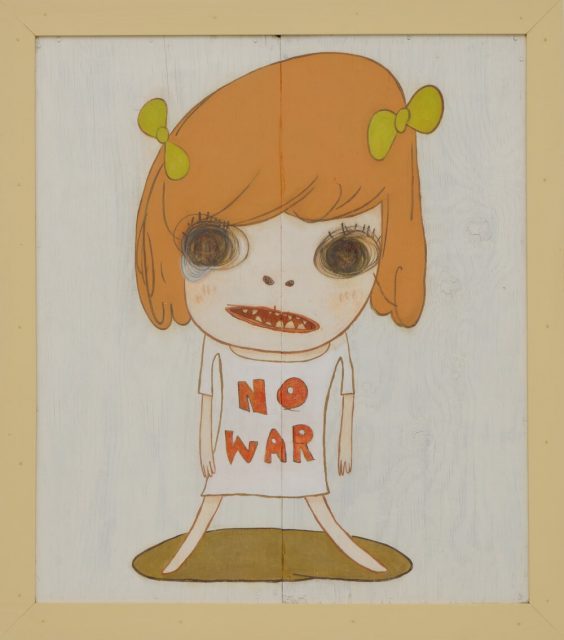
yoshitomo nara, no war, acrylic on wood, 2019 (courtesy of the artist, blum & poe, and pace gallery)

Who: Yoshitomo Nara, Pedro Alonzo
What: Live discussion
Where: Dallas Contemporary online
When: Saturday, March 20, free with RSVP, 9:00
Why: In celebration of the opening of the Yoshitomo Nara career survey “i forgot their names and often can’t remember their faces but remember their voices well,” running at Dallas Contemporary from March 20 to August 22, the Japanese artist will speak with adjunct curator Pedro Alonzo about the show, which features paintings, drawings, and sculptures from 2006 to the current day, including many works that have never been on view before. Nara will discuss his artistic process, continuing sociopolitical themes, and new, more introspective pieces he made specifically for this exhibition. Admission is free with advance RSVP.

STEPHEN PETRONIO COMPANY: SPRING FORWARD

Who: Stephen Petronio Company
What: Virtual birthday party
Where: SPC Zoom
When: Saturday, March 20, free with RSVP, 5:00
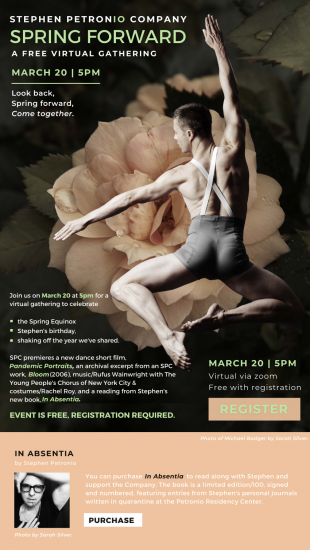
Why: In April 2013, Newark-born, New York City–based dancer and choreographer Stephen Petronio threw himself quite a New Orleans–style funeral at the Joyce for Like Lazarus Did (LLD 4/30). On March 20, he will rise up again for the spring equinox, celebrating his sixty-fifth birthday in style over Zoom. The virtual gathering will include an excerpt from SPC’s 2006 piece, Bloom, featuring music by Rufus Wainwright with the Young People’s Chorus of NYC; the world premiere of his latest short dance film, Pandemic Portraits (SPC previously presented #GimmeShelter last May and Are You Lonesome Tonight in July); and a reading and discussion of Petronio’s new book, In Absentia, consisting of personal journal entries about dealing with the current state of the world, written while Petronio was quarantining at the Petronio Residency Center in the Catskills. Signed and numbered copies of the limited edition book are available for $250. Petronio is a charming, effervescent character, so it’s always worth being in his company. Happy birthday!

NEGATIVE LIBERTY / POSITIVE LIBERTY

The Invisible Dog Art Center
51 Bergen St.
Thursday – Sunday, March 18 – April 18, free with advance RSVP
www.theinvisibledog.org
www.theamericanvicarious.org

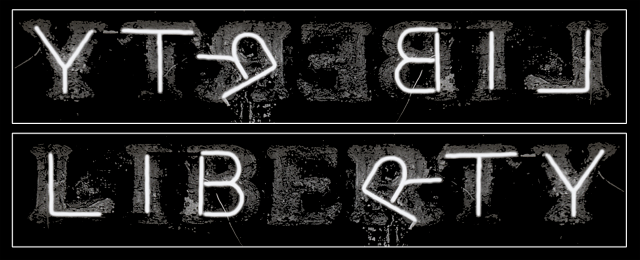
The american vicarious and the Invisible Dog Arts Center follow up their socially distanced Static Apnea with Negative Liberty / Positive Liberty, an immersive performance installation for one audience member at a time. The piece explores Latvian-born British philosopher Isaiah Berlin’s Oxford lecture delivered on Halloween 1958, “Two Concepts of Liberty: Negative & Positive.” while also incorporating Anthony Barboza’s 1966 photograph, Pensacola, Florida, of a neon sign depicting the word Liberty with a broken “E” and dangling “R,” revealing the fragility of freedom, as they both relate to current events. Berlin writes:

“To coerce a man is to deprive him of freedom – freedom from what? Almost every moralist in human history has praised freedom. Like happiness and goodness, like nature and reality, the meaning of this term is so porous that there is little interpretation that it seems able to resist. I do not propose to discuss either the history or the more than two hundred senses of this protean word, recorded by historians of ideas. I propose to examine no more than two of these senses – but those central ones, with a great deal of human history, behind them, and, I dare say, still to come. The first of these political senses of freedom or liberty (I shall use both words to mean the same), which (following much precedent) I shall call the ‘negative’ sense, is involved in the answer to the question ‘What is the area within which the subject – a person or group of persons – is or should be left to do or be what he is able to do or be, without interference by other persons?’ The second, which I shall call the positive sense, is involved in the answer to the question ‘What, or who, is the source of control or interference, that can determine someone to do, or be, one thing rather than another?’ The two questions are clearly different, even though the answers to them may overlap.”

Conceived and directed by Christopher McElroen (Debate: Baldwin vs Buckley, Static Apnea), the installation features performers Sarah Ellen Stephens and Olivia Gilliatt, with scenography by Troy Hourie, video design by Adam J. Thompson, sound by Andy Evan Cohen, and lighting by Lucrecia Briceno. Admission is free to each eight-minute session but must be reserved in advance; slots are already filling up, so you’d best sign up fast. In addition, Barboza is included in the Whitney exhibition “Working Together: The Photographers of the Kamoinge Workshop,” which continues through March 28.

ROMEO Y JULIETA

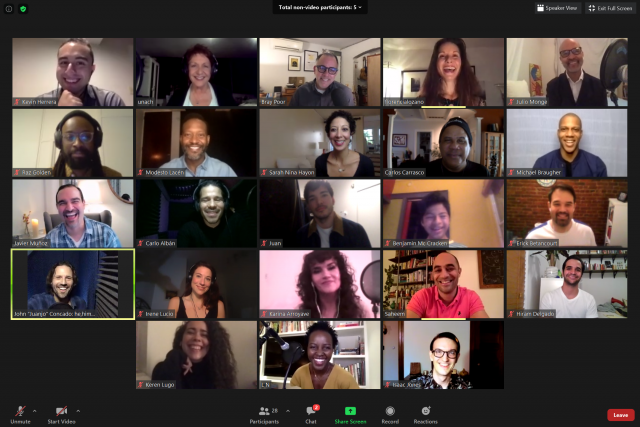
The Public Theater’s bilingual radio play Romeo y Julieta was rehearsed over Zoom (screenshot courtesy the Public Theater)

Who: Saheem Ali, Lupita Nyong’o, Juan Castano, Alfredo Michel Modenessi, Rebeca Ibarra, more
What: Online premiere listening party for bilingual audio production of Romeo y Julieta
Where: The Greene Space and the Public Theater
When: Thursday, March 18, free with RSVP, 6:45 (stream available for one year)
Why: Unsurprisingly, audio plays have made a comeback during the pandemic, with theaters in lockdown. Keen Company’s Season of Audio Theater has included finkle’s 1993 and Pearl Cleage’s Digging in the Dark, with James Anthony Tyler’s All We Need Is Us up next. Playing on Air, which predated the Covid-19 crisis, has posted such nonvisual works as Cary Gitter’s How My Grandparents Fell in Love, Daniel Reitz’s Napoleon in Exile, Naveen Bahar Choudhury’s Skin, and Dominique Morisseau’s Jezelle the Gazelle, featuring such actors as Julie White, Jesse Eisenberg, Marsha Mason, Ed Asner, Jane Kaczmarek, J. Alphonse Nicholson, and others.

Meanwhile, the Public Theater has presented Anne Washburn’s Shipwreck: A History Play About 2017 as well as the four-part Free Shakespeare on the Radio: Richard II, adapted and directed by Saheem Ali. Ali has now teamed up with playwright Ricardo Pérez González on Romeo y Julieta, a bilingual audio adaptation based Alfredo Michel Modenessi’s Spanish translation of Shakespeare’s heart-wrenching tragedy.

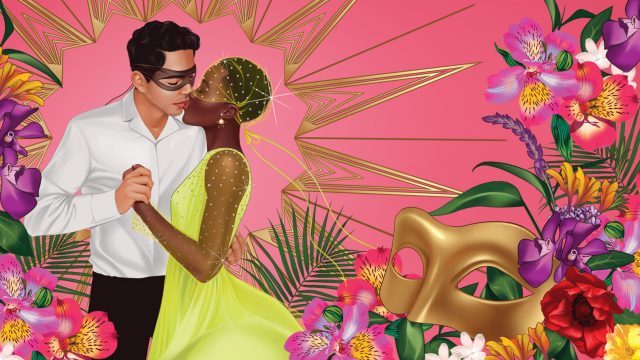
Colorful illustrations by Erick Dávila add visuals to bilingual radio play (courtesy the Public Theater)

The play alternates between English and Spanish; thankfully, you don’t hear every line in both languages, or else the show would be four hours long. However, the Public provides the script on its website so you can follow along and see the full translation. (The website also offers a visual guide to the cast and characters, a bilingual synopsis, colorful illustrations by Erick Dávila, and a trailer.) Presented in conjunction with WNYC Studios and the Greene Space, the radio play premieres on March 18 at 6:45 with much virtual fanfare, kicking off with a preshow greeting and cocktail demonstration (Mezcal Negroni or nonalcoholic Mojito), hosted by WNYC’s Rebeca Ibarra. Then the group listening party starts at 7:00, followed by a live talkback and Q&A with Ali, actors Lupita Nyong’o, who plays Juliet, and Juan Castano, who stars as Romeo, and translator Modenessi, moderated by Ibarra. Everything is free with advance RSVP, but you have to supply your own drinks.

The rest of the cast consists of Carlo Albán as Benvolio, Karina Arroyave as the apothecary, Erick Betancourt as Abram, Michael Braugher as Balthasar, Carlos Carrasco as Lord Montague, Ivonne Coll as the nurse, John J. Concado as Peter, Hiram Delgado as Tybalt, Guillermo Diaz as Gregory, Sarah Nina Hayon as Lady Montague, Kevin Herrera in the ensemble, Modesto Lacen as Prince Escalus and Capulet’s cousin, Florencia Lozano as Capulet, Irene Sofia Lucio as Mercutio, Keren Lugo as Sister Joan, Benjamin Luis McCracken as Paris’s page, Julio Monge as Friar Lawrence, Javier Muñoz as Paris, and David Zayas as Sampson. The original score by Michael Thurber is performed by Jon Lampley on trumpet, Eddie Barbash on alto saxophone, and Mark Dover on bass clarinet; bassist Thurber will also entertain the audience during intermission. The stream of the radio play will be available for one year.