this week in lectures, signings, panel discussions, workshops, and Q&As

HISTORIC UNCLE FLOYD SHOW WATCH PARTY: THIS WAS THE UNCLE FLOYD SHOW

Uncle Floyd and Oogie are back on Tuesday nights in weekly live clips show

Who: Uncle Floyd, Scott Gordon
What: Live watch party
Where: StageIt
When: Tuesday nights at 8:00, $5
Why: I was aghast to learn that there will be a live, online watch party of great moments from The Uncle Floyd Show on Tuesday, March 30, at 8:00. What made me so upset was not that the event was happening at all but that it was the eighth presentation, meaning that I had missed the first seven. The horror! I spent a significant part of my childhood dedicated to The Uncle Floyd Show, a super-low-budget pseudo-children’s show beaming out of New Jersey, available on cable station WHT, Wometco Home Theater, and U68. The host, onetime circus entertainer Floyd Vivino, was a warped version of Soupy Sales, in a checkerboard suit, bowtie, and porkpie hat, cracking jokes from before your grandparents’ time, along with double and triple entendres, delivered by a madcap group of characters that included Scott Gordon, Craig “Mugsy” Calam, Richard “Netto” Cornetto, Jim Monaco, Art “Looney Skip” Rooney, Charlie Stoddard, David “Artie Delmar” Burd, Clark the Wonder Dog, Bones Boy, and Oogie, the Uncle Floyd’s ever-present hand-puppet sidekick. They performed ridiculously silly skits (oh, how I loved the Dull family) and musical parodies (Bruce Stringbean, Neil Yuck, “Deep in the Heart of Jersey”) and had such famous guests as the Ramones (who name-check Uncle Floyd in “It’s Not My Place [in the 9 to 5 World”]), the Boomtown Rats, the Smithereens, Marshall Crenshaw, Tiny Tim, Squeeze, Cyndi Lauper, and David Johansen lip syncing to their hit songs. My favorite was vaudeville veteran Benny Bell playing his 1946 novelty classic “Shaving Cream.” I even went to see the gang perform live at the Bottom Line, and so did David Bowie, who was turned on to the show by John Lennon; the Thin White Duke’s song “Slip Away” is actually about Uncle Floyd. The Uncle Floyd Show was a nostalgia act with no past, instead predicting the future of DIY variety series and internet programs, an early version of Instagram and TikTok.

The Uncle Floyd Show ran in one form or another for nearly twenty-five years. Fortunately, Gordon preserved more than seven hundred hours of excerpts and complete broadcasts, and he and Vivino are now streaming them on Tuesday nights at 8:00 for five bucks on the StageIt platform, as Uncle Floyd and Scott’s Video Clip Club, with live, interactive discussions. This week’s edition features the full New Jersey Network show from January 8, 1985, with additional segments from the WHT broadcast from May 12, 1980, including a song from a group from Whitestone that had a hit on the Billboard Hot 100 for seventeen weeks and on the R&B charts as well. (For more fun, engineer Gordon and Vivino also team up Sunday mornings at 9:00 for the WFDU-FM 89.1 radio show Garage Sale Music.) “Once a time they nearly might have been / Bones and Oogie on a silver screen / No one knew what they could do / Except for me and you,” Bowie sings on “Slip Away,” continuing, “Don’t forget to keep your head warm / Twinkle twinkle, Uncle Floyd / Watching all the world and war torn / How I wonder where you are.” Now you know: They’re on StageIt every Tuesday night. See you there. And don’t forget to snap it, pal.

SIX FILMS BY MIDI Z: NINA WU

NINA WU (Midi Z, 2019)
Museum of the Moving Image Online Retrospective
March 26 – April 11, Nina Wu $10, others $5, series pass $30
www.movingimage.us

“I believe a film performance should be natural,” a woman casting director (Hsieh Ying-Xuan) tells actress Nina Wu (Wu Ke-Xi) at an audition in Midi Z’s harrowing psychosexual thriller Nina Wu, streaming through April 11 in the Museum of the Moving Image online retrospective “Six Films by Midi Z.” Nina then delivers the key lines from the script, the first of several times she recites them through the film: “I can’t bear it any longer. I really can’t take it anymore. They’re not only destroying my body . . . but my soul. Take me with you. Wherever you go . . . Only when I’m with you . . . can I be free.”

Her deep pain is palpable as she struggles every time she says those words, but each time we hear them it’s subtly different as we learn more about her situation. The film thoroughly blurs the boundaries between fantasy and reality: Wu Ke-Xi wrote the screenplay, inspired by actual events that happened to her as well as abuses by industry figures such as Harvey Weinstein and Bill Cosby that led to the #MeToo movement. Myanmar-born Taiwanese director Midi Z has gone back and forth between fiction films and documentaries in his career, and here he also includes dream sequences and faulty memories that are both frustrating and beguiling, melding with Nina’s conception of reality. In an elegantly designed scene in the film within a film, one that requires numerous takes, we see the track on which the camera pulls back, revealing the inner workings of cinema, reminding us we are watching a movie but also making us consider whether this camera belongs to Midi Z or the onscreen director (Shih Ming-Shuai) and whose view we are sharing.

Nina has spent the previous six years primarily acting in short films, fearful of being asked to do things she doesn’t want to do in feature films, primarily nudity. Her agent, Mark (Lee Lee-Zen), has landed her an audition for a major film that could be her breakthrough, but she is uncertain because of a three-way sex scene. She ultimately gets the role and heads off to Taipei, but she doesn’t want to leave her roots behind in the small rural community where she grew up; she tries to keep in touch with her closest friend, Kiki (Sung Yu-Hua), and helps out her parents (Cheng Ping-Chun and Wang Chuan), who are having business problems. Meanwhile, she is being stalked by a mysterious young woman (Hsia Yu-Chiao) for unknown reasons. The story zigzags between the past and the present, replaying scenes from multiple points of view, creating too much confusion in the second half until a shocking ending explains it all.

Nina Wu (Wu Ke-Xi) considers an offer with her agent (Lee Lee-Zen) in Midi Z’s psychosexual thriller

Nina Wu, which screened in the 2019 Cannes Un Certain Regard competition, looks fabulous, gorgeously photographed by Florian J. E. Zinke, with stellar production design by Kuo Chih-Da and costumes by Jelly Chung and Chan Cheuk-Ming, anchored by a stunning red dress in which Nina appears often. Wu, who also starred in Midi Z’s other fiction films, The Road to Mandalay and Ice Poison (Bing du), gives a heart-wrenching performance as Nina, who suffers and/or witnesses abuse at the hands of the director and producer (Tan Chih-Wei) as she tries to keep her life and career in balance. She’s walking a fine line that can be disturbing to watch, but that is part of the point. The harassment Nina experiences stings, making us want to look away, but we just can’t. Midi Z also prominently features the concept of doubling, not only in the repetition of scenes but in the characters themselves, who sometimes appear to be twisted doppelgängers; it’s no coincidence that writer-actress Wu named her protagonist Wu. The doubling makes the audience complicit as well, all of us part of a misogynistic system with a reprehensible legacy.

“Six Films by Midi Z” continues with 14 Apples, The Road to Mandalay, City of Jade (Fei cui zhi cheng), Ice Poison, and Return to Burma (Gui lái dí rén), along with two prerecorded interviews, one with Jessica Kiang in conversation with Midi Z and Wu Ke-Xi about Nina Wu, the other with Midi Z and Jeff Reichert focused on the director’s entire oeuvre.

MUSEUM OF CALM — IN CONVERSATION: HOLLAND ANDREWS WITH MORGAN BASSICHIS

Vocalist, composer, and performance artist Holland Andrews will discuss Museum of Calm on March 24 (photo by Maria Baranova)

Who: Holland Andrews, Morgan Bassichis
What: Live discussion about streaming performance film
Where: Baryshnikov Arts Center Zoom
When: Wednesday, March 24, free with RSVP, 8:00 (film available through March 29)
Why: Baryshnikov Arts Center’s free digital spring season continues with Holland Andrews’s Museum of Calm, a sixteen-minute performance filmed by Tatyana Tenenbaum at BAC’s John Cage & Merce Cunningham Studio on West Thirty-Seventh St. “For me, a lot of what I had been focusing on was channeling all of my focus on my interior world,” Andrews, who previously recorded albums under the name Like a Villain, says in a video introduction. “And meditation, thinking a lot about tending to what was going on inside of my emotional world because, with everything from the external being cut off, this was all I had,” they add, bringing their hands to their chest. “So the idea of Museum of Calm is your own self being your Museum of Calm, whether or not you like it because, you know, what we were attached to in finding peace, in finding calm, had been taken away.”

In the piece, a barefoot Andrews (Wordless, There You Are), whose recent Onè at Issue Project Room dealt with ancestral loss, family tragedy, and healing, incorporates a yellow ball — the kind generally used in physical therapy, but here it is more involved with psychological therapy as Andrews roams the empty studio, beautifully vocalizes words and melodies into a microphone (“I spent so much time feeling I was no good”; “How do I feel better?”), plays the clarinet, layers the different sounds into an audio palimpsest using foot pedals, and watches the sun set over the Hudson River. On March 24 at 8:00 — the day Afterwardsness, their collaboration with Bill T. Jones, was scheduled to premiere at the Park Avenue Armory but had to be postponed indefinitely because some members of the company contracted Covid even in their bubble — Andrews will take part in a live Zoom discussion and Q&A with performer and author Morgan Bassichis (The Odd Years, Nibbling the Hand That Feeds Me) about the BAC commission. The lovely and moving recording of Museum of Calm will be available on YouTube through March 29 at 5:00.

THE ACTING COMPANY: IN PROCESS

ALUMNI SPOTLIGHT SERIES
The Acting Company
March 23 – May 19, free (donations accepted)
theactingcompany.org
www.youtube.com

Founded in 1972 by John Houseman and Margot Harley, the Tony-winning Acting Company has served as a training ground for hundreds of performers over the years. During the pandemic, they are looking inside artistic creation with “In Process,” a series of online presentations written by and starring alumni. From March 23 to 26, you can stream Luis Quintero’s Hip Hop Therapy, a preview of a concept album in which Nick Bottom from A Midsummer Night’s Dream is a therapist for out-of-work actors. That is followed March 26-29 with an untitled piece by Joshua David Robinson and Susanna Stahlmann consisting of poems written in response to the protests of the summer of 2020. And March 29 to April 1 sees Jimonn Cole’s Chickens, in which Megan Bartle, Zo Tipp, and Rich Topol portray fowl creatures living on Michael Potts’s farm. Each short play will also include a Q&A with Tatiana Wechsler. After a break, “In Process” returns April 21-25 with Muse, a new play written and directed by Tom Alan Robbins, starring Dakin Matthews as a painter and Helen Cespedes as an aspiring artist and his inspiration, followed May 24 with a virtual adaptation of Nilo Cruz’s Pulitzer-winning Anna in the Tropics, directed by Alejandro Rodriguez. All events can be watched for free on YouTube, although donations will be accepted, to be split between the Acting Company and Jeffrey Wright’s Brooklyn for Life!, a nonprofit that supports Brooklyn health-care workers and small businesses, primarily restaurants.

UNCHARTED TERRITORY: DANCERS IN ISOLATION

UNCHARTED TERRITORY: DANCERS IN ISOLATION
Eryc Taylor Dance
Sunday, March 21, pay-what-you-can, 6:00
Available on demand with live Q&As March 22-28
etd.nyc

New York City–based nonprofit Eryc Taylor Dance (ETD) looks back at a year in lockdown and celebrates its fifteenth anniversary with its first dance film, Uncharted Territory: Dancers in Isolation. The half-hour work premieres on YouTube on March 21 at 6:00, introduced by Robbie Fairchild, after which it will be available on demand March 22–28.

Conceived and developed over Zoom beginning last March, Uncharted Territory is divided into five segments, each featuring one dancer portraying a character, filming themselves indoors and/or outdoors, with an original score by Daniel Tobias. “My husband was one of the first to suffer a Covid-19 infection for three excruciating weeks in March, Tobias said in a statement. “He survived, but it scared me to death. When Eryc Taylor asked me to compose music for Uncharted Territory, there was already a tsunami of emotions heading his way. Each dancer’s story helped me process this tragic epic global pandemic, and I hope the music helped them as well.”

In “Movement One: Solitude,” set to Tobias’s acoustic guitar composition “Distancia,” Taylor Ennen is Spenser, a young woman in danger of unraveling, gliding through her family’s apartment in a short, loose-fitting dress as she grabs a bottle of wine, wriggles on a table under a Noguchi Akari lamp, and sits in a rocking chair; editor Benny Krown incorporates doubling, mirroring, and ghosting as Spenser wrestles with her mind.

In “Movement Two: In-Memoriam,” set to Tobias’s wind-chime “Bahay ni Lola Grandmother’s House,” AJ Guevara is Ivan, who is grieving for his grandmother, who died alone from the coronavirus. The piece begins with birds flying in a blue sky before following Ivan as he puts on his grandmother’s jewelry and starts a ritual fire in her backyard, near a handmade sign that reads, “Lola & Papa’s Nest: Where the Flock Gathers.” In “Movement Three: Meltdown,” Alex Tenreiro Theis is Dani, an attorney who has just lost her job, going from the kitchen to the bedroom as Tobias’s “Dark City” swirls around her, with quick cuts, backward and forward jumps, slow motion, and emotional thermal colors ultimately enveloping her.

Uncharted Territory: Dancers in Isolation was rehearsed over Zoom before being filmed on location by each performer (photo by Shannel Rest)

In “Movement Four: Manhunt,” set to Tobias’s “Path,” Chris Bell plays an anonymous, lonely man seeking a random sexual encounter in the woods by a muddy lake, by the side of a highway, and at a city bus stop. And finally, rehearsal director Nicole Baker is a nurse fighting paranoia and doubt in “Movement Five: Compulsion,” roaming from her bed to her car to a gravel driveway to an outdoor shower, trying to keep herself together as Tobias’s keyboard-based “Nurses Rhapsody” sweeps over a scene occasionally bathed in a blue tint.

Uncharted Territory: Dancers in Isolation was shot by each dancer in Queens, the West Village, Marshfield, Massachusetts, Brooklyn, and Grover Beach, California. ETD, whose previous works include Cycles, Into the Light, and The Missing, dedicate the new piece “to all artists who persevere, find their fire, and create during one of the most challenging times of our lives.”

In addition, there will be several events on Instragam Live (@eryctaylordance): a Q&A with Krown on March 22 at 6:00, a 5×5 interview with photographer Shannel Resto on March 23 at 6:00, and a Q&A with Baker on March 25 at 6:00.

WOJNAROWICZ: F**K YOU F*GGOT F**KER

David Wojnarowicz tells his own story in Chris McKim documentary (Andreas Sterzing, David Wojnarowicz (Silence = Death), photograph, 1989 [courtesy of the artist, the estate of David Wojnarowicz, and P·P·O·W, New York])

WOJNAROWICZ: F**K YOU F*GGOT F**KER (Chris McKim, 2020)
Film Forum Virtual Cinema
Opens Friday, March 19; live Q&A on Tuesday, March 30, free with RSVP, 7:00
filmforum.org
kinomarquee.com

David Wojnarowicz packed a whole lot of living into his too-brief thirty-seven years, and the frenetic pace of his life and death is copiously captured in Chris McKim’s dynamic documentary, Wojnarowicz: F**k You F*ggot F**ker. Born in New Jersey in September 1954, Wojnarowicz — pronounced VOY-nah-ROH-vich — experienced a difficult childhood riddled with physical abuse from his father, became a teen street hustler in Times Square, and later dabbled in heroin. He gained fame as an avant-garde artist and anti-AIDS activist in the 1980s, when several of his pieces earned notoriety, condemned by right-wing politicians who wanted to censor the works and defund the National Endowment for the Arts, which had supported the shows of art they found objectionable or morally corrupt. (The controversy continued decades past his death, into December 2010, when the National Portrait Gallery edited his short film Fire in My Belly in a group show.)

McKim lets Wojnarowicz, who died of AIDS-related complications in July 1992, tell his own story, using the multimedia artist’s extensive archive of journals, cassette tapes, phone messages, photographs, and super 8 films; Wojnarowicz lived his life as if it was an ongoing radical performance installation itself, obsessively recording himself. “All the paintings are diaries that I always thought as proof of my own existence,” he says. “Whatever work I’ve done, it’s always been informed by what I experience as an American in this country, as a homosexual in this country, as a person who’s legislated into silence in this country.”

Editor Dave Stanke does a masterful job of putting it all together, primarily chronologically, seamlessly melding Wojnarowicz’s paintings, photographs, and videos into a compelling narrative that is as experimental, and successful, as the artist’s oeuvre, placing the audience firmly within its milieu. He intercuts news reports and other archival footage as Wojnarowicz’s life unfolds; among those whose voices we hear, either in new interviews or old recordings, are cultural critics Fran Lebowitz and Carlo McCormick, gallerist Gracie Mansion, curator Wendy Olsoff, his longtime partner Tom Rauffenbart, photographer and close friend/onetime lover Peter Hujar, artists Kiki Smith and Nan Goldin, artist and activist Sur Rodney Sur, Fire in the Belly author Cynthia Carr, Wojnarowicz’s siblings, and photographer and filmmaker Marion Scemama, who collaborated with Wojnarowicz on the haunting Untitled (Face in Dirt), pictures of the artist partially buried in the southwest desert. In addition, McKim includes such conservative mouthpieces as Donald Wildmon of the American Family Association and Senator Jesse Helms, who both sought to shut down Wojnarowicz and the NEA.

Influenced by such writers and artists as Jean Genet, William S. Burroughs, and Arthur Rimbaud, Wojnarowicz’s art is as bold and in your face as it can get, relentlessly depicting a hypocritical world inundated with lies, violence, and perpetual inequality. Among the works that are examined in the film are Untitled (Buffalo), Untitled (Peter Hujar), Gagging Cow at Pier, Arthur Rimbaud in New York (Times Square), Burning House, Untitled (One Day This Kid . . . , David Wojnarowicz (Silence = Death, New York), Untitled (Genet After Brassai), and his Fire, Water, Earth, and Air four elements series. McKim also focuses on Wojnarowicz’s incendiary East Village punk band, 3 Teens Kill 4, with snippets of such songs as “Hold Up,” “Hunger,” and “Stay & Fight.” Wojnarowicz spoke in a relatively calm, straightforward tone, especially when compared with the constant whirlwind surrounding him, but his work, from art to music, revealed the fiery emotions bubbling inside, a roiling mix of rage, rebellion, and resistance.

Self-Portrait of David Wojnarowicz, acrylic and collaged paper on gelatin silver print, 1983–84 (photo by Ron Amstutz/Whitney Museum of American Art)

McKim (RuPaul’s Drag Race, Out of Iraq) adds a curious, overly sentimental modern-day ending that might elicit a tear or two but is completely out of place; otherwise, Wojnarowicz: F**k You F*ggot F**ker, named after one of the artist’s works from 1984, is an intense journey into the mind of a deeply troubled soul who shared his endless dilemmas in very public ways that made so many people uneasy. “Last night I was standing around here, looking at my photographs. They’re my life, and I don’t owe it to anybody to distort that just for their comfort,” he says.

Wojnarowicz: F**k You F*ggot F**ker opens virtually at Film Forum through Kino Marquee on March 19 and includes a prerecorded Q&A with McKim, Mansion, McCormick, and producer Fenton Bailey, moderated by journalist Jerry Portwood. There will also be a live Q&A on March 30 at 7:00 with McKim and Stanke, moderated by artist and activist Leo Herrera, that is free and open to all.

VISION RESIDENCY: RAJA FEATHER KELLY

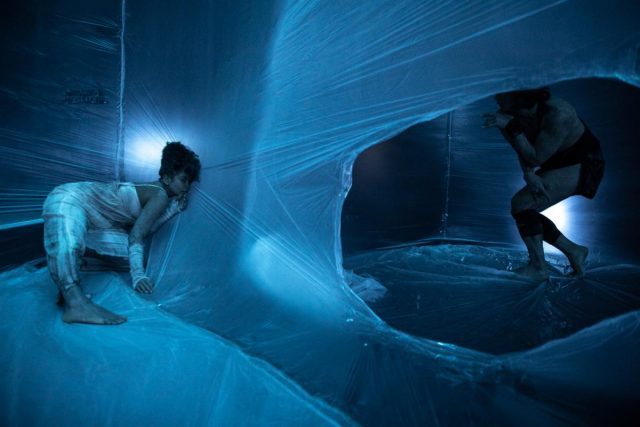
Tuçe Yasak’s Light Journals kicks off raja feather kelly’s Ars Nova Vision Residency

VISION RESIDENCY
Ars Nova
March 20 – April 9, $10 per show
arsnovanyc.com/SUPRA
thefeath3rtheory.com

It’s time to face facts: This is raja feather kelly’s world; we’re only living in it. Kelly is an Obie-winning choreographer, director, artistic director of the feath3r theory, and creative associate at Juilliard who has been involved with such productions as Young Jean Lee’s We’re Gonna Die at Second Stage, Electric Lucifer at the Kitchen, A Strange Loop and If Pretty Hurts Ugly Must Be a Muhfucka at Playwrights Horizons, Fireflies at the Atlantic, and Fairview at Soho Rep and TFANA. In December he premiered his solo performance installation Hysteria in the glassed-in lobby at New York Live Arts, for which he is also making the film Wednesday, a queer-fantasia reimagining of Dog Day Afternoon that he offered a sneak peek of at a wild watch party also in December. He will be bringing back Hysteria for encore performances April 8-10.

Kelly is now curating Ars Nova’s Vision Residency program, featuring presentations by four creators: Tuçe Yasak, Tislarm Bouie, L Morgan Lee, and Emily Wells, running March 20 to April 9. “There is no separation between who these people are as artists and who they are as people. Their work is indelible and one of a kind,” kelly said in a statement. The Ars Nova Supra events begin March 20 with Yasak’s virtual installation Light Journals, inspired by poetry by Rumi, followed March 25 by Bouie’s dance film on Black masculinity, THUG; a reading on April 8 of The Women, the working title of a play in progress, led by L Morgan Lee and kelly as Kirsten Childs, Dane Figueroa Edidi, Donnetta Lavinia Grays, Christine Toy Johnson, Bianca Leigh, Carmen LoBue, and Nia Witherspoon explore what it means to be a woman in today’s society; and, on April 9, kelly & Wells’s Artifact, a listening and viewing party previewing their work-in-progress Album and Opera. Tickets to each show are $10; a monthly subscription to Ars Nova’s Supra digital platform is $15. Kelly is one of seven 2020–21 Vision Residents; the others are Starr Busby, nicHi douglas, JJJJJerome Ellis, Jenny Koons, David Mendizábal, and Rona Siddiqui.