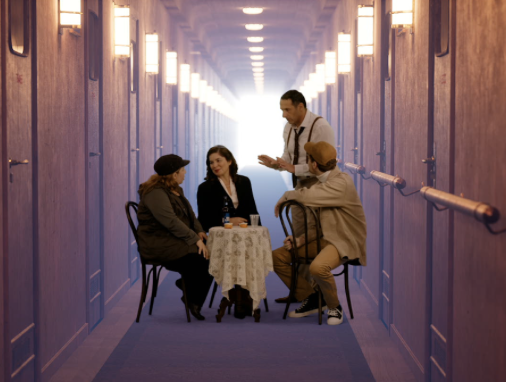
Lauren Elias, Anna Gottlieb, Nathan Malin, and Gene Ravvin on board the virtual MS St. Louis in Witness
Who:Arlekin Players Theatre What: Interactive livestreamed show Where:Zero Gravity (zero-G) Virtual Theater Lab When: December 10 – January 23, $25 Why: Perhaps no other theater company has taken to virtual, interactive productions like Arlekin Players Theatre. The Boston-based troupe first presented the powerful solo show State vs. Natasha Banina, followed by chekhovOS /an experimental game/, which featured Mikhail Baryshnikov, Jessica Hecht, and Darya Denisova, who had played Natasha Banina. Next up for the innovative, forward-thinking company, which incorporates aspects of gaming into its work, is Witness, conceived and directed by Arlekin founder Igor Golyak. The livestreamed, interactive show, developed through Arlekin’s Zero Gravity (zero-G) Virtual Theater Lab, was inspired by the true story of the MS St. Louis, the German ship carrying nearly a thousand Jewish refugees in May 1939 escaping the approaching Holocaust, only to be turned away by Cuba, Canada, and the United States.
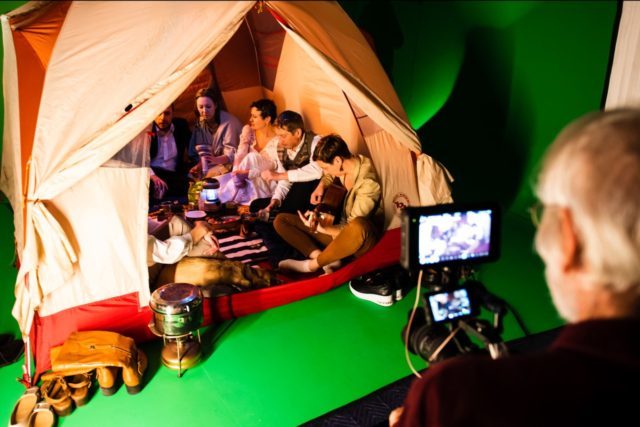
Camera operator Austin de Besche films some of the cast during the making of Witness
Golyak was born in Kiev, but his family moved to Boston when he was eleven to get away from rampant anti-Semitism. He later returned to Russia to study theater. Witness is written by Nana Grinstein with Blair Cadden and Golyak, with scenic design and costumes by Anna Fedorova, virtual design by Daniel Camino, and a live and filmed cast that includes Denisova as Lady Liberty, Gene Ravvin as the emcee, Lauren Elias as Leah, Anne Gottlieb as Rachel, Nathan Malin as Joseph, Polina Vikova as Gisela Klepl, Alex Petetsky as Fritz Buff, and others, along with voice actors. “Where do unwanted people go?” the play asks. It’s a question that is still critical today, given the ongoing immigration crisis. The interactive drama runs December 10 through January 23, with every performance followed by a talkback with members of the cast and creative team and/or experts on Jewish migration. Tickets are $25; several performances are already sold out, so get your tickets now to see the company I’ve called “The future of online productions.”
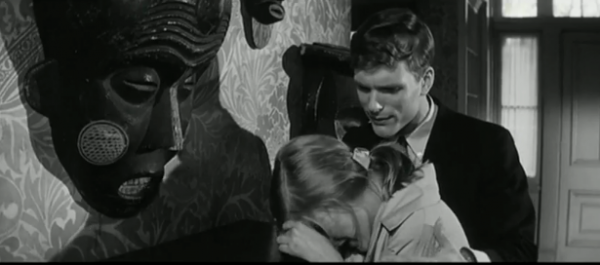
Stephen (Keir Dullea) tries to comfort his sister, Ann (Carol Lynley), in Bunny Lake Is Missing
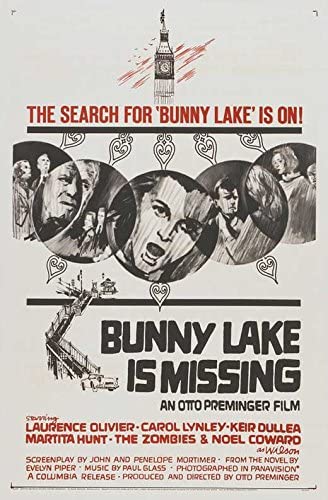
BUNNY LAKE IS MISSING (Otto Preminger, 1965)
Film Forum
209 West Houston St.
Sunday, December 7, $15, 7:00
212-727-8110 filmforum.org
“I had heard all the rumors about Preminger, but I felt he wouldn’t do that to me. I was wrong, oh so wrong,” Keir Dullea told Foster Hirsch in the 2007 biography Otto Preminger: The Man Who Would Be King, referring to the making of the 1965 psychological noir thriller Bunny Lake Is Missing and Preminger’s notorious treatment of actors. “I was playing a crazy character and the director was driving me crazy. . . . About halfway through the shoot, I began to wonder, Who do you have to f&ck to get off this picture?” On December 7, Dullea (2001: A Space Odyssey, David and Lisa) will talk with Hirsch over Zoom following a special screening at Film Forum of the fiftieth anniversary 4K digital restoration of the 1965 work. In the intensely creepy film, loosely based on the novel by Merriam Modell (under the pseudonym Evelyn Piper), Carol Lynley stars as Ann Lake, a young woman who has just moved to London from New York. She drops off her daughter, Bunny, for her first day of school, but when she returns later to pick her up, there is no evidence that the girl was ever there. When Superintendent Newhouse (Laurence Olivier) and his right-hand man, Sergeant Andrews (Clive Revill), begin investigating the case, they are soon wondering whether Bunny really exists, more than hinting that she might be a figment of Ann’s imagination.
Television veteran Lynley, who seemed on the verge of stardom after appearing in such films as Return to Peyton Place, Bunny Lake Is Missing, Shock Treatment, and The Poseidon Adventure but never quite reached that next level, gives one of her best performances as Ann, a tortured woman who is determined to stop her world from unraveling around her. Dullea is a model of efficiency as the cold, direct Stephen, a character invented by Preminger and screenwriters John and Penelope Mortimer. Shot in black-and-white by Denys N. Coop on location in London, the film also features cameos by longtime English actors Martita Hunt, Anna Massey, and Finlay Currie as well as the rock group the Zombies and Noël Coward, who plays Ann’s very kooky landlord, Horatio Wilson. Saul Bass’s titles, in which a hand tears paper as if the story is being ripped from the headlines, set the tense mood right from the start. The ending offers some neat twists but is far too abrupt. “No actor ever peaked with him. How could you?” Dullea added to Hirsch about Preminger (Laura, Stalag 17). “The subtlety that I felt I was able to give to my work in 2001, because Stanley Kubrick created a safe atmosphere where actors were not afraid to be foolish or wrong, was missing on Otto’s set. I don’t hate him; it’s too long ago. But the experience was the most unpleasant I ever had.” It should be quite fascinating to hear more from Dullea and Hirsch on December 7; Hirsch will be on hand to sign copies of his book as well.
COOKING UP (KOSHIRAERU
Japan Society
333 East Forty-Seventh St. at First Ave.
Monday, December 6, $10/$15, 7:30 japansociety.org
Japan Society will present the sixteenth installment of its annual play reading series, “Contemporary Japanese Plays in English Translation,” with Shoko Matsumura’s Cooking Up, directed by Jordana De La Cruz. Originally scheduled for March 2020 and postponed because of the pandemic lockdown, the staged reading will take place December 6 at 7:30. The story, which combines the surreal with naturalism, is set in a restaurant where the pastry chef is missing, the cook is cheating on his wife, and his mistress becomes a housecat. “Every time you think you understand the story line or the plot, something else happens,” the Brooklyn-based De La Cruz (Jack) says in a Japan Society video. “It’s a very intricate play, and it’s powerful, and it talks about isolation and companionship and really makes you think about the people that you have in your corner.”
The Yokohama-born Matsumura (Hanpuku to Junkan ni Fuzui suru Bon’yari no Boken) has acted with Toshiki Okada’s chelfitsch company and founded her own troupe, Momeraths, in 2013. Translated by Amanda Waddell, Cooking Up is part of Japan Society’s fiftieth anniversary celebration honoring New York City woman writers with ties to Japan and will be followed by an audience Q&A with De La Cruz.
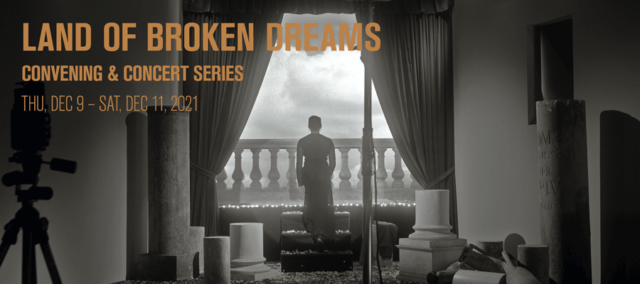
LAND OF BROKEN DREAMS
Park Ave. Armory
643 Park Ave. at Sixty-Seventh St.
Concerts and convenings: December 9-11, $25
Installation: Tuesday – Sunday through December 31, $18 www.armoryonpark.org
As part of Carrie Mae Weems’s “The Shape of Things” monumental multimedia installation at Park Ave. Armory, there will be three days of live music, conversations, and performances that activate the space. Tickets are going fast for the “Land of Broken Dreams” series, which features nighttime concerts by singer-songwriter Somi on December 9, the jazz trio of Vijay Iyer, Arooj Aftab, and Linda May Han Oh on December 10, and Terri Lyne Carrington and Lisa Fischer, whose latest project is “Music for Abolition,” on December 11. Tickets also include admission to a “Daytime Convening” from 1:00 to 7:00, with pop-up performances by more than 150 artists in the Wade Thompson Drill Hall, the Board of Officers Room, the Veterans Room, and the Colonels Room.
Among those participating are photographer Dawoud Bey, tap dancer Maurice Chestnut, painter Torkwase Dyson, theater director Scott Elliott, Reggie “Regg Roc” Gray and the D.R.E.A.M. Ring, philanthropist Agnes Gund, poet, playwright, and novelist Carl Hancock Rux, dancer and choreographer Francesca Harper, musician and author Nona Hendryx, civil rights leader Ben Jealous, interdisciplinary artist Rashid Johnson, visual artist Joan Jonas, set designer Christine Jones, artist Deborah Kass, painter Julie Mehretu, cultural theorist, poet, and scholar Fred Moten, visual artist Shirin Neshat, curator, critic, and art historian Hans Ulrich Obrist, multimedia installation artist Tony Oursler, poet, essayist, playwright, and editor Claudia Rankine, sculptor Alyson Shotz, conceptual artist Hank Willis Thomas, performance artist Carmelita Tropicana, rapper, actor, and Roots MC Tariq Trotter, author Quincy Troupe, director Whitney White, and the Peace Poets. You might just have to move in to the armory for seventy-two hours so you don’t miss a minute of what promises to be a memorable event.
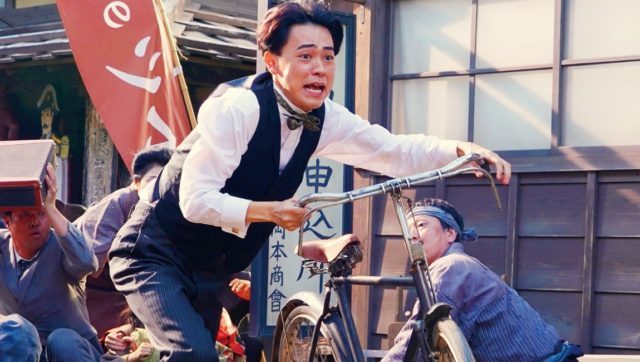
Masayuki Suo takes the audience on a wild ride in Talking the Pictures
FLASH FORWARD
Japan Society online and in-person
333 East 47th St. at First Ave.
December 3-23, free – $10 online for three-day rental, $15 in person December 11 & 17, 7:00
212-715-1258 www.japansociety.org
Japan Society and the ACA Cinema Project (Agency for Cultural Affairs, Government of Japan) follow up their inaugural festival, “21st Century Japan: Films from 2001-2020,” with “Flash Forward: Debut Works and Recent Films by Notable Japanese Directors,” running December 3-23 online and in person.
The three-week series highlights the work of six established Japanese directors, pairing their debut with a more recent film. Available on demand as a three-day rental for ten dollars or fifteen dollars per bundle are Naomi Kawase’s 1997 Cannes Camera d’Or-winning Suzaku and 2018 Vision, Miwa Nishikawa’s 2003 Wild Berries and 2016 The Long Excuse, Shuichi Okita’s 2009 The Chef of South Polar and 2020 Ora, Ora Be Goin’ Alone, Junji Sakamoto’s 1989 Knockout and 2016 The Projects (see review below), and Masayuki Suo’s 1989 Fancy Dance and 2019 Talking the Pictures. Akihiko Shiota’s 1999 Moonlight Whispers was supposed to be teamed up with his 2019 Farewell Song but will not be shown because of music rights issues; it has been replaced by his fourth film, the 2002 drama Harmful Insect.
The “Filmmakers on the Rise” section comprises recent works by six directors who might be part of “Flash Forward” if it were held again in 2040: Masakazu Kaneko 2016 The Albino’s Trees, Yuko Hakota’s 2019 Blue Hour, Omoi Sasaki’s 2017 A Boy Sato, Eisuke Naito’s Forgiven Children, Kyoko Miyake’s 2013 My Atomic Aunt, and Hiroshi Okuyama’s 2019 Jesus. These films are available for free on demand. Also free are two online talks, “Conversations with the Filmmakers,” with Kawase, Nishikawa, Okita, Sakamoto, Shiota, and Suo, and the panel discussion “Debut Works and Beyond,” with Columbia assistant professor Takuya Tsunoda, UCLA assistant professor Junko Yamazaki, and writer, curator, and filmmaker Jasper Sharp, moderated by Yale professor Aaron Gerow.
Two in-person screenings at Japan Society celebrate the late master Sadao Yamanaka, who made more than two dozen films in the 1930s, few of which survive, before dying in Manchuria in 1938 at the age of twenty-eight. On December 11 at 7:00, a new 4K restoration of Yamanaka’s 1935 Tange Sazen and the Pot Worth a Million Ryo will have its North American premiere, followed December 17 at 7:00 by the international premiere of the 4K restoration of Yamanaka’s 1936 Priest of Darkness.
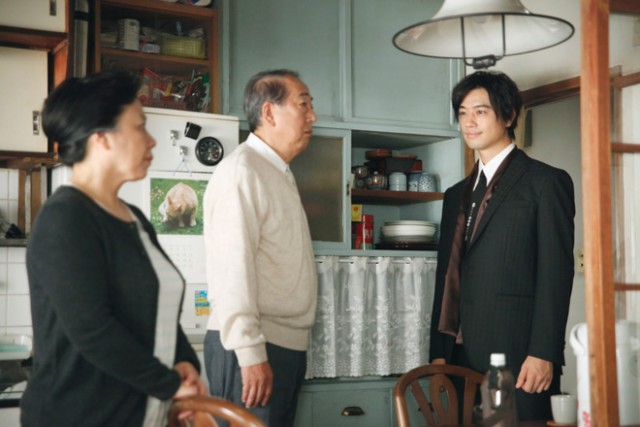
Hinako (Naomi Fujiyama) and Seiji Yamashita’s (Ittoku Kishibe) lives change once again with the return of Shinjo (Takumi Saitoh) in The Projects
“Nothing is impossible in a housing project,” several people say in Junji Sakamoto’s delightfully absurdist and downright weird black comedy The Projects, which made its North American debut at Japan Society’s tenth annual Japan Cuts Festival in 2016. Elderly couple Hinako (Naomi Fujiyama) and Seiji Yamashita (Ittoku Kishibe) have moved to an inexpensive suburban Osaka housing project, known as a danchi, after closing their popular herbal remedies shop following the tragic death of their son, Naoya. The couple lives quietly, unable to process their grief or move forward, but they’re back in business when one of their strangest customers, the well-dressed, oddly speaking Shinjo (Takumi Saitoh), tracks them down and essentially demands, in his calm, direct manner, that they begin making his special remedy again. Meanwhile, Seiji, who would rather be left alone, is dragged into the race for head of the tenant association, running against Gyotoku (Renji Ishibashi), who is having an affair with a younger resident and is married to Kimiko (Michiyo Okusu), who is obsessed with properly separating the danchi’s garbage, and young upstart Yoshizumi (Takayuki Takuma), who is not afraid to discipline his son, Kitaro (Hiroaki Ogasawara), in full view of his neighbors. After Seiji loses, he decides to hide from everyone, retreating under the floorboards whenever someone stops by, which leads a gossiping group of ladies (Hikaru Horiguchi, Yukari Taki, Mayu Harada, Mari Hamada, and Miyako Takeuchi) to believe that Hinako has actually killed her husband and chopped up the body. As the media and police get involved, things get crazier and crazier as the totally bizarre conclusion approaches.
Fujiyama and Kishibe are absolutely charming as the Yamashitas, moving and talking with a sweetly warm, slow demeanor, asking little from a life that has let them down. Sakamoto wrote The Projects specifically for comedian and stage actress Fujiyama; the two last worked together on the award-winning 2000 film Face, Fujiyama’s first film, and the pairing is another marvel. Fujiyama is wonderful in the role, imbuing Hinako with a wry, very funny sense of humor that is splendidly complemented by Kishibe’s more serious Seiji. Lovingly shot by Ryo Ohtsuka and featuring a playful score by Gorô Yasukawa, The Projects is pure fun all the way through, with many laugh-out-loud moments even as it deals with some heavy subjects, right up to its out-of-this-world finale. Don’t let the title fool you; “projects” in Japan were much-desired apartment complexes originally built in the 1950s to supply suburban public housing for the growing post-WWII Japanese population. Although they are not as popular today, they are not the kind of projects associated with drugs and crime in America. The Projects is paired with Sakamoto’s 1989 debut, Knockout(Dotsuitarunen), in “Flash Forward: Debut Works and Recent Films by Notable Japanese Directors.”
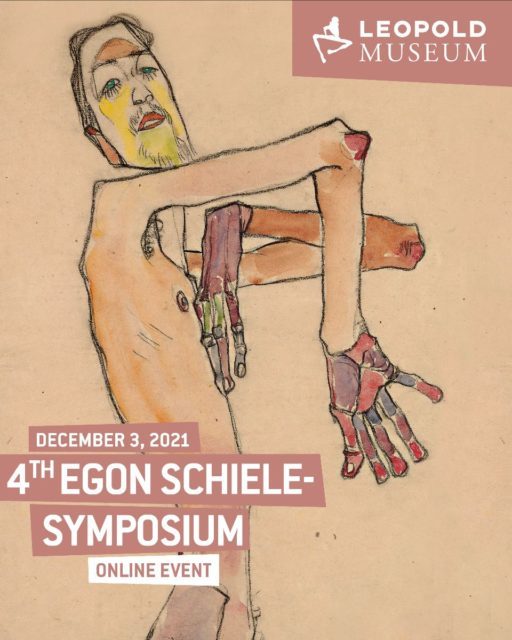
Who: Hans-Peter Wipplinger, Verena Gamper, Franz Smola, Sandra Tretter, Elisabeth Leopold, Elisabeth Dutz, Christian Bauer, Jane Kallir, Gemma Blackshaw, Stefan Kutzenberger, Karin Maierhofer, Sandra Maria Dzialek What: Fourth Egon Schiele Symposium Where:Leopold Museum online When: Friday, December 3, free with advance RSVP, 3:45 – 11:30 am Why: The Leopold Museum, whose Egon Schiele collection comprises 42 paintings, 184 watercolors, drawings, and prints, and numerous writings and miscellaneous texts, will be hosting its fourth Egon Schiele Symposium on December 3, streaming live from Vienna beginning at 3:45 am EST. Interest in Schiele, who died in 1918 at the age of twenty-eight of the Spanish flu, has continued to grow over the last decade, from a centennial exhibition at St. Galerie Etienne to the documentary Portrait of Wally to John Kelly’s remounting of his one-man show Pass the Blutwurst, Bitte.
The symposium, the first of which was held in 2016, features twelve presentations, including one in English by Galerie St. Etienne head and Kallir Research Institute director Jane Kallir, “Reconfiguring Gender: Egon Schiele and the Gay Subculture.” If, like me, you miss Kallir’s extraordinary essays about the gallery’s exhibits, her talk should be a special treat. Below is the full schedule; the symposium will be available for on-demand viewing following the livestream, which will have an interactive Zoom chat.
9:45 am: Welcoming Remarks, with Leopold Museum director Hans-Peter Wipplinger and Leopold Museum Research Center head Verena Gamper
10:00 am: Egon Schiele’s Painting Jugendströmung [Current of Youth] – New Findings About Schiele’s Contribution at the International Art Show Vienna 1909, with Österreichische Galerie Belvedere curator Franz Smola
10:30 am: Gustav Klimt and Egon Schiele at the Vienna Art Show in Berlin 1916, with Klimt Foundation deputy director Sandra Tretter
11:00 am: “I Went Through Klimt”: On Egon Schiele’s Painting Hermits and the Faculty Paintings of Gustav Klimt, with Elisabeth Leopold of the Leopold Museum Private Foundation
11:30 am: Schiele’s Death Masks – New Findings of the Ongoing Research at the Albertina’s Egon Schiele Archive, with Albertina curator Elisabeth Dutz
1:30 pm: The Body Electric: Erwin Osen – Egon Schiele, with Leopold Museum Research Center head Verena Gamper
2:00 pm: Erwin Dominik Osen: An Approach, with Egon Schiele Museum curator Christian Bauer
2:30 pm: Reconfiguring Gender: Egon Schiele and the Gay Subculture (English), with Kallir Research Institute director Jane Kallir
3:00 pm: “Dear Curator …”: Correspondence as Care for Erwin Osen’s Lustknabe [Catamite] (English), with art historian and curator Gemma Blackshaw and architectural historian and artist Adam Kaasa
4:00 pm: Blue Lady in Green Nature: A Workshop Report from Silicon Valley – Egon Schiele and Artificial Intelligence, with writer, curator, and literary scholar Stefan Kutzenberger
4:30 pm: Egon Schiele’s Painting Young Mother – Insights into the Research and Restoration Project, with Wien Museum restorer Karin Maierhofer
5:00 pm: Egon Schiele’s Towns – the Leopold Museum Holdings from a Material-Technology Perspective, with Leopold Museum restorer Sandra Maria Dzialek
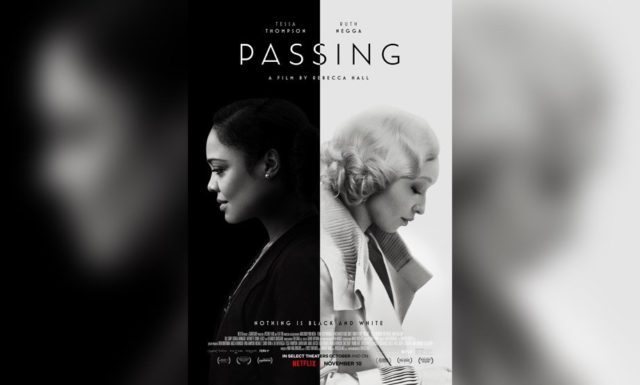
Who: Rebecca Hall, Ruth Negga, André Holland, David Nugent What:Screening and conversation Where:92nd St. Y, 1395 Lexington Ave. at 92nd St., Buttenwieser Hall and 92Y online When: Friday, December 3, $25 in person, 6:30; $20 online, 8:20 Why: In her directorial debut, Passing, award-winning actress Rebecca Hall (Vicky Cristina Barcelona,Machinal) makes her father, the late Sir Peter Hall of the RSC and the National Theatre, proud. The black-and-white Netflix drama stars Tessa Thompson as Irene “Reenie” Redfield, a Black woman living in Harlem who meets up with an old friend, Clare Kendry (Ruth Negga), who is living her life passing as a white woman. Although Reenie is uncomfortable with Clare’s decision, she takes advantage of certain situations where she can pass as well. As Clare starts spending more time with Reenie, her secret threatens to be exposed. Set during the Harlem Renaissance, the tense, beautifully photographed Passing, based on Nella Larsen’s 1929 novel, also features André Holland as Reenie’s husband, Brian Redfield, Alexander Skarsgård as Clare’s bigoted spouse, John Bellew, and Bill Camp as Hugh Wentworth, a friend and mentor to Reenie. On December 3, the 92nd St. Y is hosting a rescheduled hybrid event in which the Ethiopian-Irish Negga (Loving,Shirley), Alabama-born Holland (Selma,Moonlight), and London native Hall will screen and discuss the film with Hamptons International Film Festival artistic director David Nugent at Buttenwieser Hall; the conversation can be livestreamed beginning at 8:20.