9000 Paper Balloons tries to bridge the distance between generations
Who: Maiko Kikuchi and Spencer Lott What: A Contemporary Puppet Theater Piece Where:Japan Society, 333 East Forty-Seventh St. at First Ave. When: October 28–30, $30 Why: During WWII, Japan employed Fu-Go balloon bombs, hydrogen balloons made of paper or rubberized silk that carried incendiary devices and an anti-personnel explosive, launching more than nine thousand from Honsho in 1944-45 with the express purpose of flying across the Pacific Ocean and starting forest fires on the West Coast of the United States. American puppeteer Spencer Lott and Japanese animator Maiko Kikuchi share the true tale of this little-remembered weapon in 9000 Paper Balloons, making its in-person world premiere October 28–30 at Japan Society; Lott will portray his grandfather, a navigator on a US bomber plane, while Kikuchi will play her grandfather, who fought for Japan and was a prisoner of war.
“Distance is definitely a central theme to the play, the distance between our generation and our grandfathers, the difference between America and Japan, the distance between a fighter jet and a paper balloon,” Lott said in a statement. “We know that war capitalizes on that distance, both real and perceived. War is a throughline in our play, but our central question is, How can we collapse the distance between us? We are witnessing moments in 2022 that remind us that the distance between our generation and the WWII generation may not be all that distant after all.”
The play, which was presented virtually by HERE in November 2021, is told in the form of a ghost story, with live-feed cameras, animation projections, masks, dioramas, and more than one hundred puppets, with a fascinating behind-the-scenes look at how it’s all done as the narrative unfolds; it is directed by Aya Ogawa, who was most recently at Japan Society with their intimate and personal The Nosebleed, in which they played their own father and son. The October 28 performance will be followed by a reception with the creators, and the October 29 show will conclude with an artist Q&A.
“Because of a war, one that happened eighty years ago, there is a gap between us and our grandfathers and this gap exists in so many families, this play is our desperate attempt to collapse the distance between us and our grandparents,” Kikuchi and Lott have also said. “We aren’t pretending that this puppet show is going to end conflict or AAPI violence, but in a world that is heavy with social and political strife, we think it’s a good opportunity to gather in the dark, together as a community, and share a remarkable story that is as much about ingenuity as it is war.”
Eyes of Laura Mars is part of fashionable Machine Dazzle film series at MAD
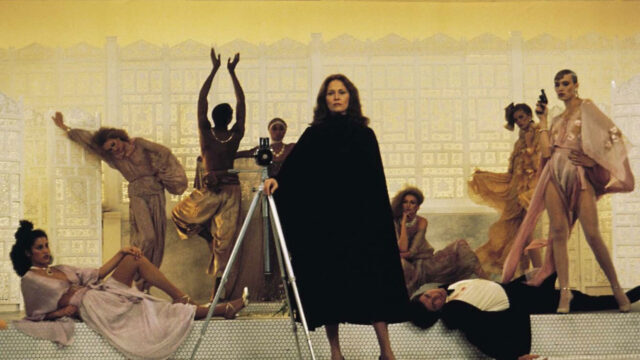
Who:Machine Dazzle What:Movie Night with Machine Where: The Theater at MAD, Museum of Arts & Design, 2 Columbus Circle at 58th St. & Eighth Ave. When: October 25 & 27, December 20, January 10, $10, 7:00 Why: Walking around the Museum of Arts and Design exhibition “Queer Maximalism x Machine Dazzle” is like wandering through a glorious movie set, with colorful costumes and artworks that tell one heckuva bizarre story; you fully expect the mannequins to suddenly come to life and enter this surreal world. The retrospective of the work of performance artist Machine Dazzle, on view through February 19, is supplemented with a film series hosted by the queer experimental theater genius, born Matthew Flower in Upper Darby, Pennsylvania, in 1972, consisting of movies that influenced him as a child of the 1970s and ’80s. It kicked off October 13 with the epic Clash of the Titans and continues October 25 with Robert Wise’s underrated Star Trek: The Motion Picture (can’t wait to hear what Machine will have to say about the Federation uniforms!) and October 27 with Irvin Kershner’s tense neo-noir thriller Eyes of Laura Mars, about a glamorous fashion photographer who is being stalked by a serial killer; the cast includes Faye Dunaway, Tommy Lee Jones, Brad Dourif, René Auberjonois, and Raúl Juliá, and one scene takes place in Columbus Circle, where the museum moved in 2008.
Machine will be on hand to introduce the screening and participate in a discussion afterward; it should be too much fun listening to him talk about the costumes and scenery, and there will be giveaways, costume contests, custom-designed step-and-repeats, photoshoots, and other cool stuff. Be sure to come back December 20 for Robert Greenwald’s Xanadu, when we can all pay tribute to the late Olivia Newton-John and celebrate Machine’s fiftieth birthday, followed January 10 by Guy Hamilton’s Agatha Christie adaptation Evil Under the Sun, featuring Peter Ustinov as Detective Hercule Poirot and also starring Maggie Smith, Jane Birkin, James Mason, Roddy McDowall, and Diana Rigg. In addition, on November 8 from 9:00 am to 1:00 pm, the museum will host “Teacher Workshop: Activism and the Art of Machine Dazzle,” comprising a curator-led tour, an art workshop, and refreshments.
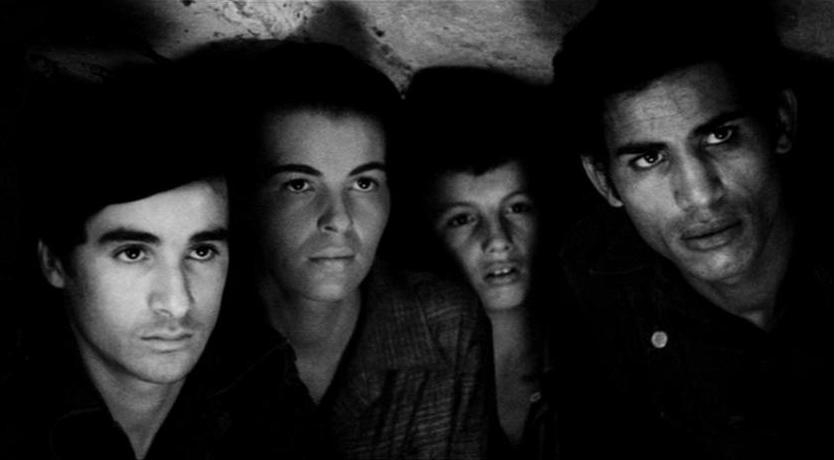
Members of the FLN hide from French paratroops in Gillo Pontecorvo’s neo-Realist classic The Battle of Algiers
THE BATTLE OF ALGIERS (Gillo Pontecorvo, 1966)
Aaron Davis Hall
160 Convent Ave.
Thursday, October 27, free with RSVP, 6:00
Series continues monthly through May 11 citycollegecenterforthearts.org
Curated by the great Dr. Jerry Carlson, longtime host of the television show City Cinematheque, City College’s free “Decolonizing Movies: Un-Tarzan Series” believes that “movies were never innocent in the colonial enterprise. Yet brave filmmakers continue to push back and create alternative decolonizing visions.” The series opened September 29 with Ousmane Sembène’s Black Girls and returns October 27 with a screening of Italian director Gillo Pontecorvo’s The Battle of Algiers.
In Pontecorvo’s gripping neo-Realist war thriller, a reporter asks French paratroop commander Lt. Col. Mathieu (Jean Martin), who has been sent to the Casbah to derail the Algerian insurgency, about an article Jean-Paul Sartre had just written for a Paris paper. “Why are the Sartres always born on the other side?” Mathieu says. “Then you like Sartre?” the reporter responds. “No, but I like him even less as a foe,” Mathieu coolly answers. In 1961, French existentialist Sartre wrote in the preface to Frantz Fanon’s Wretched of the Earth, the seminal tome on colonialism and decolonialism, “In Algeria and Angola, Europeans are massacred at sight. It is the moment of the boomerang; it is the third phase of violence; it comes back on us, it strikes us, and we do not realize any more than we did the other times that it’s we that have launched it,” referring to European colonization. “There are those among [the oppressed creatures] who assert themselves by throwing themselves barehanded against the guns; these are their heroes. Others make men of themselves by murdering Europeans, and these are shot down; brigands or martyrs, their agony exalts the terrified masses. Yes, terrified; at this fresh stage, colonial aggression turns inward in a current of terror among the natives. By this I do not only mean the fear that they experience when faced with our inexhaustible means of repression but also that which their own fury produces in them. They are cornered between our guns pointed at them and those terrifying compulsions, those desires for murder which spring from the depth of their spirits and which they do not always recognize; for at first it is not their violence, it is ours, which turns back on itself and rends them; and the first action of these oppressed creatures is to bury deep down that hidden anger which their and our moralities condemn and which is however only the last refuge of their humanity. Read Fanon: you will learn how, in the period of their helplessness, their mad impulse to murder is the expression of the natives’ collective unconscious.” Sartre’s brutally honest depiction of colonialism serves as a perfect introduction to Pontecorvo’s film, made five years later and then, unsurprisingly, banned in France. (In 1953, the Martinique-born Fanon, who fought for France in WWII, moved to Algeria, where he became a member of the National Liberation Front; French authorities expelled him from the country in 1957, but he kept working for the FLN and Algeria up to his death in 1961. For more on The Wretched of the Earth, see the documentary Concerning Violence: Nine Scenes from the Anti-Imperialistic Self-Defense.)
Terrorism and counterinsurgency take to the streets in Oscar-nominated THE BATTLE OF ALGIERS
In The Battle of Algiers, Pontecorvo (Kapò, Burn!) and screenwriter Franco Solinas follow a small group of FLN rebels, focusing on the young, unpredictable Ali la Pointe (Brahim Haggiag) and the more calm and experienced commander, El-hadi Jafar (Saadi Yacef, playing a character based on himself; the story was also inspired by his book Souvenirs de la Bataille d’Alger). Told in flashback, the film takes viewers from 1954 to 1957 as Mathieu hunts down the FLN leaders while the revolutionaries stage strikes, bomb public places, and assassinate French police. Shot in a black-and-white cinema-vérité style on location by Marcello Gatti — Pontecorvo primarily was a documentarian — The Battle of Algiers is a tense, powerful work that plays out like a thrilling procedural, touching on themes that are still relevant fifty years later, including torture, cultural racism, media manipulation, terrorism, and counterterrorism. It seems so much like a documentary — the only professional actor in the cast is Martin — that it’s hardly shocking that the film has been used as a primer for the IRA, the Black Panthers, the Pentagon, and military and paramilitary organizations on both sides of the colonialism issue, although Pontecorvo is clearly on the side of the Algerian rebels. However, it does come as a surprise that the original conception was a melodrama starring Paul Newman as a Western journalist.
All these years later, The Battle of Algiers, which earned three Oscar nominations (for Best Foreign Language Film in 1967 and Best Director and Best Original Screenplay in 1969) and underwent a 4K restoration for its fiftieth anniversary, still has a torn-from-the-headlines urgency that makes it as potent as ever. “Decolonizing Movies: Un-Tarzan Series” continues November 12 with Tomás Gutiérrez Alea’s The Last Supper, December 7 with Robert M. Young’s The Ballad of Gregorio Cortez, and January 26 with Lino Brocka’s Manila in the Claws of Light.
Who: Al Pacino What: Benefit screening and Q&A for the Actors Studio Where:United Palace Theatre, 4140 Broadway at 175th St. When: Thursday, October 27, $35-$1000, 7:00 Why: The Actors Studio is celebrating its seventy-fifth anniversary with a special event at United Palace Theatre on October 27 at 7:00, a screening of Sidney Lumet’s classic Brooklyn-set drama Dog Day Afternoon, followed by a conversation with the star of the film and current Actors Studio copresident, Al Pacino. “This incredible institution, founded by Elia Kazan, Cheryl Crawford, and Robert Lewis, followed by Lee Strasberg, has left an indelible mark on the world of film and theater,” the East Harlem-born Pacino said in a statement. “It’s where actors are given the freedom to take chances and explore their work and craft. Anyone can audition for the Actors Studio. I’m surprised more people don’t know that. Once an actor becomes a member of the Actors Studio, it doesn’t cost anything, it’s totally free, and membership is for life. It’s going to be a great night at the United Palace. I look forward to watching Dog Day Afternoon and engaging, live, with an audience of New Yorkers, some who will be seeing it for the first time and others who will be seeing it for the first time in years.”
The 1975 film, based on a true story, earned six Oscar nominations, including Pacino for Best Actor, and won one statuette, for Frank Pierson’s original screenplay. Pacino stars as Sonny Wortzik, who leads a bank robbery with his friends Sal (John Cazale) and Stevie (Gary Springer) for a very special reason; the cast also features Chris Sarandon, Carol Kane, Lance Henriksen, Judith Malina, Dominic Chianese, James Broderick, Penelope Allen, and Charles Durning. Tickets for the event range from $35 to $1000; the other copresidents of the Actors Studio, the home of Method acting, are Alec Baldwin and Ellen Burstyn. “There are actors all over the world [who] regardless of their circumstances, professional or personal, regardless of whatever difficulties they are facing, whatever problems or changes — there is one thing they can rely on and that is that eleven o’clock on Tuesday and Friday mornings come rain, shine, snow, or what have you there is a session in the Actors Studio. And the fact that actors can count on that, that they know that that exists, can help them get through,” longtime studio artistic director Strasberg, who played Hyman Roth in The Godfather II opposite Pacino’s Michael Corleone, explained once upon a time.
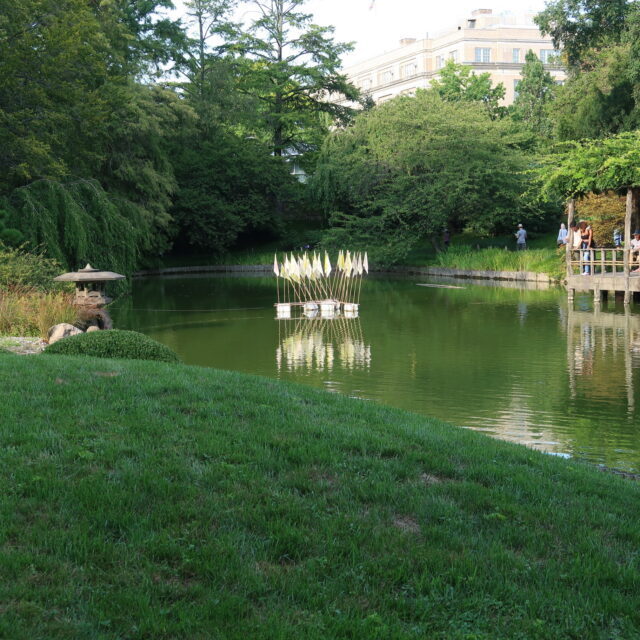
Chen Chen & Kai Williams’s Blue Heron Triangle floats on the Brooklyn Botanic Garden’s Japanese pond (photo by twi-ny/mdr)
FOR THE BIRDS
Brooklyn Botanic Garden
900 Washington Ave. at Eastern Parkway
Through October 23, $25-$30 (children under twelve free), 10:00 am – 6:00 pm
718-623-7200 www.bbg.org/forthebirds online slideshow
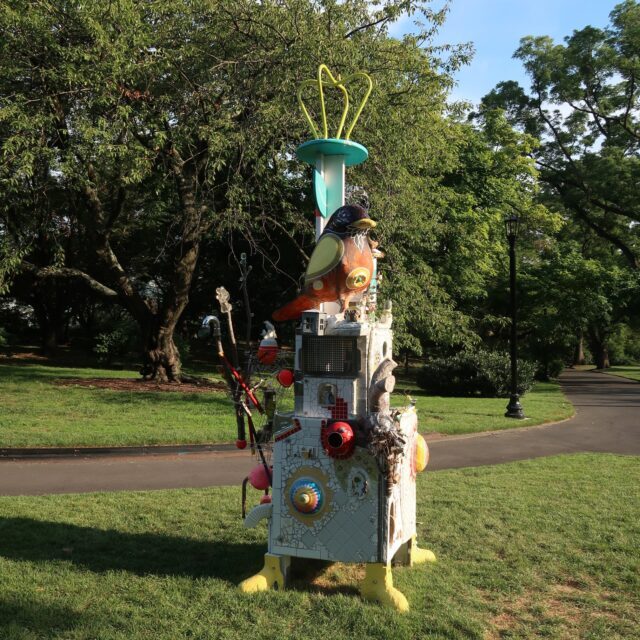
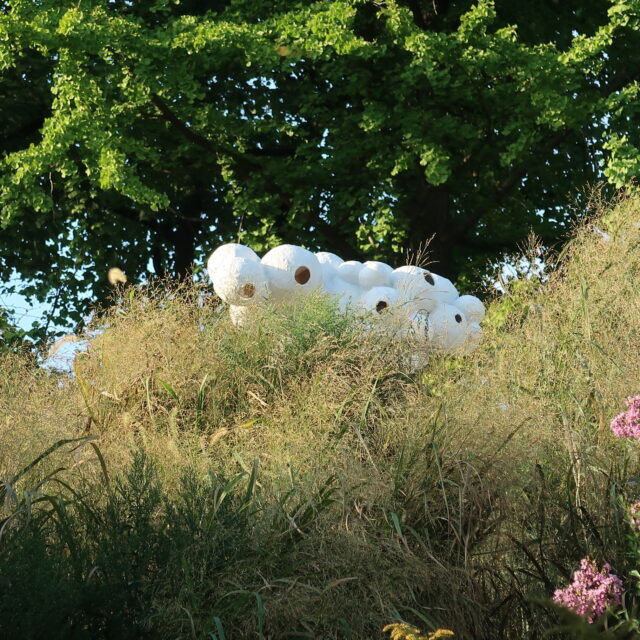
One of the most delightful outdoor exhibits of the year is “For the Birds,” concluding this weekend at the Brooklyn Botanic Garden. The show consists of more than three dozen birdhouses created by artists, architects, and others, placed throughout the garden’s fifty-two-acre expanse. Even with a map, finding each creation can be a bit like a treasure hunt as you make your way through the Native Flora Garden, Japanese Hill-and-Pond Garden, Magnolia Plaza, Ginkgo Allée, Shakespeare Garden, Bluebell Wood, Herb Garden, Belle’s Brook, Rose Garden, Bamboo Grove, Cherry Esplanade, and other lovely locations.
Each birdhouse is accompanied by a sign identifying the title, artist, and materials and including a brief background on the work. A Palace for the Eastern Bluebird by SO – IL, Dalma Földesi, Jung In Seo, and Eventscape was “inspired by the intricate and haphazard way that birds weave their nests. We chose to make a birdhouse made of 3D-printed clay because it can produce textures evocative of woven structures. We are interested in seeing how birds, particularly the eastern bluebird, will interact with this kind of material. We hope that the earth tones of the clay will be highly attractive to them.”
Kevin Quiles Bonilla’s Pal’ campo honors his Puerto Rican heritage (photo by twi-ny/mdr)
Nina Cooke John’s Oh Robin! “is an abstracted interpretation of the robin’s act of nest weaving. Robins have become invisible to us, like the grocery store cashier, Amazon delivery worker, bus driver, and other workers who are critical to the running of our city but have faded into the background of our lives. The robin shows us its scrappiness by making its nest almost anywhere.” Tom Sachs says about his contribution, Swiss, a red plywood version with a white Swiss cross, “To find home or shelter in Switzerland is the dream. If those damn birds are so above it all, why not let them share our burden? Let’s ground the birds in that reality.”
Andy Holden’s The Auguries, a kind of miniature avian sculpture park, was made by cast resin from 3D prints of waveforms created by recordings of rare bird songs. Shun Kinoshita + Charlap Hyman & Herrero’s simply named Birdhouse “is for all birds, including the spirits of birds long gone.” Kevin Quiles Bonilla’s dazzling Pal’ campo honors his family home in Puerto Rico and explores “the idea of both birds and humans as migrating beings, the memories we keep during our travels, and the notion of what home is to those who move from one place to another.”
Julie Peppito’s United Birds of America (E Pluribus Unum) is a condo of curiosities (photo by twi-ny/mdr)
Others pay tribute to the downy woodpecker, the Carolina wren, little bluestem grass, Olivier Messiaen’s use of birdsong in his compositions, scarecrows, the blue heron, the barn owl, and others while taking on climate change and extinction, envisioning birdhouses as safe havens and sanctuaries.
Many of the birdhouses are beautiful works of art all by themselves. Chen Chen & Kai Williams’s Blue Heron Triangle floats on a raft constructed of bamboo reeds tied to empty plastic containers. Sourabh Gupta’s woven offers multiple birds a place to gather. Jessica Maffia’s A Home for Flickers features a trompe l’oeil blue sky with clouds and surreal hands emerging as if holding out protection. Also look out for Pat McCarthy’s Batloft, Joey’s Coop, Babylon Coop, Niknak’s City Cart, funkmaster George Clinton’s Come Fly, Flock Together, Barry McGee’s Untitled, Luam Melake’s Descendants, Suchi Reddy’s The Nest Egg, Amy Ritter’s Safe Space, and Julie Peppito’s wildly engaging United Birds of America (E Pluribus Unum), “one big bird condo [that is] a metaphor for the United States, because we must learn to live together or divided we fall,” a robotlike form filled with tiny delights.
Sourabh Gupta’s woven hides out in BBG’s Overlook (photo by twi-ny/mdr)
In addition, most of the birdhouses are accompanied by a tune as part of the Birdsong Project, curated by Randall Poster, with specially selected songs by Michael Penn, Balmorhea, Kurt Vile, Dan Deacon, Uwade, Terry Riley, Suzzy Roche, Loudon Wainwright III, Laurie Anderson, Beck, and others. “So while in quarantine, I became much more aware of the birds and the birdsong around me,” Poster explains on the website. “I spent a lot of time listening to the birds singing. I was not alone. It was something that we began to talk about. The beauty of birds, the joy and mysteries of birdsong. Given that the situation in the fall of 2020 was sad, strange, and frightening, as plagues tend to be, this fascination with the birds was a magical distraction. Thank God for the birds. . . . And so we are building a community, joined to celebrate and protect the birds. We are birds.”
Finally, as They Might Be Giants advised once upon a time, “Make a little birdhouse in your soul.”
The Rubin’s Mandala Lab is an immersive experience that explores anger, attachment, envy, ignorance, and pride (photo courtesy Rubin Museum of Art)
FREE EXHIBITION TOUR: MANDALA LAB ANNIVERSARY
Rubin Museum of Art
150 West 17th St. at Seventh Ave.
Friday, October 21, free, 7:15
212-620-5000 rubinmuseum.org
The Rubin Museum is celebrating the one-year anniversary of its interactive Mandala Lab with a guided tour on October 21 at 7:15 as part of its weekly free K2 Friday Night, which also includes tabla player DJ Roshni Samlal, access to all galleries, and a special cocktail menu.
In Buddhism, the mandala is a symbolic image of the universe, a painting, scroll, or sand sculpture that offers the ability to contemplate transformation and enlightenment. The Mandala Lab, subtitled “Where Emotions Can Turn to Wisdom,” consists of four quadrants of experiences that explore five afflictive emotions, or kleshas — anger, envy, pride, ignorance, and attachment — through multiple senses, each associated with a color and an element, either earth, air, fire, water, or space. The project design was inspired by the Rubin’s seventeenth-century Tibetan Sarvavid Vairochana Mandala, which contains circles and squares, the Five Wisdom Buddhas, and representations of earthly elements. “All great art helps us see each other from the inside out. But Buddhist art goes a step further,” Rubin head of programs Dawn Eshelman explains in a promotional video. “It provides a kind of visual to help us survive in uncertain times.”
In “Check Your Pride,” you place a token in a slot with such statements as “I think I am better than others” or “I feel proud of achievements I haven’t earned” while standing in front of a mirror. Palden Weinreb’s Untitled (Coalescence) gives you the chance to let go of envy by sitting on a cushion and breathing in time with a circular light sculpture that dims and glows. A touch screen allows you to share your thoughts on ignorance.
Attachment is tied to smell in an installation comprising six stations featuring videos by a half dozen visual artists accompanied by a corresponding scent. Each short video about personal memories, made by Laurie Anderson (Uncle Allen), Sanford Biggers (Joanin Temple for Mandala Lab), Tenzin Tsetan Choklay (1994), Amit Dutta (The Scent of Earth), Wang Yahui (The Smell of a Rice Field), and Apichatpong Weerasethakul (Waterfall), features a related scent created by master perfumer Christophe Laudamiel that you get to guess at the end of the two-minute film.
You can bang away your anger in a gong orchestra, for which composers and musicians Billy Cobham, Sheila E., Peter Gabriel, Dame Evelyn Glennie, Sarah Hennies, Huang Ruo, Shivamani, and Bora Yoon have chosen eight unique gongs and mallets, manufactured by Ryan Shelledy or Matt Nolan and made of brass, bronze, or silver nickel, that visitors are invited to activate, following these instructions: “1. Imagine your anger. 2. Gently strike the gong in front of you one time using the mallet to the right. 3. Raise the handle to the left to partially submerge the gong in the water. 4. Listen to the sound of your anger transform. 5. Let the sound fade, and for an added challenge, watch the water return to stillness. 6. When finished, lower the handle to return the gong back to its starting position.”
While at the Rubin, be sure to see the other exhibitions as well: “Gateway to Himalayan Art,” “The Tibetan Buddhist Shrine Room,” “Tales of Muted Spirits — Dispersed Threads — Twisted Shangri-La,” “Healing Practices: Stories from Himalayan Americans,” “Shrine Room Projects: Rohini Devasher/Palden Weinreb,” and “Masterworks: A Journey Through Himalayan Art.”
In his seminal 1972 book Ways of Seeing, British essayist, novelist, and cultural thinker John Berger writes, “According to usage and conventions which are at last being questioned but have by no means been overcome, the social presence of a woman is different in kind from that of a man. A man’s presence is dependent upon the promise of power which he embodies. . . . The promised power may be moral, physical, temperamental, economic, social, sexual — but its object is always exterior to the man. A man’s presence suggests what he is capable of doing to you or for you. . . . By contrast, a woman’s presence expresses her own attitude to herself, and defines what can and cannot be done to her. Her presence is manifest in her gestures, voice, opinions, expressions, clothes, chosen surroundings, taste — indeed there is nothing she can do which does not contribute to her presence. Presence for a woman is so intrinsic to her person that men tend to think of it as an almost physical emanation, a kind of heat or smell or aura.”
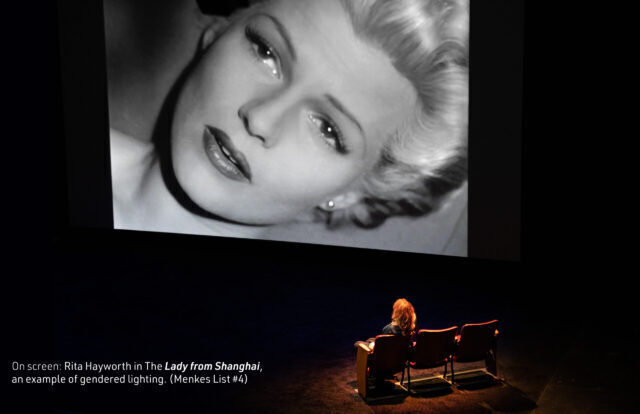
American filmmaker Nina Menkes forever changes the way you’ll see and experience movies in her eye-opening documentary Brainwashed: Sex-Camera-Power. “As a filmmaker and as a woman, I found myself drowning in a powerful vortex of visual language from which it is very difficult to escape,” she explains at the beginning of the film, an adaptation of her illustrated lecture “Sex and Power: The Visual Language of Oppression.” Producer and director Menkes, whose filmography includes Queen of Diamonds,Magdalena Viraga, and Dissolution, speaks with sixteen women and two men and shows clips from more than one hundred and twenty-five films as she reveals how much the movie industry is reliant on the male gaze, creating fantasy spaces that celebrate men while objectifying women.
Dartmouth filmmaker and faculty member Iyabo Kwayana posits, “I think we have to consider that it is through the formal visual language that we are effectively communicating meaning, and we inherit so much subliminally that comes from this language and it has to do with how shots are composed and framed, how they’re assembled and ordered in a sequence of shots. All of that becomes the grammar and syntax by which meaning is conveyed to a viewer. So in a visual culture such as ours, in which there is a ravenous appetite towards the female as object, if the camera is predatory, then the culture is predatory as well.”
Menkes divides her talk into five sections that comprise what she calls “The List”: “Subject/Object,” “Framing,” “Camera Movement,” “Lighting,” and “Narrative Position.” Among the films she examines are The Lady from Shanghai,Super Fly,Contempt,Carrie,Lost in Translation,Cuties,Crazy Rich Asians,Sleeping Beauty,Do the Right Thing,Blade Runner 2049, and The Silence of the Lambs, revealing how ingrained it is to depict men and women differently, what Transparent producer, writer, and director Joey Soloway calls “propaganda for patriarchy.” Director and activist Maria Giese adds, “Hollywood has been the worst violator of Title VII [part of the 1964 Civil Rights Act] of any industry in the United States — even worse than coal mining.”
Actress Rosanna Arquette shares the abuse she suffered at the hands of Harvey Weinstein as well as the regrets she has about a nude scene she did in After Hours. Menkes includes nude scenes throughout the film, involving Brigitte Bardot, Jane Fonda, Nicole Kidman, and many other familiar stars, describing how they can be “attacks on our selfhood.” She demonstrates how the use of slow motion focuses on a woman’s erotic sensuality but a man’s power and violence. Menkes also explores how the depiction of women on celluloid impacts sexual abuse.
Global Media Center for Social Impact founder Sandra de Castro Buffington asks, “How is rape culture normalized? There are really three key elements that we see on the screen and in real life. One is the objectification of women’s bodies. Another is the glamorization of sexual assault, especially on the screen. And the third is disregard for women’s rights and safety, even if a hand is not laid on another person. These are all of the elements that create an environment that allows one group to gain and maintain power over another.”
California State University faculty member Rhiannon Aarons expounds, “I think this visual language really contributes to female self-hatred and insecurity in a way that is not insignificant. What is normalized as beauty is really seen specifically and dominantly through a male gaze. I think that really changes how we relate in the world in general and not necessarily in the best way.”
Menkes spends extra time delving into such films as Raging Bull,Bombshell, and Mandingo, demonstrating how women’s voices are silenced and power dynamics are ingrained in visual storytelling. She uses a critical scene from Portrait of a Lady on Fire to display how director Céline Sciamma exposes that subject-object power dynamic and turns it around. Among the other women providing important insight are psychoanalyst Dr. Sachiko Take-Reece, writer Jodi Lampert, UCLA Film and Television Archive director May Hong HaDuong, intimacy coordinator Ita O’Brien, producer-director Amy Ziering, cinematographer Nancy Schreiber, author Maya Montanez Smukler, film theorist Laura Mulvey, filmmakers Julie Dash, Eliza Hittman, Catherine Hardwicke, and Penelope Spheeris, and foley artist and activist Lara Dale, who said no to sexual exploitation, effectively ending her career as an actress. Two snippets from a “Sex and Power Talk Discussion” at the California Institute of the Arts feel extraneous, but every other minute of Brainwashed is riveting.
The film is insightfully edited by Cecily Rhett and smartly shot by Shana Hagan, with a compelling score by Sharon Farber; Menkes purposely hired women to head the major departments, something she points out that Oscar-winning director Kathryn Bigelow did not do on The Hurt Locker.
Reflecting on her 2007 feature Phantom Love, Menkes says, “All of my own narrative fiction films have been centrally concerned with expressing the abject feminine — and the wound that is carried deep inside.” We still have a long way to go to heal that wound, but Brainwashed sets us on a path to affect the way we see and interpret cinema. As actor and comedian Charlyne Li tells us, “There’s a saying that people say that if people were to get rid of all the sexual predators that there would be no film industry.”
Brainwashed opens October 20 at DCTV’s Firehouse Cinema, with Q&As with Menkes at the 7:00 screenings on October 20 (moderated by critic and podcaster Violet Lucca) and October 21 and with Geise and director and programmer Dara Messinger on October 22.