this week in lectures, signings, panel discussions, workshops, and Q&As

DECOLONIZING MOVIES — THE UN-TARZAN SERIES: THE BATTLE OF ALGIERS

THE BATTLE OF ALGIERS

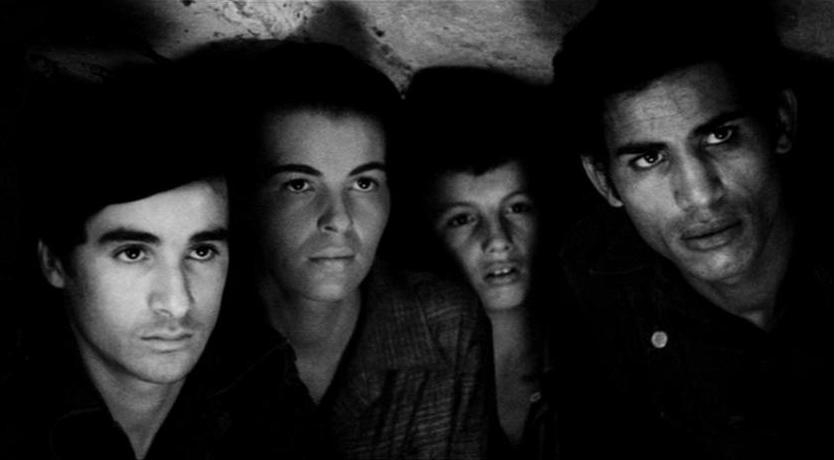
Members of the FLN hide from French paratroops in Gillo Pontecorvo’s neo-Realist classic The Battle of Algiers

THE BATTLE OF ALGIERS (Gillo Pontecorvo, 1966)
Aaron Davis Hall
160 Convent Ave.
Thursday, October 27, free with RSVP, 6:00
Series continues monthly through May 11
citycollegecenterforthearts.org

Curated by the great Dr. Jerry Carlson, longtime host of the television show City Cinematheque, City College’s free “Decolonizing Movies: Un-Tarzan Series” believes that “movies were never innocent in the colonial enterprise. Yet brave filmmakers continue to push back and create alternative decolonizing visions.” The series opened September 29 with Ousmane Sembène’s Black Girls and returns October 27 with a screening of Italian director Gillo Pontecorvo’s The Battle of Algiers.

In Pontecorvo’s gripping neo-Realist war thriller, a reporter asks French paratroop commander Lt. Col. Mathieu (Jean Martin), who has been sent to the Casbah to derail the Algerian insurgency, about an article Jean-Paul Sartre had just written for a Paris paper. “Why are the Sartres always born on the other side?” Mathieu says. “Then you like Sartre?” the reporter responds. “No, but I like him even less as a foe,” Mathieu coolly answers. In 1961, French existentialist Sartre wrote in the preface to Frantz Fanon’s Wretched of the Earth, the seminal tome on colonialism and decolonialism, “In Algeria and Angola, Europeans are massacred at sight. It is the moment of the boomerang; it is the third phase of violence; it comes back on us, it strikes us, and we do not realize any more than we did the other times that it’s we that have launched it,” referring to European colonization. “There are those among [the oppressed creatures] who assert themselves by throwing themselves barehanded against the guns; these are their heroes. Others make men of themselves by murdering Europeans, and these are shot down; brigands or martyrs, their agony exalts the terrified masses. Yes, terrified; at this fresh stage, colonial aggression turns inward in a current of terror among the natives. By this I do not only mean the fear that they experience when faced with our inexhaustible means of repression but also that which their own fury produces in them. They are cornered between our guns pointed at them and those terrifying compulsions, those desires for murder which spring from the depth of their spirits and which they do not always recognize; for at first it is not their violence, it is ours, which turns back on itself and rends them; and the first action of these oppressed creatures is to bury deep down that hidden anger which their and our moralities condemn and which is however only the last refuge of their humanity. Read Fanon: you will learn how, in the period of their helplessness, their mad impulse to murder is the expression of the natives’ collective unconscious.” Sartre’s brutally honest depiction of colonialism serves as a perfect introduction to Pontecorvo’s film, made five years later and then, unsurprisingly, banned in France. (In 1953, the Martinique-born Fanon, who fought for France in WWII, moved to Algeria, where he became a member of the National Liberation Front; French authorities expelled him from the country in 1957, but he kept working for the FLN and Algeria up to his death in 1961. For more on The Wretched of the Earth, see the documentary Concerning Violence: Nine Scenes from the Anti-Imperialistic Self-Defense.)
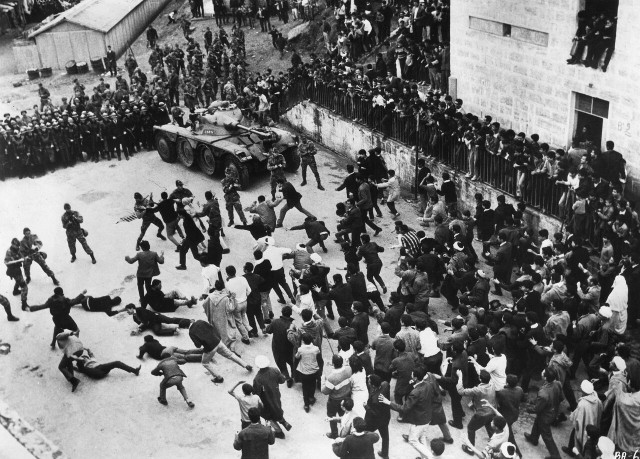
Terrorism and counterinsurgency take to the streets in Oscar-nominated THE BATTLE OF ALGIERS

Terrorism and counterinsurgency take to the streets in Oscar-nominated THE BATTLE OF ALGIERS

In The Battle of Algiers, Pontecorvo (Kapò, Burn!) and screenwriter Franco Solinas follow a small group of FLN rebels, focusing on the young, unpredictable Ali la Pointe (Brahim Haggiag) and the more calm and experienced commander, El-hadi Jafar (Saadi Yacef, playing a character based on himself; the story was also inspired by his book Souvenirs de la Bataille d’Alger). Told in flashback, the film takes viewers from 1954 to 1957 as Mathieu hunts down the FLN leaders while the revolutionaries stage strikes, bomb public places, and assassinate French police. Shot in a black-and-white cinema-vérité style on location by Marcello Gatti — Pontecorvo primarily was a documentarian — The Battle of Algiers is a tense, powerful work that plays out like a thrilling procedural, touching on themes that are still relevant fifty years later, including torture, cultural racism, media manipulation, terrorism, and counterterrorism. It seems so much like a documentary — the only professional actor in the cast is Martin — that it’s hardly shocking that the film has been used as a primer for the IRA, the Black Panthers, the Pentagon, and military and paramilitary organizations on both sides of the colonialism issue, although Pontecorvo is clearly on the side of the Algerian rebels. However, it does come as a surprise that the original conception was a melodrama starring Paul Newman as a Western journalist.

All these years later, The Battle of Algiers, which earned three Oscar nominations (for Best Foreign Language Film in 1967 and Best Director and Best Original Screenplay in 1969) and underwent a 4K restoration for its fiftieth anniversary, still has a torn-from-the-headlines urgency that makes it as potent as ever. “Decolonizing Movies: Un-Tarzan Series” continues November 12 with Tomás Gutiérrez Alea’s The Last Supper, December 7 with Robert M. Young’s The Ballad of Gregorio Cortez, and January 26 with Lino Brocka’s Manila in the Claws of Light.


ACTORS STUDIO BENEFIT: DOG DAY AFTERNOON WITH AL PACINO

Who: Al Pacino
What: Benefit screening and Q&A for the Actors Studio
Where: United Palace Theatre, 4140 Broadway at 175th St.
When: Thursday, October 27, $35-$1000, 7:00
Why: The Actors Studio is celebrating its seventy-fifth anniversary with a special event at United Palace Theatre on October 27 at 7:00, a screening of Sidney Lumet’s classic Brooklyn-set drama Dog Day Afternoon, followed by a conversation with the star of the film and current Actors Studio copresident, Al Pacino. “This incredible institution, founded by Elia Kazan, Cheryl Crawford, and Robert Lewis, followed by Lee Strasberg, has left an indelible mark on the world of film and theater,” the East Harlem-born Pacino said in a statement. “It’s where actors are given the freedom to take chances and explore their work and craft. Anyone can audition for the Actors Studio. I’m surprised more people don’t know that. Once an actor becomes a member of the Actors Studio, it doesn’t cost anything, it’s totally free, and membership is for life. It’s going to be a great night at the United Palace. I look forward to watching Dog Day Afternoon and engaging, live, with an audience of New Yorkers, some who will be seeing it for the first time and others who will be seeing it for the first time in years.”

The 1975 film, based on a true story, earned six Oscar nominations, including Pacino for Best Actor, and won one statuette, for Frank Pierson’s original screenplay. Pacino stars as Sonny Wortzik, who leads a bank robbery with his friends Sal (John Cazale) and Stevie (Gary Springer) for a very special reason; the cast also features Chris Sarandon, Carol Kane, Lance Henriksen, Judith Malina, Dominic Chianese, James Broderick, Penelope Allen, and Charles Durning. Tickets for the event range from $35 to $1000; the other copresidents of the Actors Studio, the home of Method acting, are Alec Baldwin and Ellen Burstyn. “There are actors all over the world [who] regardless of their circumstances, professional or personal, regardless of whatever difficulties they are facing, whatever problems or changes — there is one thing they can rely on and that is that eleven o’clock on Tuesday and Friday mornings come rain, shine, snow, or what have you there is a session in the Actors Studio. And the fact that actors can count on that, that they know that that exists, can help them get through,” longtime studio artistic director Strasberg, who played Hyman Roth in The Godfather II opposite Pacino’s Michael Corleone, explained once upon a time.

K2 FRIDAY NIGHT FREE EXHIBITION TOUR: MANDALA LAB ANNIVERSARY

The Rubin’s Mandala Lab is an immersive experience that explores anger, attachment, envy, ignorance, and pride (photo courtesy Rubin Museum of Art)

FREE EXHIBITION TOUR: MANDALA LAB ANNIVERSARY
Rubin Museum of Art
150 West 17th St. at Seventh Ave.
Friday, October 21, free, 7:15
212-620-5000
rubinmuseum.org

The Rubin Museum is celebrating the one-year anniversary of its interactive Mandala Lab with a guided tour on October 21 at 7:15 as part of its weekly free K2 Friday Night, which also includes tabla player DJ Roshni Samlal, access to all galleries, and a special cocktail menu.

In Buddhism, the mandala is a symbolic image of the universe, a painting, scroll, or sand sculpture that offers the ability to contemplate transformation and enlightenment. The Mandala Lab, subtitled “Where Emotions Can Turn to Wisdom,” consists of four quadrants of experiences that explore five afflictive emotions, or kleshas — anger, envy, pride, ignorance, and attachment — through multiple senses, each associated with a color and an element, either earth, air, fire, water, or space. The project design was inspired by the Rubin’s seventeenth-century Tibetan Sarvavid Vairochana Mandala, which contains circles and squares, the Five Wisdom Buddhas, and representations of earthly elements. “All great art helps us see each other from the inside out. But Buddhist art goes a step further,” Rubin head of programs Dawn Eshelman explains in a promotional video. “It provides a kind of visual to help us survive in uncertain times.”

In “Check Your Pride,” you place a token in a slot with such statements as “I think I am better than others” or “I feel proud of achievements I haven’t earned” while standing in front of a mirror. Palden Weinreb’s Untitled (Coalescence) gives you the chance to let go of envy by sitting on a cushion and breathing in time with a circular light sculpture that dims and glows. A touch screen allows you to share your thoughts on ignorance.

Attachment is tied to smell in an installation comprising six stations featuring videos by a half dozen visual artists accompanied by a corresponding scent. Each short video about personal memories, made by Laurie Anderson (Uncle Allen), Sanford Biggers (Joanin Temple for Mandala Lab), Tenzin Tsetan Choklay (1994), Amit Dutta (The Scent of Earth), Wang Yahui (The Smell of a Rice Field), and Apichatpong Weerasethakul (Waterfall), features a related scent created by master perfumer Christophe Laudamiel that you get to guess at the end of the two-minute film.

You can bang away your anger in a gong orchestra, for which composers and musicians Billy Cobham, Sheila E., Peter Gabriel, Dame Evelyn Glennie, Sarah Hennies, Huang Ruo, Shivamani, and Bora Yoon have chosen eight unique gongs and mallets, manufactured by Ryan Shelledy or Matt Nolan and made of brass, bronze, or silver nickel, that visitors are invited to activate, following these instructions: “1. Imagine your anger. 2. Gently strike the gong in front of you one time using the mallet to the right. 3. Raise the handle to the left to partially submerge the gong in the water. 4. Listen to the sound of your anger transform. 5. Let the sound fade, and for an added challenge, watch the water return to stillness. 6. When finished, lower the handle to return the gong back to its starting position.”

While at the Rubin, be sure to see the other exhibitions as well: “Gateway to Himalayan Art,” “The Tibetan Buddhist Shrine Room,” “Tales of Muted Spirits — Dispersed Threads — Twisted Shangri-La,” “Healing Practices: Stories from Himalayan Americans,” “Shrine Room Projects: Rohini Devasher/Palden Weinreb,” and “Masterworks: A Journey Through Himalayan Art.”

BRAINWASHED: SEX-CAMERA-POWER

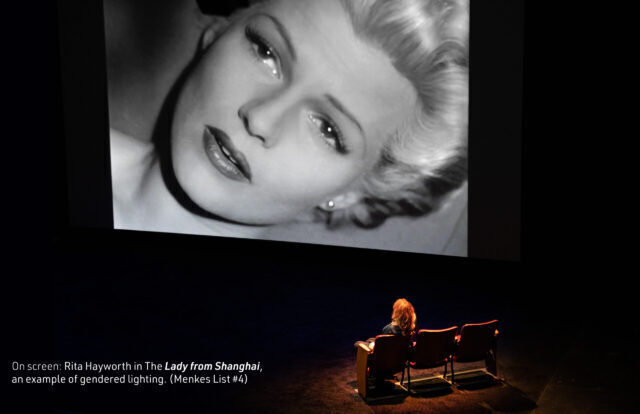
Nina Menkes delves into such films as The Lady from Shanghai in Brainwashed

BRAINWASHED: SEX-CAMERA-POWER (Nina Menkes, 2022)
DCTV’s Firehouse Cinema
87 Lafayette St.
Opens Thursday, October 20
firehouse.dctvny.org
www.brainwashedmovie.com

In his seminal 1972 book Ways of Seeing, British essayist, novelist, and cultural thinker John Berger writes, “According to usage and conventions which are at last being questioned but have by no means been overcome, the social presence of a woman is different in kind from that of a man. A man’s presence is dependent upon the promise of power which he embodies. . . . The promised power may be moral, physical, temperamental, economic, social, sexual — but its object is always exterior to the man. A man’s presence suggests what he is capable of doing to you or for you. . . . By contrast, a woman’s presence expresses her own attitude to herself, and defines what can and cannot be done to her. Her presence is manifest in her gestures, voice, opinions, expressions, clothes, chosen surroundings, taste — indeed there is nothing she can do which does not contribute to her presence. Presence for a woman is so intrinsic to her person that men tend to think of it as an almost physical emanation, a kind of heat or smell or aura.”

American filmmaker Nina Menkes forever changes the way you’ll see and experience movies in her eye-opening documentary Brainwashed: Sex-Camera-Power. “As a filmmaker and as a woman, I found myself drowning in a powerful vortex of visual language from which it is very difficult to escape,” she explains at the beginning of the film, an adaptation of her illustrated lecture “Sex and Power: The Visual Language of Oppression.” Producer and director Menkes, whose filmography includes Queen of Diamonds, Magdalena Viraga, and Dissolution, speaks with sixteen women and two men and shows clips from more than one hundred and twenty-five films as she reveals how much the movie industry is reliant on the male gaze, creating fantasy spaces that celebrate men while objectifying women.

Dartmouth filmmaker and faculty member Iyabo Kwayana posits, “I think we have to consider that it is through the formal visual language that we are effectively communicating meaning, and we inherit so much subliminally that comes from this language and it has to do with how shots are composed and framed, how they’re assembled and ordered in a sequence of shots. All of that becomes the grammar and syntax by which meaning is conveyed to a viewer. So in a visual culture such as ours, in which there is a ravenous appetite towards the female as object, if the camera is predatory, then the culture is predatory as well.”

Menkes divides her talk into five sections that comprise what she calls “The List”: “Subject/Object,” “Framing,” “Camera Movement,” “Lighting,” and “Narrative Position.” Among the films she examines are The Lady from Shanghai, Super Fly, Contempt, Carrie, Lost in Translation, Cuties, Crazy Rich Asians, Sleeping Beauty, Do the Right Thing, Blade Runner 2049, and The Silence of the Lambs, revealing how ingrained it is to depict men and women differently, what Transparent producer, writer, and director Joey Soloway calls “propaganda for patriarchy.” Director and activist Maria Giese adds, “Hollywood has been the worst violator of Title VII [part of the 1964 Civil Rights Act] of any industry in the United States — even worse than coal mining.”

Actress Rosanna Arquette shares the abuse she suffered at the hands of Harvey Weinstein as well as the regrets she has about a nude scene she did in After Hours. Menkes includes nude scenes throughout the film, involving Brigitte Bardot, Jane Fonda, Nicole Kidman, and many other familiar stars, describing how they can be “attacks on our selfhood.” She demonstrates how the use of slow motion focuses on a woman’s erotic sensuality but a man’s power and violence. Menkes also explores how the depiction of women on celluloid impacts sexual abuse.

Global Media Center for Social Impact founder Sandra de Castro Buffington asks, “How is rape culture normalized? There are really three key elements that we see on the screen and in real life. One is the objectification of women’s bodies. Another is the glamorization of sexual assault, especially on the screen. And the third is disregard for women’s rights and safety, even if a hand is not laid on another person. These are all of the elements that create an environment that allows one group to gain and maintain power over another.”

California State University faculty member Rhiannon Aarons expounds, “I think this visual language really contributes to female self-hatred and insecurity in a way that is not insignificant. What is normalized as beauty is really seen specifically and dominantly through a male gaze. I think that really changes how we relate in the world in general and not necessarily in the best way.”

Menkes spends extra time delving into such films as Raging Bull, Bombshell, and Mandingo, demonstrating how women’s voices are silenced and power dynamics are ingrained in visual storytelling. She uses a critical scene from Portrait of a Lady on Fire to display how director Céline Sciamma exposes that subject-object power dynamic and turns it around. Among the other women providing important insight are psychoanalyst Dr. Sachiko Take-Reece, writer Jodi Lampert, UCLA Film and Television Archive director May Hong HaDuong, intimacy coordinator Ita O’Brien, producer-director Amy Ziering, cinematographer Nancy Schreiber, author Maya Montanez Smukler, film theorist Laura Mulvey, filmmakers Julie Dash, Eliza Hittman, Catherine Hardwicke, and Penelope Spheeris, and foley artist and activist Lara Dale, who said no to sexual exploitation, effectively ending her career as an actress. Two snippets from a “Sex and Power Talk Discussion” at the California Institute of the Arts feel extraneous, but every other minute of Brainwashed is riveting.

The film is insightfully edited by Cecily Rhett and smartly shot by Shana Hagan, with a compelling score by Sharon Farber; Menkes purposely hired women to head the major departments, something she points out that Oscar-winning director Kathryn Bigelow did not do on The Hurt Locker.

Reflecting on her 2007 feature Phantom Love, Menkes says, “All of my own narrative fiction films have been centrally concerned with expressing the abject feminine — and the wound that is carried deep inside.” We still have a long way to go to heal that wound, but Brainwashed sets us on a path to affect the way we see and interpret cinema. As actor and comedian Charlyne Li tells us, “There’s a saying that people say that if people were to get rid of all the sexual predators that there would be no film industry.”

Brainwashed opens October 20 at DCTV’s Firehouse Cinema, with Q&As with Menkes at the 7:00 screenings on October 20 (moderated by critic and podcaster Violet Lucca) and October 21 and with Geise and director and programmer Dara Messinger on October 22.

TALES FROM THE GIMLI HOSPITAL (REDUX)

TALES FROM THE GIMLI HOSPITAL

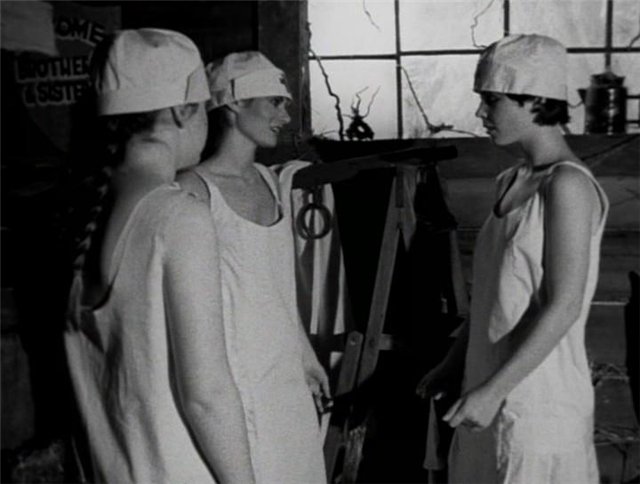
A trio of nurses deal with a deadly epidemic in early Guy Maddin cult classic, Tales form the Gimli Hospital

TALES FROM THE GIMLI HOSPITAL (REDUX) (Guy Maddin, 1988/2022)
IFC Center
323 Sixth Ave. at West Third St.
Opens Friday, October 14
212-924-7771
www.ifccenter.com
zeitgeistfilms.com

In a 2011 twi-ny talk focusing on a “reframed” version of his 1988 debut feature, Tales from the Gimli Hospital, Canadian director Guy Maddin said, “I thought, of all the films of mine that might actually thematically justify a revisiting from the director (something that truly ought not to be done under almost any circumstances!), then this was the title.” Well, Maddin has done it again with a 4K restoration of the film, which he is now calling Tales from the Gimli Hospital (Redux), featuring some trimming as well as the addition of a long-lost scene.

The Canadian DIY master reached into Icelandic sagas for the original, ultra-low-budget version. In many ways a kind of Scandinavian Frankenstein as if directed by Ingmar Bergman and George A. Romero, the mostly black-and-white Expressionist film is a story within a story (at times within another story) that an old woman, Amma (Margaret Anne MacLeod), is telling her grandchildren (Heather and David Neale) in a hospital room where their mother lies very ill. The dark, lurid fairy tale, set in “a Gimli we no longer know,” is about Einar the Lonely (assistant director Kyle McCulloch), a shy fish smoker who does not know how to relate to other people, particularly women. Felled by an epidemic, he is brought to the Gimli Hospital in Manitoba, where other men battle this dread disease, which leaves stitchlike scars on their face and body. Einar is discouraged that the patient in the bed next to him, the portly Gunnar (Michael Gottli), is treated much nicer by the nurses than he is, but he is helpless to do anything about it. Gunnar is soon telling Einar the story of his true love, Snjófridur (Angela Heck), a tragic tale with a surprising twist that brings everything full circle.

A unique visual stylist who regularly pays homage to the early days of cinema, Maddin, who directed and edited the picture (and wrote the script on Post-it Notes), purposely keeps things low-tech, including less-than-perfect sound dubbing and bumpy cuts, incorporating freak-show-like oddities alongside an ominous lo-fi soundtrack with old songs; Maddin (My Winnipeg, Careful) himself plays the weirdo surgeon who operates on Gunnar and Einar in rather strange fashion. The intentionally amateurish nature of the original work led to its being rejected by the Toronto International Film Festival (TIFF) for ineptitude; it went on to become an instant cult classic, holding the midnight-movie slot at the Quad for nearly a year. In 2011, Maddin, who is part Icelandic, reimagined the film in the special Performa presentation Tales from the Gimli Hospital: Reframed, a reedited version with a live score by Icelandic musicians. Tales from the Gimli Hospital (Redux), a 4K restoration that premiered at TIFF 2022, goes a few steps further.

“The new scene was shot in 1999 as an after-the-fact deleted scene as a way of celebrating a cast reunion after a serious car accident injured the actor Michael Gottli,” Maddin explains. “The act of shooting this scene was intended as a kind of rehab therapy for my dispirited thespian. But it turned out quite well, I think. It is inserted early on in the feature, during the scene in the hospital when a primitive Punch and Judy puppet show is deployed as an anesthetic distraction to a patient (Gottli) having his leg operated on by a man wielding a sickle. Such puppet shows were the only anesthetic available in the pioneer days of Gimli. The new scene suggests to the patient a hallucinated tale of gender transformation and some lusty BDSM involving yet another man with a fish net. I had promised Gottli I would insert this ‘deleted scene’ into the body of the feature if I ever got the chance.”

This stunning new iteration opens theatrically October 14 at IFC, preceded by Maddin’s dazzling six-minute award-winning TIFF short The Heart of the World, about science battling religion and two brothers in love with the same woman as the end of the planet approaches, with the director on hand for Q&As following the 8:10 shows on Friday and Saturday night. Maddin is both fascinating and fun to listen to, so snag your tickets now for what promises to be a special event.

BEING FUTURE BEING: LAND/CELESTIAL and INSIDE/OUTWARDS

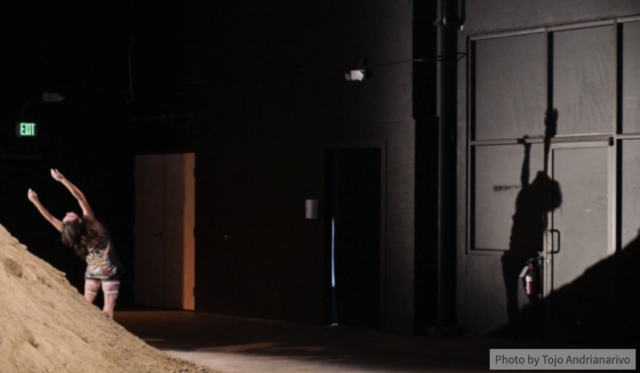
Emily Johnson’s Being Future Being comes to New York Live Arts October 20-22

Who: Emily Johnson/Catalyst
What: Being Future Being
Where: New York Live Arts, 219 West 19th St., 212-727-7476
When: Land/Celestial: October 15, $10-$30, 3:00 & 5:00; Inside/Outwards: October 20-23, $15-$40, 7:30
Why: In a July 2021 illustrated lecture to students at the Bates Dance Festival in Maine, where she was presenting the outdoor section of her work in progress Being Future Being, maker, gatherer, and protector Emily Johnson (Yup’ik) said, “We spent a lot of time in class earlier today thinking of the ground lifting up with us and also thinking about how we are always in relationship to the ground and thinking about ways in which we might be in better ongoing relationship with ground, with land, with water, with air, with relations. And from that I want to say that one day, the civil rights and sovereignty of Indigenous peoples will be recognized in relation to land, and that power imbalance and extraction will not be the default relationship in our working lives, and that theft of and abuses on and lack of recognition of Indigenous land and water and peoples will not be tolerated. And that’s the kind of future I look forward to making with all of you; that’s the kind of future I enjoy being in already with all of you.”

In such participatory works as Then a Cunning Voice and a Night We Spend Gazing at Stars, Shore, and The Ways We Love and the Ways We Love Better — Monumental Movement Toward Being Future Being(s) in addition to her Kinstillatory Mappings series outside Abrons Arts Center, Johnson, a Bessie Award-winning dancer, choreographer, curator, writer, and social justice activist, brings people together with the land and its history, taking on power imbalance and extraction by forming communities organized around the local environment.

Emily Johnson gathers people together for The Ways We Love and the Ways We Love Better — Monumental Movement Toward Being Future Being(s) in September 2020 (photo by twi-ny/mdr)

Johnson’s Being Future Being: Inside/Outwards will hold its Lenapehoking premiere October 20-22 at New York Live Arts, featuring a commissioned score by composer Raven Chacon (Navajo), sound by Chloe Alexandra Thompson (Cree), visual design by Holly Mititquq Nordlum (Iñupiaq), masks and wearables by IV Castellanos (mx Indige Quechua/Guaraní), Quilt-Beings by Korina Emmerich (Coast Salish Territory, Puyallup tribe), quilts by Maggie Thompson (Fond du Lac Ojibwe), costumes by Raphael Regan (Sisseton-Wahpeton Eastern Band of Cherokee and Diné), scenic fabrication by Joseph Silovsky, and lighting by Itohan Edoloyi. The piece will be performed by Ashley Pierre-Louis, Jasmine Shorty (Diné), Stacy Lynn Smith, and Sugar Vendil.

In addition, on October 15 there will be a special offsite performance, Land/Celestial, in Lower Manhattan; ticket holders will be advised of the specific location that day. As a whole, the creation of Being Future Being has involved four groups of collaborators, which Johnson refers to as the Branch of Knowledge, the Branch of Scholarship, the Branch of Making, and the Branch of Action. Johnson will be joined by individuals from the four branches at a Stay Late discussion following the October 21 show.

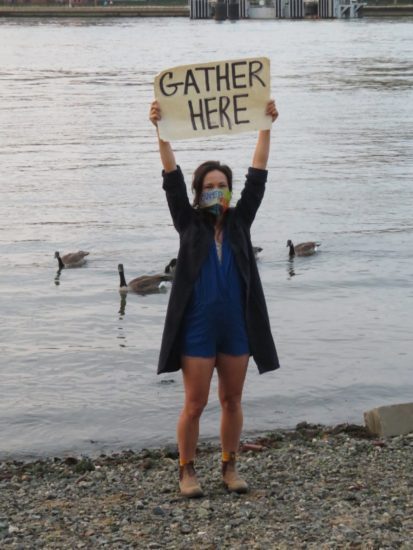
“The work asks audiences to join in community processes that move from each presentation out into the world in what I call the Speculative Architecture of the Overflow, with actions that directly support local rematriative, protection, and Land Back efforts,” Johnson explains on her website. “The Overflow is resonance, moving in the in-between, in-the-collective, in-the-invitation to GATHER HERE. Can the Overflow become supported, beyond the moment of the performance gathering, a speculative architecture resisting BUILD, but living, ongoing in an otherwise?” Johnson always asks intriguing, important questions, but the ultimate answers will have to come from each one of us.