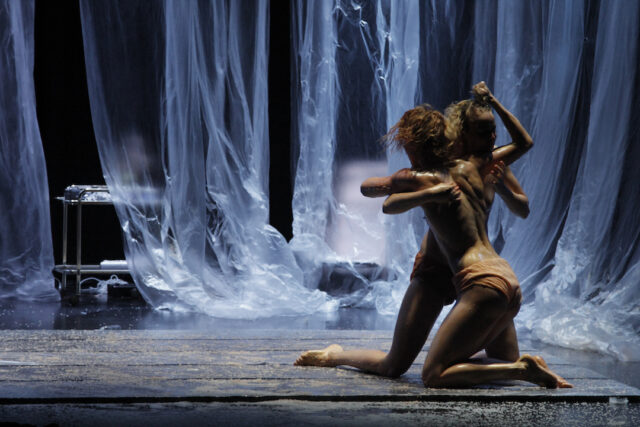
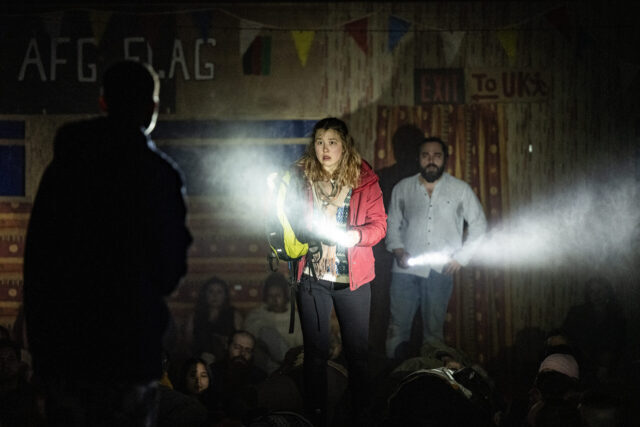
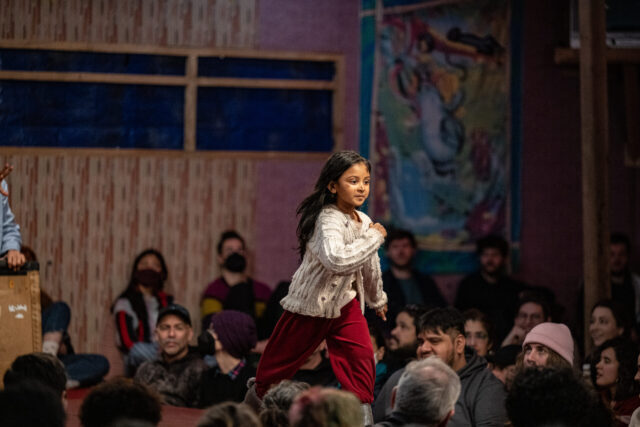
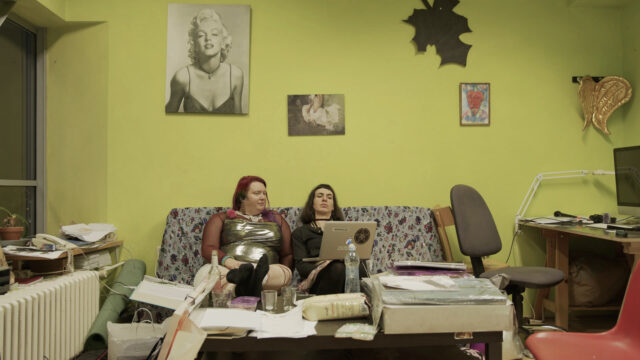
Nela H. Kornetová and Lærke Grøntved star in T.I.T.S.’s US premiere of Forced Beauty (photo courtesy T.I.T.S.)
Who: Kari Hoaas Productions, Nela Kornetová and T.I.T.S., Loco7 Dance Puppet Theatre Company, Nora Alami, Jadd Tank, Leyya Mona Tawil/Lime Rickey International, Baye & Asa, Wendy Perron and Morgan Griffin, Bobbi Jene Smith, Kayla Farrish, Kathryn Alter, Francesca Dominguez, Darvejon Jones, Cory “Supernova” Villegas/Soul Dance Co What: Eighteenth annual La MaMa Moves! Dance Festival Where:La MaMa, 74A East Fourth St. between Bowery & Second Ave. When: April 6–30, free (with advance RSVP) – $30 Why: The eighteenth annual La MaMa Moves! Dance Festival runs April 6-30, consisting of ten programs featuring a dozen creators presenting a wide range of works exploring the theme “Research, Resilience, and Testimony.” Referring to the artists, curator Nicky Paraiso explains on the festival website, “They bear witness to the uncertain times we live in, with a deeply felt personal approach that our dance audiences will not easily forget. We are living, perhaps, in a not-yet-totally postpandemic world where emotional response continues to remain tender and raw.”
The festival opens with works by two Norwegian companies, beginning April 6-8 with the world premiere of Kari Hoaas Productions’ Shadowland, in which a group of soloists weave through a web of loss, and April 7-9 with the US premiere of T.I.T.S.’s Forced Beauty, in which choreographer Nela H. Kornetová and Lærke Grøntved, often topless, act out online hate and violence directed at women on the internet. The free panel discussion “Stop Calling Them Dangerous #5, Cinema Has Power” takes place April 8 at 2:00 at CRS (Center for Remembering and Sharing), with screenings of films by Yvonne Rainer and Charles Atlas, organized by Yoshiko Chuma and promising “surprise dance-filmmakers” in attendance.
The second week kicks off with Loco7 Dance Puppet Theatre Company’s Lunch with Sonia (April 12-16), followed by a pair of shared programs: Nora Alami and Jadd Tank’s 3rd Body, inspired by VR technology, and Leyya Mona Tawil/Lime Rickey International’s Malayeen Voices, a futuristic look at folk songs and dance (April 13-16); and Baye & Asa’s duet Suck it Up, which delves into commercial imagery, with Wendy Perron and Morgan Griffin’s The Daily Mirror 1976/2022, in which teacher Perron revisits a 1976 work, now joined by one of her students, featuring film and photography by Babette Mangolte (April 14-16).
The third week is highlighted by the New York premiere of Bobbi Jene Smith’s multimedia dance-theater piece Broken Theater with AMOC* (April 20-30). Kayla Farrish’s Put Away the Fire, dear, pt.2 explores the relationship between live performance and cinema, with Farrish, Jessica Alexander, Tatiana Barber, James Barret, Alexander Diaz, Kerime Konur, and Curtis Thomas (April 21-23). The final program is Hunter College’s Emerging Choreographers Showcase with works by Kathryn Alter, Francesca Dominguez, Darvejon Jones, and Cory “Supernova” Villegas/Soul Dance Co.
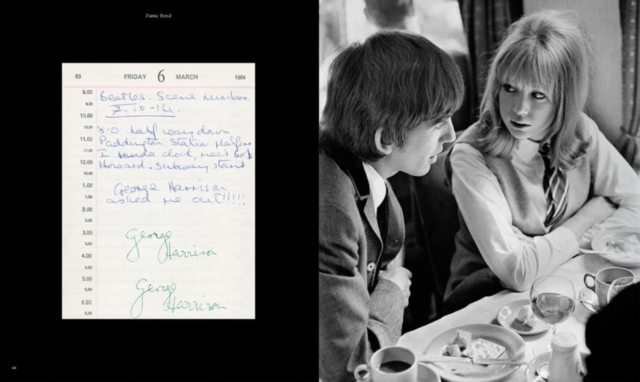
Pattie Boyd will be discussing and signing copies of her new book at Rizzoli (photo courtesy Reel Art Press)
Who:Pattie Boyd,Dave Brolan What: Book talk and signing Where:Rizzoli Bookstore, 1133 Broadway at 26th St., 212-759-2424 When: Monday, April 3, $59.87 (includes admission, signing line access, and book), 6:00 Why: “I decided very early on that there never needed to be a dull moment in life. If you find yourself feeling dull, just change your mind,” model, photographer, and muse Pattie Boyd proffers in her new book, My Life in Pictures (Reel Art Press, December 2022, $49.95).
Born in England in March 1944, Boyd has not had a very boring life. She went to boarding school in Nairobi, began modeling as a teenager, and married and divorced George Harrison and Eric Clapton. She was the muse behind Harrison’s “Something” and Clapton’s “Layla” and “Wonderful Tonight” and appeared on an endless stream of magazine covers. But all the while she was dazzling people in front of the camera, she was also taking her own photographs.
On April 3 at 6:00, Boyd will be at Rizzoli to discuss her life and career, joined by photo editor, curator, and archivist Dave Brolan from Reel Art Press. My Life in Pictures features photographs of Boyd by such lensmen as David Bailey, Eric Swayne, Norman Parkinson, Terence Donovan, Robert Freeman, and Robert Whitaker; photos by Boyd of Twiggy, Mick Jagger, Billy Preston, and the Beatles; and diary entries, artifacts, artworks, and other memorabilia, including letters from John Lennon and Yoko Ono. Tickets are still available with a copy of the book and come with access to the signing line. (Boyd will only be signing books purchased at Rizzoli.)
“I liked the idea of being independent and working but not all the time,” Boyd, who married real estate developer Rod Weston in 2015, writes in the book. “I wasn’t pinned down to anything nine to five. I thought that would be an incredibly boring thing to do.”
Who: David Broza, BETTY, Bettye LaVette, Paul Shapiro’s Ribs & Brisket, Basya and Saadya Schechter, Mark Vincent, Gary Lucas and the Golem, Modi, Resistance Revival Chorus, Dr. Ruth, Mayor Eric Adams, Congressman Max Rose, Terrance Floyd, Vince Warren, Jason Flom, Lorenzo Johnson, more What: Downtown Seder 2023 Where:City Winery, 25 Eleventh Ave. at Fifteenth St. When: Sunday, April 2, $85-$125 (livestream free), 1:00 Why: For more than three decades, Michael Dorf has been hosting all-star seders to celebrate Passover, concentrating on freedom and justice. The latest iteration takes place on Sunday afternoon, April 2, at City Winery, which Dorf opened on Varick St. in 2008 and moved to Hudson River Park’s Pier 57 in 2020. Attendees will be seated at long, communal tables and have a vegetarian meal with four glasses of wine as they go through the Haggadah, the illustrated text that tells the story of the Jewish people’s exodus from Egypt. This year’s participants include musicians David Broza, BETTY, Paul Shapiro’s Ribs & Brisket, Basya and Saadya Schechter, Mark Vincent, Resistance Revival Chorus, and Gary Lucas and the Golem, comedian Modi, Dr. Ruth, Mayor Eric Adams, Congressman Max Rose, Vince Warren of the Center for Constitutional Rights, and Jason Flom and Lorenzo Johnson of the Innocence Project. Terrance Floyd, George Floyd’s brother, will be asking “The Four Questions”; the setlist is also likely to include “Dayenu,” “Chad Gadya,” “Go Down Moses,” and “The Ten Plagues.”
“It says in the beginning of the Haggadah that one should recount and retell the story of the exodus from Egypt in the language that you understand. The ancient Israelites didn’t know Hebrew, so they told the story in Armenian. Americans read it in English,” Dorf said in a statement. “Our interpretation is to tell the story in the language of the arts, in ways we can relate and truly empathize with what it would be like to be in bondage, to be emancipated, and the universal civil rights we need to continually remind ourselves.” During the pandemic, City Winery livestreamed its Downtown Seders; you can check out the 2021 virtual event above. And it was just announced that the 2023 seder will be streamed live for free here.
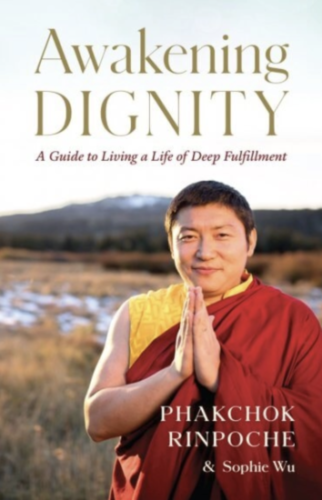
Who:Kyabgön Phakchok Rinpoche What: Talk, meditation, discussion, book signing Where:Rubin Museum of Art, 150 West 17th St. at Seventh Ave. / Dharma House NYC, 60-06 39th Ave., Woodside When: Thursday, March 23, $19 ($38.92 with lunch), 1:00 / Friday, March 24, free (donations accepted), 7:30 Why: Tibetan Buddhist teacher Kyabgön Phakchok Rinpoche returns to the Rubin Museum and Dharma House NYC for a pair of special events on March 23–24 in conjunction with the release of his latest book, Awakening Dignity: A Guide to Living a Life of Deep Fulfillment (Shambhala Publications, December 2022, $21.95). “Why is the joy inside us so hard to maintain? Why are we so easily lured by self-doubt, inadequacy, fear? Why do we feel so incomplete? What is the cause of this kind of suffering and what, if anything, can we do about it?” Phakchok Rinpoche asks in the first chapter, pointing out: “You are not alone.” The follow-up to Phakchok Rinpoche and Erric Solomon’s Radically Happy, the new book was written with associate history professor Sophie Wu and features a foreword by Daniel Goleman and Tara Bennett-Goleman. Awakening Dignity is divided into three parts, “Your Nature Is Pure,” “You Can Change,” and “Gaining Certainty and Trust,” and includes such chapters as “The Mirror of the Heart,” “Making Friends with ‘Sticky Mind,’” “Carefree Ease,” and “‘Who Am I?’”
Born in Kathmandu in 1981, Phakchok Rinpoche is a wonderful teacher with a unique sense of humor; I have sat in on numerous classes he’s led and lectures he’s given in Cooperstown, Westchester, SoHo, Nepal, and online, and they are always enlightening, whether you’re a practitioner or not. Last month I watched the livestream of the remarkable cremation ceremony for his father, Kyabje Tsikey Chokling Rinpoche, which provided stunning insights into death, ritual, and reincarnation and fits right in with the Rubin exhibition “Death Is Not the End.” On March 23 at 1:00, Phakchok Rinpoche will be at the Rubin to lead a session of the institution’s “Mindfulness Meditation” series, consisting of an opening talk dealing with the theme of “Unity,” a twenty-minute seated meditation, and a discussion, followed by a book signing. Admission is $19 or, if you want lunch, $38.92 with food from the Indian restaurant TAGMO. The book tour continues on March 24 at 7:30 when Phakchok Rinpoche will be at Dharma House New York City to deliver the public teaching “The Four Transformative Thoughts,” also known as “The Four Mind Changings”; admission is free (donations welcome), but get there a bit early for a seat.
Amid an ever-growing global immigration crisis, Joe Murphy and Joe Robertson’s bold, breathtaking The Jungle makes a triumphant return to St. Ann’s Warehouse before heading to Washington, DC. It’s political theater of the highest order, avoiding preaching while immersing audiences in all-too-real and frightening situations.
In 2015, Murphy and Robertson visited the Calais Jungle, a makeshift refugee camp where thousands of men, women, and children temporarily lived, erected on a former landfill. Over their seven months at the site, they helped construct a geodesic dome where the people could gather as a community and present plays and poetry. The two writers document the story in The Jungle, which ran at St. Ann’s in 2018–19 but had to delay its encore engagement, scheduled for March 2020, because of the coronavirus pandemic. But it’s now back, and it’s as thrilling as it is heart-wrenching.
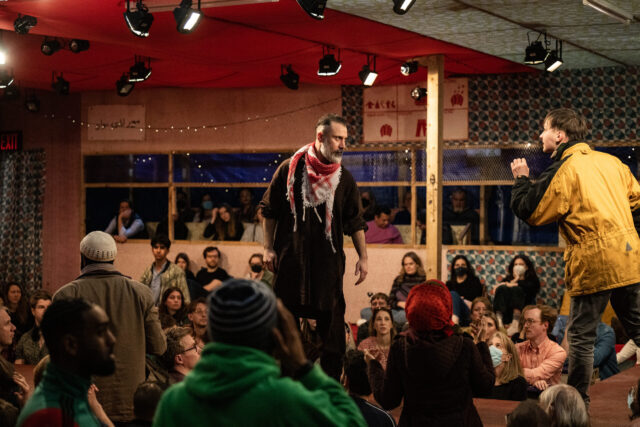
St. Ann’s has transformed itself into Zhangal, or the Jungle, with geographical markers, the Good Chance Dome (filled with photographs and artwork from camp residents), tents, graffiti, and a re-creation of Salar’s (Ben Turner) restaurant, which actually received a starred review from food critic AA Gill in the Sunday Times. The large central area features long communal tables and an interconnected series of raised platforms; the diverse cast of twenty-two (some of whom were migrants themselves) weave in and out of the audience, which is seated in sections designated by the countries the refugees escaped from. The framing premise is that we are all attending an emergency meeting “to talk about another proposed eviction of the Jungle.” The narrative then unfolds in flashback.
Beth (Liv Hill) and Safi (Ammar Haj Ahmad) try to help Okot (Rudolphe Mdlongwa) in immersive show at St. Ann’s (photo by Teddy Wolff)
“When does a place become a place?” asks the Aleppo-born Safi (Ammar Haj Ahmad), one of the leaders of the camp and the show’s narrator. “By November in the Jungle I could walk from Sudan through Palestine and Syria, pop into a Pakistani café on Oxford Street near Egypt, buy new shoes from the marketplace, Belgian cigarettes from an Iraqi cornershop, through Somalia, hot naan from the Kurdish baker, passing dentists, Eritrea, distribution points, Kuwait, hairdressers and legal centers, turn right onto François Hollande Street, turn left onto David Cameron’s Avenue, stop at the sauna, catch a play in the theater, service at the church, khutba in a mosque, before arriving at Salar’s restaurant in Afghanistan.” He then poignantly adds, “When does a place become home?”
The dome is named the Good Chance because the refugees believe they have a “good chance” of making it to the promised land, England, either via boat or truck, often arranged by Ali (Waleed Elgadi), a smuggler who charges exorbitant rates for his services. Several Caucasian British citizens work at the camp to help the migrants: Derek (Dominic Rowan), who almost always carries a clipboard with him, trying to organize things; Beth (Liv Hill), who pours her heart and soul into the camp; Paula (Julie Hesmondhalgh), who takes a more practical approach; and Sam (Jonathan Case), who is committed to build as many housing shelters as possible.
They treat the people of the Jungle with dignity, but there are limits to what they can accomplish. They also have the option at any time to go back to their homes, a choice not available to the migrants, who have left because of violence, extreme poverty, religious persecution, military juntas, and other reasons, seeking a better, safer life in the west.
Amal (Aisha Simone Baez) seeks a new life filled with hope and promise in The Jungle at St. Ann’s (photo by Teddy Wolff)
Among the key subplots are Okot’s (Rudolphe Mdlongwa) attempt to be smuggled into London; a deal between French journalist Henri (Max Geller) and Sam to exchange important information; the bitter Norullah’s (Twana Omer) racism; the plight of the adorable Amal (alternately Aisha Simone Baez or Annabelle Tural), a nine-year-old girl from Syria who has been separated from her family; and Salar’s refusal to let his restaurant be torn down when the French government announces that the southern half of the camp will be evicted. Boxer (Pearce Quigley) and Helene (Mylène Gomera) sing; Omar (Mohamed Sarrar) plays the drums; Amin (Habib Djemil) performs daring gymnastics; Maz (Fedrat Sadat) is desperate to get out. Amid all the horror and pain, the ragtag community still finds ways to celebrate life and their unique heritages through music, dance, food, and clothing.
“Great is the hope that makes man cross borders. Greater is the hope that keeps us alive,” Safi says.
Miriam Buether’s set, which extends into the garden outside St. Ann’s, also includes flags, a working kitchen, wall hangings, and other deft touches; there’s a ketchup bottle on every table, but don’t expect to get anything to eat. Catherine Kodicek’s costumes alternate between functional and traditional, highlighting the similarities and differences among the nations. The lighting by Jon Clark and sound by Paul Arditti further immerse the audience into the Jungle, especially at night when the characters use flashlights and whisper in the darkness. The music, ranging from celebratory to mysterious, is by John Pfumojena, with video by Tristan Shepherd and Duncan McLean of real-life news reports projected on several small monitors, instilling a chilling dose of reality.
The cast is extraordinary, embodying the fear that the refugees experience on a daily basis, never knowing what tomorrow might bring. Turner is bold and defiant as Salar, a man who has lost nearly everything but refuses to surrender his restaurant. Haj Ahmad is cool and calm as Safi, who is desperately trying to hold things together but knows it might be a lost cause. Hill excels as the emotionally involved Beth, who represents rescue workers who invest so much of themselves to save others. Omer is stalwart as Norullah, who is balancing that fine line between wanting to escape to England and doing the best one can in the meantime. And Baez is delightful as the little girl who can’t help but smile as chaos surrounds her.
Directors Stephen Daldry (Skylight,Billy Elliot) — who has won two Emmys, an Olivier, and three Tonys and has been nominated for three Oscars — and Justin Martin (Low Level Panic,Prima Facie), who previously collaborated on the 2021 pandemic film Together and are used to working with proscenium stages, do a marvelous job orchestrating the nonstop action, maintaining a furious pace as the injustice builds over nearly three hours (with one intermission). Murphy and Robertson’s dialogue is distinct and powerful, creating well-drawn characters who will touch your soul.
A program insert contains information about how to donate to Good Chance Theatre and the Brooklyn Community Foundation’s Immigrant Rights Fund as well as additional resources about immigration services. (The show is a coproduction of the National Theatre and the Young Vic with Good Chance.)
The artistic directors of Good Chance, Murphy and Robertson also turned the young girl in The Jungle into Little Amal, a twelve-foot-tall puppet that traveled around the world in The Walk, spreading her message about refugees: “Don’t forget about us.” It’s impossible to forget about Little Amal, just as it’s impossible to forget about The Jungle.
Kateřina Olivová and Darina Alster evaluate potential students in Art Talent Show
ART TALENT SHOW (Adéla Komrzý & Tomáš Bojar, 2022)
Museum of the Moving Image
35th Ave. at 36th St., Astoria
Sunday, March 19, 5:30
Festival runs March 15-19
718-777-6888 movingimage.us
“I think the line between reality and art has been smudged here. . . . You don’t know what’s art and what’s real anymore,” a teacher says in Adéla Komrzý and Tomáš Bojar’s vastly entertaining Art Talent Show, making its New York premiere at the Museum of the Moving Image’s twelfth “First Look” festival, which highlights new, innovative international films. I could say the same thing about Art Talent Show itself, which develops such an intriguing narrative that you might have a hard time convincing yourself that it’s nonfiction; at least I did.
In 2019, Adéla Komrzý was commissioned by rector Tomáš Vaněk and the Academy of Arts (AVU) in Prague to make a documentary in celebration of the institution’s 220th anniversary. Komrzý teamed up with Tomáš Bojar, and they spent four days filming a diverse group of applicants going through the difficult selection process to capture one of the coveted spots, not only creating art but taking written tests and undergoing rigorous personal interviews. Six professors in three departments agreed to let the cameras follow them: Vladimír Kokolia and Eva Červená from Graphic Design, Kateřina Olivová and Darina Alster from New Media, and Marek Meduna and Petr Dub from Painting.
They ask such questions as “What do you think is the role of art in today’s society?” and “What is the worst thing you have done in your life?” and get a wide range of answers from the unnamed students, who sometimes go off on tangents or freely admit they have no idea. Some try to be completely honest, others struggle to assert their identity, and a few use the opportunity to respond as if giving a performance. We learn as much, if not more, about the teachers than we do about the students, especially one who goes off on her own tangent about her sexuality and another who seems to savor grilling the applicants a bit too much. Meanwhile, a pair of older women who work at the reception/security desk gossip about it all.
The hundred-minute film provides compelling insight into the next generation of artists, even via this small sample; many of them talk about how they are making art for themselves, rather than as part of something bigger or considering how their work could influence society and the world at large. Most of them appear to have no interest in art history, instead focusing solely on what they are doing, as if they exist in a vacuum. It also serves as a microcosm of what is happening outside art school, where kids and teenagers are obsessed with social media, trying to figure out who they are in full view of others.
Inspired by Claire Simon’s Le Concours, about an annual French student contest, Komrzý (Intensive Life Unit,Viva Video, Video Viva) and Bojar (Two Nill,Breaking News) avoid reality-show pizzazz, instead trying to be as unobtrusive as possible, choosing the fly-on-the-wall route; at times they set up their cameras in rooms and operate them remotely so their physical presence will not affect the discussions between teachers and students.
The professors reveal their own predilections, especially Olivová, who dresses in colorful childlike costumes and wears kitten ears, offering the students encouragement, whereas Kokolia puts them through a much more direct and almost accusatory investigation. In a promotional interview, Dub explains, “I also realized that the presence of the crew will make us all — both [teachers] and applicants — step out of our comfort zones. However, this is what the art is principally based on: constant searching and crossing borders, whether social or artistic ones. I am not a big fan of safe zones as they blunt our perception, relation to reality, and possibilities of art experiments which are necessary to prevent existential sterility.” Scenes in which the teachers evaluate the artwork and debate topics for the students to address should give pause to the thin-skinned applying to similar programs.
“I don’t know whether to write ‘definite pass’ or ‘definite fail,’” one teacher says about a specific test. Art Talent Show is a definite pass, acing its subject.
“First Look” runs March 15-19 at MoMI, comprising more than fifty shorts and features, with many filmmakers on hand for Q&As. The opening night presentation is Babak Jalali’s Fremont, starring Anaita Wali Zada and Jeremy Allen White, paired with Ruslan Redotov’s Away, two very different refugee tales. The closing night film is C. J. “Fiery” Obasi’s Mami Wata, centered around a powerful mermaid goddess in a West African community.
ESTROGENIUS FESTIVAL: BAN(NED) TOGETHER
The Kraine Theater, 85 East Fourth St.
UNDER St. Marks, 94 St. Marks Pl.
Arts on Site, 12 St. Marks Pl.
721 Decatur Street Community Garden, Bushwick
March 15 – April 2, sliding scale $20 www.estrogenius.nyc
Since 2000, the EstroGenius Festival has been celebrating “the artistry of femme, nonbinary, nonconforming, and trans womxn artists.” The 2023 edition, presented by FRIGID New York and Manhattan Theatre Source, launches March 15 with “Funny Women of a Certain Age,” an evening of comedy with Amanda Cohen, Jessie Baade, Laura Patton, and Carole Montgomery. The festival, curated by maura nguyễn donohue, Melissa Riker, and John C. Robinson, kicks into high gear March 18 through April 2 with nearly two dozen productions taking place at the Kraine Theater, UNDER St. Marks, Arts on Site, and the 721 Decatur Street Community Garden in Bushwick, from concerts and plays to discussions and burlesque.
On March 19 at 3:30, Joya Powell and Pele Bauch team up for the open dialogue “Who We Are | Ban(ned) Together,” getting to the heart of this year’s theme: “Ban(ned) Together,” a response to the overturning of Roe v. Wade and the violence being committed against trans and femme bodies.
Claire Ayoub heads down memory lane in her solo show The GynoKid. Marina Celander shares the family-friendly story The Tale of An-Noor, incorporating dance and puppets. In the duet Develop(ing) Together: BEAR, c/s movement projects investigates balance, exhaustion, and tolerance. Molly Kirschner’s BiPolar Brunch brings together four characters seeking connection. Alt-folkers Brokeneck Girls perform songs from The Murder Ballad Musical.
“An Evening with Peterson, Savarino & Wells” features Muriel “Murri-Lynette” Peterson’s Black Enough, Kim Savarino’s Blue Bardo, and Portia Wells’s Inside Flesh Mountain, Part II. Anabella Lenzu examines herself as a woman, a mother, and an immigrant in Solo Voce: The Night You Stopped Acting. Hip-hop takes center stage with Yvonne Chow’s #Unapologetically Asian and an excerpt from Janice Tomlinson’s PRN. There are also works by sj swilley, Emily Fury Daly, Vanessa Goodman, Donna Costello, Kayla Engeman, Leslie Goshko, Soul Dance Co., and Petra Zanki, among many others.