this week in lectures, signings, panel discussions, workshops, and Q&As

NYAFF 2011: DETECTIVE DEE AND THE MYSTERY OF THE PHANTOM FLAME

Andy Lau stars as Di Renjie in Tsui Hark's impressive DETECTIVE DEE AND THE MYSTERY OF THE PHANTOM FLAME

DETECTIVE DEE AND THE MYSTERY OF THE PHANTOM FLAME (DI RENJIE) (Tsui Hark, 2010)
Film Society of Lincoln Center, Walter Reade Theater
165 West 65th St. at Amsterdam Ave.
Monday, July 11, $13, 9:00
Series runs through July 14
212-875-5601
www.filmlinc.com
www.subwaycinemanews.com

During the early Tang Dynasty in the late seventh century, Wu Zetian (Carina Lau sporting some great hairdos) is about to become the first empress of China. In preparation for her ascendance to the throne, architect Shatuo (Tony Leung Ka Fai) is leading the construction of a two-hundred-foot Buddha statue with her face, a massive structure that is like its own city inside. But when people start spontaneously combusting after a pair of amulets in the statue are moved, Wu calls in Detective Dee (Andy Lau sporting some great facial hair), who has been in prison for eight years for previously opposing her, to find out who is behind the horrific deaths. Dee is teamed up with Wu’s right-hand woman, Shangguan Jing’er (Li Bingbing), and albino warrior Donglai Pei (Deng Chao) to get to the bottom of the killings, which many believe is a curse not being perpetrated by humans. As the unlikely threesome gets closer to the answers, they become enmeshed in a series of battles featuring unusual weapons and unexpected twists and turns, not knowing whom they can trust, their lives in constant danger. Nominated for the Golden Lion at the 2010 Venice Film Festival and winner of six Hong Kong Film Awards (including Tsui Hark for Best Director, Carina Lau for Best Actress, and Phil Jones for Best Visual Effects), Detective Dee and the Mystery of the Phantom Flame is a fun and exciting old-fashioned wuxia tale, with exciting if repetitive action scenes directed by Sammo Hung and sumptuous production design by James Chiu. The inner workings of the enormous statue is a thing of beauty that has to be seen to be believed. A mix of actual and invented characters — there really was a Judge Dee (Di Renjie), who was turned into a detective hero in a series of novels by Dutch author Robert van Gulik — the film is a thrilling historical mystery epic that could have used a little more back story but is still a return to form for Hark. Detective Dee and the Mystery of the Phantom Flame will be screening July 11 at 9:00 as part of the Wu Xia Focus at the New York Asian Film Festival at Lincoln Center, and as a special bonus director Tsui Hark will be on hand to talk about the film and receive the Star Asia Lifetime Achievement Award (at 8:30, with all ticket holders welcome).
MICHAEL TULLY PRESENTS BAD RONALD

Scott Jacoby is up to no good in cult classic BAD RONALD, screening July 5 at 92YTribeca

BAD RONALD (Buzz Kulik, 1974)
92YTribeca
200 Hudson St. at Canal St.
Tuesday, July 5, $12, 8:00
212-415-5500
www.92y.org

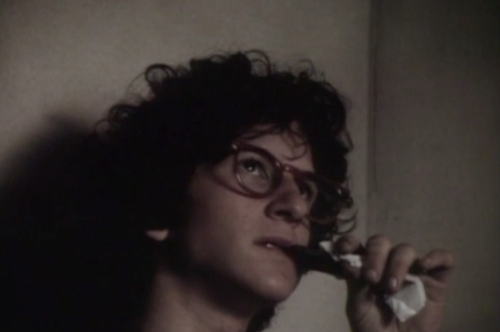
There are certain movies that are impossible to get out of your head, lingering there for years, rooting through your brain, imbedding itself in your subconscious, affecting every step you take. Buzz Kulik’s 1974 cult classic, Bad Ronald, is just such a film. For those who have seen it, Bad Ronald leaves an indelible memory imprinted on their very being. We know, because we have never been the same since first seeing it oh those many years ago. Made during the tail end of the Nixon era as a new kind of mass paranoia ran rampant across the country, Bad Ronald captured the zeitgeist of the post-Woodstock generation, with Ronald Wilby (the beautifully fro’d Scott Jacoby) the ultimate awkward latch-key kid, living behind a wall after committing a terrible act. In many ways Ronald, a childlike Rupert Pupkin, can be considered a guru to those minions currently residing in their parents’ basement, creating art and music on their laptops. In that room, Ronald immerses himself in the fantasy world of Atranta, a land of princesses and demons, with danger lurking around every corner, especially when the Woods (father Dabney Coleman, mother Pippa Scott, and three daughters) move into Ronald’s house after the death of his mother (Kim Hunter).

One of the strangest television movies ever made, Bad Ronald is getting a rare public screening tonight at 92YTribeca, where it is being presented by indie filmmaker Michael Tully. Tully cites the crazy tale as a major influence on his most recent feature, Septien, which opens at the IFC Center tomorrow. “Bad Ronald isn’t a ‘horror’ film, per se. Unless you’re a five-year-old watching television in the mid-1970s, that is,” Tully writes on the 92Y Tribeca event page. “That’s how I first encountered it, and I’m still haunted by the experience. Buzz Kulik’s ABC Movie of the Week tells the bizarre tale of high school outcast Ronald Wilby (Scott Jacoby, not just looking but sounding like Matthew Modine), who accidentally kills a girl. His overprotective mother proceeds to build a secret room in their house in order to hide him from the world. That setup works just fine, until Mom dies unexpectedly and a new family moves in. . . . Though they are very different, one of our primary goals in making Septien was to capture that same ‘five-year-old-discovering-a-movie-that-he-probably-shouldn’t-be-watching’ spirit that I felt when I stumbled upon this strangely alluring gem.” Bad Ronald is more than just a movie, more than just a 1970s oddity; it is nothing less than a life-changing experience.

(For our twi-ny talk with Tully, click here.)

TIME AGAIN

“Novel” examines different modes of storytelling as part of “Time Again” at SculptureCenter (photo by twi-ny/mdr)

SculptureCenter
4419 Purves St.
Thursday – Monday through July 25, suggested donation $5, 11:00 am – 6:00 pm
718-361-1750
www.sculpture-center.org

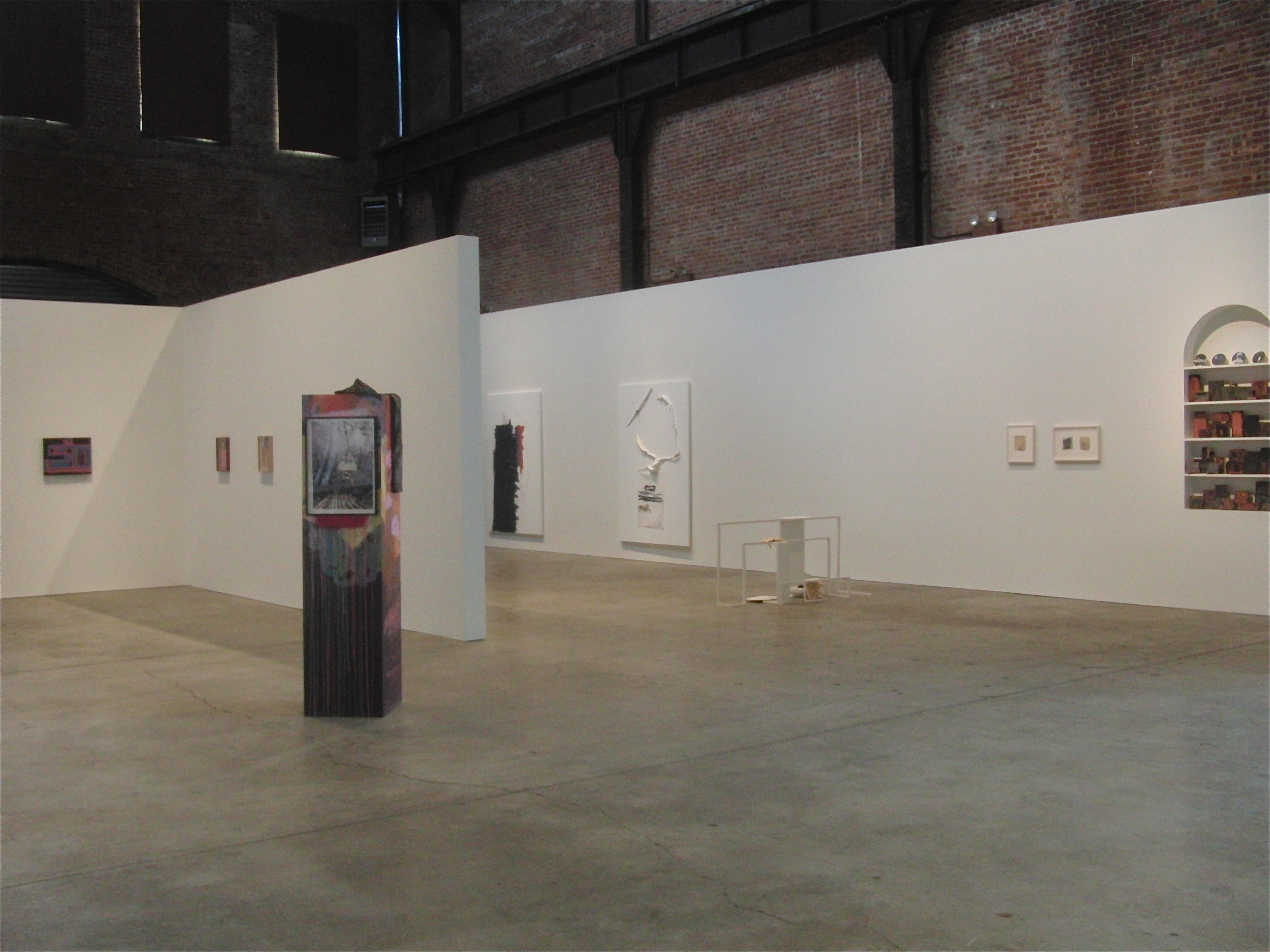
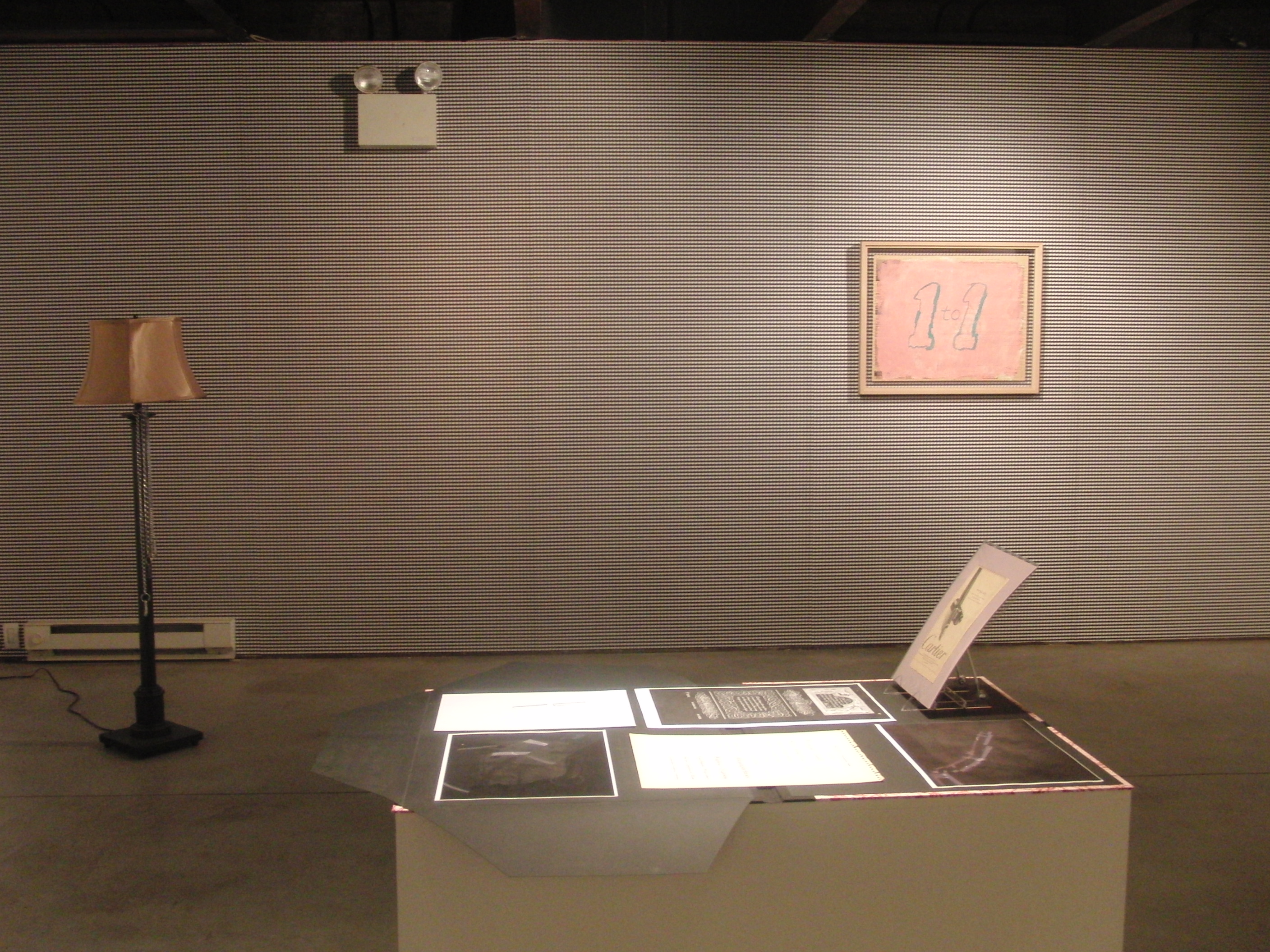
Playing off of Walter Benjamin’s theory of the vanishing point in the here and now, curator Fionn Meade has put together an intriguing collection of paintings, drawings, sculpture, installation, and video for the two-floor show “Time Again.” On view at Long Island City’s SculptureCenter through July 25, the show consists of works that self-consciously examine and manipulate imagery, representation, gesture, narrative, and the past through repetition and sequencing. In “Image of Absolon to Be Projected Until It Vanishes,” Matthew Buckingham continuously projects a single slide of Christian Gottlieb Vilhelm Bissen’s 1901 statue of Copenhagen founder Bishop Absalon atop a horse; over the course of the exhibition, the heat from the projector will cause the image to fade into nothingness, taking the history it embodies with it. Uli Hohn’s six cast plaster and wood reliefs are each slightly different, creating their own time line that feels like it is still in process. Evoking Andy Warhol’s 1960s Screen Tests, Rosalind Nashashibi’s “This Quality” cuts from a series of shots of a woman staring into the camera to cars covered by fabric on the streets of Cairo; rather than protecting the automobiles from the elements, it appears that the sheets are hiding their past, especially as people walk by. In a separate area, pieces by Sergej Jensen, R. H. Quaytman, Paul Thek, and others make up “Novel,” which provides a unique look at storytelling.

SculptureCenter examines memory and repetition in “Time Again” (photo by twi-ny/mdr)

The exhibit kicks into high gear in the basement, where the works are set up amid narrow concrete hallways and passages and in dark rooms. Laure Prouvost’s “It, Heat, Hit” video confronts viewers directly, demanding their attention and that they remember what they see, flash cuts of text and image that fly by in a fury as they tempt and attack all five senses. Rosemarie Trockel’s “Goodbye, Mrs. Mönipaer” consists of longer, calmer shots of a glassed-in bungalow on a beach, water lapping onto the sand as two women, one in a bikini, the other in a bathrobe, each one wearing a mask, are involved in a potential art deal. In “Untitled (David Wojnarowicz Project),” Emily Roysdon re-creates David Wojnarowicz’s “Arthur Rimbaud in New York” series, which comprised photographs of a man, most likely the artist himself, walking the streets of New York wearing a mask that replicated the only known photo of the influential French poet; Roysdon has revisited that idea by taking photos of friends wearing a mask that depicts Wojnarowicz’s visage. In “Berlin Flash Frames,” William E. Jones repurposes a 1961 propaganda film produced by the U.S. Information Agency to question history and memory as the Berlin Wall is constructed and individuals are prepared for relocation. And in “Rabbits,” Aurélien Froment details how to make various knots by using the “rabbit hole” storytelling technique about a rabbit and a snake, neatly tying everything together before taking them apart. The films, most of which are shown using old-fashioned projectors, are the star of the show at the cavernous SculptureCenter, which evokes the past itself, having taken over a former trolley factory, with various mechanical contraptions still visible, creating a kind of palimpsest. SculptureCenter is open on July 4; if you check in on foursquare, you get two-for-one admission and free lemonade. In addition, SculptureCenter will host a pair of “Time Again”-related screenings July 5-6 at 7:00 at Anthology Film Archives, including short works by Joan Jonas, Shahryar Nashat, Ursula Mayer, and exhibition artists Prouvost, Nashabishi, Buckingham, and Jones; Leslie Thornton and Lisa Oppenheim will participate in a special conversation following the July 5 show, with Jones taking part in a Q&A following the July 6 screening.

403 PRESENTS: THE BEAUTY IN DECAY

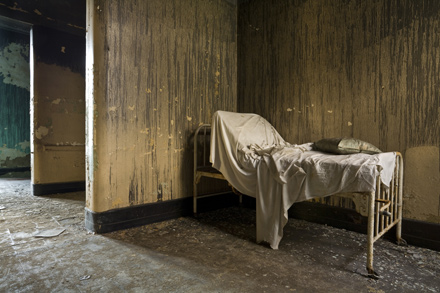
Ian Ference will talk about his images of urban decay and negative space at tonight’s 403 cultural salon (photo © Ian Ference)

Private building in downtown Manhattan (given upon RSVP)
Monday, June 27, $60 with RSVP , 7:00 – 11:00 pm
www.facebook.com/event
www.ianferencephoto.com

Lelaine Lau, who was recently honored as the May Woman of the Month by Thierry Mugler’s Womanity Project, will be hosting her latest 403 cultural salon with special guest Ian Ference. The Rochester-born, Brooklyn-based photographer focuses much of his work on architectural interiors, including a continuing project on abandoned buildings, particularly insane asylums. As Lau explains, “Ian Ference’s photography of urban decay is both transporting and beautiful. The histories that he writes are meticulously researched. They are a peek at a bygone era, a slice of history. From his haunting images of Admiral’s Row, North Brother Island, or Hart Island, to the images of abandoned hotels and theatres along the Eastern seaboard, the stories behind the buildings touch on issues of architectural heritage, societal mores and attitudes of the time, demolition-by-neglect, development, zoning, and landmarking. Other photos conjure up thoughts on a more human scale.” In his artist statement, Ference explains, “The primary purpose of my work is to create a living record of these structures, many of them architecturally rich, and most of them in danger of demolition, whether by neglect or by wrecking ball. Every building has stories — the stories of the people who worked, lived, and died within its walls. Vacant now, the walls can still tell some of these stories, and it is in that direction that I aim my camera.” Ference will discuss and present images of the vast breadth of his work at tonight’s gathering, with a light dinner and wine catered by Vance Brooking and Mey Bun.

NYAFF 2011 / JAPAN CUTS — MILOCRORZE: A LOVE STORY

Yoshimasa Ishibashi’s wild and wacky MILOCRORZE will open the tenth annual New York Asian Film Festival on July 1 and screen at Japan Cuts on July 10

MILOCRORZE: A LOVE STORY (Yoshimasa Ishibashi, 2011)
Film Society of Lincoln Center, Walter Reade Theater
165 West 65th St. at Amsterdam Ave.
Friday, July 1, $13, 9:00
Series runs July 1-14, ten-film pass $99
Japan Society
333 East 47th St. at First Ave.
Sunday, July 10, $12, 8:00
Series runs July 7-22, five-film pass $50
212-875-5601 / 212-715-1258
www.filmlinc.com
www.subwaycinemanews.com
www.japansociety.org/japancuts

The North American premiere of the wild and wacky, genre-iffic Milocrorze: A Love Story kicks off the tenth anniversary of New York City’s most exciting annual film series, the New York Asian Film Festival, running July 1-14 at Lincoln Center. Melding Michel Gondry with Quentin Tarantino and Takashi Miike filtered through Max Ophüls’s La Ronde and Jean-Pierre Jeunet’s Amélie, longtime commercial, video, and television director Yoshimasa Ishibashi makes his feature-film cinematic debut with this highly stylized three-part tale of love and romance. In the first section, seven-year-old salaryman Ovreneli Vreneligare, wearing one of the most charming costumes and hairstyles ever put on celluloid, falls in love with the beautiful, and adult, Milocrorze (Maiko) in a candy-coated fantasyland of lush colors and dreamlike sets. That bittersweet tale leads into the second part, in which bizarre youth counselor Besson Kumagi (Takayuki Yamada) abusively screams relationship advice to lonely boys over the phone, then breaks out into self-celebratory dance numbers with a couple of hot babes, a sort of Japanese version of Andy Kaufman’s Tony Clifton character. That story segues into the violent, vengeful mini-epic of rogue samurai Tamon (Yamada again), who starts out as a simple man who falls in love with Yuri the flower girl (Ann Ishibashi) but is soon trying to rescue her from a high-priced gambling and prostitution ring. Ishibashi then circles back to Milocrorze and Ovreneli Vreneligare (Yamada yet again, in his third role) years later for the tender finale. Milocrorze is a vastly entertaining, wonderfully absurd, and utterly ridiculous (and we mean that in a good way) exercise in multiple genres from the endlessly inventive Ishibashi. The samurai section goes on way too long, but otherwise this is a rousing success from start to finish, even when it is making absolutely no sense, which is very often. Milocrorze is the opening-night selection of NYAFF 2011, and both Ishibashi and Yamada will be at Lincoln Center on July 1 to participate in a postscreening Q&A; prior to the screening, Yamada will receive the Star Asia Rising Star Award. The film is being presented in conjunction with Japan Cuts: The New York Festival of Contemporary Japanese Cinema, screening at Japan Society on July 10, followed by a Q&A with Ishibashi. Keep watching twi-ny for more reviews of select films from our two favorite film festivals of the year.

HUMAN RIGHTS WATCH FILM FESTIVAL: THIS IS MY LAND . . . HEBRON

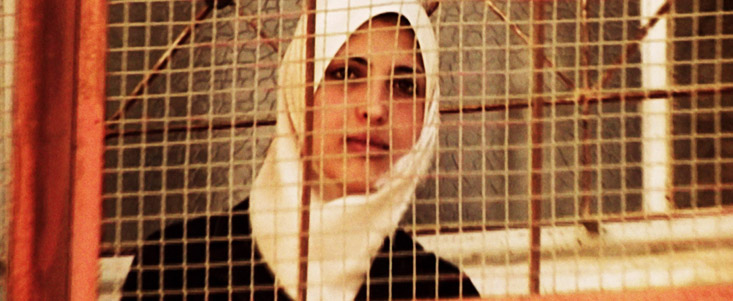
Documentary looks at escalating conflict between Israelis and Palestinians in Hebron

THIS IS MY LAND . . . HEBRON (Giulia Amati & Stephen Natanson, 2010)
Film Society of Lincoln Center, Walter Reade Theater
165 West 65th St. at Amsterdam Ave.
Monday, June 27, 4:00; Tuesday, June 28, 6:30; Wednesday, June 29, 9:00
Series runs through June 30
212-875-5601
www.filmlinc.com
www.thisismylandhebron.com

While teaching a video course in the historic city of Hebron, Giulia Amati was struck by the intense battle going on between Israeli settlers and Palestinians in the burial place of Abraham. Following the Six-Day War in 1967, a small group of Jews moved into the city, deciding to take it back from the Palestinians, whose families had been there for generations. Today, some five hundred settlers, mostly European Jews, have gained control of the embattled territory in the southern West Bank, trying to force out the 150,000 Palestinians who live there. “There is no place under the occupation that I hate more than Hebron,” Haaretz reporter Gideon Levy says in Amati and Stephen Natanson’s stirring documentary, This Is My Land . . . Hebron, adding, “It is really the place of evil.” Presenting both sides of the story, the filmmakers speak with such Jewish settlers as Miriam Grabovsky, Miriam Levinger, and spokesmen Noam Arnon and David Wilder, who believe in their God-given right to the land, and such Palestinian residents as Hamed Quashmeh and Osaid Rasheed, who don’t want to leave their homes and businesses. Jewish children in Hebron are raised to hate their Palestinian neighbors, throwing rocks and cursing them in the street. Palestinian houses are surrounded by wire fences that make it look like the families are living in cages. Former Israeli soldier Yehuda Shaul now leads “Breaking the Silence” tours of the area, revealing exactly what is going on. While some Israelis consider him a traitor, others see what he is doing as heroic, trying to get the truth out and establish peace. While much of what goes on in the Middle East is extremely complex and often sensationalized in the media, with the actions of the Israeli military and government often improperly misconstrued and wrongly criticized, the situation in Hebron seems to be clear, as Israeli Jews such as Shaul, Levy, and former Knesset member Ure Avnery explain in the film. Although This Is My Land . . . Hebron reveals the dark side of fundamentalism and racism, it should not be viewed as a microcosm in the continuing fight between the Israelis and the Palestinians but instead as a terrible side effect of an age-old conflict. Part of the “Times of Conflict and Responses to Terrorism” section of the Human Rights Watch Festival at Lincoln Center, which also includes “Migrants’ and Women’s Rights,” “Human Dignity, Discrimination, and Resources,” and “Truth, Justice, and Accountability,” This Is My Land . . . Hebron will have its North American premiere June 27-29 at the Walter Reade Theater, with all three screenings followed by a discussion with the filmmakers.

DONALD JUDD

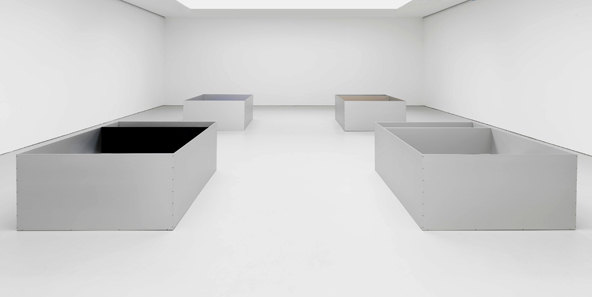
Installation view, “Donald Judd,” David Zwirner, New York, 2011 (Judd Art © Judd Foundation. Licensed by VAGA, New York, NY. Photos by Tim Nighswander / IMAGING4ART)

David Zwirner
525/533 West 19th St. between Tenth & Eleventh Aves.
Saturday, June 25, free
212-727-2070
www.davidzwirner.com
www.juddfoundation.org

In 1989, Donald Judd presented a major installation at the Staatliche Kunsthalle in Baden-Baden of a dozen large-scale open-box floor works that featured color, a rarity for Judd in pieces that size. David Zwirner has gathered together nine of the works and spread them throughout his connected galleries at 525 and 533 West Nineteenth St., along with several of the minimalist artist’s pencil and ballpoint sketches of the original layout. Each of the nine untitled Menziken boxes are an identical 39.375 x 78.75 x 78.75, composed of anodized aluminum, with different-colored Plexiglas panels inside. The black, blue, and amber sheets, not all placed in the same locations within each box, react with the brightness from the ceiling skylights to project changing reflections against the inner sides of the rectangle boxes, as if they’re alive. Thus, Judd has reshaped the space inside and outside, within each individual box as well as of the gallery space itself, in a quiet yet dynamic presentation. The show concludes June 25 with a pair of special screenings held at 519 West Nineteenth St., where, from 10:30 am to 12:30 pm, Zwirner will show Michael Blackwood’s 2010 documentary The Artist’s Studio: Donald Judd, consisting of footage of Judd (1928-94) from his homes in SoHo in 1972 and in Marfa, Texas, in 1975. That will be followed at 1:00, 3:00, and 5:00 by the 2010 film Marfa Voices, in which director Rainer Judd, the artist’s daughter, speaks with people who knew her father in Marfa. An advance RSVP to mackie@davidzwirner.com or 212-727-2070 ext122 is required for Marfa Voices, which will be introduced by the filmmaker and followed by a Q&A; a reception will follow the 5:00 screening.