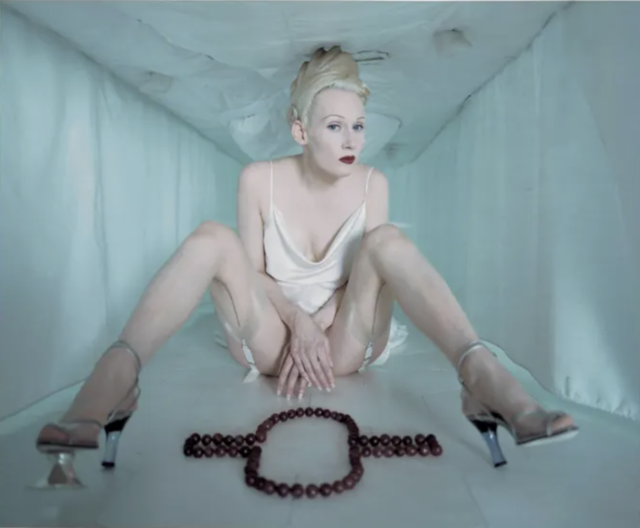
Marti Domination squeezes into a tight space in Cremaster 1
MATTHEW BARNEY: THE CREMASTER CYCLE AND SELECT EARLY WORKS
Metrograph
7 Ludlow St. between Canal & Hester Sts.
Opens May 17
212-660-0312 metrograph.com www.cremaster.net
Matthew Barney’s Cremaster is so much more than five essentially incomprehensible films totaling seven hours made over the course of eight years out of chronological order; it’s a state of mind, a whole other level of consciousness. The complete series, which will never, according to Barney, be available on DVD or cable or any other salable personal format, is rarely shown in its entirety; the last times it was seen in New York City were the world premiere in 2003 at Anthology and in 2015 at IFC. Ostensibly following the ascension and descension of the cremaster muscle, which raises and lowers the testicles as sexual differentiation takes place inside the human body, the films feature strange characters in odd metaphorical situations that are rarely immediately apparent; watching the films, I found myself continually referring to Cremaster Fanatic, which offers excellent meta-descriptions of each work, breaking down each bizarre symbol. But that doesn’t mean the narrative is impossible to follow or overly convoluted; instead, part of the fun is trying to figure out just what the heck is going on.
In conjunction with the opening of Barney’s latest exhibit, the free five-channel video installation “Secondary,” continuing in the artist’s Long Island City studio through June 25, Metrograph will be presenting the full cycle beginning May 17. On June 4, Barney, whose other films include the five-and-a-half-hour River of Fundament and the Drawing Restraint series, will be at Metrograph for a conversation with American writer Maggie Nelson following a special screening of remastered early works.
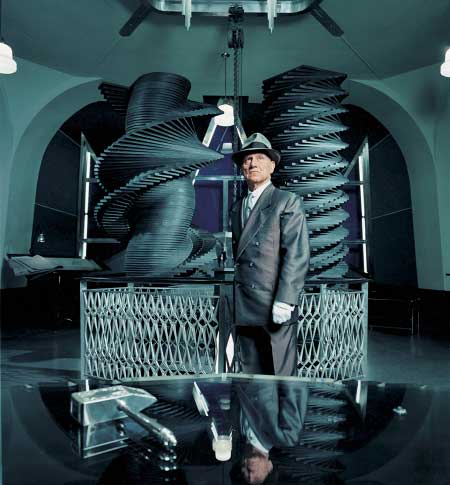
Artist Richard Serra plays the Architect in Cremaster 3
In Cremaster 1 (1995), the Goodyear blimp hovers over a stadium where the young Barney, a former quarterback, played football. Bright colors dominate as four flight attendants peer out the window, unaware that beneath a table topped with a Vaseline centerpiece a platinum blonde (Marti Domination) is stealing grapes. A beautifully choreographed Busby Berkeley-like dance ensues. In Cremaster 2 (1999), Barney plays Gary Gilmore, re-creating the murder of Mormon gas station employee Max Jensen. There’s also a séance led by Baby Fay La Foe, graphic sex, a queen bee and her drones, the Bonneville Salt Flats, the Mormon Tabernacle, and Norman Mailer, who wrote The Executioner’s Song about Gilmore, as Harry Houdini at the World’s Columbian Exposition of 1893.
At three hours, Cremaster 3 (2002) is the longest and easiest to follow of the series. It details the heated 1929 fight between the Chrysler Building and the Bank of Manhattan (40 Wall St.) to be the tallest structure in New York, framed by the Irish legend of Fionn and Fingal and the Giant’s Causeway. The cast features Barney as the Entered Apprentice climbing up the Guggenheim’s spiral walls, conceptual artist Richard Serra as the Architect (Hiram Abiff) and himself (melting Vaseline that drips down the length of the museum), amputee Aimee Mullins as the Entered Novitiate, singer Paul Brady as the Cloud Club maitre d’ serving a small group of gangster-like Masons, Terry Gillespie as a bartender with a bit of a Guinness problem (in the series’ funniest scene), and punk bands Agnostic Front and Murphy’s Law engaged in a musical battle.
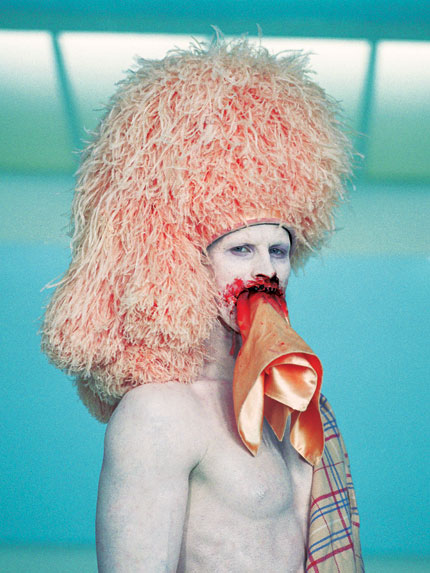
In Cremaster 4 (1994), the Ascending and Descending motorcycle sidecar teams race for the Tourist Trophy on the Isle of Man while the Loughton Candidate (Barney) carefully combs his hair (he has four potential horns on his head) and tap-dances as a trio of faeries bandy about. And in Cremaster 5 (1997), the Queen of Chain (Ursula Andress) belts out a Hungarian opera above the Gellert Baths, where Fudor Sprites swim and Jacobin pigeons are prepared for a special purpose, with Barney appearing as the Queen’s Diva, the Queen’s Magician, and the Queen’s Giant.
Matthew Barney plays multiple roles in his experimental epic The Cremaster Cycle
Watching The Cremaster Cycle is an unforgettable experience, a thrilling foray into experimental film at its finest. It’s both mind-blowing and infuriatingly confusing, stunningly gorgeous and utterly ridiculous. Everything in it is laden with meaning, though you’ll be hard-pressed to know what much of it is about. And there are more references to male genitalia than in any teen sex comedy ever made. The films will screen at select times at Metrograph over several weeks, with tickets, which will sell out quickly, available seven days in advance. The Cremaster Cycle is more than just a cinematic art project; it’s an event that has to be seen to be believed.
New York City is the star of wide-ranging Film Forum festival
THE CITY: REAL AND IMAGINED
Film Forum
209 West Houston St.
May 12 – June 8
212-727-8110 filmforum.org
Last month Ohio rep. Jim Jordan came to New York City to hold a field hearing in which he made wild accusations about the state of the five boroughs and attacked Manhattan DA Alvin Bragg, ignoring that, per capita, crime is actually worse in his state; he could not differentiate between the real and the imagined.
No one knows how to put on a New York City film festival like Film Forum does, and their latest is another doozy, melding the real with the imagined. Running May 12 through June 8, “The City: Real and Imagined” consists of more than seventy-five features, shorts, and documentaries in which NYC is essentially a character unto itself, if not the star. Held in conjunction with the Museum of the City of New York’s centennial exhibition “This Is New York: 100 Years of the City in Art and Pop Culture,” the festival’s opening weekend boasts a dozen wide-ranging titles, from Alexander Mackendrick’s Sweet Smell of Success and Spike Lee’s Do the Right Thing to Alexander Hall’s My Sister Eileen and Martin Scorsese’s Taxi Driver.
Hollywood stars are everywhere: Al Pacino, Rosalind Russell, Ernest Borgnine, Jane Fonda, Henry Fonda, Madonna, Richard Roundtree, Diane Keaton, Martin Sheen, Elaine May, Fred Astaire, Cyd Charisse, Sammy Davis Jr. Among plenty of well-known favorites, master programmer Bruce Goldstein has slipped in Sidney M. Goldin and Aubrey Scotto’s Uncle Moses, Julie Cohen’s The Sturgeon Queens, Leon Ichaso and Orlando Jiménez Leal’s El Super, Alberto Lattuada’s Mafioso, and Leo Penn’s A Man Called Adam.
Below is a closer look at sixteen of the gems. In addition, there will be intros, Q&As, and other special presentations at twenty-one screenings, for such films as Alfred Hitchcock’s The Wrong Man, Claudia Weill’s Girlfriends, Michael Roemer’s The Plot Against Harry, Joan Micklin Silver’s Hester Street, Stanley Kubrick’s Killer’s Kiss, Leslie Harris’s Just Another Girl on the I.R.T., and Michael Campus’s The Education of Sonny Carson, with stars Rony Clanton and Joyce Walker-Joseph. Rep. Jordan should move into Film Forum for a month and learn what New Yorkers are really about.
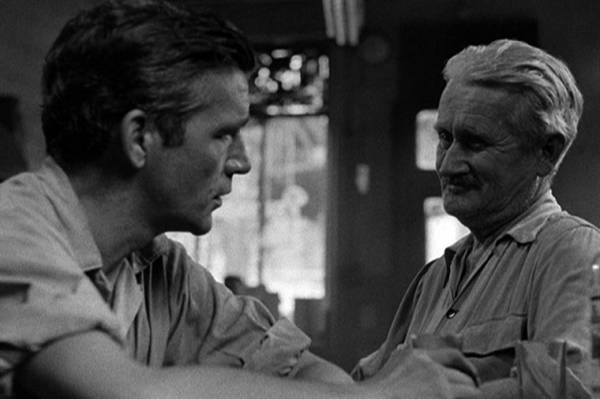
Ray Salyer and Gorman Hendricks are two of the forgotten men in Lionel Rogosin’s unforgettable On the Bowery
ON THE BOWERY (Lionel Rogosin, 1956)
Friday, May 12, 12:15
Sunday, May 21, 6:15
Thursday, May 25, 4:45
Friday, May 26, 2:35
Tuesday, May 30, 4:50 www.ontheboweryfilm.com
Lionel Rogosin’s On the Bowery is one of the greatest cinematic documents ever made about New York. The stunning 35mm restoration offers a new look at this underground classic, which caused a stir upon its release in 1956, winning prizes at the Venice Film Festival while earning criticism at home for daring to portray the grim reality of America’s dark underbelly. After spending six months living with the poor, destitute alcoholics on Skid Row as research, idealistic young filmmaker Rogosin spent the next four months making On the Bowery, a remarkable examination of the forgotten men of New York, ne’er-do-wells who can’t find jobs, sleep on the street, and will do just about anything for another drink.
Rogosin centers the film around the true story of Ray Salyer, a journeyman railroad drifter stopping off in New York City seeking temporary employment. Salyer is quickly befriended by Gorman Hendricks, who not only shows Salyer the ropes but also manages to slyly take advantage of him. Although the film follows a general structure scripted by Mark Sufrin, much of it is improvised and shot on the sly, in glorious black-and-white by Richard Bagley. The sections in which Bagley turns his camera on the streets, showing the decrepit neighborhood under the El, set to Charles Mills’s subtle, jazzy score and marvelously edited by Carl Lerner, are pure poetry, yet another reason why On the Bowery is an American treasure. Photographer Harvey Wang will show some of his own Bowery photographs at the May 21 screening.
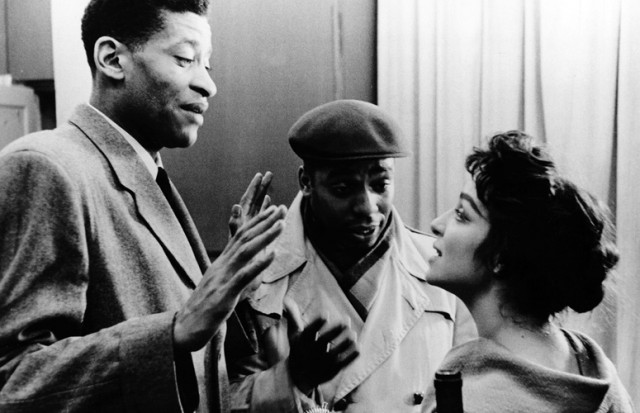
Rupert Crosse, Hugh Hurd, and Lelia Goldoni examine racism in John Cassavetes’s seminal underground film Shadows
SHADOWS (John Cassavetes, 1959)
Friday, May 12, 2:15
Monday, May 15, 8:10
Saturday, May 20, 12:15
Friday, June 2, 5:30 filmforum.org
John Cassavetes’s directorial debut, Shadows, is a landmark moment in the history of independent cinema and one of the most influential films ever made. Shot in black-and-white with a 16mm handheld camera on a modest budget of $40,000, much of which was raised following Cassavetes’s appearance on Jean Shepherd’s radio show — the credits include the line “Presented by Jean Shepherd’s Night People” — Shadows is a gritty, underground examination of race in New York City, one of the first major anti-Hollywood American movies. Although the script is credited to Cassavetes, the film is primarily improvised by a group of mostly nonprofessional or first-time actors using their real first names, set to a jazzy, moody score by Charles Mingus saxophonist Shafi Hadi. Lelia Goldoni stars as twenty-year-old Lelia, a confused young woman who loses her virginity to Tony (Anthony Ray), who thought it was a one-night stand but then decides they should start dating after she becomes clingy. However, Tony freaks out when he meets one of Lelia’s brothers, singer Hugh (Hugh Hurd), who is black. Meanwhile, their other brother, trumpeter Ben (Ben Carruthers), spends his nights with his two buddies, Dennis (Dennis Sallas) and Tom (Tom Reese), bumming money and trying to pick up chicks.
Amid Bohemian parties, street fights, and visits to Central Park, Port Authority, Grand Central Terminal, and MoMA’s sculpture garden, Cassavetes and the cast explore life, love, and racism in realistic ways, even if some of the actors are a lot better than others and certain scenes fall flat. Gordon is particularly annoying through much of the film; the most interesting relationship exists between Hugh and his devoted agent, Rupert (Rupert Crosse, who spent the next thirteen years appearing in myriad television series). Look for Cassavetes in the scene in which a stranger harasses Lelia in Times Square. Shadows comes alive with the rhythm and energy of late 1950s New York; Cassavetes died in 1989 at the age of fifty-nine, leaving behind quite a legacy.
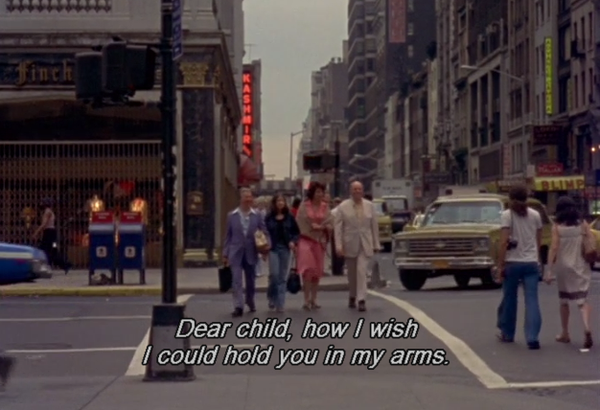
Chantal Akerman combines footage of 1970s New York with letters from her mother in News from Home
NEWS FROM HOME (Chantal Akerman, 1977)
Friday, May 12, 4:15
Saturday, May 20, 2:15 filmforum.org
In 1971, twenty-year-old Chantal Akerman moved to New York City from her native Belgium, determined to become a filmmaker. Teaming up with cinematographer Babette Mangolte, she made several experimental films, including Hotel Monterey and La Chambre, before moving back to Belgium in 1973. But in 1976 she returned to New York City to make News from Home, a mesmerizing work about family and dislocation, themes that would be prevalent throughout her career. The film consists of long, mostly static shots, using natural sound and light, depicting a gray, dismal New York City as cars move slowly down narrow, seemingly abandoned streets, people ride the graffiti-laden subway, workers and tourists pack Fifth Ave., and the Staten Island Ferry leaves Lower Manhattan.
The only spoken words occur when Akerman, in voice-over, reads letters from her mother, Natalia (Nelly) Akerman, sent during Chantal’s previous time in New York, concerned about her daughter’s welfare and safety. “I’m glad you don’t have that job anymore and that you’re liking New York,” Akerman reads in one letter. “People here are surprised. They say New York is terrible, inhuman. Perhaps they don’t really know it and are too quick to judge.” Her mother’s missives often chastise her for not writing back more often while also filling her in on the details of her family’s life, including her mother, father, and sister, Sylviane, as well as local gossip.
Although it was not meant to be a straightforward documentary, News from Home now stands as a mesmerizing time capsule of downtrodden 1970s New York, sometimes nearly unrecognizable when compared to the city of today. The film also casts another light on the relationship between mother and daughter, which was highlighted in Akerman’s final film, No Home Movie, in which Chantal attempts to get her mother, a Holocaust survivor, to open up about her experiences in Auschwitz. Nelly died shortly after filming, and Akerman committed suicide the following year, only a few months after No Home Movie played at several film festivals (and was booed at Locarno). News from Home takes on new meaning in light of Akerman’s end, a unique love letter to city and family and to how we maintained connections in a pre-internet world.
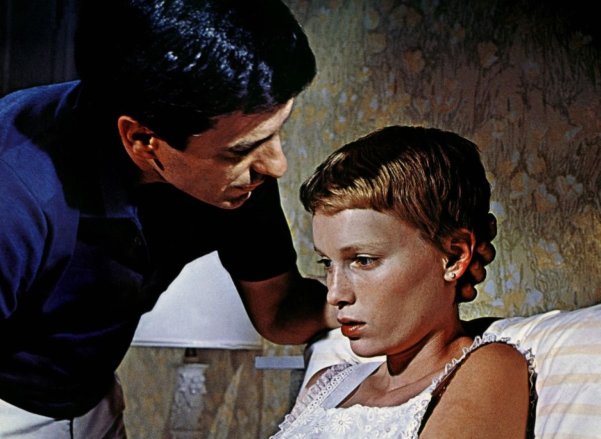
Rosemary (Mia Farrow) doesn’t know who she can trust in Roman Polanski’s horror classic
ROSEMARY’S BABY (Roman Polanski, 1968)
Saturday, May 13, 2:20
Tuesday, May 23, 2:15 filmforum.org
Based on the frightening novel by Ira Levin, Rosemary’s Baby is one of the greatest psychological horror films ever made — and one of the best ever about the hell that apartment life in New York City can be. When Rosemary (Mia Farrow) and Guy Woodhouse (John Cassavetes) move into the fancy Upper West Side apartment complex the Bramford (the Dakota), ready to start a family, Rosemary slowly grows suspicious of Guy’s new friends, particularly the sweet old couple next door (Oscar winner Ruth Gordon and Sidney Blackmer), with good reason.
Written and directed by Roman Polanski, Rosemary’s Baby works primarily because it is so believable, with recognizable characters and situations that never go over the top. It’s not just about a satanic underworld gathering in New York City; it delves headfirst into urban paranoia and the fear of adulthood and responsibility, focusing on career success and parenting, with the baby-faced Farrow expertly cast as the mom-to-be. The frightening thriller, which is filled with truly scary scenes, has held up well over the years, so beware if you’re afraid of the dark. In any case, be prepared to have the bejesus scared out of you.
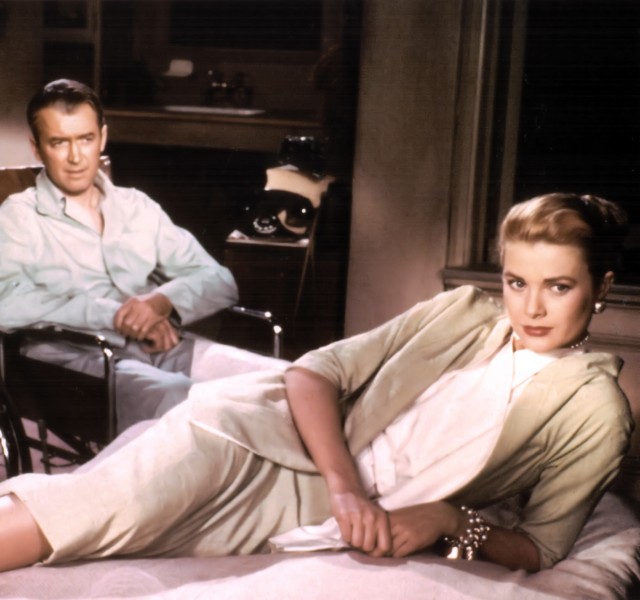
Jimmy Stewart and Grace Kelly might have just stumbled into the middle of a murder mystery in Hitchcock classic
REAR WINDOW (Alfred Hitchcock, 1954)
Sunday, May 14, 7:10
Sunday, May 21, 8:15 filmforum.org
Watching Alfred Hitchcock’s Rear Window makes people happy. One of the Master of Suspense’s best films, it’s an unforgettable voyeuristic thriller starring James Stewart as temporarily wheelchair-bound photojournalist L. B. Jeffries and Grace Kelly as his society-girl friend (and extremely well dressed) Lisa Carol Fremont. Bored out of his mind, Jeffries grabs a pair of binoculars and starts spying on the apartments across the courtyard from him, each one its own television show, including a musical comedy, a lonely romance, an exercise program, and, most ominously, perhaps a murder mystery. Ever the reporter, Jeffries decides to go after the possible killer, Lars Thorwald (Raymond Burr), and he’ll risk his life — and Lisa’s — to find out the truth. Sensational from start to finish, Rear Window works on so many levels, you’ll discover something new every time you watch it.
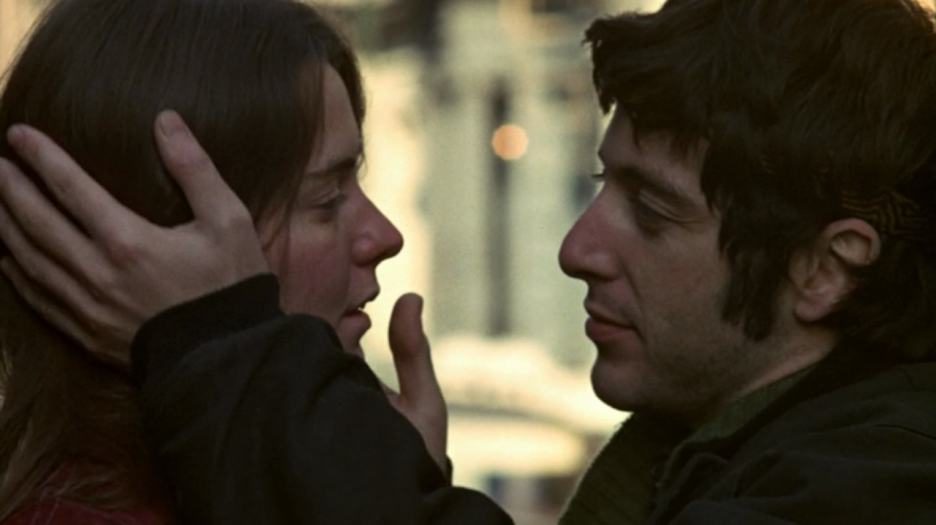
Kitty Winn and Al Pacino struggle with love and addiction in The Panic in Needle Park
THE PANIC IN NEEDLE PARK (Jerry Schatzberg, 1971)
Wednesday, May 17, 7:00
Thursday, May 18, 3:10 filmforum.org
Al Pacino burst onto the cinematic landscape in The Panic in Needle Park, his first starring role. Pacino is fabulously unsettling as Bobby, a junkie always looking to score around Sherman Square at 72nd St. and Broadway, known then as Needle Park. Bobby hooks up with Helen (Kitty Winn, who was named Best Actress at the 1971 Cannes Film Festival for her performance), and the two of them do whatever is necessary to stay high as they wander the streets of the city. Director Jerry Schatzberg (Scarecrow, The Seduction of Joe Tynan, Street Smart) uses natural sound and light to give the film a more realistic feel, as if you are walking through the streets with Bobby and Helen.
Several scenes will break your heart, including the one on the Staten Island Ferry; the powerful screenplay was the first written by novelist Joan Didion. The film launched Pacino’s stellar film career; his next five movies were The Godfather, Scarecrow, Serpico, The Godfather Part II, and Dog Day Afternoon, arguably the best start to an acting career ever. Gritty, realistic, and surprisingly tender, The Panic in Needle Park will be screening May 17 at 7:00 and 18 at 3:10; Schatzberg will sit down with Film Forum repertory artistic director Bruce Goldstein after the first show, focusing on the director’s photography, which was recently on view at Fotografiska.
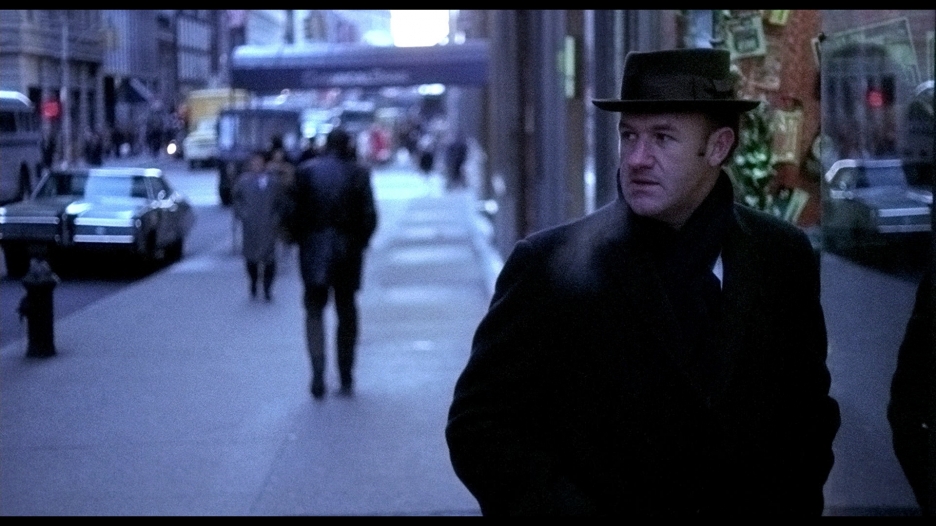
Popeye Doyle battles his inner demons and an international drug ring in New York City classic The French Connection
THE FRENCH CONNECTION (William Friedkin, 1971)
Thursday, May 18, 8:00
Saturday, May 20, 6:30
Saturday, May 27, 8:40 filmforum.org
William Friedkin’s Oscar-winning classic The French Connection is a whole lot more than just a car chase. But oh, what a car chase. Adapted by screenwriter Ernest Tidyman from a nonfiction book by Robin Moore, the gripping 1971 thriller is about obsession and paranoia, setting the stage for a decade filled with gritty, soul-searching films centered around troubled antiheroes. Way down on the list of actors to play Popeye Doyle, Gene Hackman won an Academy Award for his portrayal of the undercover detective willing to do anything to get his man. In this case, his targets are suave local hoodlum Sal Boca (Tony Lo Bianco) and elegant French drug kingpin Alain Charnier (Fernando Rey), less-than-affectionately known as Frog One.
Sure that a major international deal is about to go down, Doyle and his partner, Cloudy Russo (Roy Scheider), trail Boca and Charnier, highlighted by a marvelous cat-and-mouse game between Doyle and Charnier on the subway and then, of course, the car chase to end all car chases, as Doyle speeds underneath an elevated train in a Pontiac LeMans, determined to catch hit man Pierre Nicoli (Marcel Bozzuffi). Shot in muted browns and grays by Owen Roizman, who photographed such other New York City tales as The Taking of Pelham One Two Three, Three Days of the Condor, and Tootsie, the film was inspired by real-life situations involving cops Eddie Egan and Sonny Grosso, both of whom appear in the film (but not as themselves).
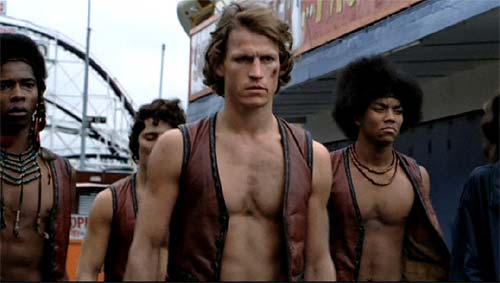
Michael Beck tries to lead the Warriors back home to Coney Island against all odds
At a huge gang meeting in the Bronx (actually shot in Riverside Park), the Warriors are wrongly accused of having killed Cyrus (Roger Hill), an outspoken leader trying to band all the warring factions together to form one huge force that can take over the New York City borough by borough. The Warriors then must make it back to their home turf, Coney Island, with every gang in New York lying in wait for them to pass through their territory. This iconic New York City gang movie is based on Sol Yurick’s novel, which in turn is loosely based on Xenophon’s Anabasis, which told of the ancient Greeks’ retreat from Persia.
Michael Beck stars as Swan, who becomes the de-facto leader of the Warriors after Cleon (Dorsey Wright) gets taken down early. Battling Swan for control is Ajax (Dexter’s James Remar) and tough-talking Mercy (Too Close for Comfort’s Deborah Van Valkenburgh). Serving as a Greek chorus is Lynne (Law & Order) Thigpen as a radio DJ, and, yes, that young woman out too late in Central Park is eventual Oscar winner Mercedes Ruehl. Among the cartoony gangs of New York who try to stop the Warriors are the roller-skating Punks, the pathetic Orphans, the militaristic Gramercy Riffs, the all-girl Lizzies, the ragtag Rogues, and the inimitable Baseball Furies. Another main character is the New York City subway system itself.
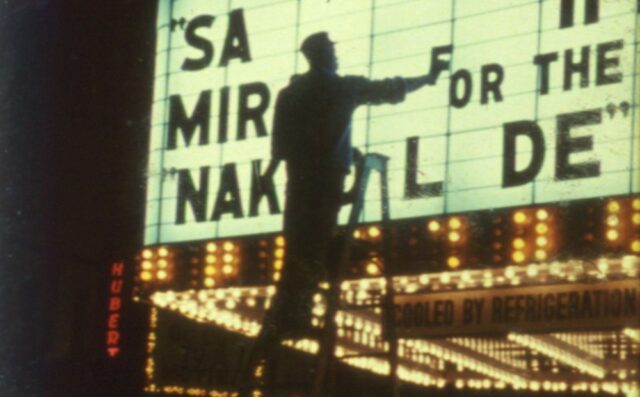
There are eight million stories in the Naked City, and Film Forum is showing some of the best ever
THE NAKED CITY (Jules Dassin, 1948)
Monday, May 22, 1:00
Monday, May 29, 4:45
Thursday, June 8, 4:40 filmforum.org
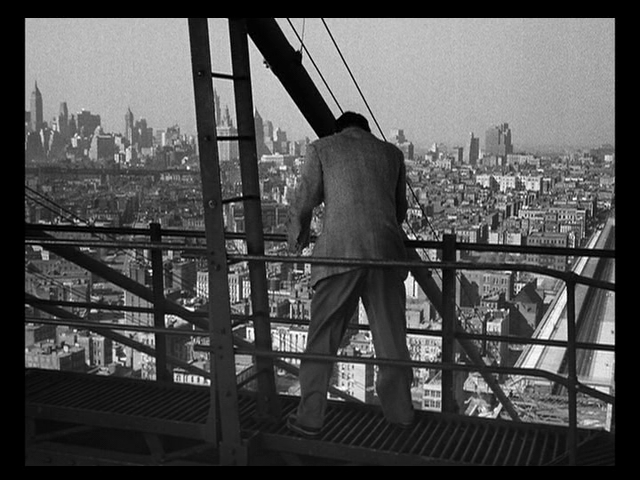
Jules Dassin’s police procedural was one of the first films shot on location in New York City, bringing to life the grit of the streets. Barry Fitzgerald stars as Lt. Muldoon, an Irish cop who knows the game, never allowing anything to get in the way of his sworn duty to uphold the law while never getting too emotionally involved. A model has turned up dead, and young detective Jimmy Halloran (Don Taylor) is heading up the investigation, which includes such suspects as swarthy Frank Niles (Howard Duff). Producer Mark Hellinger’s narration is playful and knowing, accompanying William Daniels’s great camerawork through Park Avenue and the Lower East Side, stopping at little city vignettes that have nothing to do with the story except to add to the level of reality. The thrilling conclusion takes place on the Williamsburg Bridge. The May 29 screening will include Film Forum repertory artistic director Bruce Goldstein’s short 2020 documentary Uncovering the Naked City, made during the pandemic lockdown.
Young Elgar Winthrop Julius Enders’s (Beau Bridges) spoiled life of privilege is about to dramatically change in The Landlord
THE LANDLORD (Hal Ashby, 1970)
Thursday, May 25, 8:15
Friday, May 26, 12:15
Tuesday, May 30, 2:30
Tuesday, June 6, 4:30 filmforum.org
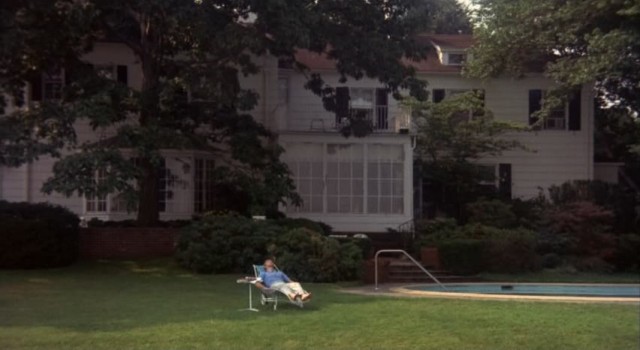
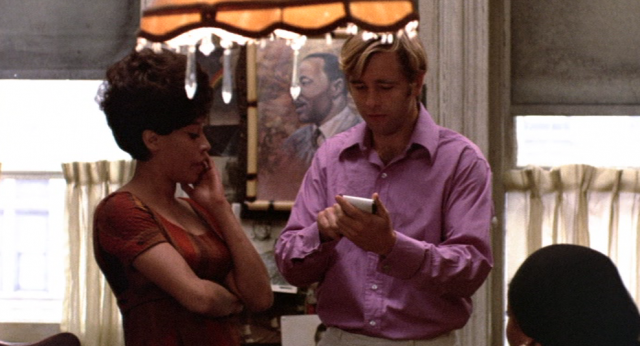
When rich kid Elgar Winthrop Julius Enders (Beau Bridges) finally decides to do something with his spoiled life of privilege, he takes a rather curious turn, buying a dilapidated tenement in a pregentrified Park Slope that resembles the South Bronx in Hal Ashby’s poignant directorial debut, The Landlord. At first, the less-than-worldly Elgar doesn’t quite know what he’s gotten himself into, believing it will be easy to kick out the current residents and then replace the decrepit building with luxury apartments. He pulls up to the place in his VW bug convertible, thinking he can just waltz in and do whatever he wants, but just as his car is vandalized, so is his previously charmed existence, as he gets to know wise house mother Marge (Pearl Bailey), the sexy Francine (Diana Sands), her activist husband, Copee (Louis Gossett Jr.), and Black Power professor Duboise (Melvin Stewart), none of whom is up-to-date with the rent. Meanwhile, Elgar starts dating Lanie (Marki Bey), a light-skinned half-black club dancer he assumed was white, infuriating his father, William (Walter Brooke), and mother, Joyce (a delightful, Oscar-nominated Lee Grant), who are in the process of setting up their daughter, Susan (Susan Anspach), with the white-bread Peter Coots (Robert Klein).
Elgar has a whole lot of learning to do in Hal Ashby’s New York City–set black comedy
Based on the novel by Kristin Hunter, The Landlord is a telling microcosm of race relations and class conflict in a tumultuous period in the nation’s history, as well as that of New York City, coming shortly after the civil rights movement and the free-love late ’60s. The film is masterfully shot by Astoria-born cinematographer Gordon Willis (Klute, Annie Hall, Manhattan, all three Godfather movies), who sets the bright, open spaces of the Enderses’ massive estate against the dark, claustrophobic rooms of the dank tenement. Screenwriter Bill Gunn (Ganja and Hess) and Ashby avoid getting overly preachy in this at-times outrageous black comedy, incorporating slapstick along with some more tender moments; the scene in which Joyce meets Marge is a marvel of both. And just wait till you see Coots’s costume at a fancy fundraiser. The Landlord began quite a string for Ashby, who followed it up with Harold and Maude, The Last Detail, Shampoo, Bound for Glory, Coming Home, and Being There in a remarkable decade for the former film editor (In the Heat of the Night) who died in 1988 at the age of fifty-nine.
Screening of cult subway graffiti film Stations of the Elevated will be hosted by director Manfred Kirchheimer
STATIONS OF THE ELEVATED (Manfred Kirchheimer, 1981)
Friday, May 26, 6:20 filmforum.org
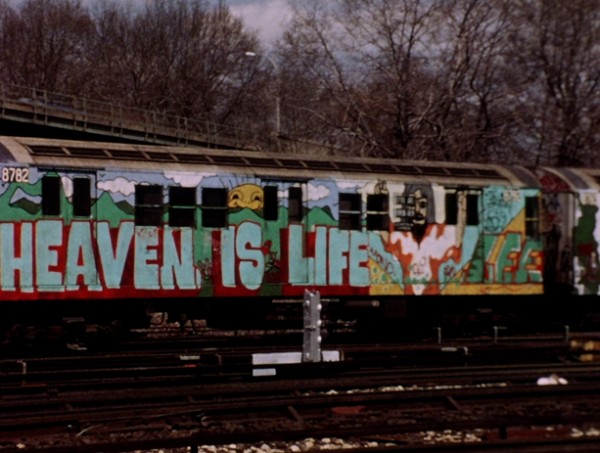
Thirty-three years after screening at the New York Film Festival, Manfred Kirchheimer’s Stations of the Elevated finally got its official U.S. theatrical release, in a gorgeous new restoration. In 1977, Kirchheimer, whose family escaped Nazi Germany in 1936, went to the Bronx and filmed graffiti-covered subway cars at the train depot and rushing across the elevated tracks, kids playing in a burned-out housing project, and giant billboards advertising hamburgers, cigarettes, alcohol, and suntan lotion. Shot on 16mm reversal stock, Stations of the Elevated is more than just a captivating document of a bygone era; it is a deeply poetic socioeconomic journey into class, race, art, and freedom of expression, told without a single word of narration or onscreen text.
Instead, producer, director, editor, and photographer Kirchheimer (Colossus on the River, Bridge High with Walter Hess) shifts from the natural sound of the environment to a superb jazz score by Charles Mingus while cutting between shots of trains covered in tags and illustrations (and such phrases as “Heaven Is Life,” “Invasion of the Earth,” “Never Die,” and “Earth Is Hell”) by such seminal figures as Blade, Daze, Lee, Pusher, Shadow, and Slave and views of colorful billboards filmed peeking through the geometric architecture of the elevated railways and set against bright blue skies. Most often, the camera focuses on the painted eyes in the ads, looking right back at the viewer as they dominate the scene, evoking the optician’s ad in that famous novel of American class, The Great Gatsby. (The concentration on the eyes also predicts how Madison Ave. was watching the graffiti movement, eventually coopting the imagery into mainstream advertising.) Through this dichotomy of meaning and execution, Kirchheimer reveals similarities in artistic styles and how the elements influenced each other; a particularly telling moment occurs when a man is shown hand painting a billboard who could have just as well been spray painting a subway car.
Kirchheimer remains outside during the course of the forty-five-minute documentary, never venturing into the tunnels, capturing the elevated train lines as if they’re just another part of New York City architecture, which of course they are. And it’s especially powerful because it was made at a time when the city was in the midst of a severe economic crisis and rampant crime epidemic, as Mayor Koch sought to eliminate the scourge of graffiti, while Kirchheimer celebrates its beauty (and New York-ness) in this glorious little film. Stations of the Elevated, which elevates the station of subway graffiti artistry with an entrancing calmness, is being shown at Film Forum on May 26 at 6:20 with other shorts by the ninety-two-year-old Kirchheimer, who will be on hand to discuss his work with film programmer Jake Perlin.
A group of straphangers are terrorized by thugs in Larry Peerce’s The Incident
THE INCIDENT (Larry Peerce, 1967)
Saturday, May 27, 4:00
Tuesday, May 30, 12:15 filmforum.org
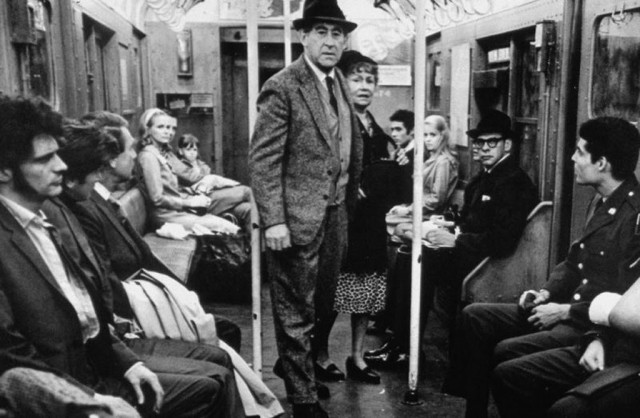
One of the ultimate nightmare scenarios of 1960s New York City, Larry Peerce’s gritty black-and-white The Incident takes viewers deep down into the subway as two thugs terrorize a group of helpless passengers. Joe Ferrante (Tony Musante) and Artie Connors (Martin Sheen, in his first movie role) are out for kicks, so after getting some out on the streets, they head underground, where they find a wide-ranging collection of twentieth-century Americans to torture, including Arnold and Joan Robinson (Brock Peters and Ruby Dee), Bill and Helen Wilks (Ed McMahon and Diana Van der Vlis), Sam and Bertha Beckerman (Jack Gilford and Thelma Ritter, in her last role), Douglas McCann (Gary Merrill), Muriel and Harry Purvis (Jan Sterling and Mike Kellin), Alice Keenan (Donna Mills), soldiers Felix Teflinger and Phillip Carmatti (Beau Bridges and Robert Bannard), and others, each representing various aspects of contemporary culture and society, all with their own personal problems that come to the surface as the harrowing ride continues.
It’s a brutal, claustrophobic, highly theatrical film that captures the fear that haunted the city in the 1960s and well into the ’70s, with an all-star cast tackling such subjects as racism, teen sex, alcoholism, homosexuality, war, and the state of the American family. Some of this rarely shown drama was filmed in the actual subway system against the MTA’s warnings.
Walter Matthau tries to get to the bottom of a bizarre subway heist in The Taking of Pelham One Two Three
THE TAKING OF PELHAM ONE TWO THREE (Joseph Sargent, 1974)
Saturday, May 27, 6:10
Monday, May 29, 12:15 filmforum.org
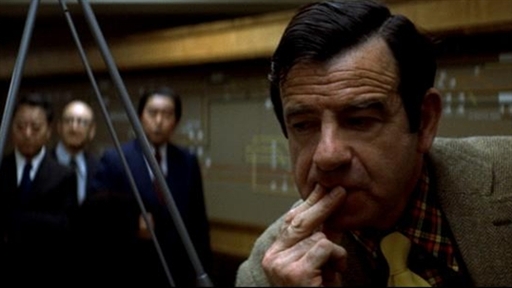
Loosely adapted from the book by John Godey, Joseph Sargent’s underground thriller The Taking of Pelham One Two Three wonderfully captures the cynicism of New York City in the 1970s. Four heavily armed and mustached men — Mr. Blue (Robert Shaw), Mr. Green (Martin Balsam), Mr. Gray (Hector Elizondo), and Mr. Brown (Earl Hindman), colorful pseudonyms that influenced Quentin Tarantino’s Reservoir Dogs — hijack an uptown 4 train, demanding one million dollars in one hour from a nearly bankrupt city or else they will kill all eighteen passengers, one at a time, minute by minute. The hapless mayor (Lee Wallace) is in bed with the flu, so Deputy Mayor Warren LaSalle (Tony Roberts) takes charge on the political end while transit detective Lt. Zachary Garber (a great Walter Matthau) and Inspector Daniels (Julius Harris) of the NYPD team up to try to figure out just how in the world the criminals expect to get away with the seemingly impossible heist.
Sargent (Sybil) offers a nostalgic look back at a bygone era, before technology radically changed the way trains are run and police work is handled. The film also features a very funny, laconic Jerry Stiller as Lt. Rico Patrone and the beloved Kenneth McMillan as the borough commander. It was remade as a television movie in 1998, starring Edward James Olmos, Vincent D’Onofrio, and Lorraine Bracco, and as an embarrassingly bad big-budget bomb in 2009 by Tony Scott. Film Forum repertory artistic director Bruce Goldstein will give an illustrated lecture preceding the May 27 screening.
Joey Norton goes on the adventure of a lifetime in Coney Island in underground indie classic Little Fugitive
LITTLE FUGITIVE (Morris Engel, Ray Ashley, and Ruth Orkin, 1953)
Sunday, May 28, 12:15
Monday, May 29, 2:30 filmforum.org
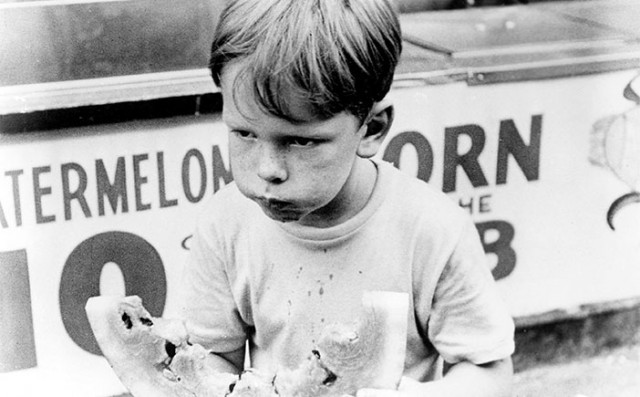
Morris Engel’s charming Little Fugitive is one of the most influential and important — and vastly entertaining — works to ever come out of New York City. Written and directed with Ray Ashley and Ruth Orkin, Engel’s future wife, Little Fugitive follows the gritty, adorable exploits of seven-year-old wannabe cowboy Joey Norton (Richie Andrusco, in his only film role), who runs away to Coney Island after his older brother, Lennie (Richard Brewster), and his brother’s friends, Harry (Charlie Moss) and Charley (Tommy DeCanio), play a trick on the young boy, using ketchup to convince Joey that he accidentally killed Lennie. With their single mother (Winifred Cushing) off visiting their ailing mother, Joey heads out on his own, determined to escape the cops who are surely after him. But once he gets to Coney Island, he decides to take advantage of all the crazy things to be found on the beach, along the boardwalk, and in the surrounding area, including, if he can get the money, riding a real pony.
A no-budget black-and-white neo-Realist masterpiece shot by Engel with a specially designed lightweight camera that was often hidden so people didn’t know they were being filmed, Little Fugitive explores the many pleasures and pains of childhood and the innate value of home and family. As Joey wanders around Coney Island, he meets all levels of humanity, preparing him for the world that awaits as he grows older. Meanwhile, Engel gets into the nooks and crannies of the popular beach area, from gorgeous sunrises to beguiling shadows under the boardwalk. In creating their beautifully told tale, Engel, Ashley, and Orkin use both trained and nonprofessional actors, including Jay Williams as Jay, the sensitive pony ride man, and Will Lee, who went on to play Mr. Hooper on Sesame Street, as an understanding photographer, while Eddie Manson’s score continually references “Home on the Range.” Rough around the edges in all the right ways, Little Fugitive became a major influence on the French New Wave, with Truffaut himself singing its well-deserved praises. There’s really nothing quite like it, before or since. The underground classic, which won the Silver Lion at the Venice Film Festival in 1953, was nominated for a Best Screenplay Oscar, and was entered into the National Film Registry in 1997, will be screening at Film Forum with Engel’s 1953 short The Dog Lover and will be introduced by Engel and Orkin’s daughter, Mary Engel.
Harold Lloyd has a crazy time in Coney Island in Speedy
SPEEDY (Ted Wilde, 1928)
Sunday, May 28, 2:30 filmforum.org
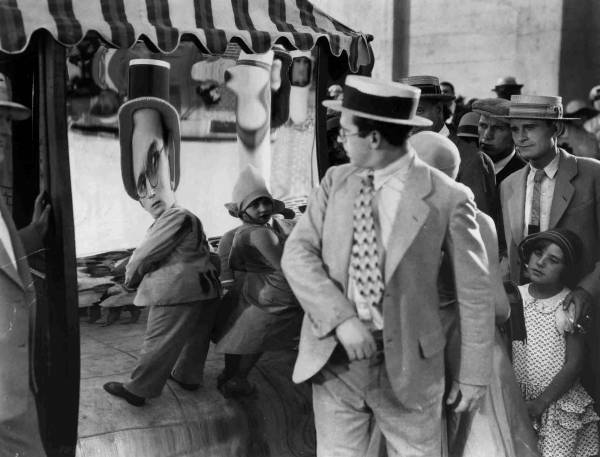
Much like the end of the silent film era itself, the last horse-drawn trolley is doomed in Harold Lloyd’s final silent film. Big business is playing dirty trying to get rid of the trolley and classic old-timer Pop Dillon. Meanwhile, Harold “Speedy” Swift, a dreamer who wanders from menial job to menial job (he makes a great soda-jerk with a unique way of announcing the Yankees score), cares only about the joy and wonder life brings. But he’s in love with Pop’s granddaughter, Jane, so he vows to save the day. Along the way, he gets to meet Babe Ruth. Ted Wilde was nominated for an Oscar for Best Director, Comedy, for this thrilling nonstop ride through beautiful Coney Island and the pre-depression streets of New York City. The restored 35mm print of Speedy is being shown May 28 at 2:30 at Film Forum with live accompaniment by pianist Steve Sterner and will be followed by Bruce Goldstein’s 2015 documentary, In the Footsteps of Speedy.
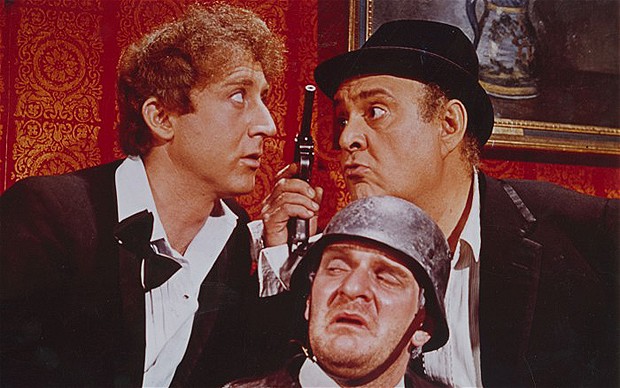
Zero Mostel and Gene Wilder, along with Kenneth Mars, concoct a crazy plan that just might work in The Producers
THE PRODUCERS (Mel Brooks, 1968)
Wednesday, May 31, 12:15
Sunday, June 4, 6:15
Tuesday, June 6, 12:30 filmforum.org
No way around it; this is one funny movie. Written and directed by Mel Brooks (who won an Oscar for Best Original Screenplay), The Producers stars Zero Mostel as Max Bialystock, a once great Broadway producer now relegated to wooing old ladies for their checkbooks. Gene Wilder earned an Oscar nomination for Best Supporting Actor as Leo Bloom, a by-the-book accountant who figures out that it could be possible to make more money from a bomb than a hit. And the bomb they turn to is the extraordinary Springtime for Hitler, featuring a great turn by Kenneth Mars as a neo-Nazi. Brooks, Mostel, Wilder, Mars, and the rest of the crazy cast — which also includes Dick Shawn, Lee Meredith, Estelle Winwood, Christopher Hewett, Renee Taylor, Barney Martin, Bill Macy, and William Hickey — don’t just play it for laughs but for giant guffaws and jaw-dropping disbelief in this riotous romp that was turned into a very good but overrated Broadway musical and a terrible film version of the show, both starring Nathan Lane and Matthew Broderick, neither of whom can fill Mostel and Wilder’s shoes.
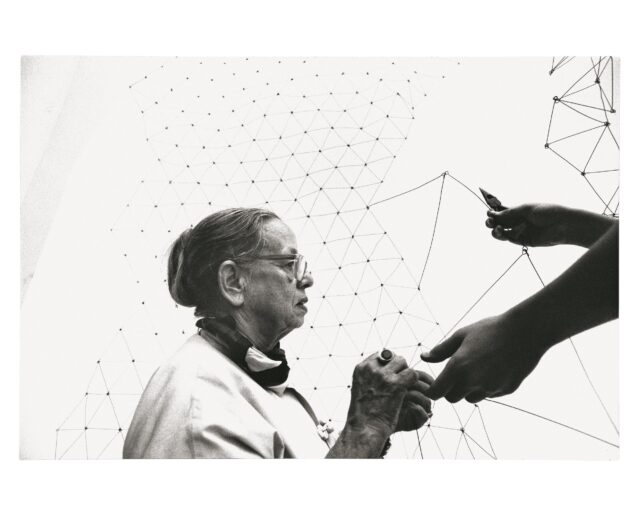
Gego installing Reticulárea 1981, 1980, permanent collection display, Sala Gego (Gego Room), Galería de Arte Nacional, Caracas (photo by Christian Belpaire, courtesy Archivo Fundación Gego)
Who: Mónica Amor, Vered Engelhard, Geaninne Gutiérrez-Guimarães, Pablo León de la Barra, Sean Nesselrode Moncada, Luis Pérez-Oramas, Mari Carmen Ramírez, Álvaro Sotillo What: Symposium on “Gego: Measuring Infinity” Where:Solomon R. Guggenheim Museum, 1071 Fifth Ave. at Eighty-Ninth St. When: Friday, May 12, $15-$25, noon – 5:00 Why: German-Venezuelan artist Gertrud Goldschmidt, better known as Gego, is the subject of the outstanding new Guggenheim exhibition “Gego: Measuring Infinity,” consisting of nearly two hundred drawings, etchings, watercolors, letters, and, primarily, mesmerizing, fragile, architectural sculptures that Gego called drawings without paper. On May 12, the Guggenheim is hosting the five-hour seminar “Gego: Weaving Lines of Thought,” examining the life and career of Gego, who was born in Hamburg in 1912 and died in Caracas in 1994. Organized by exhibition cocurators Pablo León de la Barra and Geaninne Gutiérrez-Guimarães, the symposium, part of the Guggenheim’s Latin American Circle Presents series, will feature presentations by León de la Barra, Gutiérrez-Guimarães, Mónica Amor, Vered Engelhard, Sean Nesselrode Moncada, Luis Pérez-Oramas, and Mari Carmen Ramírez in addition to longtime Gego collaborator Álvaro Sotillo. The exhibition continues through September 10; make sure to save time for the remarkable “Sarah Sze: Timelapse” as well.
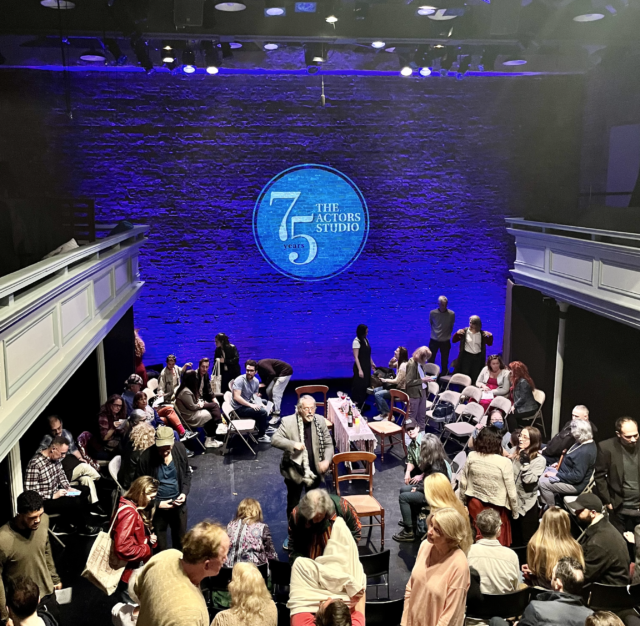
The Actors Studio continues its seventy-fifth anniversary celebration with several special free events this month (photo courtesy the Actors Studio)
THE ACTORS STUDIO IN PROCESS
The Actors Studio
432 West Forty-Fourth St. between Ninth & Tenth Aves.
May 12-13, free with RSVP, 7:00
Additional events May 14, 19-20, 25-26 theactorsstudio.org
If you haven’t been paying attention, the Actors Studio has been celebrating its seventy-fifth anniversary with some outstanding public events. Last month, “Directed by Estelle Parsons” featured the Oscar- and Obie-winning actress helming three works; in December, Carroll Baker was on hand for a talk following a screening of Elia Kazan’s Baby Doll; and in October, Al Pacino hosted a screening of Sidney Lumet’s Dog Day Afternoon at United Palace.
The party continues this weekend with Tony and Obie winner Lois Smith and others taking audiences behind the scenes in “The Actors Studio in Process.” On May 12 and 13 at 7:00, there will be open rehearsals of scenes from three plays: Elizabeth Stearns’s Hillbilly Women, directed by Marilyn Fried and starring Smith, Jacqueline Knapp, and Taylor Plas; writer-director Dennis Russo’s Midnight and Sky, with Russo and Marc Solomon; and Chris Stack and Scott McCord’s We Might Fall Apart, with McCord, Stack, and Plas. Admission is free with RSVP.
On May 14 at 3:00, an encore of “The Playwright: Tales from the Color Line” consists of scenes from plays exploring race, followed by Q&As, with Phillip Hayes Dean’s This Bird of Dawning Singeth All Night Long, directed by Paul Calderon and starring Martha Gehman and Richarda Abrams; James Baldwin’s Blues for Mister Charley, directed by Patricia Floyd and featuring McCord, Robert Mobley, Samuel Pygatt, Delissa Reynolds, and Lawrence Stallings; Lorraine Hansberry’s The Sign in Sidney Brustein’s Window, with Michael Billingsley, Aprella Godfrey-Barule, and Omar Ezat and directed by JoAnna Rhinehart; and Charles Gordone’s No Place to Be Somebody, with Mobley, Brittaney Chatman, Rony Clanton, Marcus Naylor and Steven Vause, directed by Naylor.
The festivities carry on later in the month with “On the Fly 2023: Then and Now” on May 19 and 20, a two-part presentation of short plays by BIPOC writers and directors, the first night a screening of Zoom plays streamed during the pandemic, the second live works, and May 25 and 26 with “Areyto: Latine Celebration,” an immersive theatrical ceremony rooted in equatorial tribal origins, followed by a reception.
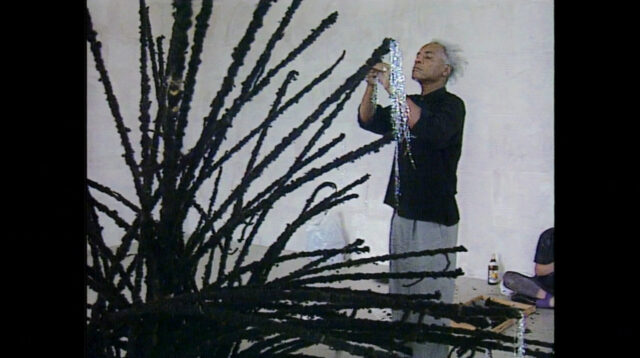
David Hammons works on a piece for Documenta IX (photo by Hessischer Rundfunk)
THE MELT GOES ON FOREVER: THE ART AND TIMES OF DAVID HAMMONS (Judd Tully & Harold Crooks, 2022)
Film Forum
209 West Houston St.
Opens Friday, May 5
212-727-8110 filmforum.org themeltfilm.com
“David believes that the less said about him, the better off he is,” the late poet and Gathering of the Tribes founder Steve Cannon says about his friend, artist David Hammons, in The Melt Goes on Forever: The Art and Times of David Hammons, opening May 5 at Film Forum.
In 2020, Hammons, who was born in Springfield, Illinois, in 1943 and has been based in New York City for nearly fifty years, installed Day’s End, an homage to Gordon Matta-Clark’s 1975 similarly named intervention in an abandoned industrial building on Pier 52, outside where the Whitney is today. The 325-foot-long brushed-steel outline of the warehouse has no interior, a ghostly memorial to those lost in the AIDS crisis.
With The Melt, directors Judd Tully and Harold Crooks have constructed a stirring documentary that is missing one key figure: Hammons, who doesn’t do interviews or talk about his personal life, preferring to have his work stand on its own. There’s a reason why the subtitle is “the Art and Times,” not the more common phrase “the Life and Times.”
More than two dozen art historians (Kellie Jones, Bridget R. Cooks, Richard Powell, Gylbert Coker, Robert Farris Thompson), dealers and gallerists (Jeanne Greenberg Rohatyn, Dominique Lévy, Jack Tilton, Adam Sheffer, Robert Mnuchin), artists (Suzanne Jackson, Fred Wilson, Tschabalala Self, Betye Saar, Joe Lewis, Lorna Simpson), collectors (Dimitris Daskalopoulos), and curators (Robert Storr, Ilene Susan Fort, Mary Jane Jacob) share stories about Hammons, forming a picture of a fabulously talented eclectic iconoclast who does what he wants, when he wants, the way he wants.
Among his revolutionary works discussed in the film are Bliz-aard Ball Sale, in which he sold snowballs, arranged in rows of descending size, on the streets of New York; African American Flag, a reimagining of the US flag but in the Pan-African colors of red, black, and green; How You Like Me Now?, a billboard of Jesse Jackson as a blond-haired, blue-eyed white man; Flight Fantasy, painted on the wall of Cannon’s apartment; Untitled (Night Train), two circular rows of clear and green bottles of Night Train and Thunderbird planted in a pile of coal; and Blues for Smoke, a blue model train rolling across tracks that wind around grand pianos on their side, inspired by John Coltrane’s song “Blue Train.”
“I just thought he was nuts,” artist Paul H-O says about watching Hammons go through garbage to find potential materials.
“It’s not the art object itself,” Hammons explains in a 1991 NPR radio interview. “It’s the daring of the act.”
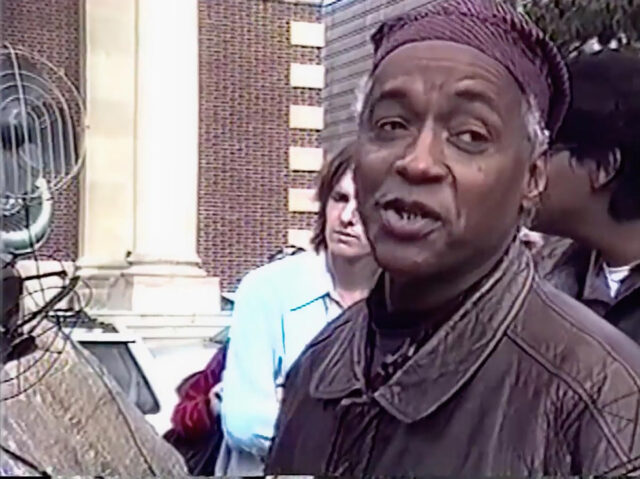
Archival footage of Hammons includes a visit by filmmaker Michael Auder to a Rome studio in 1989 where Hammons pontificates on what success means to him while constructing an untitled sculpture using real Black hair; Hammons adding cotton to wooden sticks in his Harlem studio in Michael Blackwood’s 1992 After Modernism: The Dilemma of Influence; Hammons introducing students to his outdoor sculpture Rock Fan, consisting of electric fans on a large rock on the campus of Williams College in 1993; and clips by Alex Harsley of Hammons making “Basketball Drawings” by bouncing a basketball against paper on a wall and Hammons kicking a can in his 2004 Phat Free performance.
Delving into a 1990 group show at Museum Overholland, curator Jan Christiaan Braun notes, “‘Black USA’ was more than David Hammons. It was an effort to find a podium for Black American artists. He was one of them. The meaning of ‘Black USA’ was bigger than David Hammons, and he himself thought so too. He was very, very much supporting the idea of bringing out Black art. That’s why he immediately said to me, ‘I’m your man.’”
Extensive attention is given to the 2016 career retrospective “Five Decades” at Mnuchin Gallery, which lends insight to Hammons’s wide oeuvre and process when it comes to hanging his work. “Two weeks prior to the opening, David expressed an interest in coming in to see the show,” dealer Sukanya Rajarantnam recalls, not so fondly. “Um, his reaction was not exactly exuberant. He didn’t like what we’d done and, in fact, hated it. So he decided to change things. . . . The show itself became an installation and an artwork by David.” I remember being blown away by the final exhibition, which featured many of the pieces mentioned in the documentary.
David Hammons unveils Rock Fan to students at Williams College (photo courtesy Williams College Museum of Art)
Throughout the film, arts journalist Tully and documentarian Crooks (The Price We Pay,Surviving Progress) regularly cut to Umar bin Hassan of the Last Poets performing Cannon’s catalog essay-poem “Rousing the Rubble,” recorded during Covid and originally written for Hammons’s 1990 PS1 museum show of the same name, accompanied by a barrage of grainy videos of New York City in the twentieth century and animation by Tynesha Foreman that brings some of his works to life against a pulsating Afro-jazz score:
“On the Streets of Manhattan, East Side West Side All Around the Town the Sidewalks of New York — after the bars and the clubs empty out the sordid the homeless! The misbegotten under the cover of darkness Blue Moon No moon, under the cover of darkness in the wee small hours up in Harlem — Midtown — on the Lower Eastside — Performing Artist — this is when you see the empty bottles and empty people makin’ their rounds, into makin’ their own sounds — into smiles into frowns! Digging in garbage in search of more empties — bottles and cans! Those who do be hungry doing something about their condition — with David on the scene in those lonely wee small hours after hours state of New York! Raw Energy! Making his rounds, dreams turned into nightmares heavy into art — that New York art scene outdoor art — dreams turned into realities — all night diners — back in his studio on 125th Street — making art out of that which he has heard and seen on the scene out of funk! Out of central Illinois — out of Los Angeles out of his world travels! Creating a space for the spirits! That flash of the spirit!”
The spectacular original music features composer Ramachandra Borcar on percussion, piano, found objects, and other instruments; saxophonists Idris Ackamoor, Marshall Allen, Shabaka Hutchings, and Frank Lozani; Tommy Babin and Dave Watts on bass; Aaron Doyle on trumpet and flugelhorn; Jeff Johnston on piano; and Kullak Viger Rojas on surdo. It pays tribute to the jazz influences Hammons has cited over the years, such legends as Charles Mingus, Miles Davis, Thelonius Monk, Charlie Parker, Ornette Coleman, and Coltrane. Foreman’s animation unfolds to those same vibrant rhythms, echoed in the artworks. (Hammons’s art influences range from his mentor, Charles White, to Marcel Duchamp.)
Even without their subject’s participation, Tully and Crooks are able to fill in much of the mystery surrounding Hammons, with the help of members of the arts community who adore him and his work, like partially furnishing the emptiness inherent in Day’s End. (Hammons did sit down for an interview with Whitney director Adam D. Weinberg to celebrate the opening of the Pier 52 project in June 2021, which you can watch here.)
The Melt Goes on Forever reveals Hammons to be a true nonconformist, a genius who doesn’t need to be center stage, letting his art do the talking for him.
Tully and Crooks will be at Film Forum for Q&As on May 5 at 7:15 presented by A Gathering of the Tribes, on May 6 at 7:15 with Suzanne Jackson, and on May 7 at 4:40.
Kimi Takesue’s Onlookers, screening at BAM on May 4, looks at tourists and locals in Laos
ONLOOKERS (Kimi Takesue, 2023)
BAM Cinematheque
30 Lafayette Ave. between Ashland Pl. & St. Felix St.
Thursday, May 4, 7:00
Festival runs May 3–7 at multiple venues www.bam.org www.onlookersfilm.com
“Seeing comes before words. The child looks and recognizes before it can speak,” John Berger writes in the seminal text Ways of Seeing. “But there is also another sense in which seeing comes before words. It is seeing which establishes our place in the surrounding world; we explain that world with words, but words can never undo the fact that we are surrounded by it. The relation between what we see and what we know is never settled.”
In documentary filmmaker Kimi Takesue’s Onlookers, which is screening at BAM on May 4 at 7:00 as part of “Prismatic Ground 2023” (and will be followed by a Q&A with Takesue), there are no words, no dialogue — just seventy-two minutes of stunning visuals exploring what we see and what we know, what we are present for and what we are absent for.
The film takes place in various parts of Laos as director, producer, cinematographer, sound recordist, and editor Takesue sets up her camera and leaves it there as scenes unfold in real time and with natural sound, from a breathtaking fourteen-second sunset to five and a half minutes of six women sitting by the side of the road, preparing to fill begging bowls for a long line of Buddhist monks. Animals graze in a temple courtyard as bells chime. Women sell goods at an open-air market. Rivers flow, wind rustles trees, roosters crow, birds chirp, a cat rests on a step, a man relaxes in a hammock, all taking their time, no one in a hurry.
Then the tourists arrive; a few run up to take pictures of a monk beating a drum, then walk away, not actually stopping to watch and listen. A woman snaps a photo of three fellow sightseers standing atop a small, raging waterfall as a man fishes below. A local worker waits as a woman checks her cell phone, as if he isn’t there, standing next to her. A group of backpackers gets a prime view at a boat racing festival while locals observe from the shore. On a mountain, six tourists search for the best angle to take selfies. Visitors at a guest house sit in an outdoor lounge and watch Friends.
Born in Colorado and raised in Hawai’i and Massachusetts, Takesue has previously made Where Are You Taking Me? in Uganda, Heaven’s Crossroad in Vietnam, and 95 and 6 to Go in Hawai’i, about reconnecting with her grandfather. In Onlookers, she is not necessarily criticizing the tourists or celebrating the Laotian locals; she’s merely showing how people witness and experience the world, particularly when it comes to travelers and residents.
She beautifully captures this relationship in a short but captivating scene that begins with a static shot of an old religious shrine that looks like it hasn’t been in operation for years. A young woman enters the frame, sits down, poses for a selfie, stands up, snaps a photo of the shrine, then saunters off, never once stopping to just look at the shrine itself. The camera lingers on the building for several seconds, with nobody around, just the decaying structure set against a blue sky and between lush greenery.
We see what we want to see, when we want to see it, not always recognizing what is right in front of us, whether we’re at home or on vacation. It reminded me of people who go to a museum and take pictures of classic artworks but only see them through the lens of their phone rather than experiencing them with their own eyes. In fact, each frame of Onlookers is composed like a painting that slowly comes to life.
“The way we see things is affected by what we know or what we believe,” Berger writes in his book. “Yet this seeing which comes before words, and can never be quite covered by them, is not a question of mechanically reacting to stimuli. (It can only be thought of in this way if one isolates the small part of the process which concerns the eye’s retina.) We only see what we look at. To look is an act of choice. As a result of this act, what we see is brought within our reach — though not necessarily within arm’s reach. To touch something is to situate oneself in relation to it. . . . We never look at just one thing; we are always looking at the relation between things and ourselves. Our vision is continually active, continually moving, continually holding things in a circle around itself, constituting what is present to us as we are. Soon after we can see, we are aware that we can also be seen.”
In all films, the audience might not have a choice of what they’re looking at, but they can decide for themselves what they’re seeing. And in the case of Onlookers, what they’re seeing is a gorgeous portrait of ourselves that no selfie can catch.
An annual round-up of experimental and avant-garde documentaries, the third edition of “Prismatic Ground” runs May 3–7, consisting of more than five dozen features and shorts at the Museum of the Moving Image, Maysles Documentary Center, BAM Cinematheque, DCTV’s Firehouse Cinema, Light Industry, and Anthology Film Archives. The opening-night film is Soda Jerk’s Hello Dankness, while Alexandre Larose’s scènes de ménage trilogy closes the festival. Other highlights include Ayanna Dozier’s Close, but no Cigar trilogy, Naomi Uman’s Three Sparks, and Tsai Ming-Liang’s Where and Where do you stand, Tsai Ming-Liang?
Bruna Braidotti’s Luisa is part of Italian Theater Festival across five boroughs, May 1-16
IN SCENA!
Casa Italiana Zerilli-Marimo at NYU (and other locations)
24 West Twelfth St. between Fifth & Sixth Aves.
May 1-16, free – $23.41 www.inscenany.com
The tenth edition of the “In Scena!” Italian Theater Festival takes place May 1-16, at NYU’s Casa Italiana Zerilli-Marimò and other locations in all five boroughs. This year’s iteration features eight timely plays; admission is free with advance RSVP, but donations of $23.41 will be accepted. The opening-night celebration on May 1 at 7:00 includes an awards ceremony with artists present, along with a special video and more.
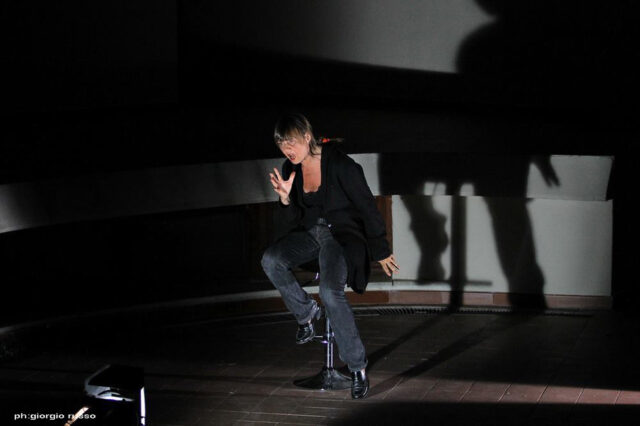
The works include four solo shows: Italian star Paola Minaccioni’s I am so much better live, with music by DJ Coco; Valentina Diana’s Mubarak’s Niece, performed by Marco Vergani, about a friendship that develops amid the Tahrir Square Revolution; Bruna Braidotti’s Luisa, which follows a woman haunted by the men in her past; Antonio Grosso’s Only Mozart Is Missing, performed by Marco Simeoli and based on the true story of Simeoli’s grandfather; and Marco De Simone’s We Puppets: Story of a life shattered by racism, set during the racial laws of 1938.
Marco Vergani stars in Valentina Diana’s Mubarak’s Niece at “In Scena!” festival
Also on the bill are The Gummy Bears’ Great War, about a fictional battle that echoes current events, written and directed by Angelo Trofa and performed by Valentina Fadda and Leonardo Tomasi; Maurizio Rippa’s Little Funerals, in which vocalist Rippa and guitarist Amedeo Monda play songs about a series of funerals; and Tiziana Troja’s DDD! Donne, Donnette, Donnacce, about a female comic duo, performed by Troja, Fadda, Trofa, Michela Sale Musio, and Michele Sarti, with original music and arrangements by Davide Sardo.
Presented by Kairos Italy Theater in association with KIT Italia and Casa Italiana Zerilli-Marimò, the festival, which moves to BAAD! Bronx Academy of Arts and Dance, Snug Harbor Cultural Center on Staten Island, the Vino Theater in Brooklyn, and Theaterlab in Queens (as well as Los Angeles, Detroit, and San Diego), concludes May 16 at the Italian Cultural Institute on Park Ave. with Andrea Scramali’s L’Attesa, about an estranged father and son who meet in an emergency room, and the presentation of the 2023 Mario Fratti Award to Scramali.