
Monday, October 3, McNally Jackson, 52 Prince St. between Lafayette & Mulberry Sts., free, 7:00
Wednesday, October 5, BookCourt, 163 Court St. between Pacific & Dean Sts., free, 7:00
www.algonquinbooksblog.com
www.hillaryjordan.com
Brooklyn-based author Hillary Jordan’s debut novel, Mudbound (Algonquin, 2009), about racial tension in a family on a Mississippi farm in the post-World War II south, was greeted with both honors and sales, winning the 2006 Bellwether Prize as well as a 2009 Alex Award from the American Library Association and becoming a favorite among reading groups. Two years later, Jordan returns with When She Woke (Algonquin, October 2011, $24.95), a novel set not in the past but the barely removed future, a dystopian America in which Christian fundamentalism, genetic manipulation, and the merging of church and state combine to solve the overcrowding in the penal system by “melachroming” convicted offenders, turning them red, blue, yellow, and green — bringing discrimination based on skin color to a whole new level. “She saw her hands first,” Jordan writes. “She held them in front of her eyes, squinting up at them. For a few seconds, shadowed by her eyelashes and backlit by the hard white light emanating from the ceiling, they appeared black. Then her eyes adjusted, and the illusion faded. She examined the backs, the palms. They floated above her, as starkly alien as starfish. She’d known what to expect — she’d seen Reds many times before, of course, on the street and on the vid — but still, she wasn’t prepared for the sight of her own changed flesh. For the twenty-six years she’d been alive, her hands had been a honey-toned pink, deepening to golden brown in the summertime. Now, they were the color of newly shed blood.” Despite this science-fiction touch, the book hearkens back, quite consciously, to that 1850 classic of American literature, Nathaniel Hawthorne’s The Scarlet Letter, as the trajectory of Jordan’s fallen woman protagonist, Hannah Payne, echoes that of Hester Prynne, both victims of a tortured “man of God” and overwhelming societal hypocrisy. Jordan’s echo of Hawthorne brings to light the Puritan narrative that still lies so close to the surface of an America that continues to struggle with sexuality, gender, crime, and punishment. Akin to and often compared with Margaret Atwood’s The Handmaid’s Tale, Jordan’s novel will hit stores October 11, and she’s opening her book tour in New York City this week with two special events, a reading, signing, and conversation with Valerie Martin on October 3 at McNally Jackson in the West Village and a reading, signing, and audience Q&A on October 5 at BookCourt in Cobble Hill.
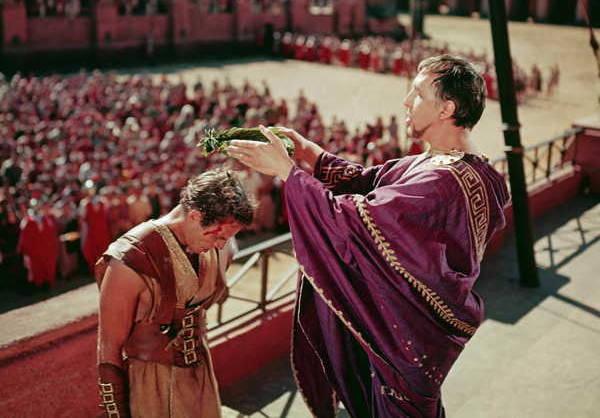
 One of the grandest epics ever made, William Wyler’s Ben-Hur is screening October 1 at Alice Tully Hall as part of the New York Film Festival’s Masterworks sidebar, which also includes Charlie Chaplin’s The Gold Rush, Sara Driver’s You Are Not I, and the thirty-seven-film “Velvet Bullets and Steel Kisses: Celebrating the Nikkatsu Centennial.” The digital restoration of Wyler’s remake of Fred Niblo’s 1925 silent version starring Ramón Novarro and Francis X. Bushman (there was also a fifteen-minute Ben Hur made in 1907, all adapted from Lew Wallace’s 1880 novel) celebrates the fiftieth anniversary of the eleven-time Oscar winner, which garnered Academy Awards for Best Picture, Best Director, Best Actor (Charlton Heston as Judah Ben-Hur), Best Supporting Actor (Hugh Griffith as Sheik Ilderim), Best Score (Miklós Rózsa), Best Cinematography, Best Set Decoration, Best Costume Design, and Best Special Effects, among other trophies. The $15 million blockbuster tells the story of two childhood friends, Judah Ben-Hur and Messala (Stephen Boyd), who get caught up in religion, politics, and slavery in first-century Rome and eventually have a magnificent showdown on the chariot course. As cinema spectacles go, they don’t get much better than this. The special screening at the New York Film Festival will be introduced by Wyler’s daughter Catherine and Heston’s son Fraser.