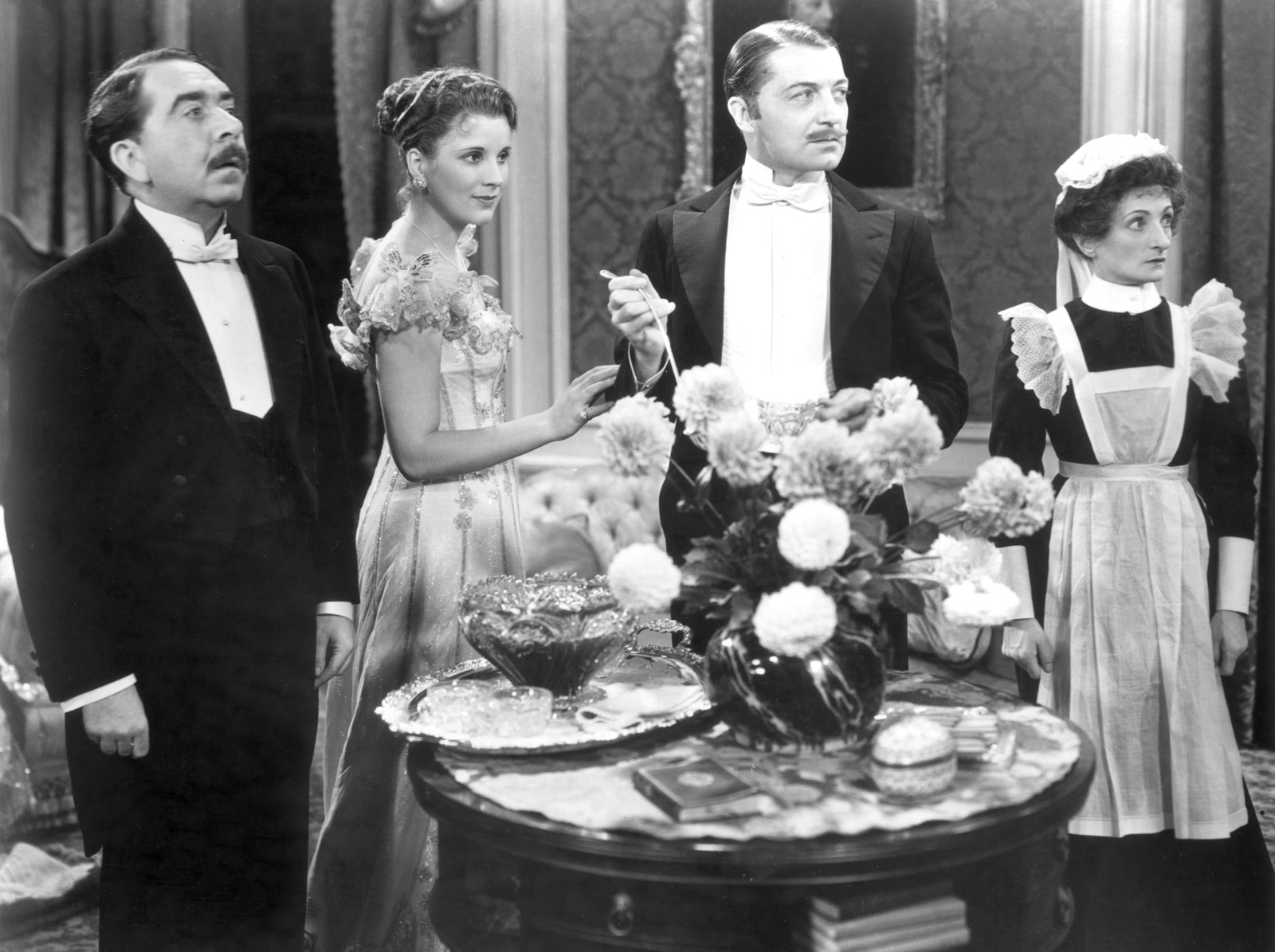
CAVALCADE gets a rare public screening Monday night as part of Noël Coward in New York festival
CAVALCADE (Frank Lloyd, 1933)
Academy Theater at Lighthouse
111 East 59th St.
Monday, March 12, $5, 7:00
www.oscars.org
www.noelcowardinnewyork.com
Hailed in ads as the “Picture of the Generation,” Frank Lloyd’s 1933 historical family epic, Cavalcade, took home the Academy Award for Best Picture, along with trophies for Best Art Direction (William S. Darling) and Best Director. The tale of the British Marryott clan from 1899 to 1933, the film was based on the 1931 play by Noël Coward and adapted by Russian screenwriter Sonya Levien (State Fair, Oklahoma!) and Hollywood scribe Reginald Berkeley (Dreyfus). Featuring songs by Coward, George M. Cohan, and others, the film earned a Best Actress nod for Diana Wynyard as family matriarch Jane Marryot and also stars Clive Brook, Una O’Connor, and Bonita Granville. The only Best Picture winner not available as a single DVD — it’s part of a three-volume Fox seventy-fifth anniversary package — Cavalcade will get a rare public screening tonight at the Monday Nights with Oscar series at the Academy Theater, hosted by Brad Rosenstein, curator of the exhibition “Star Quality: The World of Noël Coward,” on view at the New York Public Library for the Performing Arts at Lincoln Center through August 18. The screening and the display are part of the Noël Coward in New York festival, which continues with a series of special events including lectures, live performances, staged readings, and a master class at Juilliard.
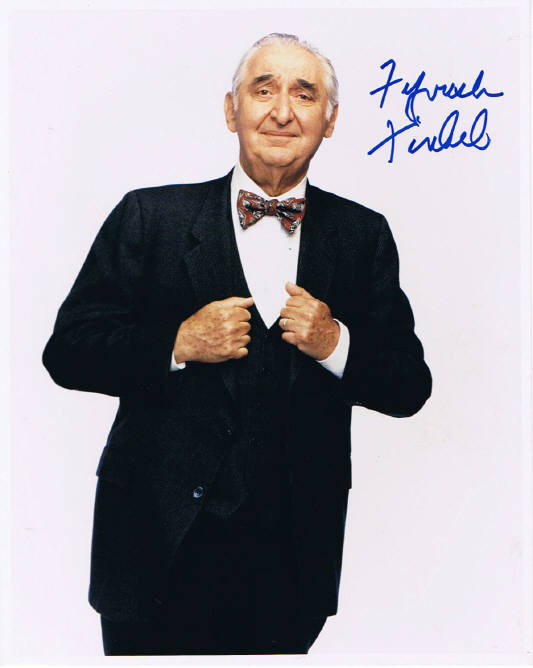
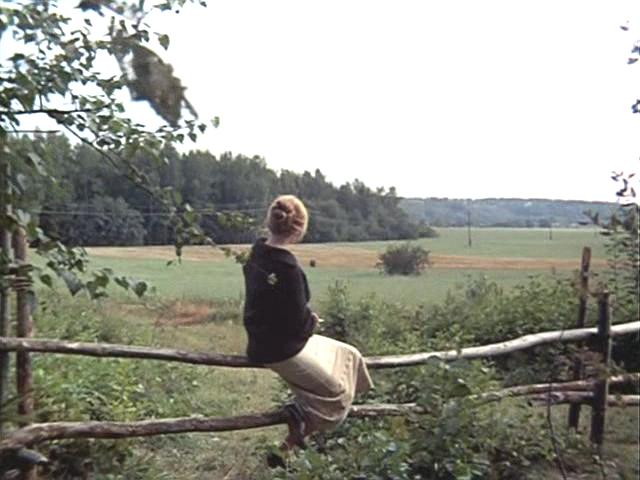
 “Words can’t really express a person’s emotions. They’re too inert.” So says Andrei Tarkovsky’s dream-filled, surreal masterpiece The Mirror, which features long scenes with little or no dialogue. Tarkovsky turns the mirror on himself and his childhood to tell the fragmented and disjointed story of WWII-era Russia through his own personal experiences with his family. Tarkovsky was obsessed with film as art, and this nonlinear film is his poetic masterpiece; he even includes his father’s poems read over shots that are crafted as if paintings. Many of the actors play several roles; have fun trying to figure out who is who and what exactly is going on at any one moment. The Mirror is screening on March 11 at 6:00 at the Museum of the Moving Image as part of the special program “Geoff Dyer on Tarkovsky, Cinema, and Life” and the ongoing “See It Big!” series and will be introduced by award-winning author Dyer, whose latest nonfiction tome is Zona: A Book About a Film About a Journey to a Room (Pantheon, February 21, $24), an obsessively detailed examination of Tarkovsky’s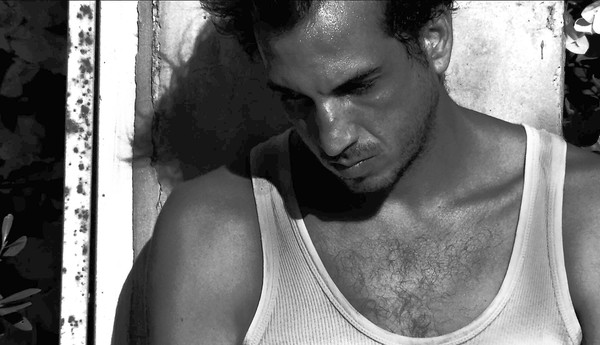
 “For me, cinema is sorcery, a creative way to interact with the world in order to rearrange perception and expand consciousness — both the viewer’s and my own,” says master filmmaker Nina Menkes. A citizen of Israel, Germany, and the United States, Menkes has made only six feature-length films and three shorts over the course of thirty years but has established an international reputation that deserves to be more widespread in America. On the occasion of the U.S. theatrical release of her latest film, Dissolution, Anthology Film Archives is holding a retrospective of Menkes’s career, following a festival held last month at her alma mater, UCLA. Shot in an Arab section of Tel Aviv and loosely based on Dostoyevsky’s Crime and Punishment, Dissolution is an intense psychological drama seething with an inner violence that is ready to explode at any moment. Didi Fire, who cowrote and coedited the film with Menkes, stars as a deeply troubled Israeli man desperate for money. The film opens with Fire gently nudging a snail with his foot, the imminent threat of his stomping on it readily apparent. Soon he is furiously sharpening a knife, obsessively timed to a ticking metronome. “There are no rules in this world. Misfortune is not punishment, nor is good luck a reward,” he later tells a friend “All meaning is barren. . . . This world has no core, except that core which has shattered.” After committing a brutal murder, he, like Raskalnikov, is left to deal with the guilt that is ravaging his soul. Shot in sharp black-and-white with a handheld digital video camera and featuring Menkes’s first male protagonist, Dissolution is a haunting tale that is as much about one man’s journey as it is about the violence and unrest that permeates throughout Israel. Named Best Drama at the 2010 Jerusalem International Film Festival, it is a powerful morality play that never preaches at the audience, instead telling its story slowly and determinedly as it unfolds in a world of scorpions and spiders, ghosts and inner demons. Dissolution is running at Anthology daily March 9-15, along with screenings of such other Menkes works as The Great Sadness of Zohara (1983), Magdalena Viraga (1986), The Bloody Child (1996), and Phantom Love (2007). As a bonus, Menkes will be on hand to talk about her career at select screenings.
 Set in a seemingly postapocalyptic world that is never explained, Andrei Tarkovsky’s Stalker is an existential work of immense beauty, a deeply philosophical, continually frustrating, and endlessly rewarding journey into nothing less than the heart and soul of the world. Alexander Kaidanovsky stars as Stalker, a careful, precise man who has been hired to lead Writer and Professor (Tarkovsky regulars Anatoli Solonitsyn and Nikolai Grinko, respectively) into the forbidden Zone, a place of mystery that houses a room where it is said that people can achieve their most inner desires. While Stalker’s home and the bar where the men meet are dark, gray, and foreboding, the Zone is filled with lush green fields, trees, and aromatic flowers — as well as abandoned vehicles, strange passageways, and inexplicable sounds. The Zone — which heavily influenced J. J. Abrams’s creation of the island on Lost — has a life all its own as past, present, and future merge in an expansive land where every forward movement is fraught with danger but there is no turning back. An obsessive tyrant of a filmmaker, Tarkovsky (Andrei Rublev, Solaris) imbues every shot with a supreme majesty, taking viewers on an unusual and unforgettable cinematic adventure. On March 10 at 5:00, the New York Institute for the Humanities at NYU and the Illustration Program at Parsons are teaming up to present “Tarkovsy Interruptus,” a free screening of the film that will be stopped at several points for commentary from what is being referred to as a “a distinguished panel of Tarkovsky fanatics,” including Geoff Dyer, Walter Murch, Phillip Lopate, Francine Prose, Michael Benson, and Dana Stevens. The program is being held in conjunction with the publication of Dyer’s latest work, Zona: A Book About a Film About a Journey to a Room (Pantheon, February 21, $24). For more on Dyer, who will also introduce the screening, you can read our twi-ny talk with him
 Experimental director Marie Losier tells a very different kind of love story in the intimate documentary The Ballad of Genesis and Lady Jaye, her debut feature-length film. In 1993, British industrial music legend Genesis P-Orridge, the founder of such highly influential groups as Psychic TV, Throbbing Gristle, and COUM Transmissions (and who changed his name from Neil Andrew Megson in 1971), married Jacqueline Mary Breyer, a nurse and singer who then changed her name to Lady Jaye Breyer P-Orridge. The two artists were so madly in love that they decided to become a single “pandrogynous” unit known as Breyer P-Orridge, undergoing various forms of plastic surgery to look more alike. Both their life and their music were influenced by the literary cut-up style developed by Brion Gysin and William S. Burroughs, but the film itself has the feel that it too was cut up and randomly put back together, resulting in a seriously flawed and fractured narrative that has fascinating individual moments that don’t form a cohesive whole. Mixing in home movies, staged reenactments, archival concert footage, voice-over narration by Genesis, and new interviews (with such friends and colleagues as Tony Conrad, Marti Domination, Lili Chopra, and Peaches), Losier never quite gets to the heart of the matter. Much of the film feels as if something’s missing, as if the director got too close to her subjects and assumed the audience can fill in certain gaps. As she says in the project’s production notes, “The film will attempt to present the incredible complexity of Genesis’ personality from many different angles, most especially my subjective point of view. From my earliest films, my feeling has been that when shooting real life subjects, my very presence changes the reality of what I am filming. Therefore, I am not a neutral participant, but one equally engaged and inspired by what is happening in front of my camera.” As personal and revealing as the film gets at times, much of it also seems forced and overly arty. The Ballad of Genesis and Lady Jaye opens tonight at Clearview Cinemas in Chelsea, with Losier and Genesis P-Orridge on hand for a Q&A following the 7:00 screening.