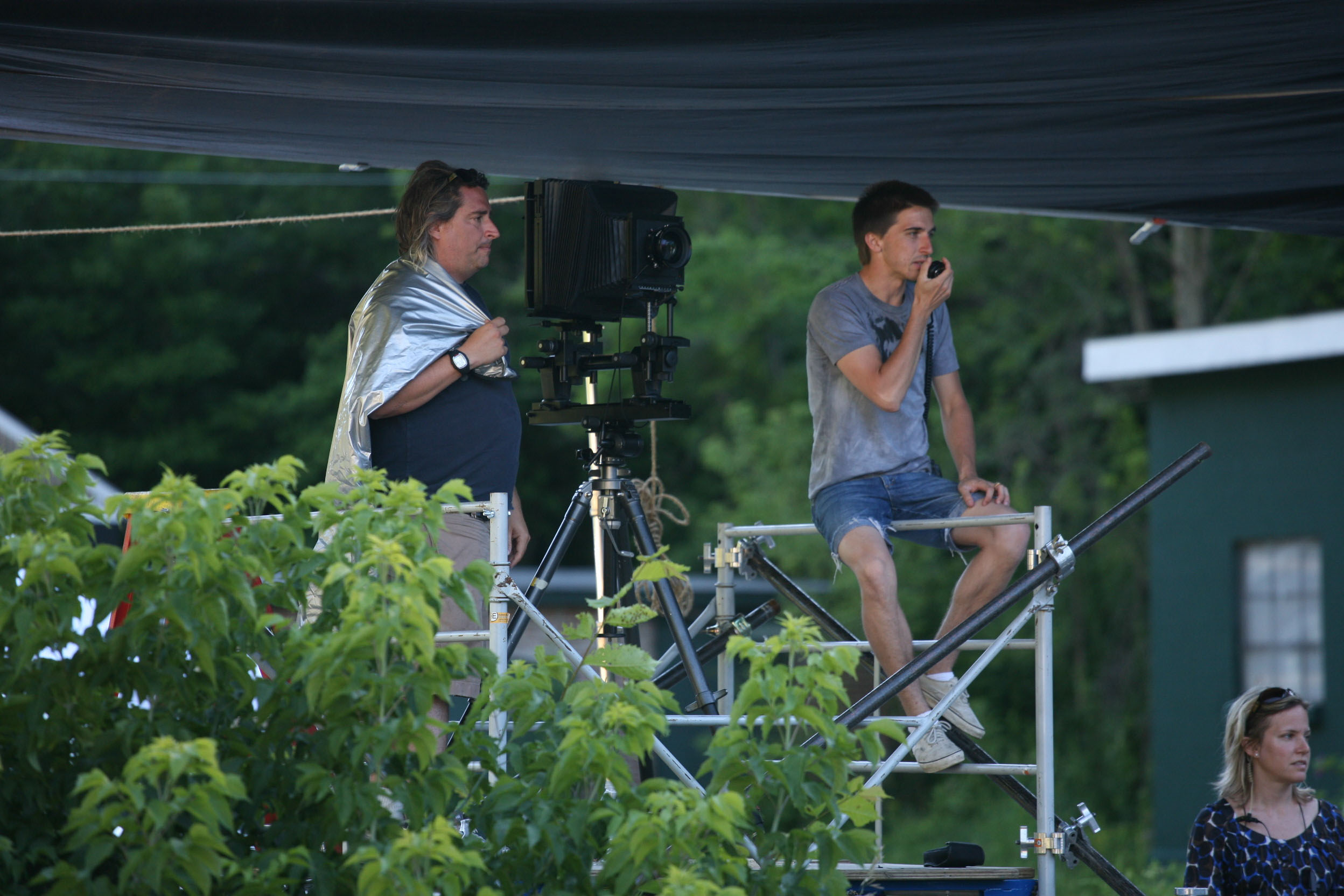
Gregory Crewdson carefully composes his next photograph in BRIEF ENCOUNTERS (courtesy Zeitgeist Films)
GREGORY CREWDSON: BRIEF ENCOUNTERS (Ben Shapiro, 2012)
Elinor Bunin Munroe Film Center: Francesca Beale Theater
144 West 65th St. between Broadway & Amsterdam Ave.
November 16-22
212-875-5601
www.filmlinc.com
www.gregorycrewdsonmovie.com
 From 2002 to 2008, Gregory Crewdson created a sensational body of work he called “Beneath the Roses,” consisting of intricately arranged large-scale photographs that capture the mysterious underside of small-town, middle-class America. Filmed primarily in the Western Massachusetts community where his family spent their summers while he was growing up, the photographs, all taken at twilight, are powerful, emotional still shots that look like they’re from a movie, usually involving solitary figures on the street or in a tense room, staring out, often with a car nearby, its door or trunk flung open, compelling viewers to come up with their own narrative of what they’re seeing. For ten years, Ben Shapiro followed Crewdson around as he worked on that series and others, and he details the Park Slope-born photographer’s unique creative process in the vastly entertaining and informative documentary Gregory Crewdson: Brief Encounters. Crewdson, who shoots only at twilight, is obsessive about the shot he gets, agonizing first over the setting itself, then going over every little detail, from the turn of a character’s head to the proper amount of leg to reveal, with a crew that includes a director of photography, a production designer, a casting director, and other jobs usually more associated with film. “My pictures are about a search for a moment — a perfect moment,” he explains. “To me the most powerful moment in the whole process is when everything comes together and there is that perfect, beautiful, still moment. And for that instant, my life makes sense.”
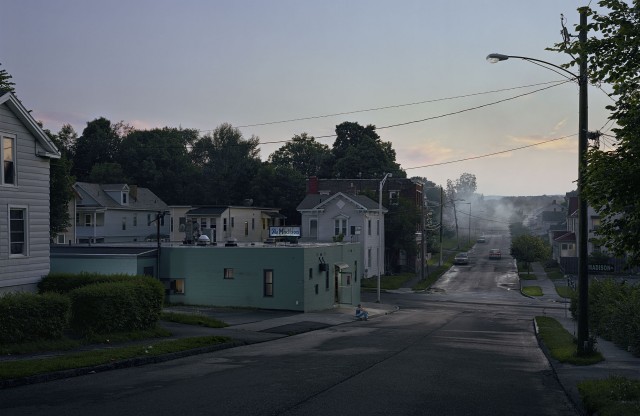
Gregory Crewdson, “Untitled (The Madison),” from “Beneath the Roses,” archival pigment print, 2007 (© Gregory Crewdson)
Crewdson also talks about his past as he drives around Pittsfield searching out locations or looks through a photo album, discussing how he was influenced by his psychologist father and a trip they made to see a Diane Arbus exhibition at MoMA in 1972, when Crewdson was ten. Among those who share their thoughts about Crewdson are writers Russell Banks and Rick Moody, photographer Laurie Simmons, Aperture editor in chief Melissa Harris, and Crewdson’s director of photography, Richard Sands. Shapiro also travels to Rome with Crewdson for his 2010 “Sanctuary” series, taken at the abandoned Cinecittà studio in Rome, furthering his interest in film. Just as it’s fascinating to spend time exploring Crewdson’s photographs, it’s equally fascinating spending time with the man himself, a complex, bigger-than-life character with an intriguing outlook on his medium as well as the world at large. Gregory Crewdson: Brief Encounters just finished an abbreviated run at Film Forum because of Hurricane Sandy, but the Film Society of Lincoln Center has picked it up and will screen it at the Francesca Beale Theater from November 16 to 22, with Crewdson participating in a Q&A with writer-director Noah Baumbach following the 7:15 show on Friday night.
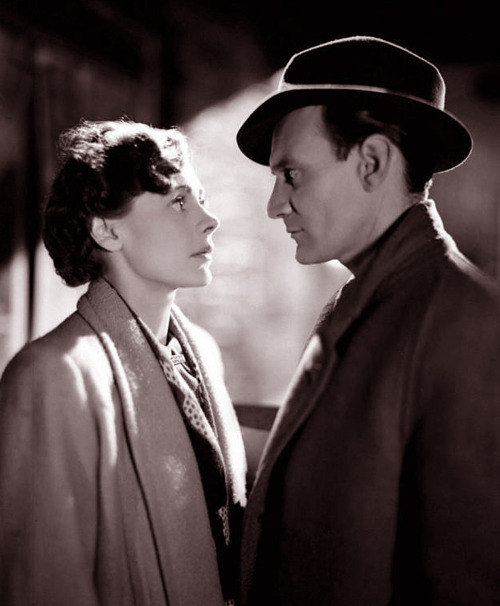
 “Don’t hurry. I’m perfectly happy,” Laura Jesson (Celia Johnson) tells her rather boring husband, Fred (Cyril Raymond), as he returns to his crossword puzzle one night. “How can I possibly say that?” she then thinks to herself. “‘Don’t hurry. I’m perfectly happy.’ If only it were true. Not, I suppose, that anybody’s ever perfectly happy, really. But just to be ordinarily contented, to be at peace. It’s such a little while ago really but it seems an eternity since that train went out of the station, taking him away into the darkness. I was happy then.” In David Lean’s Brief Encounter, one of the greatest romantic films ever made, Laura, a housewife and mother, can’t stop herself from falling for dapper doctor Alec Harvey (Trevor Howard), who is also married. As they explore a potential physical relationship, Laura is wracked with guilt, especially as she keeps bumping into nosy gossip Myrtle Bagot (Joyce Carey). But the two potential lovers are so drawn to each other, filling the holes in each other’s lives, that they consider risking all they have for just one more moment together. Winner of the 1946 Palme d’Or at Cannes, Brief Encounter is told in flashback in Laura’s voice as she goes over every wonderful and terrifying detail in her mind while contemplating whether to spill the beans to the generally oblivious Fred. Written by Noël Coward based on his 1936 one-act play, Still Life, the film features terrifically subtle performances by Johnson and Howard as the daring couple; you can’t help but root for them, despite the possible consequences. Lean, who earned the first of his seven Best Director Oscar nominations for the heartbreaking film, keeps things relatively, well, lean, getting right to the point in less than ninety minutes; he would go on to helm such sprawling epics as The Bridge on the River Kwai, Lawrence of Arabia, Doctor Zhivago, and A Passage to India before his death in 1991 at the age of eighty-three. Brief Encounter is screening on November 16 as part of the Rubin Museum Cabaret Cinema series “Happiness is . . .” and will be introduced by journalist Marie Brenner; the series continues through December 28 with such films as Michael Curtiz’s Casablanca, George Cukor’s Camille, and Vincente Minnellis’s An American in Paris, held in conjunction with the larger Rubin Museum program “
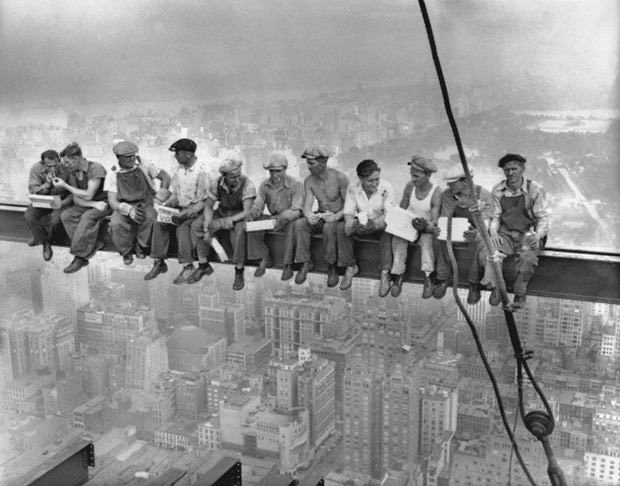
 Seán Ó Cualáín puts one of the most iconic photographs ever of New York City under the microscope in the interesting yet too often slipshod documentary Men at Lunch. In 1932, a photographer snapped a picture of eleven construction workers having lunch while sitting atop a girder on what would become the sixty-ninth floor of the RCA Building in Rockefeller Center. The men are casually talking, having a smoke, and holding white cardboard lunchboxes while dangling their feet some 850 feet in the air, a bustling city below them, Central Park sprawled out behind them. Narrated by Fionnula Flanagan (Ulysses, Waking Ned Devine), the film delves into who the men might be, attempts to figure out whether it was indeed Charles C. Ebbets who took the photo, and seeks to put the picture into the social and cultural context of the depression and the wave of immigration, focusing on the Irish (the film is an Irish production), many of whom went into the construction industry. “This is a photograph in which every element of photography and of New York City kind of come together with spectacular panache,” filmmaker Ric Burns says. But while Ó Cualáín employs captivating archival footage as he tries to solve the photograph’s many mysteries, he extends the focus too far, biting off more than he can chew in a mere seventy minutes, as a handful of talking heads and Niall Murphy’s text make grand statements about the human condition in the twentieth century that are too often a reach, then spends too much time with a pair of Irish characters who believe they are related to two of the men in the picture. Still, the part of the film that zeroes in on the taking of the photograph is absolutely fascinating. Men at Lunch is making its U.S. premiere at the DOC NYC festival November 10 at the SVA Theatre and November 14 at the IFC Center, with Ó Cualáín on hand at the first screening to talk about the film.