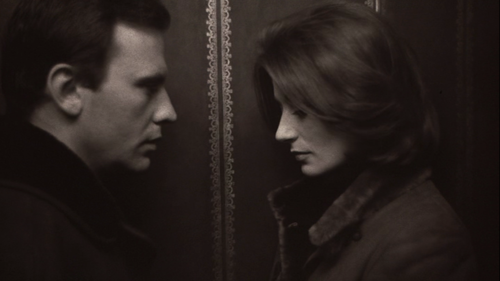
Anouk Aimée and Jean-Louis Trintignant play characters trying to escape their pasts in Claude Lelouch’s A MAN AND A WOMAN
THE TENTH MoMA INTERNATIONAL FESTIVAL OF FILM PRESERVATION/MONDAY NIGHTS WITH OSCAR: A MAN AND A WOMAN (UN HOMME ET UNE FEMME) (Claude Lelouch, 1966)
Academy Theater at Lighthouse International
111 East 59th St. between Lexington & Park Aves.
Monday, October 15, $5, 7:00
212-821-9251
www.oscars.org
www.moma.org
 Winner of both the Oscar for Best Foreign Language Film and the Palme d’Or at Cannes, Claude Lelouch’s A Man and a Woman is one of the most popular, and most unusual, romantic love stories ever put on film. Oscar-nominated Anouk Aimée stars as Anne Gauthier and Jean-Louis Trintignant as Jean-Louis Duroc, two people who each has a child in a boarding school in Deauville. Anne, a former actress, and Jean-Louis, a successful racecar driver, seem to hit it off immediately, but they both have pasts that haunt them and threaten any kind of relationship. Shot in three weeks with a handheld camera by Lelouch, who earned nods for Best Director and Best Screenplay (with Pierre Uytterhoeven), A Man and a Woman is a tour-de-force of filmmaking, going from the modern day to the past via a series of flashbacks that at first alternate between color and black-and-white, then shift hues in curious, indeterminate ways. Much of the film takes place in cars, either as Jean-Louis races around a track or the protagonists sit in his red Mustang convertible and talk about their lives, their hopes, their fears. The heat they generate is palpable, making their reluctance to just fall madly, deeply in love that much more heart-wrenching, all set to a memorable soundtrack by Francis Lai. Lelouch, Trintignant, and Aimée revisited the story in 1986 with A Man and a Woman: 20 Years Later, without the same impact and success. A new print of the original will be shown on October 15 at the Academy Theater as part of MoMA’s annual “To Serve and Project” film preservation festival, in conjunction with the Motion Picture Academy of Arts and Sciences’ monthly “Monday Nights with Oscar” programming and will be introduced by Aimée, who has appeared in several recent films following a seven-year hiatus. The MoMA series, cocurated by J. Hoberman, continues through November 12 with such films as Jacques Demy’s Lola, Andy Warhol’s San Diego Surf, Raoul Walsh’s Wild Girl, and the director’s cut of Roberto Rossellini’s General della Rovere.

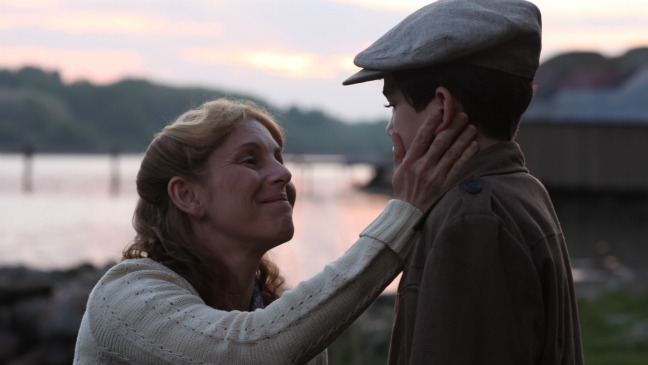
 Nominated for thirteen Swedish Academy Awards, Simon & the Oaks is a soapy, sweeping Scandinavian epic about the search for identity. The first film based on a novel by celebrated Swedish author Marianne Frederiksson, Simon & the Oaks follows the confused, troubled Simon as he grows from a timid boy (Jonatan S. Wächter) into a strapping young man (Bill Skargård, son of Stellan) during the WWII era. Simon loves music and books, but his working-class father, Erik (Stefan Gödicke), wants him to forget about education and instead learn a physical trade. Simon becomes friends with a Jewish boy, Isak (Karl Martin Eriksson, then Karl Linnertorp), whose father, Ruben (Jan Josef Liefers), has moved the family from Germany to escape the Nazis. As Simon starts spending more time with Ruben, Erik becomes angry and resentful, while Simon’s mother, Karin (Helen Sjöholm), develops a dangerous closeness with Ruben, a wealthy businessman whose wife (Lena Nylén) is confined to a sanitarium. Simon is a dreamer, looking out at the horizon believing that anything is possible, talking to the whispering oak by the lake behind his house. But he lives in a changing world where everyone around him has to face startling realities centered around bigotry and genocide while protecting him from a powerful secret. Director Lisa Ohlin (Sex, Hope and Love, Waiting for the Tenor), who experienced some of the same things that Simon does, gives the film a lush, grand feel that often overwhelms its more personal story while including numerous clichéd scenes, particularly between fathers and sons, that detract from the already straightforward narrative. The film works best when Liefers is on-screen, playing a complex character who is fascinating to watch as he calmly moves forward despite the maelstrom that surrounds him. Simon & the Oaks opens October 12 at the Paris Theatre, with Ohlin appearing for a Q&A following the 7:00 screening.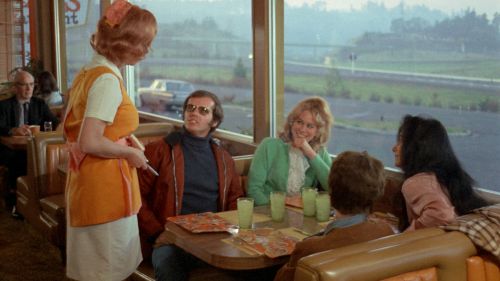
 A key film that helped lead 1960s cinema into the grittier 1970s, Bob Rafelson’s Five Easy Pieces is one of the most American of dramas, a tale of ennui and unrest among the rich and the poor, a road movie that travels from trailer parks to fashionable country estates. Caught in between is Bobby Dupea (Jack Nicholson), a former piano prodigy now working on an oil rig and living with a well-meaning but not very bright waitress, Rayette (Karen Black). When Bobby finds out that his father is ill, he reluctantly returns to the family home, the prodigal son who had left all that behind, escaping to a less-complicated though unsatisfying life putting his fingers in a bowling ball rather than tickling the keys of a grand piano. Back in his old house, he has to deal with his brother, Carl (Ralph Waite), a onetime violinist who can no longer play because of an injured neck and who serves as the film’s comic relief; Carl’s wife, Catherine (Susan Anspach), a snooty woman Bobby has always been attracted to; and Bobby’s sister, Partita (Lois Smith), a lonely, troubled soul who has the hots for Spicer (John Ryan), the live-in nurse who takes care of their wheelchair-bound father (William Challee). Rafelson had previously directed the psychedelic movie Head (he cocreated the Monkees band and TV show) and would go on to make such films as