The cultural revolution on the early 1970s is back in Olivier Assayas’s SOMETHING IN THE AIR
SOMETHING IN THE AIR (APRÈS MAI) (Olivier Assayas, 2012)
BAMcinématek, BAM Rose Cinemas
30 Lafayette Ave. between Ashland Pl. & St. Felix St.
Saturday, October 27, 6:00
Series runs October 26-28
718-636-4100
www.bam.org
www.ifcfilms.com
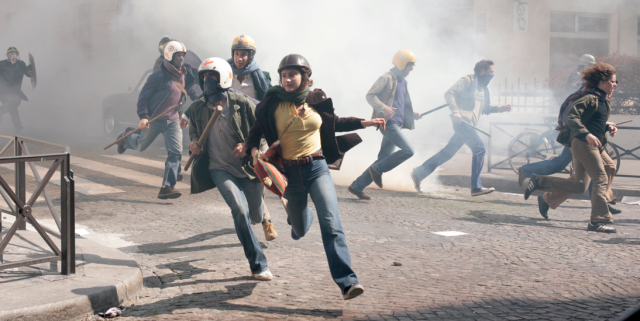
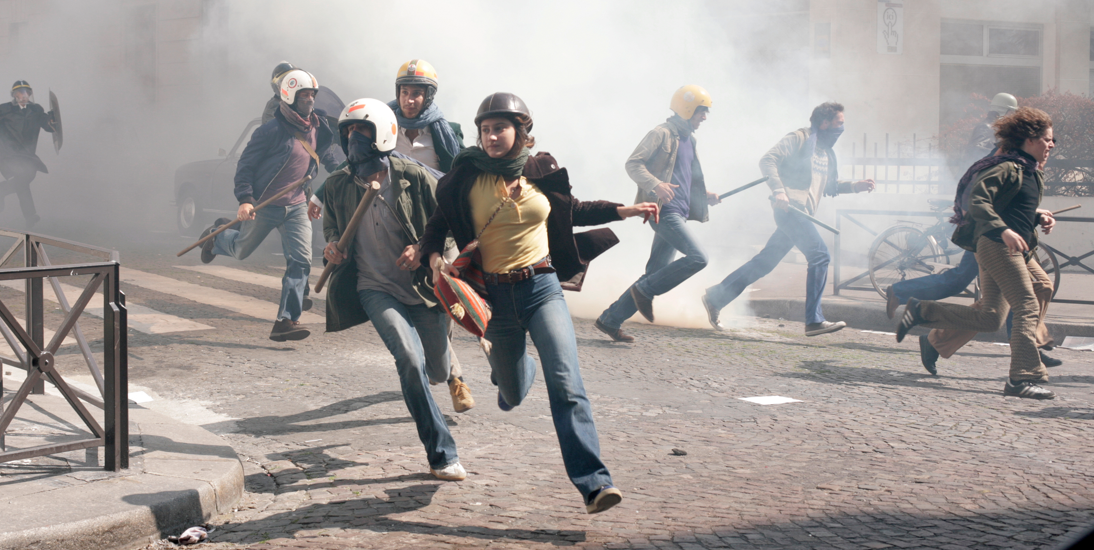
 Olivier Assayas’s autobiographical coming-of-age tale Something in the Air is a fresh, exhilarating look back at a critical period in twentieth-century French history. In this sort-of follow-up to his 1994 film about 1970s teenagers, Cold Water, which starred Virginie Ledoyen as Christine and Cyprien Fouquet as Gilles, Something in the Air features newcomer Clément Métayer as a boy named Gilles and Lola Créton (Goodbye First Love) as a girl named Christine, a pair of high school students who are part of a growing underground anarchist movement. Following a planned demonstration that is violently broken up by a special brigade police force, some of the students cover their school in spray paint and political posters, leading to a confrontation with security guards that results in the arrest of the innocent Jean-Pierre (Hugo Conzelmann), which only further emboldens the anarchists. But their seething rage slowly changes as they explore the transformative world of free love, drugs, art, music, travel, and experimental film. Assayas (Les Destinées sentimentales, Summer Hours) doesn’t turn Something in the Air — the original French title is actually Après Mai, or After May, referring to the May 1968 riots — into a personal nostalgia trip. Instead it’s an engaging and charming examination of a time when young people truly cared about something other than themselves and genuinely believed they could change the world, filled with what Assayas described as a “crazy utopian hope for the future” at a New York Film Festival press conference. The talented cast also includes Félix Armand, India Salvor Menuez, Léa Rougeron, and Carole Combes as Laure, both Gilles’s and Assayas’s muse.
Assayas fills Something in the Air with direct and indirect references to such writers, artists, philosophers, and musicians as Syd Barrett, Gregory Corso, Amazing Blondel, Blaise Pascal, Kasimir Malevitch, Max Stirner, Alighiero Boetti, Joe Hill, Soft Machine, Georges Simenon, Frans Hals, and Simon Ley (The Chairman’s New Clothes: Mao and the Cultural Revolution), not necessarily your usual batch of 1970s heroes who show up in hippie-era films. Writer-director Assayas, editors Luc Barnier and Mathilde Van de Moortel, and cinematographer Éric Gautier move effortlessly from France to Italy to England, from thrilling, fast-paced chases to intimate scenes of young love to a groovy psychedelic concert, wonderfully capturing a moment in time that is too often marginally idealized and made overly sentimental on celluloid. “We’ve got to get together sooner or later / Because the revolution’s here,” Thunderclap Newman sings in their 1969 hit “Something in the Air,” which oddly is not used in Assayas’s film, continuing, “And you know it’s right / and you know that it’s right.” Indeed, Assayas gets it right in Something in the Air, depicting a generation when revolution required a lot more than clicking a button on the internet. Something in the Air is screening October 27 at 6:00 as part of the BAMcinématek series “IFC Sneaks” and will be followed by a Q&A with Menuez. The series, which runs October 26-28, offers an advance look at such upcoming IFC Films as Rodney Ascher’s Room 237, an obsessive examination of Stanley Kubrick’s The Shining, and Walter Salles’s hotly anticipated On the Road, an adaptation of the Jack Kerouac novel with Garrett Hedlund as Dean Moriarty, Sam Riley as Sal Paradise, Kristen Stewart as Marylou, Amy Adams as Jane, Kirsten Dunst as Camille, and Viggo Mortensen as Old Bull Lee.
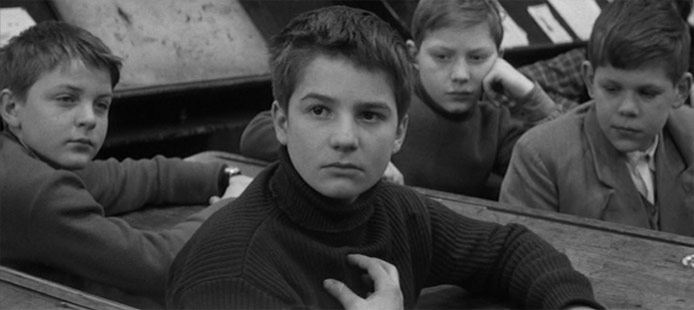
 “They won’t be happy you’re missing school like this,” a man tells fourteen-year-old Jean-Pierre Léaud as he’s auditioning for the part of Antoine Doinel in François Truffaut’s The 400 Blows. “It doesn’t matter, as long as I’m happy,” Léaud responds. Screening on October 26 as part of the Rubin Museum Cabaret Cinema series “Happiness Is . . . ,” where it will be introduced by Columbia professor and Truffaut expert Annette Insdorf, The 400 Blows marked the first of five films, including one short, in which Léaud played the iconic character, as audiences around the world followed his search for happiness. In The 400 Blows, Doinel is a twelve-year-old kid who loves Balzac, has never seen the ocean, and is always getting into trouble with his parents, who treat him more like a problem than a son. He is clearly very smart, but he does poorly in school, where he is harassed by his teacher (Guy Decomble). One day when he decides to play hooky, he catches his mother (Claire Maurier) kissing another man, and instead of telling his father (Albert Rémy), he runs away from home, moving in with his friend René (Patrick Auffay), setting off a series of events that lead to a whole lot more trouble and an unforgettable final shot. The 400 Blows is one of the most intelligent films ever made about adolescence, a tender, honest portrayal of a mischievous kid who just wants to be understood. Léaud gives a wonderfully nuanced performance that makes Antoine a uniquely believable and sympathetic character even when he is making some very bad choices. The film is also about escape of all kinds, beginning and ending with the camera racing away alongside Jean Constantin’s glorious score. The Adventures of Antoine Doinel series continues with 1962’s Antoine and Colette, 1968’s Stolen Kisses, 1970’s Bed and Board, and 1979’s Love on the Run, while “Happiness is . . .” continues through December 28 with such films as Ingmar Bergman’s Cries and Whispers, Michael Curtiz’s Casablanca, and George Cukor’s Camille, held in conjunction with the larger Rubin Museum program “