this week in lectures, signings, panel discussions, workshops, and Q&As

MARTHA ROSLER: META-MONUMENTAL GARAGE SALE

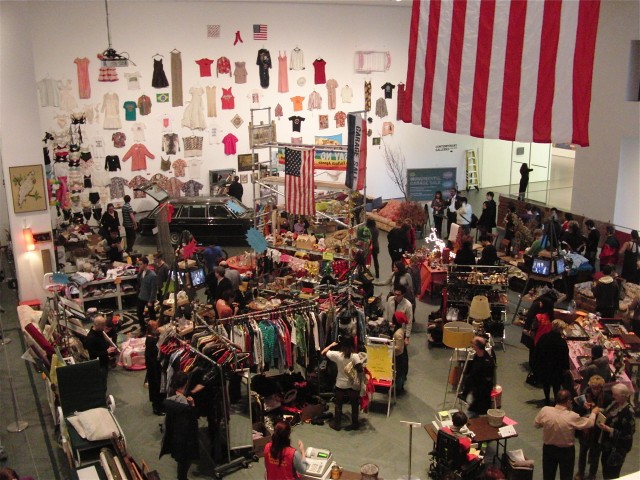
Martha Rosler’s “Meta-Monumental Garage Sale” invites visitors to haggle over donated items in interactive MoMA installation (photo by twi-ny/mdr)

Museum of Modern Art
The Donald B. and Catherine C. Marron Atrium, second floor
11 West 53rd St. between Fifth & Sixth Aves.
Wednesday-Thursday & Saturday–Monday 12 noon – 5:30, Friday 12 noon – 7:30 (closed Tuesdays & Thanksgiving Day)
Museum admission: $22.50 ($12 can be applied to the purchase of a film ticket within thirty days)
212-708-9400
www.moma.org
meta-monumental garage sale slideshow

Does Brooklyn-born multimedia conceptual performance artist Martha Rosler have a deal for you! For her first solo exhibition at MoMA, Rosler (“Semiotics of the Kitchen,” “Bringing the War Home: House Beautiful”) is staging the most American of events, a garage sale. (A huge American flag hovers over the installation like the hand of god.) From May through September, Rosler accumulated everyday objects, both her own and through public donations, that she will be selling in MoMA’s second-floor atrium through November 30. Visitors are encouraged to approach Rosler and haggle over items they are interested in, which will be available at whatever price the sixty-nine-year-old Greenpoint-based artist wants to sell them for. And be prepared: Rosler is a tough negotiator. You can also watch the transactions in real time at the sale’s official website. A comment on community, capitalism, and the art market itself, particularly in these difficult economic times, this “Meta-Monumental Garage Sale” is the latest in a series of sales Rosler has been conducting since its debut, at the University of California, San Diego, back in 1973, when she was a graduate student there; New York experienced this previously in 2000 at the New Museum. The space at MoMA resembles a cluttered house, evoking a statement Rosler wrote on a chalkboard all those years ago in San Diego: “Maybe the Garage Sale is a metaphor for the mind.” It’s also a wonderful way to meet a highly influential artist and walk out of MoMA with a unique object that can’t be found in the museum store. Rosler isn’t saying where the money she collects will be going, other than to explain it won’t go into her or the museum’s pockets. (However, one hour’s proceeds from each day’s sales will go directly to the Hurricane Sandy relief effort.) There are several special programs associated with the exhibition: On November 19, a psychic, a stylist, and an art conservator will come together for “Meta-Monumental Garage Sale: Exploring Value Systems”; on November 26, “An Evening with Martha Rosler” will feature Rosler in conversation with curator Sabine Breitwieser, talking about “Meta-Monumental Garage Sale” as well as “She Sees in Herself a New Woman Every Day,” an audiovisual installation that is part of the current “Performing Histories (1)” exhibit; and on November 29, panel and round-table discussions will examine “Meta-Monumental Garage Sale: Women, Labor, and Work.”

TURNING

Antony and the Johnsons and Charles Atlas celebrate sexual identity and personal freedom in beautifully poignant TURNING

TURNING (Charles Atlas, 2012)
IFC Center
323 Sixth Ave. at West Third St.
Opens Friday, November 16
212-924-7771
www.ifccenter.com
www.turningfilm.com

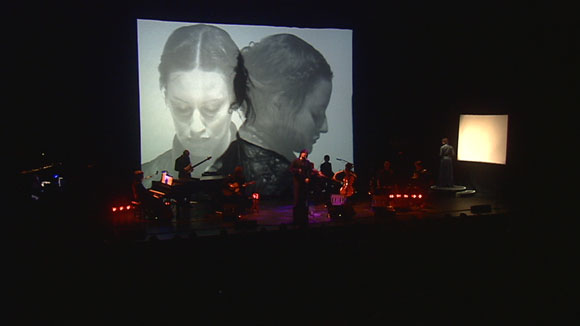
In 2004, musician and composer Antony Hegarty and film and video pioneer Charles Atlas premiered their multimedia collaboration, Turning, at the Whitney Biennial. The performance featured Antony and the Johnsons playing songs in front of a large screen on which Atlas projected live multiple images of a parade of “beauties” who one at a time slowly turned on a circular platform, standing tall and proud. The production went on an international tour, which Atlas and Antony document in a beautiful, intimate film version that made its U.S. premiere November 11 as part of the DOC NYC festival and now opens theatrically on November 16 at the IFC Center. Atlas, a former filmmaker-in-residence with the Merce Cunningham Dance Company and director of the widely hailed The Legend of Leigh Bowery, takes viewers behind the scenes as the cast rehearses, puts on their costumes and makeup, gets pep talks from Antony, and opens up about their lives. Throughout the film, the women — Julia Yasuda, Catrina Delapena, Honey Dijon, Joie Iacono, Joey Gabriel, Kembra Pfahler, Nomi Ruiz, Stacey Marks, Johanna Constantine, Eliza Douglas, and Morisane Sunny Shiroma, who come from very different backgrounds and professional disciplines — share their poignant, emotional stories, addressing deeply personal issues of androgyny, transsexuality, and other aspects of sexual and gender identity. The soundtrack features Antony and the Johnsons — violinist Maxim Moston, cellist Julia Kent, bassist Jeff Langston, guitarist and violinist Rob Moose, drummer Parker Kindred, pianist Thomas Bartlett, horn player Christian Biegai, and accordionist Will Holshouser — performing such hauntingly evocative songs as “Everything Is New,” “For Today I Am a Buoy,” “Kiss My Name,” “Twilight,” and “Spiralling” as the women celebrate the freedom to be themselves in a defiant, public way. “Are you a boy / Are you a girl,” Antony, himself a former member of the underground avant-garde LGBT performance troupe Blacklips, repeats in “I Fell in Love with a Dead Boy.” In the subtly powerful Turning, such labels don’t matter as a group of women face their future with confidence and hope. Antony, Gabriel, Ruiz, Honey Dijon, Shiroma, Douglas, Marks, and Connie Fleming will be on hand for the 7:45 screening on November 16, Atlas and Constantine will attend the 7:45 screening on November 17, Atlas and MoMA curator Klaus Biesenbach will be at the 7:45 screening on November 18, and Antony and performance artist Marina Abramović will be at the IFC Center for the 7:45 screening on November 20.
GREGORY CREWDSON: BRIEF ENCOUNTERS

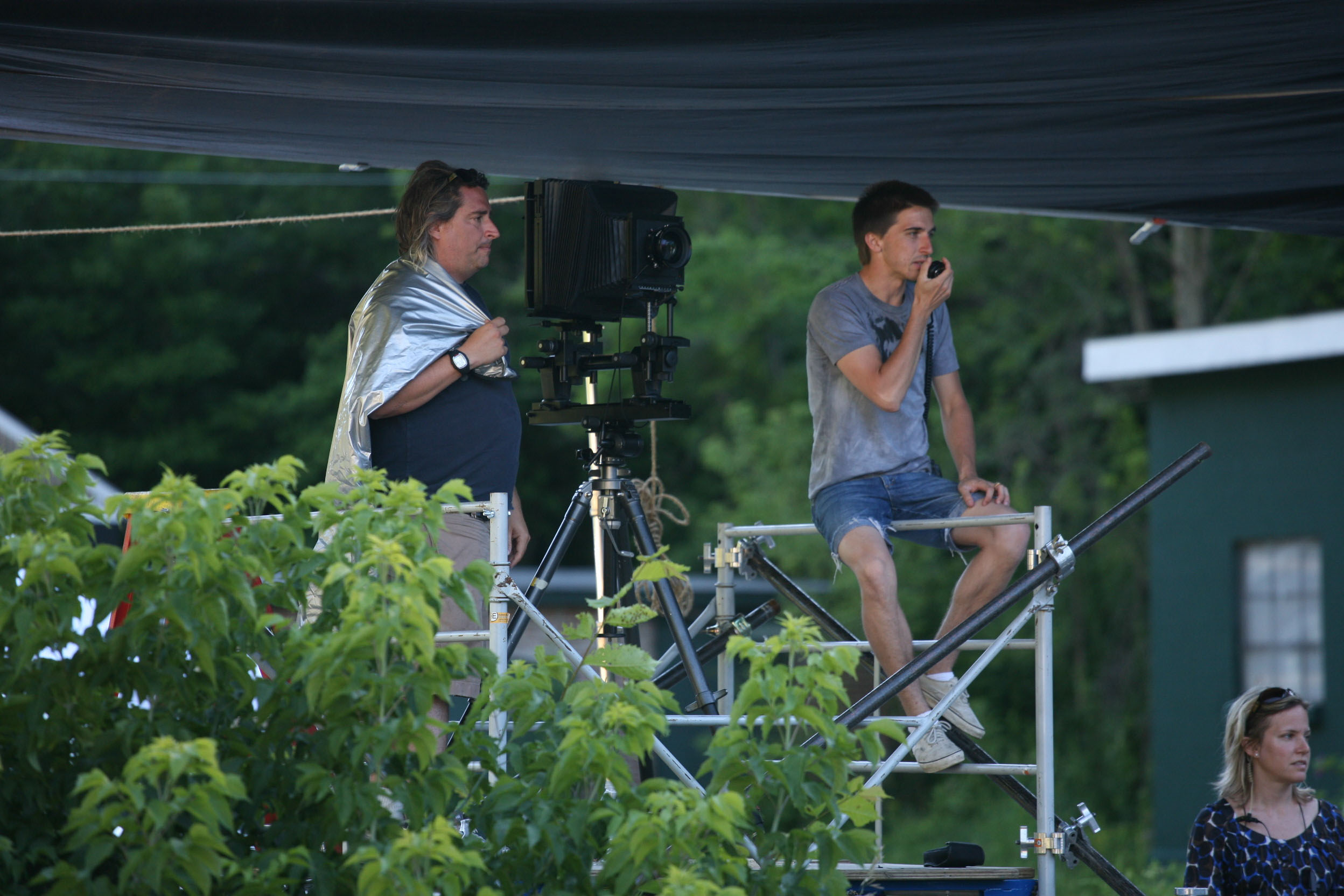
Gregory Crewdson carefully composes his next photograph in BRIEF ENCOUNTERS (courtesy Zeitgeist Films)

GREGORY CREWDSON: BRIEF ENCOUNTERS (Ben Shapiro, 2012)
Elinor Bunin Munroe Film Center: Francesca Beale Theater
144 West 65th St. between Broadway & Amsterdam Ave.
November 16-22
212-875-5601
www.filmlinc.com
www.gregorycrewdsonmovie.com

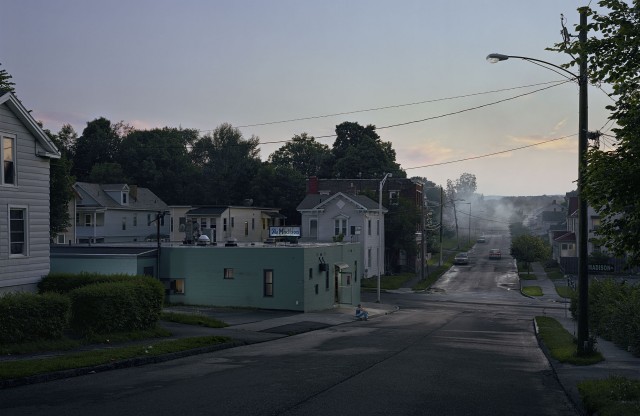
From 2002 to 2008, Gregory Crewdson created a sensational body of work he called “Beneath the Roses,” consisting of intricately arranged large-scale photographs that capture the mysterious underside of small-town, middle-class America. Filmed primarily in the Western Massachusetts community where his family spent their summers while he was growing up, the photographs, all taken at twilight, are powerful, emotional still shots that look like they’re from a movie, usually involving solitary figures on the street or in a tense room, staring out, often with a car nearby, its door or trunk flung open, compelling viewers to come up with their own narrative of what they’re seeing. For ten years, Ben Shapiro followed Crewdson around as he worked on that series and others, and he details the Park Slope-born photographer’s unique creative process in the vastly entertaining and informative documentary Gregory Crewdson: Brief Encounters. Crewdson, who shoots only at twilight, is obsessive about the shot he gets, agonizing first over the setting itself, then going over every little detail, from the turn of a character’s head to the proper amount of leg to reveal, with a crew that includes a director of photography, a production designer, a casting director, and other jobs usually more associated with film. “My pictures are about a search for a moment — a perfect moment,” he explains. “To me the most powerful moment in the whole process is when everything comes together and there is that perfect, beautiful, still moment. And for that instant, my life makes sense.”

Gregory Crewdson, “Untitled (The Madison),” from “Beneath the Roses,” archival pigment print, 2007 (© Gregory Crewdson)

Crewdson also talks about his past as he drives around Pittsfield searching out locations or looks through a photo album, discussing how he was influenced by his psychologist father and a trip they made to see a Diane Arbus exhibition at MoMA in 1972, when Crewdson was ten. Among those who share their thoughts about Crewdson are writers Russell Banks and Rick Moody, photographer Laurie Simmons, Aperture editor in chief Melissa Harris, and Crewdson’s director of photography, Richard Sands. Shapiro also travels to Rome with Crewdson for his 2010 “Sanctuary” series, taken at the abandoned Cinecittà studio in Rome, furthering his interest in film. Just as it’s fascinating to spend time exploring Crewdson’s photographs, it’s equally fascinating spending time with the man himself, a complex, bigger-than-life character with an intriguing outlook on his medium as well as the world at large. Gregory Crewdson: Brief Encounters just finished an abbreviated run at Film Forum because of Hurricane Sandy, but the Film Society of Lincoln Center has picked it up and will screen it at the Francesca Beale Theater from November 16 to 22, with Crewdson participating in a Q&A with writer-director Noah Baumbach following the 7:15 show on Friday night.

HAPPINESS IS . . . BRIEF ENCOUNTER

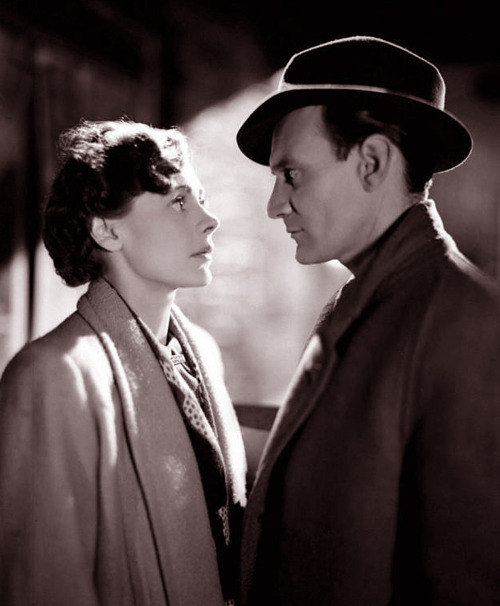
Laura Jesson (Celia Johnson) and Alec Harvey (Trevor Howard) explore an extramarital affair in BRIEF ENCOUNTER

CABARET CINEMA: BRIEF ENCOUNTER (David Lean, 1945)
Rubin Museum of Art
150 West 17th St. at Seventh Ave.
Friday, November 16, free with $7 bar minimum, 9:30
212-620-5000
www.rmanyc.org

“Don’t hurry. I’m perfectly happy,” Laura Jesson (Celia Johnson) tells her rather boring husband, Fred (Cyril Raymond), as he returns to his crossword puzzle one night. “How can I possibly say that?” she then thinks to herself. “‘Don’t hurry. I’m perfectly happy.’ If only it were true. Not, I suppose, that anybody’s ever perfectly happy, really. But just to be ordinarily contented, to be at peace. It’s such a little while ago really but it seems an eternity since that train went out of the station, taking him away into the darkness. I was happy then.” In David Lean’s Brief Encounter, one of the greatest romantic films ever made, Laura, a housewife and mother, can’t stop herself from falling for dapper doctor Alec Harvey (Trevor Howard), who is also married. As they explore a potential physical relationship, Laura is wracked with guilt, especially as she keeps bumping into nosy gossip Myrtle Bagot (Joyce Carey). But the two potential lovers are so drawn to each other, filling the holes in each other’s lives, that they consider risking all they have for just one more moment together. Winner of the 1946 Palme d’Or at Cannes, Brief Encounter is told in flashback in Laura’s voice as she goes over every wonderful and terrifying detail in her mind while contemplating whether to spill the beans to the generally oblivious Fred. Written by Noël Coward based on his 1936 one-act play, Still Life, the film features terrifically subtle performances by Johnson and Howard as the daring couple; you can’t help but root for them, despite the possible consequences. Lean, who earned the first of his seven Best Director Oscar nominations for the heartbreaking film, keeps things relatively, well, lean, getting right to the point in less than ninety minutes; he would go on to helm such sprawling epics as The Bridge on the River Kwai, Lawrence of Arabia, Doctor Zhivago, and A Passage to India before his death in 1991 at the age of eighty-three. Brief Encounter is screening on November 16 as part of the Rubin Museum Cabaret Cinema series “Happiness is . . .” and will be introduced by journalist Marie Brenner; the series continues through December 28 with such films as Michael Curtiz’s Casablanca, George Cukor’s Camille, and Vincente Minnellis’s An American in Paris, held in conjunction with the larger Rubin Museum program “Happy Talk.”

PIVOTAL WORKS: THE VILCEK FOUNDATION PROJECT

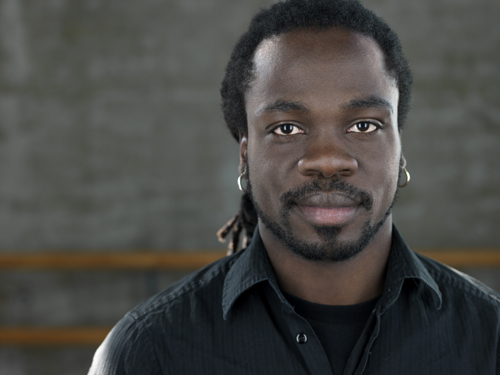
Vilcek Prize winner Michel Kouakou will present two world premieres November 17-18 at the Joyce SoHo

Joyce SoHo
155 Mercer St. between Houston & Prince Sts.
November 15-18, $15
212-242-0800
www.joyce.org
www.vilcek.org

The Vilcek Foundation, which supports and honors contributions in the sciences, arts, and culture by immigrants, continues its year-long celebration of dance with the Vilcek Prize for Creative Promise, taking place November 15-18 at the Joyce SoHo. The program on Thursday and Friday at 7:30 features the four finalists, who were chosen by a panel consisting of Alicia Adams, Bonnie Brooks, Joan Finkelstein, Jane Forde, Larry Keigwin, Larry Rhodes, and Andrea Snyder. Vietnam’s Thang Dao will present Lenore, inspired by Edgar Allan Poe’s The Raven; France’s Fanny Ara will perform the solo piece Solea; Italy’s Alice Gosti examines pasta and family in the potentially messy Spaghetti Co.; and Sweden’s Pontus Lidberg will be represented by an excerpt of the multimedia WITHIN (Labyrinth Within), which he created for Morphoses and ran at the Joyce in full last week. On November 17 at 7:30 and November 18 at 2:00, Ivory Coast’s Michel Kouakou, winner of the $25,000 Vilcek Prize for Creative Promise, will lead his company, Daara Dance, in a pair of world premieres, Shifters and A Drop from Nowhere. There will be receptions following the performances on November 15 and 17.

DOC NYC — AI WEIWEI: NEVER SORRY

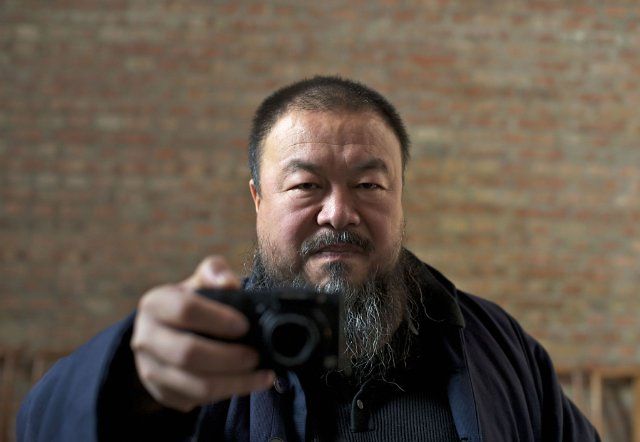
Ai Weiwei lets the camera follow him everywhere in revealing documentary about art and activism

NEW YORK’S DOCUMENTARY FESTIVAL — AI WEIWEI: NEVER SORRY (Alison Klayman, 2011)
IFC Center
323 Sixth Ave. at West Third St.
Tuesday, November 13, $16.50, 9:15
212-924-7771
www.docnyc.net
aiweiweineversorry.com

“I consider myself more of a chess player,” Ai Weiwei says at the beginning of Never Sorry, Alison Klayman’s revealing documentary about the larger-than-life Chinese artist and dissident. “My opponent makes a move, I make a move. Now I’m waiting for my opponent to make the next move.” Over the last several years, Ai has become perhaps the most famous and controversial artist in the world, primarily since he participated in the design of Beijing National Stadium, known as the Bird’s Nest, for the 2008 Summer Olympics, then denounced the Games on political grounds. Ai gives director, producer, and cinematographer Klayman, making her first full-length film, remarkable access to his personal and professional life as he gets physically abused by Chinese police, prepares to open major exhibits in Munich and London, and visits with his young son, Ai Lao, the result of a tryst with Wang Fen, an editor on his underground films. Klayman speaks with Ai Weiwei’s devoted wife, Lu Qing, an artist who publicly fought for his freedom when he disappeared in 2011; his mother, Gao Ying, who spent time in a labor camp with her dissident-poet husband, the late Ai Quing; and such fellow Chinese artists and critics as Chen Danqing, Feng Boyi, Hsieh Tehching, and Gu Changwei, who speak admiringly of Ai’s dedication to his art and his fearless search for the truth. A round man with a long, graying bear, Ai is a fascinating, complicated character, a gentle bull who openly criticizes his country because he loves it so much. He is a social media giant, making documentaries that are available for free on the internet and revolutionizing the way Twitter and the blogosphere are used. Ai risks his own freedom by demanding freedom for all, calling for government transparency before and after he is secretly arrested, not afraid of the potential repercussions. And he is also a proud cat lover — more than forty felines regularly roam around his studio — eagerly showing off one talented kitty that has a unique way of opening a door. Ai Weiwei: Never Sorry shows Ai to be an honorable, supremely principled human being who has deep respect for the history of China and a fierce determination to improve its future, no matter the personal cost. The film completed its extended run at the IFC Center on November 8, but it will have an encore screening there on November 13, with Klayman on hand, as part of the DOC NYC festival, a week of nonfiction screenings that also includes such works as Emad Burnat and Guy Davidi’s 5 Broken Cameras, with Michael Moore in attendance; Rob Fruchtman and Lisa Fruchtman’s Sweet Dreams, with the directors and special guests participating in a discussion; and Mary Kerr’s Radioman, with the iconic New York character there to talk about himself and the film.

(To find out more about Ai Weiwei’s art, specifically his recent projects in New York City, please follow these links: “Sunflower Seeds,” “Circle of Animals: Zodiac Heads,” “Ai Weiwei: New York Photographs 1983-1993,” and “1001 Chairs for Ai Weiwei.”

DOC NYC: TURNING

Antony and the Johnsons and Charles Atlas celebrate sexual identity and personal freedom in beautifully poignant TURNING

NEW YORK’S DOCUMENTARY FESTIVAL: TURNING (Charles Atlas, 2012)
SVA Theatre
333 West 23rd St. between Eighth & Ninth Aves.
Sunday, November 11, $20, 9:30
www.docnyc.net
www.turningfilm.com

In 2004, musician and composer Antony Hegarty and film and video pioneer Charles Atlas premiered their multimedia collaboration, Turning, at the Whitney Biennial. The performance featured Antony and the Johnsons playing songs in front of a large screen on which Atlas projected live multiple images of a parade of “beauties” who one at a time slowly turned on a circular platform, standing tall and proud. The production went on an international tour, which Atlas and Antony document in a beautiful, intimate film version that is making its U.S. premiere November 11 as part of the DOC NYC festival before opening theatrically on November 16. Atlas, a former filmmaker-in-residence with the Merce Cunningham Dance Company and director of the widely hailed The Legend of Leigh Bowery, takes viewers behind the scenes as the cast rehearses, puts on their costumes and makeup, gets pep talks from Antony, and opens up about their lives. Throughout the film, the women — Julia Yasuda, Catrina Delapena, Honey Dijon, Joie Iacono, Joey Gabriel, Kembra Pfahler, Nomi Ruiz, Stacey Mark, Johanna Constantine, Eliza Douglas, and Morisane Sunny Shiroma, who come from very different backgrounds and professional disciplines — share their poignant, emotional stories, addressing deeply personal issues of androgyny, transsexuality, and other aspects of sexual and gender identity. The soundtrack features Antony and the Johnsons — violinist Maxim Moston, cellist Julia Kent, bassist Jeff Langston, guitarist and violinist Rob Moose, drummer Parker Kindred, pianist Thomas Bartlett, horn player Christian Biegai, and accordionist Will Holshouser — performing such hauntingly evocative songs as “Everything Is New,” “For Today I Am a Buoy,” “Kiss My Name,” “Twilight,” and “Spiralling” as the women celebrate the freedom to be themselves in a defiant, public way. “Are you a boy / Are you a girl,” Antony, himself a former member of the underground avant-garde LGBT performance troupe Blacklips, repeats in “I Fell in Love with a Dead Boy.” In the subtly powerful Turning, such labels don’t matter as a group of women face their future with confidence and hope. Antony and Atlas will be in attendance at the November 11 screening at the SVA Theatre to talk about the film, which will be followed by a free after-party, open to the general public, at the Bowery Electric, highlighted by a live performance by Nomi.