this week in lectures, signings, panel discussions, workshops, and Q&As

PRISMATIC GROUND: ONLOOKERS

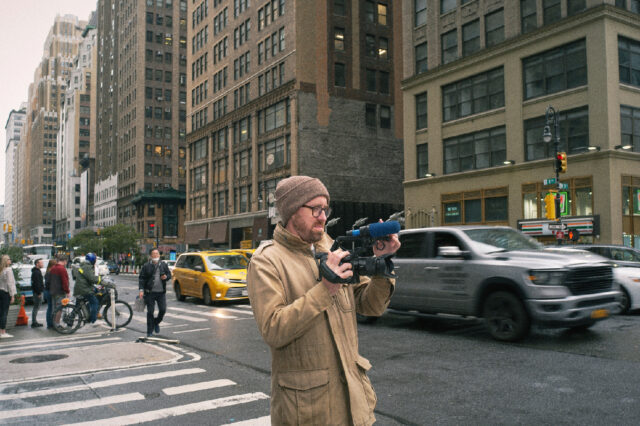
Kimi Takesue’s Onlookers, screening at BAM on May 4, looks at tourists and locals in Laos

ONLOOKERS (Kimi Takesue, 2023)
BAM Cinematheque
30 Lafayette Ave. between Ashland Pl. & St. Felix St.
Thursday, May 4, 7:00
Festival runs May 3–7 at multiple venues
www.bam.org
www.onlookersfilm.com

“Seeing comes before words. The child looks and recognizes before it can speak,” John Berger writes in the seminal text Ways of Seeing. “But there is also another sense in which seeing comes before words. It is seeing which establishes our place in the surrounding world; we explain that world with words, but words can never undo the fact that we are surrounded by it. The relation between what we see and what we know is never settled.”

In documentary filmmaker Kimi Takesue’s Onlookers, which is screening at BAM on May 4 at 7:00 as part of “Prismatic Ground 2023” (and will be followed by a Q&A with Takesue), there are no words, no dialogue — just seventy-two minutes of stunning visuals exploring what we see and what we know, what we are present for and what we are absent for.

The film takes place in various parts of Laos as director, producer, cinematographer, sound recordist, and editor Takesue sets up her camera and leaves it there as scenes unfold in real time and with natural sound, from a breathtaking fourteen-second sunset to five and a half minutes of six women sitting by the side of the road, preparing to fill begging bowls for a long line of Buddhist monks. Animals graze in a temple courtyard as bells chime. Women sell goods at an open-air market. Rivers flow, wind rustles trees, roosters crow, birds chirp, a cat rests on a step, a man relaxes in a hammock, all taking their time, no one in a hurry.

Then the tourists arrive; a few run up to take pictures of a monk beating a drum, then walk away, not actually stopping to watch and listen. A woman snaps a photo of three fellow sightseers standing atop a small, raging waterfall as a man fishes below. A local worker waits as a woman checks her cell phone, as if he isn’t there, standing next to her. A group of backpackers gets a prime view at a boat racing festival while locals observe from the shore. On a mountain, six tourists search for the best angle to take selfies. Visitors at a guest house sit in an outdoor lounge and watch Friends.

Born in Colorado and raised in Hawai’i and Massachusetts, Takesue has previously made Where Are You Taking Me? in Uganda, Heaven’s Crossroad in Vietnam, and 95 and 6 to Go in Hawai’i, about reconnecting with her grandfather. In Onlookers, she is not necessarily criticizing the tourists or celebrating the Laotian locals; she’s merely showing how people witness and experience the world, particularly when it comes to travelers and residents.

She beautifully captures this relationship in a short but captivating scene that begins with a static shot of an old religious shrine that looks like it hasn’t been in operation for years. A young woman enters the frame, sits down, poses for a selfie, stands up, snaps a photo of the shrine, then saunters off, never once stopping to just look at the shrine itself. The camera lingers on the building for several seconds, with nobody around, just the decaying structure set against a blue sky and between lush greenery.

We see what we want to see, when we want to see it, not always recognizing what is right in front of us, whether we’re at home or on vacation. It reminded me of people who go to a museum and take pictures of classic artworks but only see them through the lens of their phone rather than experiencing them with their own eyes. In fact, each frame of Onlookers is composed like a painting that slowly comes to life.

“The way we see things is affected by what we know or what we believe,” Berger writes in his book. “Yet this seeing which comes before words, and can never be quite covered by them, is not a question of mechanically reacting to stimuli. (It can only be thought of in this way if one isolates the small part of the process which concerns the eye’s retina.) We only see what we look at. To look is an act of choice. As a result of this act, what we see is brought within our reach — though not necessarily within arm’s reach. To touch something is to situate oneself in relation to it. . . . We never look at just one thing; we are always looking at the relation between things and ourselves. Our vision is continually active, continually moving, continually holding things in a circle around itself, constituting what is present to us as we are. Soon after we can see, we are aware that we can also be seen.”

In all films, the audience might not have a choice of what they’re looking at, but they can decide for themselves what they’re seeing. And in the case of Onlookers, what they’re seeing is a gorgeous portrait of ourselves that no selfie can catch.

An annual round-up of experimental and avant-garde documentaries, the third edition of “Prismatic Ground” runs May 3–7, consisting of more than five dozen features and shorts at the Museum of the Moving Image, Maysles Documentary Center, BAM Cinematheque, DCTV’s Firehouse Cinema, Light Industry, and Anthology Film Archives. The opening-night film is Soda Jerk’s Hello Dankness, while Alexandre Larose’s scènes de ménage trilogy closes the festival. Other highlights include Ayanna Dozier’s Close, but no Cigar trilogy, Naomi Uman’s Three Sparks, and Tsai Ming-Liang’s Where and Where do you stand, Tsai Ming-Liang?

IN SCENA! ITALIAN THEATER FESTIVAL NY 2023

Bruna Braidotti’s Luisa is part of Italian Theater Festival across five boroughs, May 1-16

IN SCENA!
Casa Italiana Zerilli-Marimo at NYU (and other locations)
24 West Twelfth St. between Fifth & Sixth Aves.
May 1-16, free – $23.41
www.inscenany.com

The tenth edition of the “In Scena!” Italian Theater Festival takes place May 1-16, at NYU’s Casa Italiana Zerilli-Marimò and other locations in all five boroughs. This year’s iteration features eight timely plays; admission is free with advance RSVP, but donations of $23.41 will be accepted. The opening-night celebration on May 1 at 7:00 includes an awards ceremony with artists present, along with a special video and more.

The works include four solo shows: Italian star Paola Minaccioni’s I am so much better live, with music by DJ Coco; Valentina Diana’s Mubarak’s Niece, performed by Marco Vergani, about a friendship that develops amid the Tahrir Square Revolution; Bruna Braidotti’s Luisa, which follows a woman haunted by the men in her past; Antonio Grosso’s Only Mozart Is Missing, performed by Marco Simeoli and based on the true story of Simeoli’s grandfather; and Marco De Simone’s We Puppets: Story of a life shattered by racism, set during the racial laws of 1938.

Marco Vergani stars in Valentina Diana’s Mubarak’s Niece at “In Scena!” festival

Also on the bill are The Gummy Bears’ Great War, about a fictional battle that echoes current events, written and directed by Angelo Trofa and performed by Valentina Fadda and Leonardo Tomasi; Maurizio Rippa’s Little Funerals, in which vocalist Rippa and guitarist Amedeo Monda play songs about a series of funerals; and Tiziana Troja’s DDD! Donne, Donnette, Donnacce, about a female comic duo, performed by Troja, Fadda, Trofa, Michela Sale Musio, and Michele Sarti, with original music and arrangements by Davide Sardo.

Presented by Kairos Italy Theater in association with KIT Italia and Casa Italiana Zerilli-Marimò, the festival, which moves to BAAD! Bronx Academy of Arts and Dance, Snug Harbor Cultural Center on Staten Island, the Vino Theater in Brooklyn, and Theaterlab in Queens (as well as Los Angeles, Detroit, and San Diego), concludes May 16 at the Italian Cultural Institute on Park Ave. with Andrea Scramali’s L’Attesa, about an estranged father and son who meet in an emergency room, and the presentation of the 2023 Mario Fratti Award to Scramali.

32 SOUNDS

Sam Green explores how we listen and connect with humanity and nature in 32 Sounds

32 SOUNDS (Sam Green, 2022)
Film Forum
209 West Houston St.
Opens Friday, April 28
212-727-8110
filmforum.org
32sounds.com

Sam Green’s 32 Sounds might be about how we hear the world, but it’s also filled with a barrage of stunning visuals that, combined with the binaural audio, creates a unique and exciting cinematic journey.

Green was inspired by his relatively new friendship with experimental composer and musician Annea Lockwood, which blossomed over Skype during the pandemic, and by François Girard’s 1993 biographical anthology Thirty Two Short Films About Glenn Gould, in which Colm Feore portrays the Canadian classical pianist most famous for his interpretations of such Bach works as the Goldberg Variations. In 32 Sounds, Green teams with composer, DJ, and musician JD Samson, from such bands as Le Tigre and MEN, to present ninety-five minutes of remarkable delicacy and insight.

The film is best experienced on headphones; at Film Forum, where it opens April 28, it will be shown several different ways, including with specially customized headphones with the audio mixed live inside the theater. The sound was recorded binaurally, so the audience can hear speech and movement as if it’s to your left or right, behind you, far away, or close up.

In the film, Princeton professor and scientist Edgar Choueiri introduces us to Johann Christoff, a recording device shaped like a human head that “captures sound exactly how you hear it.” Similar technology has been used for such theatrical presentations as The Encounter and Blindness. Hollywood veteran and two-time Oscar winner Mark Mangini (Dune, Mad Max: Fury Road) designed the sound for the film, immersing the viewer into what feels like a three-dimensional universe.

The film kicks off with Green and Samson in a playful scene that sets the stage for what is to follow. “This is a little bit of an odd movie in that we’re going to ask you to do some things,” Green explains. “Simple things, like close your eyes. If you don’t want to do them, don’t worry about it. But the truth is, the more you give yourself to the experience” — Samson then cuts in, finishing, “the more you get out of it.”

The first sound Green explores, appropriately enough, is of the womb, recorded by former midwife Aggie Murch, whose husband is Oscar-winning film editor and sound designer Walter Murch (Apocalypse Now, The English Patient, The Conversation). Over a purplish white screen with no figuration, Green discusses Walter Murch’s 2005 essay “Womb Tone,” in which Murch writes, “Hearing is the first of our senses to be switched on. . . . Although our mature consciousness may be betrothed to sight, it was suckled by sound, and if we are looking for the source of sound’s ability — in all its forms — to move us more deeply than the other senses and occasionally give us a mysterious feeling of connectedness to the universe, this primal intimacy is a good place to begin.”

Green then jumps from birth to death, taking out old cassette tapes of voice messages he has saved from decades past, telling us how “they hold the voices of so many people I’ve loved who are gone. I was wondering, How does that work? How does a little piece of eighth-of-an-inch magnetic tape hold a person? Make it seem like they are alive and in front of you more than any photo or piece of film ever could. I was wondering if sound is somehow a way to understand time, and time passing, and loss, and the ephemeral beauty of the present moment, all the things that I keep coming back to in my movies.”

He meets with Cheryl Tipp, curator of Wildlife and Environmental Sounds at the British Library Sound Archive, who shares the poignant and heartbreaking story of the mating call of the Hawaiian bird the moho braccatus. Lockwood, the subject of a short companion film Green directed, demonstrates how she has recorded the sound of rivers for fifty years, after gaining notoriety for her burning-piano installations.

Foley artist Joanna Fang reveals how she creates sound effects for films using unusual items in her studio, from a bowling ball to a wet cloth. “Art can elevate a truth beyond what is feasibly there,” she says. “And if we pull it off right, hopefully the emotional experience of hearing it and being part of it is enough to make you fully accept the poetry of what you’re hearing. Because isn’t that what we’re all trying to do, trying to take what we’re feeling on the inside and show it to somebody else, or let them listen to it, and have them feel the same way we do?”

Black revolutionary and fugitive Nehanda Abiodun listens to a tape of McFadden & Whitehead’s “Ain’t No Stopping Us Now,” transporting her to another place and time. Poet and cultural theorist Fred Moten marvels about “ghost sounds” of his relatives. Bay Area military veteran and environmental journalist Harold Gilliam postulates about sleep and foghorns in the context of “being part of this total community of life and nonlife on Earth.” Lebanese artist and musician Mazen Kerbaj recalls being able to make sound art during bombings when others were trapped in their homes or dying.

Green gives examples of recording “room tones,” a documentary process in which the subject is silent for thirty seconds as the sound recordist grabs the natural sound in order to help with later editing. It’s fascinating watching Philip Glass, Laurie Anderson, Rebecca Solnit, and others sit or stand uncomfortably as they wait, and we wait; we are not used to seeing such stagnation in a motion picture.

Annea Lockwood has been recording rivers for more than fifty years

Deaf sound artist Christine Sun Kim uses ASL to describe vibration and how she was taught when she was a child that sound was not part of her life, a concept that infuses her art. “I realized that sound is like money, power, control; it’s social currency,” she explains.

Along the way Green also looks at inventor Thomas Edison, polymath Charles Babbage, electronics engineer Alan Blumlein, and a classic Memorex commercial starring Ella Fitzgerald. We see and hear Glass playing piano, church bells ringing in Venice, Don Garcia driving through the city in his red Mazda blasting Phil Collins’s “In the Air Tonight,” and John Cage performing 4’33” outdoors. A Zamboni cleans the ice at a hockey rink. A cat purrs. Evel Knievel jumps over obstacles on his motorcycle. Samson blasts away on a whoopee cushion. Danny drives his Big Wheel through the empty halls of the Overlook Hotel in The Shining. Different groups dance to Donna Summer’s “I Feel Love.”

Oscar nominee Green (The Weather Underground, A Thousand Thoughts) edited the documentary with Nels Bangerter; the new, sharp cinematography is by Yoni Brook. The visuals range from a deluge of quick cuts of archival footage to nearly blank screens when Green asks the audience to close their eyes and just listen.

While the film is a technical marvel, it also becomes deeply emotional, as Green and several subjects listen to recordings of friends and family no longer with us, something you can’t get out of a photo album. It made me think of the messages I had saved on my answering machine of my mother, who passed away in 2017; while I try to avoid hearing them — they used to pop up after I went through new messages, sending me screaming into another room — it is comforting to know that they exist, that I can hear her whenever I need to. Such is the power of sound.

Green will be at Film Forum for postscreening Q&As with Lockwood, moderated by Nadia Sirota, on April 28 at 7:40, with Choueiri and Anderson on April 29 at 7:40, and with Samson, moderated by Matt Wolf, on April 30 at 5:15.

PUBLIC ART FUND TALKS: JACOLBY SATTERWHITE

Jacolby Satterwhite’s An Eclectic Dance to the Music of Time is on view at Lincoln Center (photo by Nicholas Knight)

Who: Jacolby Satterwhite
What: Public Art Fund Talk
Where: The Cooper Union’s Frederick P. Rose Auditorium, 41 Cooper Sq., Third Ave. at Seventh St.
When: Wednesday, April 26, free with advance RSVP for in-person or livestream, 6:30
Why: In a 2021 “Meet the Artist” interview with the Haus der Kunst museum in Munich, multimedia artist Jacolby Satterwhite explains, “The influences I draw on are from pop culture, politics, my family, my personal histories, queer theory, art history, postructuralism and design, gaming. It’s sort of like, you know, the simulacra of the universe.” Born in 1986 in Columbia, South Carolina, the New York–based Satterwhite’s latest installation is An Eclectic Dance to the Music of Time, on view on the fifty-foot-long Hauser Digital Wall in the Karen and Richard LeFrak Lobby in David Geffen Hall, home of the New York Philharmonic.

Commissioned by Lincoln Center for the Performing Arts in collaboration with the Studio Museum in Harlem and Public Art Fund, the nearly half-hour work explores the past, present, and future of Lincoln Center, featuring more than seventy-five dancers and more than fifty musicians from local performing art schools amid HD color video and 3D animation incorporating real-life figures, archival footage, trees, buildings, text, paintings, and photographs. On April 26 at 6:30, Satterwhite will be at the Cooper Union’s Frederick P. Rose Auditorium to discuss An Eclectic Dance to the Music of Time and place it within the context of his career as well as the arts community it celebrates. “I wanted to describe time and history through a vehicle of abstraction, using color, shape, landscape, horizontality, and movement as a way to kind of reorient the history in a way that it hasn’t been normally told,” he says in the above Lincoln Center video. You can hear more on April 26 either at the Cooper Union or via livestream, both free with advance RSVP.

BROOKLYN BY THE BOOK: LUCINDA WILLIAMS IN CONVERSATION WITH STEVE EARLE

Who: Lucinda Williams, Steve Earle
What: Book launch
Where: Congregation Beth Elohim, 271 Garfield Pl., Brooklyn
When: Monday, April 24, $36.84, 7:00
Why: “Yes, my family was dysfunctional, fucked up. But that’s not what really matters to me. What matters is that I inherited my musical talent from my mother and my writing ability from my father,” Louisiana-born singer-songwriter Lucinda Williams writes in her new memoir, Don’t Tell Anybody the Secrets I Told You (Crown, April 25, $28.99). She also admits about choosing not to attend the 1994 Grammy Awards, where her tune “Passionate Kisses” won for Best Country Song, “The truth is that I was not just self-conscious but also scared. I feared that I didn’t belong. It’s a feeling I’ve been trying to shake my entire life.” She has proved she belongs over the last twenty-nine years, being nominated for a total of seventeen Grammys and winning twice more, for Best Contemporary Folk Album for the amazing Car Wheels on a Gravel Road and Best Female Rock Vocal Performance for “Get Right with God.” Her next album, Stories from a Rock n Roll Heart, featuring such songs as “Stolen Moments” and “New York Comeback,” the latter with background vocals by Bruce Springsteen, is due out June 30.

On April 24, Williams, who finishes up a four-show run at City Winery on Tuesday night, will be at Congregation Beth Elohim with another Bruce collaborator, Steve Earle, to discuss her life and career. Williams and Earle have been longtime friends who joined forces on Earle’s “You’re Still Standin’ There” in 1996, on Williams’s “Joy” in 2004, and for a New Yorker interview with performances during the pandemic, so it promises to be an intimate evening, which is organized by Brooklyn’s Community Bookstore. Tickets are $36.84 and come with a copy of Don’t Tell Anybody the Secrets I Told You.

PLAN 75

Michi Kakutani (Chieko Baisho) faces the end of her life sooner than she wants to in Plan 75

PLAN 75 (Chie Hayakawa, 2022)
IFC Center
323 Sixth Ave. at West Third St.
Opens Friday, April 21
212-924-7771
www.ifccenter.com
www.kimstim.com

In March 2020, at the beginning of the Covid-19 pandemic, sixty-nine-year-old Texas lt. gov. Dan Patrick told Tucker Carlson on Fox News, “No one reached out to me and said, ‘As a senior citizen, are you willing to take a chance on your survival in exchange for keeping the America that all America loves for your children and grandchildren?’ And if that’s the exchange, I’m all in.” Many people agreed that in order to protect the US economy, it was acceptable to let senior citizens die from the coronavirus.

Japanese writer-director Chie Hayakawa takes that concept to the next level in her debut feature, the melancholic, gorgeously photographed Plan 75, opening April 21 at IFC Center.

Expanded from a short film she made for the 2018 omnibus Ten Years Japan, in which five directors made works set ten years in the future, Plan 75 unfolds in a near dystopia where the Japanese government, in order to combat the inconvenient truth that the population is aging at a potentially unsustainable rate, offers all citizens seventy-five and older the opportunity to be euthanized, no questions asked, in exchange for one thousand dollars and free cremation, among other lures.

“The surplus of seniors is draining Japan’s economy and taking a heavy toll on the young generation,” a young man with a rifle narrates at the beginning of the film. “Surely the elderly don’t wish to be a blight on our lives. The Japanese have a long, proud history of sacrificing themselves to benefit the country. I pray that my courageous act will trigger discussion and a future that’s brighter for this nation.”

Yôko Narimiya (Yumi Kawai) takes a job at a government euthanasia company in Plan 75

Plan 75 evokes elements of Richard Fleischer’s 1973 thriller Soylent Green, in which the government provides extravagantly organized assisted suicide, and Michael Anderson’s 1976 sci-fi flick Logan’s Run, in which citizens are not permitted to live past the age of thirty.

Legendary actress and singer Chieko Baisho is mesmerizing as Michi Kakutani, an elegant seventy-eight-year-old woman with no family. After losing her job as a hotel maid, she tries to find other employment, but it’s difficult at her age. Running out of money, she worries that she might soon be homeless.

She then finds out about the government program called Plan 75; cheerful banners and television commercials are pervasive. Several of her friends, including Ineko (Hisako Ôkata), are interested in the proposition, especially the part that comes with a free stay in a resort. But Michi is not ready to die.

Hiromu Okabe (Hayato Isomura) is a bright and enthusiastic young man who is one of Plan 75’s leading salesmen. He eagerly signs up senior citizens for Plan 75 with a smile on his face, believing it is a good thing for everyone. But when his uncle, Yukio Okabe (Taka Takao), shows up to enroll in the program, he starts having second thoughts.

Meanwhile, fellow employee Yôko Narimiya (Yumi Kawai) is assigned to Michi’s case, quickly growing close with the older woman, which is against the rules. And Maria (Stefanie Arianne) is a Filipino caregiver who has come to Japan to make enough money to pay for her ailing daughter’s heart operation; instead of helping sick and elderly people survive, she is now processing their belongings after they are killed by the state, reminiscent of how the Nazis collected the possessions of victims of the gas chambers.

“Humans have no choice about whether to be born, but it would be a good thing if we were able to choose when it’s time to die,” an elderly woman says happily in a commercial in a Plan 75 waiting room that reverses our usual expectations; instead of waiting to see doctors to keep them healthy, these seniors are waiting to die. “Being able to decide how my life will end provided me peace of mind,” the spokeswoman adds.

Plan 75 is a chilling look at where we might be headed; at times it feels like a documentary, its narrative all too believable. Cinematographer Hideho Urata’s camera ranges from close-ups of Baishô’s face, both celebrating and mourning every deep wrinkle, to dark interiors where the elderly slowly go through their meager daily existence and bright exteriors where children play and trains speed by as Michi can only watch.

At one point, after reading a section of the Plan 75 manual, which purports to give older people the chance to die with dignity, Yôko stares accusingly at the audience, implicating us in this frightening example of elder abuse. Hayakawa and Urata then cut to a sunset peeking through a tree next to a bland housing complex, followed by a shot of Michi’s hand, held up to a fading light through the window, examining each bent and crooked finger as she lies on a futon, wondering if she’s made the right choice — or even was given much of one in the first place.

Winner of a Caméra d’Or Special Distinction at Cannes, Plan 75 is a haunting cautionary tale that speaks volumes as to how senior citizens are treated, or mistreated, whether during a global pandemic or just every day, in Japan or elsewhere, including right here in America, where too many politicians consider them excess baggage. And the stunning finale emphasizes that we need to do something about it, and fast.

Hayakawa (Bird, Niagara) will be at IFC Center opening weekend, participating in Q&As on April 21 at 7:00 with Reiko Tahara, April 22 at 7:10 with Risa Morimoto, and April 23 at 4:25 with Kris Montello.

RIALTO AT 25

World premiere of 4K restoration of Jean-Luc Godard’s Alphaville kicks off “Rialto at 25” at MoMA (photo courtesy the Kobal Collection)

RIALTO AT 25
MoMA Film, Museum of Modern Art
11 West 53rd St. between Fifth & Sixth Aves.
April 19 – May 22, $8-$12
212-708-9400
www.moma.org
www.rialtopictures.com

In 1997, Bruce Goldstein started Rialto Pictures, joined the following year by Adrienne Halpern. For more than a quarter-century, Rialto has been dedicated to reissuing and restoring classic foreign and independent films, both famous and forgotten, often debuting them at Film Forum, where Goldstein has long served as master programmer. MoMA pays tribute to copresidents Goldstein and Halpern with “Rialto at 25,” a five-week series consisting of thirty-one films released by the beloved distribution company, beginning with Henri-Georges Clouzot’s 1947 murder mystery, Quai Des Orfèvres, and the world premiere of a brand-new 4K restoration of Jean-Luc Godard’s 1965 futuristic thriller, Alphaville.

Organized by MoMA Film curator Dave Kehr, the festival also includes Jean-Pierre Melville’s Army of Shadows, Francis Ford Coppola’s The Conversation, John Carpenter’s Escape from New York, Robert Hamer’s Kind Hearts and Coronets, Marcel Carné’s Le Jour Se Lève, Akira Kurosawa’s Ran, Carol Reed’s The Third Man, Joe Dante’s The Howling, and Alberto Cavalcanti’s Went the Day Well?

“I began Rialto Pictures out of sheer frustration. Many classic movies, particularly European films, had no distribution in the United States, with prints either impossible to get or unavailable to repertory cinemas,” Goldstein said in a statement. “And, just as bad, a lot of important classics — like Renoir’s Grand Illusion and Godard’s Breathless — were seen for decades only in miserable 16mm copies, with bad image and sound. By getting the rights to movies like these myself, I could make brand new 35mm prints and show them — not just in New York — but in movie theaters across the country.”

Rialto has amassed a profoundly remarkable collection that is well represented in the MoMA series; among the other highlights and surprises are Federico Fellini’s Nights of Cabiria (with a seven-minute restored scene), Jules Dassin’s Rififi, Orson Welles’s The Trial, Joseph Losey’s Mr. Klein, John Boulting’s Brighton Rock, and Luis Buñuel’s The Discreet Charm of the Bourgeoisie and That Obscure Object of Desire. In addition, MoMA has created a special forty-five-minute compilation of Rialto trailers.

On April 29, Goldstein will present the illustrated talk “The Art of Subtitles”; several screenings will feature introductions or discussions; and originally commissioned Rialto posters will be on view. Goldstein will introduce Jacques Deray’s La Piscine on April 26 and Dino Risi’s Una Vita Difficile on May 14, translator and subtitler Michael F. Moore will introduce Francesco Rosi’s Christ Stopped at Eboli on April 22, Whit Stillman and actors Dylan Hundley and Carolyn Farina will participate in a discussion following a screening of Metropolitan on April 27, actor Madjid Niroumand will talk about Amir Naderi’s Davandeh with Goldstein after a screening on April 28, and Julien Duvivier’s Panique will be introduced on April 26 by Pierre Simon, the son of Georges Simenon, on whose novel the film is based. You might as well just move in to MoMA from April 19 to May 22, but keep looking over your shoulder.