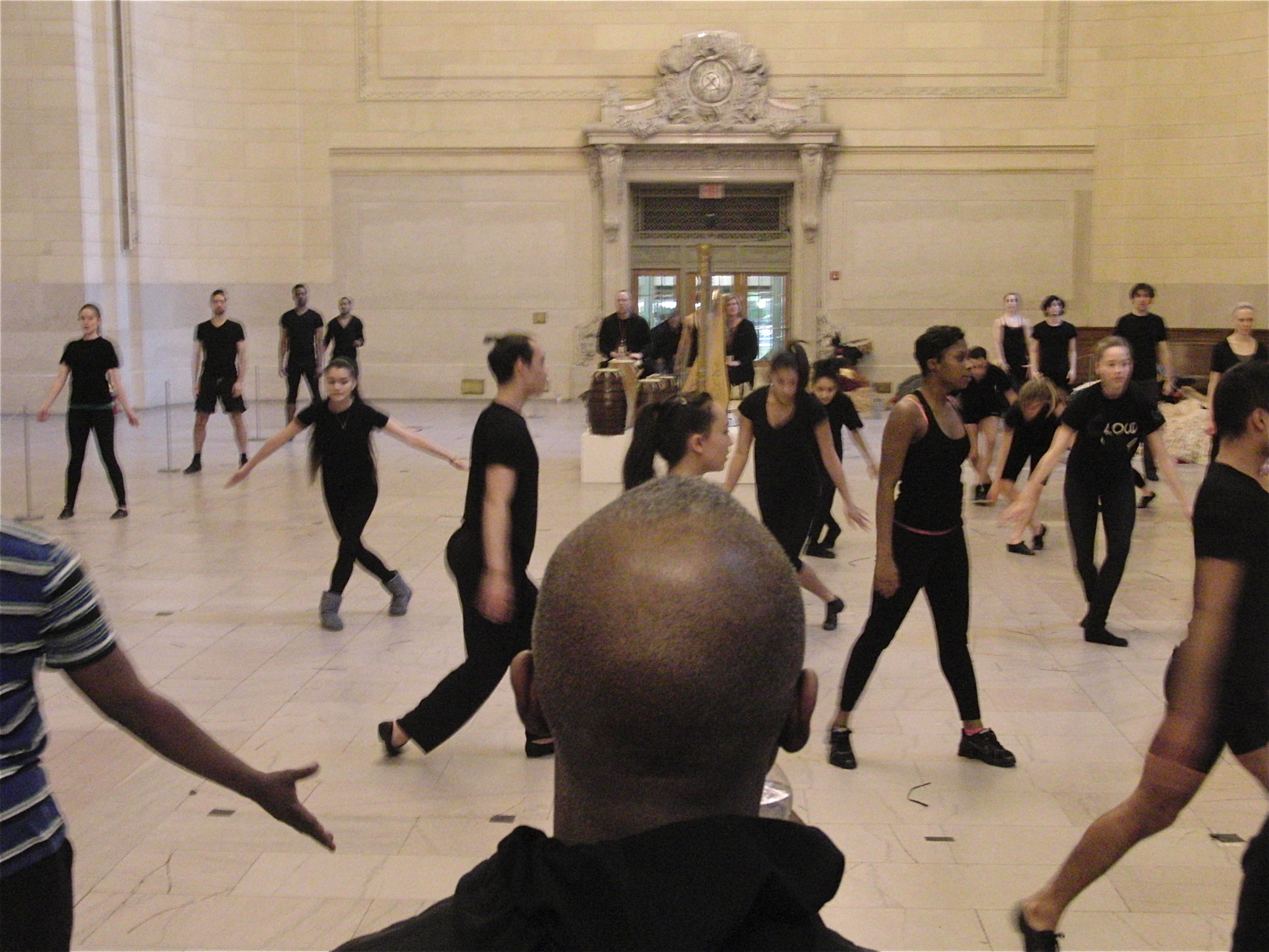
Nick Cave’s “Heard•NY” transforms Vanderbilt Hall into a performance petting zoo (photo by twi-ny/mdr)
Grand Central Terminal, Vanderbilt Hall
89 East 42nd St. between Lexington and Vanderbilt
Daily crossings at 11:00 and 2:00, tours at 3:30 through March 31
www.creativetime.org
heard•ny rehearsal slideshow
heard•ny performance slideshow
Artist Nick Cave has transformed Grand Central Terminal’s Vanderbilt Hall into a unique and wonderful petting zoo like none other. The Missouri-based Cave, who makes colorful, life-size Soundsuits out of found and recycled materials, has created a menagerie of exotic horses for “Heard•NY,” which continues as part of GCT’s centennial celebration through March 31. On each roped-in side of Vanderbilt Hall, Cave has placed fifteen horses on saw horses. Each day at 11:00 and 2:00, the saw horses are removed and student dancers from the Ailey School march into the area and get inside the horse suits, two dancers per animal. They then parade around the periphery of the rectangle, allowing onlookers to take photographs and to pet them, before commencing a dance choreographed by Cave and William Gill, set to music played by a harpist and a percussionist. The horses stomp their hooves, proudly lift their heads, kick out, and form trios, then meet at the center, where the dancer in the back of the animal separates from the front, forming a collection of multicolored cheerleaders, evoking psychedelic Cousin Itts, who spin around, fall to the ground, and then get back inside their respective horses and eventually return the Soundsuits to their saw horse, although they no longer look like costumes but living and breathing horses taking a break until the next performance. It’s a great deal of fun, a playful riff not only on the perpetually busy and crowded Grand Central Terminal — where so many people are always in a rush, never stopping to enjoy the wonders around them — but also the concept of zoos themselves, where animals are put on display for the enjoyment of humans. Show up about a half hour before showtime to get a good spot, because it fills up quickly and often reaches capacity; one of the four sides of each corral is reserved for children so kids don’t have to compete with adults for a better view. Each performance, which is free, takes about twenty to twenty-five minutes and is an absolute charmer not to be missed.
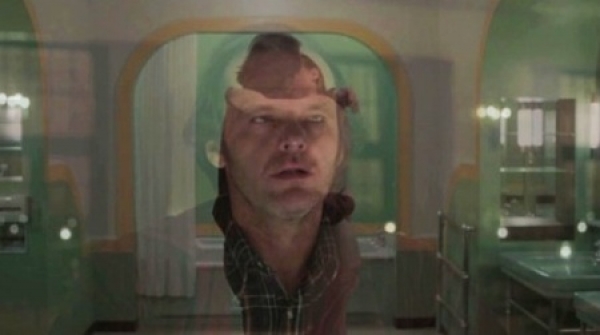
 The next time you watch Stanley Kubrick’s cult classic horror flick, The Shining, you’re gonna want to put on a tinfoil hat while drinking your soda and munching on popcorn after seeing Rodney Ascher’s Room 237, an extremely entertaining study of obsession, the love of movies, and people with a little too much time on their hands. A marvelous exploration of how we watch and individually interpret movies, Room 237 allows a handful of wild theorists to deconstruct and reconstruct Kubrick’s widely examined film, based on Stephen King’s 1975 bestselling novel. From the sweeping opening helicopter shot to the final zoom on a black-and-white photograph, four men and one woman share their deeply researched insight into what virtually every moment of Kubrick’s frightening tale of a writer (Jack Nicholson) and his wife (Shelley Duvall) and son (Danny Lloyd) taking care of a Colorado mountain hotel during the off-season is really about. But these are not just plain nuts; among them is an award-winning journalist, an accomplished historian, a published playwright, and a musician and WFMU deejay. Ascher (The S from Hell) never shows the commentators, instead allowing them to verbally describe their theories while he plays the relevant clips, accompanied by brief shots from all of Kubrick’s films (Dr. Strangelove, Full Metal Jacket, Paths of Glory, A Clockwork Orange, 2001: A Space Odyssey, etc.) and other movies and television programs that cleverly relate to the storytelling. Jay Weidner believes that The Shining is Kubrick’s apology for having directed the faked Apollo 11 moon landing, Bill Blakemore thinks it’s about the genocide of the American Indians, Geoffrey Cocks is sure it’s about the Holocaust, and Juli Kearns finds it to be about the mythical Minotaur; Kearns also has generated a three-dimensional map of the Overlook Hotel to delve into the impossible spatial relationships perpetrated by Kubrick, always, she claims, with a very specific reason. Perhaps the most creative of the subjects is John Fell Ryan, who insists that the film was meant to be seen both forward and backward — at the same time. One of the “leading” Shining explorers, Kevin McLeod, aka “mstrmnd,” declined to appear in the film, but some of his views are included as well. While many of the theories will leave you scratching your head or laughing hysterically, you’re almost sure to start giving credence to a few, so beware; it’s a natural tendency of the human brain to try to detect patterns in things, and in this case the work has already been done for you. But one thing is certainly true: After watching Room 237, you’ll never be able to look at The Shining the same way again. Room 237 opens March 29 at the IFC Center and the Elinor Bunin Munroe Film Center, with Ascher and producer Tim Kirk going back and forth between the two venues on Friday and Saturday for various Q&As and introductions.