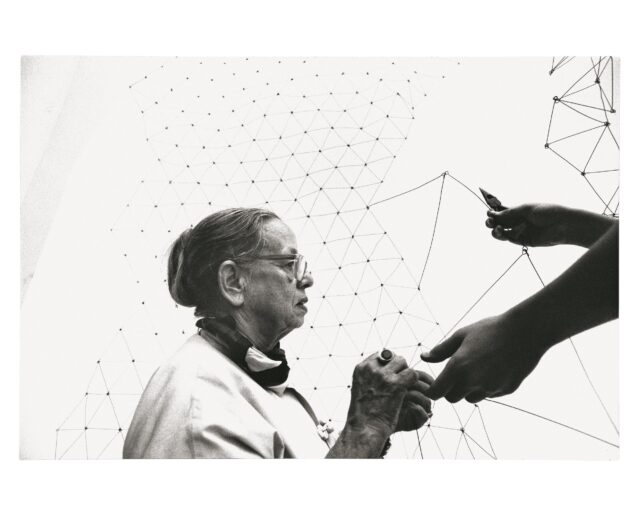
Gego installing Reticulárea 1981, 1980, permanent collection display, Sala Gego (Gego Room), Galería de Arte Nacional, Caracas (photo by Christian Belpaire, courtesy Archivo Fundación Gego)
Who: Mónica Amor, Vered Engelhard, Geaninne Gutiérrez-Guimarães, Pablo León de la Barra, Sean Nesselrode Moncada, Luis Pérez-Oramas, Mari Carmen Ramírez, Álvaro Sotillo What: Symposium on “Gego: Measuring Infinity” Where:Solomon R. Guggenheim Museum, 1071 Fifth Ave. at Eighty-Ninth St. When: Friday, May 12, $15-$25, noon – 5:00 Why: German-Venezuelan artist Gertrud Goldschmidt, better known as Gego, is the subject of the outstanding new Guggenheim exhibition “Gego: Measuring Infinity,” consisting of nearly two hundred drawings, etchings, watercolors, letters, and, primarily, mesmerizing, fragile, architectural sculptures that Gego called drawings without paper. On May 12, the Guggenheim is hosting the five-hour seminar “Gego: Weaving Lines of Thought,” examining the life and career of Gego, who was born in Hamburg in 1912 and died in Caracas in 1994. Organized by exhibition cocurators Pablo León de la Barra and Geaninne Gutiérrez-Guimarães, the symposium, part of the Guggenheim’s Latin American Circle Presents series, will feature presentations by León de la Barra, Gutiérrez-Guimarães, Mónica Amor, Vered Engelhard, Sean Nesselrode Moncada, Luis Pérez-Oramas, and Mari Carmen Ramírez in addition to longtime Gego collaborator Álvaro Sotillo. The exhibition continues through September 10; make sure to save time for the remarkable “Sarah Sze: Timelapse” as well.
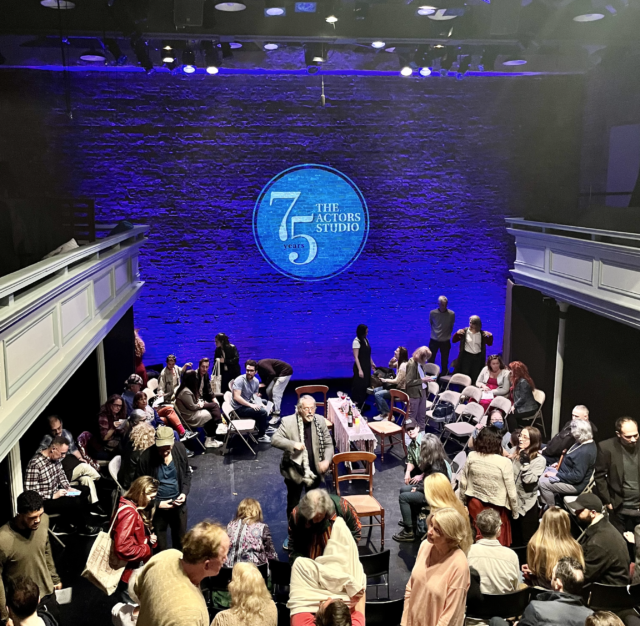
The Actors Studio continues its seventy-fifth anniversary celebration with several special free events this month (photo courtesy the Actors Studio)
THE ACTORS STUDIO IN PROCESS
The Actors Studio
432 West Forty-Fourth St. between Ninth & Tenth Aves.
May 12-13, free with RSVP, 7:00
Additional events May 14, 19-20, 25-26 theactorsstudio.org
If you haven’t been paying attention, the Actors Studio has been celebrating its seventy-fifth anniversary with some outstanding public events. Last month, “Directed by Estelle Parsons” featured the Oscar- and Obie-winning actress helming three works; in December, Carroll Baker was on hand for a talk following a screening of Elia Kazan’s Baby Doll; and in October, Al Pacino hosted a screening of Sidney Lumet’s Dog Day Afternoon at United Palace.
The party continues this weekend with Tony and Obie winner Lois Smith and others taking audiences behind the scenes in “The Actors Studio in Process.” On May 12 and 13 at 7:00, there will be open rehearsals of scenes from three plays: Elizabeth Stearns’s Hillbilly Women, directed by Marilyn Fried and starring Smith, Jacqueline Knapp, and Taylor Plas; writer-director Dennis Russo’s Midnight and Sky, with Russo and Marc Solomon; and Chris Stack and Scott McCord’s We Might Fall Apart, with McCord, Stack, and Plas. Admission is free with RSVP.
On May 14 at 3:00, an encore of “The Playwright: Tales from the Color Line” consists of scenes from plays exploring race, followed by Q&As, with Phillip Hayes Dean’s This Bird of Dawning Singeth All Night Long, directed by Paul Calderon and starring Martha Gehman and Richarda Abrams; James Baldwin’s Blues for Mister Charley, directed by Patricia Floyd and featuring McCord, Robert Mobley, Samuel Pygatt, Delissa Reynolds, and Lawrence Stallings; Lorraine Hansberry’s The Sign in Sidney Brustein’s Window, with Michael Billingsley, Aprella Godfrey-Barule, and Omar Ezat and directed by JoAnna Rhinehart; and Charles Gordone’s No Place to Be Somebody, with Mobley, Brittaney Chatman, Rony Clanton, Marcus Naylor and Steven Vause, directed by Naylor.
The festivities carry on later in the month with “On the Fly 2023: Then and Now” on May 19 and 20, a two-part presentation of short plays by BIPOC writers and directors, the first night a screening of Zoom plays streamed during the pandemic, the second live works, and May 25 and 26 with “Areyto: Latine Celebration,” an immersive theatrical ceremony rooted in equatorial tribal origins, followed by a reception.
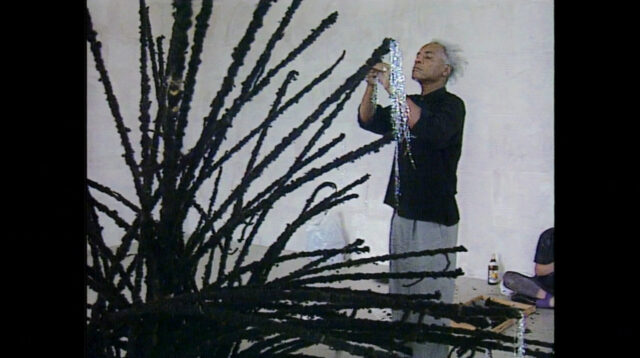
David Hammons works on a piece for Documenta IX (photo by Hessischer Rundfunk)
THE MELT GOES ON FOREVER: THE ART AND TIMES OF DAVID HAMMONS (Judd Tully & Harold Crooks, 2022)
Film Forum
209 West Houston St.
Opens Friday, May 5
212-727-8110 filmforum.org themeltfilm.com
“David believes that the less said about him, the better off he is,” the late poet and Gathering of the Tribes founder Steve Cannon says about his friend, artist David Hammons, in The Melt Goes on Forever: The Art and Times of David Hammons, opening May 5 at Film Forum.
In 2020, Hammons, who was born in Springfield, Illinois, in 1943 and has been based in New York City for nearly fifty years, installed Day’s End, an homage to Gordon Matta-Clark’s 1975 similarly named intervention in an abandoned industrial building on Pier 52, outside where the Whitney is today. The 325-foot-long brushed-steel outline of the warehouse has no interior, a ghostly memorial to those lost in the AIDS crisis.
With The Melt, directors Judd Tully and Harold Crooks have constructed a stirring documentary that is missing one key figure: Hammons, who doesn’t do interviews or talk about his personal life, preferring to have his work stand on its own. There’s a reason why the subtitle is “the Art and Times,” not the more common phrase “the Life and Times.”
More than two dozen art historians (Kellie Jones, Bridget R. Cooks, Richard Powell, Gylbert Coker, Robert Farris Thompson), dealers and gallerists (Jeanne Greenberg Rohatyn, Dominique Lévy, Jack Tilton, Adam Sheffer, Robert Mnuchin), artists (Suzanne Jackson, Fred Wilson, Tschabalala Self, Betye Saar, Joe Lewis, Lorna Simpson), collectors (Dimitris Daskalopoulos), and curators (Robert Storr, Ilene Susan Fort, Mary Jane Jacob) share stories about Hammons, forming a picture of a fabulously talented eclectic iconoclast who does what he wants, when he wants, the way he wants.
Among his revolutionary works discussed in the film are Bliz-aard Ball Sale, in which he sold snowballs, arranged in rows of descending size, on the streets of New York; African American Flag, a reimagining of the US flag but in the Pan-African colors of red, black, and green; How You Like Me Now?, a billboard of Jesse Jackson as a blond-haired, blue-eyed white man; Flight Fantasy, painted on the wall of Cannon’s apartment; Untitled (Night Train), two circular rows of clear and green bottles of Night Train and Thunderbird planted in a pile of coal; and Blues for Smoke, a blue model train rolling across tracks that wind around grand pianos on their side, inspired by John Coltrane’s song “Blue Train.”
“I just thought he was nuts,” artist Paul H-O says about watching Hammons go through garbage to find potential materials.
“It’s not the art object itself,” Hammons explains in a 1991 NPR radio interview. “It’s the daring of the act.”
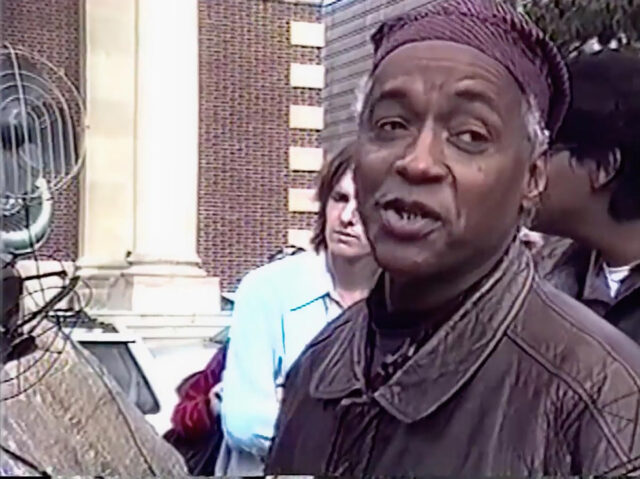
Archival footage of Hammons includes a visit by filmmaker Michael Auder to a Rome studio in 1989 where Hammons pontificates on what success means to him while constructing an untitled sculpture using real Black hair; Hammons adding cotton to wooden sticks in his Harlem studio in Michael Blackwood’s 1992 After Modernism: The Dilemma of Influence; Hammons introducing students to his outdoor sculpture Rock Fan, consisting of electric fans on a large rock on the campus of Williams College in 1993; and clips by Alex Harsley of Hammons making “Basketball Drawings” by bouncing a basketball against paper on a wall and Hammons kicking a can in his 2004 Phat Free performance.
Delving into a 1990 group show at Museum Overholland, curator Jan Christiaan Braun notes, “‘Black USA’ was more than David Hammons. It was an effort to find a podium for Black American artists. He was one of them. The meaning of ‘Black USA’ was bigger than David Hammons, and he himself thought so too. He was very, very much supporting the idea of bringing out Black art. That’s why he immediately said to me, ‘I’m your man.’”
Extensive attention is given to the 2016 career retrospective “Five Decades” at Mnuchin Gallery, which lends insight to Hammons’s wide oeuvre and process when it comes to hanging his work. “Two weeks prior to the opening, David expressed an interest in coming in to see the show,” dealer Sukanya Rajarantnam recalls, not so fondly. “Um, his reaction was not exactly exuberant. He didn’t like what we’d done and, in fact, hated it. So he decided to change things. . . . The show itself became an installation and an artwork by David.” I remember being blown away by the final exhibition, which featured many of the pieces mentioned in the documentary.
David Hammons unveils Rock Fan to students at Williams College (photo courtesy Williams College Museum of Art)
Throughout the film, arts journalist Tully and documentarian Crooks (The Price We Pay,Surviving Progress) regularly cut to Umar bin Hassan of the Last Poets performing Cannon’s catalog essay-poem “Rousing the Rubble,” recorded during Covid and originally written for Hammons’s 1990 PS1 museum show of the same name, accompanied by a barrage of grainy videos of New York City in the twentieth century and animation by Tynesha Foreman that brings some of his works to life against a pulsating Afro-jazz score:
“On the Streets of Manhattan, East Side West Side All Around the Town the Sidewalks of New York — after the bars and the clubs empty out the sordid the homeless! The misbegotten under the cover of darkness Blue Moon No moon, under the cover of darkness in the wee small hours up in Harlem — Midtown — on the Lower Eastside — Performing Artist — this is when you see the empty bottles and empty people makin’ their rounds, into makin’ their own sounds — into smiles into frowns! Digging in garbage in search of more empties — bottles and cans! Those who do be hungry doing something about their condition — with David on the scene in those lonely wee small hours after hours state of New York! Raw Energy! Making his rounds, dreams turned into nightmares heavy into art — that New York art scene outdoor art — dreams turned into realities — all night diners — back in his studio on 125th Street — making art out of that which he has heard and seen on the scene out of funk! Out of central Illinois — out of Los Angeles out of his world travels! Creating a space for the spirits! That flash of the spirit!”
The spectacular original music features composer Ramachandra Borcar on percussion, piano, found objects, and other instruments; saxophonists Idris Ackamoor, Marshall Allen, Shabaka Hutchings, and Frank Lozani; Tommy Babin and Dave Watts on bass; Aaron Doyle on trumpet and flugelhorn; Jeff Johnston on piano; and Kullak Viger Rojas on surdo. It pays tribute to the jazz influences Hammons has cited over the years, such legends as Charles Mingus, Miles Davis, Thelonius Monk, Charlie Parker, Ornette Coleman, and Coltrane. Foreman’s animation unfolds to those same vibrant rhythms, echoed in the artworks. (Hammons’s art influences range from his mentor, Charles White, to Marcel Duchamp.)
Even without their subject’s participation, Tully and Crooks are able to fill in much of the mystery surrounding Hammons, with the help of members of the arts community who adore him and his work, like partially furnishing the emptiness inherent in Day’s End. (Hammons did sit down for an interview with Whitney director Adam D. Weinberg to celebrate the opening of the Pier 52 project in June 2021, which you can watch here.)
The Melt Goes on Forever reveals Hammons to be a true nonconformist, a genius who doesn’t need to be center stage, letting his art do the talking for him.
Tully and Crooks will be at Film Forum for Q&As on May 5 at 7:15 presented by A Gathering of the Tribes, on May 6 at 7:15 with Suzanne Jackson, and on May 7 at 4:40.
Kimi Takesue’s Onlookers, screening at BAM on May 4, looks at tourists and locals in Laos
ONLOOKERS (Kimi Takesue, 2023)
BAM Cinematheque
30 Lafayette Ave. between Ashland Pl. & St. Felix St.
Thursday, May 4, 7:00
Festival runs May 3–7 at multiple venues www.bam.org www.onlookersfilm.com
“Seeing comes before words. The child looks and recognizes before it can speak,” John Berger writes in the seminal text Ways of Seeing. “But there is also another sense in which seeing comes before words. It is seeing which establishes our place in the surrounding world; we explain that world with words, but words can never undo the fact that we are surrounded by it. The relation between what we see and what we know is never settled.”
In documentary filmmaker Kimi Takesue’s Onlookers, which is screening at BAM on May 4 at 7:00 as part of “Prismatic Ground 2023” (and will be followed by a Q&A with Takesue), there are no words, no dialogue — just seventy-two minutes of stunning visuals exploring what we see and what we know, what we are present for and what we are absent for.
The film takes place in various parts of Laos as director, producer, cinematographer, sound recordist, and editor Takesue sets up her camera and leaves it there as scenes unfold in real time and with natural sound, from a breathtaking fourteen-second sunset to five and a half minutes of six women sitting by the side of the road, preparing to fill begging bowls for a long line of Buddhist monks. Animals graze in a temple courtyard as bells chime. Women sell goods at an open-air market. Rivers flow, wind rustles trees, roosters crow, birds chirp, a cat rests on a step, a man relaxes in a hammock, all taking their time, no one in a hurry.
Then the tourists arrive; a few run up to take pictures of a monk beating a drum, then walk away, not actually stopping to watch and listen. A woman snaps a photo of three fellow sightseers standing atop a small, raging waterfall as a man fishes below. A local worker waits as a woman checks her cell phone, as if he isn’t there, standing next to her. A group of backpackers gets a prime view at a boat racing festival while locals observe from the shore. On a mountain, six tourists search for the best angle to take selfies. Visitors at a guest house sit in an outdoor lounge and watch Friends.
Born in Colorado and raised in Hawai’i and Massachusetts, Takesue has previously made Where Are You Taking Me? in Uganda, Heaven’s Crossroad in Vietnam, and 95 and 6 to Go in Hawai’i, about reconnecting with her grandfather. In Onlookers, she is not necessarily criticizing the tourists or celebrating the Laotian locals; she’s merely showing how people witness and experience the world, particularly when it comes to travelers and residents.
She beautifully captures this relationship in a short but captivating scene that begins with a static shot of an old religious shrine that looks like it hasn’t been in operation for years. A young woman enters the frame, sits down, poses for a selfie, stands up, snaps a photo of the shrine, then saunters off, never once stopping to just look at the shrine itself. The camera lingers on the building for several seconds, with nobody around, just the decaying structure set against a blue sky and between lush greenery.
We see what we want to see, when we want to see it, not always recognizing what is right in front of us, whether we’re at home or on vacation. It reminded me of people who go to a museum and take pictures of classic artworks but only see them through the lens of their phone rather than experiencing them with their own eyes. In fact, each frame of Onlookers is composed like a painting that slowly comes to life.
“The way we see things is affected by what we know or what we believe,” Berger writes in his book. “Yet this seeing which comes before words, and can never be quite covered by them, is not a question of mechanically reacting to stimuli. (It can only be thought of in this way if one isolates the small part of the process which concerns the eye’s retina.) We only see what we look at. To look is an act of choice. As a result of this act, what we see is brought within our reach — though not necessarily within arm’s reach. To touch something is to situate oneself in relation to it. . . . We never look at just one thing; we are always looking at the relation between things and ourselves. Our vision is continually active, continually moving, continually holding things in a circle around itself, constituting what is present to us as we are. Soon after we can see, we are aware that we can also be seen.”
In all films, the audience might not have a choice of what they’re looking at, but they can decide for themselves what they’re seeing. And in the case of Onlookers, what they’re seeing is a gorgeous portrait of ourselves that no selfie can catch.
An annual round-up of experimental and avant-garde documentaries, the third edition of “Prismatic Ground” runs May 3–7, consisting of more than five dozen features and shorts at the Museum of the Moving Image, Maysles Documentary Center, BAM Cinematheque, DCTV’s Firehouse Cinema, Light Industry, and Anthology Film Archives. The opening-night film is Soda Jerk’s Hello Dankness, while Alexandre Larose’s scènes de ménage trilogy closes the festival. Other highlights include Ayanna Dozier’s Close, but no Cigar trilogy, Naomi Uman’s Three Sparks, and Tsai Ming-Liang’s Where and Where do you stand, Tsai Ming-Liang?
Bruna Braidotti’s Luisa is part of Italian Theater Festival across five boroughs, May 1-16
IN SCENA!
Casa Italiana Zerilli-Marimo at NYU (and other locations)
24 West Twelfth St. between Fifth & Sixth Aves.
May 1-16, free – $23.41 www.inscenany.com
The tenth edition of the “In Scena!” Italian Theater Festival takes place May 1-16, at NYU’s Casa Italiana Zerilli-Marimò and other locations in all five boroughs. This year’s iteration features eight timely plays; admission is free with advance RSVP, but donations of $23.41 will be accepted. The opening-night celebration on May 1 at 7:00 includes an awards ceremony with artists present, along with a special video and more.
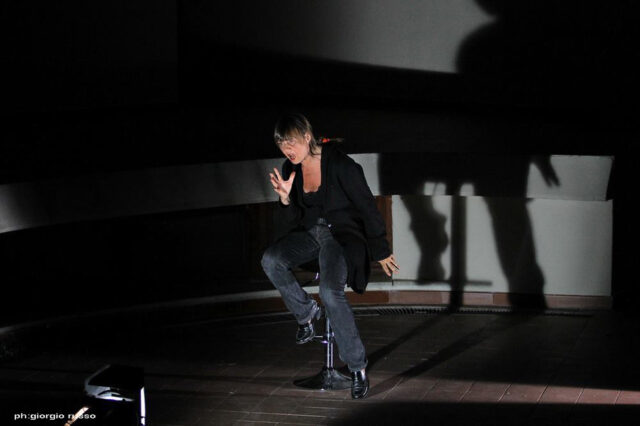
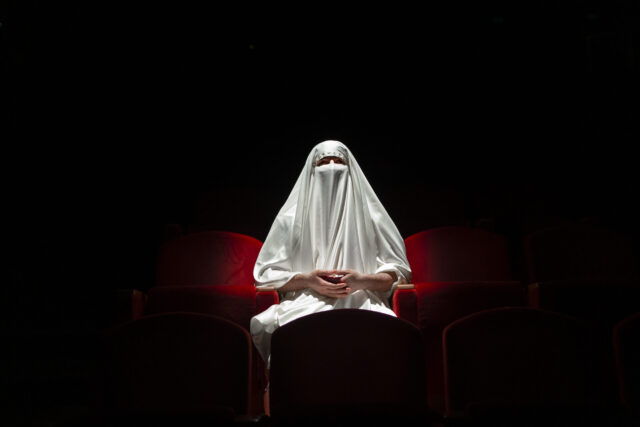
The works include four solo shows: Italian star Paola Minaccioni’s I am so much better live, with music by DJ Coco; Valentina Diana’s Mubarak’s Niece, performed by Marco Vergani, about a friendship that develops amid the Tahrir Square Revolution; Bruna Braidotti’s Luisa, which follows a woman haunted by the men in her past; Antonio Grosso’s Only Mozart Is Missing, performed by Marco Simeoli and based on the true story of Simeoli’s grandfather; and Marco De Simone’s We Puppets: Story of a life shattered by racism, set during the racial laws of 1938.
Marco Vergani stars in Valentina Diana’s Mubarak’s Niece at “In Scena!” festival
Also on the bill are The Gummy Bears’ Great War, about a fictional battle that echoes current events, written and directed by Angelo Trofa and performed by Valentina Fadda and Leonardo Tomasi; Maurizio Rippa’s Little Funerals, in which vocalist Rippa and guitarist Amedeo Monda play songs about a series of funerals; and Tiziana Troja’s DDD! Donne, Donnette, Donnacce, about a female comic duo, performed by Troja, Fadda, Trofa, Michela Sale Musio, and Michele Sarti, with original music and arrangements by Davide Sardo.
Presented by Kairos Italy Theater in association with KIT Italia and Casa Italiana Zerilli-Marimò, the festival, which moves to BAAD! Bronx Academy of Arts and Dance, Snug Harbor Cultural Center on Staten Island, the Vino Theater in Brooklyn, and Theaterlab in Queens (as well as Los Angeles, Detroit, and San Diego), concludes May 16 at the Italian Cultural Institute on Park Ave. with Andrea Scramali’s L’Attesa, about an estranged father and son who meet in an emergency room, and the presentation of the 2023 Mario Fratti Award to Scramali.
Sam Green explores how we listen and connect with humanity and nature in 32 Sounds
32 SOUNDS (Sam Green, 2022)
Film Forum
209 West Houston St.
Opens Friday, April 28
212-727-8110 filmforum.org 32sounds.com
Sam Green’s 32 Sounds might be about how we hear the world, but it’s also filled with a barrage of stunning visuals that, combined with the binaural audio, creates a unique and exciting cinematic journey.
Green was inspired by his relatively new friendship with experimental composer and musician Annea Lockwood, which blossomed over Skype during the pandemic, and by François Girard’s 1993 biographical anthology Thirty Two Short Films About Glenn Gould, in which Colm Feore portrays the Canadian classical pianist most famous for his interpretations of such Bach works as the Goldberg Variations. In 32 Sounds, Green teams with composer, DJ, and musician JD Samson, from such bands as Le Tigre and MEN, to present ninety-five minutes of remarkable delicacy and insight.
The film is best experienced on headphones; at Film Forum, where it opens April 28, it will be shown several different ways, including with specially customized headphones with the audio mixed live inside the theater. The sound was recorded binaurally, so the audience can hear speech and movement as if it’s to your left or right, behind you, far away, or close up.
In the film, Princeton professor and scientist Edgar Choueiri introduces us to Johann Christoff, a recording device shaped like a human head that “captures sound exactly how you hear it.” Similar technology has been used for such theatrical presentations as The Encounter and Blindness. Hollywood veteran and two-time Oscar winner Mark Mangini (Dune,Mad Max: Fury Road) designed the sound for the film, immersing the viewer into what feels like a three-dimensional universe.
The film kicks off with Green and Samson in a playful scene that sets the stage for what is to follow. “This is a little bit of an odd movie in that we’re going to ask you to do some things,” Green explains. “Simple things, like close your eyes. If you don’t want to do them, don’t worry about it. But the truth is, the more you give yourself to the experience” — Samson then cuts in, finishing, “the more you get out of it.”
The first sound Green explores, appropriately enough, is of the womb, recorded by former midwife Aggie Murch, whose husband is Oscar-winning film editor and sound designer Walter Murch (Apocalypse Now,The English Patient,The Conversation). Over a purplish white screen with no figuration, Green discusses Walter Murch’s 2005 essay “Womb Tone,” in which Murch writes, “Hearing is the first of our senses to be switched on. . . . Although our mature consciousness may be betrothed to sight, it was suckled by sound, and if we are looking for the source of sound’s ability — in all its forms — to move us more deeply than the other senses and occasionally give us a mysterious feeling of connectedness to the universe, this primal intimacy is a good place to begin.”
Green then jumps from birth to death, taking out old cassette tapes of voice messages he has saved from decades past, telling us how “they hold the voices of so many people I’ve loved who are gone. I was wondering, How does that work? How does a little piece of eighth-of-an-inch magnetic tape hold a person? Make it seem like they are alive and in front of you more than any photo or piece of film ever could. I was wondering if sound is somehow a way to understand time, and time passing, and loss, and the ephemeral beauty of the present moment, all the things that I keep coming back to in my movies.”
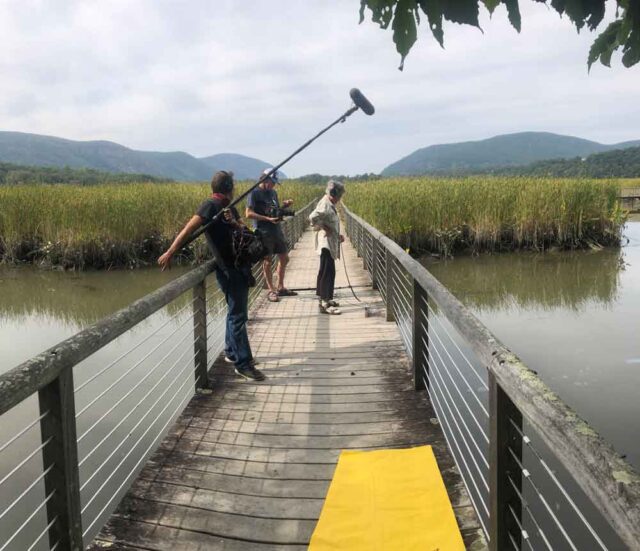
He meets with Cheryl Tipp, curator of Wildlife and Environmental Sounds at the British Library Sound Archive, who shares the poignant and heartbreaking story of the mating call of the Hawaiian bird the moho braccatus. Lockwood, the subject of a short companion film Green directed, demonstrates how she has recorded the sound of rivers for fifty years, after gaining notoriety for her burning-piano installations.
Foley artist Joanna Fang reveals how she creates sound effects for films using unusual items in her studio, from a bowling ball to a wet cloth. “Art can elevate a truth beyond what is feasibly there,” she says. “And if we pull it off right, hopefully the emotional experience of hearing it and being part of it is enough to make you fully accept the poetry of what you’re hearing. Because isn’t that what we’re all trying to do, trying to take what we’re feeling on the inside and show it to somebody else, or let them listen to it, and have them feel the same way we do?”
Black revolutionary and fugitive Nehanda Abiodun listens to a tape of McFadden & Whitehead’s “Ain’t No Stopping Us Now,” transporting her to another place and time. Poet and cultural theorist Fred Moten marvels about “ghost sounds” of his relatives. Bay Area military veteran and environmental journalist Harold Gilliam postulates about sleep and foghorns in the context of “being part of this total community of life and nonlife on Earth.” Lebanese artist and musician Mazen Kerbaj recalls being able to make sound art during bombings when others were trapped in their homes or dying.
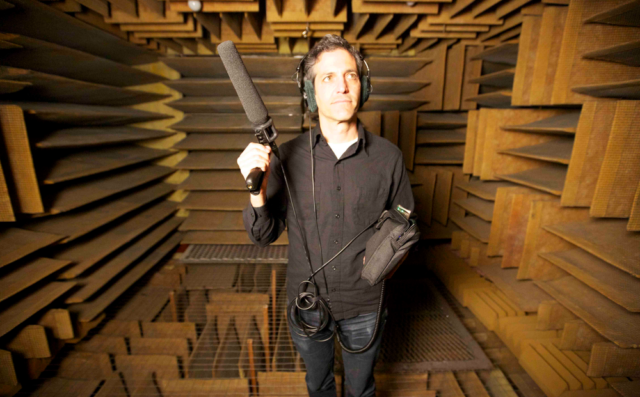
Green gives examples of recording “room tones,” a documentary process in which the subject is silent for thirty seconds as the sound recordist grabs the natural sound in order to help with later editing. It’s fascinating watching Philip Glass, Laurie Anderson, Rebecca Solnit, and others sit or stand uncomfortably as they wait, and we wait; we are not used to seeing such stagnation in a motion picture.
Annea Lockwood has been recording rivers for more than fifty years
Deaf sound artist Christine Sun Kim uses ASL to describe vibration and how she was taught when she was a child that sound was not part of her life, a concept that infuses her art. “I realized that sound is like money, power, control; it’s social currency,” she explains.
Along the way Green also looks at inventor Thomas Edison, polymath Charles Babbage, electronics engineer Alan Blumlein, and a classic Memorex commercial starring Ella Fitzgerald. We see and hear Glass playing piano, church bells ringing in Venice, Don Garcia driving through the city in his red Mazda blasting Phil Collins’s “In the Air Tonight,” and John Cage performing 4’33” outdoors. A Zamboni cleans the ice at a hockey rink. A cat purrs. Evel Knievel jumps over obstacles on his motorcycle. Samson blasts away on a whoopee cushion. Danny drives his Big Wheel through the empty halls of the Overlook Hotel in The Shining. Different groups dance to Donna Summer’s “I Feel Love.”
Oscar nominee Green (The Weather Underground,A Thousand Thoughts) edited the documentary with Nels Bangerter; the new, sharp cinematography is by Yoni Brook. The visuals range from a deluge of quick cuts of archival footage to nearly blank screens when Green asks the audience to close their eyes and just listen.
While the film is a technical marvel, it also becomes deeply emotional, as Green and several subjects listen to recordings of friends and family no longer with us, something you can’t get out of a photo album. It made me think of the messages I had saved on my answering machine of my mother, who passed away in 2017; while I try to avoid hearing them — they used to pop up after I went through new messages, sending me screaming into another room — it is comforting to know that they exist, that I can hear her whenever I need to. Such is the power of sound.
Green will be at Film Forum for postscreening Q&As with Lockwood, moderated by Nadia Sirota, on April 28 at 7:40, with Choueiri and Anderson on April 29 at 7:40, and with Samson, moderated by Matt Wolf, on April 30 at 5:15.
Jacolby Satterwhite’s An Eclectic Dance to the Music of Time is on view at Lincoln Center (photo by Nicholas Knight)
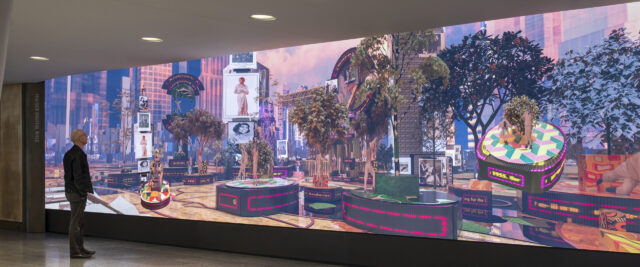
Who:Jacolby Satterwhite What:Public Art Fund Talk Where:The Cooper Union’s Frederick P. Rose Auditorium, 41 Cooper Sq., Third Ave. at Seventh St. When: Wednesday, April 26, free with advance RSVP for in-person or livestream, 6:30 Why: In a 2021 “Meet the Artist” interview with the Haus der Kunst museum in Munich, multimedia artist Jacolby Satterwhite explains, “The influences I draw on are from pop culture, politics, my family, my personal histories, queer theory, art history, postructuralism and design, gaming. It’s sort of like, you know, the simulacra of the universe.” Born in 1986 in Columbia, South Carolina, the New York–based Satterwhite’s latest installation is An Eclectic Dance to the Music of Time, on view on the fifty-foot-long Hauser Digital Wall in the Karen and Richard LeFrak Lobby in David Geffen Hall, home of the New York Philharmonic.
Commissioned by Lincoln Center for the Performing Arts in collaboration with the Studio Museum in Harlem and Public Art Fund, the nearly half-hour work explores the past, present, and future of Lincoln Center, featuring more than seventy-five dancers and more than fifty musicians from local performing art schools amid HD color video and 3D animation incorporating real-life figures, archival footage, trees, buildings, text, paintings, and photographs. On April 26 at 6:30, Satterwhite will be at the Cooper Union’s Frederick P. Rose Auditorium to discuss An Eclectic Dance to the Music of Time and place it within the context of his career as well as the arts community it celebrates. “I wanted to describe time and history through a vehicle of abstraction, using color, shape, landscape, horizontality, and movement as a way to kind of reorient the history in a way that it hasn’t been normally told,” he says in the above Lincoln Center video. You can hear more on April 26 either at the Cooper Union or via livestream, both free with advance RSVP.