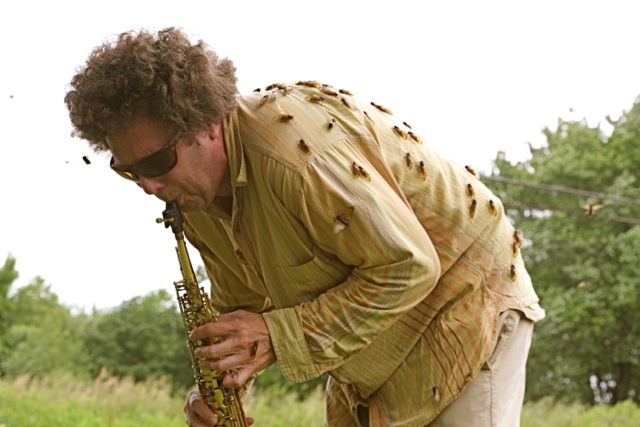
David Rothenberg will jam with humans and insects at special Ear to the Earth program at Judson Church (photo by Charles Lindsay)
INSECT MUSIC
Judson Church
Wednesday May 22, suggested donation $15, 7:30
www.bugmusicbook.com
www.davidrothenberg.net
You better watch out, because Brood II is on its way, ready to strike at any minute. It’s been seventeen years since Magicicadas have hit New York City, but they’re preparing to emerge, buzzing the metropolitan area with their 7 kHz mating call. The nymphs, which will grow quickly into adult cicadas, will appear once the temperature hits a steady sixty-four degrees, but David Rothenberg is already set for the onslaught. The self-described musician, composer, author, and philosopher-naturalist has just released Bug Music: How Insects Gave Us Rhythm and Noise (St. Martin’s, April 2013, $26.99) and the accompanying Bug Music CD (Terra Nova), completing the trilogy that began with Why Birds Sing: A Journey into the Mystery of Birdsong and Thousand Mile Song: Whale Music in a Sea of Sound. “Each shrill, whining, or whooshing song is a call to the endless nature of love,” he writes in the new book. “However fast love goes we know it will return, the one sure thing that will never be exhausted as all the rest of nature gets spent, used up, or destroyed. Cicadas on the branches, eternal optimists, lovers of the moment.” Rothenberg will headline the special program “Insect Music” on May 22 at Judson Church, presented by Ear to the Earth, consisting of an introduction by Cicada Mania founder Dan Mozgai, the world premiere of Richard Knox Robinson’s half-hour film Song of the Cicadas, a panel discussion with Rothenberg, Robinson, performance artist and former political prisoner Tim Blunk, and David’s son, Umru Rothenberg, moderated by Radiolab founder Robert Krulwich, and a live performance by David Rothenberg on clarinets and laptop, Pauline Oliveros on accordion, Harmonic Choir member Timothy Hill providing overtone vocals, and Garth Stevenson on double bass, along with recordings of cicadas, crickets, katydids, leafhoppers, water bugs, and other insects.

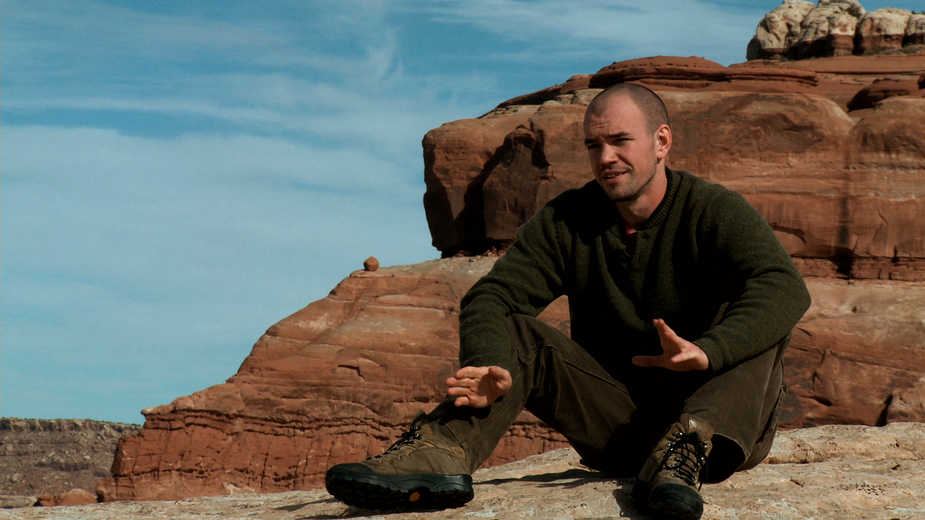
 Can one person really make a difference? In Bidder 70, directors Beth and George Gage tell the inspiring story of Tim DeChristopher, who has followed in the footsteps of such peaceful, nonviolent protestors as Rosa Parks, the Reverend Dr. Martin Luther King Jr., and Mahatma Gandhi, although the humble West Virginia native wouldn’t dare put himself in such lofty company. In December 2008, DeChristopher attended a Utah Bureau of Land Management oil and gas lease auction without a real plan, knowing only that he had to do something to keep the pristine wilderness land out of the hands of corporate drillers; he ended up winning bids on more than twenty-two thousand acres for $1.7 million without any intention of actually paying, so he was arrested and charged with two felonies that could put him in prison for a long time. But he just couldn’t sit back and let the sale take place, and he’s willing to face the consequences. “It’s really hard for me to not think about climate change with anything that we’re doing,” the West Virginia native says in the film while relaxing in a vast, rocky landscape. “It’s this big weight that our generation is bearing on our shoulders, and it’s like something chasing us, that’s getting closer all the time. We’ve always been told that things are just beyond our control and that corporations have all the power, and we don’t often get to be reminded that we’re citizens of what was once the greatest democracy on the planet and that we’re human beings with the power to inspire others through our actions.” The Gages (American Outrage, Fire on the Mountain) follow the modest DeChristopher as he becomes a leader in the civil disobedience movement, cofounding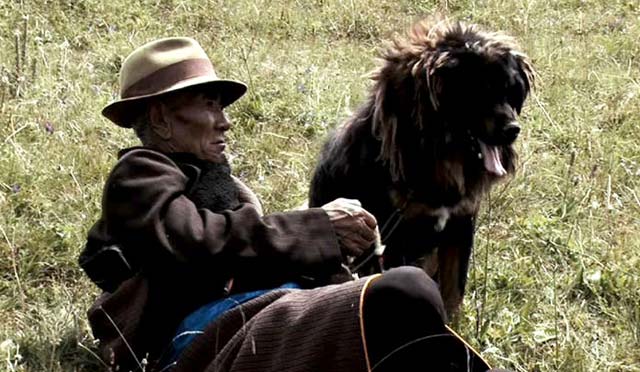
 Pema Tseden’s Old Dog is a beautifully told, slowly paced meditation on Buddhism’s four Noble Truths — “Life means suffering”; The origin of suffering is attachment”; “The cessation of suffering is attainable”; and “There is a path to the cessation of suffering” — that ends with a shocking, manipulative finale that nearly destroys everything that came before it. In order to get a little money and to save the family’s sheep-herding dog from being stolen, Gonpo (Drolma Kyab) sells their Tibetan nomad mastiff to Lao Wang (Yanbum Gyal), a dealer who resells the prized breed to stores in China, where they’re used for protection. When Gonpa’s father (Lochey) finds out what his son has done, he goes back to Lao Wang and demands the return of the dog he’s taken care of for thirteen years. “I’d sell myself before the dog,” he tells his son. And so begins a gentle tale of parents and children, set in a modern-day Tibet that is ruled by China’s heavy hand. Gonpa’s father doesn’t understand why his son, a lazy man who rides around on a motorized bike and never seems to do much of anything, doesn’t yet have any children of his own, so he pays for Gonpa and his wife Rikso, (Tamdrin Tso), to go to the doctor to see what’s wrong. Meanwhile, the old man keeps a close watch on his dog, wary that Lao Wang will to try to steal it again. Writer-director Pema Tseden (The Silent Holy Stones, The Search) explores such themes as materialism, family, and attachment in a lovely little film that sadly is nearly ruined by its extreme final scene. Old Dog is screening at MoMA May 15-20 as part of “Chinese Realities/Documentary Visions,” with Tseden taking part in a discussion with Asia Society film curator La Frances Hui after the 8:00 show on May 16 and with Hui and Chris Berry following the 7:00 show on May 18. The series continues through June 1 with such other films as Zhang Yuan’s Mama, Zhang Yimou’s The Story of Qiu Ju, Jia Zhangke’s 24 City, and Ai Weiwei’s Disturbing the Peace.