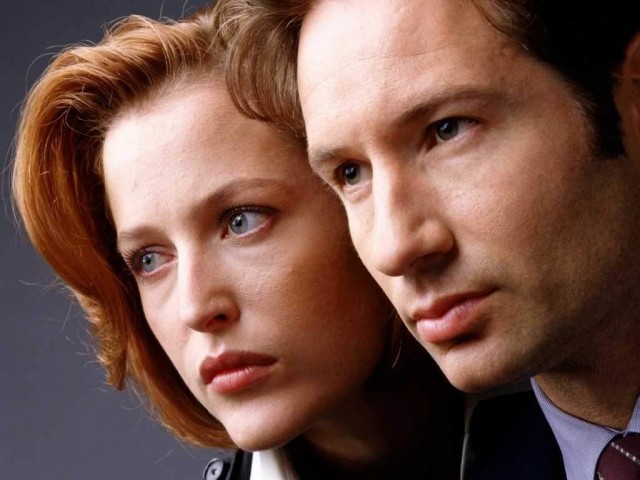
Gillian Anderson and David Duchovny will talk X-FILES and take pictures with fans at New York Comic Con
Jacob K. Javits Convention Center
655 West 34th St. (11th Ave. between 34th & 39th Sts.)
October 10-13, $30-$50 per day, four-day pass $85
www.newyorkcomiccon.com
New York Comic Con continues its exponential growth this year by focusing on the small screen more than ever. The eighth edition, taking place October 10-13 at the Javits Center, includes presentations on a wide range of television programs, including Game of Thrones, Haven, Falling Skies, The Following, The Walking Dead, Robot Chicken, Archer, Bob’s Burgers, Doctor Who, Teen Wolf, Futurescape with James Woods, Marvel’s Agents of S.H.I.E.L.D., Person of Interest, Sleepy Hollow, The League, and others, with the shows’ stars, writers, and producers on hand for screenings, discussions, and Q&As, all free with the price of admission. There are lots of autograph sessions and photo ops as well, but some of them will cost you a pretty penny; it’s $220 to get your picture taken with Patrick Stewart and William Shatner together, or with Gillian Anderson and David Duchovny, who will be talking up The X-Files on Sunday afternoon. Below are our recommendations for this year’s convention; please note that many of the guests will be signing autographs on multiple days.
Thursday, October 10
Autographing Highlights: Zoë Bell, Marissa Jade, Miss Zukie, Kathy Najimi, Joe Quinones, Greg Pack, Greg Rucka, Jamie Tyndall
Women in Comics, with Claudia McGivney, Megan Kociolek, Amy Chu, Becky Cloonan, Emily Weisenstein, Erica Schultz, and Laura Pope-Robbins, 1A15, 3:15
Welcome to the Brass Screen: Steampunk TV and Film, with Bruce Boxleitner, Matt James Daley, Thom Truelove, Trevor Crafts, and Leanna Renee Hieber, moderated by Diana Pho, 1A17, 3:45
Bill Plympton’s Cheatin’ & Kickstarter, with Adam Rackoff, James Hancock, and Bill Plympton, 1A08, 4:15
Carmine Infantino: A VisualLecture Retrospective, with Arlen Schumer, 1A08, 6:45
NYCC Thursday Night Kickoff with Comedy Mutant, featuring Brian Posehn, Janeane Garofalo, Mike Drucker, and Myq Kaplan, Main stage 1-D, 8:00
Friday, October 11
Autographing Highlights: Kristin Bauer, Andrea Cremer, Mick Foley, Joel Grey, Dean Haspiel, Darlene Love, Greg Pak, Raphael Sbarge, Stuart Moore, Veronica Taylor
Hatsune Miku Live Party 2013 in Kansai Special Film Concert at NYCC, 1A23, 11:15 am
He’s Back! Celebrate Chucky’s 25th Anniversary with the Creators & Cast, with Brad Dourif, Danielle Bisutti, Don Mancini, Fiona Dourif, Harry Knowles, and Jennifer Tilly, Main Stage 1-D, 12:15
Game of Thrones with Jerome Flynn, 1A23, 12:30
B. J. Novak’s One More Thing: Stories and Other Stories, with B. J. Novak and Lev Grossman, 1A22, 1:30
Will.i.am’s Wizards and Robots, with will.i.am, 1A23, 1:45
The Walking Dead 10th Anniversary Panel,” with Charlie Adlard and Robert Kirkman, Empire Stage 1-E, 2:45
[Adult Swim] Presents Robot Chicken, with Breckin Meyer, Clare Grant, Keith Crofford, Matthew Senreich, and Seth Green, Main Stage 1-D, 5:00
Oldboy, with Mark Protosevich, Michael Imperioli, and Pom Klementieff, Main Stage 1-D, 6:00
Spotlight on the Fifth Beatle: The Story of Brian Epstein, with Bruce Cohen, Dave Marsh, David Kahne, Vivek J. Tiwary, and Andrew C. Robinson, 1A01, 6:30
The Cyanide and Happiness Show! with Dave McElfatrick, Kris Wilson, and Shawn Coss, 1A10, 8:00
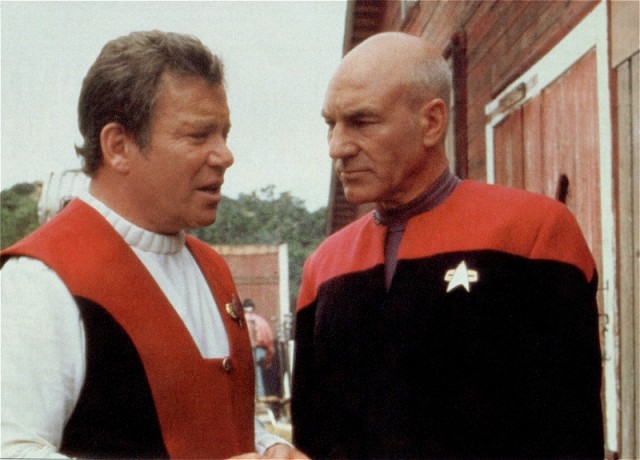
William Shatner and Patrick Stewart will be together again at New York Comic Con
Saturday, October 12
Autographing Highlights: Gillian Anderson, Julie Benz, Bruce Boxleitner, David Duchovny, Boomer Esiason, Hulk Hogan, Jerry “the King” Lawler, Stan Lee, Andrew McCarthy, William Shatner, Neil deGrasse Tyson, Billy West
Archer Discussion and Q&A, with Adam Reed, Aisha Tyler, Amber Nash, Chris Parnell, H. Jon Benjamin, Jessica Walter, Judy Greer, and Lucky Yates, Main Stage 1-D, 11:00 am
Fifty Years of Doctor Who, with Barnaby Edwards, Deborah Stanish, Graeme Burk, JK Woodward, Ken Deep, Robert Smith (TBC), and Andre Tessier, 1A23, 11:15
Spotlight on J. Michael Straczynski, with J. Michael Straczynski, 1A14, 12:15
IFC’s Back to Back Comedy Event: Comedy Bang! Bang! and The Birthday Boys, with members of the Birthday Boys, Reggie Watts, and Scott Aukerman, 1A06, 2:30
Beauty and the Beast Screening and Fan Q&A, with Jay Ryan, Kristin Kreuk, and Matt Mitovich, Main Stage 1-D, 3:45
Marvel’s Agents of S.H.I.E.L.D., with Jeph Loeb, Main Stage 1-D, 5:00
Showrunners, with Des Doyle, Greg Plageman, Ronald D. Moore, Ryan Patrick McGuffey, and Terence Winter, moderated by Tara DiLullo Bennett, 1A23, 5:30
AMC’s The Walking Dead, with Andrew Lincoln, Chad Coleman, Danai Gurira, Lauren Cohan, Melissa McBride, Norman Reedus, and Steven Yeun, moderated by Debra Birnbaum, Main Stage 1-D, 6:30
Wikia (Live) Cosplay Contest, 1A06, 8:30
Sunday, October 13
Autographing Highlights: John Barrowman, Anthony Daniels, Chip Kidd, Gareth David-Lloyd, Simon Fraser, Andrew McCarthy, William Shatner, Gary Sohmers, Patrick Stewart
Sunday Conversation with Dan DiDio, 1A06, 10:45 am
Defiance: A New Earth — with New Rules, with Grant Bowler, Jaime Murray, Julie Benz, Michael Nankin, and Stephanie Leonidas, Main Stage 1-D, 11:00
Person of Interest Special Video Presentation and Q&A, with Amy Acker, Greg Plageman, Kevin Chapman, Sarah Shahi, and Taraji P. Henson, Empire Stage 1-E, 12:15
The Following Special Video Presentation and Q&A, with Connie Nielsen, James Purefoy, Kevin Bacon, Kevin Williamson, Marcos Siega, Shawn Ashmore, and Valorie Curry, Empire Stage 1-E, 1:30
Chozen Screening and Q&A, with Bobby Moynihan, Grant Dekernion, Hannibal Buress, Method Man, and Tom Brady, Main Stage 1-D, 1:30
The Making of Star Wars: Return of the Jedi, with J. W. Rinzler and Jason Fry, 1A23, 2:45
William Shatner Q&A, 1A22, 3:45
Gillian Anderson & David Duchovny Talk X-Files, Main Stage 1-D, 4:00



 During his sixteen-year career, Sixth Generation Chinese filmmaker Jia Zhangke has made both narrative works (The World, Platform, Still Life) and documentaries (Useless, I Wish I Knew), with his fiction films containing elements of nonfiction and vice versa. Such is the case with his latest film, the powerful A Touch of Sin, which explores four based-on-fact outbreaks of shocking violence in four different regions of China. In Shanxi, outspoken miner Dahai (Jiang Wu) won’t stay quiet about the rampant corruption of the village elders. In Chongqing, married migrant worker and father Zhao San (Wang Baoqiang) obtains a handgun and is not afraid to use it. In Hubei, brothel receptionist Ziao Yu (Zhao Tao, Jia’s longtime muse and now wife) can no longer take the abuse and assumptions of the male clientele. And in Dongguan, young Xiao Hui (Luo Lanshan) tries to make a life for himself but is soon overwhelmed by his lack of success. Inspired by King Hu’s 1971 wuxia film A Touch of Zen, Jia also owes a debt to Max Ophüls’s 1950 bittersweet romance La Ronde, in which a character from one segment continues into the next, linking the stories. In A Touch of Sin, there is also a character connection in each successive tale, though not as overt, as Jia makes a wry, understated comment on the changing ways that people connect in modern society. In depicting these four acts of violence, Jia also exposes the widening economic gap between the rich and the poor and the social injustice that is prevalent all over contemporary China — as well as the rest of the world — leading to dissatisfied individuals fighting for their dignity in extreme ways. A gripping, frightening film that earned Jia the Best Screenplay Award at Cannes this year, A Touch of Zen opens October 4 at Lincoln Plaza and the IFC Center, with Jia and Zhao appearing at Lincoln Plaza for a Q&A following the 4:55 screening and to introduce the 7:25 show, after which they will head over to IFC for a Q&A following the 7:00 screening and to introduce the 9:35 show.