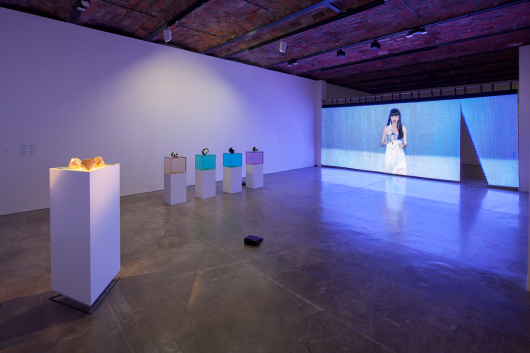
“ProBio” looks at the future with “dark optimism” at MoMA PS 1 (photo by Matthew Septimus)
MoMA PS1
22-25 Jackson Ave. at 46th Ave.
Thursday – Monday through September 2, suggested admission $10 (free with paid MoMA ticket within fourteen days), 12 noon – 6:00
718-784-2084
www.momaps1.org
The presentation of MoMA PS1’s summer exhibition, “Expo 1: New York,” smartly echoes how climate change, technology, and evolution have impacted the progression and devastation of the natural world in the twenty-first century. The show began in May with a series of modules in various locations, with some of those individual parts, including “Rain Room” at MoMA, Olafur Eliasson’s Icelandic glacier installation “Your waste of time” at PS1, Adrián Villar Rojas’s “La inocencia de los animales (The innocence of animals)” PS 1 lecture hall, and the VW Dome on Rockaway Beach, now having gone extinct, disappearing like the melting ice caps. But the show, which promotes Triple Canopy’s concept of a “dark optimism” for the future of humanity and the planet, still has several worthwhile displays at its primary hub at PS 1, examining its mission statement that “we live in a time that is marked by both the seeming end of the world and its beginning, being on the brink of apocalypse but also at the onset of unprecedented technological transformation.” Curators Klaus Biesenbach and Hans Ulrich Obrist reach back fifteen years for Meg Webster’s “Pool,” which PS 1 founder Alanna Heiss originally commissioned in 1998, a swampy water environment that could not exist without the coming together of natural materials and man-made electronic elements. Downstairs in the basement, the Cinema is offering up recent film, video games, and online content from the YouTube generation; the upcoming schedule includes the video games “Journey” and “Proteus,” Sterling Ruby’s Transient Trilogy, Althea Thauberger’s Northern, and Khavn de la Cruz’s Kalakala and Mondomanila or: How I Fixed My Hair After a Rather Long Journey, with the director on hand to discuss his work (and provide live piano accompaniment for the former). Organized by Josh Kline, “ProBio” takes a futuristic look at the intersection of technology and the human body, with intriguing cutting-edge works by such artists as Alisa Baremboym, Antoine Catala, Carissa Rodriguez, and Georgia Sagri; watch out for those Roomba-like robots scouring the floor. One offsite project still remains, Marie Lorenz’s “The Tide and Current Taxi,” which visitors can hail in New York harbor. As always at MoMA PS 1, the many rooms hold little surprises, so be sure to explore so you can also catch pieces by Charles Ray, Matthew Barney, Zoe Leonard, Steve McQueen, Mark Dion, Chris Burden, Pierre Huyghe, Agnes Denes, Ugo Rondinone, and others. And for the final week of “Expo 1,” a77’s communal courtyard installation “Colony” is taken over by Glenn O’Brien, who will be hosting “TV Party Goes to Camp.”


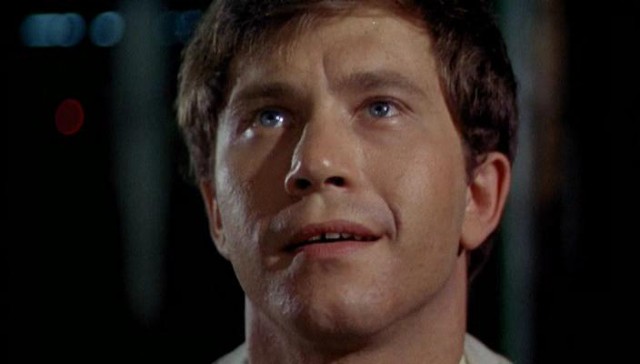
 Poor Bernard Chanticleer (Peter Kastner). His mother (Geraldine Page) sends him locks of her hair and pays a prudish landlord (Julie Harris), aided by a tough cop (Dolph Sweet), to make sure no girls visit him in his new apartment. Bernard’s father (Rip Torn) rules over him with an iron fist in the basement of the New York Public Library. A nice, innocent young woman (Karen Black in her first major role) is interested in him, but he wants a psycho go-go dancer/actress (Elizabeth Hartman). Meanwhile, he is getting all the wrong advice from his best friend (Tony Bill). Francis Ford Coppola’s little-known romantic comedy — his second feature, following Dementia 13 — earned Page an Academy Award nomination, Kastner a BAFTA nomination as Most Promising Newcomer, and a Palme d’Or nomination at Cannes. Coppola uses the New York City settings with a charming intelligence and wit, whether Bernard is chasing a kite across the Sheep Meadow, wandering through the Times Square peep shows, or being chased through the New York Public Library. The Lovin’ Spoonful supplies the fabulously sixties soundtrack. Based on David Benedictus’s novel, You’re a Big Boy Now kicks off the Museum of the Moving Image series “Fun City: New York in the Movies 1967-75,” with guest curator J. Hoberman on hand to introduce the film. The festival, which runs August 10 through September 1, includes a wide range of works made in and about the Big Apple, from such familiar favorites as Rosemary’s Baby, The French Connection, Superfly, Midnight Cowboy, and Dog Day Afternoon to such lesser-known treats as Bye Bye Braverman, The Angel Levine, Little Murders, The Landlord, and Dick Fontaine’s 1970 documentary, Norman Mailer vs. Fun City.