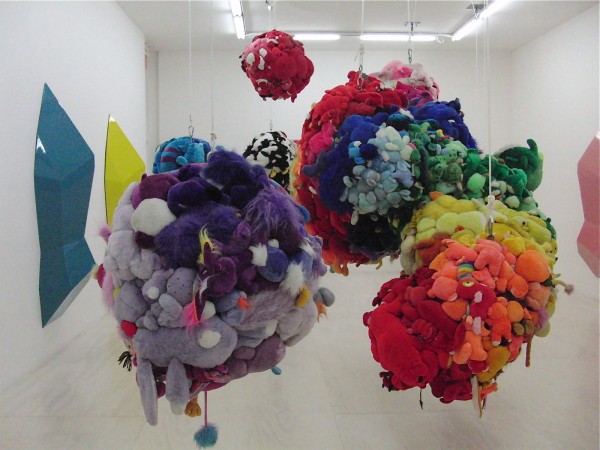
Mike Kelley, “Deodorized Central Mass with Satellites,” plush toys sewn over wood and wire frames with styrofoam packing material, nylon rope, pulleys, steel hardware and hanging plates, fiberglass, car paint, and disinfectant, 1991/1999 (photo by twi-ny/mdr)
MoMA PS1
22-25 Jackson Ave. at 46th Ave.
Sunday, February 2, $18 in advance, $20 day of show, 4:00
Exhibition continues through February 2, suggested admission $10 (free with paid MoMA ticket
within fourteen days), 12 noon – 6:00 (9:00 on Saturday)
718-784-2084
www.momaps1.org
A few weeks ago, an art-world friend who was at MoMA PS1 posted on Facebook, “OK, sell me on Mike Kelley.” Most of the respondents agreed with her that they just didn’t get all the hullabaloo over the influential multimedia artist who committed suicide on February 1, 2012, while in the midst of participating in his career retrospective, which posthumously took over all of the Long Island City institution on October 13, 2013. The show, the largest at MoMA PS1 since 1976, features more than 250 works by the Detroit-born Kelley, who was an original member of the punk band Destroy All Monsters while at the University of Michigan before moving to Los Angeles and studying at CalArts under such teachers as John Baldessari, Laurie Anderson, Jonathan Borofsky, and Douglas Huebler. On February 2, the last day of the show, Sonic Youth cofounder and visual artist Kim Gordon and German artist, musician, and critic Jutta Koether are creating a special farewell event in the VW Dome that may or may not help sell yet more people on Kelley. The two women have previously collaborated on such projects as “Her Noise”; Kelley created the cover image for Sonic Youth’s Dirty album, while the band contributed music to his “Plato’s Cave, Rothko’s Chapel, Lincoln’s Profile” performance piece. “Mike dug a huge hole, but his sculptures, videos, recordings, writings, and drawings fill it in, heaped so high that they stand like a formidable mountain of gifts, rewards, like a monument to getting out from under,” Gordon, a close friend of Kelley’s, wrote in Artforum a few months after his death.
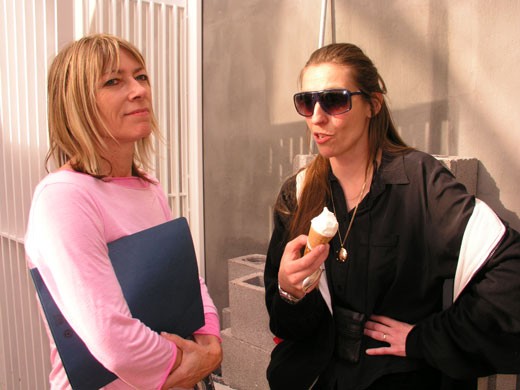
Kim Gordon and Jutta Koether will bid farewell to Mike Kelley exhibit with special performance at MoMA PS1
The sprawling exhibition contains sculptures, videos, recordings, writings, drawings, and more, offering many different types of rewards. It all begins in the courtyard VW Dome, where Kelley’s nearly-three-hour epic, Day Is Done, screens continuously, a subversive spectacle that sets the tone for the rest of the show, highlighting Kelley’s obsessions with childhood imagery and pop culture, his unique spirituality, his repurposing of found objects, and the low-budget, DIY nature of his work, which can often have an amateurish feel that turns off viewers. Inside the former school, there is art everywhere, from the hallways to the boiler room, displaying Kelley’s vast range. His Kandor series consists of numerous multicolored, glowing versions of the Krypton city from the Superman comics, each one existing in a glass bottle hooked up to a kind-of life-support system, with accompanying video. “Pay for Your Pleasure” is a narrow corridor with banners on either side containing portraits of writers and philosophers, along with a quote from each one about art, crime, law, and civilization; at the end is an artwork by a local murderer.
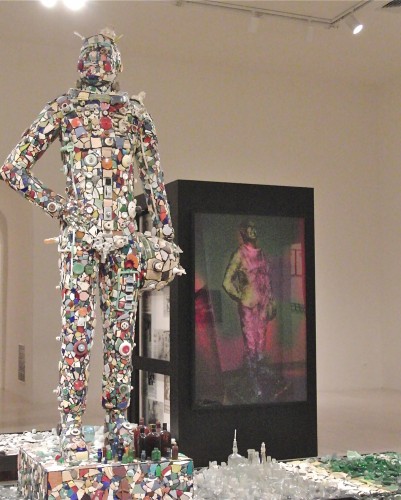
Mike Kelley, “John Glenn Memorial Detroit River Reclamation Project (Including the Local Culture Pictorial Guide, 1968-1972, Wayne/Westland Eagle),” mixed media, 2001 (photo by twi-ny/mdr)
One large gallery space is dedicated to several of Kelley’s “Extracurricular Activity Projective Reconstruction” installations, in which he starts with a photograph from a high school yearbook and turns it into a short film, screened on a set with architectural elements echoing what is happening in the imagined story. (“Extracurricular Activity Projective Reconstruction #1 [A Domestic Scene]” is also being shown at MoMA in Midtown.) “John Glenn Memorial Detroit River Reclamation Project” is centered by a tall mosaic statue of astronaut John Glenn made out of broken glass, pottery, plates, ceramic figures, and other detritus, delving into another regular subject of Kelley’s, repressed memory syndrome. In “Deodorized Central Mass with Satellites,” colorful stuffed animals have been formed into orbs that hang from the ceiling like a planetary system as futuristic wall pieces shoot out disinfectant. Two small crawlspaces allow non-claustrophobics to wind their way to a peephole where they can see the famous locker-room peeping scene from Porky’s. And “Horizontal Tracking Shot of a Cross Section of Trauma Rooms” consists of videos of traumatic scenes taken from the internet, then shown on monitors attached to the back of a wall of fence posts of different colors and sizes. Not everything will work for everyone, but there’s bound to be at least a handful that any person would at least find fascinating and intriguing, thought-provoking and challenging. In response to our friend’s Facebook request, we proffered, “The Michigan-born multimedia artist created fantastical worlds using found objects that reexamined mass culture through DIY installations that can be playful and nonsensical as well as cutting and poignant.” At the end of the thread, she readily admitted that having seen the show, she has a greater appreciation for his work. And sometimes, that’s all one can ask for.

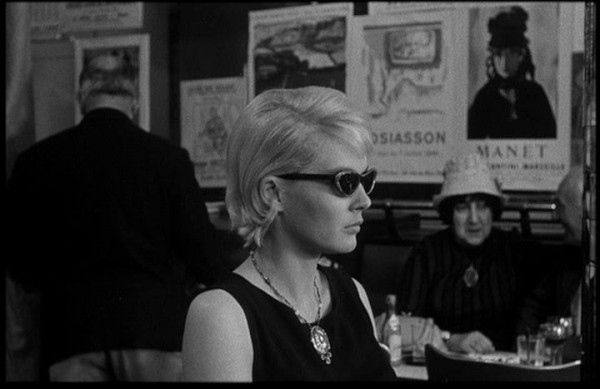
 After getting a biopsy taken and drawing the death card while consulting a fortune-teller, popular French singer Cléo (Corinne Marchand) begins looking back at her life — and wondering just what’s left of it — while awaiting the dreaded results. The blonde beauty talks with old friends, asks her piano player (Michel Legrand, who composed the score) to write her a song, and meets a dapper gentleman in the park, becoming both participant and viewer in her own existence. As Cléo makes her way around town, director (and former photographer) Agnès Varda (Le Bonheur, Vagabond) shows off early 1960s Paris, expertly winding her camera through the Rive Gauche. Just as Cléo seeks to find out what’s real (her actual name is Florence and that gorgeous hair is a wig), Varda shoots the film in a cinema verité style, almost as if it’s a documentary. She even sets the film in real time (adding chapter titles with a clock update), enhancing the audience’s connection with Cléo as she awaits her fate, but the movie runs only ninety minutes, adding mystery to what is to become of Cléo, as if she exists both on-screen and off, alongside the viewer. A central film in the French Nouvelle Vague and one of the first to be made by a woman, Cléo de 5 à 7 is an influential classic even as it has lost a step or two over the years. A new digital restoration of Cléo de 5 à 7 is screening January 28 at 4:00 & 7:30 as part of the FIAF CinéSalon series “Remastered & Restored: Treasures of French Cinema”; the later screening will be introduced by French author Catherine Cusset. The three-month festival continues with such other recently restored French classics as Jean Renoir’s Boudu Saved from Drowning (introduced by Henry Bean), Jacques Demy’s Une chambre en ville (introduced by Adam Gopnik), and Max Ophüls’s Lola Montès (introduced by Lola Montes Schnabel).
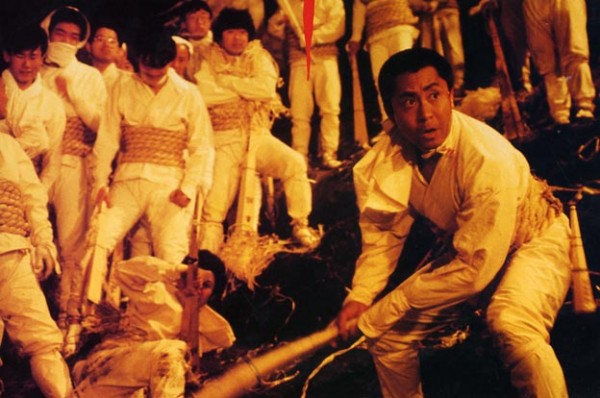
 There’s something always lurking just beneath the surface of Mitsuo Yanagimachi’s 1985 drama, Himatsuri, and when it finally arrives, it’s shocking and explosive. In the small coastal village of Nigishima, the fishermen are at odds with the lumberjacks. Someone is dumping oil in the water, killing the fish, and the chief suspect is Tatsuo (Kinya Kitaoji), a strong woodsman who chops down trees, raises dogs to hunt down wild boars, shoots monkeys, cheats on his wife with a former girlfriend turned hussy (Kiwako Taichi), and is the only villager who refuses to sell his property to a company intent on building a marine park there. He both cavorts with and defies nature and the local spiritual beliefs, at one point swimming naked in the waters leading to a sanctuary. “Only I can make the goddess feel like a woman,” he proclaims. Carefully watching and worshiping Tatsuo is young Ryota (Ryota Nakamoto), who also oversteps boundaries, using sacred branches in animal traps, and is forced to expose himself to the goddess in retribution. Soon a storm comes, transforming Tatsuo and leading to a horrific conclusion. Set in the area where the Japanese creation myth takes place, Himatsuri is a strange creature indeed, with confusing plot twists, bizarre transitions, and some very weird scenes, with a creepy score by Tōru Takemitsu and lush photography by Tamura Masaki. Yanagimachi’s tale, written by Kenji Nakagami, is no mere clarion call to save the environment; instead, it’s an examination of man’s inhumanity to nature, the disregard for the trees, the oceans, the animals (while also commenting on religion, homosexuality, and contemporary society). Yanagimachi (God Speed You! Black Emperor; Ai ni tsuite, Tokyo) mixes genres, from horror to thriller to romance to musical, as he tells the story of one man who just can’t stop himself.