this week in lectures, signings, panel discussions, workshops, and Q&As

FOR YOUR CONSIDERATION — DOCUMENTARY OSCAR HOPEFULS: THE SQUARE

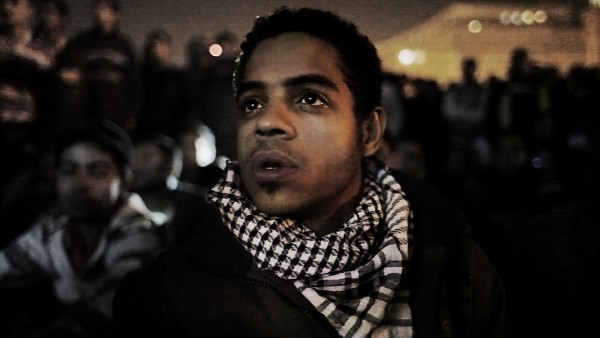
Ahmed THE SQUARE

Ahmed Hassan fights for a better future for Egypt in THE SQUARE

THE SQUARE (AL MIDAN) (Jehane Noujaim, 2013)
Film Society of Lincoln Center
Elinor Bunin Munroe Film Center, Howard Gilman Theater
Sunday, December 22, 4:00, and Monday, December 23, 8:15
Series runs December 20-26
212-875-5601
www.thesquarefilm.com
www.filmlinc.com

“During the early days, we agreed to stay united no matter what,” Ahmed Hassan tells those around him in Jehane Noujaim’s powerful and important documentary The Square. “When we were united, we brought down the dictator. How do we succeed now? We succeed by uniting once again.” But Ahmed, one of several Egyptian revolutionaries who Noujaim follows for two years in the film, finds that it is not that easy to bring everyone together, as the government leaders continue to change and factions develop that favor the military and the Muslim Brotherhood. Putting her own life in danger, Noujaim (The Control Room, Startup.com) is right in the middle of it all as she shares the stories of Ahmed, a young man who is determined to see the revolution through until peace and justice prevail; Magdy Ashour, a member of the Muslim Brotherhood who must choose between his own personal beliefs and that of his power-hungry organization; and Khalid Abdalla, the British-Egyptian star of The Kite Runner and United 93 who becomes an activist like his father, serving as the revolution’s main link to the international community through the media and by posting videos. In The Square, a 2013 New York Film Festival selection, Noujaim also introduces viewers to human rights lawyer Ragia Omran, protest singer Ramy Essam, and filmmaker Aida El Kashef, none of whom is willing to give in even as the violence increases.
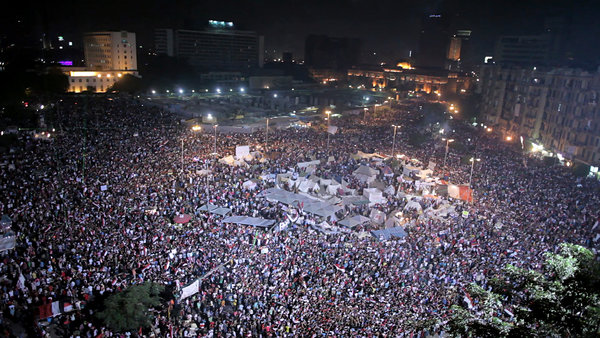
Massive crowds of  Egyptians occupy Tahrir Square to demand freedom and democracy in THE SQUARE

Documentary offers an inside look at the occupation of Tahrir Square by Egyptians demanding freedom and democracy

In the documentary, Noujaim includes footage of televised political speeches and interviews that contradict what is actually happening in Tahrir Square as elections near. Reminiscent of Stefano Savona’s Tahrir: Liberation Square, which played at the 2011 New York Film Festival, The Square makes the audience feel like it’s in Tahrir Square, rooting for the revolutionaries to gain the freedom and democracy they so covet. The film also features several stunning shots of the massive crowds, most memorably as thousands of men kneel down in unison to pray to Mecca. Among its many strengths, The Square personalizes the revolution in such a way as to reveal that a small group of people can indeed make a difference, although sometimes they just have to keep on fighting and fighting and fighting. The Square is screening December 22 at 4:00 and December 23 at 8:15, both followed by Q&As with Noujaim, as part the Film Society of Lincoln Center series “For Your Consideration: Documentary Oscar Hopefuls,” which runs December 20-26 and consists of all fifteen nonfiction features that have made the Academy Awards short-list, including Cutie and the Boxer, Dirty Wars, Stories We Tell, Blackfish, and 20 Feet from Stardom. The festival will be followed December 27 – January 2 by “For Your Consideration: Foreign Oscar Hopefuls,” comprising such international fare as Wong Kar-wai’s The Grandmaster, Thomas Vinterberg’s The Hunt, Kleber Mendonça Filho’s Neighboring Sounds, and Haifaa Al Mansour’s Wadjda.

FOR YOUR CONSIDERATION — DOCUMENTARY OSCAR HOPEFULS: CUTIE AND THE BOXER

CUTIE AND THE BOXER

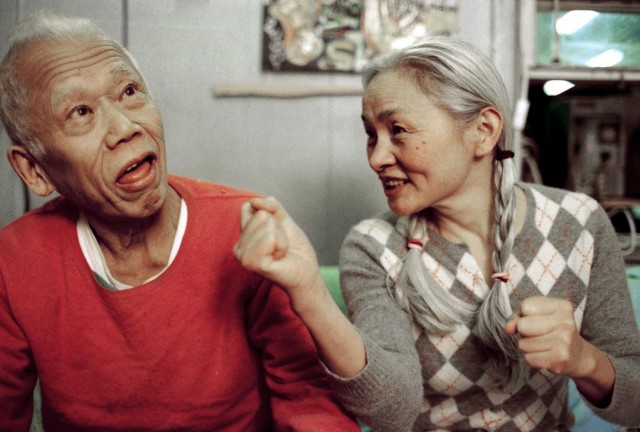
Documentary tells the engaging story of a pair of Japanese artists and the life they have made for themselves in Brooklyn

CUTIE AND THE BOXER (Zachary Heinzerling, 2013)
Film Society of Lincoln Center
Elinor Bunin Munroe Film Center, Howard Gilman Theater
Sunday, December 22, 2:00, and Tuesday, December 24, 7:00
Series runs December 20-26
212-875-5601
www.filmlinc.com
www.facebook.com/cutieandtheboxer

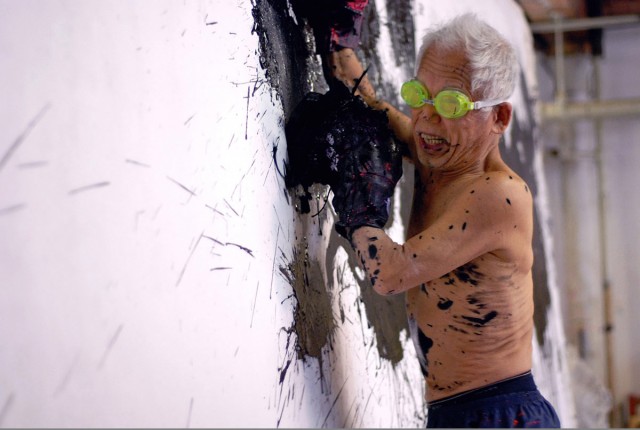
Zachary Heinzerling’s Cutie and the Boxer is a beautifully told story of love and art and the many sacrifices one must make to try to succeed in both. In 1969, controversial Japanese Neo Dada action painter and sculptor Ushio Shinohara came to New York City, looking to expand his career. According to the catalog for the recent MoMA show “Tokyo 1955-1970: A New Avant-Garde,” which featured four works by Ushio, “American art had seemed to him to be ‘marching toward the glorious prairie of the rainbow and oasis of the future, carrying all the world’s expectations of modern painting.’” Four years later, he met nineteen-year-old Noriko, who had left Japan to become an artist in New York as well. The two fell in love and have been together ever since, immersed in a fascinating relationship that Heinzerling explores over a five-year period in his splendid feature-length theatrical debut. Ushio and Noriko live in a cramped apartment and studio in DUMBO, where he puts on boxing gloves, dips them in paint, and pounds away at large, rectangular canvases and builds oversized motorcycle sculptures out of found materials. Meanwhile, Noriko, who has spent most of the last forty years taking care of her often childlike husband and staying with him through some rowdy times and battles with the bottle, is finally creating her own work, an R. Crumb-like series of drawings detailing the life of her alter ego, Cutie, and her often cruel husband, Bullie. (“Ushi” means “bull” in Japanese.) While Ushio is more forthcoming verbally in the film, mugging for the camera and speaking his mind, the pig-tailed Noriko is far more tentative, so director and cinematographer Heinzerling brings her tale to life by animating her work, her characters jumping off the page to show Cutie’s constant frustration with Bullie.

Ushio Shinohara creates one of his action paintings in CUTIE AND THE BOXER

Ushio Shinohara creates one of his action paintings in CUTIE AND THE BOXER

During the course of the too-short eighty-two-minute film — it would have been great to spend even more time with these unique and compelling figures — the audience is introduced to the couple’s forty-year-old son, who has some issues of his own; Guggenheim senior curator of Asian Art Alexandra Munroe, who stops by the studio to consider purchasing one of Ushio’s boxing paintings for the museum; and Chelsea gallery owner Ethan Cohen, who represents Ushio. But things never quite take off for Ushio, who seems to always be right on the cusp of making it. Instead, the couple struggles to pay their rent. One of the funniest, yet somehow tragic, scenes in the film involves Ushio packing up some of his sculptures — forcing them into a suitcase like clothing — and heading back to Japan to try to sell some pieces. Cutie and the Boxer is a special documentary that gets to the heart of the creative process as it applies both to art and love, focusing on two disparate people who have made a strange yet thoroughly charming life for themselves. Cutie and the Boxer is screening December 22 at 2:00, followed by a Q&A with Heinzerling, and December 24 at 7:00 as part the Film Society of Lincoln Center series “For Your Consideration: Documentary Oscar Hopefuls,” which runs December 20-26 and consists of all fifteen nonfiction features that have made the Academy Awards short-list, including Blackfish, The Act of Killing, Life According to Sam, The Crash Reel, First Cousin Once Removed, and Which Way Is the Front Line from Here? The festival will be followed December 27 – January 2 by “For Your Consideration: Foreign Oscar Hopefuls,” comprising such international fare as Wong Kar-wai’s The Grandmaster, Thomas Vinterberg’s The Hunt, Kleber Mendonça Filho’s Neighboring Sounds, and Haifaa Al Mansour’s Wadjda.

VICE PRESENTS THE FILM FOUNDATION SCREENING SERIES: THE NIGHT OF THE HUNTER

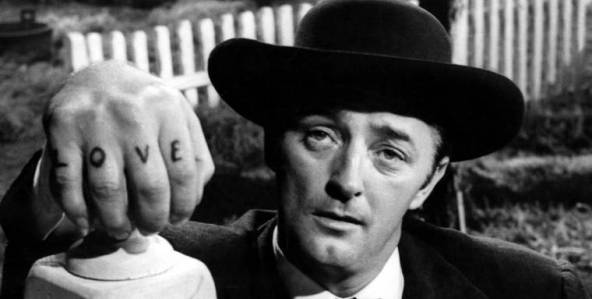
Robert Mitchum gets caught up in some dangerous dichotomies in THE NIGHT OF THE HUNTER

ONE NITE ONLY: THE NIGHT OF THE HUNTER (Charles Laughton, 1955)
Nitehawk Cinema
136 Metropolitan Ave. between Berry St. & Wythe Ave.
Tuesday, December 17, $16, 9:30
718-384-3980
www.nitehawkcinema.com

Robert Mitchum stars in Charles Laughton’s lurid story of traveling preacher/con man/murderer Harry Powell, who has the word “love” tattooed on one set of knuckles and “hate” on the other. While in prison, Powell bunks with Ben Harper (Peter Graves), who got caught stealing $10,000 — but the only person who knows where the money is is Ben’s young son, John (Billy Chapin). When Preacher is released from jail, he shows up on the Harpers’ doorstep, ready to woo the widow Willa (Shelley Winters) — and get his hands on the money any way he can, including torturing John and his sister, Ruby (Gloria Castillo). Laughton’s only directorial effort is seriously flawed — the scenes in the beginning and end with Lillian Gish are wholly unnecessary and detract from the overall mood. Stanley Cortez’s cinematography is outstanding, featuring his unique use of shadows, the battle between light and dark (which plays off of several themes: old versus young, rich versus poor, good versus evil, and men versus women), and some marvelous silhouettes. Based on Davis Grubb’s 1953 novel, the film has made its way onto many best-of lists, from scariest and most thrilling to all-time great and most beautiful. The Night of the Hunter is screening December 17 at 9:30 as part of Nitehawk Cinema’s “One Nite Only” and “VICE Presents: The Film Foundation Screening Series” and will be introduced by fashion photographer and documentary filmmaker Bruce Weber. The screening will be followed by an after-party in the downstairs bar with complimentary Larceny Bourbon drinks. The VICE series continues on January 28 with Barbara Loden’s Wanda and February 25 with Shirley Clarke’s The Connection.

BUST MAGAZINE CRAFTACULAR AND FOOD FAIR / DEGENERATE CRAFT FAIR

BUST magazine

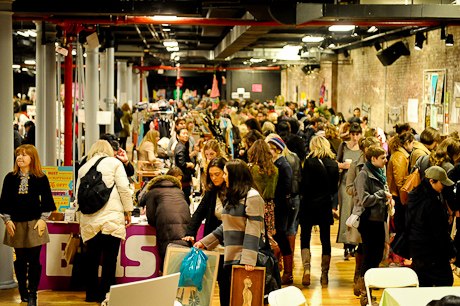
BUST magazine busts into the Metropolitan Pavilion for Craftacular Fair this weekend

It’s two weeks before Christmas, and the holiday market season is kicking into high gear. There are more markets than ever, from Grand Central Terminal, Union Square Park, and Columbus Circle to Bryant Park, the LIC Flea, and Astoria Market. A pair of unique indoor markets pull into town this weekend, open only Saturday and Sunday. The eighth annual Bust Magazine Holiday Craftacular & Food Fair will take place at the Metropolitan Pavilion on December 14-15, featuring nearly two hundred and fifty vendors in addition to workshops and tutorials (led by S.W. Basics, Textile Arts Center, paper artist Julie Schneider, wedding designer Michelle Edgemont, and others), adoptable pets, and music by DJs Ali Gruber and a Good LHOOQ. Admission is three bucks, and the first three hundred attendees each day will receive a special tote bag filled with cool stuff. Among the vendors are Natural Adornment, Belindabilly, Vintage Robot, Eavesmade, Queen Bee Fibers, and wantnot, along with such eateries as i heart keenwah, Two Boots Pizza, FattyCakes NY, MitchMallows, Better Off Spread, and Vegan Wain Bakery. Things are a whole lot more DIY at the fifth annual Degenerate Craft Fair, being held in the DCTV Firehouse on Lafayette St. More than fifty vendors will be selling items mostly under fifty dollars, including 100cameras, Au Retour, Broderpress, Carrier Pigeon, Cigar Box Guitars, Hi Rise Hive, Instant Rabbit, nico icon, and Three-armed Squid. There will be an opening reception December 14 from 6:00 to 8:00 with music and free beer, while the first fifty guests on December 15 (the fair opens at 11:00 am) get a free tote of stuff.

THE LIFE AND DEATH OF MARINA ABRAMOVIC

Willem Dafoe

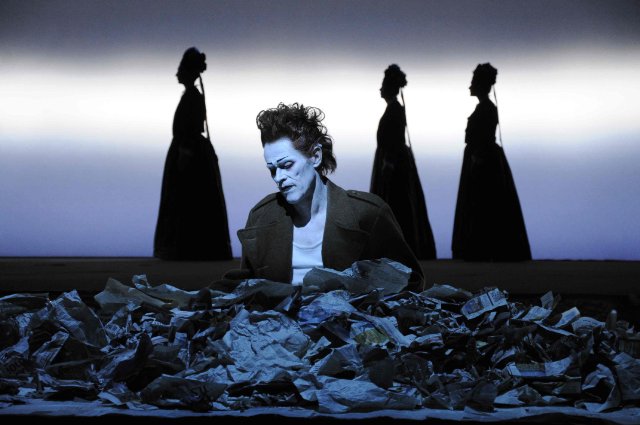
Marina Abramović’s life — and death — takes center stage with the help of Willem Dafoe, Antony, Robert Wilson, and others

Park Avenue Armory, Wade Thompson Drill Hall
643 Park Ave. at 67th St.
December 13-21, $135, 7:30
212-933-5812
www.armoryonpark.org

Performance artist extraordinaire Marina Abramović has been undergoing a career renaissance this century, highlighted by an exciting, vibrant 2010 MoMA retrospective, “The Artist Is Present,” and the 2012 documentary about the making of the exhibition. The Serbian-born, New York-based Abramović is a regular at fancy galas, and she even recently performed at Pace Gallery with Jay-Z. So what does the sixty-seven-year-old artist do, just as her life and career have become rejuvenated? Well, she stages her own funeral, of course. Actually, Abramović has decided to hand her biography over to experimental theater maestro Robert Wilson, the man behind such innovative and unique collaborations as The Black Rider with William S. Burroughs and Tom Waits, Einstein on the Beach with Philip Glass and Lucinda Childs, and The Temptation of Saint Anthony with Bernice Johnson Reagon and Geoffrey Holder. In The Life and Death of Marina Abramović, the woman behind the “Rhythm” series and so many other cutting-edge works plays herself and her mother, with Willem Dafoe serving as narrator and songs by Antony Hegarty. Conceived and directed by Wilson, it is another audiovisual spectacle that has already had a documentary made about its creation; “Marina is the landscape, Bob the mind, Antony the heart, Willem the body,” director Giada Colagrande explains. The Life and Death of Marina Abramović will fill the Park Ave. Armory’s Wade Thompson Drill Hall December 12-21; on December 15 at 6:15, armory artistic director Alex Poots will moderate an artist talk with Abramović and Dafoe in the Veterans Room as part of the Malkin Lecture Series.

RICHIE’S FANTASTIC FIVE — KUROSAWA, MIZOGUCHI, OZU, YANAGIMACHI & KORE-EDA: LATE AUTUMN

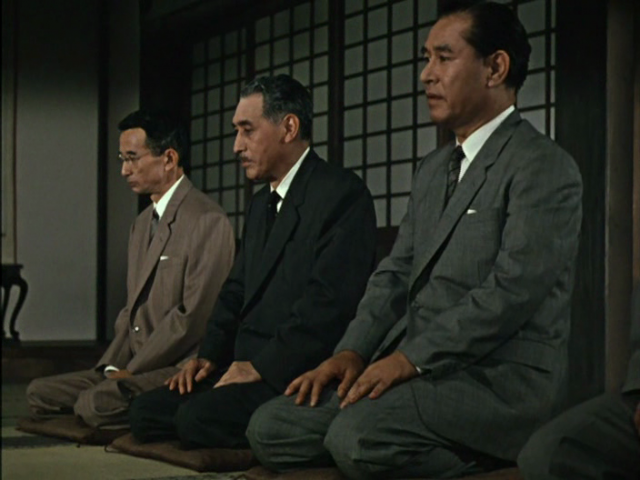
A trio of yentas in LATE AUTUMN

Nobuo Nakamura, Ryuji Kita, and Shin Saburi play a trio of matchmaking yentas in Ozu’s LATE AUTUMN

LATE AUTUMN (AKIBIYORI) (Yasujirō Ozu, 1960)
Japan Society
333 East 47th St. at First Ave.
Thursday, December 12, $12, 7:00
Series runs monthly through February
212-715-1258
www.japansociety.org

Yasujirō Ozu revisits one of his greatest triumphs, 1949’s Late Spring, in the 1960 drama Late Autumn, the Japanese auteur’s fourth color film and his third-to-last work. Whereas the black-and-white Late Spring is about a widowed father (Chishu Ryu) and his unmarried adult daughter (Setsuko Hara) contemplating their futures, Late Autumn deals with young widow Akiko Miwa (Hara again) and her daughter, Ayako (Yoku Tsukasa). At a ceremony honoring the seventh anniversary of Mr. Miwa’s death, several of his old friends gather together and are soon plotting to marry off both the younger Akiko, whom they all had crushes on, and twenty-four-year-old Ayako. The three businessmen — Soichi Mamiya (Shin Saburi), Shuzo Taguchi (Nobuo Nakamura), and Seiichiro Hirayama (Ryuji Kita) — serve as a kind of comedic Greek chorus, matchmaking and arguing like a trio of yentas, while Akiko and Ayako maintain creepy smiles as the men lay out their misguided, unwelcome plans. Mamiya makes numerous attempts to fix Ayako up with one of his employees, Shotaru Goto (Keiji Sada), but Ayako wants none of it, preferring the freedom and independence displayed by her best friend, Yoko (Yuriko Tashiro), who represents the new generation in Japan. At the same time, their matchmaking for Akiko borders on the slapstick. Based on a story by Ton Satomi, Late Autumn, written by Ozu with longtime collaborator Kôgo Noda, is a relatively lighthearted film from the master, with sly jokes and playful references while examining a Japan that is in the midst of significant societal change in the postwar era. Kojun Saitô’s Hollywood-esque score is often bombastically melodramatic, but Yuuharu Atsuta’s cinematography keeps things well grounded with Ozu’s trademark low-angle, unmoving shots amid carefully designed interior sets.

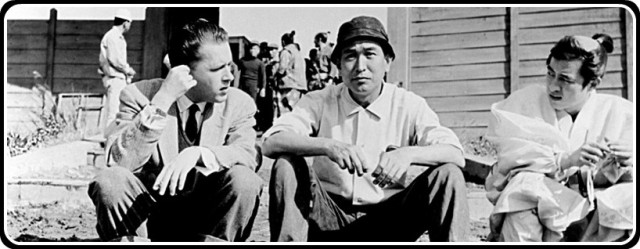
Japan Society series honors Donald Richie (l.) with screening of film by Yasujiro Ozu (c.)

Japan Society series honors Donald Richie (l.) with screening of film by Yasujiro Ozu (c.)

Late Autumn is downright fun to watch, and you can see it on December 12 — Ozu’s 110th birthday, as well as the 50th anniversary of his death — at 7:00 at Japan Society, introduced by director, writer, and producer Atsushi Funahashi, as part of the monthly tribute series “Richie’s Fantastic Five: Kurosawa, Mizoguchi, Ozu, Yanagimachi & Kore-eda,” which honors Ohio-born writer, critic, scholar, curator, and filmmaker Donald Richie, who died in February at the age of eighty-eight. Richie was a tireless champion of Japanese culture and, particularly, cinema, and the series features six works by five of his favorite directors. Here’s what Richie said about Late Autumn: “A daughter is reluctant to leave her widowed mother, even though it is time for her to marry. The story could be seen as a ‘remake’ of Late Spring — and though more autumnal, it is just as moving.” The Late Autumn screening will also be followed by a special Ozu birthday reception. The series continues in January with Mitsuo Yanagimachi’s Himatsuri and concludes in February with Hirokazu Kore-eda’s After Life, appropriately on the one-year anniversary of Richie’s passing.

THE FEST FOR BEATLES FANS 2014

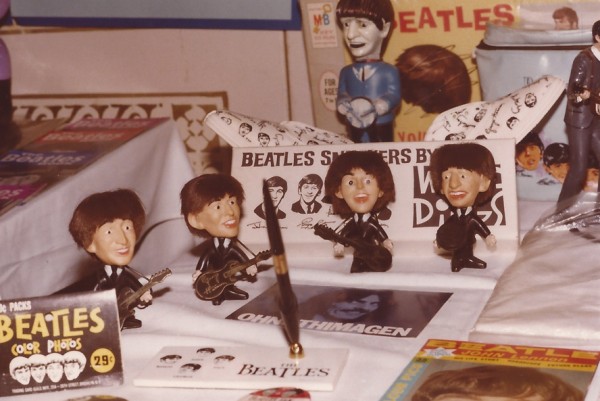
Lots of Fab Four memorabilia will be on sale and on view at the fortieth anniversary of the Fest for Beatles Fans

Lots of Fab Four memorabilia will be on sale and on view at fortieth anniversary of the Fest for Beatles Fans

Grand Hyatt
109 East 42nd St. at Lexington Ave.
February 7-9, adults $55 – $195 (through January 17)
www.thefest.com

When we were mere lads, we got our post-breakup, pre-iTunes Beatles fix by checking out Beatlemania on Broadway, seeing Paul McCartney and Wings at Madison Square Garden, and going to a Beatles Fest convention on Long Island, where we finally got to watch Magical Mystery Tour and went home with all kinds of little trinkets; we still have that Shea Stadium Beatles coin that nearly bankrupted us at six bucks. The elephant in the room back then was the constant speculation of a possible Beatles reunion, with all four Moptops still alive and well. But that all came to a startling end thirty-three years ago today, when John Lennon was assassinated at the age of forty. George Harrison’s death at the age of fifty-eight on November 29, 2001, closed another chapter in the continuing Fab Four saga. Paul and Ringo are still around, touring, making records, and playing new and old songs, but it will never be the same. Even Shea Stadium, where the Beatles played on August 15, 1965, is gone.

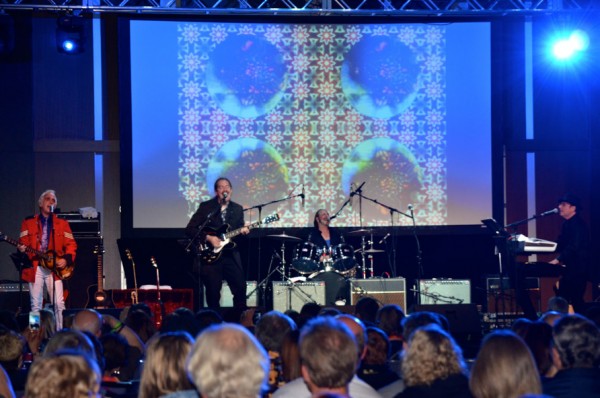
Longtime Beatles cover band Liverpool will be at NYC fest honoring fiftieth anniversary of Beatels' arrival in America

Longtime Beatles cover band Liverpool will be at NYC fest honoring fiftieth anniversary of Beatles’ arrival in America

But the memories will come flooding back February 7-9 when the Fest for Beatles Fans, which began in 1974, takes place at the Grand Hyatt, held in honor of the fiftieth anniversary of the Beatles’ arrival at JFK airport on February 7, 1964, and one of the most famous television appearances of all time, when the Fab Four played on The Ed Sullivan Show. (The Fest will also be in Chicago August 15-17, then move on to Los Angeles October 10-12, cities that actually got two shows back in 1965.) The three-day Manhattan party will feature dozens of special guests giving talks, signing memorabilia, presenting videos and art exhibitions, participating in panel discussions, and playing live sets. Among those confirmed are Peter & Gordon’s Peter Asher; photographers Bob Gruen, Allen Tannenbaum, and Rob Shanahan; “Breakfast with the Beatles” DJ Ken Dashow; Beatles scholar Martin Lewis, who will serve as MC; newscaster Larry Kane; producer Mark Hudson; animator Ron Campbell; and lots of authors, historians, and cover bands. Performers include Chad & Jeremy, Billy J. Kramer, the Smithereens (re-creating the Beatles’ February 11, 1964, concert at the Washington Coliseum), and Donovan, who will also give a meditation lecture. There will be a Beatles marketplace, screenings of the documentary Good Ol’ Freda (with Freda Kelly), an auction, a dance party, costume and trivia contests, a parade, a walking tour, a tribute to the late Sid Bernstein, and much more. Ticket prices through January 17 range from $55 for Friday night to $79 for Saturday or Sunday to $195 for an all-access three-day pass; children six to sixteen are half price and those five and under free.