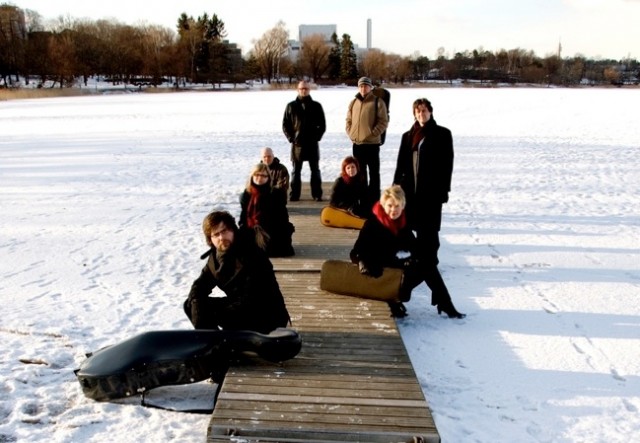
Finnish new music ensemble Uusinta will be performing at the MATA Festival
The Kitchen and other locations
512 West 19th St. between Tenth & Eleventh Aves.
April 14-21, workshops and talks free with advance RSVP, concerts $20
www.matafestival.org
www.thekitchen.org
Tired of the same old, same old? Try something rather different at the annual spring MATA Festival. A nonprofit organization founded in 1996 by Philip Glass, Eleonor Sandresky, and Lisa Bielawa, MATA showcases the work of composers and musicians under the age of forty. This year’s fest runs April 14-21 at the Kitchen and other venues, with free workshops and panel discussions (with advance RSVP) and concerts a mere twenty bucks. The lineup features thirty-four composers from seventeen countries, beginning with a sweet sixteen gala on April 14 at Paula Cooper Gallery with live performances by ICE and Matt Evans, a sound installation by Christopher Marianetti, and more. On April 16, Yotam Haber, Melissa Smey, Chris McIntyre, Amelia Lukas, and Mark Peskanov will discuss “On the Art of Curation” at BMI at 7 World Trade Center at 2:00, and the Kitchen will host “Between Noise and Silence,” with Helsinki music ensemble Uusinta playing works by Aaron Helgeson, Alexander Khubeev, Joan Arnau Pàmies, Hikari Kiyama, Ilari Kaila, and Sampo Haapamäki. On April 17 at 3:30, the workshop “The Business of Being a Composer Part 1” will bring together Cia Toscanini, Scott Winship, Paola Prestini, Steven Swartz, Richard Carrick, and Sarah Kirkland Snider at ASCAP at 1 Lincoln Plaza; at the Kitchen at 8:00, “That Which Remains” consists of Rubens Askenar García Hernández’s El Puerperio, André Damião Bandeira’s em_bruto, Natacha Diels’s A Is for Alphabet, a new work by Alex Weiser, and a new MATA commission by Carolyn Chen, performed by such musicians as pianist Vicky Chow, percussionist Matt Evans, and violinist Marina Kiff.
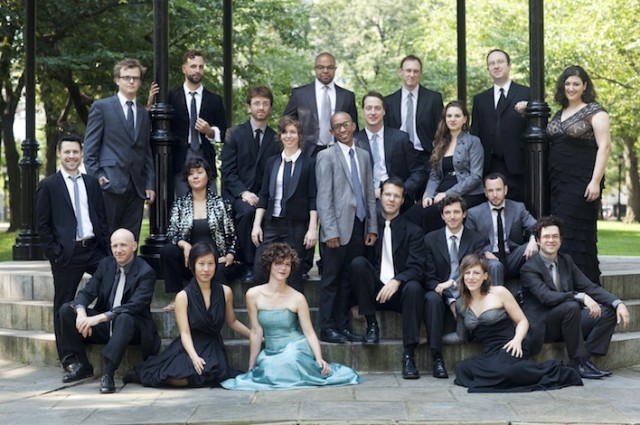
The International Contemporary Ensemble (ICE) will present U.S. premiere of Oscar Bianchi’s MATRA with Neue Vocalsolisten
On April 18 at 11:00 am, Uusinta is back for an Afternoon Reading Session at BMI; that night, Talea Ensemble and Ekmeles team up on pieces by Šimon Vosecek, Edward Hamel, Clara Ianotta, Todd Tarantino, Martin Iddon, and Josep Sanz for the program “Lives in Miniature.” On April 19 at 8:00 at the Kitchen, Germany’s Neue Vocalsolisten and ICE will present the U.S. premiere of Oscar Bianchi’s Matra, with tubax, contrabass recorder, and bass flute, followed by a Q&A. On Easter Sunday at 1:00 at the Kitchen, the a cappella Neue Vocalsolisten will highlight works by American composers Georges Aperghis, Silvia Rosani, Brahim Kerkour, Zaid Jabri, Francesco Filidei, Gabriel Dharmoo, Lars Petter Hagen, and Jennifer Walshe. The festival concludes on April 21 with the workshop “The Business of Being a Composer Part 2” at BMI at 11:00 am with Ralph N. Jackson, Deirdre Chadwick, Bill Holab, Katie Baron, and Michael Geller; a pair of snare drummers will play David Bird’s Fields on the High Line between Nineteenth & Twentieth Sts. at 1:30 (free, no RSVP necessary); and MIVOS Quartet and Mantra Percussion combine for “Of Circles and Motions of the Others” at the Kitchen at 8:00, performing Lisa Streich’s Playtime, Daniel Wohl’s Progression, Yotam Haber’s Torus, Ansgar Beste’s Pelerinage Fantastique, Paula Matthusen’s The Days Are Nouns, and Ke Xu’s Tai Chi.
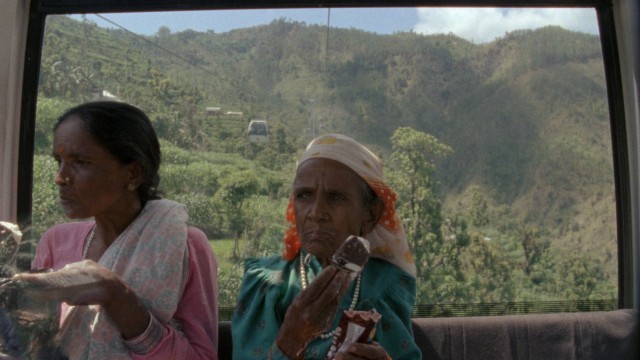
 If you’re an adventurous filmgoer who likes to be challenged and surprised, the less you know about Pacho Velez and Stephanie Spray’s Manakamana, the better. But if you want to know more, here goes: Evoking such experimental films as Michael Snow’s Wavelength, Hollis Frampton’s Zorns Lemma, and Andy Warhol’s Screen Tests as well as the more narrative works of such unique auteurs as Jim Jarmusch and Abbas Kiarostami, Manakamana is a beautiful, meditative journey that is sure to try your patience at first. The two-hour film, which requires a substantial investment on the part of the audience, takes place in a five-foot-by-five-foot cable car in Nepal that shuttles men, women, and children to and from the historic Manakamana temple, on a pilgrimage to worship a wish-fulfilling Hindu goddess. With Velez operating the stationary Aaton 7 LTR camera — the same one used by Robert Gardner for his 1986 documentary Forest of Bliss — and Spray recording the sound, the film follows a series of individuals and small groups as they either go to or return from the temple, traveling high over the lush green landscape that used to have to be traversed on foot before the cable car was built. A man and his son barely acknowledge each other; a woman carries a basket of flowers on her lap; an elderly mother and her middle-age daughter try to eat melting ice-cream bars; a pair of musicians play their instruments to pass the time.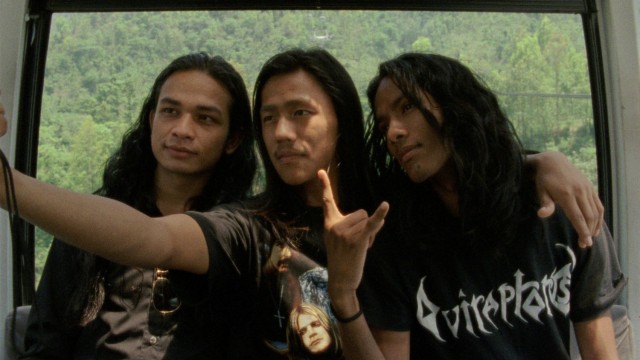



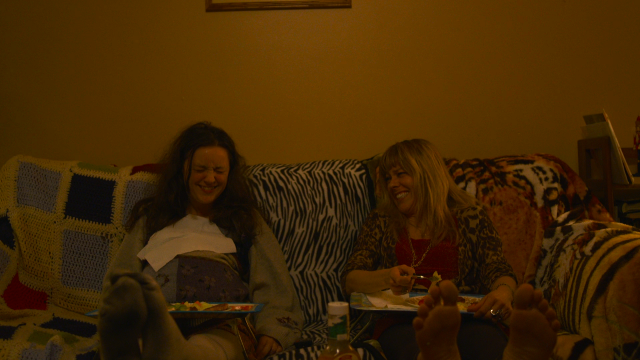
 As writer-director Drew Tobia’s debut feature, See You Next Tuesday, opens, Mona (Eleanore Pienta) is standing still, staring straight ahead, mouth slightly agape, the camera pulling back ever so slowly as Brian McOmber’s sweetly European-sounding score plays, revealing that she is in a supermarket, out-of-focus shoppers passing by behind her. The scene beautifully sets the stage for what is to follow, an uncomfortable yet charming black comedy about a pregnant young woman who seems to exist in a different world from everyone else. A cashier at a Brooklyn Key Food, Mona is about to give birth, but she refuses to see a doctor or take care of herself in any way. She lives alone in a miserable apartment that doesn’t have its own bathroom or telephone. When she’s desperate, she goes to her loser mother, May (Dana Eskelson), an unpleasant alcoholic who lacks a maternal instinct; she wants to be Mona’s friend instead of parent. Mona also seeks out her sister, Jordan (Molly Plunk), who is estranged from their mother and is living with her older girlfriend, Sylve (Keisha Zollar). Mona, May, and Jordan are not exactly the brightest bulbs on the planet; they take family dysfunction to a whole new level. But at the center of it all is Mona, a young woman with something significantly off about her, unable to understand her very serious situation, acting out like a child when she doesn’t get what she wants, passing judgment on others without a filter, drinking and smoking even though her baby could come at any minute. But through all the nastiness, all the bitterness, all the cringe-worthy moments — and there are plenty — Tobia (Leperfuck, Ladyfemmes) still manages to make us care about this crazy family, even though we would never want to meet any of these women in real life. Pienta is dazzling as the overemotional, unpredictable Mona, immersing herself deeply into this mentally unstable character who has no boundaries (and whom Mona created for her own video and photograph series).