PEN WORLD VOICES FESTIVAL OF INTERNATIONAL LITERATURE
Multiple locations
April 28 – May 4, free – $20
www.worldvoices.pen.org
“I want to stand as close to the edge as I can without going over. Out on the edge you see all the kinds of things you can’t see from the center,” Kurt Vonnegut wrote in his debut novel, 1952’s Player Piano. That sentiment is the theme for the tenth annual Pen World Voices Festival of International Literature, a week of lectures, workshops, readings, debates, conversations, performances, and more celebrating writers who are not afraid to go out on the edge and take risks, both personal and political. Sponsored by the PEN America Center, which supports freedom of expression throughout the world, the festival will feature more than 150 writers from 30 nations participating in nearly five dozen events. “Many of the finest writers in the world, the ones whose voices speak most eloquently to us, are also, all too often, the most exposed and vulnerable, because they are so prominently visible,” festival chairman and founder Salman Rushdie said in a statement. “Yet these are the voices we must listen to, the voices that show us how the world joins up.” Among those taking part in the festival are Colm Tóibín, Noam Chomsky, Elinor Lipman, Saul Williams, A. M. Homes, Bob Holman, Judith Thurman, Shirin Neshat, Paul Muldoon, Eileen Myles, Siri Hustvedt, Martin Amis, Parker Posey, Jay McInerney, Rosario Dawson, Joseph O’Neill, Francine Prose, and Rushdie. There’s always a lot to do and see at this annual celebration of the power of the written word; below are just some of the highlights.
Monday, April 28
Opening Night: On the Edge, with Adonis, Gado, Sofi Oksanen, Colm Tóibín, Noam Chomsky, Salman Rushdie, Judith Butler, and Paul Berman delivering seven-minute orations, the Great Hall of the Cooper Union, $15-$20, 7:00
Tuesday, April 29
A Literary Safari, with Kevin Barry, Eliane Brum, Christopher Farley, Justin Go, Frédéric Gros, Joanne Hillhouse, Barbara Jenkins, Sharon Leach, Geert Mak, Vanessa Manko, Andrés Neuman, Jaap Scholten, Gabrielle Selz, Francesc Serés, Sue Shapiro, Kenan Trebincevic, Igor Stiks, Bae Suah, Elinor Lipman, and Deji Olukotun, taking place in rooms throughout the Westbeth Center for the Arts, $15-$20, 6:30
Obsession: Eileen Myles on Spoilage and Ruination of Other Kinds, with Eileen Myles, hosted by Mike Albo, Chez André at the Standard, $15-$20, 9:00
Wednesday, April 30
The FBI Was Never the Same: 1971 Screening and Discussion, with Johanna Hamilton, Bonnie Raines, John Raines, Larry Siems, and Betty Medsger, NYU Cantor Film Center, $15-$20, 7:00
Literary Death Match, with Kevin Barry, Alona Kimhi, Bae Suah, Parker Posey, Michael Ian Black, and Jay McInerney, Ace Hotel, $15-$20, 7:00
Thursday, May 1
The Nuyorican Poets Café, with Saul Williams, Rome Neal, Jive Poetic, Rosario Dawson, Gado, Natasha Trethewey, participants from Mark Nowak’s workshops with Domestic Workers United and Alliance for Taxi Drivers, Nuyorican Poets Café, $10-$20, 6:00
Obsession: Jennifer Boylan on Lost Loves, with Jennifer Boylan, hosted by Mike Albo, Chez André at the Standard, $15-$20, 9:00
Friday, May 2
The Literary Mews, with Clayton Eshleman, Deji Olukotun, Ed Pavlić, Yacouba Sissoko, Dan Neely, Tine Kindermann, Albert Behar, Paula Deitz, Mark Jarman, RS. Gwynn, Johanna Keller, Jeff Kline, Alexa de Puivert, Eddie Mandhry, Chinelo Okparanta, Godfrey Mwampembwa, Tope Folarin, Mukoma Wa Ngugi, Tarfia Faizullah, Luis Francia, April Naoko Heck, Hieu Minh Nguyen, George Prochnik, Eric Jarosinski, Stacey Knecht, Richard Sieburth, Chuck Wachtel, Jill Schoolman, Sebastian Barry, Maxim Leo, Yascha Mounk, Atina Grossmann, Benjamin Moser, Eric Banks, and Kevin Barry, Washington Mews, NYU, free, 10:00 am – 8:00 pm
Dylan Live: A Tribute to Dylan Thomas, with Paul Muldoon, Aneirin Karadog, Martin Daws, and Daniel Williams, the Auditorium at the New School, $15-$20, 8:00
Obsession: Dan Savage on Plaques and Trophies, with Dan Savage, hosted by Mike Albo, Chez André at the Standard, $15-$20, 9:00
Saturday, May 3
Broken Dreams in Two Acts: 25 Years since the Fall of the Berlin Wall, with Timothy Garton Ash, György Konrád, Geert Mak, Adam Michnik, and Elzbieta Matynia, Frederick P. Rose Auditorium at the Cooper Union, $15-$20, 3:00
Interview Magazine: The Re-Interview with Martin Amis and Michael Stipe, the Auditorium at the New School, $15-$20, 7:30
Sunday, May 4
Sex and Violence in Children’s Books: Where the Wild Things (Really) Are, with Sarwat Chadda, Robie Harris, Susan Kuklin, Niki Walker, and Sharyn November, Frederick P. Rose Auditorium at the Cooper Union, $10-$15, 12:30
In Conversation: Timothy Garton Ash and Salman Rushdie, Anspacher Theater at the Public Theater, $12-$15, 4:00
Arthur Miller Freedom to Write Lecture: Colm Tóibín, the Great Hall at the Cooper Union, $15-$20, 6:00
 The only real problem with Speak the Music: Robert Mann and the Mysteries of Chamber Music, an engaging look at the violinist extraordinaire, is its brevity, clocking in at just under an hour. Oscar-winning documentarian Allan Miller, who has made films about Isaac Stern, Zubin Mehta, Itzhak Perlman, John Cage, Eubie Blake, and other musicians, gets up close and personal with Robert Mann, a cofounder of the Juilliard String Quartet and an enthusiastic teacher at the Manhattan School of Music. Mann, who was born in Portland, Oregon, in 1920, is shown discussing his love of fishing and how he wanted to be a forest ranger; playing at the White House and the Library of Congress; performing with his wife and son; and talking about how watching waves crash against an Oregon cliff helped him understand “the slow growth of musical intensity.” Among those singing his praises and hailing his influence are Perlman, conductor Seiji Ozawa, composer Elliott Carter, pianist Stephen Hough, and cellist Joel Krosnick. But the film really shines when Mann is seen teaching the Amphion Quartet, the Ars Nova Quartet, and others, flailing his arms about, trying to get the musicians to go deep inside themselves and the music and not to play like they’re pounding on a typewriter. Of course, the film is also filled with lots of beautiful chamber music by Beethoven, Haydn, Bartók, etc., from rare archival footage to more contemporary performances, concluding with Mann in a lovely rehearsal of the third movement of Mozart’s Quintet in G Minor, making sure every note and pause is just right, not merely mechanical but intensely emotional and heartfelt, lovingly putting bow to strings. Speak the Music opens at the Quad on May 2, with Miller participating in Q&As following the 6:30 screenings on Friday, Saturday, and Sunday.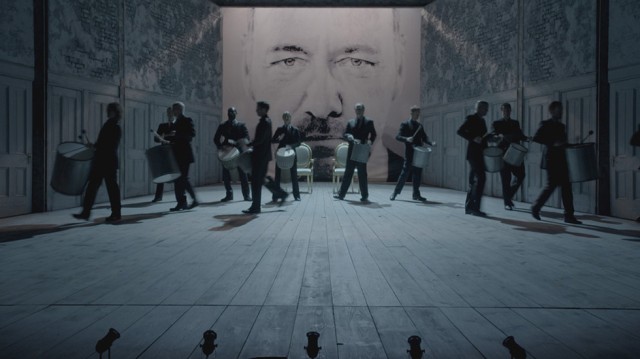
 Now: In the Wings on a World Stage, the marvelous new documentary that follows a transatlantic company as it performs Richard III around the globe, did not get its name only because it’s the first word of Shakespeare’s classic tragedy — “Now is the winter of our discontent” — nor simply because it takes place in modern times in modern dress with nods to modern technology, but also because it’s a spine-tingling celebration of the immediacy of live theater. In 2009, Sam Mendes’s Neal Street Productions, the Old Vic under the leadership of Kevin Spacey, and the Brooklyn Academy of Music, led by Joseph Melillo, formed a partnership in which British and American actors would present five classic plays over three years. Dubbed the Bridge Project, the wildly successful venture concluded in 2012 with Spacey, an American living and working in London, starring in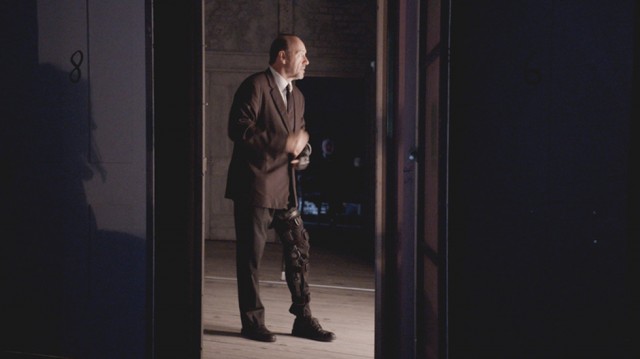
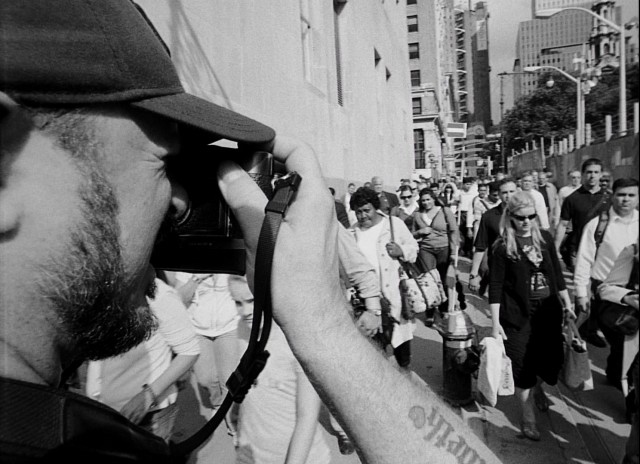
 “I need to be kind of weird to photograph people all the time without permission, because it’s very aggressive, and I have to do it,” street photographer Matt Weber says at the beginning of Dan Wechsler’s fun documentary More Than the Rainbow, adding, “And you have to be kind of a psycho.” Wechsler — a filmmaker and rare bookseller who, with George Koppelman, has just claimed to have discovered William Shakespeare’s annotated dictionary — follows Weber around New York, primarily in the subways and Coney Island, as the former taxi driver tries to capture the spirit of the city on film, looking for unique shots that can come and go in a flash. Wechsler speaks with such other photographers as Ralph Gibson, who waxes poetic about the art form, sometimes in French; Dave Beckerman, who gave up a successful business career to shoot on the streets; Philadelphia’s Zoe Strauss, whose “10 Years” exhibition was recently at ICP; Jeff Mermelstein, a street photographer who shoots mostly in color; critic and photographer Ben Lifson, who passed away last year; Cuban-born photographer Julio Mitchel; and, most curiously, San Francisco–based fetish photographer Erik Kroll, who doesn’t care for Weber’s work. Weber, who has been photographing the city since 1978, is also shown collaborating with Todd Oldham, who is designing a book on Weber’s subway series. All of the photographers discuss the relative merits of color versus black-and-white, whether they ask people for permission before taking their pictures, and the inherent differences between analog and digital. The film often strays too far from its main subject, Weber, losing sight of itself in its effort to cover too much in a mere eighty-three minutes, but it usually gets back on track, particularly with lovely 35mm interstitial trips through the city, in color and black-and-white, set to the music of Thelonius Monk and Keith Gurland, courtesy of John Rosenberg, who edited the film and music and shot the documentary with Arlene Muller. Especially in an age when everyone thinks he or she is a photographer, snapping photos with camera phones and posting them on social media sites, More Than a Rainbow shows how it’s really done. The film opens at the Quad on May 2, with Wechsler and Weber participating in Q&As following the 8:30 screenings on Friday and Saturday.
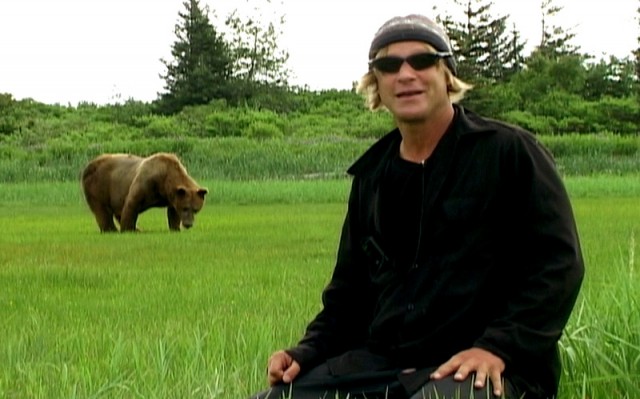
 For thirteen straight summers, Timothy Treadwell ventured into the wilds of Katmai National Park in Alaska, where he lived among grizzly bears. For the last five of those years, he brought along a video camera and detailed his life with them and his battle to protect the bears (all of which he named) from poachers. “I have no idea if there’s a God, but if there’s a God, God would be very, very pleased with me,” Treadwell says into his camera in Werner Herzog’s brilliant documentary Grizzly Man, “because he can just watch me, how much I love them, how much I adore them, how respectful I am of them, how I am one of them. . . . Be warned: I will die for these animals, I will die for these animals, I will die for these animals. Thank you so much for letting me do this. Thank you so much to these animals for giving me a life. I had no life. Now I have a life.” In October 2003, Treadwell and his girlfriend, Amie Huguenard, were brutally killed and eaten by one of the bears. Herzog, who knows a little something about filming in treacherous locations (Fitzcarraldo, Little Dieter Needs to Fly, Aguirre, the Wrath of God), made Grizzly Man from more than one hundred hours of tape, supplementing that with interviews with Treadwell’s friends and family. They all talk about a much-loved but troubled man who was desperate to be famous. His life with the bears got him onto television with Rosie O’Donnell and David Letterman, but it also got him killed, which some people think was what he deserved for crossing the line and thinking he could survive living with grizzlies. But Herzog shows him to be a thoughtful, compassionate man who just might have found his true purpose in life. (To find out more about Treadwell, check out The Grizzly Man Diaries