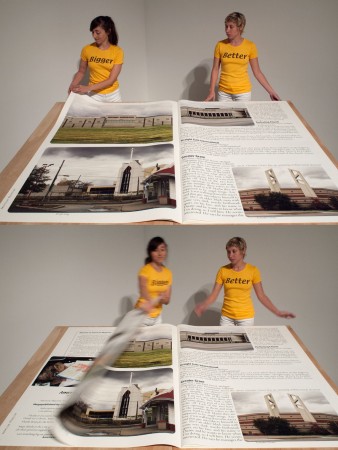
Lisa Anne Auerbach will activate her “American Megazine” on Friday nights at the Whitney Biennial (photograph © Lisa Anne Auerbach)
Whitney Museum of American Art
945 Madison Ave. at 75th St.
Through May 25, $18 (pay-what-you-wish Fridays 6:00 – 9:00)
Many programs require advance registration and/or tickets
212-570-3600
www.whitney.org
The 2014 Whitney Biennial, the last to be held in Marcel Breuer and Hamilton P. Smith’s 1960s building on the corner of Madison and Seventy-Fifth, is another mixed bag, further complicated by the curious decision to have three floors organized by three different curators, creating a more disjointed survey of the state of American art than usual. Perhaps the best time to take in this year’s model is when you get the added bonus of a special performance or program, many of which require advance RSVP or tickets. On May 7 at 7:30 ($8), the curators, Stuart Comer, Anthony Elms, and Michelle Grabner, will participate in a roundtable discussion with Jay Sanders that should shed plenty of light on their choices, but there are lots of other events as well. From April 2 to 6 in the second-floor Kaufman Astoria Studios Film and Video Gallery, Academy Records and Matt Hanner present the concurrent film loop The Bower with the three-hour audio No Jets, combining visuals of a cherry tree with audio of flight delays immediately following the events of September 11, while Gary Indiana’s Stanley Park merges images of a Cuban prison with shots of jellyfish. Zackary Drucker and Rhys Ernst’s twenty-three-minute short, She Gone Rogue, plays April 2-6 and 9-13 in the lobby gallery. On April 4, New York City teens in grades nine through twelve are invited to a free artist workshop led by the collective My Barbarian; the program continues April 11 with Joshua Mosley. On Friday nights through May 23, Lisa Anne Auerbach will activate her large-scale American Megazine on the third floor.
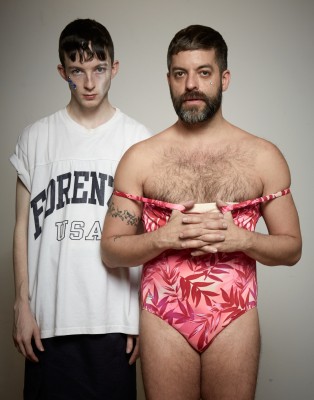
Miguel Gutierrez and Mickey Mahar team up for dance performance that examines midcareer anxiety (photo by Eric McNatt)
On April 6 at 4:00, James Benning’s re-creation of the 1969 classic Easy Rider will be shown in the Kaufman gallery in conjunction with Julie Ault’s “Afterlife: a constellation.” Composer Robert Ashley and director Alex Waterman will present the world premiere of their opera, Crash, April 10-13 ($20); their Spanish-language TV opera, Vidas Perfectas, runs April 17-20 ($20), while their reimagined speaking opera, The Trial of Anne Opie Wehrer and Unknown Accomplices for Crimes Against Humanity, with Amy Sillman, Wayne Koestenbaum, Mary Farley, and Barbara Bloom, plays April 23-27 ($20). Fred Lonidier will lead a teach-in on April 11 at 7:00 that looks at art and labor. On April 12 and 26 ($10 per family), Whitney Wees offers kid-friendly tours and workshops for families with children ages four to five, in addition to the sketching tour “Sculpture and Drawing” for families with kids ages six to ten ($10); also on April 12, Mosely will be leading an Artist’s Choice Workshop for families with children ages eight to twelve ($10), and the Open Studio program, for kids of all ages, will examine Sheila Hicks’s “Pillar of Inquiry / Supple Column.” (Other family workshops are scheduled for April 26 in the Whitney Studio, May 2 with Dan Walsh, May 10 for kids with autism and with My Barbarian, and May 17 with Sara Greenberger Rafferty.) From April 16 to 20, Taisha Paggett will debut a new performance piece in the lobby gallery. On April 17 at 7:00 ($8), Miguel Gutierrez and My Barbarian’s Alexandro Segade have put together “Take Ecstasy with Me,” an evening of performances and reflections by Kalup Linzy, Jacolby Satterwhite, Nao Bustamante, Jorge Cortiñas, A. L. Steiner, Kate Bush Dance Troupe, Juliana Huxtable, and others, inspired by the work of the late Cuban theorist José Esteban Muñoz; Gutierrez will perform the duet Age & Beauty Part 1: Mid-Career Artist/Suicide Note or &:-/ with dancer Mickey Mahar April 23 – May 4 ($20).
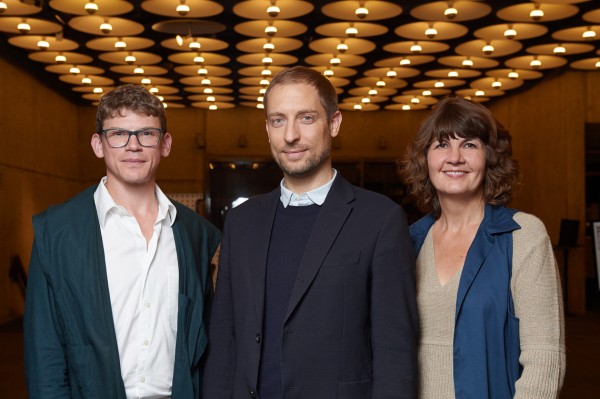
Anthony Elms, Stuart Comer, and Michelle Grabner will discuss their curatorial choices at May 7 panel discussion (photo by Filip Wolak)
On April 18 at 7:30, Kevin Beasley, with Leon Finley and Christhian Diaz, will present the interactive audio piece “Public Programs in Sonic Masses.” (Beasley will also host a teen workshop on May 2 and activate his sound sculptures on May 14 at noon, May 16 at 1:00, and May 17 at 3:00 in the lobby gallery.) On April 26 at 6:30 ($8), Triple Canopy will investigate “Media Replication Services.” Doug Ischar’s Come Lontano, Tristes Tarzan, and Alone with You will screen April 30 – May 4 in the Kaufman gallery. On May 1 at 6:30 ($8), Joseph Grigely will deliver a “Seminars with Artists” lecture about communication and miscommunication, followed by Susan Howe’s talk on the “telepathy of archives” on May 14 at 6:30 ($8) and Amy Sillman examining the materiality of color on May 22 at 6:30 ($8). On May 6 at 7:00 ($8), Ault, Benning, and William Least Heat-Moon will discuss “Histories of Place.” On May 11, Travis Jeppesen will read his novel The Suiciders in a durational performance on the third floor. And on May 19 at 7:00 ($8), Dawoud Bey will lead a roundtable Conversations of Art discussion about the portrayal of southern blacks during the civil rights movement. Tickets are available in advance for all of the above events that require an additional fee, as indicated in parentheses; some free programs require preregistration, so don’t hesitate if you want to attend any of these Whitney Biennial bonuses.
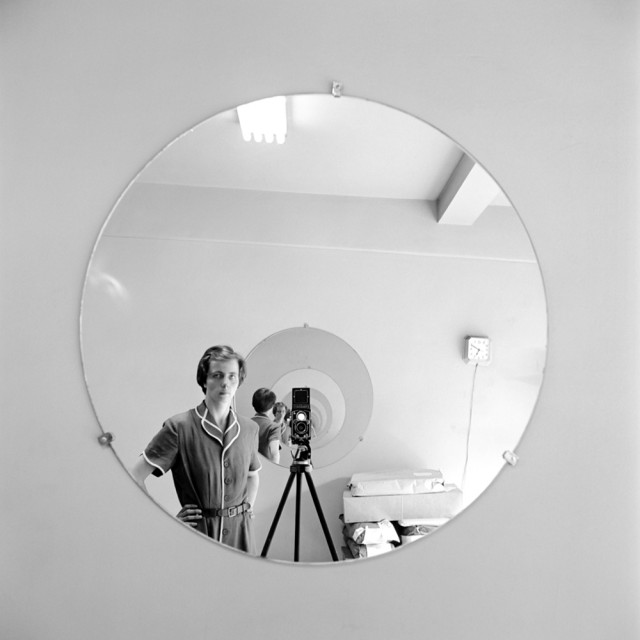
 By their very nature, street photographers take pictures of anonymous individuals, capturing a moment in time in which viewers can fill in their own details. In the wonderful documentary Finding Vivian Maier, codirectors John Maloof and Charlie Siskel turn the lens around on a street photographer herself, attempting to fill in the details of the curious life and times of Vivian Maier, about whom very little was known. “I find the mystery of it more interesting than her work itself,” says one woman for whom Vivian Maier served as a nanny decades earlier. “I’d love to know more about this person, and I don’t think you can do that through her work.” In 2007, while looking for historical photos for a book on the Portage Park section of Chicago, Maloof purchased a box of negatives at an auction. Upon discovering that they were high-quality, museum-worthy photographs, he set off on a mission to learn more about the photographer. Playing detective — while also developing hundreds of rolls of film, with thousands more to go — Maloof meets with men and women who knew Maier as an oddball, hoarding nanny who went everywhere with her camera and shared little, if anything, about her personal life. “I’m the mystery woman,” Maier says in a color home movie. Her former employers and charges, including talk-show host Phil Donahue, debate her background, the spelling and pronunciation of her name, her accent, and how she might have felt about a documentary delving into her secretive life.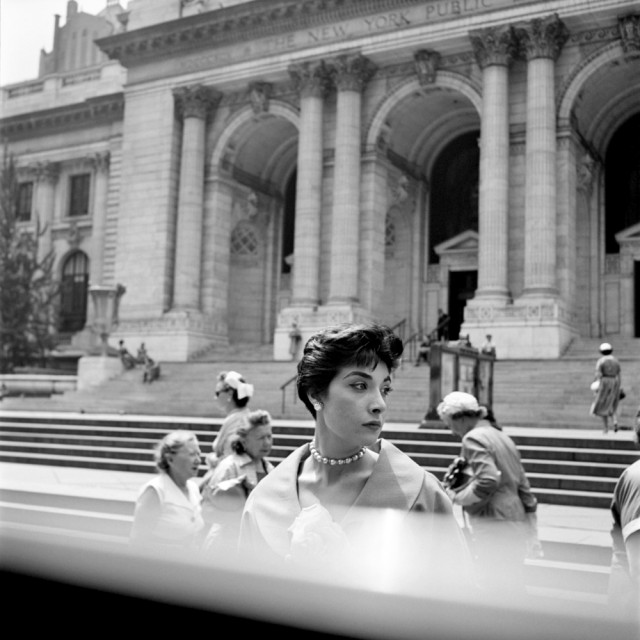



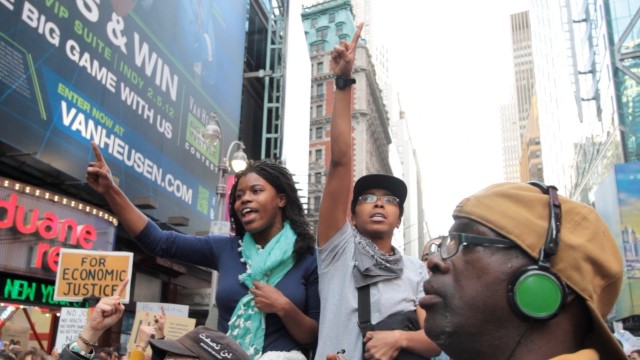
 Ira McKinley has had plenty of opportunities to give up on life and turn his back on society. His father was shot and killed by the police when Ira was fourteen. He suffered through a crack addiction, has PTSD after serving in the Air Force, spent three years in prison for attempted robbery, and has been homeless and jobless for virtually all of his adult life. But he was determined to not end up just another throwaway, someone with no present and no future. “They look at you like you’re nothing, like you’re, like I said, a throwaway. And they expect you to fail,” McKinley says in the powerful hour-long documentary The Throwaways, which he codirected with Bhawin Suchak. “That’s when I started my activism. I told people, ‘Listen, you’re in here messing with the wrong person.’” McKinley went to Northampton, Massachusetts, where he learned about filmmaking at a public access station. He then went out with his camera, using it as a “tool,” a “weapon,” and an “equalizer” as he talked to people in the abandoned streets of Albany, attended press conferences by Van Jones, mayor Jerry Jennings, and police chief Steven Krokoff, and met with such activists as Michelle Alexander, author of The New Jim Crow: Mass Incarceration in the Age of Colorblindness, a book that has had a profound influence on McKinley. He also visits places from his past that are filled with a mix of painful and poignant memories. The documentary was initially supposed to be about social justice in the state capitol, but the focus turned to McKinley when Suchak couldn’t line up enough talking heads — and, perhaps more important, because McKinley, a big bear of a man, proved to be such a fascinating character, one who the camera is naturally drawn to. McKinley has been through it all, so he’s not afraid to get up in people’s faces, which is not always the best way to try to implement change, but he’s determined to show the government and society at large that human beings should not be thrown away like yesterday’s trash and that something can be done about it.