Nan Goldin gets personal in Sabine Lidl’s intimate documentary
NAN GOLDIN — I REMEMBER YOUR FACE (Sabine Lidl, 2013)
Quad Cinema
34 West 13th St.
June 13-19, 1:00 & 6:30
212-255-2243
www.kinofestivalnyc.com
www.nangoldinirememberyourface.wordpress.com
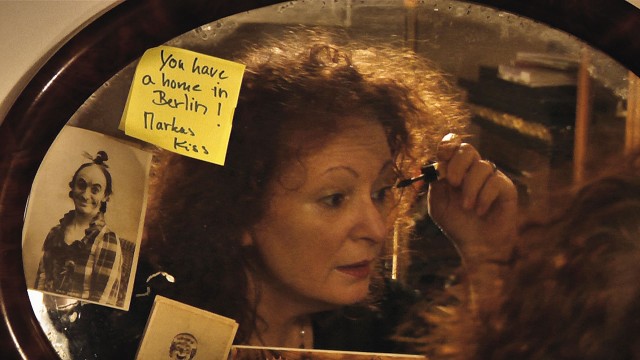
 Thankfully, Sabine Lidl’s Nan Goldin — I Remember Your Face, which kicks off the Kino! Festival of German Films on June 13, is only an hour long. As it turns out, there’s only so much one can take of the justly celebrated photographer in one sitting; she can be a bit abrasive, self-obsessed, and controlling. “Take that f*cking thing away,” Goldin tells Lidl at the start of the film, referring to the camera Lidl brings in to shoot her in a Paris bedroom. Later, when visiting former model Clemens Schick, Goldin rearranges a photo display of her work on his wall while also sharing details of their lovemaking years before. And the now sixty-year-old artist even gets credit as cowriter of the film (along with producer Irene Höfer). In I Remember Your Face, Lidl (Henry Hübchen — My Life / Ma vie) follows Goldin as she visits with old friends, colleagues, and models in Paris and Berlin, intimately discussing various aspects of her life and career. “I’m not modest about it,” she says. “I think in the eighties I created a sea change in photography, that I gave people permission to show their own lives as valuable and as valid as all the other documentary of people they didn’t know, and I think I opened a door.” In the film, she opens a door to her past, talking about her Harvard-educated father, her sister’s suicide, and her own addictions. Along the way, Lidl includes stunning photographs from such Goldin exhibitions as “The Ballad of Sexual Dependency,” “Poste Restante,” “Fire Leap,” and “Scopophilia” that confirm Goldin’s standing as one of the most important and influential photographers of the last forty years. “She takes the face of a person and photographs it, but what she captures in that face is her own psychological state,” artist and former Goldin model Piotr Nathan explains. “This way it becomes a mirror image of herself.”

Seminal photographer Nan Goldin talks about life, love, and art, with ever-present cigarette
Goldin, who is nearly always smoking throughout the film, also reveals a childlike curiosity of the world as well as a need to be loved as she visits with such people from her past as Joachim Sartorius (“Sartortius the Glorious”), Käthe Kruse, and Christine Fenzl, who all talk about their strong, lasting bonds with Goldin, who even made an extreme impact on Lidl herself. “As soon as I met Nan, I felt such a deep connection,” Lidl says in her director’s statement. “It was almost like falling in love with her.” It can all get rather intense and cliquish, so sixty minutes is just the right amount of time to spend hanging out with Goldin and her inner circle. Nan Goldin — I Remember Your Face is playing at the Quad June 13-19 as part of the Kino! Festival, with Lidl on hand to talk about the film after the screenings. Among the other films being shown are Frauke Finsterwalder’s Finsterworld, about Furries (Google it when no one else is around) and other fetishes; Christian Alvart’s Banklady, set in 1966 Hamburg; Julia von Heinz’s Hanna’s Journey, about a woman who goes to Israel to continue her career helping disabled people; and Grzegorz Muskala’s Whispers Behind the Wall, in which a law student moves to Berlin looking to better his life.

 More than thirty years after Faith McNulty’s book The Burning Bed, which was adapted into a powerful and influential 1984 film starring Farrah Fawcett, Private Violence shows that there is still a long way to go in dealing with the very real issue of battered women. In the moving, emotional documentary, director-producer Cynthia Hill tells the story of Deanna Walters, an abused North Carolina housewife working with advocates Kit Gruelle and Stacy Cox to try to put Deanna’s dangerous and abusive husband behind bars so she can have a life with her young daughter. It’s horrifying to see photos of Deanna’s severely beaten face and body, then hear that law enforcement agencies and the legal system still often regard such cases as minor domestic disputes that do not require arrests and imprisonment. At the center of the controversy is the prevailing attitude that it is somehow the woman’s fault for not simply leaving her abusive partner, instead returning again and again for more physical and psychological torture, a premise that is proved wrong in many ways. Hill (The Guest Worker, Tobacco Money Feeds My Family) concentrates on the main narrative, not talking heads and statistics, following the developments procedurally, while more is revealed about Kit as well, who suffered her own torment at the hands of an abusive husband.