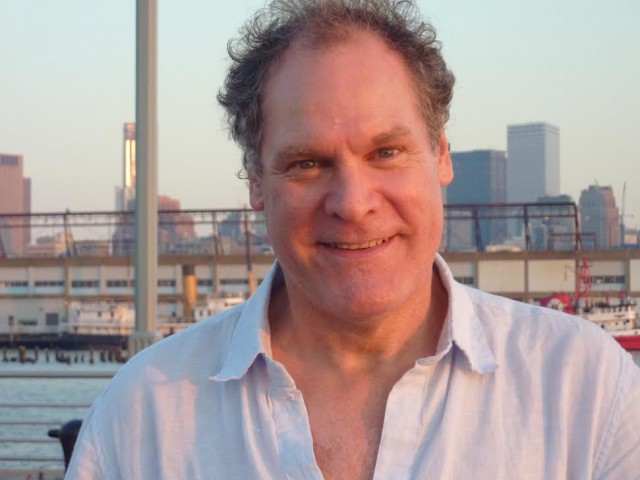
Jay O. Sanders will present UNEXPLORED INTERIOR at Museum of Jewish Heritage on May 11 as part of twentieth anniversary commemoration of Rwandan genocide
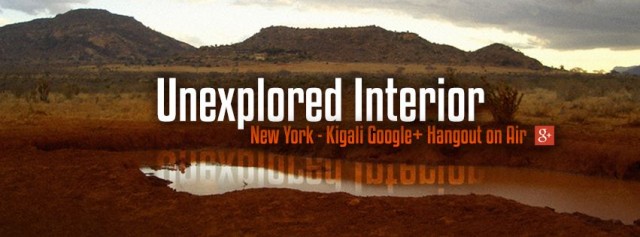
UNEXPLORED INTERIOR
Museum of Jewish Heritage — A Living Memorial to the Holocaust
Edmond J. Safra Plaza, 36 Battery Pl.
Sunday, May 11, 12 noon, free with advance RSVP
www.mjhnyc.org
www.theflea.org
In 2004, struck by the world’s continued indifference to the 1994 Rwandan genocide, actor Jay O. Sanders attended the ten-year commemoration of the start of the mass killings in Kigali, the African nation’s capital. Moved by what he saw, Sanders, the Austin-born son of activist parents, decided to do something about it. A Shakespeare in the Park regular who has appeared in such films as JFK, The Day After Tomorrow, and Revolutionary Road and has played recurring characters on such series as True Detective, Person of Interest, and Law & Order: Criminal Intent, Sanders began writing Unexplored Interior, a fictionalized play that takes place immediately following the 1994 genocide, as a Hutu man and Tutsi woman fall in love, a Rwandan student in New York City sets out to make a film about what happened, and a UN peacekeeper contemplates his own life in the wake of the tragic events. The play will have its latest staged reading on May 11 at 12 noon at the Museum of Jewish Heritage (admission is free with advance RSVP) as part of the official Kwibuka20 events commemorating the twentieth anniversary of the Rwandan genocide, calling for people to “remember — unite — renew.” An all-star cast will be directed by James Glossman (Trouble Is My Business; Smiling, the Boy Fell Dead), and the production in New York will be broadcast live at the new outdoor amphitheater at the Kigali Genocide Memorial Center courtesy of Google+ Hangout on Air, followed by an international panel discussion and Q&A session.
twi-ny: What was the genesis of Unexplored Interior and your interest in Rwanda?
Jay O. Sanders: Let me give you the short answer. In April of 1994, my wife and I, both working actors, were cloistered in our West Village apartment with our five-week-old, first-and-only child, reflecting on what it meant to be the guardians of a life, when President Habyarimana’s plane was shot down in Kigali and the start of genocide hit. We watched the news as reports of this horrific event unfolded and repeatedly told us it was beyond our understanding. Stories began to flow of brutal, neighbor-on-neighbor mass killings and a Canadian U.N. peacekeeping commander who was calling for help but no one was being sent, and all without pictures, as no press was inside the country. Until they began to show video of hundreds and hundreds of bloated bodies floating down the rivers along the borders, caught on the rocks, going over falls. It was a mind-numbing, grotesque, and totally infuriating circus of ignorance and failure of the world to respond.
I got it in my head that if I could just see out through the peacekeeper’s eyes, as a fellow Westerner, I might at least be able to understand. I thought, I need to play him (as actors do). I watched every report I could find, yielding reports of that same man refusing to order a full withdrawal and managing to save the lives of some tens of thousands of refugees while bearing witness to the 800,000 whom he couldn’t, and finally, on returning home, attempting suicide numerous times, unable to process what he’d been through. After ten years of germination and finding myself still as ignorant as before, I was overcome with the need to find an answer I could give my son. To arm him with an understanding of this genocide of his lifetime. I felt I owed him an answer.
twi-ny: You’re a well-respected actor, familiar for your work in numerous films and plays and on television. How did your acting experience inform your writing of the play?
JOS: I started out to write a one-man show for myself as [Roméo] Dallaire, the peacekeeper. It seemed like an obvious, straightforward way to enter the story and bring it to others. So I found him in Rwanda at the ten-year commemoration, flew myself over to see for myself where all this had happened and be among those who had experienced it. I had discovered that, fortunately, he was still alive and now the author of a book about his experiences, Shake Hands with the Devil.
Again, the short version: I met him there, then spent time with him later in Quebec, and proceeded to write that play. But I soon discovered, the more I knew about what had happened, that Dallaire was actually my White Rabbit who led me into the situation, and the larger story was among the people themselves. So, I continued to study and write and emerged with a twenty-six-character play for fourteen actors which weaves many stories together, including Dallaire’s, with crossing themes on a much larger canvas.
twi-ny: How did you hook up with Google+, the Museum of Jewish Heritage, and the Kigali Genocide Memorial Center?
JOS: My wife, Maryann Plunkett, and I had done a reading down at the museum several years ago and I had noted the beauty of both this center of record for not only the Holocaust but all related genocide, as well as the beauty of the theater [Edmond J. Safra Hall] itself. When I began to think about where my play began, this was perfect. When I flew over for the ten-year commemoration in 2004, I was recognized by members of the CNN team, who invited me to join them for the week, which I did, gladly, finding myself front and center at all the major official events, including the official opening of the Aegis trust Kigali Genocide Memorial. I was there as President Kagame, General Dallaire, and many, many others witnessed the lighting of the eternal flame, above a mass grave holding 250,000 victims of the genocide.
So, when I was thinking about where I wanted to connect with our event, that, again, was obvious. Then, one of my producers, my dear friend Daniel Neiden, introduced me to Paula Gil Rodriguez, who had, herself, produced several large Google+ Hangouts on Air and knew a number of people at Google. She loved the idea of the project and she and her husband, Nick Lopez, came on board. My friend James Glossman has been my director from the moment the idea hit me to write this. It all just grew and grew.
twi-ny: Who are some of the people who will be participating in the reading?
JOS: We have a brilliant family of actors — some well known to you, others who you should know. Michael McKean, presently in All the Way on Broadway, plays Dallaire; Sharon Washington, award nominated for Wild with Happy at the Public and on Broadway with The Scottsboro Boys; Arthur French, who has been in everything and most recently of The Trip to Bountiful on Broadway; Fritz Weaver, one of the most distinguished stage and film actors of his generation; Charles Parnell, whose TV series The Last Ship premieres soon; Owiso Odera, Marlyne Barrett, Clark Jackson, Craig Alan Edwards, Irungu Mutu, Matthew Murumba, Benjamin Thys, and our youngest at thirteen, Nile Bullock, lately also of The Scottsboro Boys — all fantastic, deeply dedicated to this project, and each one a reason to see the play.
twi-ny: Is a full production of the play in the works?
JOS: We are still looking for a production. I’m hoping this presentation grabs the imagination of some brave producer or producers!
twi-ny: As opposed to last year’s presentation, this one will use social media in a fascinating way. What’s your personal experience with social media? Are you a Facebook/Twitter/Google+ junkie?
JOS: My personal experience is everyday. I use Facebook regularly as an international bulletin board and have just recently ventured over to Google+ as well, because of this project. I have a Twitter account but am not very fluent with it yet. These online forums have afforded me connections beyond anything I might have come upon otherwise — people out of my past, which included a lot of traveling, so that reaches a very long way, and those I’m just now meeting with common friends and/or common interests. Also, I regularly give master classes out at my alma mater, SUNY Purchase, and social media is a place we can all stay in touch for mutual news, project updates, and personal encouragement. It has been a godsend.
twi-ny: At any given moment, there is some kind of brutal civil war or genocide going on somewhere in the world, and more often than not, the U.S. government opts not to get involved. What can we as individual, peace-loving Americans do to try to change things?
JOS: Learn. Understand as much as you can. It’s always evolving — it requires regular effort — but there are ways to make a difference through awareness, voting, challenging the machine, humanizing world issues, applying compassion in your own life. Kindness begins with each one of us, at home, at work, in our communities, with the homeless, in our voices lifted against apathy — it ripples out and grows from those seeds into and across the world.

 The only real problem with Speak the Music: Robert Mann and the Mysteries of Chamber Music, an engaging look at the violinist extraordinaire, is its brevity, clocking in at just under an hour. Oscar-winning documentarian Allan Miller, who has made films about Isaac Stern, Zubin Mehta, Itzhak Perlman, John Cage, Eubie Blake, and other musicians, gets up close and personal with Robert Mann, a cofounder of the Juilliard String Quartet and an enthusiastic teacher at the Manhattan School of Music. Mann, who was born in Portland, Oregon, in 1920, is shown discussing his love of fishing and how he wanted to be a forest ranger; playing at the White House and the Library of Congress; performing with his wife and son; and talking about how watching waves crash against an Oregon cliff helped him understand “the slow growth of musical intensity.” Among those singing his praises and hailing his influence are Perlman, conductor Seiji Ozawa, composer Elliott Carter, pianist Stephen Hough, and cellist Joel Krosnick. But the film really shines when Mann is seen teaching the Amphion Quartet, the Ars Nova Quartet, and others, flailing his arms about, trying to get the musicians to go deep inside themselves and the music and not to play like they’re pounding on a typewriter. Of course, the film is also filled with lots of beautiful chamber music by Beethoven, Haydn, Bartók, etc., from rare archival footage to more contemporary performances, concluding with Mann in a lovely rehearsal of the third movement of Mozart’s Quintet in G Minor, making sure every note and pause is just right, not merely mechanical but intensely emotional and heartfelt, lovingly putting bow to strings. Speak the Music opens at the Quad on May 2, with Miller participating in Q&As following the 6:30 screenings on Friday, Saturday, and Sunday.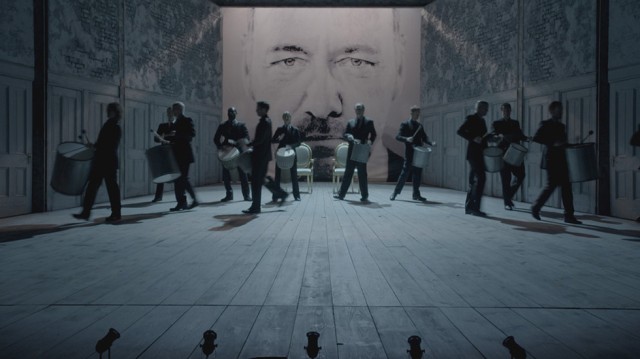
 Now: In the Wings on a World Stage, the marvelous new documentary that follows a transatlantic company as it performs Richard III around the globe, did not get its name only because it’s the first word of Shakespeare’s classic tragedy — “Now is the winter of our discontent” — nor simply because it takes place in modern times in modern dress with nods to modern technology, but also because it’s a spine-tingling celebration of the immediacy of live theater. In 2009, Sam Mendes’s Neal Street Productions, the Old Vic under the leadership of Kevin Spacey, and the Brooklyn Academy of Music, led by Joseph Melillo, formed a partnership in which British and American actors would present five classic plays over three years. Dubbed the Bridge Project, the wildly successful venture concluded in 2012 with Spacey, an American living and working in London, starring in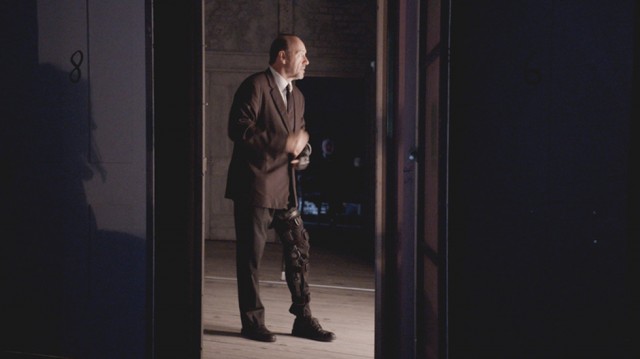
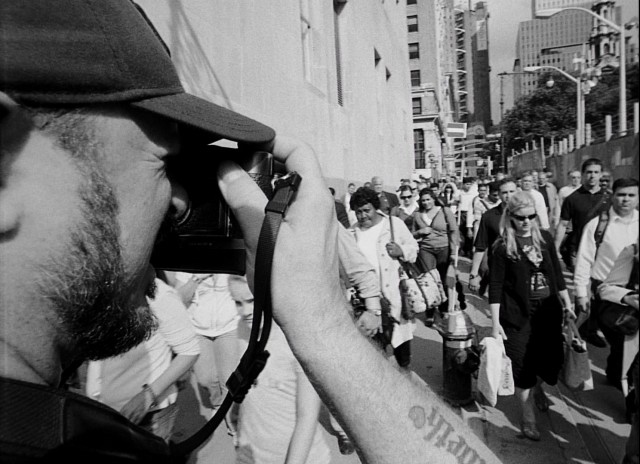
 “I need to be kind of weird to photograph people all the time without permission, because it’s very aggressive, and I have to do it,” street photographer Matt Weber says at the beginning of Dan Wechsler’s fun documentary More Than the Rainbow, adding, “And you have to be kind of a psycho.” Wechsler — a filmmaker and rare bookseller who, with George Koppelman, has just claimed to have discovered William Shakespeare’s annotated dictionary — follows Weber around New York, primarily in the subways and Coney Island, as the former taxi driver tries to capture the spirit of the city on film, looking for unique shots that can come and go in a flash. Wechsler speaks with such other photographers as Ralph Gibson, who waxes poetic about the art form, sometimes in French; Dave Beckerman, who gave up a successful business career to shoot on the streets; Philadelphia’s Zoe Strauss, whose “10 Years” exhibition was recently at ICP; Jeff Mermelstein, a street photographer who shoots mostly in color; critic and photographer Ben Lifson, who passed away last year; Cuban-born photographer Julio Mitchel; and, most curiously, San Francisco–based fetish photographer Erik Kroll, who doesn’t care for Weber’s work. Weber, who has been photographing the city since 1978, is also shown collaborating with Todd Oldham, who is designing a book on Weber’s subway series. All of the photographers discuss the relative merits of color versus black-and-white, whether they ask people for permission before taking their pictures, and the inherent differences between analog and digital. The film often strays too far from its main subject, Weber, losing sight of itself in its effort to cover too much in a mere eighty-three minutes, but it usually gets back on track, particularly with lovely 35mm interstitial trips through the city, in color and black-and-white, set to the music of Thelonius Monk and Keith Gurland, courtesy of John Rosenberg, who edited the film and music and shot the documentary with Arlene Muller. Especially in an age when everyone thinks he or she is a photographer, snapping photos with camera phones and posting them on social media sites, More Than a Rainbow shows how it’s really done. The film opens at the Quad on May 2, with Wechsler and Weber participating in Q&As following the 8:30 screenings on Friday and Saturday.