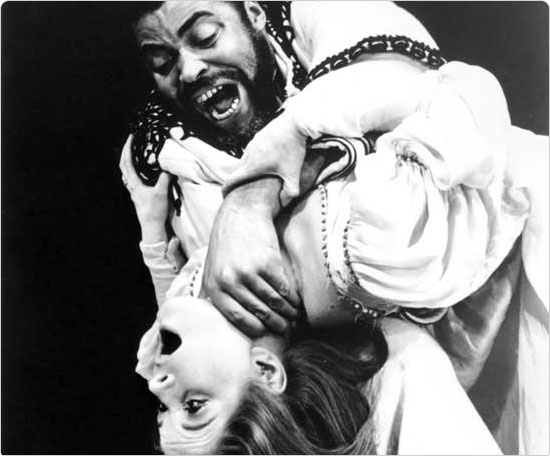
James Earl Jones, who played the title role in the 1964 Shakespeare in the Park production of OTHELLO, will be back at the Delacorte as special evening honoring the Bard’s influence on America
FREE PUBLIC FORUM
Delacorte Theatre
Monday, June 30, free, 8:00
Tickets available June 30 at 12 noon at the Delacorte and online lottery
www.publictheater.org
The latest free public forum hosted by the Public Theater takes a look at the lasting and still-evolving impact of the works of William Shakespeare on American culture. The special evening is inspired by the new book Shakespeare in America: An Anthology from the Revolution to Now (Library of America, April 2014, $29.95), in which President Bill Clinton writes in the foreword, “Shakespeare only had a fleeting acquaintance with America, judging from his work, which brushed up against the New World on only a couple of occasions. . . . Nevertheless, our engagement with him as been long and sustained: generation after generation of Americans has fallen under his spell.” Taking place Monday, June 30, at the Delacorte, where Shakespeare in the Park is currently presenting a rousing version of Much Ado About Nothing, the forum will include James Earl Jones reading a scene from Othello, fifty years after he starred in a production at the Delacorte; Alec Baldwin reading from Macbeth and other works; Kelli O’Hara and Renée Elise Goldsberry singing a number from Shakespeare in the Park’s Twelfth Night; Steven Pasquale handling the male part of the “Tonight” duet from West Side Story; along with presentations from Elizabeth Alexander, Billy Collins, Brian Dennehy, Colin Donnell, Michael Friedman, André Holland, Harold Holzer, Stephen Merritt, Bryce Pinkham, Caesar Samoyoa, Vijay Seshadri, Sarah Amengual, Colman Domingo, Cynthia Nixon, Annie-B Parson, and Michael Stuhlbarg. “In a nation wrestling with great issues,” Shakespeare in America editor and Public Theater Shakespeare scholar in residence James Shapiro writes in the book’s introduction, “Shakespeare’s works allowed Americans to express views that may otherwise have been hard to articulate – or admit to.”
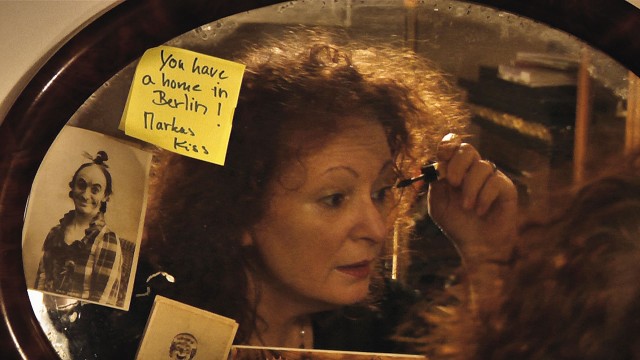
 Thankfully, Sabine Lidl’s Nan Goldin — I Remember Your Face, which kicks off the Kino! Festival of German Films on June 13, is only an hour long. As it turns out, there’s only so much one can take of the justly celebrated photographer in one sitting; she can be a bit abrasive, self-obsessed, and controlling. “Take that f*cking thing away,” Goldin tells Lidl at the start of the film, referring to the camera Lidl brings in to shoot her in a Paris bedroom. Later, when visiting former model Clemens Schick, Goldin rearranges a photo display of her work on his wall while also sharing details of their lovemaking years before. And the now sixty-year-old artist even gets credit as cowriter of the film (along with producer Irene Höfer). In I Remember Your Face, Lidl (Henry Hübchen — My Life / Ma vie) follows Goldin as she visits with old friends, colleagues, and models in Paris and Berlin, intimately discussing various aspects of her life and career. “I’m not modest about it,” she says. “I think in the eighties I created a sea change in photography, that I gave people permission to show their own lives as valuable and as valid as all the other documentary of people they didn’t know, and I think I opened a door.” In the film, she opens a door to her past, talking about her Harvard-educated father, her sister’s suicide, and her own addictions. Along the way, Lidl includes stunning photographs from such Goldin exhibitions as “The Ballad of Sexual Dependency,” “Poste Restante,” “Fire Leap,” and “Scopophilia” that confirm Goldin’s standing as one of the most important and influential photographers of the last forty years. “She takes the face of a person and photographs it, but what she captures in that face is her own psychological state,” artist and former Goldin model Piotr Nathan explains. “This way it becomes a mirror image of herself.”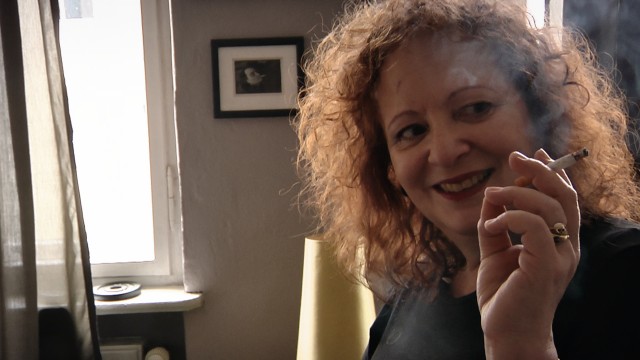

 More than thirty years after Faith McNulty’s book The Burning Bed, which was adapted into a powerful and influential 1984 film starring Farrah Fawcett, Private Violence shows that there is still a long way to go in dealing with the very real issue of battered women. In the moving, emotional documentary, director-producer Cynthia Hill tells the story of Deanna Walters, an abused North Carolina housewife working with advocates Kit Gruelle and Stacy Cox to try to put Deanna’s dangerous and abusive husband behind bars so she can have a life with her young daughter. It’s horrifying to see photos of Deanna’s severely beaten face and body, then hear that law enforcement agencies and the legal system still often regard such cases as minor domestic disputes that do not require arrests and imprisonment. At the center of the controversy is the prevailing attitude that it is somehow the woman’s fault for not simply leaving her abusive partner, instead returning again and again for more physical and psychological torture, a premise that is proved wrong in many ways. Hill (The Guest Worker, Tobacco Money Feeds My Family) concentrates on the main narrative, not talking heads and statistics, following the developments procedurally, while more is revealed about Kit as well, who suffered her own torment at the hands of an abusive husband.